1. Introduction
The petrography and geochemistry of siliciclastic rocks has widely been used to identify different sources, providing reliable information about provenance. In regions where information on the source of sediments and the occurrence of sediment recycling is difficult to evaluate using petrography and geochemistry, detrital zircon U–Pb geochronology may provide a useful means for testing potential sources (Andersen, Reference Andersen2005; Gehrels et al. Reference Gehrels, Blakey, Karlstrom, Timmons, Dickinson and Pecha2011). Zircon grains found in siliciclastic rocks may derive directly from primary sources and/or represent recycled material from intermediate sediment repositories (Pereira et al. Reference Pereira, Albardeiro, Gama, Chichorro, Hofmann and Linnemann2016a,b) associated with multiple sedimentary cycles (Morton et al. Reference Morton, Fanning and Milner2008; Thomas, Reference Thomas2011). Detrital zircon U–Pb ages are hence critically important to the process of creating a geological historical profile of sedimentary basins and their surrounding (local) and remote (external) source regions (Fedo et al. Reference Fedo, Sircombe, Rainbird, Hanchar and Hoskin2003). Often such a relationship is not readily recognizable because sources may have been displaced or separated, with a distance of hundreds of kilometres between them, as a result of the movement of the lithospheric plates.
Following the complex process of the formation of Pangaea as a result of the collision between Laurussia and Gondwana that led to the juxtaposition of distinct Palaeozoic terranes, both basements experienced uplift and erosion. As debris derives from different sources it is very likely that contrasting zircon age populations are recognizable in the Triassic basins formed during the first stages of the fragmentation of this supercontinent, where they were deposited. Mixed provenance may also be a significant phenomenon depending on the complexity of the dispersal paths connecting sources to the basins. According to palaeogeographic maps showing the plate configuration, palaeoenvironment and lithofacies during late Triassic time, Iberia is located at the core of Pangaea and is bounded in the east by the Neotethys Ocean (Golonka, Reference Golonka2007). In the fragmentation stages of Pangaea, the separation of North America and Gondwana (Europe and NW Africa), initiated in early Triassic time, continued during late Triassic time with the development of terrestrial clastic depositional systems in the region where the Central Atlantic spreading axis (Golonka & Ford, Reference Golonka and Ford2000) later emerged during late Sinemurian time (c. 195 Ma; Sahabi et al. Reference Sahabi, Aslanian and Olivet2004). In order to identify the potential sources of the late Triassic basins from the Central Atlantic Ocean realm, the configuration of the late Palaeozoic orogen, showing the probable spatial distribution of the distinct provenances of the Palaeozoic terranes, before Pangaea fragmentation, must be reconstructed. Terrestrial deposition was diachronous in Iberia (López-Gómez et al. Reference López-Gómez, Alonso-Azcárate, Arche, Arribas, Barrenechea, Borruel-Abadía, Bourquin, Cadenas, Cuevas, De la Horra, Díez, Escudero-Mozo, Fernández-Viejo, Galán-Abellán, Galé, Gaspar-Escribano, Aguilar, Gómez-Gras, Goy, Gretter, Carballo, Lago, Lloret, Luque, Márquez, Márquez-Aliaga, Martín-Algarra, Martín-Chivelet, Martín-González, Marzo, Mercedes-Martín, Ortí, Pérez-López, Pérez-Valera, Pérez-Valera, Plasencia, Ramos, Rodríguez-Méndez, Ronchi, Salas, Sánchez-Fernández, Sánchez-Moya, Sopeña, Suárez-Rodríguez, Tubía, Ubide, Garcés, Vargas, Viseras, Quesada and Oliveira2019), presenting Late Permian – Middle Triassic ages in eastern and southeastern basins (Pyrenees, Iberian Ranges and Betics; López-Gómez et al. Reference López-Gómez, Arche, Marzo and Durand2005; Sánchez Martínez et al. Reference Sánchez Martínez, De la Horra, Arenas, Gerdes, Galán-Abellán, López-Gómez, Barrenechea and Arche2012) and Late–Middle Triassic ages in western and southwestern ones (Lusitanian, Alentejo and Algarve basins: Palain, Reference Palain1976; Azerêdo et al. Reference Azerêdo, Duarte, Henriques and Manuppella2003; Alves et al. Reference Alves, Moita, Sandnes, Cunha, Monteiro and Pinheiro2006; Soares et al. Reference Soares, Kullberg, Marques, Rocha and Callapez2012; Pereira et al. Reference Pereira, Gama, Chichorro, Silva, Gutiérrez-Alonso, Hofmann, Linnemann and Gärtner2016b, 2017c; Dinis et al. Reference Dinis, Fernandes, Jorge, Rodrigues, Chew and Tassinari2018).
The aim of this paper is to present findings for detrital zircon ages obtained from six samples of Triassic siliciclastic rocks of the Algarve Basin that complement information already published (Pereira et al. Reference Pereira, Ribeiro, Gama, Drost, Chichorro, Vilallonga, Hofmann and Linnemann2017c; Dinis et al. Reference Dinis, Fernandes, Jorge, Rodrigues, Chew and Tassinari2018) and test for the existence of more than one potential source or mixed provenance. The U–Pb data for the Algarve Triassic sandstone obtained in the present study are compared with a compilation of detrital zircon ages from siliciclastic rocks of SW Iberia (upper Neoproterozoic to Permian; Pereira et al. Reference Pereira, Chichorro, Williams, Silva, Ennih and Liégeois2008, Reference Pereira, Chichorro, Johnston, Gutiérrez-Alonso, Silva, Linnemann, Hofmann and Drost2012a,b, 2017b; Linnemann et al. Reference Linnemann, Pereira, Jeffries, Drost and Gerdes2008; Braid et al. Reference Braid, Murphy, Quesada and Mortensen2011; Rodrigues et al. Reference Rodrigues, Chew, Jorge, Fernandes, Veiga-Pires and Oliveira2015; Pérez-Cáceres et al. Reference Pérez-Cáceres, Poyatos, Simancas and Azor2017; Dinis et al. Reference Dinis, Fernandes, Jorge, Rodrigues, Chew and Tassinari2018), Nova Scotia (lower Neoproterozoic to Devonian; Waldron et al. Reference Waldron, White, Barr, Simonetti and Heaman2009, Reference Waldron, Schofield, White and Barr2011; Henderson et al. Reference Henderson, Collins, Murphy, Gutiérrez-Alonso and Hand2016; White et al. Reference White, Barr and Linnemann2018) and NW Morocco (Cambrian; Pérez-Cáceres et al. Reference Pérez-Cáceres, Poyatos, Simancas and Azor2017) using the Kolmogorov–Smirnov (K–S) statistical test (DeGraaff-Surpless et al. Reference DeGraaff-Surpless, Mahoney, Wooden and McWilliams2003; Barbeau et al. Reference Barbeau, Davis, Murray, Valencia, Gehrels, Zahid and Gombosi2009; Vermeesch, Reference Vermeesch2013) and multidimensional scaling (MDS; Vermeesch, Reference Vermeesch2013, Reference Vermeesch2018; Spencer & Kirkland, Reference Spencer and Kirkland2015). These statistical tools provide useful means for verifying whether the zircon age populations found in the Ediacaran to Permian siliciclastic rocks of SW Iberia were reproduced faithfully in the Algarve Triassic sandstone as a result of sediment recycling, or whether there was input from other sources, such as Nova Scotia (Maritime Canada) and NW Morocco (NW Africa).
2. Geological setting
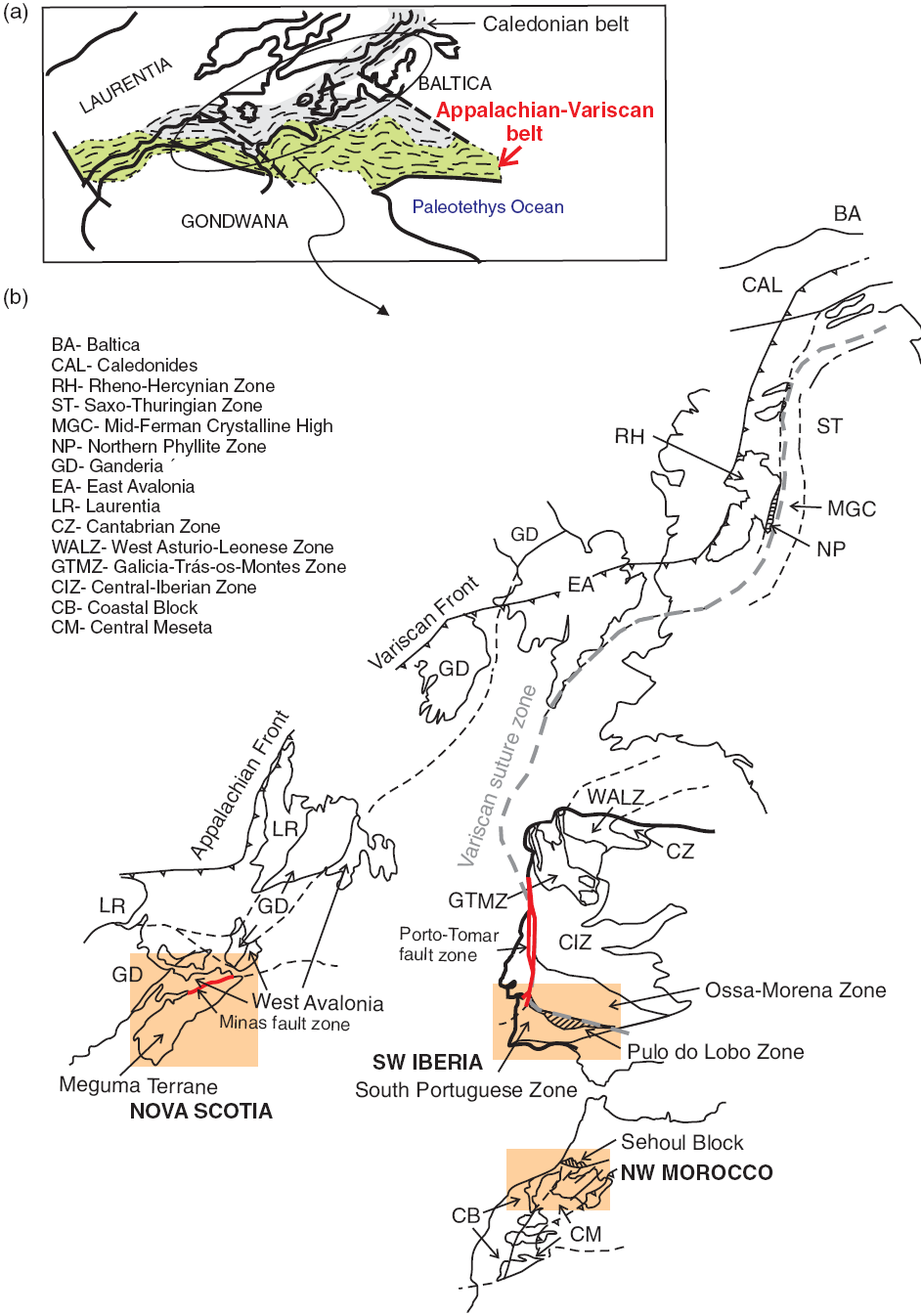
SW Iberia, Nova Scotia and NW Morocco are separated segments of the late Palaeozoic Appalachian–Variscan orogenic belt (Matte, Reference Matte2001; Nance et al. Reference Nance, Gutiérrez-Alonso, Keppie, Linnemann, Murphy, Quesada, Strachan and Woodcock2010; Murphy & Nance, Reference Murphy and Nance2013) (Fig. 1) showing a pre-Mesozoic stratigraphy that demonstrates common periods of evolution but also points to periods during which they evolved independently, and are thus marked by notable stratigraphic differences.
(a) Inset with location of SW Iberia, Nova Scotia and NW Morocco in the Appalachian–Variscan belt (modified from Matte, Reference Matte2001; Murphy & Keppie, Reference Murphy and Keppie2005). (b) Tectonic map with regional distribution of the main Palaeozoic terranes of the Appalachian–Variscan belt showing location of the South Portuguese, Pulo do Lobo and Ossa–Morena zones (SW Iberia), Sehoul Block (NW Morocco) and West Avalonia and Meguma Terrane (Nova Scotia). CIZ – Central Iberian Zone; CZ – Cantabrian Zone; WALZ – West Asturian–Leonese Zone; GTMZ – Galicia-Trás-os-Montes Zone; STZ – Saxo-Thuringian Zone; GD – Ganderia; LR – Laurentia (modified from van Staal & Barr, Reference van Staal and Barr2012; von Raumer et al. Reference von Raumer, Nesbor and Stampfli2017; Pereira et al. Reference Pereira, Gutiérrez-Alonso, Murphy, Drost, Gama and Silva2017b).

2.a. SW Iberia
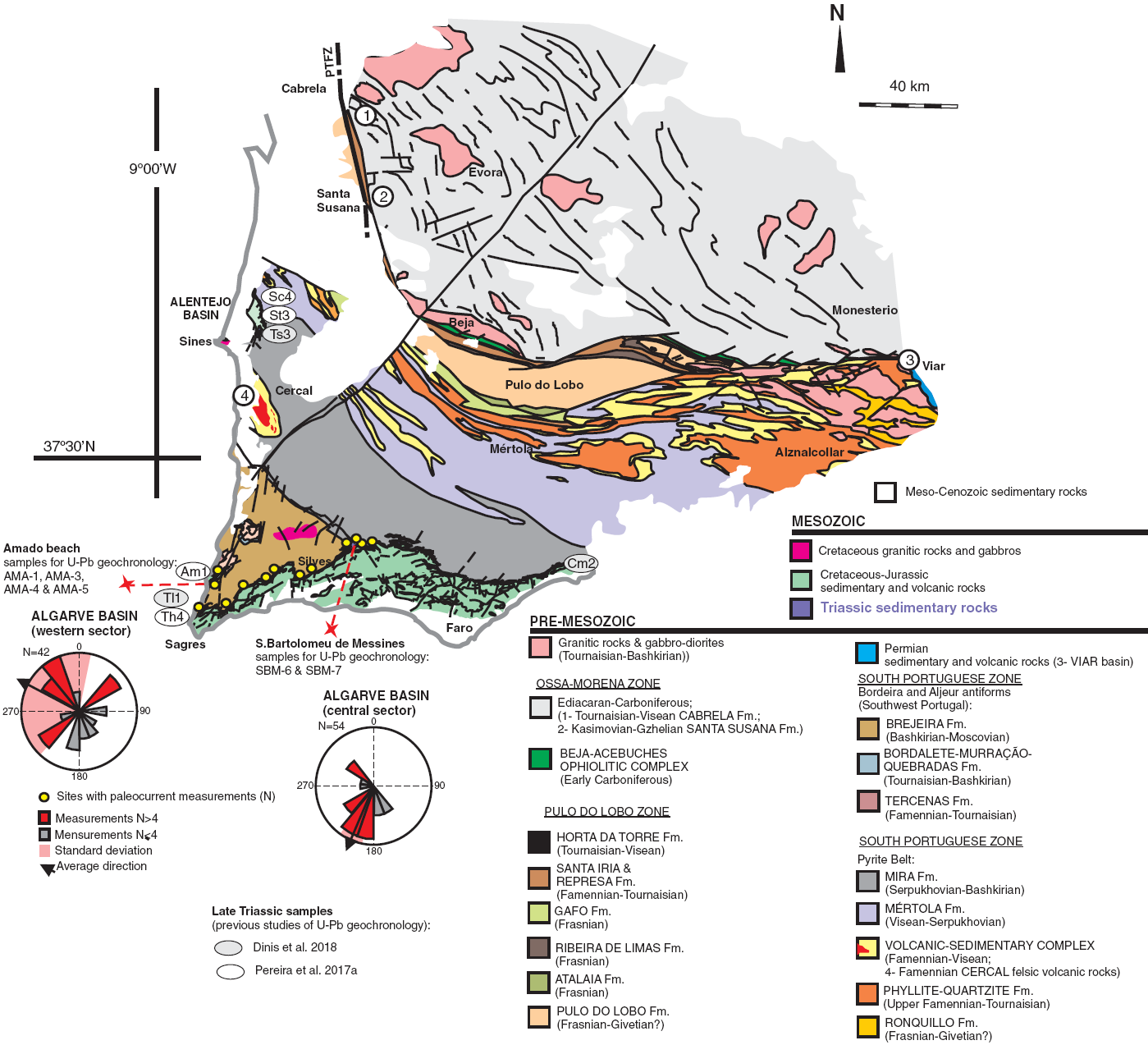
In SW Iberia, the Variscan belt includes the Ossa–Morena Zone (OMZ, Gondwanan side) that is separated from the Pulo do Lobo and South Portuguese zones (PLZ and SPZ, Laurussian side) by the Beja-Acebuches Ophiolitic Complex (Variscan suture zone) and presents distinct features in terms of sedimentation and magmatism (Fig. 2). A singular aspect of this area of the Variscan belt is the absence of Silurian and Devonian plutonic rocks, whereas Carboniferous plutons are found on both sides of the Rheic suture: the Sierra Norte batholith (c. 359–335 Ma; de la Rosa et al. Reference de la Rosa, Jenner and Castro2002; Gladney et al. Reference Gladney, Braid, Murphy, Quesada and McFarlane2014), the Beja igneous complex (c. 353–350 Ma; Pin et al. Reference Pin, Fonseca, Paquette, Castro and Matte2008), the Valencia del Ventoso plutonic complex (c. 337–330 Ma; Cambeses et al. Reference Cambeses, Scarrow, Montero, Molina and Moreno2015) and the great variety of plutons from the Évora massif (c. 341–324 Ma; Lima et al. Reference Lima, Corfu, Neiva and Ramos2012; Moita et al. Reference Moita, Santos, Pereira, Costa and Corfu2015; Pereira et al. Reference Pereira, Chichorro, Moita, Santos, Solá, Williams, Silva and Armstrong2015a; Dias da Silva et al. Reference Dias da Silva, Pereira, Silva and Gama2018).
Simplified geological map of SW Iberia showing the late Triassic Algarve and Alentejo basins and the pre-Mesozoic basement comprising the South Portuguese, Pulo do Lobo and Ossa–Morena zones (modified from Oliveira, Reference Oliveira, Dallmeyer and Martínez-García)1990; Pereira et al. Reference Pereira, Gutiérrez-Alonso, Murphy, Drost, Gama and Silva2017b; Pérez-Cáceres et al. Reference Pérez-Cáceres, Poyatos, Simancas and Azor2017) with sample locations used for U–Pb geochronology. Rose diagrams shows palaeocurrent directions measured in the Algarve Triassic sandstone of the central and western sectors (modified from Palain, Reference Palain1979). PTFZ – Porto-Tomar fault zone.

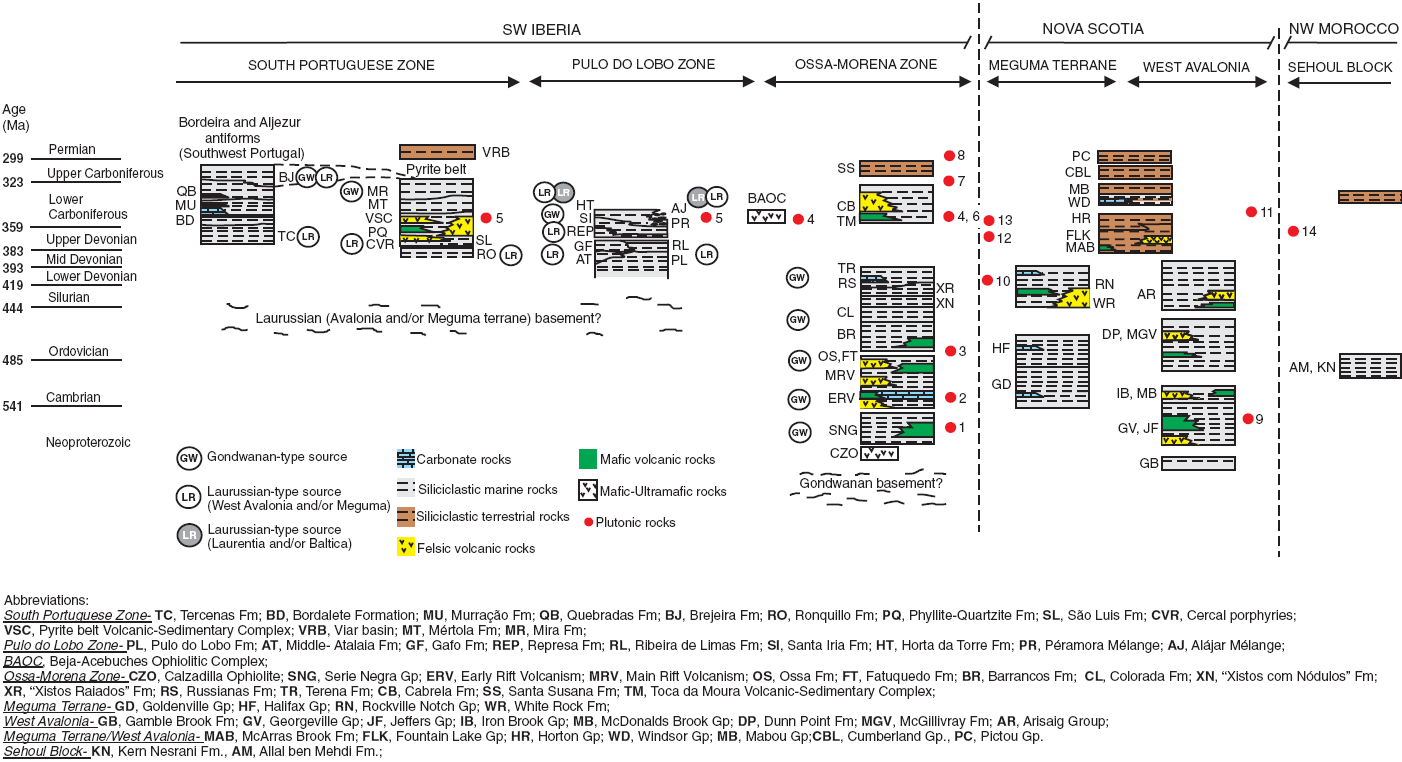
The OMZ metasedimentary sequence extends from the Ediacaran (Serie Negra Group) to the lower Devonian (Terena Formation), presenting large volumes of magmatic rocks ranging from Ediacaran to early Ordovician in age (Sánchez-García et al. Reference Sánchez-García, Bellido and Quesada2003; Robardet & Gutiérrez Marco, Reference Robardet and Gutiérrez Marco2004; Chichorro et al. Reference Chichorro, Pereira, Díaz-Azpiroz, Williams, Fernández, Pin and Silva2008; Pereira et al. Reference Pereira, Chichorro, Solá, Silva, Sánchez-García and Bellido2011, Reference Pereira, Solá, Chichorro, Lopes, Gerdes and Silva2012b; Cambeses et al. Reference Cambeses, Scarrow, Montero, Lázaro and Bea2017) (Fig. 3). Cambrian to lower Devonian metasedimentary sequences (Ossa, Fatuquedo, Barrancos, Colorada, ‘Xistos com Nódulos’, ‘Xistos Raiados’, Russianas and Terena formations; Oliveira et al. Reference Oliveira, Oliveira and Piçarra1991) and Cambrian (Early-Rift and Main-Rift volcanism; Sánchez-García et al. Reference Sánchez-García, Bellido, Pereira, Chichorro, Quesada and Pin2010, Reference Sánchez-García, Pereira, Bellido, Chichorro, Silva, Valverde-Vaquero, Pin and Solá2013) to Ordovician (Sánchez-García et al. Reference Sánchez-García, Bellido and Quesada2003; Díez Fernández et al. Reference Díez Fernández, Pereira and Foster2015) magmatism are related to the geodynamic evolution of the outermost Gondwanan passive margin of the Rheic Ocean (Sánchez-García et al. Reference Sánchez-García, Bellido and Quesada2003; Linnemann et al. Reference Linnemann, Pereira, Jeffries, Drost and Gerdes2008; Pereira et al. Reference Pereira, Solá, Chichorro, Lopes, Gerdes and Silva2012b; Díez Fernández et al. Reference Díez Fernández, Arenas, Pereira, Sánchez Martínez, Albert, Martín Parra, Rubio Pascual and Matas2016) (Fig. 3). Overlying sequences are represented by lower Carboniferous syn-orogenic marine sedimentary and volcanic rocks (Cabrela Formation and Toca da Moura volcanic–sedimentary complex; Pereira et al. Reference Pereira, Chichorro, Johnston, Gutiérrez-Alonso, Silva, Linnemann, Hofmann and Drost2012a and references therein), early to late Carboniferous Baleizão porphyries and upper Carboniferous terrestrial siliciclastic rocks of the Santa Susana Basin (Oliveira et al. Reference Oliveira, Oliveira and Piçarra1991; Machado et al. Reference Machado, Dias da Silva and Almeida2012) (Fig. 3). In SW Iberia, the Rheic suture has been interpreted as being marked by a narrow band of amphibolite, with c. 340 Ma protolith ages (Azor et al. Reference Azor, Rubatto, Simancas, González Lodeiro, Martínez Poyatos, Martín Parra and Matas2008) from the Beja-Acebuches Ophiolitic Complex (Quesada et al. Reference Quesada, Fonseca, Munhá, Oliveira and Ribeiro1994), separating the OMZ, to the north, from the PLZ and the SPZ, to the south. Middle–upper Devonian strata are almost absent in the OMZ (Robardet & Gutiérrez Marco, Reference Robardet and Gutiérrez Marco2004).
Time–space distribution of potential sources for Algarve Triassic sandstone. Summary of the stratigraphy of the South Portuguese, Pulo do Lobo and Ossa–Morena zones (modified from Oliveira, Reference Oliveira, Dallmeyer and Martínez-García)1990; Robardet & Gutiérrez-Marco, 2004; Pereira et al. Reference Pereira, Gutiérrez-Alonso, Murphy, Drost, Gama and Silva2017b and references therein; Pereira & Gama, Reference Pereira and Gama2017; Arenas et al. Reference Arenas, Fernández-Suárez, Montero, Díez Fernández, Andonaegui, Sánchez Martínez, Albert, Fuenlabrada, Matas, Martín Parra, Rubio Pascual, Jiménez-Díaz and Pereira2018), Meguma Terrane and West Avalonia (modified from Waldron et al. Reference Waldron, Rygel, Gibling and Calder2013; Murphy et al. Reference Murphy, Shellnutt and Collins2018; White et al. Reference White, Barr and Linnemann2018) and Sehoul Block (modified from El Hassani, Reference El Hassani, El Hassani, Piqué and Tahiri1994a; Michard et al. Reference Michard, Soulaimani, Hoepffner, Ouanaimi, Baidder, Rjimati and Saddiqi2010). Plutonic rocks: 1 – Sardoal orthogneiss and Mouriscas amphibolite (Henriques et al. Reference Henriques, Neiva, Ribeiro, Dunning and Tajčmanová2015); 2 – Barreiros granitic rocks (Sánchez-Garcia et al. 2013); 3 – Arronches and Cevadais orthogneiss and Elvas syenite (Díez Fernández et al. Reference Díez Fernández, Pereira and Foster2015); 4 – Beja gabbro and diorite (Pin et al. Reference Pin, Fonseca, Paquette, Castro and Matte2008); 5 – Sierra North batholith granitic rocks (Gladney et al. Reference Gladney, Braid, Murphy, Quesada and McFarlane2014); 6 – Évora Massif granitic rocks and gabbro-diorite (Pereira et al. Reference Pereira, Chichorro, Moita, Santos, Solá, Williams, Silva and Armstrong2015a; Moita et al. Reference Moita, Santos, Pereira, Costa and Corfu2015); 7 – Pavia Massif granitic rocks (Lima et al. Reference Lima, Corfu, Neiva and Ramos2012; Dias da Silva et al. Reference Dias da Silva, Pereira, Silva and Gama2018); 8 – Santa Eulália–Monforte Massif granitic rocks and gabbro-diorite (Pereira et al. Reference Pereira, Gama and Rodríguez2017a); 9 – Debert River granodiorite and Greendale Complex appinite (Doig et al. Reference Doig, Murphy and Nance1991; Murphy et al. Reference Murphy, Keppie, Davis and Krogh1997); 10 – Mavillette gabbro (Warsame et al. Reference Warsame, McCausland, White, Barr and Dunning2017); 11 – Hart Lake–Byers Lake granite (Pe-Piper & Piper, Reference Pe-Piper and Piper2002 and references therein); 12 – South Mountain Batholith leucogranite and Birchtown diorite (Tate & Clarke, Reference Tate and Clarke1995 and references therein; Clarke et al. Reference Clarke, MacDonald, Tate, Sinha, Whalen and Hogan1997); 13 – Seal Island Pluton and Wedgeport Pluton monzogranites (MacLean et al. Reference MacLean, Barr, White and Ketchum2003; Moran et al. Reference Moran, Barr, White and Hamilton2007); 14 – Rabat granitic rocks (Tahiri et al. Reference Tahiri, Montero, El Hadi, Martínez Poyatos, Azor, Bea, Simancas and González Lodeiro2010).

The PLZ stratigraphy includes upper Devonian (and possibly older) to lower Carboniferous metasedimentary formations. The oldest strata of the Pulo do Lobo, Gafo, Atalaia and Ribeira de Limas formations are unconformably overlain by the siliciclastic rocks of the Horta da Torre, Santa Iria and Represa formations (Pereira et al. Reference Pereira, Fernandes and Oliveira2007) (Fig. 3). In this zone, two stratigraphic units are described as block-in-matrix mélanges: (i) the Alájar Mélange, which resulted from the deformation of quartzitic beds of the Horta da Torre Formation, and (ii) the Péramora Mélange, which consists of blocks of mafic rocks in a schistose mafic matrix. Both these mélanges have been assigned to the lower Carboniferous (Dahn et al. Reference Dahn, Braid, Murphy, Quesada, Dupuis and McFarlane2014; Pérez-Cáceres et al. Reference Pérez-Cáceres, Martínez Poyatos, Simancas and Azor2015) (Fig. 3). The PLZ was recently interpreted as being a Devonian back-arc basin located on the Laurussian active margin associated with Rheic Ocean subduction (Rubio Pascual et al. Reference Rubio Pascual, Matas and Martín Parra2013; Pereira et al. Reference Pereira, Gutiérrez-Alonso, Murphy, Drost, Gama and Silva2017b), a tectonic framework also being proposed for equivalent units in the Rheno-Hercynian Zone in Central Europe (Eckelmann et al. Reference Eckelmann, Nesbor, Königshof, Linnemann, Hofmann, Lange and Sagawe2014; von Raumer et al. Reference von Raumer, Nesbor and Stampfli2017).
In the SPZ, the oldest strata known consist of siliciclastic (São Luis Formation; Oliveira, Reference Oliveira1984) and volcanic rocks, dated at c. 374 Ma (Cercal volcanic rocks; Rosa et al. Reference Rosa, Finch, Andersen and Inverno2009), of the Pyrite Belt (Oliveira et al. Reference Oliveira, Rosa, Pereira, Rosa, Matos, Inverno and Andersen2013 and references therein) (Fig. 3). The Pyrite Belt stratigraphy also includes upper Devonian – lower Carboniferous siliciclastic rocks (Phyllite-Quartzite Formation; Oliveira, Reference Oliveira, Dallmeyer and Martínez-García)1990) conformably overlain by an upper Devonian – lower Carboniferous Volcanic–Sedimentary Complex (Oliveira, Reference Oliveira, Dallmeyer and Martínez-García)1990) (Fig. 3). The Phyllite-Quartzite Formation unconformably overlies the Ronquillo Formation, presenting siliciclastic rocks that have yielded a maximum depositional age of c. 400 Ma (Pérez-Cáceres et al. Reference Pérez-Cáceres, Poyatos, Simancas and Azor2017) (Fig. 3). Upper Devonian – lower Carboniferous siliciclastic rocks also occur in the Aljezur and Bordeira antiforms of SW Portugal (Tercenas Formation; Oliveira, Reference Oliveira, Dallmeyer and Martínez-García)1990), and are overlain by lower to upper Carboniferous turbiditic rocks of the Carrapateira Group (Bordeira, Murração and Quebradas formations; Oliveira, Reference Oliveira, Dallmeyer and Martínez-García)1990) (Fig. 3). The Volcanic–Sedimentary Complex of the Pyrite Belt is overlain by lower to upper Carboniferous siliciclastic rocks of the base of the Baixo Alentejo Flysch Group (Mértola and Mira formations; Oliveira, Reference Oliveira, Dallmeyer and Martínez-García)1990) (Fig. 3). The youngest upper Carboniferous siliciclastic strata of the Baixo Alentejo Flysch Group (Brejeira Formation; Oliveira, Reference Oliveira, Dallmeyer and Martínez-García)1990) overlie the Mira and Quebradas formations (Fig. 3). The Permian terrestrial siliciclastic and volcanic rocks of the Viar Basin present an unconformable sedimentary contact with the Devono-Carboniferous rocks of the SPZ to the south (Sierra et al. Reference Sierra, Moreno and Pascual2009). The basement of the SPZ is not exposed but its identity has been inferred geochemically to be that of Meguma/Avalonian type (de la Rosa et al. Reference de la Rosa, Jenner and Castro2002; Braid et al. Reference Braid, Murphy, Quesada and Mortensen2011, Reference Braid, Murphy, Quesada, Bickerton and Mortensen2012; Murphy et al. Reference Murphy, Braid, Quesada, Dahn, Glandney, Dupuis, Li, Evans and Murphy2015; Pereira et al. Reference Pereira, Gutiérrez-Alonso, Murphy, Drost, Gama and Silva2017b).
2.b. Nova Scotia
In Nova Scotia, the northern Appalachian belt includes the Meguma Terrane to the south, separated by the Minas fault zone extending from West Avalonia to the north (Murphy et al. Reference Murphy, Waldron, Kontak, Pe-Piper and Piper2011) (Fig. 1). Some authors consider that Meguma and West Avalonia shifted together as part of the same terrane after drifting away from Gondwana in early Ordovician time, and resided on the same margin of the Rheic Ocean from early Silurian to early Devonian times (Keppie & Krogh, Reference Keppie and Krogh2000; Murphy et al. Reference Murphy, Fernández-Suárez, Keppie and Jeffries2004b). Others infer a two-stage accretion of the West Avalonia and Meguma terranes along the Laurentian margin from late Silurian to late Devonian times (van Staal et al. Reference van Staal, Whalen, Valverde-Vaquero, Zagorevski, Rogers, Murphy, Keppie and Hynes2009). The question remains unresolved as to whether West Avalonia and the Meguma Terrane were definitely separated by oceanic lithosphere rather than thinned continental and/or transitional crust (van Staal & Barr, Reference van Staal and Barr2012). Late Devonian – early Carboniferous subduction of the Rheic oceanic lithosphere is suggested as a cause of widespread arc magmatism in the Meguma Terrane (Moran et al. Reference Moran, Barr, White and Hamilton2007), which preceded the Laurussia–Gondwana collision.
The stratigraphy of West Avalonia includes Neoproterozoic to middle Devonian rocks (Nance et al. Reference Nance, Murphy and Keppie2002 and references therein) (Fig. 3). The oldest strata belong to the Gamble Brook Formation siliciclastic rocks, presenting a c. 975 Ma maximum depositional age (Henderson et al. Reference Henderson, Collins, Murphy, Gutiérrez-Alonso and Hand2016), while the youngest siliciclastic rocks interbedded with c. 628–618 Ma volcanic rocks are included in the Georgeville and Jeffers groups, which are intruded by c. 607–604 Ma granitic rocks (Murphy et al. Reference Murphy, Keppie, Davis and Krogh1997) (Fig. 3). The Palaeozoic record begins with Cambrian to lower Ordovician siliciclastic rocks, a few carbonate rocks and bimodal volcanic rocks from the Iron Brook and McDonalds Brook groups (Keppie et al. Reference Keppie, Dostal, Murphy and Cousens1997 and references therein), unconformably overlain by siliciclastic rocks of the Dunn Point and McGillivray Brook formations associated with c. 460–455 Ma volcanic rocks (Hamilton & Murphy, Reference Hamilton and Murphy2004; Murphy et al. Reference Murphy, Hamilton and LeBlanc2012). These Ordovician rocks are overlain by Silurian to lower Devonian siliciclastic rocks and minor ash beds of the Arisaig Group (Murphy et al. Reference Murphy, Fernández-Suárez and Jeffries2004a,b, 2008) (Fig. 3). The contact between the Arisaig Group and the youngest Devonian volcanic and siliciclastic rocks of the McAras Brook Formation is marked by an angular unconformity (Braid & Murphy, Reference Braid and Murphy2006). The McAras Brook Formation, predominately composed of interbedded siliciclastic rocks and basalts, is coeval with the Fountain Lake Group, which includes felsic volcanic rocks associated with plutons dated at c. 363–350 Ma (Doig et al. Reference Doig, Murphy, Pe-Piper and Piper1996; Pe-Piper & Piper, Reference Pe-Piper and Piper2002; Murphy et al. Reference Murphy, Shellnutt and Collins2018 and references therein) (Fig. 3).
The Meguma Terrane stratigraphy is composed of Cambrian to lower Ordovician siliciclastic rocks (Goldenville and Halifax groups) unconformably overlain by Silurian to lower Devonian siliciclastic and volcanic rocks (Rockville Notch Group) (White & Barr, Reference White, Barr, Tollo, Batholomew, Hibbard and Karabinos2010 and references therein) (Fig. 3). At the base of the Rockville Notch Group there is the White Rock Formation (White & Barr, Reference White and Barr2017), including volcanic rocks dated at c. 446–434 Ma (Keppie & Krogh, Reference Keppie and Krogh2000; White et al. Reference White, Barr and Linnemann2018) (Fig. 3). These lower Palaeozoic units are intruded by c. 382–357 Ma plutons (including the South Mountain Batholith; Moran et al. Reference Moran, Barr, White and Hamilton2007 and references therein). In Nova Scotia, upper Devonian – lower Carboniferous siliciclastic rocks unconformably overlie both West Avalonia and the Meguma Terrane (Murphy et al. Reference Murphy, Dostal and Keppie2008; Waldron et al. Reference Waldron, Rygel, Gibling and Calder2013 and references therein). Upper Devonian – lower Carboniferous fluvial and lacustrine siliciclastic rocks of the Horton and Fountain Lake groups are overlain by lower Carboniferous marine siliciclastic, carbonate and evaporitic rocks of the Windsor Group (Fig. 3). The early–late Carboniferous transition is marked by terrestrial siliciclastic sequences of the Mabou and Cumberland groups, with upper Carboniferous – lower Permian terrestrial red beds of the Pictou Group towards the top (Fig. 3). In Nova Scotia, the Permian terrestrial siliciclastic rocks of the Honeycomb Point Formation are included in the Fundy Group, which is essentially composed of middle–upper Triassic terrestrial siliciclastic sequences (Sues & Olsen, Reference Sues and Olsen2015 and references therein).
2.c. NW Morocco
In NW Africa, the Moroccan Meseta is the southernmost extension of the Variscan belt. It includes the Sehoul Block, which is separated from the northern tip of the Western Meseta by the Rabat Tiflet fault zone/Sehoul thrust (Simancas et al. Reference Simancas, Azor, Martínez-Poyatos, Tahiri, El Hadi, González-Lodeiro, Pérez-Estaún and Carbonell2009; Tahiri et al. Reference Tahiri, Montero, El Hadi, Martínez Poyatos, Azor, Bea, Simancas and González Lodeiro2010). The Sehoul Block stratigraphy includes lower–middle Cambrian phyllites and metasandstones (Allal ben Mehdi and Kern Nesrani formations; El Hassani et al. Reference El Hassani, El Hassani, Piqué and Tahiri1994a) unconformably overlain by lower Carboniferous terrestrial conglomerates (Michard et al. Reference Michard, Soulaimani, Hoepffner, Ouanaimi, Baidder, Rjimati and Saddiqi2010 and references therein; Pérez-Cáceres et al. Reference Pérez-Cáceres, Poyatos, Simancas and Azor2017) (Fig. 3). Cambrian siliciclastic rocks experienced late Ordovician deformation and metamorphism (El Hassani et al. Reference El Hassani, El Hassani, Piqué and Tahiri1994b; Michard et al. Reference Michard, Soulaimani, Hoepffner, Ouanaimi, Baidder, Rjimati and Saddiqi2010) and are intruded by the late Devonian Rabat Massif granitic rocks (c. 367 Ma; Tahiri et al. Reference Tahiri, Montero, El Hadi, Martínez Poyatos, Azor, Bea, Simancas and González Lodeiro2010). The Sehoul Block has been interpreted as a fragment of Avalonia (Hoepffner et al. Reference Hoepffner, Soulaimani and Piqué2005; Simancas et al. Reference Simancas, Tahiri, Azor, González Lodeiro, Martínez Poyatos and El Hadi2005; Pérez-Cáceres et al. Reference Pérez-Cáceres, Poyatos, Simancas and Azor2017) or the Meguma Terrane (Schenk, Reference Schenk1997; Michard et al. Reference Michard, Soulaimani, Hoepffner, Ouanaimi, Baidder, Rjimati and Saddiqi2010). The Sehoul Block is separated from the Gondwanan margin by the Sehoul thrust (Tahiri et al. Reference Tahiri, Montero, El Hadi, Martínez Poyatos, Azor, Bea, Simancas and González Lodeiro2010), being the Palaeozoic suture most probably located offshore Morocco (Michard et al. Reference Michard, Soulaimani, Hoepffner, Ouanaimi, Baidder, Rjimati and Saddiqi2010). The Laurussia–Gondwana boundary in Africa could correspond to the Rheic Ocean suture described southwards in the Mauritanides (Gärtner et al. Reference Gärtner, Villeneuve, Linnemann, El Archi and Bellon2013 and references therein), but this topic is still under debate.
2.d. Algarve basin
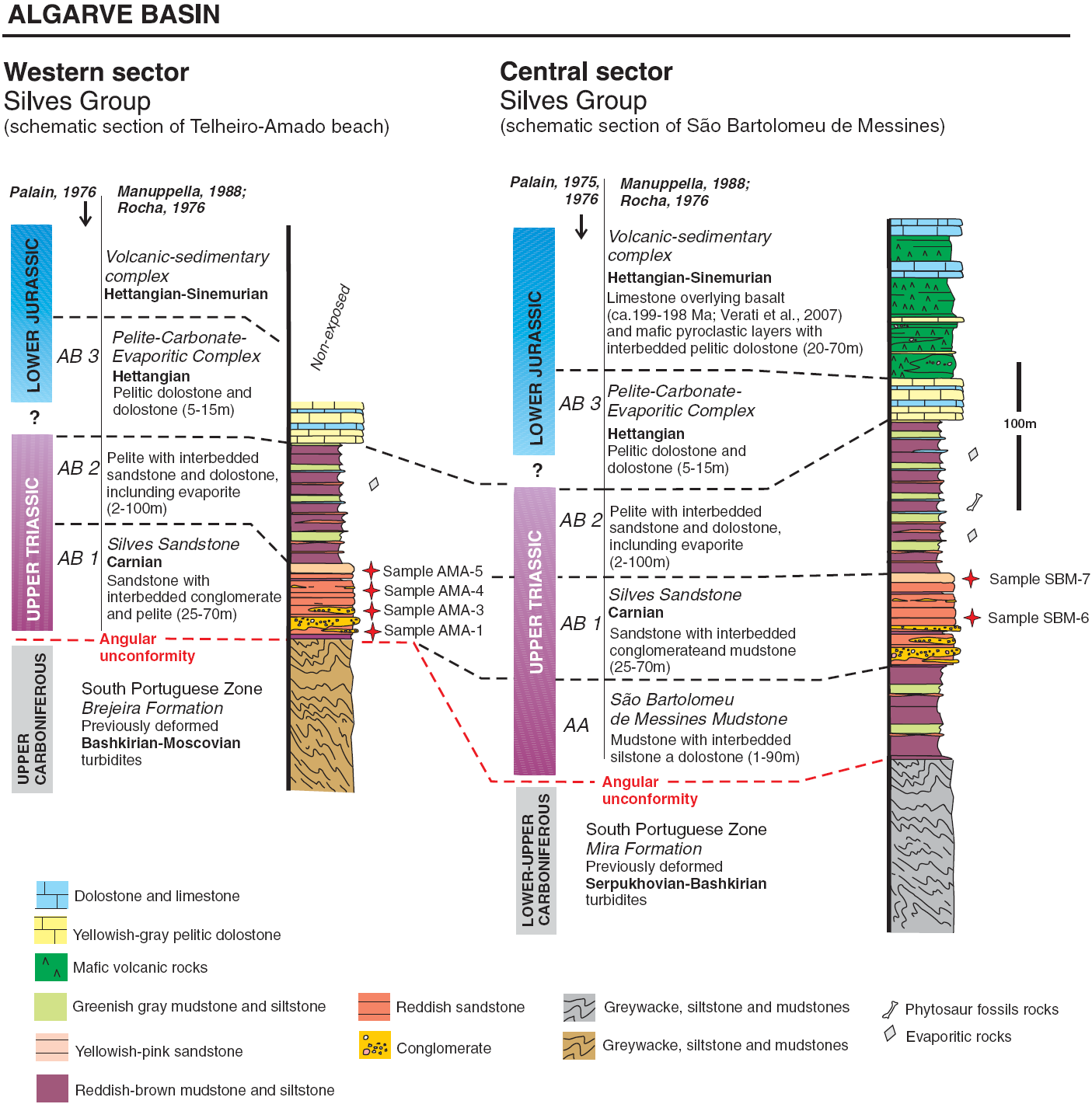
The upper Triassic sedimentary rocks of the Algarve Basin (Silves Group) rest with an angular unconformity on the previously deformed lower to upper Carboniferous Baixo Alentejo Flysch Group (Oliveira, Reference Oliveira, Dallmeyer and Martínez-García)1990). Thus, stratigraphic contact is made with the Brejeira Formation (Bashkirian–Moscovian) in the western sector, the Mira Formation (Sepukhovian–Bashkirian) in the central sector and the Mértola Formation (Visean–Serpukhovian) in the eastern sector (Fig. 4). The sedimentary record of the Triassic (Silves Group) starts, in the central sector, with a discontinuous unit of brown-reddish mudstone with interbedded siltstone, which is up to 100 m thick (the São Bartolomeu de Messines Mudstone, Manuppella, Reference Manuppella1988; AA unit, Palain, Reference Palain1976) (Fig. 4). This member is overlain by a 10 to 150 m thick unit mainly composed of reddish to yellowish, fine- to coarse-grained sandstone and minor siltstone and mudstone with parallel and oblique bedding, including palaeo-channels filled with conglomerate (Silves Sandstone, Manuppella, Reference Manuppella1988; AB1 unit, Palain, Reference Palain1976) (Fig. 4). These terrestrial deposits are typical of sedimentary environments with alluvial fans separated by rivers and alluvial plains with temporary meander-form rivers under semi-arid climatic conditions, in which evaporites formed (Choffat, Reference Choffat1887; Palain, Reference Palain1976, Reference Palain1979; Azerêdo et al. Reference Azerêdo, Duarte, Henriques and Manuppella2003).
Schematic stratigraphy of the late Triassic Algarve Basin western and central sectors. Modified from Palain (Reference Palain1976), Pereira et al. (Reference Pereira, Ribeiro, Gama, Drost, Chichorro, Vilallonga, Hofmann and Linnemann2017c) and Pereira & Gama (Reference Pereira and Gama2017).

Samples Sbm-6 and Sbm-7 and samples Ama-1, Ama-3, Ama-4 and Ama-5 were collected from the Silves Sandstone beds of the central and western sectors of the Algarve Basin, respectively (Figs 2, 4). The overlying Silves Sandstone, a 50 to 180 m thick sequence composed of reddish and greenish mudstone, siltstone and yellowish dolostone, is interlayered with discontinuous beds of fine-grained sandstone and evaporitic rocks (AB2 unit, Palain, Reference Palain1976; Pelite–Carbonate–Evaporite complex, Manuppella, Reference Manuppella1988) (Fig. 4), suggesting a shallow-marine and/or coastal lagoon environment (Azerêdo et al. Reference Azerêdo, Duarte, Henriques and Manuppella2003). The palaeontological remains of a terrestrial and semi-aquatic vertebrate (bones and teeth of a phytosaur specimen) were found in the AB2 unit indicating a late Triassic (Carnian–Norian) biostratigraphic age (Steyer et al. Reference Steyer, Mateus, Butler, Brusatte and Whiteside2011; Mateus et al. Reference Mateus, Butler, Brusatte and Whiteside2014). Lower Jurassic grey-yellowish dolostone beds interlayered with basalt, mafic breccia and tuff (AB3 unit, Palain, Reference Palain1976; volcanic–sedimentary complex, Manuppella, Reference Manuppella1988; Martins et al. Reference Martins, Madeira, Youbi, Munhá, Mata and Kerrich2008) overlie the Triassic strata of the Algarve Basin.
3. Methods
Zircon grains for U–Pb geochronology were selected using traditional techniques: density separation using a Wilfley table (Universidad Complutense de Madrid); granulometric separation using sieves with mesh size less than 500 microns; and mineral identification using a binocular lens and preparation of epoxy resin mounts with zircon grains (University of Évora). Cathodoluminescence imaging used to select targets and U–Pb measurements were performed at Trinity College Dublin using laser ablation inductively coupled plasma mass spectrometry (LA-ICP-MS), following the previously described procedure by Crowley & Strachan (Reference Crowley and Strachan2015). Probability density plots and histograms were done using Isoplot 4 (Ludwig, Reference Ludwig2003), using 90–110 % concordant 206Pb–238U ages for grains younger than 1.0 Ga, and 207Pb–206Pb ages for the older grains (for details see Frei & Gerdes, Reference Frei and Gerdes2009). U–Th–Pb results are listed in online Supplementary Material Tables S1–S6.
The K–S test was used to compare the distinct populations of detrital zircon U–Pb ages obtained. This is a non-parametric statistical tool that has been used successfully for sedimentary provenance studies due to the fact that it enables the comparison of two populations of detrital zircon U–Pb ages by evaluating whether they are significantly different, i.e. indicating whether zircon age populations correlate with a similar source or not (DeGraaff-Surpless et al. Reference DeGraaff-Surpless, Mahoney, Wooden and McWilliams2003; Barbeau et al. Reference Barbeau, Davis, Murray, Valencia, Gehrels, Zahid and Gombosi2009). The test procedure involves a ‘null hypothesis’, which assumes that if the two populations are similar they probably share a common source, and an ‘alternative hypothesis’, which assumes that the two populations are distinct and do not come from the same source (Guynn & Gehrels, Reference Guynn and Gehrels2010). The K–S test is carried out by ordering the zircon ages of two different populations separately and then plotting cumulative curves of the frequency of zircon ages. The maximum vertical difference between the cumulative curves is compared using D-values (Guynn & Gehrels, Reference Guynn and Gehrels2010). The K–S test fails if the D-value is greater than a critical distance (set by choosing a confidence interval that contributes to the cumulative function if the values obtained are shown to be significant after more than 20 measurements, regardless of whether they are of different sizes) showing that the two populations do not derive from the same source (Barbeau et al. Reference Barbeau, Davis, Murray, Valencia, Gehrels, Zahid and Gombosi2009). The probability of the observed D-value being unrelated to age differences between the two populations is given by a P-value corresponding to a confidence interval of 95 % (Barbeau et al. Reference Barbeau, Davis, Murray, Valencia, Gehrels, Zahid and Gombosi2009). High D-values and low P-values indicate that the observed difference between the two populations may be explained by the existence of distinct origins (Pereira et al. Reference Pereira, Albardeiro, Gama, Chichorro, Hofmann and Linnemann2016a and references therein). Two detrital zircon age populations are linked to the same source if P-values are higher than 0.05 (Guynn & Gehrels, Reference Guynn and Gehrels2010). P-values falling within the range 0.001 < P-value < 0.05 suggest a degree of proximity between the two populations. If P-values are lower than 0.001, the two populations are probably significantly different, indicating distinct sources (Fernández-Suárez et al. Reference Fernández-Suárez, Gutiérrez-Alonso, Pastor-Galán, Hofmann, Murphy and Linnemann2014).
In the present study, a detailed analysis was conducted by comparing the different detrital zircon age populations of the Triassic sandstone of the Algarve Basin with potential sources from SW Iberia and Nova Scotia using the K–S test complemented by MDS diagrams. The MDS technique provides a means to compare samples based on quantified pairwise comparisons of their detrital zircon ages, and is extremely useful for visualizing the level of similarity of samples in a two-dimensional space (Vermeesch, Reference Vermeesch2013; Spencer & Kirkland, Reference Spencer and Kirkland2015). MDS was used to transform a matrix of pairwise similarities among detrital zircon age populations into Cartesian coordinates in a two-dimensional space, where greater distances between samples represent a greater degree of dissimilarity between points on the MDS diagrams (Wissink et al. Reference Wissink, Wilkinson and Hoke2018). K–S analyses were carried out using an Excel spreadsheet published on the University of Arizona Geochronological Center website at: https://sites.google.com/a/laserchron.org/laserchron/. MDS diagrams were produced using IsoplotR (Vermeesch, Reference Vermeesch2018).
4. Results
Samples Ama-1, Ama-3, Ama-4 and Ama-5 are fine to medium grained and poorly to well sorted, with sub-angular to rounded grains. Quartz grains are dominant while white mica, K-feldspar and plagioclase are poorly represented. Some centimetre-thick layers of sandstone are only constituted by opaque minerals. Rock fragments are mostly made of pelite and have an elongated shape, and there is also some limestone, chert and quartzite. The composition of the cement is characterized as being carbonate and ferruginous.
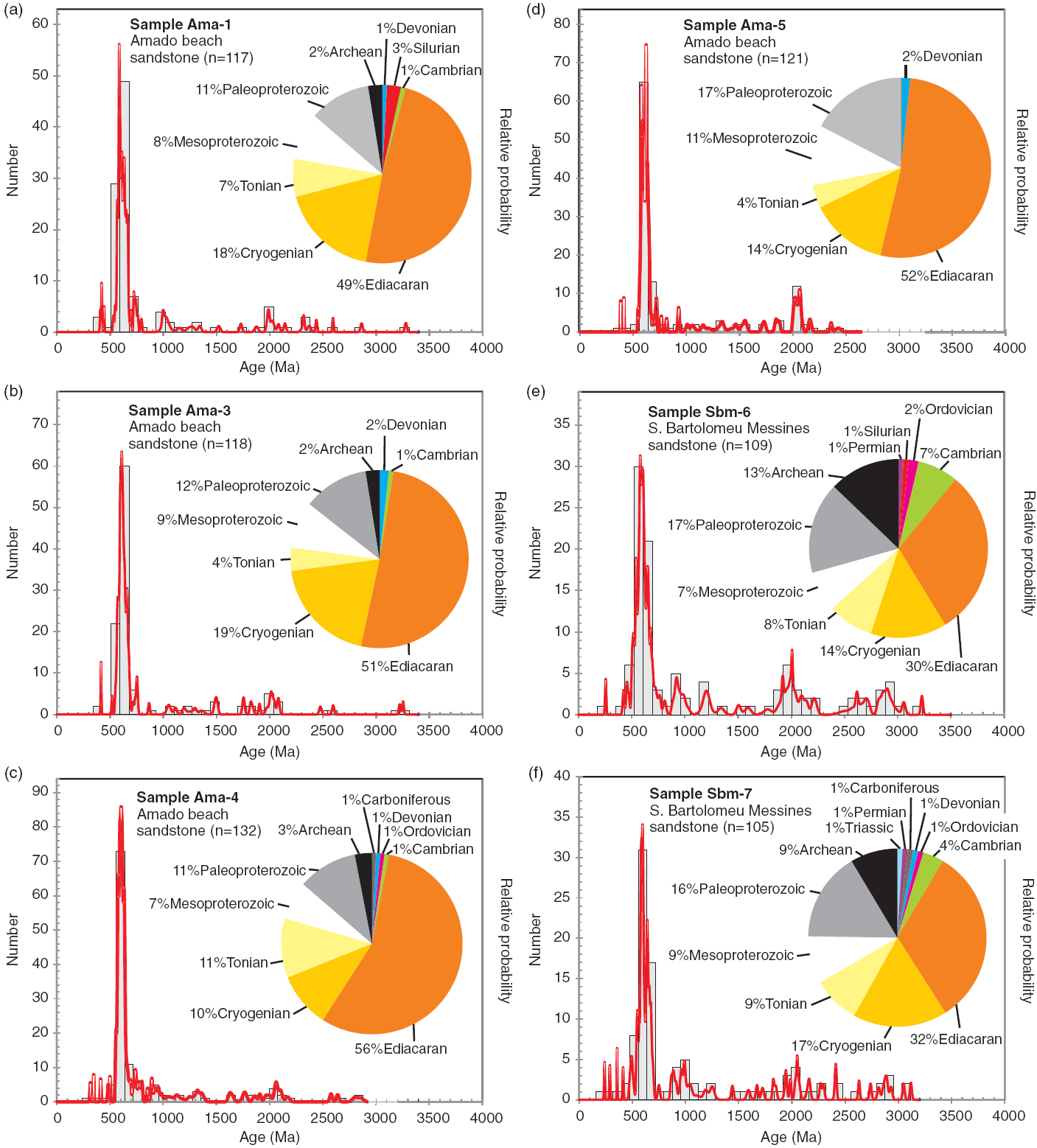
Of a total of 120 spots measured in sample Ama-1, 117 yielded 90–110 % concordant ages (Fig. 5a). Only 5 % of ages are Palaeozoic, 93 % are Proterozoic and 2 % are Archaean (c. 3.3, 2.9 and 2.6 Ga). Palaeozoic ages range from c. 531 Ma to c. 408 Ma, including 3 % Silurian grains (c. 444, 424 and 420 Ma). Neoproterozoic grains (74 %) are widespread at c. 633–547 Ma (49 % Ediacaran), c. 698–636 Ma (18 % Cryogenian) and c. 997–722 Ma (7 % Tonian). Palaeoproterozoic zircon grains (11 %) are distributed over the age interval of c. 2.4–1.7 Ga, and Mesoproterozoic ages (8 %) are 1.5–1 Ga.
Zircon age spectra and pie charts showing the age distribution of detrital zircons from the Triassic sandstone sampled in the western (a–d) and central (e, f) sectors of the Algarve Basin.

Of a total of 121 spots measured in sample Ama-3, 118 yielded 90–110 % concordant ages (Fig. 5b). The majority of zircon grains present Precambrian ages (97 %), and only 3 % Palaeozoic ages (Cambrian, c. 519 Ma; Devonian, c. 416 and 414 Ma). The Proterozoic population is dominated by Neoproterozoic grains (74 %: 51 % Ediacaran, c. 634–549 Ma; 19 % Cryogenian, c. 717–636 Ma; and 4 % Tonian, c. 866–736 Ma), followed by Palaeoproterozoic (12 %, c. 2.5–1.8 Ga) and Mesoproterozoic (9 %, c. 1.5–1 Ga) grains. Archaean grains are rare (2 %, c. 3.3–2.6 Ga).
Of a total of 135 spots measured in sample Ama-4, 132 yielded 90–110 % concordant ages (Fig. 5c). Proterozoic zircon ages are dominant (94 %) and the remaining grains are Palaeozoic (3%: Carboniferous, c. 348 Ma; Devonian, c. 413 Ma; Ordovician, c. 484 Ma and Cambrian, c. 501 Ma) and Archaean (3 %, c. 2.5, 2.6 and 2.8 Ga). The Precambrian population is dominated by Neoproterozoic grains (77 %: 56 % Ediacaran, c. 635–551 Ma; 10 % Cryogenian, c. 716–636 Ma; and 11 % Tonian, c. 991–983 Ma), followed by Palaeoproterozoic (11 %, c. 2.1–1.6 Ga) and Mesoproterozoic (7 %, c. 1.4–1 Ga) grains, and rare grains with Archaean ages (c. 2.8–2.5 Ga).
Of a total of 123 spots measured in sample Ama-5, 121 yielded 90–110 % concordant ages (Fig. 5d). A total of 101 yielded Precambrian ages (98 %), and only two grains presented Palaeozoic ages (2 %: Devonian, c. 413 Ma and c. 383 Ma). The Proterozoic population is dominated by Neoproterozoic grains (70 %: 52 % Ediacaran, c. 633–547 Ma; 14 % Cryogenian, c. 719–635 Ma; and 4 % Tonian, c. 929–721 Ma), followed by Palaeoproterozoic (17 %, c. 2.4–1.7 Ga) and Mesoproterozoic (11 %, c. 1.6–1 Ga) grains. There are no Archaean ages.
Samples Sbm-6 and Sbm-7 are fine to medium grained, poorly to well sorted, with sub-angular to rounded grains and carbonate and ferruginous cement. Quartz grains are dominant, opaque minerals are present in thin-layers, while K-feldspar and white mica are rare. Rock fragments include pelite, chert and quartzite.
Of a total of 117 spots measured in sample Sbm-6, 109 yielded 90–110 % concordant ages (Fig. 5e). The population of detrital zircon is dominated by Proterozoic (76 %), Archaean (13 %) and Palaeozoic (11 %) ages. Proterozoic grains are dominated by Neoproterozoic ages (52 %: 30 % Ediacaran, c. 621–548 Ma; 14 % Cryogenian, c. 719–638 Ma; and 8 % Tonian, c. 988–736 Ma), and also contain Palaeoproterozoic (17 %, c. 2.2–1.8 Ga) and Mesoproterozoic (7 %, c. 1.6–1 Ga) ages. The Palaeozoic population includes Cambrian (7 %, c. 541–502 Ma), Ordovician (2 %, c. 471 and 454 Ma) and rare Silurian (1 %, c. 424 Ma) and Permian (1%, c. 256 Ma) grains.
Of a total of 110 spots measured in sample Sbm-7, 105 yielded 90–110 % concordant ages (Fig. 5f). The majority of detrital zircon grains are Proterozoic (83 %) followed by Archaean (9 %, c. 3.1–2.6 Ga), Palaeozoic (8%: 4% Cambrian, c. 541–489 Ma; 1 % Ordovician, c. 477 Ma; 1 % Devonian, c. 413 Ma; 1 % Carboniferous, c. 357 Ma; and 1 % Permian, c. 289 Ma), while one grain is Triassic (c. 240 Ma). Neoproterozoic grains (58 %) are widespread in the age interval c. 992–543 Ma (32 % Ediacaran, c. 633–543 Ma; 17 % Cryogenian, c. 695–637 Ma; and 9 % Tonian, c. 992–750 Ma). Palaeoproterozoic zircon (16 %) is c. 2.4–1.7 Ga, and Mesoproterozoic ages (9 %) are 1.6–1 Ga.
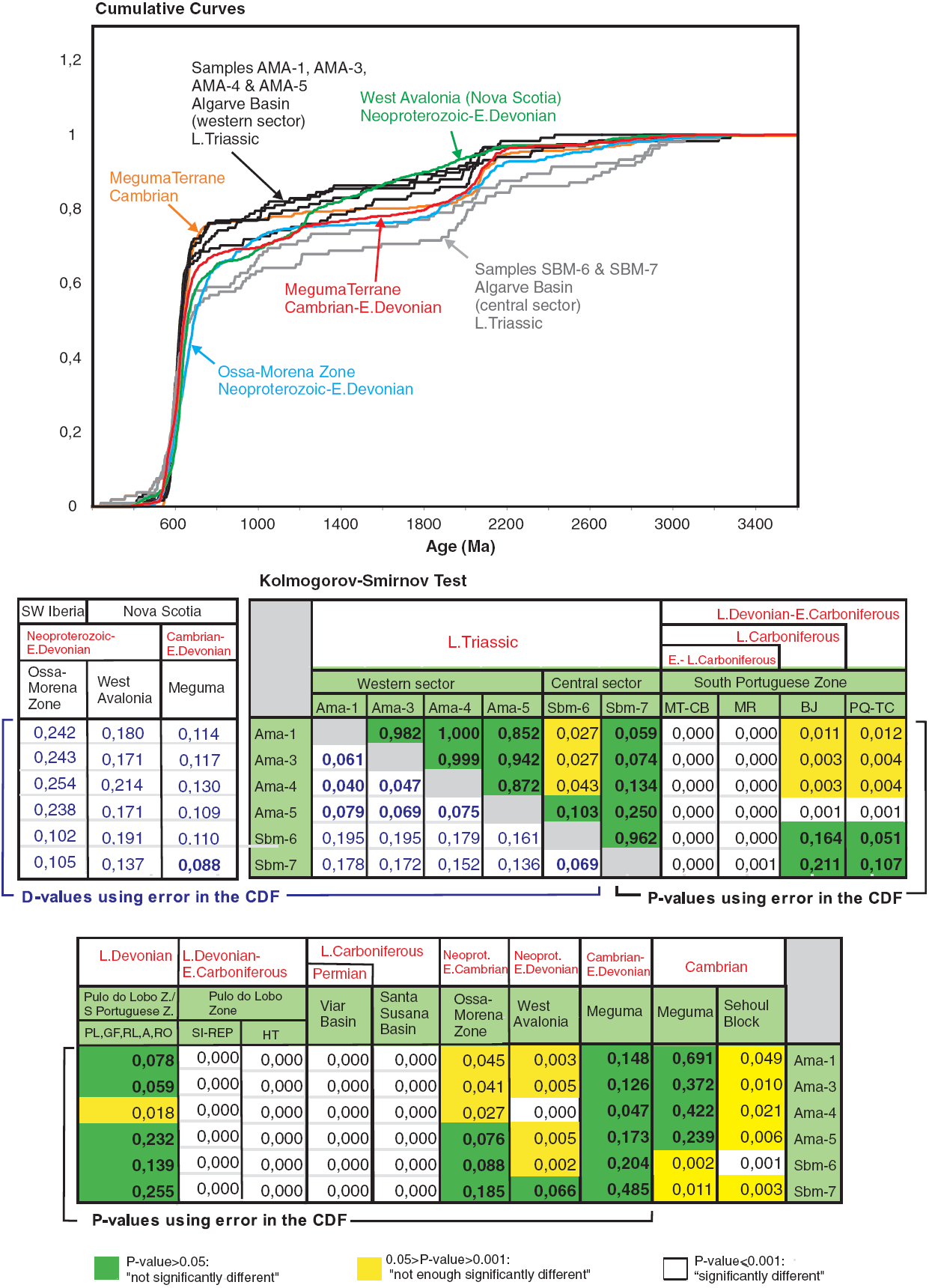
A comparison of samples of the Algarve Triassic sandstone from each sector using the K–S test shows that P-values are very close to 1 (western sector: 0.852 ≤ P-value ≤ 1; central sector: P-value = 0.962) (Fig. 6), indicating a common source for the two sectors. D-values are smaller between the cumulative curves of the samples from each sector (western sector: 0.04 ≤ D-value ≤ 0.079; central sector: D-value = 0.069) but greater between the sectors (0.136 ≤ D-value ≤ 0.195) (Fig. 6), suggesting some differences in terms of source between the two sectors. The U–Pb age distributions of samples Ama-1, Ama-3, Ama-4 and Ama-5 compared with sample Sbm-7, and those of sample Sbm-6 compared with Ama-5, are ‘not significantly different’ at the 5 % confidence level (P-values ranging from 0.059 to 0.25 and P-value = 0.103, respectively) (Fig. 6), indicating the same provenance. But, the U–Pb age distribution of sample Sbm-6 is ‘not sufficiently significantly different’ from samples Ama-1, Ama-3 and Ama-4 (P-values ranging from 0.027 to 0.043). The relevant MDS diagram demonstrates a lack of similarity with the U–Pb detrital geochronology dataset of the Triassic sandstone sampled in the western and central sectors of the Algarve Basin (Fig. 7b).
Results of the K–S (Kolmogorov–Smirnov) test showing: the U–Pb age cumulative frequency plots applied to the U–Pb ages (90–110 % concordance) of detrital zircon grains from the Algarve Triassic sandstone (Ama-1, Ama-3, Ama-4, Ama-5 – western sector; Sbm-6, Sbm-7 – central sector), South Portuguese Zone (MT-CB – Mértola and Cabrela formations; MR – Mira Formation; BJ – Brejeira Formation; PQ-TRC – Phyllite-Quartzite and Tercenas formations; RO – Ronquillo Formation), Pulo do Lobo Zone (PL; PL-GF-RL-A – Pulo do Lobo, Gafo, Ribeira de Limas and Atalaia formations; HT – Horta da Torre Formation; SI-REP – Santa Iria and Represa formations) and Ossa–Morena Zone, Meguma Terrane and West Avalonia siliciclastic rocks. Table showing the comparison of detrital zircon populations of the Algarve Triassic sandstone, South Portuguese, Pulo do Lobo and Ossa–Morena zones, Santa Susana and Viar basins, Sehoul Block, Meguma Terrane and West Avalonia siliciclastic rocks. Data sources are mentioned in the text.

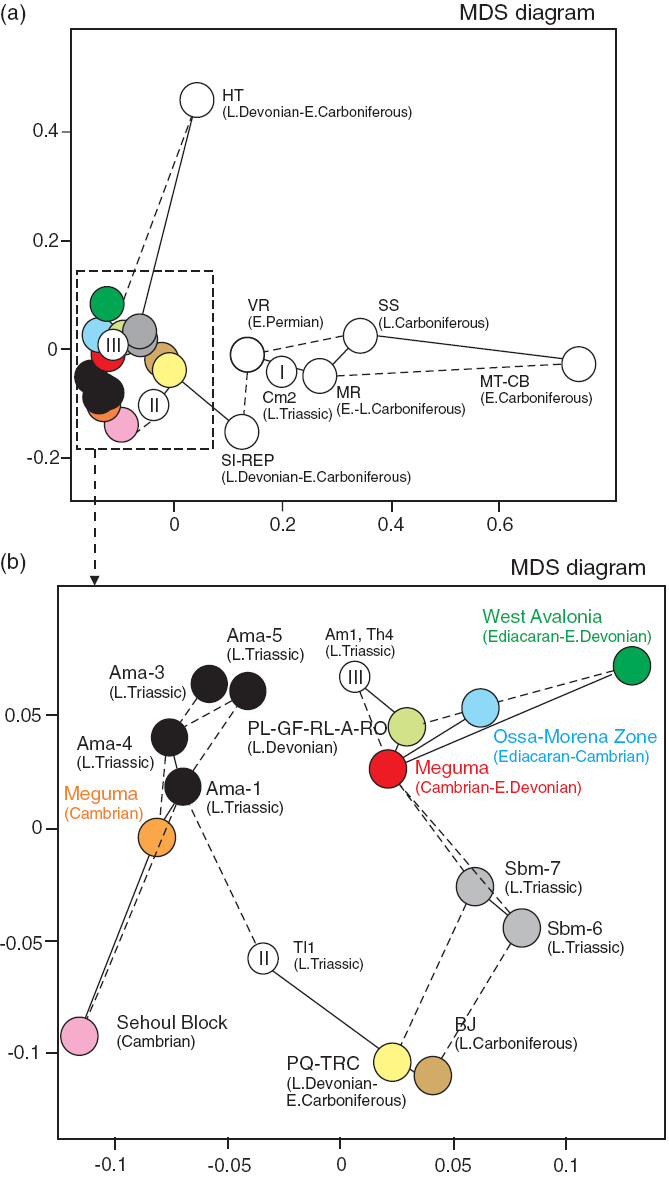
MDS diagrams showing: (a) the comparison of detrital zircon populations of the Algarve Triassic sandstone, South Portuguese, Pulo do Lobo and Ossa–Morena zones (the acronyms are the same as in Fig. 6), Santa Susana (SS) and Viar (VR) basins, Sehoul Block, Meguma Terrane and West Avalonia siliciclastic rocks; (b) a detail of (a) comparing the samples with greater affinity. Data sources are mentioned in the text.

5. Discussion
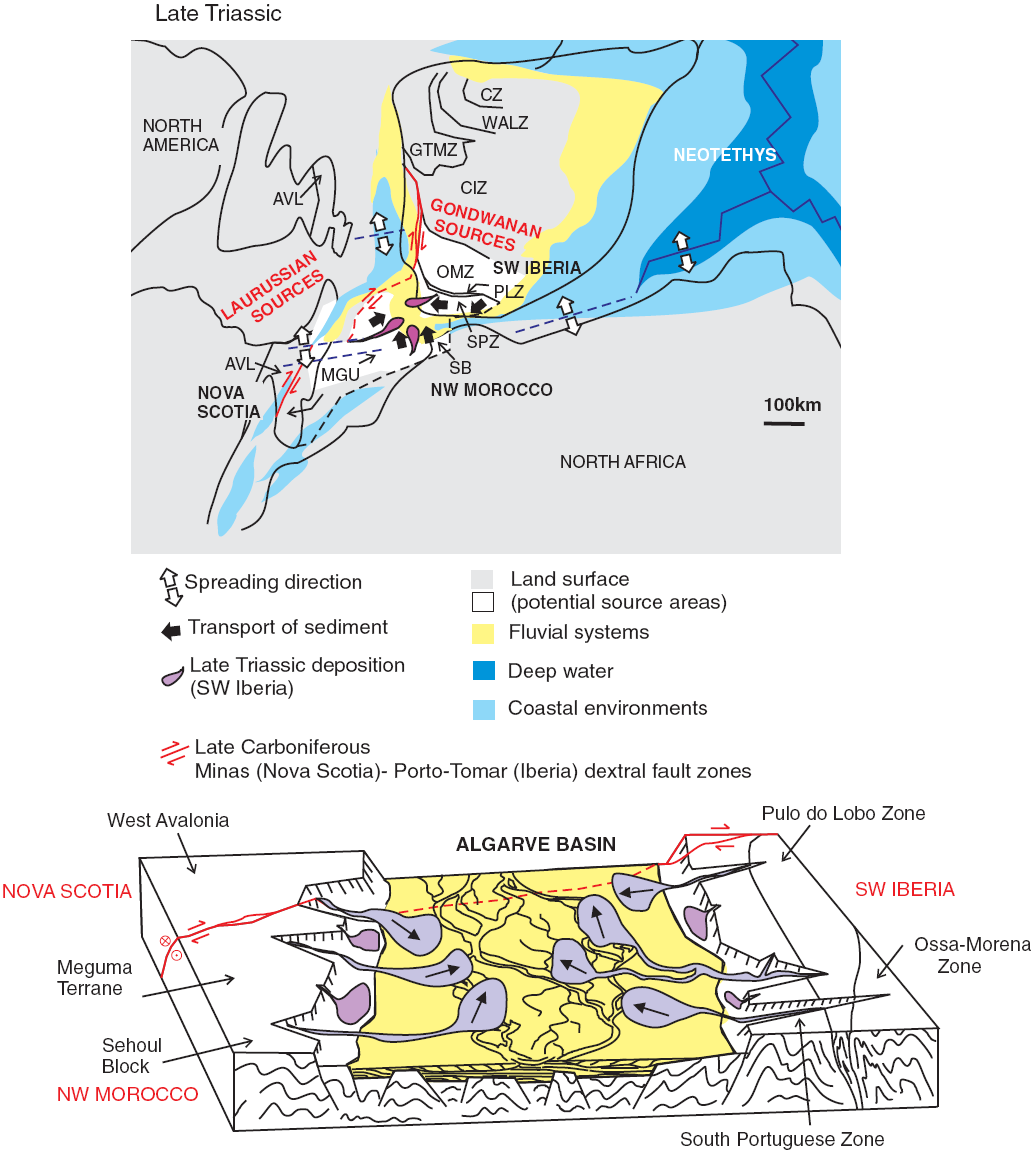
In the present study, Algarve Triassic sandstone detrital zircon populations were compared with those of (i) Ediacaran to lower Devonian siliciclastic rocks from the Meguma Terrane and West Avalonia as potential Laurussian-type sources, and (ii) OMZ Ediacaran–Cambrian siliciclastic rocks as a potential Gondwanan-type source. In addition, a comparison was made between the detrital zircon ages of the Algarve Triassic sandstone and those of Cambrian siliciclastic rocks from the Sehoul Block, which has been identified as part of the Laurussian margin (Schenk, Reference Schenk1997; Hoepffner et al. Reference Hoepffner, Soulaimani and Piqué2005; Simancas et al. Reference Simancas, Tahiri, Azor, González Lodeiro, Martínez Poyatos and El Hadi2005; Michard et al. Reference Michard, Soulaimani, Hoepffner, Ouanaimi, Baidder, Rjimati and Saddiqi2010). The most significant differences between the detrital zircon populations of the Algarve Triassic sandstone are the higher percentages of Neoproterozoic ages (70–77 %), in particular Ediacaran (49–56 %), in the western sector, contrasting with the higher percentages of Archaean (9–13 %) and Palaeozoic (9–11 %) zircon grains found in the central sector (Fig. 5). This lateral change in sources may be caused by sediment transport derived from independent drainage systems, which is most likely, where the catchment zones of palaeo-rivers were located in distinct terrane sources (Gondwanan- and Laurussian-type) (Fig. 8).
Palaeogeographic context of: (a) late Triassic continental rifting at the core of Pangaea (adapted from Golonka, Reference Golonka2007; Pereira & Gama, Reference Pereira and Gama2017); (b) late Triassic alluvial fan and river deposition within the Algarve Basin, showing the underlying Appalachian–Variscan belt architecture with distinct Palaeozoic source terranes.

The fact that Palaeozoic detrital zircon grains occur in the Algarve Triassic sandstone without a great representation of late Palaeozoic ages made the K–S test very sensitive in terms of achieving a comparison with Devonian, Carboniferous and Permian siliciclastic rocks from SW Iberia, indicating that some of these do not provide potential sources. The K–S test results show that the U–Pb age distributions of detrital zircons from the Triassic samples are ‘significantly different’ at the 5 % confidence level (P-value < 0.001) from those of the lower–upper Carboniferous siliciclastic rocks of the Mértola and Mira formations (Pereira et al. Reference Pereira, Chichorro, Johnston, Gutiérrez-Alonso, Silva, Linnemann, Hofmann and Drost2012a, 2014; Rodrigues et al. Reference Rodrigues, Chew, Jorge, Fernandes, Veiga-Pires and Oliveira2015), and the upper Devonian (Famennian) – lower Carboniferous siliciclastic rocks from the Horta da Torre, Represa and Santa Iria formations are ‘significantly different’ at the 5 % confidence level (P-values < 0.001) (Pereira et al. Reference Pereira, Gutiérrez-Alonso, Murphy, Drost, Gama and Silva2017b; Pérez-Cáceres et al. Reference Pérez-Cáceres, Poyatos, Simancas and Azor2017), as are the upper Carboniferous Santa Susana and lower Permian Viar siliciclastic rocks (Dinis et al. Reference Dinis, Fernandes, Jorge, Rodrigues, Chew and Tassinari2018) (Fig. 6). All of these samples contain a significant number of detrital zircon grains with Carboniferous and Devonian ages. This difference is confirmed by the MDS diagrams, on which the detrital zircon populations of the above-mentioned SW Iberian upper Devonian to lower Permian siliciclastic sequences are located at some distance from those of the Algarve Triassic sandstone (Fig. 7a).
5.a. Gondwanan-type source of detrital zircon
The K–S test results show that the detrital zircon populations of the Algarve Triassic sandstone of the western sector are ‘not sufficiently significantly different’ at the 5 % confidence level (P-values < 0.001) from the Ediacaran–Cambrian siliciclastic rocks of the OMZ (Fig. 6), indicating that they could provide a source for them. However, if we consider that in the Ama-1, Ama-3 and Ama-4 samples there are Mesoproterozoic, Silurian and late Ordovician detrital zircon grains, we have to consider the contribution from another source, which may be the Meguma Terrane (see Section 5.b.).
In contrast, the detrital zircon populations of the Triassic sandstone of the central sector (Sbm-6 and Sbm-7) and sample Ama-5 from the western sector are ‘not significantly different’ from those of the OMZ (Fig. 6), suggesting derivation from a Gondwanan-type source. This is supported by the fact that the cumulative curve for the OMZ siliciclastic rocks is somewhat closer to that of the central sector Triassic sandstone (D-values of 0.102 and 0.105) when compared to the western sector as regards the distance between the curves (0.238 ≤ D-value ≤ 0.254) (Fig. 6). This difference is also evident on the MDS diagrams (Fig. 7b), where the detrital zircon population of the OMZ rocks is located some distance from that of the western sector Triassic sandstone (with the exception of sample Ama-5, which is at the same distance from the OMZ as samples Sbm-6 and Sbm-7). This difference may be owing to the almost complete absence of Archaean (3 %) detrital zircon grains and the presence of Mesoproterozoic (7–11 %) detrital zircon grains in the western sector Triassic sandstone, which contrasts with the detrital zircon register for the OMZ rocks. At the same time, the detrital zircon population of the central sector Triassic sandstone (samples Sbm-6 and Sbm-7), which is also dominated by Cryogenian–Ediacaran (44–49 %) grains, also contains Palaeoproterozoic (16–17 % Rhyacian to Statherian) and Archaean (9–13 %) grains (Fig. 5). These Precambrian detrital zircon grains were most probably recycled from both the Avalonian–Cadomian magmatic arc system, which developed on the continental margin of Gondwana in Neoproterozoic times (Nance et al. Reference Nance, Murphy, Strachan, Keppie, Gutiérrez-Alonso, Fernández-Suárez, Quesada, Linnemann, D’Lemos, Pisarevsky, Ennih and Liégeois2008; Pereira et al. Reference Pereira, Chichorro, Williams, Silva, Ennih and Liégeois2008; Linnemann et al. Reference Linnemann, Pereira, Jeffries, Drost and Gerdes2008) and older West African craton sources (Eburnian–Birimian (Schofield et al. Reference Schofield, Horstwood, Pitfield, Crowley, Wilkinson and Sidaty2006; Youbi et al. Reference Youbi, Kouyaté, Söderlund, Ernst, Soulaimania, Hafidg, Ikenneh, El Bahath, Bertrand, Chahama, Abbouj, Mortajih, El Ghorfik, Zouhairk and El Janati2012; Pereira et al. Reference Pereira, El Houicha, Chichorro, Armstrong, Jouhari, El Attari, Ennih and Silva2015b), Liberian (Potrel et al. Reference Potrel, Peucat, Fanning, Auvray, Burg and Caruba1996; Key et al. Reference Key, Loughlin, Gillespie, Del Rio, Horstwood, Crowley, Darbishire, Pitfield, Henney, Ennih and Liégeois2008) and Leonian (Thieblemont et al. Reference Thieblemont, Goujou, Egal, Cocherie, Delor, Lafon and Fanning2004 and references therein) magmatic events). Cambrian–early Ordovician grains (5–9 %) may have been recycled from magmatic rocks that are abundant in the OMZ and have been assigned to a major rifting event on the continental margin of Gondwana (Sánchez-García et al. Reference Sánchez-García, Bellido and Quesada2003; Murphy et al. Reference Murphy, Gutiérrez-Alonso, Nance, Fernández-Suárez, Keppie, Quesada, Strachan and Dostal2006; Linnemann et al. Reference Linnemann, Pereira, Jeffries, Drost and Gerdes2008; Pereira et al. Reference Pereira, Solá, Chichorro, Lopes, Gerdes and Silva2012b; Díez Fernández et al. Reference Díez Fernández, Pereira and Foster2015).
5.b. Laurussian-type sources of detrital zircon
In palaeogeographic reconstructions for the Palaeozoic period, the palaeolocation of the Meguma Terrane and West Avalonia in relation to the continental margin of Gondwana has changed over time from the Cambrian to Devonian (Keppie et al. Reference Keppie, Dostal, Murphy and Cousens1997; Cocks & Torsvik, Reference Cocks and Torsvik2002, Reference Cocks, Torsvik, Gee and Stephenson2006; Waldron et al. Reference Waldron, White, Barr, Simonetti and Heaman2009). In Neoproterozoic–Cambrian times, both terranes were part of the northern Gondwanan margin, but they later drifted away and were subsequently accreted to the continental margin of Laurussia in Silurian time, remaining part of it until Carboniferous time (Murphy et al. Reference Murphy, Gutiérrez-Alonso, Nance, Fernández-Suárez, Keppie, Quesada, Strachan and Dostal2006; Nance et al. Reference Nance, Gutiérrez-Alonso, Keppie, Linnemann, Murphy, Quesada, Strachan and Woodcock2010). This explains why the Palaeoproterozoic and Neoproterozoic detrital zircon age distribution of these two Laurussian-type sources is consistent with derivation from the northern Gondwanan continental margin during a certain period of their stratigraphic record, and therefore, these sources show some similarities with the detrital zircon population of the OMZ Ediacaran–Cambrian siliciclastic rocks. However, contrary to the OMZ (which is defined in the present paper as a ‘Gondwanan-type source’ because it never drifted away from the northern continental margin of Gondwana), the Meguma Terrane and West Avalonia are distinguishable by the fact that they present a significant population of Mesoproterozoic, late Ordovician, Silurian and early Devonian zircon grains. The Mesoproterozoic detrital zircon grains found in West Avalonian Ediacaran and Cambrian sedimentary rocks are compatible with an Amazonian provenance (Barr et al. Reference Barr, Hamilton, Samson, Satkoski and White2012). The presence of a detrital zircon population dated at c. 1.6–1 Ga in Silurian and Devonian siliciclastic rocks of the Meguma Terrane has been interpreted as having been derived from a source composed of Mesoproterozoic crust (White et al. Reference White, Barr and Linnemann2018), or recycling from West Avalonian sources from Silurian times (Murphy et al. Reference Murphy, Fernández-Suárez, Keppie and Jeffries2004b). In addition, Mesoproterozoic zircon grains are found in the oldest Neoproterozoic siliciclastic rocks of West Avalonia (Gamble Brook Formation; Henderson et al. Reference Henderson, Collins, Murphy, Gutiérrez-Alonso and Hand2016), which could have been later recycled into younger formations during Ediacaran to Devonian times. However, this hypothesis lacks validity as the Gamble Brook Formation includes, along with the Mesoproterozoic grains, a significant population of early Palaeoproterozoic ages, typical of Baltica sources (Sveconorwegian: Andersen et al. Reference Andersen, Andresen and Sylvester2002), which have not been fully recognized in the Neoproterozoic–lower Devonian siliciclastic rocks of West Avalonia (Henderson et al. Reference Henderson, Collins, Murphy, Gutiérrez-Alonso and Hand2016) and the Meguma Terrane (Murphy et al. Reference Murphy, Fernández-Suárez, Keppie and Jeffries2004b; Waldron et al. Reference Waldron, White, Barr, Simonetti and Heaman2009; White et al. Reference White, Barr and Linnemann2018).
The lack of late Ordovician, Silurian and early Devonian magmatism is another feature of the OMZ, which may provide a criterion for distinguishing between Gondwanan- and Laurussian-type sources (West Avalonia and Meguma terranes). In West Avalonia, the bimodal volcanism of the Dunn Point and McGillivray Brook formations yielded c. 460–454 Ma ages (Hamilton & Murphy, Reference Hamilton and Murphy2004; Murphy et al. Reference Murphy, Hamilton and LeBlanc2012). Late Ordovician – early Silurian magmatic events are found in the Meguma Terrane. The White Rock Formation of the Rockville Notch Group is composed of felsic volcanic rocks dated at c. 446–434 Ma (White et al. Reference White, Barr and Linnemann2018), and in addition, the Mavillete gabbro intrusive in the White Rock Formation was dated at c. 426 Ma (Warsame et al. Reference Warsame, McCausland, White, Barr and Dunning2017). The occurrence of c. 440 Ma detrital zircon grains in the upper Silurian siliciclastic rocks of the Arisaig Group could derive from erosion of a Silurian volcanic belt and/or they may have originally been transported as airborne ash and subsequently reworked from coeval volcanic beds (Murphy et al. Reference Murphy, Fernández-Suárez and Jeffries2004a). Another group of detrital zircon grains that is characteristic of Laurussian-type sources present early Devonian ages (c. 419–393 Ma). Detrital zircon grains included in this age interval were found in the Lochkovian siliciclastic rocks of the Arisaig Group (c. 418–397 Ma, Knoydart Formation; B. Henderson, unpub. Ph.D. thesis, Univ. Adelaide, 2016). These early Devonian zircon grains may have derived from a few interbedded volcanic beds (Murphy et al. Reference Murphy, Dostal and Keppie2008), and/or the Acadian magmatic rocks of the nearby Newfoundland segment of the Appalachian belt (Gander Zone of the Ganderia Terrane; van Staal et al. Reference van Staal, Whalen, Valverde-Vaquero, Zagorevski, Rogers, Murphy, Keppie and Hynes2009; van Staal & Barr, Reference van Staal and Barr2012).
K–S test results indicate that the U–Pb age distributions of all samples of the Triassic sandstone are ‘not significantly different’ at the 5 % confidence level (P-values ranging from 0.047 to 0.485) from the Ediacaran–lower Devonian siliciclastic rocks of the Meguma Terrane, strongly suggesting they are possible sources. At the same time, sample Sbm-7 is the only Triassic sandstone with a U–Pb age distribution that is ‘not significantly different’ at the 5 % confidence level (P-value = 0.066) from the Cambrian–lower Devonian siliciclastic rocks of West Avalonia. The remaining samples are ‘not sufficiently significantly different’ with P-values ranging from 0.002 to 0.005, in contrast to sample Ama-4, which is ‘significantly different’ (P-value < 0.001). When performing the K–S test for the comparison of the Algarve Triassic sandstone and Meguma Terrane Cambrian siliciclastic rocks, there is a greater degree of similarity with the samples of the western sector (P-values = 0.239–0.691) (Fig. 6), which is also evident from the MDS diagram (Fig. 7).
Although the zircon age spectra in the Algarve Triassic sandstone may indicate ultimate derivation from the Meguma Terrane with a contribution from West Avalonia, the upper Devonian–Carboniferous formations of the SPZ and the PLZ cannot be ruled out as additional potential sources since zircon age signatures are closely comparable (Braid et al. Reference Braid, Murphy, Quesada and Mortensen2011; Pereira et al. Reference Pereira, Ribeiro, Vilallonga, Chichorro, Drost, Silva, Albardeiro, Hofmann and Linnemann2014, Reference Pereira, Gutiérrez-Alonso, Murphy, Drost, Gama and Silva2017b; Pérez-Cáceres et al. Reference Pérez-Cáceres, Poyatos, Simancas and Azor2017), as evident from the relevant MDS diagram (Fig. 7b). As regards the detrital zircon age populations of the Algarve Triassic sandstone as compared with those of the SPZ siliciclastic rocks, upper Devonian – lower Carboniferous Phyllite-Quartzite and Tercenas formations (Braid et al. Reference Braid, Murphy, Quesada and Mortensen2011; Pereira et al. Reference Pereira, Chichorro, Johnston, Gutiérrez-Alonso, Silva, Linnemann, Hofmann and Drost2012a; Pérez-Cáceres et al. Reference Pérez-Cáceres, Poyatos, Simancas and Azor2017), and lower to upper Carboniferous Mértola, Mira and Brejeira formations (Pereira et al. Reference Pereira, Chichorro, Johnston, Gutiérrez-Alonso, Silva, Linnemann, Hofmann and Drost2012a, 2014; Rodrigues et al. Reference Rodrigues, Chew, Jorge, Fernandes, Veiga-Pires and Oliveira2015), there are significant differences. The K–S test results show that U–Pb age distributions of the Triassic sandstone from the central sector are ‘not significantly different’ at the 5 % confidence level from the Brejeira Formation (P-values of 0.164 and 0.211) and both the Phyllite-Quartzite and Tercenas formations (P-values of 0.051 and 0.107), which may be regarded as probable sources (Fig. 6). The same result is evident from the relevant MDS diagram (Fig. 7b), which also indicates similarities between the detrital zircon populations of sample Tl1 (Dinis et al. Reference Dinis, Fernandes, Jorge, Rodrigues, Chew and Tassinari2018; Fig. 2) and the Phyllite-Quartzite Formation. In the western sector, with the exception of sample Ama-5, which is ‘significantly different’ (P-value < 0.001), samples are ‘not sufficiently significantly different’ at the 5 % confidence level from either the Brejeira Formation turbidites (P-values ranging from 0.003 to 0.011) or both the Phyllite-Quartzite and Tercenas formations (P-values of 0.004 to 0.012), suggesting a lesser degree of affinity, which is also evident from the distance between them on the relevant MDS diagram (Fig. 7b). A similar analysis conducted with the detrital zircon populations of the Algarve Triassic sandstone and the Frasnian siliciclastic rocks of the PLZ and the SPZ (Pereira et al. Reference Pereira, Gutiérrez-Alonso, Murphy, Drost, Gama and Silva2017b; Pérez-Cáceres et al. Reference Pérez-Cáceres, Poyatos, Simancas and Azor2017) showed that they are ‘not significantly different’ at the 5 % confidence level (P-values ranging from 0.059 to 0.255). The same result is evident from the relevant MDS diagram (Fig. 7b), showing a proximity between sample Am1 (Pereira et al. Reference Pereira, Ribeiro, Gama, Drost, Chichorro, Vilallonga, Hofmann and Linnemann2017c; Fig. 2) and the Frasnian siliciclastic rocks. Sample Ama-4 provides the exception to this, with a P-value = 0.018 (‘not sufficiently significantly different’). The affinity between the detrital zircon populations of the Frasnian siliciclastic rocks and of the Meguma Terrane Ediacaran to lower Devonian siliciclastic rocks (Krogh & Keppie, Reference Krogh and Keppie1990; Murphy et al. Reference Murphy, Fernández-Suárez and Jeffries2004a; Waldron et al. Reference Waldron, Schofield, White and Barr2011) is also evident from the relevant MDS diagram (Fig. 7b), suggesting that the more recent rocks resulted from the recycling of older ones that contained abundant Cryogenian–Ediacaran detrital zircon grains, and Palaeoproterozoic, Mesoproterozoic, late Ordovician, Silurian and early Devonian ages. Upper Devonian – lower Carboniferous formations of the SPZ and the PLZ may have acted as intermediate sediment repositories composed of detritus recycled from older sedimentary/igneous sources from West Avalonia and the Meguma Terrane.
As for the Algarve Triassic sandstone of the central sector, it is evident from the K–S test result and MDS diagrams (Figs 6, 7) that its detrital zircon populations have a greater degree of affinity with those of the West Avalonian Ediacaran to lower Devonian siliciclastic rocks (Pollock et al. Reference Pollock, Sylvester and Barr2015; Henderson et al. Reference Henderson, Collins, Murphy, Gutiérrez-Alonso and Hand2016) and the OMZ Ediacaran–Cambrian siliciclastic rocks (Linnemann et al. Reference Linnemann, Pereira, Jeffries, Drost and Gerdes2008; Pereira et al. Reference Pereira, Chichorro, Williams, Silva, Ennih and Liégeois2008, Reference Pereira, Solá, Chichorro, Lopes, Gerdes and Silva2012b), which may indicate these two as sources. The degree of similarity between the detrital zircon populations of the West Avalonian Ediacaran to lower Devonian siliciclastic rocks and sample Th4 (Pereira et al. Reference Pereira, Ribeiro, Gama, Drost, Chichorro, Vilallonga, Hofmann and Linnemann2017c; Fig. 2) is evident on the MDS diagram (Fig. 7b).
5.c. Palaeogeographic context of the late Triassic deposition in SW Iberia
Our new detrital zircon U–Pb geochronology findings demonstrate that the Triassic sandstone is recycled, and the range of its ages indicates a number of terrane sources forming the exposed basement during the deposition of the Algarve Basin in late Triassic time. Traditionally, prior to geochronological studies, an OMZ provenance has been attributed to the Algarve Triassic sandstone. However, the recycling of the detrital zircon population of the OMZ Ediacaran–Cambrian siliciclastic rocks cannot account for the presence of late Ordovician, Silurian, Devonian and Mesoproterozoic zircons in the Algarve Triassic siliciclastic rocks. The most likely sources of the Triassic sandstone are the Palaeozoic terranes of Nova Scotia and SW Iberia itself, supporting previous interpretations of provenance data (Pereira et al. Reference Pereira, Ribeiro, Gama, Drost, Chichorro, Vilallonga, Hofmann and Linnemann2017c). In the Algarve Basin, palaeocurrent indicators exist with local-scale directions of transport of detritus moving from the northeast (current geographic coordinates; Palain, Reference Palain1976) from the pre-Mesozoic basement of SW Iberia (SPZ, PLZ and OMZ) and from the southeast (Fig. 2), suggesting source areas located outside SW Iberia, probably in NW Morocco (perhaps the Sehoul Block). However, in the western sector of the Algarve Basin, palaeocurrents also indicate transport from the southwest (current geographic coordinates; Palain, Reference Palain1976), which may indicate other sources located outside Iberia. In accordance with late Triassic palaeogeographic reconstructions, SW Iberia was probably located close to Nova Scotia before the opening of the Central Atlantic Ocean, supporting the suggestion of a likely West Avalonian and Meguma Terrane derivation for the Triassic sandstone.
Therefore, we suggest that the detrital zircon grains of the Algarve Triassic sandstone mostly derived directly from Nova Scotia Neoproterozoic to lower Devonian siliciclastic sequences of the Meguma and West Avalonia terranes, the Sehoul Block and the SW Iberian Meguma and West Avalonia terrane derivatives, i.e. the Frasnian siliciclastic rocks of the PLZ and the SPZ, and the upper Devonian – lower Carboniferous (Phyllite-Quartzite and Tercenas formations) and upper Carboniferous (Brejeira Formation) siliciclastic rocks of the SPZ. Nevertheless, possible concurrent derivation from the Ediacaran to Cambrian siliciclastic rocks of the OMZ and the Sehoul Block cannot be ruled out, since they show a similarity with the detrital zircon signature of the Meguma Terrane and West Avalonian siliciclastic sequences. Another important finding is the almost complete absence of late Devonian–Carboniferous zircon grains in the Triassic sandstone of the Algarve Basin. This probably indicates that the catchments of palaeo-rivers include, or are closely adjacent to, regions of the Variscan–Appalachian belt with no large-scale occurrences of the exposure of late Devonian–Carboniferous magmatic rocks because they were never emplaced there or they all were uplifted and eroded before late Triassic time. However, it is important to underline that detrital zircon grains with Carboniferous and Devonian ages are recognized in the upper Triassic siliciclastic rocks from the easternmost sector of the Algarve Basin (sample Cm2; Dinis et al. Reference Dinis, Fernandes, Jorge, Rodrigues, Chew and Tassinari2018), having a great degree of similarity with the zircon age populations of the equivalent unit from the Alentejo Basin (samples St3 and Sc4; Pereira et al. Reference Pereira, Ribeiro, Gama, Drost, Chichorro, Vilallonga, Hofmann and Linnemann2017c).
Our new detrital zircon U–Pb geochronology data support the interpretation that the Devonian–Carboniferous siliciclastic rocks of the SPZ and the PLZ are most probably the recycled product of pre-upper Devonian sequences from the Meguma and West Avalonia terranes. This is essential for advancing the hypothesis that the provenance of the Triassic sandstone from the Algarve Basin is intrinsically linked to the crustal architecture of the Appalachian–Variscan belt immediately prior to the fragmentation of Pangaea. According to palaeogeographic reconstruction maps describing the continent configuration, palaeoenvironment and lithofacies during late Triassic time, Nova Scotia, NW Morocco and Iberia are located at the core of Pangaea (Stampfli & Kozur, Reference Stampfli, Kozur, Gee and Stephenson2006; Golonka, Reference Golonka2007; Leleu et al. Reference Leleu, Hartley, van Oosterhout, Kennan, Ruckwied and Gerdes2016), where the Appalachian–Variscan belt extends (Fig. 8). The separation of North America (Nova Scotia) and Gondwana (SW Iberia and NW Morocco) began with the Permian–Triassic transition, with the development of continental interior clastic depositional systems, and continued during Jurassic time for shallow-marine basins with associated volcanism, in the area of the future Central Atlantic Ocean (Golonka & Ford, Reference Golonka and Ford2000). In palaeogeographic reconstruction models of late Triassic to early Cretaceous rifting in the Central Atlantic region, two main conjugate margin connections are illustrated: Newfoundland–Iberia (Skogseid, Reference Skogseid, Pena dos Reis and Pimentel2010) and Nova Scotia–Morocco (Labais et al. Reference Labais, Olivet, Aslain and Roest2010), which are separated by the Newfoundland–Azores–Gibraltar fault zone. In such plate reconstruction models, the lack of representation of the spatial distribution of the Palaeozoic terranes associated with the Appalachian–Variscan belt that underwent denudation in late Triassic time is common. The Meguma Terrane, exposed only in southern mainland Nova Scotia, underlies much of the continental shelf of New England and Maritime Canada (Nance et al. Reference Nance, Gutiérrez-Alonso, Keppie, Linnemann, Murphy, Quesada, Strachan and Woodcock2010). Accordingly, the Meguma Terrane could be regionally extensive to the North Atlantic African and European margin, with correlatives in SW Iberia and NW Morocco. However, the connection of the Nova Scotia Palaeozoic terranes with SW Iberia has been overlooked. This has occurred because the spatial distribution of the Palaeozoic terranes just before the beginning of the fragmentation of Pangaea has not yet been completely defined in Iberia. One obstacle to defining late Palaeozoic crustal architecture is the lack of pre-upper Devonian stratigraphy in the SPZ and PLZ. Another difficulty in this regard has to do with Carboniferous deformation and metamorphism occurring within major shear zones located along the boundary that separates the SPZ and PLZ (Laurussian side) from the OMZ (Gondwanan side), which obliterates the original stratigraphic relationships. If the effect of post-Triassic tectonic movement along the Newfoundland–Azores–Gibraltar fault is discounted, a spatial connection between the Minas (Nova Scotia; Murphy et al. Reference Murphy, Waldron, Kontak, Pe-Piper and Piper2011) and Porto-Tomar (Iberia; Pereira et al. Reference Pereira, Silva, Drost, Chichorro and Apraiz2010 and references therein) dextral fault zones can be recreated (Fig. 8). Such reconstruction of late Palaeozoic crustal architecture is extremely useful for providing an understanding of the spatial distribution of Palaeozoic terranes before the opening of the Central Atlantic Ocean illustrating the extension of the Meguma Terrane through NW Morocco and SW Iberia, which is crucial for demonstrating the existence of Gondwanan- and Laurussian-type sources of sediment in the late Triassic Algarve Basin.
In Iberia, the Triassic terrestrial sedimentation related to erosion of the Appalachian–Variscan orogenic belt was formed through local or widespread drainage systems (Arche & López-Gómez, Reference Arche and López-Gómez2005; Soares et al. Reference Soares, Kullberg, Marques, Rocha and Callapez2012; Sánchez Martínez et al. Reference Sánchez Martínez, De la Horra, Arenas, Gerdes, Galán-Abellán, López-Gómez, Barrenechea and Arche2012; Pereira & Gama, Reference Pereira and Gama2017). Sánchez Martínez et al. (Reference Sánchez Martínez, De la Horra, Arenas, Gerdes, Galán-Abellán, López-Gómez, Barrenechea and Arche2012), based on the U–Pb dating of detrital zircon, argued that the provenance of the Triassic sediments of the Iberian Ranges changes over time. This change was probably owing to variations in the activity of fluvial systems and tectonic causes during the development of a rift system. For these authors, sediments were transported in early Triassic time from long distances when the rift propagated to the northwest into North America (i.e. Avalonia and Laurentia), while during middle Triassic time, sediments mainly derived from local source areas (i.e. the axial zone of the Iberian Variscan belt). Recent studies have suggested that the diverse detrital zircon age populations of the upper Triassic strata from the Lusitanian, Alentejo and Algarve basins are most probably related to the local erosion and recycling of the Iberian Variscan belt (Pereira et al. Reference Pereira, Albardeiro, Gama, Chichorro, Hofmann and Linnemann2016a,b; Pereira & Gama, Reference Pereira and Gama2017). Sediments probably derived directly from primary crystalline sources and from recycling of intermediate sediment repositories. The Alentejo Basin may have shared sources with the Lusitanian and Algarve basins, while the Algarve Basin upper Triassic sediments mostly derived from zircon-bearing rocks currently located in SW Iberia (i.e. the SPZ and the PLZ), Nova Scotia (i.e. West Avalonia and Meguma terranes) and NW Africa (i.e. Sehoul Block) that would have represented juxtaposed local source areas before the opening of the Atlantic Ocean (Pereira & Gama, Reference Pereira and Gama2017).
6. Conclusions
(1) The U–Pb geochronology of detrital zircon grains of Triassic sandstone from the western (70–77 % Neoproterozoic, 11–17 % Palaeoproterozoic, 7–11 % Mesoproterozoic, 2–5 % Palaeozoic and 0–3 % Archaean) and central (52–58 % Neoproterozoic, 16–17 % Palaeoproterozoic, 9–13 % Archaean, 8–11 % Palaeozoic and 7–9 % Mesoproterozoic) sectors of the Algarve Basin are significantly different, indicating lateral changes in sources.
(2) K–S test results and MDS diagrams enable the conclusion to be drawn that the detrital zircon populations of the Algarve Triassic sandstone are quite different from those of the lower to upper Carboniferous siliciclastic rocks of the Mértola and Mira formations (SPZ), the upper Devonian – lower Carboniferous siliciclastic rocks from the Horta da Torre, Represa and Santa Iria formations (PLZ), and the late Carboniferous Santa Susana and early Permian Viar terrestrial basins, which excludes them as potential sources for SW Iberia.
(3) Statistically indistinguishable detrital zircon populations from the central sector Algarve Triassic sandstone, OMZ Ediacaran–Cambrian siliciclastic rocks, SPZ upper Devonian–Carboniferous Ronquillo, Tercenas, Phyllite-Quartzite and Brejeira formations, and PLZ upper Devonian Pulo do Lobo, Gafo, Atalaia and Ribeira de Limas formations suggest that detritus was reworked into the Algarve Basin from Gondwanan- and Laurussian-type sources exposed in SW Iberia.
(4) The detrital zircon U–Pb ages presented in this study support the hypothesis that the Meguma Terrane and Sehoul Block Cambrian siliciclastic rocks are the main (Laurussian-type) sources of the western sector Algarve Triassic sandstone, while SW Iberian locations such as the SPZ, the PLZ and the OMZ located to the north (current geographic coordinates) may be ruled out as being unique sources.
(5) Statistical analysis enables the advancement of the suggestion that the zircon age populations of West Avalonia and Meguma Terrane sources were reproduced faithfully in intermediate repositories as the result of sediment recycling in late Devonian–Carboniferous times (SPZ and PLZ), and later reworked into the late Triassic Algarve Basin.
(6) Deposition in the late Triassic Algarve Basin involved the denudation of the pre-Mesozoic basement of SW Iberia (OMZ, PLZ and SPZ) with additional material deriving from outside present-day Iberia (Nova Scotia: West Avalonia, Meguma Terrane; and NW Morocco: Sehoul Block). The late Triassic Algarve Basin presents different (Gondwanan- and Laurussian-type) sources as sediment transport was probably determined by a drainage system in which the catchments of palaeo-rivers were located in distinct Palaeozoic terrane sources. This present study provides an extremely useful model for examining the influence of the underlying Appalachian–Variscan belt architecture on the provenance of the late Triassic Algarve Basin during the fragmentation of Pangaea just before the opening of the Central Atlantic Ocean.
Acknowledgements
This work is a contribution to the ICT’s Research Group 6 – Lithosphere Dynamics (ICT-UID/GEO/04683/2019) and, IDL’s Research Group 3 – Solid Earth dynamics, hazards, and resources (Portuguese FCT). We thank the careful review of Gabriel Gutiérrez-Alonso and Ricardo Arenas who contributed decisively to improve the content of this study.
Supplementary material
To view supplementary material for this article, please visit https://doi.org/10.1017/S0016756820000370