One of the most important questions in international policy and research is whether justice is possible in a system dominated by self-regarding sovereign states. The International Criminal Court (ICC) provides a challenging opportunity to probe the possibilities for international law to reduce human suffering in inter- and intrastate conflict. The court has jurisdiction in a domain where military and strategic logic generally prevails, though it does not have its own police force and must instead rely on domestic law enforcement or third parties to arrest people charged with crimes under its jurisdiction. The ICC's task is inherently difficult: it can prosecute state agents, including heads of state, as well as nonstate actors such as rebel group leaders over whom international institutions traditionally have scant authority. Its goals are ambitious: the attainment of peace and security, as well as justice for those who commit atrocities. Is the court contributing to achieving these goals, as its original drafters envisioned? In particular, under what conditions can the ICC reduce egregious human rights violations against civilians?
The question of the ICC's impact is important because the court has the authority to enforce international law against those who commit the most serious and systematic crimes. We examine the ICC's ability to deter one of the most dastardly international crimes: the widespread and intentional killing of civilians in states that have experienced civil wars in their recent past. We take a broad view of deterrence and explicate both its prosecutorial as well as social dimensions. Prosecutorial deterrence is a direct consequence of legal punishment: it holds when potential perpetrators reduce or avoid law-breaking for fear of being tried and officially punished. Social deterrence is a consequence of the broader social milieu in which actors operate: it occurs when potential perpetrators calculate the informal consequences of law-breaking.
A judicial institution is at its most powerful when prosecutorial and social deterrence reinforce one another, which happens when actors threaten to impose extra-legal costs for noncompliance with legal authority. Recognizing this complementary relationship between formal prosecution and informal compliance pressures, we argue that the ICC's influence may go well beyond the common assertion that the institution has no teeth. There are multiple mechanisms—legal and social, international and domestic—associated with the ICC's authority that can potentially deter law violation in countries prone to civil violence.
At the same time, we acknowledge what few would have doubted: the ICC's contribution to deterrence is conditional. On average, it has stronger positive effects on governments than on rebels. We also acknowledge that the ICC has so far had little effect in some countries where it has intervened with indictments (Sudan and Libya, for example), but in other cases, ICC jurisdiction has mobilized domestic actors and stimulated important domestic reforms (weak yet notable improvements can be seen in Uganda, Kenya, and Côte d'Ivoire, for example). Overall, our results contrast with the predictions of those who view the ICC as a worthless institution—or worse.
Research on the Effects of the ICC
There are many standards by which international criminal justice institutions such as the ICC can be judged. They may be evaluated based on their contribution to justice,Footnote 1 on their normative value,Footnote 2 on their capacity to offer societal “atonement,”Footnote 3 and on their legitimacy in the eyes of local victims.Footnote 4 As a “renewed commitment to international idealism,”Footnote 5 the ICC almost by definition raises hopes and expectations beyond anything we have seen since the Nuremburg and Tokyo trials. Yet its critics are rife. Some view it as incapable of calibrating threats and rewards to coerce an end to wartime atrocities.Footnote 6 Others see it as an institution whose success is regularly frustrated by local and regional politics.Footnote 7
Some of the most heated debates over the ICC relate to the effect it may have on the dynamics of peacemaking. For example, Snyder and Vinjamuri argue that international prosecutions can discourage pragmatic bargaining between warring parties and block the use of amnesty that could usher in peace.Footnote 8 Similarly, Goldsmith and Krasner warn that “the ICC could initiate prosecutions that aggravate bloody political conflicts and prolong political instability in the affected regions.”Footnote 9 Practically no systematic evidence has been produced to date to support such concerns. In fact, other studies have found suggestive evidence that a government's ratification of the ICC tends to be correlated with a pause in civil war hostilitiesFootnote 10 or reduction in human rights violations.Footnote 11 Sikkink's research on domestic trials suggests that prosecutions have been associated with human rights improvements. Certainly, the history of impunity has hardly racked up a stunning record for peace.Footnote 12 There may be some cases in which the unreasonable insistence on prosecution could be antithetical to the more practical idea of making deals and compromising with atrocity offenders, and we do not deny that carefully calibrated amnesties may in some circumstances support peace processes,Footnote 13 but as a general matter there is little evidence to suggest the peace versus justice tradeoff is anything other than a false dichotomy.
A related but distinct issue is whether the ICC can deter the specific crimes it is designed to address. After all, the ICC does not outlaw war; it outlaws specific violations of the laws of war, those “limited to the most serious crimes of concern to the international community as a whole” including genocide, crimes against humanity, and war crimes.Footnote 14 Does the ICC deter such crimes by raising the risk of punishment for the worst offenses? Again, skeptics abound. Goldsmith and Krasner assert flatly that to think the ICC may saves lives “is wishful thinking.”Footnote 15 Ku and Nzelibe argue that ICC deterrence is undercut because it depends on states' willingness to cooperate and cannot impose the death penalty.Footnote 16 Cronin-Furman similarly concludes that the absence of severe punishment and low probability of capture makes the ICC deterrent effect weak.Footnote 17 Fish calls the ICC's deterrent effect “weak”Footnote 18 and “speculative”Footnote 19 while Ainley calls it “as yet unproven.”Footnote 20 Specialists in criminal justice point out that the ICC does not have the resources to make punishment a real risk.Footnote 21 We would simply point out the inconsistency among some of the ICC's most ardent critics: it is odd to argue that the court's weakness renders it unable to deter crime, and yet to claim that the court exacerbates conflict by (credibly, apparently) threatening to punish perpetrators, who are thereby supposedly incentivized to elude justice and continue fighting.
Our investigation avoids generalized claims and instead advances conditional arguments about ICC deterrence, flowing both from its formal authority to prosecute and its focal power as a socially relevant justice institution. We are careful to craft arguments conditional on who is expected to be deterred. We argue first that ICC jurisdiction increases the risk of prosecution compared with impunity, and that this can deter some individuals from committing crimes, especially when the ICC signals its will and capacity to prosecute. But acknowledging the uncertainty of being tried and punished, we argue that the ICC is more likely to deter actors when they are sensitive to social pressure. Actors who are concerned with their legitimacy in the eyes of domestic publics and/or the international community are much more likely to be deterred by the possibility of ICC prosecution than those who are not.
A Theory of the ICC's Conditional Impact
How can an international institution with broad legal authority to enforce the law, but only limited material capacity, influence the course of civil war violence? We specify two broad channels of deterrence: prosecutorial deterrence and social deterrence. Prosecutorial deterrence works via anticipated legalized, court-ordered punishment. Social deterrence results from extra-legal social costs associated with law violation. Both of these channels can be accommodated in a framework that views the propensity to commit a crime as a function of the likelihood of getting caught and the cost of punishment, broadly understood.Footnote 22 This framework assumes, of course, that potential perpetrators are aware of and can weigh risks, costs, and benefits and update their assessments over time.
Prosecutorial Deterrence
Prosecutorial deterrence refers to the omission of a criminal act out of fear of sanctions resulting from legal prosecution. People are increasingly likely to be deterred from violating the law when the chances and severity of a legal sanction, such as a fine, incarceration, or capital punishment, increases. As such, law violation is a function of prosecution and sentencing; as the risk of more severe penalties is perceived to increase, the likelihood that an individual will commit a crime is reduced and the crime rate falls (holding any “utility” resulting from the violation constant).
For decades, the criminal deterrence literature has debated the question of exactly which elements of this rationalist model account for the deterrence of criminal behavior. The idea that severity of punishment largely drives deterrenceFootnote 23 fueled the move toward harsher sentencing in the United States in the 1980s. However, a growing consensus in the deterrence literature suggests that the swiftness and especially the likelihood of punishment may more effectively deter crime than severity of punishment.Footnote 24 Empirical researchers employing surveys, experiments, and scenarios also conclude that the likelihood of punishment is key for deterring crimes ranging from tax evasion to theft to sexual assault.Footnote 25 Observational studies often find that measures that raise the risk of apprehension, such as increased policingFootnote 26 or the greater presence of cell phonesFootnote 27 reduce crime.
Although the criminology literature is exceptionally thin in parts of the world where ICC jurisdiction currently looms large, many of the same themes are common. A large study affiliated with the World Bank based on developing countries found that higher conviction rates tended to reduce crime, even while controlling for the death penalty.Footnote 28 Major texts on criminal deterrence in Africa agree that the key to crime control in most contexts in Africa is not the severity of punishment, but its likelihood.Footnote 29 A growing literature on the role of courts in authoritarian states reveals that courts can sometimes gain a good deal of independence from political actors,Footnote 30 and thus potentially deter some kinds of law-breaking. But even states with less robust judicial systems where elites may have become accustomed to operating above the law, the theoretical role of raising perceived risks of prosecution has been widely accepted as a starting point in a wide range of contexts.
Raising the risk of punishment where the rule of law is otherwise weak is precisely the formal role envisioned for the ICC. The court was designed to do this through its own authority to prosecute. The court's jurisdiction applies to cases of genocide, crimes against humanity, egregious human rights violations, and war crimesFootnote 31 that occurred after 1 July 2002 in the territory of a state that has ratified the treaty or that is committed by a national of such a state or in cases referred to it by the UN Security Council.Footnote 32 The Office of the Prosecutor ultimately decides which cases to pursue, but cases may be referred by member states (for example, Uganda, the Democratic Republic of the Congo (DRC), the Central African Republic, and Mali), the Security Council (Sudan and Libya), or initiated by the prosecutor herself (Kenya and Côte d'Ivoire). Importantly, immunities of local officials are not to be recognized by the court.Footnote 33
Prosecutorial deterrence is possible only if the court's existence and actions raise the perceived likelihood that an individual will be tried and punished. To date, the ICC prosecutor has indicted more than thirty-five people, and a further nine cases (involving Afghanistan, Honduras, Korea, Nigeria, Colombia, Georgia, Guinea, Palestine, and Ukraine) are under preliminary examination for jurisdiction and admissibility. Prosecutorial deterrence theory implies that investigations, indictments, and especially successful prosecutions should trigger a reassessment of the likelihood of punishment and a boost to deterrenceFootnote 34 —a result consistent with Kim and Sikkink's study of national human rights trials in transition countries.Footnote 35 But even if suspects are never apprehended, one costly result of the ICC regime, as Gilligan demonstrates theoretically, is that perpetrators have fewer asylum options, which potentially deters them from flagrant violations.Footnote 36
The Rome Statute's complementarity regime creates a channel for the ICC to support prosecutorial deterrence at the national level as well. The ICC is designed to complement and not to preempt or substitute for national prosecution. National courts have the option of investigating a case domestically before the ICC can adjudicate it.Footnote 37 The ICC may nonetheless find a case admissible despite domestic action if the court determines that “the state is unwilling or unable genuinely to carry out the investigation or prosecution.”Footnote 38 Sudan's desultory investigations and prosecutions of crimes committed in Darfur provide an example of the kind of behavior the admissibility provisions were designed to override.Footnote 39
This complementarity principle bolsters the ICC's prosecutorial deterrence to the extent that it creates incentives for states to strengthen their own legal capacities.Footnote 40 The ICC report to the United Nations notes several reforms that came after the launch of preliminary examinations, including reforms in Guinea, Colombia, and Georgia.Footnote 41 Nouwen documents how ICC investigations catalyzed legal reforms in the DRC and Sudan.Footnote 42 Uganda's ICC-implementing legislation was passed only recently in 2010 but it empowers the Ugandan High Court to prosecute international crimes.Footnote 43 Thus, an indirect channel through which the ICC may exert prosecutorial deterrence is through stimulating national courts to act,Footnote 44 theoretically creating favorable conditions for internal monitoring and law enforcement, bolstering prosecutorial deterrence. Arguably, national courts have contributed to a broader system-wide expectation that impunity is no longer quietly tolerated.Footnote 45
In sum, prosecutorial deterrence is expected to be enhanced by any condition that makes prosecution more likely in a given jurisdiction, such as ratification of the Rome Statutes, passage of ICC-implementing legislation, national trials, or court reforms that make trials more probable and credible.Footnote 46 Qualitative research reveals that such changes become part of leaders' updated calculations. For example, former Colombian President Andrés Pastrana expressed concerns that he might get prosecuted by the ICC, and the paramilitary leader, Vincente Castano, of the Autodefensas Unidas de Colombia (AUC), was “sharply aware and fearful of the possibility of ICC prosecution, a fear that reportedly directly contributed to his demobilization.”Footnote 47 Even some rebel groups have begun to assess risks in the ICC's shadow. For example, the two main rebel groups in Colombia—the Fuerzas Armadas Revolucionarias de Colombia (FARC-EP) and the Unión Camilista–Ejército de Liberación Nacional (UC-ELN)—have published internal documents assessing the likelihood of prosecution by the ICC or domestic courts.Footnote 48 ICC investigations, indictments, and convictions or those triggered by complementarity are likely to encourage actual or potential perpetrators to reassess the risks of punishment—relative to the status quo, which is often impunity—and to moderate their behavior.
Social Deterrence
A narrow focus on prosecution is likely to underestimate the full deterrent effect of the court. The ICC is the institutional manifestation of a movement, years in the making, to punish international crimes and to put them firmly beyond the pale. Quite aside from its formal power to prosecute, the court's legal mandate signals the nature and strength of community norms.Footnote 49 When community norms are challenged in a clear way (signaled, for example, by ICC actions or statements), there is significant potential for a social reaction to law violations.
The concept of social deterrence has been central to behavioral models in criminology for decades.Footnote 50 In their research on criminal behavior, Zimring and Hawkins noted long ago that threatened consequences include “social reactions that may provide potential offenders with more reason to avoid conviction than the officially imposed unpleasantness of punishment.”Footnote 51 Experimental research suggests that potential offenders are often deterred from violating the law more as a result of the anticipated social response than the likelihood of prosecution and punishment by formal legal processes.Footnote 52 Indeed some studies conclude that “the extralegal consequences from conviction appear to be at least as great a deterrent as the legal consequences.”Footnote 53 Social deterrence depends for its effectiveness on the expression of clear standards of behavior as well as enhanced monitoring.Footnote 54 Kahan emphasizes that law signals information about what a broader community values.Footnote 55 The willingness of a community to defend its values informally must be taken into account by a would-be offender.
The social consequences of violation can range from the psychic costs of stigmatization to the material costs of being shunned from profitable relationships. The central characteristic of social deterrence is its informal, extralegal character, as distinct from the likelihood of formal prosecution. One social cost of a common crime might be that it is harder to get a job, not because one would be legally barred, but because many people do not want to hire—or even to be seen to hire—a criminal. Social deterrence, as this example illustrates, does not correspond directly to material versus intangible sanctions. In the theory we advance, extrajudicial actors may shun or shame offenders; those with resources may potentially deploy material pressures extralegally to advance community values. Importantly, this range of informal social pressure is both elicited and legitimated by the normative focal power of a criminal tribunal.
Social deterrence is a central feature of research on compliance with international human rights norms, which are notoriously difficult to enforce internationally. That literature recognizes that international norms are largely enforced through extralegal means: by transnational organizations that publicize violations and ally with states and international organizations to condemn them.Footnote 56 Hafner-Burton emphasizes international social pressures backed by economic sanctions.Footnote 57 One conclusion to which the human rights literature clearly points is the central importance of extralegal deterrents to law violation. More broadly, social deterrence is emphasized in compliance research where legitimacy of rules and authority plays a critical role in deterring crimes and inducing compliance.Footnote 58 In fact, it may be especially relevant precisely when norms are strong but the formal institutions of law—policing, courts, and formal confinement capacities—are weak.
The concept of social deterrence has largely been missing from accounts of how and why the ICC is a potentially powerful institution. This relative silence is ironic since one key purpose of the ICC is to set expectations, thereby placing some tactics outside the boundary of acceptable behavior. As the world's first permanent and global criminal court, the ICC is especially central in defining international society's response to international crimes. In this spirit, Koskenniemi views international criminal trials as enabling the formation of a “moral community,”Footnote 59 whereas Akhavan refers to the “socio-pedagogical influence of judicial stigmatization,”Footnote 60 which he characterizes as subtle, but potentially quite far reaching.
Our argument about the capacity of the ICC to stimulate social deterrence is compatible with this literature. Law violation in the presence of ICC authority crosses a fairly bright line that the international community as a whole values and therefore has an interest in maintaining. State officials and rebel groups vary in their sensitivity to the values of the international community; integration into global networks and dependence on the approval of foreign actors critical to strengthening the ICC in the first placeFootnote 61 may well enhance external social deterrence.
Domestic communities may be also highly relevant to social deterrence, as is well-documented in the human rights literature. Simmons argues for the importance of domestic mobilization for deterring human rights violations of ratified treaties.Footnote 62 Parties to a civil conflict must consider their ability to maintain support from civilian populations and their own troops in the event of an ICC investigation. A war crime accusation could severely damage a government's or rebel group's relationship with domestic populations. Civil societies may be emboldened by the ICC to mobilize for some form of justice, petitioning the cases to national courts and potentially providing evidence to the ICC.Footnote 63
We are not suggesting that all civil society members will want to turn to the ICC. In Uganda, for example, Acholi leaders suggested traditional restorative justice rather than the ICC,Footnote 64 but even in this case, the ICC galvanized the local discussion on accountability norms and (as intended by the ICC's complementarity principle) stimulated domestic demands for reform of the justice system.Footnote 65 Scholars have also documented the supportive role of civil society actors during ICC investigations in the Central African Republic.Footnote 66 In Kenya, some supporters of Kenyatta and Ruto quite obviously did not want the ICC to put their leaders on trial,Footnote 67 and the government commenced a relentless campaign against the ICC (to include Kenya's withdrawal from the institution). Even so, in late 2011 nearly 60 percent of Kenyans supported the ICC process, rising to nearly 70 percent in Nairobi and 86 percent in the Nyanza region. Moreover, 77 percent of Kenyans polled said they had followed the ICC proceedings naming the Ocampo Six very closely.Footnote 68 These cases illustrate why it may be important to supplement an understanding of the ICC's prosecutorial deterrence power with its broader ability to mobilize extralegal pressures. As the ICC takes action, it not only raises expectations of prosecution; it shapes social expectations about what constitutes justice more broadly.
Theoretical Expectations
Our analysis suggests that the ICC's effects may be much more nuanced than discussions of its formal capacities recognize. The ICC may have varying effects on different categories of actors, depending on (1) their exposure to the risk of prosecution and (2) the importance they attach—or the vulnerability they believe they have—to the social costs of criminal law violation.
First, we expect prosecutorial deterrence to depend on state ratification, which is the primary mechanism for the court to gain jurisdiction. The absolute risk of punishment by the ICC remains small, but it is not negligible and is much higher than was the case when impunity was the default. Of course, government and rebel forces may believe that prosecution is a remote possibility and may be more sensitive to risks of crude retribution by their enemies than to the threat of ICC prosecution. Or a government may have ratified to make rebel prosecution more likely,Footnote 69 which does not affect the jurisdictional fact that to do so brings the government under ICC scrutiny as well.Footnote 70 Although the calculations of individual actors may be complex and attenuated, our theoretical expectation is clear: a reduction in the commission of ICC crimes postratification is consistent with expectations based on direct prosecutorial deterrence.
We make this argument fully aware that states consciously select into treaties in the first place. States may have ratified the ICC for a number of reasons. Simmons and Danner have argued that two kinds of states have been especially likely to ratify ICC statutes:Footnote 71 peaceful democracies for whom ratification is likely to be relatively costlessFootnote 72 but also states with a history of civil wars and weak institutions, for whom making a credible commitment to reduce violence via ratification may be especially valuable. Cultural sources of acceptance and resistance also abound. Areas of the world that have adopted Western legal forms, such as Latin America and parts of Africa, have been willing to ratify the Rome statutes, but ratification in Asia, for example, has been explained by a “disconnect between formalized justice processes (as exhibited in the ICC) and indigenous or embedded manners of resolving conflict.”Footnote 73 External sources of pressure to ratify should also not be overlooked. A number of studies have found external economic dependence to be a significant explanation for ICC ratification.Footnote 74 For our purposes, the most significant threat to our ability to draw inferences about ICC deterrence is likely related to domestic political developments that both encourage ratification and a shift away from domestic violence, such as liberal domestic reform.
Prosecutorial deterrence should also increase as the court demonstrates its will and capacity to prosecute. Governments, military officials, and rebel leaders within the court's jurisdiction are expected to consider new evidence of the court's authority and the prosecutor's determination to investigate, indict, and convict. For example, the M23 rebel group in the DRC publicly expressed its willingness to adhere to international humanitarian law in the aftermath of Lubanga's conviction, and appears to have moderated the extent of war crimes and strengthened its soldiers' discipline in the wake of that case.Footnote 75 If this example can be generalized, we should expect a public display of the court's power to strengthen direct prosecutorial deterrence. The most powerful boost to deterrence is likely to be within the situation to which the court's action pertains, but could influence actors more broadly,Footnote 76 since such interventions display globally the authority and determination of the institution to act. ICC crimes should diminish when the court begins an investigation, indicts, or convicts.
The ICC may exert prosecutorial deterrence indirectly as well. The complementarity mechanism creates incentives for states to develop their own capacity to investigate and try ICC crimes.Footnote 77 Dancy and Sikkink have shown that when states ratify human rights treaties that require them to prosecute violators, states are in fact more likely to hold domestic trials.Footnote 78 Similarly, we expect ICC crimes to decrease when states implement ICC-consistent statutes, when they improve their courts' capacity to try war criminals, and when they build military capacities to detect and punish international crimes.Footnote 79 It is possible that some states adopt ICC-statutes in their national laws without intending to improve their criminal justice systems. But a number of recent studies suggest that ICC-required reforms have been important in holding human rights violators accountable.Footnote 80
One of our primary expectations is that extralegal social pressures deter international crime as well. These mechanisms are highly conditional: they depend on the existence of salient groups or networks who matter to the target, and who have the ability to apply costly social pressure.Footnote 81 In terms of materially backed social sanctions, we expect state actors that are more dependent on foreign assistance to be more likely to be deterred from using tactics that are a clear violation of international criminal law.Footnote 82 But social pressure need not be backed by material coercion. We also expect state actors to be deterred by mobilization pressures from domestic and international human rights organizations.Footnote 83 Domestic groups draw attention to official actions, raising legitimacy challenges that, at a minimum, have the potential to increase the costs to government actors of maintaining power. Where human rights mobilization is more intense locally, government officials and military forces should be more deterred from committing international crimes, especially if state officials have raised behavioral expectations by ratifying the ICC's statutes.
Unlike state actors, rebel groups rarely have formal institutional mechanisms to participate in the creation of international law or to commit themselves to international norms.Footnote 84 Vague awareness of the ICC's jurisdiction, an ability to hide in rough terrain, and in some cases exceptional brutality contribute to a weaker expectation of deterrence for many rebel groups. Nonetheless, in theory, the ICC has changed the legal context in which rebels operate as well. On the one hand, like state officers, rebels may be formally subject to enhanced prosecutorial deterrence, since the ICC has the power to investigate situations involving both state and nonstate actors within its jurisdiction. In fact, among the individuals indicted by the ICC,Footnote 85 about half are rebel-group leaders. On the other hand, rebel groups may not be as well informed as government officials of the court's operation, which could attenuate prosecutorial deterrence effects.
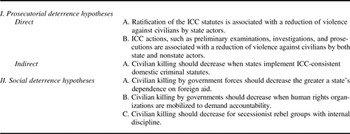
Our social deterrence theory predicts that some rebels may be more deterrable than others. Secessionist groups, for example, need to cultivate international legitimacy. Recent research suggests they therefore tend to abide by international humanitarian law and refrain from civilian abuse, relative to nonsecessionist groups.Footnote 86 This is despite the fact that separatist civil wars tend to be brutal and long-lasting, generating many battle-related deaths between combatants.Footnote 87 Furthermore, secessionist groups are more likely to be aware of international affairs and to conduct international diplomacy than are nonsecessionist counterparts.Footnote 88 Consistent with the civil war literature, we would expect any deterrent effect to be stronger to the extent that such groups are able to exert strong command and control over their troops.Footnote 89 Table 1 summarizes our hypotheses.
Expectations

Note: All of the II.A to II.C effects should be amplified where the ICC is in force.
Prosecutorial and social deterrence effects are not necessarily completely independent influences. Prosecutorial deterrence can shape social deterrence over time as investigations, arrests, and convictions reinforce broadly shared values, which sharpens the focal power of an institution such as the ICC. Heightened social sensitivity can in turn strengthen prosecutorial deterrence when civil society actors push for legal reforms and cooperate by reporting, testifying, and producing evidence in legal proceedings. The international community created the ICC, after all, because it wants crimes against civilian populations to stop. Prosecutorial and social deterrence are mutually reinforcing, but the latter can matter even if the former is statistically unlikely.
Empirical Investigation of the ICC's Impacts
Sample
Studying deterrence empirically is a difficult endeavor. The first challenge is to identify a relevant population at risk of committing a crime on a scale that might conceivably draw the ICC's attention.Footnote 90 We need a set of cases where atrocities seem possible so we have therefore selected countries that had at least one episode of civil war since 1945. Civil wars are not the only political context that can generate ICC crimes, but they are likely to increase their occurrence among warring parties.Footnote 91
Based on this sampling strategy, potential candidates for deterrence are found in 101 states and involve 264 rebel groups between 1989 and 2011.Footnote 92 For the case of government violations, the unit of observation is the country-year. The resulting data structure is a balanced panel for each country for twenty-three years.Footnote 93 For the case of rebels, we must account for their varying and often shorter life span (average longevity of 4.5 years)Footnote 94 so we analyze only the years when rebel groups were active in an unbalanced panel with each rebel group as a unit. The list of rebel groups is from the Non-State Actor (NSA) Dataset,Footnote 95 which defines a civil war with a threshold of twenty-five battle deaths. This means we are likely examining the ICC's deterrence potential vis-à-vis rebels who are at least moderately capable of inflicting violence.
The resulting sample includes all ICC “situations”Footnote 96 to date—Uganda, the Central African Republic, the DRC, Côte d'Ivoire, Sudan, Kenya, Libya, and Mali. The countries in the sample are diverse in terms of level of violence against civilians (zero to 500,000 killed), ratification records (fifty-two had ratified and forty-nine had not during our observation window), and geographic scope (forty-one African countries, twenty in the Americas, seventeen in Asia, eleven in the Middle East, and twelve in Europe). The period 1989–2011 includes thirteen years before the ICC was established in 2002 and ten years after, which allows us to assess the change before and after ICC entry into force.
Dependent Variable
The dependent variable is the number of civilians killed intentionally by government forces or rebel groups in a direct military confrontation. The data are culled based on media reports, sourced from the One-Sided Violence (OSV) data set.Footnote 97 The data exclude indirect events such as unintended collateral damage, social demonstrations, or deaths from environmental disasters. Intentionality is important for our purposes. Deliberate civilian killing, usually generated by superior command, is an egregious rights violation, a crime against humanity, and a war crime under ICC jurisdiction. It is clearly one of the major crimes that the ICC was designed to deter and to punish.Footnote 98 We acknowledge it is not the only ICC crime that potentially might be deterred,Footnote 99 but to our knowledge, it is the best available measure to assess the ICC's impact cross-nationally. Relative to other ICC crimes such as rape, intentional killing of civilians is more observable and comparable across cases.Footnote 100 Significant disagreements exist about what constitutes a legal case of genocide,Footnote 101 and it is difficult to tell the age of children when they are recruited to military ranks,Footnote 102 making these other ICC crimes less amenable to systematic testing. Nonetheless, if intentional civilian killing can be deterred, this should encourage further research into a range of heinous crimes—from sexual violence to trafficking in children to widespread pillaging—that the ICC was meant to address.Footnote 103
In our sample, the yearly average intentional civilian killing by a government is thirty-four, excluding the Rwanda 1994 figure of 50,000.Footnote 104 The figure for rebel groups is eighty-three. Government killing does occasionally occur in non-civil-war years; Kenya's 2007–2008 election violence is one such example. Because OSV data include any case that generates more than twenty-five civilian fatalities, its standard is different from the definition of civil war given by the Armed Conflict Dataset, which is more than twenty-five battle deaths.Footnote 105 Consequently, our data set includes 30 percent civil war years and about 70 percent non-civil-war years. About 27 percent of the civil war years and 3 percent of the non-civil-war years in the sample had government-perpetrated civilian killings, corroborating our claim that civil wars are breeding grounds for ICC crimes, while showing that they can occur (though rarely) during non-civil-war years as well. For the years where OSV data do not specify civilian killing counts, we assume zero counts for civilian killing.Footnote 106
Independent Variables
We test for direct prosecutorial deterrence with two indicators. One is whether or not the state has ratified the Rome Statutes (icc ratification), which we expect to be associated with the reduction in civilian killing by government actors. The second indicator is what we call icc actions. This is a three-year moving average of the collective counts of preliminary examinations, investigations, and arrest warrants announced by the Office of the Prosecutor (OTP), up to the previous year.Footnote 107 This variable signals to actors globally the determination of the OTP to prosecute, and we expect it to be associated with the reduction of intentional civilian killing by both governments and rebels over time.
Indirect prosecutorial deterrence via complementarity is captured by domestic crime statute, which ranges from 0 (no domestic crime statute dealing with international crimes in place) to 1 (existing domestic crime statute), 2 (minor reform), and 3 (substantial reform).Footnote 108 Since these cases of legal reform may face difficulties in implementation in societies with weak legal institutions,Footnote 109 we control for the rule of law indicator published by the World Bank.Footnote 110 We expect statutory reform to help deter intentional civilian killing by increasing the perceived likelihood of meaningful domestic prosecution.
We proxy a state official's international susceptibility to material manifestations of social pressure with total official development assistance. aid pressure is captured by the amount of economic aid, multiplied by the reporting counts from the New York Times (reflecting donor interest).Footnote 111 Domestically, social deterrence is likely to be less tangible and should intensify with mobilization by human rights organizations (HROs). The growth of HROs is expected to stimulate demands for justice, in turn raising legitimacy concerns and governing costs for state officials and military leaders who commit atrocities. The variable hro growth measures the incremental number of international and domestic HROs within a country.Footnote 112 We recognize that some HROs are critical of the ICC while others support its efforts, but on average this indicator proxies attention to human rights within a polity, capturing demands for attention to the plight of victims and challenging the legitimacy of the perpetrator. Both aid pressure and hro growth are interacted with icc ratification to capture the argument that social pressure is strongest when backed by clear expressions of community standards of behavior, which we assume is precisely what ratification of the ICC does.
We also control for the factors that influence ratification and atrocities to ensure that it is ICC ratification, not other factors, that reduce violence against civilians. Logic and experience suggest that democracies are much less likely to target civilians, so we control for political regime type using Polity IV data. We also employ a binary variable, ongoing civil war, from the PRIO Armed Conflict Dataset to mark years of active civil conflicts.Footnote 113 To reduce the possibility that temporal trends affect our results, we include both year dummies and an indicator for the presence of the ICC itself, post icc regime, which is 0 before 2002 and 1 on and after 2002.Footnote 114
Finally, we control for states' preferences for and experiences with other peace and justice institutions. A strong preference for peace and reconciliation is indicated by policy decisions designed to curtail violent conflict and achieve peaceful conciliation, including the acceptance of peacekeepersFootnote 115 and the decision to institute amnesty for human rights violations that may have been committed in the past. We first combine and then cumulate these experiences over time, calling this variable peace preference. Footnote 116 A preference for justice is proxied by policy combinations, including human rights trials and accountability via truth commissions; we call this variable justice preference.Footnote 117 Trials and other forms of accountability may influence the level of violence in a society;Footnote 118 here we deploy these accumulated experiences as indicators of revealed preferences for justice. It is important to attempt to model these preferences in anticipation of inevitable concerns about endogeneity that we discuss later.
Data on rebel groups' characteristics are drawn from the NSA Dataset.Footnote 119 We view secessionist rebels as the rebel groups most likely to seek legitimacy, and thus most susceptible to various forms of social deterrence.Footnote 120 We include rebels with autonomy aims as well as those involved in secessionist conflicts in this category because many rebel groups pursue both goals. rebel discipline captures strength of command and control with an ordinal measure (low, moderate, high). We also include an ordinal rebel strength scale to control for the military strength of rebel groups relative to government (much weaker, weaker, equal, stronger, much stronger). All other variables are the same as in the government analysis.
We first present the results from our analysis of intentional civilian killing by governments and then move to the analysis of rebel groups. We use random effects panel analysis as our key estimation approach.Footnote 121 Missing data were imputed to increase efficiency and reduce bias.Footnote 122
Results
Government Forces
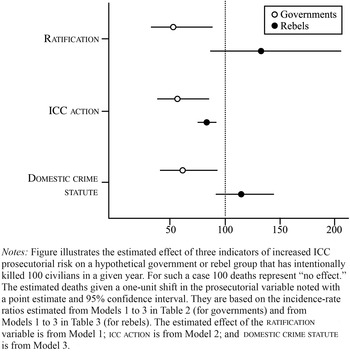
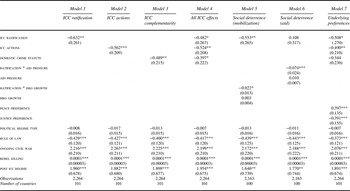
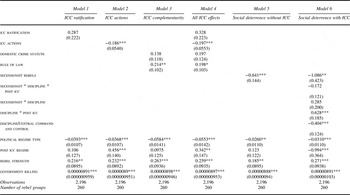
Table 2 presents the results for government forces. Consistent with our hypothesis about prosecutorial deterrence, the significant and negative incidence-rate ratioFootnote 123 suggests that ratification reduces the intentional civilian killing by a factor of .531, compared to nonratification.Footnote 124 For example, if, hypothetically, 100 civilians were killed by a nonratifying government, our estimates suggest about fifty-three civilians are likely to be killed, assuming ratification with all other control variables held constant (see Figure 1). All specifications control for core predictors for civilian killing such as the nature of the political regime, ongoing civil war, intentional rebel killing of civilians (to account for the possibility of reciprocity as well as for trends in violence over time), and an indicator for before and after the ICC came into force. Surprisingly, these models suggest that regime type is not likely to explain intentional civilian killing, though active civil wars certainly do. Governments are also much more likely to commit violence against civilians when rebels do so, which suggests that ICC deterrence may contribute to breaking cycles of violence committed on both sides of a conflict.
Estimated effect of prosecutorial risks on intentional civilian killing

ICC effect on civilian killing by governments

Notes: Standard errors are in parentheses. The dependent variable is the count of civilians killed intentionally by government forces. Results are based on a negative binomial panel analysis with random effects. Year fixed effects are included but not reported. Constants are suppressed. * p < .10; ** p < .05; *** p < .01.
Model 2 looks at the effect of icc actions, the three-year moving average of previous preliminary examinations, investigations, and warrants by the OTP. According to the incidence-rate ratio based on Model 2, one additional investigation each year over the three-year term is estimated to reduce intentional civilian killing by a factor of 0.570. (See Table 1 for an estimate of lives spared, which is substantial.) Note that the significant effect of icc actions is robust even after including post-icc regime, a variable that captures the court's existence, but not its actions. It is therefore quite unlikely that the effect of icc actions is merely an artifact of some general violence-reducing temporal trend or the result of a passive court. Rather, icc actions represent new information, available to all actors, demonstrating that the ICC is operational, authoritative, and that the prosecutor means to bring perpetrators to justice.
What of complementarity? Model 3 demonstrates that improvements in domestic crime statutes—which are themselves influenced by the presence of the ICCFootnote 125 —are also associated with reduced civilian killing. This effect is robust to the control of rule of law, suggesting that it is not merely the capacity to enforce but the substantive legal change that is critical. One categorical shift toward stronger ICC-consistent domestic legal reform is estimated to reduce civilian killing by a factor of 0.61, the substantive impact of which is illustrated in Figure 1. Importantly, ratification of the ICC itself has significantly contributed to these reforms. Knowing the ICC may step in where domestic institutions fail seems to have encouraged domestic legal change, which in turn helps to deter at least some intentional violence against civilians by government forces. Model 4 includes all ICC prosecutorial effects simultaneously. It demonstrates that ratification, ICC signals of strength via prosecutorial actions, and complementarity have all contributed to significant reductions in intentional civilian killing.
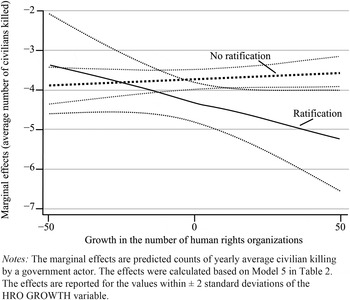
Our second main hypothesis is that state actors can be socially deterred. Extralegal social pressure at the domestic level is most likely to be of the nonmaterial sort; for example, challenges to the justness and legitimacy of actions taken by government agents. These challenges are hypothesized to be strongest where law focuses social expectations and draws bright lines that distinguish unacceptable behavior. The interaction term in Model 5 tests this idea. It shows that in addition to whatever effect ratification alone may have, human rights groups are able to capitalize on ICC norms to further hold governments accountable to civil society when their state has ratified the Rome Statute. The combination of ICC ratification and growth in human rights mobilization, captured by the interaction term, is associated with less intentional killing (that is, a negative coefficient), likely through social deterrence but also because human rights organizations contribute to prosecutorial risks. Our goal is not to disentangle these effects, but to illustrate that they are in fact mutually reinforcing. Interestingly, in the absence of ICC ratification, human rights organizations appear to have far less traction.
Figure 2 plots marginal effects of hro growth conditional on ratification, based on the estimates from Model 5 in Table 2. The graph shows the change in the predicted count of civilians killed as mobilization increases. Because the number of HROs increases about two per year on average and standard deviation is about 25, we report the graph within 2 standard deviations, from −50 to 50 organizations. The marginal effects remain negative between −2 and −7 throughout the entire range [−50, 50], indicating that hro growth generally decreases civilian killings. But this civil society effect is substantially magnified by the focal power and jurisdiction of the ICC: the slope given ratification is steeper and more negative than for nonratifying states. With ICC ratification, adding one more human rights organization is estimated to reduce intentional killing by between three and six civilians. Without ICC ratification, the effect of increases in HROs is almost flat. Theoretically, this is what we would expect if civil society organizations use highly focal legal values to hold governments more accountable for their actions.
Marginal effects of mobilization on civilian killing conditional on ICC ratification

Of course, it is possible that both icc ratification and hro growth are attributable to some third factor, such as political liberalization. To address what is essentially a form of potential omitted variable bias, we control for political regime type in Table 2 and further explore this broader reform thesis in the online appendix using Freedom House measures of changes in civil liberties. The evidence suggests that the connection between ratification and mobilization is likely not spurious: even controlling for broader governance changes (obviously not attributable to ICC ratification), the growth in the number of HROs is strongly connected to the reduction in civilian killing only when a state has ratified the ICC statutes.Footnote 126
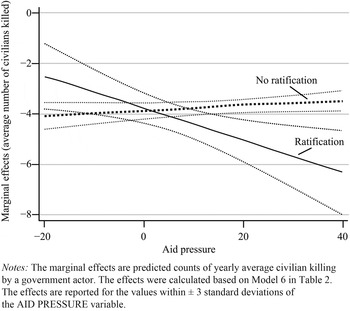
At the international level, social deterrence may be supported through economic dependency relationships. Our results show that while aid itself is not systematically associated with a reduction of violence, governments that ratified the ICC Statute were subsequently much more likely to reduce or to refrain from intentional civilian violence the more aid they received (Model 6). As Figure 3 illustrates, increasing aid reduces violence more with ICC ratification than without. Social pressures—in this case, the possibility of losing aid—appear to provide important support for international norms. In contrast, without ratification, increasing aid has little marginal effect. Similarly, ICC ratification has much weaker effects when states receive no foreign aid at all. Social deterrence operates precisely under these interactive conditions: when extralegal pressures interact with accepted focal norms.
Marginal effects of aid pressure on civilian killing conditional on ICC ratification

Model 7 contains all the ICC-related variables as well as two key proxies for underlying preferences for peace and for justice. By including these proxies, we examine how changing underlying proclivities toward peace and justice alone cannot explain the deterrent effects we are trying to isolate. Model 7 shows that these two preference proxies do significantly influence the likelihood that governments will target civilians. In particular, experience with justice and accountability institutions (trials and truth commissions) are correlated with reduced killing, while the opposite seems to be true of efforts to reconcile and establish peace. But even when we control for such preferences and experiences, our central finding is the same: the ICC continues to exert independent deterrence effects of approximately the same magnitude. There is a slight decrease in the estimated effect of domestic crime statue reforms, but the sign is strongly negative and nearly statistically significant.
The evidence of the ICC's ability to deter is based on rigorous controls for many underlying conditions that could plausibly contribute both to ratification and reduced civilian killing, such as changing regime type, quality of the rule of law, government-rebel reciprocity regarding civilians, even changing experiences and preferences with respect to peace and justice. But there may still be concerns that ICC ratification is not causally related to civilian violence. One possibility is that some ratifying countries were already in the process of halting civilian killing by the late 1990s, and therefore might have selected themselves into ratification.Footnote 127 To account for this potential source of endogeneity, we conduct matching analysis to control for important characteristics that may lead some states to ratify in the first place. Using a coarsened exact matching algorithm,Footnote 128 we find results similar to our panel analysis.Footnote 129 We recognize that matching does not completely solve the problem of selection on unobservables. But matching does show that the net effect of ratification and ICC-related interventions are strongly discernable after controlling for selection into ratification, getting a balanced sample via matching between treatment (ratification-years) and control (nonratification-years), and estimating the differences between these cases.
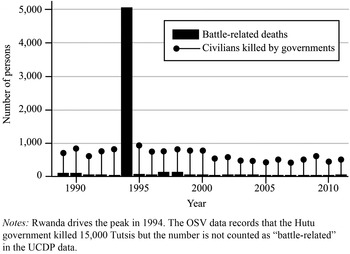
A second potential threat to inference is the temporal trend of violence. Critics might suspect that our results are primarily attributable to the less brutal nature of more recent conflicts,Footnote 130 rather than the ICC itself. However, we find no particular trend in overall violence between 1989 and 2011 (Figure 4).Footnote 131 Average battle-related deaths worldwide have consistently hovered around 500 per year during the past two decades, albeit with a slightly decreasing trend. Moreover, the results are robust to the inclusion of period and year dummies. The results in support of ICC deterrence are not likely simply a reflection of a decreasingly violent climate.Footnote 132 Collectively, the evidence is highly suggestive that the ICC has influenced government tactics when it comes to civilian violence. We now analyze whether the ICC has influenced the behavior of nonstate actors.
Battle-related deaths and government civilian killing

Rebel Groups
Rebel groups are likely to be the most difficult case for ICC deterrence. Rebels rarely participate in norm consolidation during international negotiations. They are not directly responsible to any constituency, have varying motives from secession to self-enrichment, and often are located in regions that make their crimes difficult to investigate. If indicted, they are notoriously hard to apprehend. In the early days of the ICC many rebel groups might not have been informed of its jurisdiction or even its existence, although that is changing.
Table 3 reports the results of civilian killing by rebel groups in a way analogous to that of governments in Table 2. It is clear that formal legal change apparently makes no impression on rebel groups generally. Neither icc ratification (Model 1) nor domestic crime statute (Model 3) appears to reduce rebel civilian killing. However, even rebel groups appear to respond to icc actions (Model 2). Rebels do not respond to legal change alone; they are much more impressed with action. The effects are borne out consistently in Model 4, which includes all ICC prosecutorial risks. Rebels tend to behave as though they update their estimates of their chances of prosecution when the ICC demonstrates its resolve through investigations, warrants, and prosecutions. The incidence-rate ratio for icc action is .830 [.747, .923].Footnote 133 Figure 1 illustrates the estimated impact for a hypothetical rebel group responsible for some 100 civilian deaths. We estimate that in such a case about seventeen individuals might be spared through the deterrent effects flowing from investigative and prosecutorial actions by the ICC. This suggests that rebels are likely to alter their tactics in light of new evidence that the prosecutor's office intends to hold actors accountable for their atrocities.
ICC effect on civilian killing by rebel groups

Notes: Standard errors are in parentheses. The dependent variable is the count of civilians killed by rebel groups. Results are based on a negative binomial panel analysis with random effects. Constants are suppressed. * p < .10; ** p < .05; *** p < .01.
Models 5 and 6 attempt to capture social deterrence among rebel groups. Rebel groups with secessionist aims are in general likely to kill fewer civilians than those without such aims (Model 5). We use a triple interaction among secessionist rebels, rebel discipline, and post icc regime in Model 6 to test the idea that secessionist rebels with internal discipline further reduce their violence after the ICC regime is in place. The triple interaction term is negative and weakly significant, indicating some evidence of social deterrence for a particular class of rebel groups. The substantive effects suggest some possibility of social deterrence among rebel groups. For example, our estimate suggests that a hypothetical well-organized secessionist movement that would have used tactics intentionally leading to the deaths of 100 civilians in the years prior to the ICC's entry into force might have killed “only” eighty-two civilians after entry into force, holding all other variables at their mean.Footnote 134 The differences are statistically distinguishable and do suggest some behavioral moderation after the ICC entered into force. Most importantly, these results provide useful guidance on where to look for normative progress among potentially violent nonstate actors: those with both the incentive and the ability to control their troops.
Conclusion
Few issues in international relations are more urgent than improving the life chances for civilians who become pawns in civil war violence. Since the end of the Cold War, the international community has been groping toward a way to end impunity with respect to the worst human rights violations, especially in intrastate conflicts. The Yugoslavian and Rwandan Tribunals were important milestones in this regard, but the most ambitious effort to date has been the ICC. Few institutions have inspired such high hopes while stimulating so much controversy. Even though the court has been operating for only twelve years, it is time to supplement anecdotal speculation with careful study of its effects. As realists Goldsmith and Krasner remind us, “ideals can be pursued effectively only if decision-makers are alert to … the consequences of their policies.”Footnote 135
This study is an attempt to at least address the “chasm between theory and practice” Footnote 136 noted by ICC skeptics. First, we have been careful to specify exactly what it is we might expect the ICC to do: to deter a significant crime category within its jurisdiction. This is not the only consequence one might want to explore relating to the ICC, but it is one of its primary goals. Civilian suffering as the result of intentional, strategic behavior by combatants has been one of the more tragic outcomes of the explosion of civil wars in the past two decades.
Second, we have theorized two broad and mutually reinforcing channels of potential deterrence—prosecutorial and social deterrence—and specified the conditions under which we might expect them to hold. We have argued that the ICC contributes directly to prosecutorial deterrence by investigating and prosecuting international crimes on its own authority. It also encourages member states to improve their capacity to reduce, detect, and prosecute such crimes domestically. Indeed, ratifying states are much more likely than nonratifiers to do so. As well, there is strong evidence of a reduction in intentional civilian killing by government actors when states implement ICC-consistent statutes in domestic criminal law, which we can reasonably attribute, at least indirectly, to the ICC's influence. Such domestic statutes magnify the ICC's prosecutorial deterrent effect by bolstering it with the added possibility of punishment at home. Finally, it is critical to understand that legal rules interact with social pressures, both tangible and intangible. The ICC also deters because it mobilizes the international community as well as domestic civil society to demand justice. In this sense, our view of the ICC is fully consistent with broader trends in human rights prosecutions at the local, regional, and global level.Footnote 137
We want to stress that our claims are modulated. People who intentionally terrorize civilians for their personal or political purposes are difficult to deter under any circumstances. But through the channels we discussed, the ICC has raised the risks of consequences for violations. We illustrate the plausibility of these channels but also demonstrate their limits. Governments that depend on aid relationships are easier to deter than the more self-reliant, largely because their economic dependence makes them more vulnerable to external actors who use their resources to enforce broader community values. Rebels are harder to deter than governments. Nonetheless, even rebels appear to have significantly reduced intentional civilian killing when the ICC has signaled its determination to prosecute. Debates over the effects of the ICC have been sterile largely because they have failed to specify the conditions under which one might expect the court to work.
We are not pushing the position that one prosecutor, acting alone and without significant backing by the international community or local support, could have brought about these consequences merely by issuing a decision to investigate or signing a warrant. ICC interventions are powerful because they are part of a package of efforts to rally support for ending impunity. Moreover, part of the package has taken time to unfold—a redoubling of domestic efforts to develop the legal capacity to prosecute crimes against humanity and other egregious rights abuses, which is precisely how the ICC's complementarity is intended to operate. The evidence suggests these efforts contributed to an indirect prosecutorial effect of the ICC itself, though only for government officials. But the evidence also suggests that the ICC's demonstrated determination to investigate and issue warrants has contributed to the reduction of violence by convincing even some types of rebel leaders that impunity is a waning option.
We are under no illusions that the International Criminal Court has positive impacts in all cases. These are average results, based on imperfectly measured exposures to prosecutorial and social risks and costs. Our theory as well as empirical analysis of prosecutorial deterrence is probabilistic, not deterministic. It is easy to point to conflicts that the ICC has not solved. The Bemba trial in relation to the situation in the Central African Republic did not stop violence by the Seleka faction, which reminds us that the ICC cannot solve deep-rooted social problems in a short period of time.Footnote 138 However, the OTP prioritizes cases where violations are “grave”Footnote 139 and these are precisely cases where violence is prone to recur. ICC situations are some of the most protracted cases of conflict in the world—a fact that makes the modest positive consequences we document all the more remarkable.
The ICC had its ten-year anniversary in 2012. It has yet to gain consistent support from major powers such as the United States, China, Russia, and India that would boost its resources and legitimacy. Although the ICC enjoys the support of 123 countries, observers note that the court faces many practical challenges in its day-to-day operations, such as gathering evidence and conducting quality fact-finding.Footnote 140 In many respects we agree. But its willingness to prosecute has contributed to perceptions that impunity for egregious crimes against humanity is a diminishing option. The evidence suggests that this role has potential to save at least a few lives in some of the most violent settings in recent decades.
Supplementary Material
Supplementary material for this article is available at http://dx.doi.org/10.1017/S0020818316000114.