As Mary Jane Curry has said in Supporting graduate student writers:
[There is] growing pressure worldwide for students to publish early and often [and that] pressures are growing as the diminishing number of tenure track faculty positions exacerbates competition for jobs (Curry Reference Curry, Simpson, Caplan, Cox and Phillips2016: 89)
Publishing is also, of course, important for students studying in countries where it is a requirement for the award of their degree (Barbero Reference Barbero2008; Li Reference Li2016). In addition, academic publications are, in some situations, a requirement for receiving a scholarship for doctoral studies as well as for the winning of research grants (Iida Reference Iida, Macmaster and Murphy2016). Indeed, research students are often told that ‘their academic future is dependent on peer-reviewed publications’ (Badenhorst & Xu Reference Badenhorst and Xu2016: 1). This is as true for them when they are just starting out in a new academic position as when they are seeking tenure or promotion in that position (Lee Reference Lee2014; Lou & Hyland Reference Hyland2017). All of this has implications for the field of writing for research publication purposes (Flowerdew Reference Flowerdew, Paltridge and Starfield2013; Paltridge Reference Paltridge2018), and, in particular, the increased need to support students in getting their work published in academic journals. There are, of course, publications such as Curry & Lillis's work on getting published in academic journals (Lillis & Curry Reference Lillis and Curry2010; Curry & Lillis Reference Curry and Lillis2013) and the Swales & Feak publications (Swales & Feak Reference Swales and Feak2000, Reference Swales and Feak2009, Reference Swales and Feak2011, Reference Swales and Feak2012; Feak & Swales Reference Feak and Swales2009, Reference Feak and Swales2011) that surround this endeavour. More broadly, however, I think we need to talk with students, as much as we can, not just about what good research writing looks like, but also what's involved in getting it published so we can demystify what, for many of them, is a very mysterious process.
In this paper, I discuss work I have done with Sue Starfield which aims to do this (Paltridge & Starfield Reference Paltridge and Starfield2016; Starfield & Paltridge forthcoming) and some of the matters we think are important for student writers to understand in order to get their work published in academic journals. I will also talk about a project I recently completed (Paltridge Reference Paltridge2017) in which I looked at the reports that reviewers write on submissions to academic journals and some of the features of these reports that are difficult for beginning academic writers to interpret and, as a result, respond to.
Much of what I discuss here comes from the work I have done in the teaching of academic writing to second language writers although most of what I say applies just as much to first language writers as well who, in my experience, are just as unfamiliar with the process of peer review and the genres and expectations of writing for publication as second language writers (see Huang Reference Huang2010; Hyland Reference Hyland2016a, Reference Hyland2016b; Politzer-Ahles et al. Reference Politzer-Ahles, Holliday, Girolama, Spychalska and Berkson2016, Subtirelu Reference Subtirelu2016; Paltridge forthcoming for discussions of this). In addition, while this paper is about getting published in academic journals, there are, of course, other kinds of writing, such as articles aimed at classroom teachers or policy makers that students might undertake, where the expectations for the writing might be different from those of research articles. If these pieces of writing are, however, subject to peer review, many of the things I discuss will also apply.
The book I wrote with Sue Starfield, Getting published in academic journals (Paltridge & Starfield Reference Paltridge and Starfield2016), while covering much of the same ground as would be expected in a book on this topic, is based on our experiences of getting published in academic journals, teaching courses on writing for publication, as well as having been editors and reviewers for peer-reviewed journals. It is, thus, an insider's view of what is involved in ‘navigating the publication process,’ the subtitle of our book. What we would like to say, among all this, is that while what we have said in our book – and what I say in this paper – may be obvious to experienced authors and, of course, to editors and reviewers, we need to keep in mind that much of this is not at all obvious to beginning authors and that there are many things they need to understand and be able to do in order to get their work published that may not, at first, be clear to them. This is especially the case when beginning authors get reviews that are critical of their work and do not know how to respond to them. Indeed, as Becky Kwan (Reference Kwan2010) says:
Many first-time writers are confused, discouraged or even shocked by the negative reviews they receive and the substantial revisions requested . . . Some never attempt to revise and resubmit their work that reviewers see as having potential for publication (Kwan Reference Kwan2010: 213).
Our view would be that anything other than a rejection is good news, or as Rowena Murray (Reference Murray2013) points out, a cause for celebration. If students are being asked to revise, they should revise.
Why, however, are reviewers’ reports sometimes confusing and hard to interpret? Often, for reasons of politeness, reviewers are reluctant to tell authors directly what they want them to do with their manuscripts. This can make it particularly hard for new researchers to understand what the reviewers want them to do with their submissions. Below are some examples of reviewer comments that an inexperienced author might not know how to interpret (from reviewers’ comments on an article I wrote with colleagues on doctoral writing in the visual and performing arts):
If you looked at professional doctorates in areas such as education, business/management, engineering you would probably find analogous tensions to those you describe.
I'd be a bit more cautious in talking about the history of doctorates in the performing arts, unless you have thoroughly checked the sources.
Did the students experience identity struggles? What is learnt from their experiences?
Often, beginning authors might interpret comments such as these as suggestions or requests for clarification, rather than instructions to make changes to their submission. Further, Christine Feak (Reference Feak2009) points out that authors often have difficulty in interpreting reviewer comments that take the form of questions. Thus, if a reviewer says ‘Did the students experience identity struggles?’ the reviewer most likely wants the author to clarify something and is not just asking a question.
I recently carried out a study (Paltridge Reference Paltridge2017) in which I examined matters such as these in reviewers’ reports on articles that had been submitted to the journal English for Specific Purposes. I examined 57 reviewers’ reports. Forty-five reviewers also completed a questionnaire which asked about their experience in doing peer reviews, how they had learnt to do write reviewers’ reports, and the issues they faced in writing them (see Paltridge Reference Paltridge2013). In addition, I sent follow-up emails to reviewers in order to seek further elaboration on answers they had provided in the questionnaire.
One of the matters I examined was how the reviewers had asked for changes to be made to the submissions that they reviewed. I found that requests for changes were largely made as directions, suggestions, clarification requests and recommendations. While a good number of these changes were requested directly, a large number of them were not. That is, the reviewers used both direct and indirect speech acts (Austin Reference Austin1962; Searle Reference Searle1969; Sbisà Reference Sbisà, Verschueren and Östman2009) to do this. Examples of this are:
Directions
Reanalyze your data [direct speech act]
Research question 1 has not been dealt with in the paper [indirect speech act]
Suggestions
Below are some references to intercultural communication I suggest you familiarize yourself with [direct speech act]
It would be worth citing a more recent volume [indirect speech act]
Clarification requests
Clarify what is meant by ‘business discourse’ [direct speech act]
Are you saying that bilinguals are naturally more creative than monolinguals? [indirect speech act]
Recommendations
I recommend a thorough rewrite of the paper before submission [direct speech act]
And, of course, not all direct speech acts are as straightforward as they might seem. For example, a speech act which contains the verb ‘suggest’ as in ‘Below are some references I suggest you familiarize yourself with’, or ‘recommend’ as in ‘I recommend a thorough rewrite of the paper before submission’ are not really direct speech acts but rather directions to the author to make a change to their submission. Indeed, as Thomson (Reference Thomson2017) points out:
Making suggestions about what to change in a paper is common. These are not suggestions [bold in the original]. The reviewer is basically saying ‘Do this. And if I get this paper back for re-review and you haven't done it you'd better have a pretty good explanation for why not’.
Often, then, indirect speech acts are used by reviewers where a direct criticism or disagreement may be seen as impolite and threatening to the other person's (that is, the author's) face (Brown & Levinson Reference Brown and Levinson1987; Haugh Reference Haugh2012; Huang Reference Huang2014). This use of indirect speech acts, however, makes it difficult, especially for beginning authors, to decode the reports and work out what they are being asked to do. The decoding of these acts requires both writers (the reviewers) and readers (the authors) of the reviews to have a shared understanding of how the suggestions, clarification requests, and recommendations are intended to be read and acted upon. For writers who are new to the world of peer review or from a different language and cultural background from the reviewer (Feak Reference Feak2017), this may not be at all clear and the reviewer's intention (that is, that the author make changes to their submission) might not be recognized.
Further, different language backgrounds of reviewers may make this situation even more complex. For example, of the 57 reviewers who took part in my study, 43 were native speakers of English, whereas 14 were non-native speakers of English. While there were not as many non-native speaker reviewers as there were native speaker reviewers, there were differences in the reviews written by these two groups of writers. In particular, the non-native speaker reviewers typically used fewer indirect speech acts than the native speaker reviewers when they requested changes be made to submissions. One possible reason for this is suggested by second language acquisition research which has argued that with high proficiency second language users (which the non-native speaker reviewers in the study would be), their linguistic competence is often more developed than their pragmatic competence (Beebe & Waring Reference Beebe, Waring, Frodesen and Holten2005; Taguchi & Roever Reference Taguchi and Roever2017). As a result, the non-native speaker reviewers were sometimes not as indirect as the native speaker reviewers when they asked for changes to be made to submissions.
Belcher (Reference Belcher2007), in her study of reviewers’ reports (also for the journal English for Specific Purposes), makes a similar observation about reviews written by non-native speaker writers. She found that some of the non-native speakers’ reviews that she examined were quite blunt when they were criticizing an author's work. This could, of course, be a matter of personal style. For example, one native speaker reviewer in my study used direct speech acts to ask for changes in all of the reviews he wrote whereas another native speaker reviewer used indirect speech acts consistently to do this in his reviews. None of the non-native speaker reviewers, however, wrote reviews that contained only indirect speech acts in the reports that they wrote.
Other examples of politeness strategies that occurred in the reviews were the use of:
Good news/bad news frames (Belcher Reference Belcher2007)
I applaud the authors’ effort to address reviewers’ comments but I'm afraid this manuscript is still not appropriate for publication.
Praise/criticism pairs (Hyland Reference Hyland2000)
While the author of this paper has to be lauded for taking on the large and impossible topic of culture, the manner in which the issues relating to it get dealt with are problematic.
Hedging (Hyland Reference Hyland2000)
Perhaps the author could state more explicitly that it is the addressing of this first question that forms the focus of the paper.
Taking personal responsibility for a comment (Hyland Reference Hyland2000)
In the view of this reviewer, more revisions should be made.
Reviewers also used politeness strategies (Brown & Levinson Reference Brown and Levinson1987) where they:
Intensify interest in the submission
This is an excellent piece of work in all respects. . .
Express approval
I enjoyed this paper for a number of reasons. . .
but followed this with ‘However . . .’
In addition, reviewers avoided disagreement as in:
I am not sure if I have understood what the author wants to say
or asserted common ground with the author:
As I am sure the author will agree. . .
Across all the reviews, the most common of these politeness strategies was expressing approval for what the authors had done, although this was much less common, unsurprisingly, in the reject reviews. A further politeness strategy was the use of indirectness. Just under half of the reject reviews in the corpus, however, opened with criticisms which were not softened in any way by a politeness strategy, such as expressing approval, or the use of indirectness. This is an important point for beginning authors who may not be used to such negative commentary on their work. A common editor's letter to an author on a rejected submission might contain a sentence such as:
I append the reviewers’ comments and hope they will be useful to you should you decide to revise your article and submit it elsewhere.
Authors who are new to the publication process might find it hard to see how reviewers’ reports are useful when they contain only negative comments and very little, if any, encouragement to continue with their work. Ros Mitchell, a former editor of the journal Applied Linguistics, once said:
It is important to bear in mind that a rejection from one journal doesn't mean your paper is unpublishable. . . . Rejection is common, it is normal, it is frequent and by no means means that the paper won't find a home somewhere else (BAAL 1993: 10–11).
This is a point beginning authors need to keep in mind when dealing with these kinds of reviews.
The reviews were also examined to see whether there were any gendered differences (Belcher Reference Belcher, Silva and Matsuda2001; Sunderland Reference Sunderland2004) in terms of politeness strategies employed in the reports. Thirty-six of the reviewers were male and sixty-one were female. There were no gendered differences in the reviews that recommended an article be accepted in terms of the use of politeness strategies. This was equally the case with the reviews that made minor and major revisions recommendations. The minor and major revisions reviews, further, all contained praise/criticism pairs, regardless of the gender of the reviewer. There was also no gendered difference in the reject reviews in the use of praise/criticism pairs, although not all of the reject reviews contained these. Of the thirteen reject reviews that did not express approval and went straight to criticism, six were written by males and seven by females, suggesting there was not a gendered difference here either. All of this, then, considered from the point of view of politeness as social practice (Haugh Reference Haugh2013), would suggest that reviewers, regardless of gender, have an understanding of what is polite in the context of a reviewer's report and use, in this dataset at least, very similar strategies for showing this. This also suggests that, with the exception of reject reviews, disagreement in the context of reviewers’ reports is generally seen as a face threatening act which needs to be mitigated in some way by the use of a politeness strategy such as expressing approval or indirectness. This disagreement, however, which is typical of reviewers’ reports, is intended to be read, not as criticisms, but, rather, as requests for improvement that will enable articles to meet the standards set by the journals for publication (Fortanet Reference Fortanet2008).
I also examined the stance (Hyland Reference Hyland2005a, Reference Hyland2005b) that reviewers took in their reports. For example, I found instances of:
Attitude markers
The manuscript is well documented, well structured and relevant to genre-based ESP/EAP teaching settings.
Self-mentions
I am satisfied that the authors have addressed my concerns with their earlier draft.
Hedging
Perhaps rephrase the first sentence.
Boosters
I was very interested throughout.
The most frequent stance markers in the reviews were attitude markers in the accept- and minor-revisions reviews and self-mentions in the major revisions and reject reviews, with fewer boosters in all of the reviews. There were, further, compared to published research articles (McGrath & Kuteeva Reference McGrath and Kuteeva2012; Hyland & Jiang Reference Hyland and Jiang2016), many fewer instances of hedging than attitude markers and self-mentions in the reviews. This, thus, showed a high level of certainty in the views expressed by the reviewers. In terms of what was commented on in the evaluations, the most common features of the papers referred to were the review of the literature, the analysis of the data, the results, the topic of the article, the methodology employed, the quality of the writing, and the author's argument and discussion, showing these to be the most important (and most valued) aspects of the papers to the reviewers.
In addition, following the work of Starfield et al. (Reference Starfield, Paltridge, McMurtrie, Holbrook, Bourke, Lovat, Kiley and Fairbairn2017), who examined the roles that examiners take in their assessment of doctoral theses, I examined, through a transitivity analysis (Halliday Reference Halliday1994; Hart Reference Hart2014) of the texts, the roles the reviewers adopted as they wrote their reports. The most common roles were evaluator, commentator, reviewer, and editor roles. For example:
The author has done very nice work revising this manuscript [evaluator role]
I do not think that the design of the study is sufficiently rigorous for useful generalizations to be made [commentator role]
I recommend this paper be accepted for publication [reviewer role]
There are a few minor language points to clear up in this [editor role]
These roles were not as clear-cut as this might suggest, however, with more than one role sometimes being co-present with another in a reviewer's statement, as in:
I applaud the authors’ effort to address reviewers’ comments [reviewer role] but I'm afraid this manuscript is still not appropriate for publication [evaluator role]
This can also be difficult for beginning authors as the reviewer is being encouraging in their reviewer role but much less so as they take on an evaluator role. In addition, when the reviewer takes a commentator role, it is not always immediately clear to an author how they should respond to the reviewer's comment.
How, then, can we help student writers better understand reviewers’ reports so they can participate more effectively in the process of peer review? In the course we teach on writing for publication at the University of Sydney I bring copies of reviews of submissions I have made to academic journals to the class. These nearly always surprise students as they mostly have not seen these kinds of texts before and are surprised by the amount of negative comment in them, even though (most of the submissions) were finally published. One of the reviewers who took part in my study made a similar comment in a follow-up interview where she talked about having examined reviewers’ reports in one of the classes she took during her doctoral studies. In her words:
I remember finding it interesting (and reassuring) that comments on the paper [that we examined in class] were somewhat critical, though the final version of the paper won the best article award for that year in [the journal] . . . It was rather eye-opening to realise that even experienced authors don't always get acceptances on the first submission!
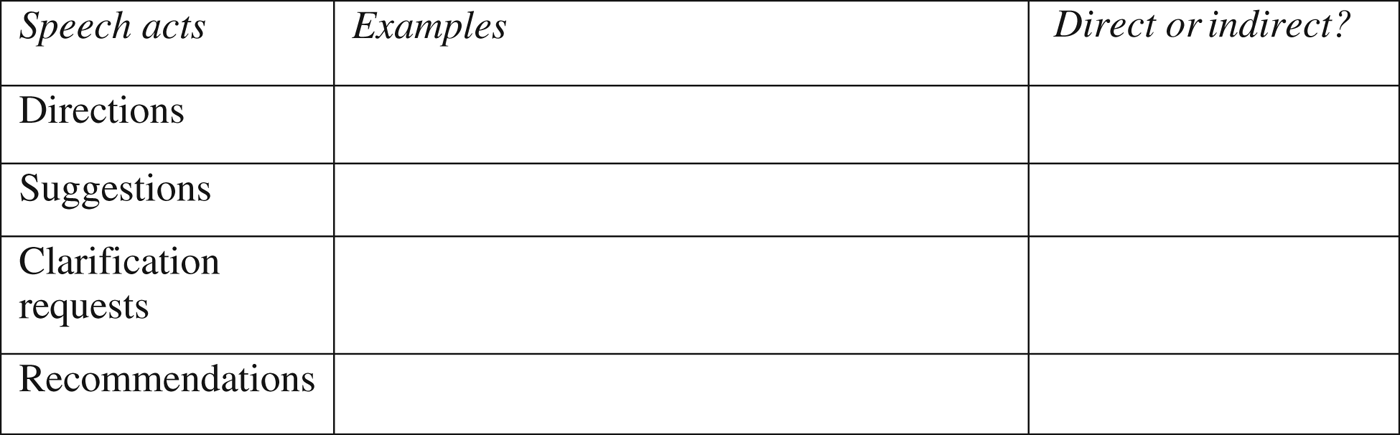
In our course, we ask students to analyse the reviews we have brought to class by focussing on the pragmatics of reviewer's reports, that is, what is meant by what is said in the reports as opposed to what is literally said, politeness strategies employed in the reviews, and evaluative commentary in the reviews. The first task that students undertake (see Figure 1) focusses on how changes were asked to be made to the submissions in the reviews, i.e. whether they were asked for directly or indirectly. In other words, the task helps students to analyse what the reviewers meant by what they said in their reports.
Asking for changes to submissions

Task 1
Look at the reviewers’ reports and identify how changes are asked to be made to the submission. That is, whether they are asked directly or indirectly, as directives, suggestions, clarification requests or recommendations. Complete the chart (see Figure 1) as you do this.
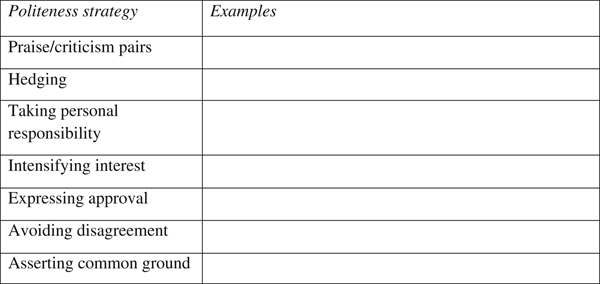
Students then look at the reviews to identify other politeness strategies that have been used in the reports (Figure 2), and examples of positive and negative evaluations in the reviews (Figure 3).
Politeness and reviewers’ reports

Evaluation in reviewers’ reports

Task 2
Examine the reports for the use of politeness strategies, completing the chart (see Figure 2) as you do this.
Task 3
Look at the reviews and identify examples of positive and negative evaluations. Complete the chart (see Figure 3) as you do this.
Do the negative evaluations in the reviews outweigh the positive evaluations? To what extent do you feel the author needs to address the negative evaluations in order to get their article published?
As students do these tasks, they find that many of the requests for changes were made indirectly by the use of indirect speech acts as well as other politeness strategies. In addition, while there may have been some positive evaluation in the reviews they were looking at, this was nearly always outweighed by negative evaluation. Students then consider what, in their view, needs to be addressed for the paper to be accepted for publication. And, of course, the answer is very nearly always everything (or there needs to be an explanation as to why it isn't).
Once they have completed these tasks, students analyse reviews they have received on their own work in order to work out what they are being asked to do with their submission in order for it to be published. When students write their responses to the reviewers (see Swales & Feak Reference Swales and Feak2011; Wisker Reference Wisker2015; Paltridge & Starfield Reference Paltridge and Starfield2016) we tell them to address the reviewers’ comments systematically and politely, taking each comment one at a time. We also tell them to explain how they have made the required changes or explain why they haven't made particular changes (with a justification for not having made them, rather than saying ‘I disagree’).
A further point we make is that student writers should not be put off by what seems to be the very high standing of the journal in which they want to publish or what is involved in getting published in it. The good news is that while a journal may have a low overall acceptance rate, if an author is asked to make revisions to their article, there is a much stronger likelihood that it will be accepted for publication. For example, in 2014, the acceptance rate for research articles in TESOL Quarterly was 6.7%. However, authors of 64% of the papers that were sent out for review were asked to make revisions to their article, and 75% of the authors who were asked to make revisions finally had their article accepted for publication (Paltridge & Starfield Reference Paltridge and Starfield2016). What this says is if an author is asked to revise their article, they should do this as there is now a much better chance that it will be accepted for publication – provided the feedback provided by the editor and the reviewers has been taken on board and addressed in the re-submission.
Further, as Atsushi Iida (Reference Iida, Macmaster and Murphy2016), argues, beginning authors should not be discouraged if their paper is rejected by a journal. In his words:
Even if you receive a rejection letter from the editor, you can still learn a lot from the publication process and can polish your manuscripts in response to reviewers’ comments (Iida Reference Iida, Macmaster and Murphy2016: 47).
Students should be encouraged, then, to ‘read between the lines’ in the reports they receive on their submissions in order to work out what the changes are they are being asked to make to their submissions, then (as long as it is possible) do them. They should let the editor and the reviewers know what they have changed by providing a clear (and polite) response to the reviewers. Beyond this, however, they should, importantly, treat the process of dealing with reviewers’ reports as a learning experience rather than be discouraged by the comments and criticisms they receive on their work.
Brian Paltridge is Professor of TESOL (teaching English to speakers of other languages) at the University of Sydney. His most recent publications are Getting published in academic journals (with Sue Starfield, University of Michigan Press, 2016) and The discourse of peer review (Palgrave Macmillan, 2017). He has recently completed a book titled Writing for research purposes to be published by Shanghai Foreign Language Education Press. He is a former co-editor of TESOL Quarterly and an editor emeritus of English for Specific Purposes. His research interests include thesis and dissertation writing and writing for publication.