Marine shell was embedded into religious systems, exchange economies, and expressions of sociopolitical status across North America during prehistory. Traded as early as 4000 BC to locations far removed from the coasts, marine shell artifacts are found far into the interior of the continent (Brain and Phillips Reference Brain and Phillips1996; Brown and Kelly Reference Brown, Kelly and Ahler2000; Jackson Reference Jackson2010; Lippincott Reference Lippincott1997; Marquardt and Kozuch Reference Marquardt and Kozuch2016; Trubitt Reference Trubitt2005). Existing treatments of marine shell products, production, and trade at midwestern sites have largely focused on Middle Mississippian-era (AD 900–1400) centers and associated peripheral sites where these items are abundant. At these sites, marine shell working supports arguments for Mississippian craft specialization, wealth accumulation, gift economies, and burial rituals (Brown and Kelly Reference Brown, Kelly and Ahler2000; Brown et al. Reference Brown, Kerber, Winters and Smith1990; Marquardt and Kozuch Reference Marquardt and Kozuch2016; Trubitt Reference Trubitt2005; Yerkes Reference Yerkes and Stoltman1991, Reference Yerkes and Beyries1993).
During late prehistory (AD 1400–1670) in the Midwest, marine shell artifacts, though significantly less common than at earlier Mississippian sites, are most commonly found with burials (Marquardt and Kozuch Reference Marquardt and Kozuch2016). Marine shell goods include beads, buttons/pendants, ear plugs, maskettes/gorgets, and fragments (Bluhm and Fenner Reference Bluhm, Fenner and Bluhm1961; Bluhm and Liss Reference Bluhm, Liss and Bluhm1961; Hall Reference Hall1962; Herold et al. Reference Herold, O'Brien, Wenner, Brown and O'Brien1990). These goods are typically relegated to exotic classifications that receive only cursory treatment and are often assumed to be traded into communities as finished items (e.g., Jackson Reference Jackson2010). Consequently, there has been no investigation of marine shell working at later, smaller midwestern sites.
This article describes and contextualizes recently uncovered evidence of marine shell working at Middle Grant Creek (MGC), an early seventeenth-century village in northern Illinois. This finding suggests that the small-scale production of marine shell goods occurred outside earlier large ceremonial centers in the American Midwest. It is also the only known evidence of marine shell working in Oneota contexts, making it the farthest known location of marine shell working sourced from the Gulf of Mexico coast and the only known site of marine shell working during protohistory in the Midwest. This evidence challenges assumptions that only completed marine shell goods were brought into these communities, and it illustrates that the skill and knowledge required to work marine shell may have been more widespread than previously thought. Overall, this report on Oneota marine shell working should encourage a reexamining of marine shell artifacts when archaeologists have assumed they were imported as finished goods.
Middle Grant Creek
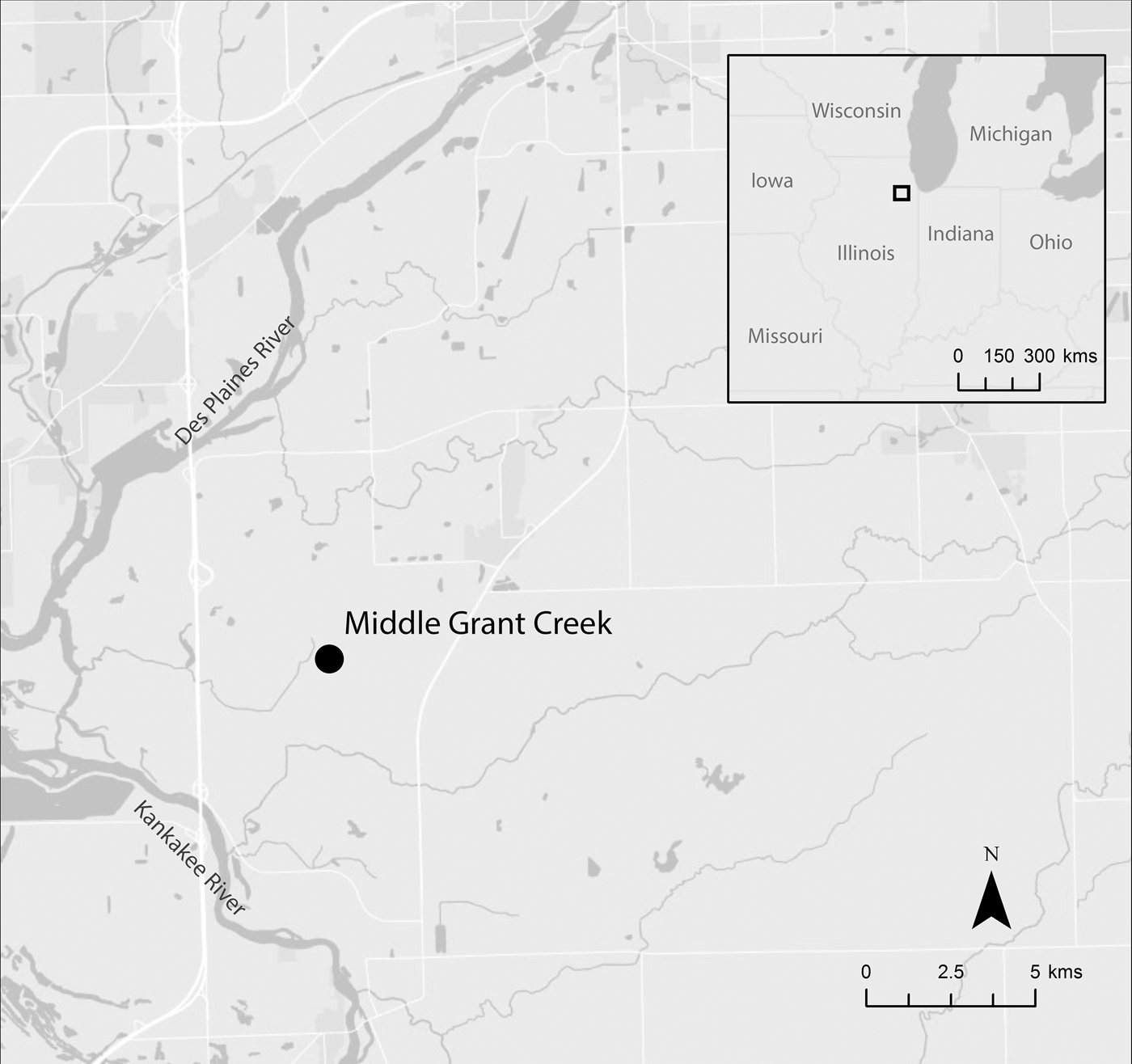
MGC (11Wi2739) is located atop a glacial outwash ridge in Will County, Illinois (Figure 1), and is defined by a collection of refuse-filled subterranean storage pits that remained intact following twentieth-century plowing. The site dates to the early seventeenth-century protohistoric period and is interpreted as an activity and storage area (3.4 ha) within a village that may extend for at least 25 ha (McLeester et al. Reference McLeester, Casana, Schurr, Hill and Wheeler2018). Artifacts from the site are consistent with the Huber phase, the sixteenth- to seventeenth-century easternmost Oneota tradition (McLeester Reference McLeester2017). Oneota is a broadly defined archaeological tradition of shared attributes from AD 900 to European contact in the northeastern Midwest (Henning Reference Henning and Wood1998). Oneota communities moved among warm-weather agricultural villages and seasonal resource-extraction camps, and they maintained long-distance trade relationships. Villages incorporated widespread housing, earthworks, and activity and storage areas (Henning Reference Henning and Wood1998; McLeester et al. Reference McLeester, Casana, Schurr, Hill and Wheeler2018; Sterner Reference Sterner2018).
Location of Middle Grant Creek (11Wi2739) in Wilmington, Illinois. Map data courtesy of Esri, HERE, Garmin, © OpenStreetMap contributors, and the GIS user community.

Marine shell is occasionally found at Oneota sites, usually in burials (Hall Reference Hall1962; Henning Reference Henning and Wood1998). Despite their overall infrequent occurrence at Oneota sites, marine shell goods are present at most Huber phase Oneota sites in Illinois, including those contexts where only a small portion of the site has been excavated. Marine shell artifacts at other Huber sites include a waste body fragment (like the one found at MGC) and finished items including beads, buttons/pendants, an ear plug, and maskettes/gorgets (Bluhm and Fenner Reference Bluhm, Fenner and Bluhm1961; Bluhm and Liss Reference Bluhm, Liss and Bluhm1961; Herold et al. Reference Herold, O'Brien, Wenner, Brown and O'Brien1990).
Shell Working at Middle Grant Creek
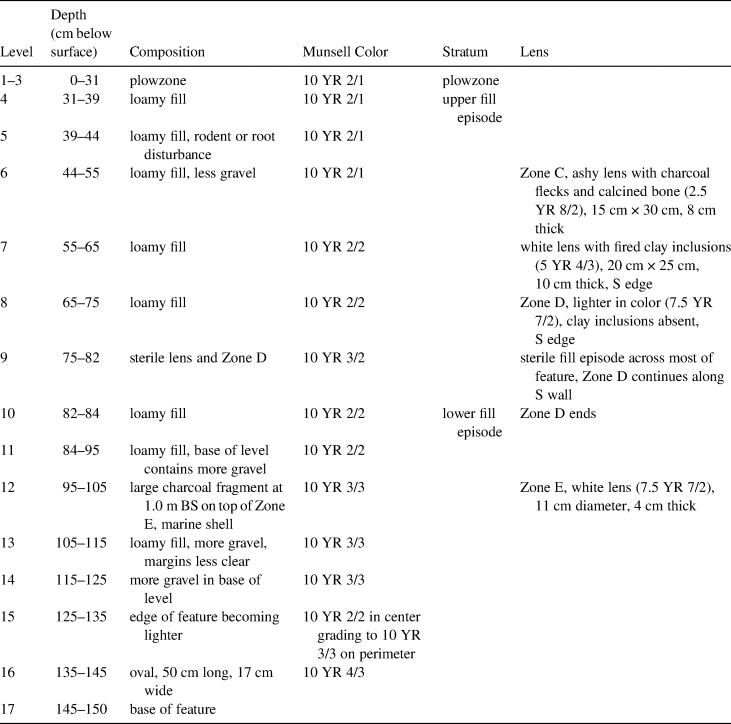
The refuse from one episode of marine shell working was found in 2017 within a round-bottomed, refilled storage feature measuring approximately 1.0 m in diameter and 1.5 m deep (designated Feature 3). The feature, originally a maize storage pit, was emptied and repurposed as a refuse pit and refilled with a mix of ceramic, faunal, macrobotanical, and lithic debris common across the site. It had two major and five minor depositional episodes represented by well-defined lenses (Table 1). All artifacts associated with marine shell working were located between 65 cm and 112 cm deep. The remains of the episode of shell working include a discarded and cut marine shell fragment, a microlith, and a white lens, possibly shell dust.
Summary of Feature 3 Fill Contents.

Marine Shell Waste Fragment
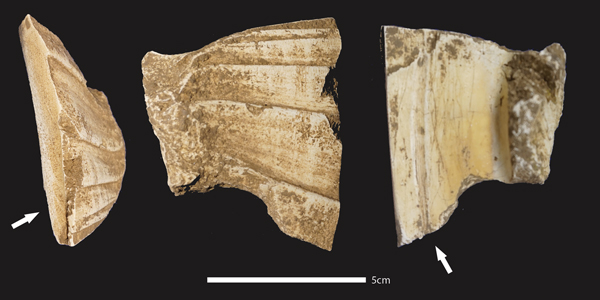
The cut marine shell fragment (Figure 2) was discarded in the refuse pit and located at 97 cm below the surface. The shell was identified as Lightning Whelk (Busycon sinistrum) by Laura Kozuch (personal communication 2017), a specialist in marine shell found in archaeological contexts. The shell's size, shape, and lack of spines indicate that it probably came from the eastern Gulf of Mexico. It measures 6.5 cm by 6.5 cm and has a mass of 89.0 g. It is a worked fragment of the shoulder that is sanded on the anterior side and possibly on the perpendicular side, and it has a 3.0 mm wide incised line on the inner whorl parallel to the sanded anterior edge (Figure 2). This fragment has been worked in multiple sections and may have been cut from a whole shell or traded as a fragment and further reworked before being discarded.
Three views of the worked Lightning Whelk shell (Busycon sinistrum) shoulder fragment. The center image is the exterior surface. The cut on the anterior edge is indicated on the far left, and the interior incised line is indicated on the far right. Photographs by Madeleine McLeester.

Marine Shell AMS Radiocarbon Dating Results
A radiocarbon date on the shell established that it was contemporaneous with the site occupation and not a legacy piece. The shell fragment was sampled and graphitized at the Houghton Carbon, Water & Soils Lab, USDA-FS Northern Research Station, Michigan Technological University, and was AMS radiocarbon dated at the W. M. Keck Carbon Cycle Accelerator Mass Spectrometer Facility, University of California, Irvine. The marine reservoir effects were calculated using CALIB 6.0.1. The uncalibrated date of 690 ± 15 BP (UCIAMS-198867; marine shell) produced a marine reservoir calibrated two sigma date of cal AD 1608 ± 61.
Although radiocarbon dating of marine shells can be fraught (Douka Reference Douka and Allen2017), an early seventeenth-century date strongly aligns with our expectations based on a corresponding radiocarbon date from a maize kernel, the site's Huber assemblage, and European goods, including brass and a Period II blue glass bead from the same feature that were likely acquired indirectly through indigenous trade networks.
Microlithic Use-Wear Analysis
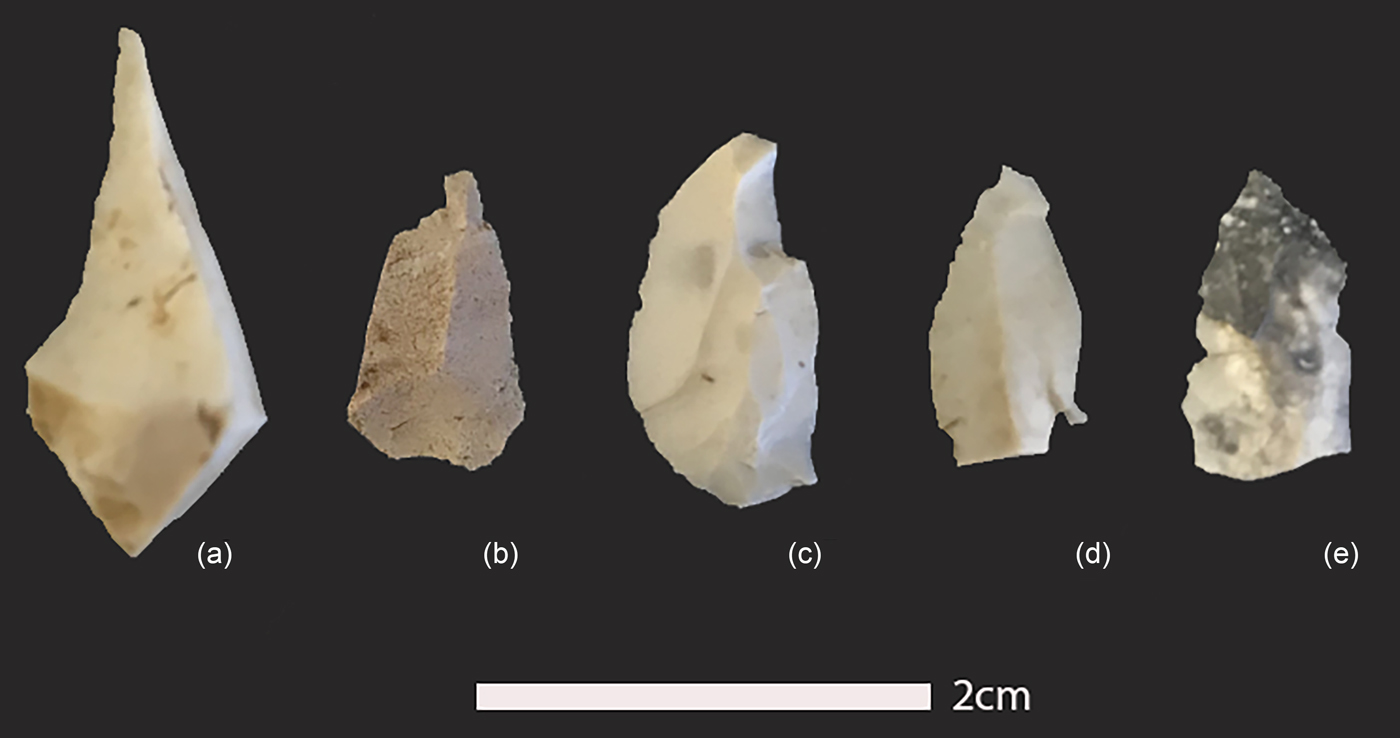
Microwear analysis has been previously used on microliths to identify evidence of shell working (e.g., Miller Reference Miller2015; Pope Reference Pope1989; Yerkes Reference Yerkes1983). The same approach is used here. Five small lithic flakes were examined for microwear (Figure 3). These small flakes were made of Starved Rock chert and were between 1.22 cm and 2.3 cm long. Four were found in context with the marine shell. Wear patterns on one retouched flake were consistent with shell microwear.
Flakes analyzed for microwear from MGC: FS 143 (a), FS 143(2) (b), FS 192 (c), FS 219 (d), and FS 194 (e). Photographs of microliths by Katherine M. Sterner.

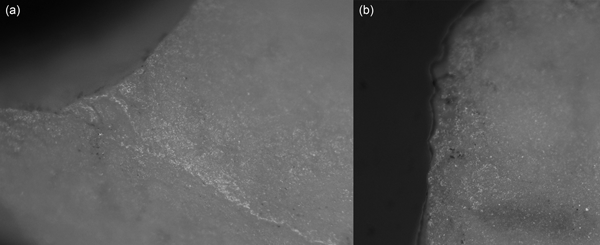
The flakes were examined using an Olympus BH-1 compound microscope with a reflected-light fluorescence attachment. Prior to examination, tools were washed for 20 minutes in an ultrasonic cleaner using warm water and dish detergent (Ahlrichs and Sterner-Miller Reference Ahlrichs and Sterner-Miller2015; Juel Jensen Reference Juel Jensen1994; Pope Reference Pope2005). Tools were scanned at 50x, 100x, and 200x magnification, and use-wear was documented with photomicrographs taken with an Amscope 5.1MP digital camera (Figure 4). Designations of use were made based on indications of microflaking, rounding, and micropolishing. To arrive at the most accurate use designation, we compared archaeological specimens with the University of Wisconsin-Milwaukee Archaeological Research Laboratory experimental use-wear collection and comparative samples (see Sterner-Miller et al. Reference Sterner-Miller, Jeske and Ahlrichs2015).
Microwear on tool FS 219: (a) shell micropolish on the ventral side of the distal end, 100× magnification, and (b) microchipping on the dorsal side of the distal end, 50× magnification. Photographs by Katherine M. Sterner.

The worked flake (FS 219) displayed the most convincing evidence for use on shell and was located in Feature 3 between a depth of 95 cm and 105 cm, approximately the same depth as the marine shell fragment (Figure 3d, Figure 4). The polish on the distal tip is congruent with shell polish on experimental flakes used to incise designs on shell. Shell polish is typically bright and exhibits striations perpendicular to the working edge (Yerkes Reference Yerkes1983). The microchipping pattern on the lateral margin of this artifact is also comparable to edge damage from cutting shell. FS 219 exhibited mircoflaking concentrated near the distal end of the piece. Flake scars were fairly contiguous and had feathered terminations. These characteristics are consistent with our comparative samples as well as experimental microliths used by Yerkes (Reference Yerkes1983) to identify shell microwear on Mississippian microliths. Though slightly smaller, FS 219 is otherwise similar to those from Mississippian contexts (Yerkes Reference Yerkes1983).
Two other flakes (FS 192 and FS 194) display traces of use, but the contact material and motion of use are indeterminate. A generic weak polish can develop during the initial stages of use, but is not diagnostic regarding the contact material (Vaughan Reference Vaughan1985). FS 192 exhibited traces of generic weak polish and microflaking on the distal end, as well as heavy plant polish on the proximal end, indicative of hafting. FS 194 exhibited minimal generic weak polish on the distal end and heavy hide polish on the proximal end, indicating that it too was hafted. FS 219 did not display wear from hafting (Table 2). The remaining two flakes analyzed were not used.
Summary of Microwear Results.

Possible Shell Dust Lens
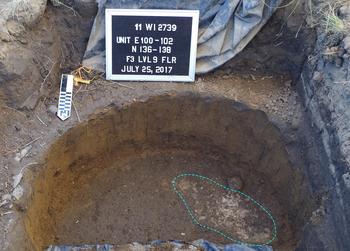
Interpreted as possible shell dust, a white lens (Munsell 7.5 YR 7/2) with a very fine particle size containing no artifacts was located at a depth of 65–84 cm in Feature 3 along the southern edge. This lens was designated Zone D (Table 1; Figure 5). A smaller, similar lens (Zone E) was also uncovered with the marine shell 10 cm below large (>3 cm) pieces of charcoal, but no sediment was collected from it. An acid dissolution was performed on Zone D sediment from the base of the lens to test for carbonates, which was then compared to a control soil sample taken from the surrounding darker fill. Dry soil was weighed, treated with 1 M HCl until the reaction ceased, rinsed three times with deionized water, centrifuged, and dried at 90°C for 48 hours. Zone D contained 23.3% carbonate versus 5.5% carbonate in the control sediment. We interpreted this high percentage of carbonates in Zone D as the result of finely ground or cut shell (analogous to sawdust) that was deposited in the feature. Although the lens could be degraded local freshwater mussel shells, wood ash, or freshwater shell dust, these alternatives seem less likely. The soil at the site has a pH around 7 and is well buffered with small limestone fragments, indicating an environment that preserves rather than degrades shells. In addition, well-preserved, unworked freshwater shells were found in the sediment surrounding the lens at the same level, suggesting that the white lens is not degraded shells. Wood ash also seems unlikely because areas of the lens contained no small (<1 cm) charcoal fragments and does not resemble other ash lenses at the site. While dust from freshwater shell working is possible, the proximity to the cut and worked marine shell fragment suggests it is the more likely source.
Image of Feature 3 with white lens, Zone D, outlined in dashed lines. Photograph by Madeleine McLeester.

Discussion
Together, the discarded marine shell fragment, microlith with shell wear, and likely shell dust lens suggest at least one episode of marine shell working in protohistoric northern Illinois. This finding provides the only known evidence for marine shell working from Oneota contexts and the only known work site outside the Middle Mississippian period (AD 900–1300) in the US Midwest.
Shell working areas and debris are difficult to locate archaeologically in the US Midwest (Trubitt Reference Trubitt2003) and are confirmed through the (sometimes burned) waste fragments of shell (mostly Lightning Whelk) and microliths showing edge wear characteristic of shell working (Kozuch Reference Kozuch2003, Reference Kozuch2013; Kozuch et al. Reference Kozuch, Walker and Marquardt2017). There are clear differences between the single episode of marine shell working and other known, larger midwestern shell working contexts, otherwise limited to Middle Mississippian period centers and associated sites (Yerkes Reference Yerkes and Beyries1993). There, marine shell working often occurred in defined workshops distinguished by scale, ranging from households to large production areas (Brown et al. Reference Brown, Kerber, Winters and Smith1990).
At all scales of production, working marine shell requires tremendous skill and is exceptionally difficult. Marine shell can have a hardness value measured on the Mohs scale of up to 5.5, harder than iron (which is 4; Marquardt and Kozuch Reference Marquardt and Kozuch2016), making it difficult to cut, especially without metal tools. In contrast, freshwater shells have a Mohs hardness of about 3. Using experimental methods, Kozuch (Reference Kozuch2007) has demonstrated that marine shell at Mississippian sites was cut using a groove-and-snap technique. Sandstone saws may also have been used to cut the shells (Trubitt Reference Trubitt2005), and fire may have been used to “cut, drill, and polish” the shell (Kozuch Reference Kozuch2007:152). Once cut, marine shell products require a large number of microdrills to finalize the product. Beyond skill, the work involved to complete a shell product requires tools and time. For example, one columella bead requires more than six hours of labor and significant specialization to craft (Kozuch Reference Kozuch2007).
Unlike in other midwestern contexts, the fragment, utilized flake, and possible shell dust at MGC were located among refuse, suggesting that the workspace was cleaned and the debris discarded. If the white lens is shell dust, it indicates that working may have occurred over a hide or mat that decomposed after disposal. This refuse context departs from larger Mississippian workshops where working debris is left in situ. However, shell working debris is found in refuse deposits similar to MGC in other locations in North America, such as at Phoenix basin Hohokam sites (McGuire and Howard Reference McGuire and Howard1987). At MGC, additional shell working debris may have been present on the ground surface, but the surface was destroyed during plowing. The shell dust and the microwear patterns on the flake also could be the result of freshwater shell working, common at Oneota sites. While the white lens could have freshwater shell origins (see above), the microlith found near the marine shell was probably not used for freshwater shell working, since freshwater shells at Huber sites are worked mostly into tools or undecorated ornaments (Bluhm and Liss Reference Bluhm, Liss and Bluhm1961; Faulkner Reference Faulkner1972; Henning Reference Henning and Wood1998; Lamb Reference Lamb2011), work that would not require microliths. More ornately produced gorgets and beads from Huber contexts appear to be made only of marine shell.
This new evidence indicates that marine shell working in the American Midwest was not confined to major Mississippian centers, thereby challenging existing ideas that all marine shell goods were imported into Oneota communities in final form, as previously assumed. For example, the marine shell maskettes at the nearby Huber phase Anker site in Cook County, Illinois, are thought to have been procured as completed artifacts obtained through down-the-line trade networks (Jackson Reference Jackson2010:371). Parallel assumptions about the importation of finished shell artifacts are also suggested among contemporaneous late prehistoric Fort Ancient occupations (AD 1000–1600) of the Ohio Valley (e.g., Drooker Reference Drooker1997:301, but see Pollack et al. Reference Pollack, Henderson and Begley2002:213, who propose possible local production). The likely marine shell working at MGC should encourage a search for similar evidence when outside production has been assumed.
Conclusions
These data suggest at least one episode of protohistoric marine shell working in the US Midwest and document the working of marine shell by Oneota peoples, an activity previously discounted. This finding indicates that marine shell working in the Midwest was a more widespread practice temporally and geographically by providing evidence of small-scale marine shell working outside major Mississippian centers. Overall, this finding encourages a reexamination of contexts where archaeologists assumed marine shell goods were exclusively imported trade goods.
Acknowledgments
Thank you to the U.S. Forest Service, Passport in Time, Midewin staff and volunteers, and especially Joe Wheeler for their ongoing support of this research. This work was funded by a challenge cost-share agreement through the U.S. Forest Service (17-CS-11091500-003). The identification of the marine shell was generously done by Laura Kozuch at the recommendation of Terry Martin. We are grateful to Estefanía Vidal Montero for translating our abstract into Spanish and to Lynn Gamble, Hugh Radde, Peggy Dayton, and the reviewers who helped improve this article.
Data Availability Statement
All materials and documentation from Middle Grant Creek are currently curated at the Department of Anthropology, University of Notre Dame, and are available for review on request. The collection and associated documentation will ultimately be curated at the Illinois State Museum Research and Collections Center, Springfield, Illinois, with the agreement of the U.S. Forest Service.