In 1859 the news that Royal Vauxhall Gardens was to be sold to developers came as a shock. Since the late seventeenth century this twelve-acre suburban garden on the south bank of the Thames had been providing Londoners with a place to promenade, dine, and enjoy music on summer evenings. Journalist Laman Blanchard compared the prospect of a last night at Vauxhall with the sale of the pyramids or the last fall of water over Niagara.Footnote 1 His surprise is striking, as the property had changed hands repeatedly during the previous twenty years, with several series of “last nights” being held. When the tickets for the 1859 last night were printed the organizers were at pains to make it clear that this was to be, “positively,” the very last night “for ever.” By the mid-nineteenth century, the Gardens largely served to remind observers of its heyday as a gilded, polite Georgian paradise haunted by the great and the good—a heyday that many identified with their own youth. For such people, the decay and closure of the Gardens represented the loss of innocence, or, perhaps more accurately, the loss of a willed suspension of disbelief in the illusions that underpinned the pleasure garden's success. As the Daily Director and Entr’acte put it in 1860, “Reader, if you are not on the shady side of forty, you know nothing of Vauxhall.”
The same statement, without the age restriction, might almost be said of historians of eighteenth- and nineteenth-century British culture. Pleasure gardens such as Vauxhall are regularly cited as typifying a nascent public sphere, one identified with the commodification of culture and the rise of the “middling rank.” In John Brewer's masterful survey of English culture in the eighteenth century, The Pleasures of the Imagination, pleasure gardens join West End theaters, art exhibitions, and concert halls as “part of an established itinerary of cultural pleasures.”Footnote 2 Yet while art exhibitions, concerts, and theaters are well researched, our understanding of pleasure gardens is stuck in the nineteenth century.Footnote 3 Admittedly, Roy Porter and Richard Altick do note the survival of Vauxhall into the Victorian period in their histories of London society and entertainments. For the most part, however, it is described in terms of the slow, seedy decline of a resort that belonged in the previous century.Footnote 4
The focus of this essay is on Vauxhall's afterlife. This Georgian institution's survival well into the Victorian age affords an excellent opportunity to follow the transition between two historical periods and their cultures. It shows how a unique space based around a polite, self-policing, and self-regarding crowd sought to contain anxieties about moral decay by borrowing from a new generation of entertainment venues, where a line between respectable spectators and disreputable actors was clearly drawn. Its open-air setting and the persistent appeal of a playful culture of illusion and display made policing this line remarkably difficult. The fact that this apparently straightforward struggle—Victorian prurience versus Georgian ebullience—remained undecided for so long suggests a parallel struggle inside the Gardens's thousands of nineteenth-century visitors. The reaction to the closure shows that for many, the wrestling, whether enjoyable or not, had been more satisfying than the resolution.
Throughout its history, Vauxhall's main appeal lay in its “autovoyeurism”: the practice of seeing others and being seen by them, the opposite of “panopticism.”Footnote 5 Although autovoyeurism could be enjoyed in many other public spaces in London and elsewhere, under the cover of shopping, artistic and musical exhibitions, or divine service, for example, Vauxhall was different. Here autovoyeurism was the central activity, indulged in consciously and deliberately by men and women of different generations and social classes. It was closely associated with role play and illusion. As de Bolla has shown in his account of the eighteenth-century Gardens, Vauxhall's publicity and painted decorations not only used illusions to toy with visitors, but constantly reminded them of their willed complicity in suspended disbelief.Footnote 6 In doing so it obliged them to cross and recross the border between illusion and reality with disorientating rapidity.
Vauxhall would probably not have been able to thrive for so long had this autovoyeurism not been celebrated as a truly British spectacle and as an index of the health of a constitution under which different ranks could, whatever their station in the world of work, mingle at leisure without any police other than that imposed by their own autovoyeurism. In his Characteristics (1711), the Earl of Shaftesbury proposed a casual link between this and liberty: “All politeness is owing to liberty,” he wrote. “We polish one another and rub off our … rough sides by a sort of amicable collision. To restrain this is … to bring a rust upon men's understandings.”Footnote 7 In 1760s and 1770s France, the establishment of “les Wauxhalls” was advocated as a means of reforming decadent, factional Parisian society. This pre-Revolutionary “Vauxhall Utopianism” shows how a single pleasure resort could be seen as a window on an entire social regime characterized by polite “douce égalité” and a small state.Footnote 8 Such celebration of the Gardens's social and even political benefits explains some of the reluctance to lend credence to nineteenth-century critics’ characterization of the resort as an unruly or disordered space.
The first three sections of this article describe three phases in the development of the Gardens between 1780 and 1859, tracing changes in admission price, management, attractions, and, where possible, audience. I draw on collections of Vauxhall ephemera in London and elsewhere that do not appear to have attracted attention from historians.Footnote 9 A particularly rich seam of material runs through the English literary canon, with fictional accounts of Vauxhall appearing in a range of works from Fielding to Thackeray via Oliver Goldsmith, Tobias Smollett, Fanny Burney, Pierce Egan, William Ainsworth, and Charles Dickens. In such accounts, visitors often bemoan the decline of the Gardens from its prior grandeur and decorum. The survival of the Gardens and its successful reinvention in the Victorian period suggest that such complaints are best seen as a Vauxhall trope, rather than as evidence of real decline. As Cunningham has noted, the history of pleasure gardens in the nineteenth century “was not simply one of decline, rather of a broadening in their social base.”Footnote 10
The final section considers what Vauxhall's long afterlife has to tell us about middle-class attitudes to the polite mingling of different sexes and classes associated with this resort. Powerful arguments have been made in favor of the thesis that sees this culture crumbling in the thirty years after 1780, giving way to a chillier climate of respectability. Unlike politeness, this respectability sought to police or regulate leisure by means of institutions (some of them state based) that saw the mingling of ranks and gender roles as transgressions against a normative order.Footnote 11 Far from endeavoring to suppress its associations with Georgian role play, Vauxhall constructed its own history and myth as part of its own appeal to Victorian visitors. Its justified—if carefully cultivated—reputation as the forcing ground of national musical and artistic talent (Handel and Hogarth especially) as well as its sheer longevity made it a place where Londoners reveled in their city's Georgian past. Rather than being the preserve of antiquarians or those alienated by progress, Vauxhall nostalgia was of a sort that many Londoners otherwise welcoming of “municipal improvements” could pleasurably indulge. Indeed, this “olden time” nostalgia was steam powered, as the railways and the diffusion of cheap novels brought a real or virtual visit to Vauxhall within the reach of middle-class Britons who did not live in London.
By the 1770s, Vauxhall had been open for over a century, and its layout and attractions were well established. The resort was strictly seasonal and nocturnal, only open on summer nights, and, given its alfresco nature, highly dependent on the fickle English weather. All evidence indicates that visitors’ discussions before, during, and after visits circled around this national topic. The Gardens enjoyed a suburban setting on the south bank of the Thames in Surrey, and were best reached by water. As the nearest bridge was down at Westminster, those who attempted to travel by carriage could suffer the indignity of being caught in a traffic jam. Once safely arrived, parties entered through the house on the western edge of the site, where they paid their admission fees and deposited their servants in special holding pens. On the other side, two snaking lines of supper boxes stretched ahead of the visitor, flanking a raised orchestra pavilion surrounded by trees. The rotunda (or “Temple of Pleasure”) and a saloon were on the left.
The majority of the site was given over to long allées or “walks”: three running to the eastern edge of the site, bisected by two more running north-south. The supper boxes, orchestra, and westernmost walks were brightly illuminated with hundreds of lamps, but the “dark walks” clearly lured many visitors to explore the dim reaches of the site. Here lived a mock hermit in his hermitage (where he told fortunes), a marble statue of Milton surrounded by “musical bushes” (a small orchestra hidden in pits dug in the earth), and a small diorama of a village mill powered by a tin cascade—the effect of moving water created by “waves” made of tin mounted on rollers and a synchronized “waterwheel.” This diorama was unveiled only for performances, announced by the ringing of a bell. One of the bisecting walks had trompe l’oeil eye-catchers at each end: massive canvases painted with fake views of the Roman campagna. Although the musical programming was excellent, the main entertainment offered at Vauxhall was not scripted. It lay in perambulating in groups around these sights, looking at other people and being looked at oneself. Given the popularity of the Gardens with the Prince of Wales, his mistresses, duchesses, actors, and visiting dignitaries (including Native American chiefs), surprises lay around every dimly lit corner.
Much of Vauxhall's success was owed to Jonathan Tyers, the impresario who took over its management in 1728. As Solkin has shown, in 1732 Tyers relaunched Vauxhall after a well-advertised cleanup campaign that involved introducing strolling Methodist ministers in an attempt to keep strumpet numbers down.Footnote 12 Tyers laid the foundations of the Gardens's future fame as the nation's musical shrine by holding the first performance of Handel's Music for the Royal Fireworks in 1748 and commissioning Rysbrack to carve a marble statue of the composer that he placed in the resort's heart.Footnote 13 In 1760 he also commissioned Francis Hayman and other unrecorded artists to produce large paintings illustrative of major moments in British history and literature. These graced the grand chinoiserie rotunda, as well as the supper boxes.Footnote 14
Here the management's generosity ended. The food and drink, ordered from perambulating waiters, were renowned for their exiguous portions and high prices. By 1770, being overcharged for paper-thin slices of ham was just one of a number of Vauxhall rituals, along with running to “catch the cascade,” commenting on the poor weather, feeling superior to other visitors less fashionable than oneself, and speculating as to whether any of the hundreds of new lamps purportedly added each summer were in fact visible. Although the tin cascade disappeared in the 1820s, each of these rituals was, if anything, even more entrenched in 1849.Footnote 15
Thanks to Tyers's reorganization, by the 1780s it was a commonplace to view the mingling of ranks at Vauxhall as a positive indication of the social and constitutional health of Britain relative to other states. An account of Vauxhall from that decade spoke of how “the manners of the lower order of the people have … been humanized by often mixing with their betters, and that national spirit of independence which is the admiration … of Europe … takes birth from the equality it occasions.”Footnote 16 Exactly forty years later, on the other side of the great caesura of the French Revolution (with its distinctly worrying crowds), one hears the same sentiment: “All the various ranks of life, from the noble to the tradesman, may be observed [at Vauxhall] mingled in orderly and agreeable confusion; and those restraints which the difference of rank and station, the laws of manners and the decencies of society require, are here preserved and respected; not by military aid, or the presence of an overpowering police; nor yet by the instinctive prejudices and habits of a servile education.”Footnote 17 The Vauxhall crowd was a spectacle of cohesion rather than confusion.
To judge by the opinions expressed by the characters in Georgian novels, however, Vauxhall was never quite as good as it had been before: the music never quite matched those melting strains heard on previous visits, the company was always of a more questionable sort. Goldsmith was the first to characterize this popular response to Vauxhall in his Citizen of the World (1760), where a snobbish habitué responds to a new visitor's wide-eyed wonder by insisting that she had heard and seen better than what the Gardens now had to offer.Footnote 18 This “miserable refinement,” as Goldsmith put it, was obviously a way by which visitors could root themselves in the eddying crowds and ceaselessly shifting scenery of the Gardens. By unfavorably contrasting the latter-day Vauxhall with its earlier, “better” manifestations, they could not only appear fashionable, but socially superior—to bemoan the introduction of “new,” unwelcome, “vulgar” interlopers into the Edenic garden was to elevate one's own social status. In a related, if rather contradictory impulse, new visitors were expected to be amazed by what they saw and heard—and were prodded if they did not deliver the goods. The heroine of Fielding's Amelia (1751) breathlessly comments on her first visit that the impression of the Gardens “carried my Soul almost to Heaven in its Ideas.”Footnote 19 Led about the garden by her uncongenial companions “purposely to enjoy my first sight,” the heroine of Fanny Burney's Evelina (1778) barely has the chance to produce the expected wonderment:
When wine and cyder were brought, Mr. Smith said, “Well, Ma’am, and how do you like Vauxhall?” “Like it!” cried young Branghton, “why, how can she help liking it? She has never seen such a place before, that I’ll answer for.” “For my part,” said Mrs. Branghton, “I like it because it is not vulgar.” “This must have been a fine treat for you, Miss,” said Mr. Branghton; “why, I suppose you was never so happy in all your life before?” I endeavoured to express my satisfaction with some pleasure, yet I believe they were much amazed at my coldness. “Miss ought to stay in town till the last night,” said young Branghton, “and then, it's my belief, she’d say something to it. Why, Lord, it's the best night of any; there's always a riot,—and there the folks run about,—and then there's such squealing and squalling!—and there all the lamps are broke,—and the women run skimper scamper;—I declare I would not take five guineas to miss the last night!”Footnote 20
This passage shows the sort of vicarious wonderment the Gardens afforded those who were capable simultaneously of expressing a regret that social standards were slipping. The fact that the same comments were made from the Gardens's mid-eighteenth-century “heyday” right up to the middle of the next century proves that these were stock responses with little bearing on reality.
The entry fee in 1770 was one shilling, which brought a visit well within the reach of the lower middling rank. Although servants in livery and men in working clothes were not admitted, enough complaints survive to suggest that members of the lower middle class and the lower classes did get in occasionally.Footnote 21 Those able to adopt the dress and manners of their superiors could slip in undetected. Vauxhall's macaronis and the crisis they created in the 1770s highlighted this problem. The Italian dress, cravats, and ornate accessories these male dandies affected were made to be seen and admired. In one description, a macaroni had to “be a museum of everything that was not thought or dreamt of before the year 1772,” but they could not be “read.”Footnote 22 Their dress implied that they were well-off aristocrats back from the Grand Tour. In reality, however, they regularly turned out to be haberdashers’ assistants rather than lords. But it took an “affray” or some other unpleasant incident to reveal the truth.
In addition to dress, macaronis were also conspicuous for their persistent staring and impertinent language. Bad behavior could, in a curious twist, become a badge of class and fashion. Though otherwise made for show, the macaronis refused to avail themselves of the conversational skills, “address,” good posture, or any other of the subtle means by which everyone else in the Gardens made their politeness and gentility clear. They had apparently decided that true class lay, not in a finicky ticking of the boxes of polite behavior, but in throwing over the traces entirely, in subverting “polite” norms. It was all very well for those socially “beneath” them to emulate the Joneses—they were going to épater les bourgeois. At Vauxhall they tripped up the waiters, broke the lamps, stared aggressively at female visitors, and made slighting remarks intended to provoke duels. Despite this conspicuous manliness, macaronis rarely honored their challenges, usually running away when their bluff was called. The success of British commerce in diffusing knowledge of polite norms and the means to follow them seemed to have homogenized society to the point where “distinction” was anything but distinct.
Although the macaronis were a phenomenon of 1770s Vauxhall, their behavior and spyglass ogling lived on. In 1780 a newspaper account of the evening on which a new record of 8,000 visitors (“the generality of which, however, were of the middling, and inferior classes”) stated that “in consequence of the prudent precautions taken by the managers, no riot happened till about 3 o’clock in the morning, when between thirty and forty lamps were broken by three blades, two of whom were a hair-dresser and an attorney's clerk.”Footnote 23 The “Jack O’dandy hero” at Vauxhall who refuses to stop ogling Tom and Jerry's dancing partners in Pierce Egan's famed book Life in London (1821) proves readier with impudent language than with his fists—running away before Bob Logic can fight him, in classic macaroni fashion.Footnote 24 By the 1830s, the figure of the “swell” filled the role that had been filled at other times by either the macaroni or the dandy. In a print of 1837 entitled “A Swell out of luck!!!” we even find him accessorized in a similar fashion: a cane and a monocle (cracked, in this case).Footnote 25
These clear bloodlines linking the macaroni to the flaneur, dandy, and swell confirm the impression of the type as evanescent rather than dominant.Footnote 26 Thanks to Foucault, intense, itinerant observation of others has been irrevocably linked to surveillance and control, to rigid classification. But these male observers seem to have had very little control over others, let alone themselves. They seem unstable, unreadable, insubstantial, and uncommunicative—a blind alley of masculinity compared to the stolid chivalry of the Victorian gentleman.Footnote 27
During the Napoleonic Wars a decrease in the numbers of such undesirables at the Gardens was noted, and welcomed. Whereas the strong patronage of both Frederick, Prince of Wales, and his great-grandson Prince George had lent the eighteenth-century Gardens a strong whiff of Opposition, the wars saw the Gardens adopt a fierce patriotic loyalty to royalty and nation. The fireworks introduced in 1798 and the grand fetes and festivals held in this period saw the Gardens rebrand itself as “Royal Vauxhall Gardens”: a Grand Festival of Royalty (1805) and the Vittoria Fete (1813) were held to celebrate great military victories. As a result of such “Grand Military Entertainments,” The Times observed, “many hundreds of families of the first rank and fashion become constant visitors at that charming place of amusement.”Footnote 28 Tickets to these special events were much more expensive, partly to cover the cost of the larger orchestras and extended firework displays. But even normal admission had become more expensive, raised to 3s. 6d. in 1809. Vauxhall remained one of the places to watch for those interested in the latest fashions, as the engraved plate of “Fashionables at the Vittoria Fete, Vauxhall” featured in Carnan's Ladies Compleat Pocket Book for 1813 demonstrates.Footnote 29
To more outspoken journals like The Examiner, however, the Gardens's leap onto this “national” bandwagon could appear objectionable. Such “shewy and tricksome” shows, it wrote, “have more of a French than an English character, and are rather contrivances for disseminating court luxury and enlarging the court interest than meetings to encourage the national spirit.”Footnote 30 In an age marked by campaigns against the “Old Corruption” of noble sinecurists, the fact that the 1810s saw the Gardens cease to be a regular resort of the aristocracy would presumably have reassured rather than repelled middle-class Londoners.
Thus the fifty years following 1770 saw only gradual change in Vauxhall's attractions and in the social makeup of the visitors. The mingling it afforded continued to be seen positively in national terms. Its appeal to macaronis and Regency courtiers might easily have been taken as signs that the venue was in rude health. Yet there were, as we have seen, contemporaries who saw these people as interlopers, as subversive figures who needed to be driven out. That the figures to be excluded were aristocratic (or presented themselves as such) suggests that these fifty years witnessed the Gardens's appropriation by the middle class. Although evidence for this gradual shift can be hard to find, the radical changes made after 1820 indicate that something important about the audience had changed.
The remarks of one commentator who reviewed Vauxhall right at the end of this period seem to show which way the wind was blowing. This 1819 piece from an unidentified London newspaper began positively enough, observing that such “popular amusements” as pleasure gardens were no longer seen as criminal by their very nature. Yet, he noted, at Vauxhall
There is literally scarcely any resource from the monotony of marching round and round the same walks, perpetually molested by the same faces, and living only in the moment, “like angel-visits, short and far between”, when the bell rings for the tumblers, or the loungers are summoned to be astounded by the flying genius of Madame Saqui. In the intervals, all is dreariness … the old expedient of moving round the arcade serves but for a while: … every ear is strained for the toll of the tardy bell that is to announce the miracles of the Fire Queen, Signora Hengler. … If the object is to make Vauxhall a place of sentimental wandering and dignified delight, the object is hopeless. It must be a place of popular amusement or nothing, and popular amusement consists in the variety, the newness, the continued succession of its objects, much more than in their taste, costliness, or dignity.
Yet at the same time as he called for more shows, this visitor could not resist remarking how vulgar they were, interpreting them as evidence of the “facility” with which “the higher orders can enter into the amusements of their humbler compatriots.”Footnote 31
Within two years of this complaint, the Gardens changed hands, and the new management appeared to respond by introducing novelties. The years 1821–40 represent a second phase in the Gardens's development, marked by a shift toward staged entertainments, aerial acrobatics, and ballooning displays joining music and fireworks as regular draws.Footnote 32 The new operators were a partnership led by Frederick Gye (“the elder”), a printer who had made his fortune from the state lottery, first by winning the lucrative account for printing the tickets, and then by winning the lottery itself. He had then bought himself into the wine and tea trade, where he made himself conspicuous through the aggressiveness of his marketing methods and the opulence of his firm's branches. His partners in the Vauxhall venture were the lottery agent Thomas Bish and William Hughes, who had an interest in music.
Gye raised admission to four shillings and used the proceeds to fund new attractions, the most popular of which were the sword swallower Ramoo Sammee, slack-rope dancing, and the “fantoccini figures”—a type of shadow play invented by a Vauxhall carpenter named Grey.Footnote 33 In 1827, Gye organized the first of what would be a series of Waterloo reenactments, complete with cannon fire, explosions, and a large cast of actors, supplemented by artistes from Ducrow's equestrian team, well known for their displays at Astley's Circus. The climax, which showed Napoleon's flight, was especially popular. As Prince Pückler-Muskau noted, the emperor's carriage—the original of which was a popular tourist sight at London's Egyptian Hall—crisscrossed the stage again and again, “pursued and fugitive, to tickle English vanity, and afford a triumph to the ‘plebs’ in good and bad coats.”Footnote 34
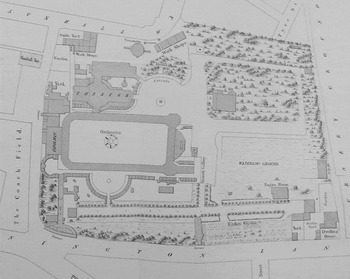
Such new attractions needed plenty of space, and so led to some rearrangement of the internal layout. Thus the rope-dancing stage was erected where the tin cascade had been, and a large “Waterloo Ground” was created to the east by clearing away trees (fig. 1). The long narrow avenue once depicted by Canaletto was now a broad open space, at the end of which stood a sixty-foot mast that had been erected some time before 1816. Madame Saqui, the first of a royal line of “fire queens,” performed her first descent from it in that year, hurtling down a 350-foot rope through a blaze of fireworks. In 1837 Gye engaged Professor Keller and his troupe to put on “poses plastiques”—tableaux vivants in which famous classical sculptures and Old Master paintings were recreated with great fidelity to the originals.Footnote 35
Meanwhile, Vauxhall's music had not been neglected. From the 1770s to the 1790s Vauxhall had been remarkably successful at marketing its music for nonvisitors in the form of specially printed collections of the latest “Vauxhall songs,” whose accompanying illustrations and lyrics celebrated the Gardens's charms. With the singer Madame Lucia Vestris's “Cherry Ripe” (1825), however, a Vauxhall song reached an unprecedented level of penetration—endless repetitions throughout the capital by professionals and nonprofessionals alike driving some close to distraction. Original plays, cantatas, vaudeville operas, and ballads were created expressly for the Gardens by the playwright James Robinson Planché and the composer Henry Rowley Bishop, who were in charge of musical programming at the Gardens in 1826–27 and 1830–33, respectively.
Both men (as well as Lucia Vestris herself) were anything but bit players on London's musical scene, playing important roles in the management of Covent Garden and the introduction of Weber and Scribe's operas to London. Their close involvement suggests one avenue for future research into Vauxhall. Cunningham has argued that, far from being a parasite on the London music scene, pleasure gardens represented a crucial bridge linking the eighteenth-century world of glees and catch-clubs with the music halls that would begin opening in London in the 1850s. Vauxhall's significance here has, he notes, been overlooked, while the role played by Judge and Jury shows and supper rooms has been exaggerated.Footnote 36
Gye's efforts were rewarded with a record-breaking attendance of 140,000 for the year 1823. Reaching out to new audiences, that year he organized the first of a series of annual “Juvenile Fetes,” to which all children under twelve were admitted
Map of Vauxhall in 1841 (Museum of London, Warwick Wroth Collection).

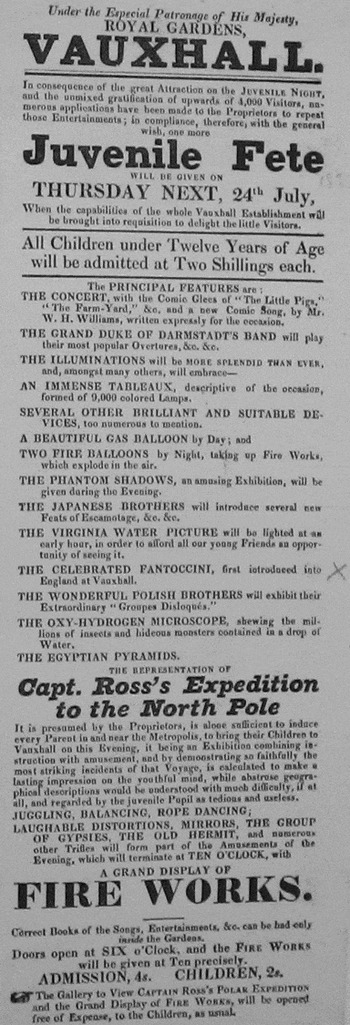
for two shillings. Such fetes included performances by barnyard impressionists and Japanese contortionists as well as scientific demonstrations of something called the “oxy-hydrogen microscope.” The highlight in 1833 was a representation of Captain Ross's expedition to the North Pole. This, the poster claimed, would leave a lasting impression, whereas “abstruse geographical descriptions would be understood with much difficulty, if at all, and regarded by the juvenile Pupil as tedious and useless” (fig. 2). Gye's genius lay in the fact that such fetes not only highlighted the Gardens's provision of family entertainment, but tapped two new audiences: the children, of course, but also those who came to see the children enjoying themselves.Footnote 37 Everything was over by ten o’clock, the poster promised, allowing Gye to hold such fetes on a Saturday, when normal operations were impossible.
Vauxhall did not open on Sundays. This was not enough, however, to satisfy Sabbatarians, who objected to Saturday opening on the grounds that the entertainment continued into the early hours of the Sabbath. Although the fireworks that marked the official end of the show at Vauxhall were usually held at 11:00 p.m., many young blades and women of easy virtue did stay until the early hours of the following morning—as they had in the eighteenth century. In the early 1830s organizations like Sir Andrew Agnew's Lord's Day Observance Society campaigned inside and outside parliament for statutory protection of the Sabbath.Footnote 38 Vauxhall had become a target for such agitation slightly earlier, when efforts were still local and relatively uncoordinated. Opposition to Vauxhall on Sabbatarian grounds seems to have peaked in the mid-to-late 1820s. This was, as Roberts has noted, a period when volunteer moral reform groups such as the largely Dissenting Christian Instruction Society had solicited magistrates to crack down on “irrational” recreations.Footnote 39 In 1825 Surrey magistrates made the renewal of Vauxhall's license conditional on the illumination of the “dark” walks. Further conditions were made the following year.
The dispute between Gye and the magistrates spilled over into the letter columns of The Times. Here it became clear that magisterial objections were focused on the fact that the dividing line between respectable spectators and disreputable professional actors and artistes was being transgressed at Vauxhall. As “An Old Under Sheriff” commented in a letter on “National Morals” published in The Times of 9 October 1827:
When Addison benignantly smiled at a portion of its company, even that grave censor could only find matter for his wit … and, long since that period, our own memories can supply us with the recollection of scenes which might defy the severities of criticism, and the censures of morality. Alas! … For years past, the whole character of the place has been entirely altered; and instead of offering only legitimate pleasures to the honest and respectable part of society, it has too long furnished every species of allurement to the corrupt and vitiated taste of the worst and lowest of our species. To the chaste and simple singing of its orchestra have succeeded theatrical amusements, fireworks, and dancing: while the last has not been confined, as in other cases, to performers paid for the amusement of spectators, but spectators have themselves become actors.
Flyer for a juvenile fete, 1833 (Museum of London, Warwick Wroth Collection).

Worse, he continued, the bands of musicians who wandered about the Gardens (rather than remaining securely on their stage) also encouraged visitors to participate.Footnote 40
Such jeremiads, contrasting the loose morals of latter-day Vauxhall with its unsullied eighteenth-century state, did not go uncontested. On the subject of the much maligned “dark” walks, a journalist writing the previous year accurately observed that “forty or fifty years ago, all the walks at Vauxhall … were dark walks.” Magistrates, he facetiously claimed, had stated that they would now require Vauxhall's waiters to wear mourning, women and men to dine separately, and the proprietors “to erect several large clocks, to strike the hours and chime the quarters, to give due notice of the march of time.”Footnote 41 Such responses suggest that Vauxhall's pleasures were offending not so much a mainstream respectability, but rather that of an articulate minority eager to root out rivals to its own “rational recreations” and to police those spaces where different types of pleasure could be enjoyed simultaneously in a beau desordre. At Vauxhall, Bob Logic observed in Pierce Egan's Life in London (1821), “you may be as gay as a dancing-master, and enter into all the fun and frolic by which you are surrounded; or you can be as decorous as a parson in his pulpit, and be nothing more than a common observer.”Footnote 42 When Sabbatarians presented a petition on the subject in 1837, even the editor of The Times could not forbear stating his objections to such pious meddling.Footnote 43
Contemporary tourist guides to London do not suggest that “well-dressed persons” had ceased attending. Indeed, they often repeat the tropes of mid-eighteenth-century accounts of Vauxhall: that it was the “Arabian nights” realized and the envy of foreigners, who were supposedly unable to imagine such a place existing anywhere else.Footnote 44 The fastidiously polite (if not fawning) Master of Ceremonies Charles H. Simpson did his bit to maintain continuity, serving from 1797 to 1833. Simpson often circulated the Gardens, raising his hat to welcome all and sundry to “the royal property.” He also puffed up the Gardens in obsequious letters to the editors of the major London papers, begging their readers’ patience long enough to point out the elegancies of Vauxhall. In both his manner and his dress, Simpson stubbornly refused to move with the times. This was in keeping with the orchestra, which was still wearing cocked hats in the late 1830s. These important touches laid the groundwork for the “Old Vauxhall” nostalgia regularly used to market the Gardens after 1840. They doubtless also served as a useful foil to Gye's innovations, masking the extent to which the Gardens had changed.
Gye's good fortune seems to have run out in the mid-1830s. The expansion of London had now swallowed up what had been a market-garden setting twenty years before. The pastoral aspect of Vauxhall, celebrated in hundreds of songs documenting the loves of nymphs and swains, was increasingly difficult to maintain. The extension of the London and Southampton Railway to Waterloo also changed the Gardens's surroundings. Whereas the old terminus had formerly been to the southwest of the Gardens, at Nine Elms, in the early 1840s new elevated tracks were laid that ran very close to Vauxhall's western border. At the same time several of London's gas companies erected gasometers near the Gardens, to the southeast (by the Oval) and at Nine Elms. Although Vauxhall had always been about illusion, these developments challenged the open-air resort.
If visitors had continued to play along with this illusion of a rural retreat, perhaps these developments would not have had the impact they did. The account of a return visit to Vauxhall from Pierce Egan's much less successful second book, The Pilgrims of the Thames, in Search of the National! (1838), suggests that the crowds had become less tolerant of “amicable collision.” Egan's middle-aged, self-made man of business (Mr. Makemoney) combines appreciation of the Gardens's unfamiliar, new-fangled spectacles with nostalgia for the autovoyeuristic crowd of the past:
O the days when I were young!! VAUXHALL then, appeared to every visitor a decided place of fascination—a sort of Elysium—and all the cares of the world left outside of the gardens. Gaiety was the leading feature … pleasure in all its variety of taste. … Yet, I must confess, the entertainments were not half so grand, nor half so good—but the visitors appear to me completely changed altogether! They walk about, appear indifferent; seem stiff, formal: and not inclined to recognize each other upon equal terms; but at the period I allude to, the company appeared like one family! Such a change is not at all the fault of the proprietors; on the contrary, they have out-heroded herod in their exertions to produce novelties: and to furnish every sort of intellectual amusement to attract the public to visit Vauxhall Gardens.Footnote 45
Egan pins the blame for Vauxhall's chillier atmosphere on the visitors, not the management. It is important to note that this change is not explained by a change in the class makeup of the crowd. Although the “national” of the title proves to be an elusive quarry, Makemoney's comments elsewhere in the book make it clear that he views such spaces of social mingling as “source and spring of our national spirit—our love of independence, of justice, and of our country,” even if they sometimes caused “crowds” and “riots.”Footnote 46
Under pressure of diminishing audiences, Gye attempted several experiments. He tried a one-shilling night in 1833, which drew 27,000 punters. He eventually made the reduction to one shilling permanent and opened Vauxhall three alternate nights a week. He took his lights and performers on the road, holding performances in Bath's Sydney Gardens, and in 1836 introduced Charles Green's Royal Vauxhall (later, Royal Nassau) balloon. Although highly risky night ascents were attempted in the mid-1840s, for the first few years these ascents were held during the day. Gye may have hoped that the sight of the balloon over London would operate as free advertising. In practice, admitting the public to view the machinery of illusion underpinning Vauxhall's fairytale world by the harsh light of day was highly inadvisable. Yet he compounded this mistake in 1839 by organizing twice-weekly “morning entertainments” devoted to chariot and other “Thessalonian sports” (again, Ducrow's troupe was brought in) held on a reconstruction of a classical race course “129 yards longer than the original at Rome.”
Charles Dickens attended one of these daytime balloon launches in 1836, recording his disillusionment in a piece for the Morning Chronicle entitled “Vauxhall by day,” later republished in the first series of Sketches by Boz. Vauxhall by day was, as he observed, “a porter-pot without porter, the House of Commons without the Speaker, a gas-lamp without the gas—pooh, nonsense, the thing was not to be thought of.” The proprietors were guilty of “rudely and harshly disturbing that veil of mystery which had hung about the property for many years,” revealing “our favorite views” to be “mere patches of paint.”Footnote 47 Dickens's account, together with that of Egan, seems a moving, elegiac farewell to Vauxhall, seen as a fancy-dress childhood fantasy cruelly spoiled, in part by the unstoppable passage of time and advancing age. Yet, as shall be discussed later, there is also a hint of complicity in the passing of its charms—a sense that the change in Vauxhall was as much in the heart as in the eye of the beholder.
By 1840 it was clear that Gye's innovations had failed to turn the tide, and he sold up. The arrival of his replacement as impresario, Alfred Bunn, heralded the final phase of Vauxhall's development, characterized by an overwhelming proliferation of entertainment acts, the increase of dancing facilities for new, simpler dances such as the polka and the galop, and, finally, increased emphasis on Vauxhall as a Georgian historical artifact. Whereas Frederick Gye and his son (“the younger”) had managed the Gardens for almost twenty years, the last twenty years saw at least four different managers.Footnote 48 During this period of rapid turnover there were several years in which the Gardens were entirely dark, or only opened for a few “gala nights.” Rumors of its final closure were rife, and may have been seized upon as a means of increasing receipts for the night when the great resort would “positively close its doors for ever!”—as Bunn claimed it would at the end of his first season.Footnote 49
In 1840 Vauxhall did not open, and the following year it was auctioned. All seem to have expected that the property would be developed as residential housing. Instead, another triumvirate stepped forward, led by Alfred Bunn. After ten years managing provincial theaters, Bunn had taken the London stage by storm in the 1830s, becoming lessee of both Drury Lane and Covent Garden in 1833 and of the English Opera House in 1837. Although his introduction of lion tamers and tightrope acts to the patent theaters brought him the opprobrium of actors and playwrights alike, such experience was useful to anyone thinking of taking on Vauxhall.Footnote 50
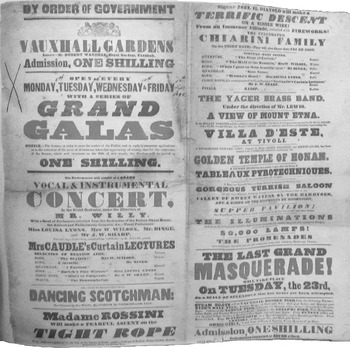
Even with new multicolored fonts, Vauxhall's posters struggled to do justice to the panoply of acts engaged by the irrepressible Bunn, or to the mammoth illusionistic tableaux that rose from the far end of the Waterloo Ground (fig. 3). The
Vauxhall poster of 1845 (Museum of London, Warwick Wroth Collection).

Waterloo Ground spectacles had begun in Gye's time with “the Polar Regions” (1834), but under Bunn became much more architectural, starting with the “City of Acre” in 1841, which was bombarded by a “crusader army,” and the “City of Hamburgh” in 1842, which burned down nightly in a fashion “as near reality as the most fervid admirer of fire and flame could wish.”Footnote 51 They continued, under later managers, with Venice (1847), which included fireworks, and ended in 1850 with the Temple at Rangoon, which was stormed.Footnote 52 In addition to this open space (which now had raked open-air seating), in the 1840s Vauxhall also boasted a circus (in the old rotunda, complete with boxes) and a small ballet theater (erected to the east of the rotunda). The orchestra was now framed by a rectangular covered walk, the enclosed open space being covered with a dancing platform by 1850. Bunn showcased electrifying French conductors such as Musard and Louis Jullien in the early 1840s. Charismatic performers in their own right, these men astonished audiences with their élan, their arrangements providing familiar orchestral favorites with covering fire (cannons as percussion). Later managers were less inventive, although the usual diet of comic songs and medleys of Rossini, Beethoven, and Auber continued. The last three years saw an increase in circus acts, notably the world-famous clown Edwin Croueste, who appeared in 1858 as part of his brother Harry Croueste's Circus.
The increase in covered areas for visitors and performers lessened the Gardens's dependence on the weather, but at a cost: the structures required the chopping down of trees and made the Gardens feel much less “natural.” There were only two short “walks” left in 1841, and many of their trees were well past their prime. This made it difficult to keep up with the competitors such as Cremorne Gardens and, especially, the Surrey Zoological Gardens, which combined similar acts with horticultural displays that made daytime visiting an inviting prospect for visitors.Footnote 53
By following Gye's example in borrowing acts like Keller's “poses plastiques” and Ducrow's “Beautiful Horses and Equestrian Artistes” from rival venues, Bunn and his successors were hardly building on the Gardens's strengths. The seating arrangements at the various Vauxhall stages were hastily concocted and frequently altered. Large unregulated crowds wandered from act to act as the traditional bell demanded, but were rarely comfortable enough to give the plot of the opera or other show their undivided attention.Footnote 54 The backstage arrangements for Waterloo reenactments and other large-scale equestrian displays could hardly be expected to rival the purpose-built facilities at the rival Astley's Circus. Some observers clearly felt that Vauxhall was wasting its time trying to keep up. Its history and tradition were powerful enough to lift it above such petty rivalries.
Vauxhall could make a virtue of its superannuation—by packaging itself as “Old Vauxhall,” as a Georgian period piece, or even as a living museum. The appeal of this approach was suggested by the following account of the Gardens from The Mirror of Literature, Amusement, and Instruction for August 1830: “Old and young—the world in all its seven ages—everyone loves Vauxhall. It is a pleasant place for old folks to think of by-gone days and scenes; and there's so much agreable anecdote respecting the spot, that it is impossible not to be charmed with the name. You dream of its hundredfold associations; —as Addison, and Sir Roger de Coverley's voyage to the gardens; old Jonathan Tyers, and all the paintings in the pavilions by Hayman and Hogarth, and the singers, too; and the old-fashioned orchestra.”Footnote 55 Vauxhall's associations with the Georgian literary, artistic, and musical canon were clear. Although Hogarth's role in the Gardens was frequently exaggerated, for the most part this reputation was deserved.
Seen in this light, presenting “Old Vauxhall” as a piece of national heritage was easy. Illustrations by George Cruikshank and others in the nineteenth-century editions of classics like Fielding's Amelia linked a national literary canon with images of Vauxhall.Footnote 56 Inside the Gardens themselves, programs from the 1840s included “a vocal ballet with summer masque, call’d Old Vauxhall, or the Hermit's Ring” and songs by “Old Vauxhall” composers like Arne. Historical associations with Addison and others were the mainstay of Bunn's Vauxhall Papers (1841), an illustrated periodical “published every night” and sold in the Gardens. As its editor observed, “in honest truth, Vauxhall must have its historian, or perhaps half a dozen, according to the length of the material which we may be furnished with, in addition to which we possess.” In publications, Bunn juxtaposed transcripts of eighteenth-century menus, songs, and descriptions and engraved vignettes of 1840s Vauxhall's equivalents.Footnote 57 He even cheerfully repeated the familiar, if not rather tired, jokes surrounding the thinness of the ham.Footnote 58
Vauxhall's cod-Georgian invites comparison with that vaguely Elizabethan “Olden Time” cult discussed by Peter Mandler, an easily digestible costume drama where class, religious, or any other species of bothersome conflict is forgotten in the blur of merrie maypole dancers. Although mainly concerned with how “Olden Time” helped save the country house, Mandler does note that London monuments were also transformed into popular tourist destinations by the historical novels of William Harrison Ainsworth (1805–82), notably his Tower of London: A historical romance (1840) and Old Saint Paul’s (1841), each part romance, part guidebook.Footnote 59
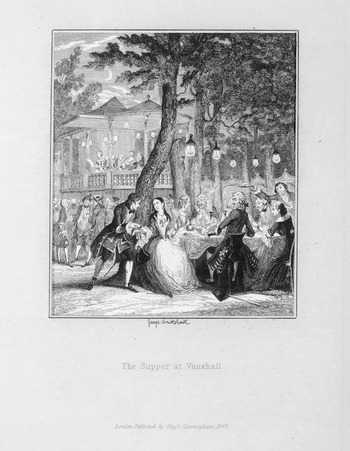
Ainsworth published his most successful novels in the early 1840s, and among them was the three-volume The Miser's Daughter (1841; 2nd ed. 1843), set in eighteenth-century London. This melodramatic page-turner (subsequently adapted for the stage) follows the bumpy road to matrimony traveled by the beautiful Hilda Scarve and the sturdy countryman Randulph Crew.Footnote 60 Ainsworth's characters spend much of their time in pleasure gardens. The author introduces each visit with historical background, bewailing the loss of Ranelagh and Marylebone Gardens, which he describes as “the delight of our grandfathers and grandmothers, the boast of the metropolis, the envy of foreigners, the renowned in song and story, the paradise of hoops and wigs.”Footnote 61 Vauxhall Gardens, he “rejoices” to note, “are not altogether closed.”Footnote 62 Pleasure gardens are presented as places for masquerade and role playing, where fateful meetings and affrays occur. Here the foppish aristocrat Beau Villiers encounters his own valet posing as a lord (in his master's clothes) and squiring a rich heiress round the avenues. Here Crew and Hilda can steal a moment together (fig. 4), vowing eternal devotion to each other. Here Beau's dastardly plot to lure Hilda into one of Vauxhall's dark walks and kidnap her is foiled by Crew's dramatic entrance (“Not so fast, villains!”). The next morning they fight a duel. Star-crossed love, role reversal, affray: the novel's plot is driven by meetings and collisions in pleasure gardens.Footnote 63 Once again, George
George Cruishank, The Supper at Vauxhall, illustration from Ainsworth's The Miser's Daughter, 1843.

Cruikshank's illustrations showed gardens thronged with simpering lords, ogling masqueraders, and even (at Ranelagh) maypole dancers.Footnote 64
London travelogues and memoirs from the 1850s were also haunted by “Old Vauxhall.” By this decade, rumors of the Garden's closure had become almost an annual feature, if not a tradition in themselves. As the Victorian historian of London Edward Walford observed, “no public favourite ever had so many ‘positive last appearances’ as Vauxhall.”Footnote 65 In 1851, the year of the Great Exhibition, John Tallis's Illustrated London still noted Vauxhall as one of the “metropolitan sights that foreigners and strangers should not leave unvisited.”Footnote 66 The persistence of Vauxhall in Victorian guidebooks is a useful corrective to accounts of its decline, and points to an important paradox. The railway that blighted Vauxhall's surroundings, and which allowed Londoners to neglect it in favor of excursions further afield, became, thanks to the fame of “Old Vauxhall,” its savior. For now tourists from around the country could visit Vauxhall. As James Ewing Ritchie explained in his Here and There in London (1859): “The railway system has done this for London. From the wilds of Connemara, from the distant Land's End and remote John o’Groat’s, old and young, male and female, rich and poor, wise or foolish, come in shoals to see London and its sights. Now Vauxhall, and its illumination, and its sliver of ham, have become the wonder of generations, and to Vauxhall away they rush.”Footnote 67 At the same time, he unapologetically stated, it had to be admitted that “Vauxhall is one of the delusions of London life. It lives on the past.”
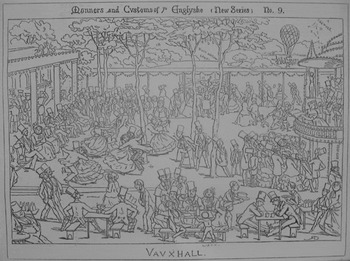
The image of Vauxhall as a beloved, if slightly shabby national treasure is confirmed by Punch's 1850 scene of the Gardens (fig. 5), part of a series illustrating the “Manners and Customs of ye Englyshe”—the “Olde”-style spelling lending it a quaint historical feel. Here we find the same old joke about “10,000 additional lamps” and the same dandies strutting about or jauntily leaned up against the trees, watching others with macaroni-esque intensity. What is different from similar scenes of Vauxhall crowds dating from the two earlier phases is the dancing, which seems to have grown in importance in the 1850s. Emulating Cremorne, the platform was extended into a “monster platform” by Wardell in 1851. Also noteworthy is the number of children, suggesting that Gye's bid for a family audience had succeeded. A first visit to Vauxhall had been a rite of passage for young children of both sexes since the eighteenth century. Whereas the age for a first visit seems to have been around sixteen in the late eighteenth century, by 1830 it had dropped to about twelve. Author and mountaineer Albert Smith was twelve when he took his much-anticipated first steps into the Gardens, speechless with wonder.Footnote 68 The children in the Punch cartoon seem even younger. There seem to be several groups of the sort Boz described in 1836 as consisting of a “gentleman, with his wife, and children, and mother, and wife's sister, and a host of female friends, in all the gentility of white pocket-hankerchiefs, frills, and spencers.”Footnote 69
Seen with hindsight, Bunn's arrival marked a shift toward a lower-middle-class audience. Insofar as Vauxhall had always been known as a place for mingling ranks, thinly veiled soliciting, and some questionable behavior—Vauxhall's waiters were tripped up and otherwise abused for over a century—it may have been difficult
David Reynolds, Vauxhall, illustration from Punch, 1850.

for contemporaries to note this change, other than in the time-honored way of recalling previous visits with tinted spectacles. Writing in 1851, Charles Knight noted in his Cyclopaedia of London that the performances at the Gardens were “constantly varied, according to the prevailing fashion. At some seasons balloons are all the rage; at others, equestrian exhibitions. Music and fireworks are never-ceasing attractions. Vauxhall has ceased to be a place of fashionable amusement; but it is not the less decorous for being cheap.”Footnote 70 Although 1855 saw Tyrrel Smith put on six “Fetes for the Million” (“million” suggesting a working-class audience), the closure of the Gardens caught Knight by surprise. As he wrote in his London (1860): “It were a curious study to trace the progress of the public taste in matters of amusement. Take, for instance, the once prosperous as well as famous place of entertainment [Vauxhall] … how should we explain the fact that, having made bankrupts of more than one of its proprietors, [it] came to an end in the height of its popularity with the middle classes about the year 1860?”Footnote 71
Vauxhall's last night finally came on 25 July 1859, and on 29 August the various sets, booths, and lights were sold at auction, an event that moved Punch's “Man of Feeling” to strike a comically plangent note.Footnote 72 A developer bought the lease and covered the former Vauxhall grounds with low-quality terraced housing, arranged along a network of new streets, some of which (“Italian Walk” and “Gye Street”) alluded to the site's history. At some point after the Second World War the majority of these houses were cleared. The resulting park allows one mentally to reconstruct some of the Gardens's features—and to marvel that so much life and imagination was devoted to such a small, unassuming plot of Lambeth real estate.
Taking a step back, the history of Vauxhall Gardens post-1770 seems to be characterized by two apparently contradictory trends: the introduction of alternatives to the autovoyeuristic circulation that had formed the Gardens's main appeal in the eighteenth century, and the marketing of the Gardens as a land of eternal Georgian youth. The former process began with the introduction of fireworks in 1798 and shifted up in gear in the 1820s and the 1840s. Instead of leaving the visitors to perform for themselves to the accompaniment of music, the management increasingly provided them with other things to look at—performances by paid professionals. The more the management diversified the entertainments on offer, the more trees and open walks had to be swept away in order to build the requisite theaters and show grounds.
The panoply of acts engaged by Vauxhall's impresarios could be seen as a panicked reaction to attacks on the immorality of participation in autovoyeurist pleasure, as a moralizing attempt to provide something to stop the visitors from role playing with themselves. Or it might emerge from a natural desire to give the people what they want, combined with a realization that looking at the crowd was no longer fun. The 1820s campaign by predominantly Dissenting voluntary groups to pressurize Surrey magistrates into cracking down on Vauxhall was motivated by a concern that “spectators have themselves become actors.”Footnote 73 But in defending the right to pleasure, opponents of such prurient meddlers had to admit that Vauxhall's main spectacle—the crowd—no longer provided any.
Widespread regret at the loss of Vauxhall should give us pause here. There is little evidence to suggest that the 1850s saw Vauxhall fall prey to the demonization of that social mixing that had been its defining characteristic for nigh on two centuries. On the contrary, around mid-century social commentators from the camps of “Young England” (like Lord John Manners) and “Christian Socialists” (like Charles Kingsley) highlighted the importance of resisting the trend toward class-specific leisure pursuits.Footnote 74 Almost twenty years after the event, the Benthamite statistician and political economist William Stanley Jevons bemoaned the closure of Vauxhall in a Contemporary Review essay on “Methods of Social Reform,” linking its demise with a narrow-minded NIMBYism and exaggerated bourgeois distaste for amusement. It was foolish for would-be improvers of the poor to focus on museums and scientific lectures, when the best means lay in encouraging “our great caterers … [to] make a point of mingling all classes together, and retaining a reputation as places of fashionable resort.”Footnote 75
That social commentators as diverse as these could agree that the decline of Vauxhall represented a serious loss suggests that the retreat of the upper and middle class from Vauxhall by 1840 was not primarily motivated by fear or disgust for mingling and autovoyeurism. Far from being seen as a threat to national morals, even after its disappearance Vauxhall could still be seen as a way of remodeling society for the better. But its relative simplicity compared to the wide range of new shows available year-round in central London made it seem behind the times. Examples of these include panoramas and the omnium gatherum of scientific amusement to be found in the Egyptian Hall and the Adelaide Gallery from the 1830s onward. Astley's own success in marketing his circus as a “national institution” created a climate in which thirteen more permanent circus buildings were erected in London by 1843, when the Theater Regulation Act loosened up restrictions on their operation.Footnote 76 All these enterprises demanded large capital investment. In order to recoup that investment, impresarios needed long seasons. As a summer-only resort, Vauxhall struggled to compete. It also faced thousands of smaller rivals in those other gardens attached to suburban villas. These helped make domestic gardening a popular yet private diversion that by the 1830s was clearly engrossing many of those one would otherwise have expected to visit Vauxhall.Footnote 77
Yet the nostalgia of “Old Vauxhall” could make a virtue out of the Gardens's failure to match the novelties introduced by its rivals and also reassure those fearful of its temptations by packaging its pleasures as historical. This began in the 1820s with Master of Ceremonies C. H. Simpson, “the very climax of obsolete politeness,” and accelerated in the 1840s.Footnote 78 Far from suggesting an artificial cordon sanitaire between present and past, for many visitors Vauxhall's history was family history—something familiar and close at hand, rather than strange and remote. The relics of “Old Vauxhall” could be found in the stories told by grandparents, in the new illustrated editions of familiar classics, or on the walls of one's home. Albert Smith's “earliest notions … of Vauxhall were formed from an old coloured print which decorated a bed-room at home, and represented the Gardens as they were in the time of hoops and high head-dresses, bag-wigs, and swords.” In a “damp spare-room closet” he found “old pocket-books and magazines” containing the texts of Vauxhall ballads, and he wrote that “for years I looked forward to going to Vauxhall, as a treat too magnificent ever to take place.” These comments from Smith's autobiography were twice removed from the age that produced these prints and ballads. In a twist on the familiar process that has youthful fantasy yield to mature engagement with sober reality, in Smith's case reality never lived up to Vauxhall's illusion. He described visiting the battlefield of Waterloo many years after seeing a Waterloo reenactment at Vauxhall: “I was disappointed in its effect. I thought it ought to have been a great deal more like Vauxhall.”
“Despite its hacknied amusements,” Smith concluded, “we have all pleasant associations connected with Vauxhall: I would not willingly exchange my own for dearer reminiscences of things far more important in the romance of life.”Footnote 79 A space that had been genuinely exciting and challenging to norms of politeness and gender-appropriate behavior in the late eighteenth century was thus retrospectively tamed. Rather than a reminder of an oversophisticated age playing fast and loose with identities that were best left untouched, Vauxhall was associated with a simpler age: with childish credulity and honesty rather than the willed disbelief and complex ambivalences that in fact characterized the late eighteenth-century resort. This explains why Smith, Egan, Dickens (the latter in the guises of Makemoney and Boz), as well as less renowned commentators refused to explain Vauxhall's decline solely in terms of mismanagement or of working-class debasement of a preserve formerly restricted to the upper classes.
This also explains their feelings of complicity. Vauxhall had not changed—they had. A correspondent to a London newspaper in 1830 wrote that “the world is as of old—and Vauxhall may be, but ‘the vision and the faculty divine’ have passed from us—our eyes are open, and our hearts are closed.” He added, “something of this change may be in ourselves.”Footnote 80 As Dickens put it, formerly these middle-class visitors had been willing to play along: “The temples and saloons and cosmoramas and fountains glittered and sparkled before our eyes; the beauty of the lady singers and the elegant deportment of the gentlemen, captivated our hearts; a few hundred thousand of additional lamps dazzled our senses; a bowl or two of reeking punch bewildered our brains; and we were happy.”Footnote 81 But then they were lured into demanding greater illusions, even though the pleasurable return on this increased investment was diminished by greater awareness of their fictitiousness. Knowing sophistication replaced willed disbelief. In accounting for Vauxhall's Victorian afterlife it is hard to disagree with Alfred Bunn's pithy conclusion: “Vauxhall never lost itself—other people lost it; and on the principle of drowning men catch[ing] at straws, the attempts to resuscitate it, sank it.”Footnote 82
Far from being a curious survival of eighteenth-century London or a stale backwater that appealed to the baser appetites of a lower class, nineteenth-century Vauxhall continued to draw visitors from a wide social range. Indeed, the arrival of juvenile fetes, new attractions, and railway tourists broadened its generational, social, and geographical catchment. Its afterlife was actually a reinvention: “Old Vauxhall” certainly involved harking back to a gilded, Georgian past—but this very gesture was a characteristically modern one. Its survival forced Londoners to consider how the demands they made of leisure had changed, along with the way in which they triangulated between themselves, their fellow spectators, and increasingly professionalized actors.
Flagging interest and newer, scripted performances by paid professionals made autovoyeurism less appealing from 1820 onward. Heightened moral concerns surrounding role play were also an important factor. We should be careful not to overemphasize such concerns, however, and should certainly not instrumentalize them into a power play by a Dissenting middle-class clique of social reformers, or as evidence of a big ditch separating Georgian and Victorian cultures. More work is needed here on diaries and other sources to see how female observers visualized the Gardens, building on recent scholarship that seeks to write women back into the Victorian city.Footnote 83
It is important to recognize that even if the reinvention of Vauxhall made the Gardens less disorientating, many observers still felt that something had been lost. Vauxhall's afterlife, the countless “last nights” and rich historical, literary, and personal associations it enjoyed in the eighty years preceding 1859 could be seen as comprising one extremely labored and drawn-out farewell to polite Georgian illusion. It would be better to see it as evidence of real continuities in Georgian and Victorian culture.