Introduction
Underage alcohol binge drinking has sharply increased and is a health and social concern (Halkjelsvik, Brunborg, & Bye, Reference Halkjelsvik, Brunborg and Bye2021). The intersection between intoxicating alcohol binges and the adolescent brain can trigger structural and functional impairment of critical neural pathways (Jones, Lueras, & Nagel, Reference Jones, Lueras and Nagel2018) that can hinder the high-powered potential of the developing brain to maintain emotional control and cope with psychological threats (Sachser, Hennessy, & Kaiser, Reference Sachser, Hennessy and Kaiser2011). Adolescence indeed is sculpted with highly conserved characteristics to meet common evolutionary pressures and social stress, which may include confrontations among peers, and subordination when encountering intimidating older adults.
Both alcohol- and social stress-adaptation involve common neural circuitries (Bath et al., Reference Bath, Russo, Pleil, Wohleb, Duman and Radley2017; Brancato et al., Reference Brancato, Castelli, Cavallaro, Lavanco, Plescia and Cannizzaro2018; Brancato, Plescia, Lavanco, Cavallaro, & Cannizzaro, Reference Brancato, Plescia, Lavanco, Cavallaro and Cannizzaro2016; Koob, Reference Koob2013; Plescia et al., Reference Plescia, Cannizzaro, Brancato, Martines, Di Naro, Mucia and Cannizzaro2015) interconnected in the nucleus accumbens (NAc). Besides activating the neuroendocrine hypothalamic–pituitary–adrenal (HPA) axis, social stress exposure induces lasting changes in dopamine (DA) and excitatory plasticity-related signals in the reward circuitry (Baik, Reference Baik2020; Deal, Konstantopoulos, Weiner, & Budygin, Reference Deal, Konstantopoulos, Weiner and Budygin2018) that may promote negative emotional states and abnormal coping.
Likewise, intoxicating alcohol binges induce hyper-responsiveness of the HPA axis, in terms of abnormal hypothalamic and extrahypothalamic corticotropin-releasing hormone (CRH) expression and serum glucocorticoid levels; in addition, metaplastic changes in the DA and glutamate signalling occur in the accumbal synaptic triad, that correlate with dysfunctional behaviour (Brancato et al., Reference Brancato, Castelli, Lavanco, Tringali, Micale, Kuchar and Cannizzaro2021; Retson, Sterling, & Van Bockstaele, Reference Retson, Sterling and Van Bockstaele2016). Previous work evidenced a considerable susceptibility of NAc morpho-functional architecture to acute and prolonged alcohol withdrawal resulting in altered synaptic plasticity and dendritic remodelling (Cannizzaro et al., Reference Cannizzaro, Talani, Brancato, Mulas, Spiga, De Luca and Diana2019; Spiga et al., Reference Spiga, Talani, Mulas, Licheri, Fois, Muggironi and Diana2014).
While several reports describe how the adolescent brain is particularly vulnerable to alcohol as a result of stress-related changes (Boutros et al., Reference Boutros, Der-Avakian, Kesby, Lee, Markou and Semenova2018; Burke & Miczek, Reference Burke and Miczek2014), little evidence can be found on the interference intoxicating alcohol binges have on specific abilities to adapt to psychosocial stress. Indeed, adolescents can easily engage both in alcohol binge drinking and in challenging social threats, putting at risk the development of appropriate adaptive responses.
Face and construct validity support the use of the resident–intruder paradigm (RIP), as a tool for studying applicable aspects of social stress response in rodents: isolated, older aggressive resident rats are confronted in their home cage with grouped young intruders that implement – and adjust – their defensive behaviour to receive fewer attacks (Burke & Miczek, Reference Burke and Miczek2015; Koolhaas et al., Reference Koolhaas, Coppens, de Boer, Buwalda, Meerlo and Timmermans2013).
Hence, the current research addresses the perplexing issue namely if coping strategy to social stress might be jeopardized in young rats following repeated intermittent exposure to intoxicating alcohol levels during adolescence. Stress-related HPA axis response, in terms of corticosterone plasma levels, is also investigated.
Once we assessed the expression of abnormal defensive behaviour in the RIP, we explored different levels of neuroplasticity in the rat NAc. Here, alcohol abuse and withdrawal can disarrange the subtle balance between DA levels and glutamate release that critically regulates synaptic plasticity and affect spine shape and stability in the medium spiny neurons (MSNs) (Cannizzaro et al., Reference Cannizzaro, Talani, Brancato, Mulas, Spiga, De Luca and Diana2019; Dani & Zhou, Reference Dani and Zhou2004; Fasano et al., Reference Fasano, Bourque, Lapointe, Leo, Thibault, Haber and Trudeau2013; Paillé et al., Reference Paillé, Picconi, Bagetta, Ghiglieri, Sgobio, Di Filippo and Calabresi2010; Spiga et al., Reference Spiga, Talani, Mulas, Licheri, Fois, Muggironi and Diana2014).
Indeed, our working hypothesis is that the NAc represents the intersection point in which maladaptive plasticity induced by binge-alcohol withdrawal combines – and impacts – neuroadaptation that occurs as a consequence of social stress exposure. In detail, we investigated DA mesolimbic signalling by measuring presynaptic tyrosine hydroxylase (TH) and DA transporter (DAT) density, as a measure of DA synthesis and reuptake, and postsynaptic D1- and D2-receptor mRNA expression; MSN excitatory plasticity through post-synaptic density protein 95 (PSD95) and Homer 1 (HOM1) expression (Brancato et al., Reference Brancato, Castelli, Lavanco, Tringali, Micale, Kuchar and Cannizzaro2021; Brancato, Castelli, Lavanco, Marino, & Cannizzaro, Reference Brancato, Castelli, Lavanco, Marino and Cannizzaro2020); spine dynamics and activation, by quantifying the expression of the activity-regulated cytoskeleton-associated protein (ARC) (Guzowski et al., Reference Guzowski, Miyashita, Chawla, Sanderson, Maes, Houston and Barnes2006), and experience-dependent structural and functional adaptation in MSNs, through the expression of forkhead box P1 (FOXP1) (Anderson, Kulkarni, Harper, & Konopka, Reference Anderson, Kulkarni, Harper and Konopka2020).
At last, we hypothesized a counteractive strategy based on the favourable effects of the largest non-psychotomimetic (Viudez-Martínez et al., Reference Viudez-Martínez, García-Gutiérrez, Medrano-Relinque, Navarrón, Navarrete and Manzanares2019) phytochemical component of cannabis, cannabidiol (CBD), on alcohol-related harms in preclinical models and stress-induced anxiety and discomfort in humans (Elsaid, Kloiber, & Le Foll, Reference Elsaid, Kloiber and Le Foll2019; Viudez-Martínez et al., Reference Viudez-Martínez, García-Gutiérrez, Navarrón, Morales-Calero, Navarrete, Torres-Suárez and Manzanares2018b). CBD can functionally interact with the mesolimbic DA system in the NAc, where it exerts modulatory effects on various cognitive and emotional processes via a multimodal pharmacological profile that involves not exclusively the endocannabinoid transmission (Bhattacharyya et al., Reference Bhattacharyya, Morrison, Fusar-Poli, Martin-Santos, Borgwardt, Winton-Brown and McGuire2010; Guimarães, Zuardi, Del Bel, & Guimarães, Reference Guimarães, Zuardi, Del Bel and Guimarães2004; Melas, Scherma, Fratta, Cifani, & Fadda, Reference Melas, Scherma, Fratta, Cifani and Fadda2021). Accordingly, we administered sub-chronic doses of CBD during the RIP to test its potential in offsetting the behavioural and molecular changes associated with binge-like alcohol exposure during adolescence.
Materials and methods
For a complete description of the experimental methods, refer to the online Supplementary material.
Animals
Adolescent male Wistar rats and retired breeder male Wistar rats (Envigo, Italy) were housed in standard polycarbonate cages with bedding (in pairs and single, respectively), maintained at 22 ± 2°C, with 55 ± 5% humidity, on a 12 h light/dark cycle (lights on at 08:00 AM), with ad libitum food (Mucedola, Italy) and water. Procedures were approved by the Italian Ministry of Health (1119/2016-PR) in adherence with Italian (D.L.26/2014) and European (2010/63/EU) legislation on laboratory animals' use. Every effort was made to minimize the number of animals used and their suffering.
Drugs
Alcohol (96%; Carlo Erba, Italy) was diluted with tap water at 25% v/v. Cannabidiol (2-[(1R,6R)-6-isopropenyl-3-methylcyclohex-2-en-1-yl]-5pentylbenzene-1,3-diol, CBD) was isolated in the Forensic Laboratory of Biologically Active Substances of the University of Chemistry and Technology of Prague from supercritical CO2 extracts obtained from technical cannabis, with purity (NMR) >99% (Nemeškalová, Hájková, Mikulů, Sýkora, & Kuchař, Reference Nemeškalová, Hájková, Mikulů, Sýkora and Kuchař2020). Binge-like alcohol withdrawn (BAW) and control (CTRL) rats were sub-chronically administered with CBD at 60 mg/kg, or vehicle (1% ethanol, 1% Tween 80, saline) (i.p.) (Brancato et al., Reference Brancato, Castelli, Lavanco, Tringali, Micale, Kuchar and Cannizzaro2021), 90 min before the experimental sessions (Deiana et al., Reference Deiana, Watanabe, Yamasaki, Amada, Arthur, Fleming and Riedel2012). This dose, devoid of suppressive motor activity (online Supplementary material), was shown to reduce alcohol reinforcing properties, motivation and relapse, together with specific related gene expression (Viudez-Martínez et al., Reference Viudez-Martínez, García-Gutiérrez, Navarrón, Morales-Calero, Navarrete, Torres-Suárez and Manzanares2018b).
Binge-like alcohol exposure
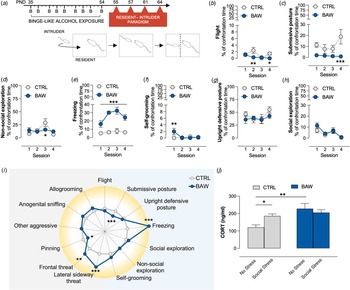
Rats were exposed to an intermittent binge-like alcohol paradigm during adolescence (PND 35–54, Spear, Reference Spear2000) at the dosage of 3.5 g/kg (Varlinskaya, Truxell, & Spear, Reference Varlinskaya, Truxell and Spear2014), every other day, for nine exposures (Fig. 1a). The 25% alcohol solution was daily prepared and administered per os as previously described (Turner, Brabb, Pekow, & Vasbinder, Reference Turner, Brabb, Pekow and Vasbinder2011), resulting in binge-like blood alcohol concentrations (193 ± 19 mg/dl) (Brancato et al., Reference Brancato, Castelli, Lavanco, Tringali, Micale, Kuchar and Cannizzaro2021). CTRL rats were given an isovolumetric amount of water on the same exposure days.
BAW impairs behavioural and neuroendocrine social stress coping. (a) Rats were exposed to binge-like alcohol during adolescence and evaluated for coping abilities in four sessions of the RIP during withdrawal, in comparison with CTRL counterparts. (b) BAW rats displayed decreased flight, (c) submissive postures and (d) non-social exploration when compared with CTRL rats. On the other hand, (e) BAW rats showed increased freezing over the sessions, and (f) self-grooming in comparison with CTRLs. (g) Upright defensive posture and (h) social exploration were not affected by BAW. (i) Overall, the analysis of cumulated percentages of intruder behaviour indicated a different social stress-coping strategy in BAW rats with respect to CTRLs (two-way ANOVA, BAW: F (1,84) = 0.3543, p = 0.5533; behaviour: F (6,84) = 131.2, p < 0.0001; interaction: F (6,84) = 13.99, p < 0.0001). In detail, BAW intruders displayed decreased submissive postures (t = 4.087, df = 84.00, p = 0.0007) and increased freezing (t = 7.884, df = 84.00, p < 0.0001) when compared with CTRL, while no significant differences were highlighted in cumulated percentages of flight (t = 0.3508, df = 84, p > 0.999); upright defensive posture (t = 2.225; df = 84; p = 0.2014); social exploration (t = 0.4957, df = 84, p > 0.999); non-social exploration (t = 0.2913, df = 84, p > 0.999) and self-grooming (t = 0.1493, df = 84, p > 0.999). Moreover, the analysis highlighted a higher resident aggressive behaviour towards BAW rats than CTRLs. Indeed, although no different mean rate of bites was observed (CTRL = 0.324 ± 0.122 attack/min; BAW = 0.546 ± 0.481 attack/min; Mann–Whitney test: U = 17, p = 0.3666), the analysis of cumulated percentages of aggressive behaviour the intruders showed that BAW rats underwent higher level of aggressive behaviour (two-way ANOVA, binge-like alcohol exposure: F (1,72) = 18.79, p < 0.0001; behaviour: F (5,72) = 28.85, p < 0.0001; interaction: F (5,72) = 15.38, p < 0.0001), with increased lateral sideways threats (t = 8.508, df = 72, p < 0.0001) and frontal threat posture (t = 3.821, df = 72, p = 0.0017) with respect to CTRL rats. In addition, post hoc analysis showed a decrease in cumulated pinning in BAW rats (t = 2.819, df = 72, p = 0.0373) when compared to CTRLs, and no significant difference in cumulated percentages of other aggressive behaviour (t = 0.0665, df = 72, p > 0.999); anogenital sniffing (t = 0.2139, df = 72, p > 0.999) and allogrooming (t = 0.8259, df = 72, p > 0.999). (j) In addition, neuroendocrine response to the RIP revealed a blunted neuroendocrine response to social stress in BAW rats. Each circle and each bar represent the mean of n = 7 rats, while error bars indicate s.e.m. Dots in radar graph represent standardized values, cantered at zero for the CTRL group. *p < 0.05; **p < 0.01; ***p < 0.001. PND, postnatal day; CTRL, control; BAW, binge alcohol withdrawal.

Resident–intruder paradigm
Twenty-four hours after the last alcohol administration, BAW and CTRL rats were tested in the RIP (Burke & Miczek, Reference Burke and Miczek2015) at PND 55 (session 1), 57 (session 2), 61 (session 3) and 64 (session 4) (Fig. 1a). Briefly, the intruder rat was introduced into the resident's home cage for the confrontation, which terminated 5 min after the first attack bite, and exposed to further sensory contact for 10 min. RIP occurred between 9:00 AM and 1:00 PM under dim light (15–20 lux). The sessions were recorded and intruder- and resident behaviours during the confrontation were quantified by a trained observer, blind to the treatment, using Boris v. 7.9.4 (Friard & Gamba, Reference Friard and Gamba2016). They were expressed as a percentage of total confrontation time. Resident aggressions were expressed in number of attacks per minute. No-stress exposed groups (NS-CTRL; NS-BAW) remained undisturbed in their home cage.
Corticosterone determination
Twenty-four hours after the last RIP session, rats were anesthetized and sacrificed (1:00 and 3:00 PM), trunk blood samples were collected for serum preparation and kept at −20°C. Serum corticosterone levels (CORT, ng/ml) were measured using a commercially available ELISA kit (Demeditec Diagnostics GmbH, Kiel, Germany), according to the manufacturers' instructions.
Gene expression analysis
Brains were rapidly removed, divided into two sagittal halves in a brain matrix on ice, for NAc dissection (Paxinos & Watson, Reference Paxinos and Watson1986). Tissue was flash frozen, and stored at −80°C until gene expression analysis. RNA extraction and quantitative real-time polymerase chain reaction (qRT-PCR) were conducted as previously described (Brancato et al., Reference Brancato, Castelli, Lavanco, Tringali, Micale, Kuchar and Cannizzaro2021). Primers employed in qRT-PCR experiments are provided in the online Supplementary material. Analysis was performed using the ΔΔC(t) method, using glyceraldehyde 3-phosphate dehydrogenase as a reference gene. Data are expressed as fold change relative to relevant control group (NS-CTRL; CTRL).
Immunofluorescence experiments
Free-floating immunofluorescent staining was performed as previously described (Brancato et al., Reference Brancato, Castelli, Lavanco, Marino and Cannizzaro2020, Reference Brancato, Castelli, Lavanco, Tringali, Micale, Kuchar and Cannizzaro2021). Details, including primary and secondary antibodies employed, are provided in the online Supplementary material. For each NAc section, images of core and shell were acquired at 100× magnification (U plan 100×/1.25 oil, Meji Techno, Japan), and deconvolved using Deltapix Insight, Denmark. Immunofluorescence was quantified as to integrated density over the threshold (ImageJ, NIH). Shell and core values from each NAc section were averaged and expressed as relative immunofluorescence percentages, with reference to controls levels (NS-CTRL; CTRL).
Data analysis
Behavioural data were analysed by repeated measure (RM) two-way analysis of variance (ANOVA), or RM three-way ANOVA with Geisser–Greenhouse correction, performed on the percentage of the duration of each behavioural category over the four RIP sessions. Two-way or three-way ANOVA were employed for the analysis of cumulated percentages over the four sessions. Mann–Whitney test was performed, when appropriate. Neuroendocrine and neurobiological data were analysed by two-way ANOVA. Bonferroni post-hoc test was employed, when necessary. Grubb's test was employed to identify outliers and one sample, out of seven, was excluded from the statistical analysis of D2R expression data. Data are reported as mean ± s.e.m. Radar graphs represent standardized measures to the reference condition. Statistical analysis was performed using Prism v.9.3.1 (GraphPad). Significance was set at alpha = 0.05.
Results
BAW alters social stress response
BAW intruder rats' defensive behaviour displayed a significant decrease in flight (Fig. 1b), submissive postures (Fig. 1c), non-social exploration (Fig. 1d); a significant increase in freezing (Fig. 1e) and self-grooming (Fig. 1f), compared with CTRLs. No difference was observed in upright defensive postures and social exploration (online Supplementary material). Complete statistical analysis is reported in online Supplementary Table S1.
Overall, the analysis of cumulated percentages of behaviour indicated different social stress coping in BAW rats with respect to CTRLs: BAW rats displayed lower submissive postures and higher freezing than CTRL rats; moreover, BAW intruders underwent increased lateral sideways and frontal threats, and decreased pinning, compared to CTRLs (Fig. 1i).
In addition, different serum CORT levels were observed in response to the RIP (BAW: F (1,24) = 10.74, p = 0.0032; stress: F (1,24) = 1.248, p = 0.2750; interaction: F (1,24) = 5.167, p = 0.0323). NS-BAW rats showed higher CORT levels than NS-CTRL rats (t = 3.924, df = 24, p = 0.0013); however, while RIP exposure was associated with higher CORT levels in CTRLs (t = 2.397, df = 24, p = 0.0493), no difference was observed in BAW rats (t = 0.8174, df = 24, p = 0.8435) (Fig. 1j).
BAW modifies neuroplasticity in the NAc
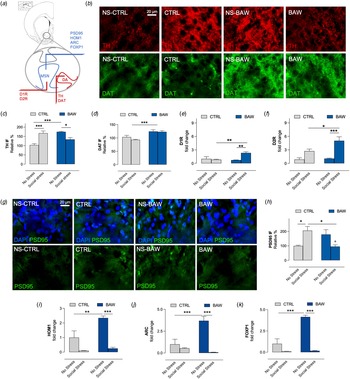
BAW (F (1,24) = 4.526, p = 0.0439) and its interaction with social stress exposure (F (1,24) = 35.37, p < 0.0001) significantly altered TH-positive immunofluorescence (main effect of stress: F (1,24) = 1.662, p = 0.2096). In detail, NS-BAW rats showed higher TH levels than NS-CTRLs (t = 5.71, df = 24, p < 0.001); however, social stress exposure was associated with increased TH levels in CTRL intruder rats (t = 117, df = 24, p = 0.002), and to decreased TH immunofluorescence in BAW intruder rats (t = 3.294, df = 24, p = 0.0184), compared with respective NS counterparts (Fig. 2b, c).
BAW disrupts social stress-related DA and glutamate neuroplasticity in the NAc. (a) Relevant markers of DA- and glutamate-related neuroplasticity in the NAc following the RIP were evaluated in BAW and CTRL rats and compared with NS-counterparts. (b) DA presynaptic markers were assessed by immunofluorescence, as shown in representative pictures of TH (red) and DAT (green) staining. We observed: (c) increased TH levels in CTRL rats compared to NS-CTRL, and decreased levels in BAW rats with respect to NS-BAW; moreover (d) higher DAT-positive immunofluorescence in BAW rats than in CTRLs. As to DA-related postsynaptic markers, RIP-exposed BAW rats displayed (e) increased D1R expression, and (f) increased D2R levels, in comparison with NS-BAW rats and CTRLs. (g) PSD95 (green) and nuclear (DAPI, blue) immunofluorescence staining was employed for assessing excitatory neuroplasticity. (h) While CTRL rats showed increased PSD95 levels with respect to NS-CTRLs, BAW rats displayed a decreasing trend compared to NS-BAW, and lower PSD95 levels than respective CTRLs. In addition, we observed (i) decreased HOM1-, (j) ARC- and (k) FOXP1-levels in BAW rats, compared to the NS-BAW group. Each bar represents the mean of n = 6–7 rats, while error bars indicate SEM. *p < 0.05; **p < 0.01; ***p < 0.001; °p < 0.1. PND, postnatal day; CTRL, control; BAW, binge alcohol withdrawal; DA, dopamine; MSN, medium spiny neuron; TH, tyrosine hydroxylase; DAT, dopamine transporter; D1R, type 1 dopamine receptor; D2R, type 2 dopamine receptor; PSD95, post-synaptic density protein 95; HOM1, Homer 1 protein; ARC, activity-regulated cytoskeleton-associated protein; FOXP1, Forkhead Box P1; IF, immunofluorescence; NS, no exposure to social stress in the RIP; DAPI, 4′,6-diamidino-2-phenylindole.

In addition, DAT-positive immunofluorescence was higher in BAW rats than in CTRLs, irrespective of RIP exposure (BAW: F (1,24) = 26.36, p < 0.0001; stress: F (1,24) = 1.398, p = 0.2486; interaction: F (1,24) = 0.7994, p = 0.3802) (Fig. 2b, d).
When DA-related postsynaptic markers were evaluated, we found altered D1R expression (BAW: F (1,24) = 4.807, p = 0.0383; stress: F (1,24) = 6.654, p = 0.0164; interaction: F (1,24) = 9.966, p = 0.0043): BAW intruder rats displayed increased D1R expression levels in comparison with NS counterpart (t = 4.056, df = 24, p = 0.0027) and CTRLs (t = 3.783, df = 24, p = 0.0055) (Fig. 2e). Likewise, differences in D2R expression were highlighted (BAW: F (1,23) = 6.421, p = 0.0185; stress: F (1,23) = 34.47, p < 0.0001; interaction: F (1,23) = 4.464, p = 0.0457). In detail, BAW intruders showed increased D2R expression in comparison with NS-BAW rats (t = 5.536, df = 23, p < 0.001) and CTRLs (t = 3.222, df = 23, p = 0.0226) (Fig. 2f).
As to excitatory neuroplasticity in MSNs, in the face of no significant difference in the number of 4′,6-diamidino-2-phenylindole (DAPI)-stained nuclei (p > 0.999), we observed differences in PSD95-positive levels (BAW: F (1,24) = 0.4774, p = 0.4962; stress: F (1,24) = 0.2571, p = 0.6167; interaction: F (1,24) = 17.77, p = 0.0003); in particular CTRL intruder rats displayed increased PSD95 levels with respect to NS-CTRLs (t = 3.339, df = 24, p = 0.0164); BAW intruders showed a trending decrease compared with NS-BAW (t = 2.622, df = 24, p = 0.0896) and lower PSD95 levels than CTRLs (t = 3.469, df = 24, p = 0.0119) (Fig. 2g, h).
Gene expression analysis revealed significant differences in HOM1 expression (BAW: F (1,24) = 9.541, p = 0.0050; stress: F (1,24) = 38.01, p < 0.001; interaction: F (1,24) = 6.033, p = 0.0217). In detail, NS-BAW rats showed higher HOM1 levels than the NS-CTRL group (t = 3.921, df = 24, p = 0.0039); social stress did not affect HOM1 levels in CTRL rats (t = 2.623, df = 24, p = 0.0895), while decreased its expression in BAW rats (t = 6.097, df = 24, p < 0.001) (Fig. 2i). Significant differences were highlighted in ARC expression (BAW: F (1,24) = 8.579, p = 0.0073; stress: F (1,24) = 28.61, p < 0.0001; interaction: F (1,24) = 17.26, p = 0.0004). In detail, NS-BAW rats showed higher ARC levels than NS-CTRLs (t = 5.009, df = 24, p = 0.0002); social stress did not affect ARC levels in CTRL rats (t = 0.8445, df = 24, p > 0.999), whereas it decreased ARC expression in BAW rats (t = 6.720, df = 24, p < 0.0001) (Fig. 2j).
In addition, two-way ANOVA indicated significant differences in FOXP1 expression (BAW: F (1,24) = 27.58, p < 0.0001; stress: F (1,24) = 63.41, p < 0.0001; interaction: F (1,24) = 25.56, p < 0.0001). NS-BAW rats displayed higher FOXP1 levels than NS-CTRLs (t = 7.289, df = 24, p < 0.0001); social stress did not modify FOXP1 levels in CTRL rats (t = 2.056, df = 24, p = 0.3051), while it significantly decreased FOXP1 expression in BAW rats (t = 9.206, df = 24, p < 0.0001) (Fig. 2k).
Sub-chronic CBD administration modifies social stress coping in the RIP
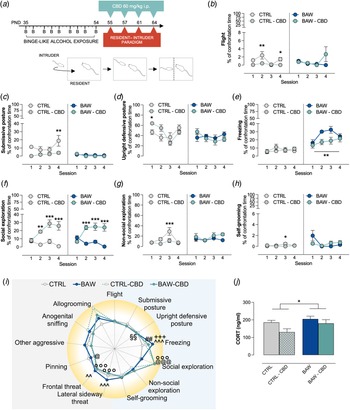
CBD at 60 mg/kg did not alter rats' locomotor activity and behavioural reactivity in the open-field test (online Supplementary material). CBD effects on CTRL and BAW intruder rats were evaluated on each behavioural category over the RIP sessions (Fig. 3a). We observed that CBD decreased flight and submissive posture in CTRLs and not in BAW rats (Fig. 3b, c). Upright defensive postures significantly increased in CBD-administered CTRL rats, in session 1 (Fig. 3d). CBD did not affect freezing in CTRL rats while a significant decrease was observed in BAW rats (Fig. 3e). Interestingly, CBD exerted a significant increase in social interaction in both CTRL and BAW rats, from session 2 onwards (Fig. 3f). On the other hand, CBD decreased non-social exploration in CTRL rats but not in BAW rats (Fig. 3g). At last, the evaluation of data from self-grooming indicated a significant three-way interaction among session, BAW and CBD (Fig. 3h). Complete statistical results are reported in online Supplementary Table S2. Overall, CBD discretely affected cumulated defensive behaviour of CTRL and BAW rats, exerting a significant increase in social exploration in both CTRL and BAW rats. Moreover, CBD administration decreased the cumulate aggressive behaviour towards BAW and CTRL intruders (Fig. 3i).
CBD ameliorates social stress coping deficits in BAW rats. (a) CBD was administered before each session of the RIP and its effects were evaluated on each behavioural category. CBD induced a decrease in (b) flight and (c) submissive postures in CTRL rats, but not in BAW rats. (d) CBD altered upright defensive postures in CTRL rats but not in BAW rats. However, (e) CBD decreased freezing in BAW rats and (f) increased social exploration in both CTRL and BAW groups. In addition, (g) CBD administration decreased non-social exploration and (h) self-grooming in CTRL rats. (i) Overall, the analysis of cumulated behaviour indicated a different social stress coping strategy in CBD-administered rats. Indeed, when CBD effect was evaluated on cumulated defensive behaviour of CTRL and BAW rats, we observed a three-way interaction among behavioural category, CBD and BAW (F (6,168) = 4.539, p = 0.0003). In addition, significant two-way interactions between behavioural category and CBD (F (6,168) = 13.11, p < 0.0001), and between behavioural category and BAW (F (6,168) = 17.50, p < 0.0001) were observed. On the other hand, the two-way interaction between CBD and BAW was not significant (F (1,168) = 0.1666, p = 0.6836). In addition, a significant main effect of behavioural category (F (6,168) = 245.3, p < 0.0001), but not of CBD (F (1,168) = 2.118, p = 0.1474) and BAW (F (1,168)=1.494, p = 0.2233) were highlighted. Post hoc analysis indicated that CBD did not affect flight (p > 0.999) and submissive posture (p > 0.999); BAW rats administered with CBD showed a significant decrease in upright defensive posture with respect to the CTRL-CBD group (t = 4.705, df = 168, p = 0.0020). In addition, BAW rats showed increased freezing when compared to CTRL rats (t = 7.625, df = 168, p < 0.001); BAW-CBD rats displayed no significant difference when compared to CBD-CTRL rats (t = 3.758, df = 168, p = 0.0891), but higher freezing than CTRLs (t = 4.512, df = 168, p = 0.0045). Interestingly, CBD significantly increased social exploration in both CTRL (t = 6.272, df = 168, p < 0.001) and BAW rats (t = 5.575, df = 168, p < 0.001). No differences were observed in non-social exploration (p > 0.999) and self-grooming (p > 0.999). Moreover, the statistical analysis highlighted a lower resident aggressive behaviour towards CBD-administered intruders. Indeed, when cumulate aggressive behaviour towards BAW and CTRL intruders was analyses, we observed a significant three-way interaction among behavioural category, CBD and BAW (F (5,144) = 17.55, p < 0.0001). Moreover, significant two-way interactions between behavioural category and CBD (F (5,144) = 14.67, p < 0.0001), behavioural category and BAW (F (5,144) = 6.524, p < 0.0001) and CBD and BAW (F (1,144) = 41.59, p < 0.0001) were highlighted. In addition a significant main effect of behavioural category (F (5,144) = 30.62, p < 0.0001) and CBD (F (1,144) = 37.40, p < 0.0001) was revealed. BAW rats received higher lateral sideways threats (t = 10.04, df = 144, p < 0.001) and frontal threats (t = 4.508, df = 144, p = 0.0037) than CTRL intruders. However, when BAW rats were administered with CBD, we observed a significant reduction in lateral sideway threats (t = 13.11, df = 144, p < 0.001) and frontal threats (t = 6.138, df = 144, p < 0.001) with respect to BAW. A significant decrease in pinning was also observed in CBD-administered CTRL intruders with respect to CTRL (t = 6.138, df = 144, p = 0.0110). Overall, both CTRL and BAW intruders administered with CBD underwent a decreased mean rate of attack bites (two-way ANOVA, CBD: F (1,24) = 4.51, p = 0.0442; BAW: F (1,24) = 0.866, p = 0.3614; interaction: F (1,24) = 1.22, p = 0.2798). (j) Moreover, CBD administration decreased serum CORT levels in both groups. Each circle and each bar represent the mean of n = 7 rats, while error bars indicate s.e.m. *p < 0.05; **p < 0.01; ***p < 0.001. Dots in radar graph represent standardized values, cantered at zero for the CTRL group. *p < 0.05; ***p < 0.001 v. CTRL. §§p < 0.01 CBD-BAW v. CBD-CTRL; ^^p < 0.01, ^^^p < 0.001 BAW v. CTRL; +++p < 0.001 BAW v. CBD-CTRL; ##p < 0.01 CBD-BAW v. CTRL; °°°CBD-BAW v. BAW; @p < 0.05, @@@p < 0.001 CBD-CTRL v. CTRL. PND, postnatal day; CTRL, control; BAW, binge alcohol withdrawal; CBD, cannabidiol.

As to the neuroendocrine response to social stress, CBD administration decreased serum CORT levels (BAW: F (1,24) = 4.036, p = 0.0559; CBD: F (1,24) = 5.493, p = 0.0277; interaction: F (1,24) = 0.7644, p = 0.3906) (Fig. 3j).
Sub-chronic CBD administration affects BAW-induced maladaptive plasticity in the NAc
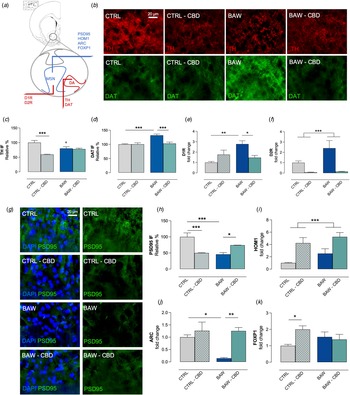
With reference to DA-related signalling in the NAc (Fig. 4a), TH levels were significantly different (BAW: F (1,24) = 0.0164, p = 0.8991; CBD: F (1,24) = 18.12, p = 0.0003; interaction: F (1,24) = 14.88, p = 0.0008). In detail, BAW rats displayed a decreasing trend in TH levels when compared with the CTRL group (t = 2.819, df = 24, p = 0.0571); CBD administration decreased TH levels in CTRL rats (t = 5.738, df = 24.00, p < 0.001) (Fig. 4b, c).
CBD promotes a stress-adaptive synaptic plasticity in the NAc of BAW rats. (a) The effects of CBD administrations during the RIP were evaluated on the markers of DA- and glutamate-related neuroplasticity in the NAc. (b) Immunofluorescence assessment of DA presynaptic markers, as shown in representative pictures of TH (red) and DAT (green) staining, showed that (c) CBD administration decreased TH levels in CTRL rats and (d) decreased DAT levels in BAW rats. (e) In addition, CBD administration normalized the D1R overexpression in BAW rats and (f) and abolished D2R overexpression in both groups. The evaluation of excitatory neuroplasticity in immunofluorescent experiments, with (g) representative pictures of nuclei (DAPI, blue), and PSD95 (green) staining, indicated that (h) CBD reduced PSD95-positive immunofluorescence in CTRL rats, whereas increased PSD95 levels in BAW rats. Gene expression analysis of relevant markers of glutamate-related neuroplasticity revealed that CBD administration (i) increased HOM1 expression in CTRL and BAW rats, (j) increased ARC levels in BAW rats and (k) increased FOXP1 levels in CTRL rats. Each bar represents the mean of n = 7 rats, error bars indicate s.e.m. *p < 0.05; **p < 0.01; ***p < 0.001. DA, dopamine; MSN, medium spiny neuron; TH, tyrosine hydroxylase; DAT, dopamine transporter; DAPI, 4′,6-diamidino-2-phenylindole; D1R, type 1 dopamine receptor; D2R, type 2 dopamine receptor; PSD95, post-synaptic density protein 95; HOM1, Homer 1 protein; ARC, activity-regulated cytoskeleton-associated protein; FOXP1, Forkhead box P1; IF, immunofluorescence; CTRL, control; BAW, binge-like alcohol withdrawal; CBD, cannabidiol.

In addition, DAT-positive immunofluorescence was affected (BAW: F (1,24) = 15.85, p = 0.0006; CBD: F (1,24) = 10.84, p = 0.0031; interaction: F (1,24) = 11.28, p = 0.0026). BAW rats showed higher DAT levels than CTRLs (t = 5.19, df = 24, p = 0.0002). CBD administration did not modify DAT levels in CTRL rats (t = 0.046, df = 24.00, p > 0.999) while it decreased DAT immunofluorescence in the BAW group (t = 4.703, df = 24, p = 0.0005), with no difference between CTRL-CBD and BD-CBD rats (t = 0.4402, df = 24, p > 0.999) (Fig. 4b, d).
Significant differences were highlighted in D1R expression (BAW: F (1,24) = 6.549, p = 0.0172; CBD: F (1,24) = 0.8612, p = 0.3626; interaction: F (1,24) = 12.71, p = 0.0016). The significant increase in D1R expression that BAW rats displayed in comparison with CTRLs (t = 4.33, df = 24, p = 0.0014), was normalized by CBD administration (t = 3.177, df = 24, p = 0.0244) (Fig. 4e).
When D2R expression was evaluated, two-way ANOVA revealed a significant main effect of CBD administration in decreasing D2R expression in both CTRL and BAW rats (F (1,24) = 17.79, p = 0.0003) (BAW: F (1,24) = 3.830, p = 0.0621; interaction: F (1,24) = 3.161, p = 0.0881) (Fig. 4f).
When excitatory neuroplasticity was considered (Fig. 4a), in the face of no significant difference in the number of DAPI-stained nuclei (p > 0.999), we observed significant PSD95 levels (BAW: F (1,24) = 4.954, p = 0.0357; CBD: F (1,24) = 2.537, p = 0.143; interaction: F (1,24) = 354, p < 0.001). In detail, BAW rats displayed decreased PSD95 levels with respect to CTRLs (t = 5.669, df = 24, p < 0.001). CBD decreased PSD95 levels in CTRLs (t = 5.222, df = 24, p = 0.001), whereas it increased PSD95 immunofluorescence in BAW rats (t = 2.969, df = 24.00, p = 0.0401) (Fig. 4g, h).
In addition, CBD administration increased HOM1 expression in CTRL and BAW rats (BAW: F (1,24) = 3.414, p = 0.0770; CBD: F (1,24) = 18.75, p = 0.0002; interaction: F (1,24) = 0.1392, p = 0.7123) (Fig. 4i), while ARC expression was discretely affected (BAW: F (1,24) = 4.918, p = 0.0363; CBD: F (1,24) = 12.45, p = 0.0017; interaction: F (1,24) = 4.756, p = 0.0392). In detail, the significant decrease in ARC expression that we observed in BAW rats in comparison with CTRLs (t = 3.11, df = 24, p = 0.0286) was reversed by CBD administration (t = 4.037, df = 24, p = 0.0029) (Fig. 4j).
Moreover, significant differences were observed in FOXP1 expression (BAW: F (1,24) = 0.02471, p = 0.8764; CBD: F (1,24) = 2.855, p = 0.1040; interaction: F (1,24) = 5.369, p = 0.0294); in detail, CBD administration increased FOXP1 expression level in CTRL rats (t = 2.833, df = 24, p = 0.0184) but not in BAW rats (t = 0.4436, df = 24, p > 0.999) (Fig. 4k).
Discussion
The current investigation looked at the effects of binge-like alcohol administration during adolescence on defensive behaviour and neurobiological correlates in rats exposed to repeated social stress during withdrawal. The working hypothesis was that in the NAc alcohol withdrawal-induced aberrant plasticity combines with – and impacts – neuroadaptation due to social stress, entailing alterations in stress coping, and in significant components of synaptic plasticity.
Indeed, BAW intruder rats displayed a deteriorated pattern of adaptive behaviour when exposed to the RIP, a test which allows the spontaneous and natural expression of both offensive and defensive behaviour in a semi-natural laboratory setting. In response to aggression, defeat and subjugation trigger an adaptive behavioural and physiological response aimed at reducing the offensive attacks. The ‘predatory imminence theory’ posits that defensive behaviour resizes with threat proximity on a spatiotemporal scale, such that freezing is observed in post-encounter modes whereas flight occurs when the threat is proximal (Fanselow & Lester, Reference Fanselow, Lester, Bolles and Beecher1988). Freezing is not a passive state but rather a brake on the motor system, relevant to perception and preparation of appropriate defensive action, i.e. fight-or-flight reaction (Roelofs, Reference Roelofs2017; Tringali, Greco, Lisi, Pozzoli, & Navarra, Reference Tringali, Greco, Lisi, Pozzoli and Navarra2012). Accordingly, in our study, CTRL did not increase their freezing behaviour throughout the interactive sessions once the threat had been realized and shifted towards a proactive strategy, i.e. flight and submissive postures, to optimize their response capacity. On the other hand, BAW rats did not display an evolution in their defensive behaviour, maintaining higher freezing levels than controls, at the expenses of flight and submissive postures. The level and intensity of offensive aggression follow from, at least partially, the defensive strategy of the intruder. Indeed, we found that BAW intruder rats received a higher degree of aggressive behaviour from the resident than CTRLs, suggesting that binge-like alcohol exposure in adolescence can result in a vulnerable phenotype characterized by deficits in coping with dominance.
Our evidence is consistent with studies showing that male rats exposed to chronic alcohol displayed heightened freezing in context-induced memory tasks indicating the occurrence of a maladaptive coping to adverse stimuli (Rorick, Finn, & Steinmetz, Reference Rorick, Finn and Steinmetz2003; Staples et al., Reference Staples, Herman, Lockner, Avchalumov, Kharidia, Janda and Mandyam2021). Notably, the only report available, to our knowledge, on the response to social stress in a human population exposed to alcohol during adolescence highlighted a significant association between early alcohol use and impaired stress perception and HPA axis reactivity during a social stress procedure (Evans, Greaves-Lord, Euser, Franken, & Huizink, Reference Evans, Greaves-Lord, Euser, Franken and Huizink2012). Besides, adolescent binge drinking has been also associated with increased rate and severity of stress-related psychopathologies (Fortier et al., Reference Fortier, Whitworth, Fonda, Currao, Beck, Levin and McGlinchey2021). Current research is ongoing to examine reliable sex-specific paradigms of social stress, since female rats do not typically display territorial aggression unless subjected to irreversible hypothalamic lesions (Solomon, Reference Solomon2017). Social stress coping combines a proper emotional control and the selection of an adaptive natural defensive repertoire. Consistent behavioural findings from our recent experiments, in rats withdrawn from binge-like alcohol during adolescence, show the occurrence of an emotional dysregulation in paradigms such as the social interaction test and the novelty-suppressed feeding test, and decreased coping with the inescapable swim stress (Brancato et al., Reference Brancato, Castelli, Lavanco, Tringali, Micale, Kuchar and Cannizzaro2021).
HPA axis activation is an initial step in an integrated neuroendocrine–neurochemical–behavioural response when the organism evaluates a threat and triggers defence reactions to cope with it. Our data show an altered neuroendocrine stress response in BAW rats in terms of higher basal CORT levels than in CTRLs and a dampened response to the RIP. High levels of circulating glucocorticoids have been described in alcohol withdrawal, together with increased extrahypothalamic CRH levels (Brancato et al., Reference Brancato, Castelli, Lavanco, Tringali, Micale, Kuchar and Cannizzaro2021). Heavy drinkers also display a blunted stress-induced HPA axis response, suggesting neuroendocrine tolerance and impaired inhibitory HPA axis control (Blaine & Sinha, Reference Blaine and Sinha2017; Koob, Reference Koob2010; Thayer, Hall, Sollers, & Fischer, Reference Thayer, Hall, Sollers and Fischer2006). In our model, withdrawal after chronic binge-like alcohol exposure in adolescence is associated with HPA axis basal hyperactivation, a blunted stress-related response, and a disruption in defensive behaviour organization. The prolongation and repetition of freezing in BAW intruders, therefore, can be interpreted as an impaired behavioural flexibility to the social threat that likely mirrors an anomaly in social behaviour-related brain areas.
Among them the NAc is essential for driving reward and aversion-related behaviour. Indeed, the emotional ambience of external environments retunes the valence of the functions there generated (Reynolds & Berridge, Reference Reynolds and Berridge2008) and allows the expression of both appetitive and fearful responses (Faure, Reynolds, Richard, & Berridge, Reference Faure, Reynolds, Richard and Berridge2008). This group has previously reported that DA- and glutamate-related plasticity in the NAc during alcohol withdrawal results in aberrant processing of aversive stimuli (Cannizzaro et al., Reference Cannizzaro, Talani, Brancato, Mulas, Spiga, De Luca and Diana2019). Consistently now we show that the interplay between BAW-induced abnormal plasticity and RIP-induced neuroadaptation results in relevant markers of DA and glutamate aberrant signalling. This is in accordance with other groups' evidence of metaplastic changes in striatal microcircuits during alcohol withdrawal (Ostroumov & Dani, Reference Ostroumov and Dani2018). Indeed, our data suggest a higher DA synthesis in RIP-exposed CTRL, while DA reuptake is not affected. On the other hand, the evidence of a reduced TH expression and increased DAT levels in BAW rats suggests a decreased DA synthesis and higher DA removal from the synaptic cleft. This is highly consistent with reports from other groups showing that social defeat stress can increase burst activity in the ventral tegmental area and phasic DA release in the NAc in freely moving rats (Deal et al., Reference Deal, Konstantopoulos, Weiner and Budygin2018). However, a history of alcohol self-administration can increase the rate of DA uptake and blunt the effects of social stress on NAc DA dynamics (Karkhanis, Rose, Huggins, Konstantopoulos, & Jones, Reference Karkhanis, Rose, Huggins, Konstantopoulos and Jones2015). These alterations can correlate with impairment in aversive limbic memory and behavioural flexibility, as reported by this and other research groups (Cannizzaro et al., Reference Cannizzaro, Talani, Brancato, Mulas, Spiga, De Luca and Diana2019; Kern, Stanwood, & Smith, Reference Kern, Stanwood and Smith2010; Korn et al., Reference Korn, Akam, Jensen, Vagnoni, Huber, Tunbridge and Walton2021). Intriguingly, we report a prominent D2R mRNA expression relative to DR1 in the NAc of RIP-exposed BAW rats, compared to non-stressed counterparts and CTRLs, which suggests a function-specific vulnerability of this pathway in BAW rats. Notably, the NAc drives distinct processes through the recruitment of discrete subpopulations of cells. Generally, NAc D1R-expressing MSNs are approach-promoting, whereas NAc D2R-positive MSNs are aversion-promoting and essential for aversive learning (Hikida et al., Reference Hikida, Yawata, Yamaguchi, Danjo, Sasaoka, Wang and Nakanishi2013). D2Rs play a major role in the expression of defensive behaviour in rodents and alterations in D2 receptor signalling may produce hyper-defensiveness and altered environmental processing (Tang, Yang, Shi, & Chen, Reference Tang, Yang, Shi and Chen2022). Therefore, the altered presynaptic markers of DA-synthesis and reuptake, in association with the prominent activity of avoidance-driving D2R signalling of BAW intruder rats may contribute to the dysfunctional elaboration of the social threat, and the generation of the aberrant behavioural output, thus contravening the ‘practice makes perfect’ rule of complex-learned social motor actions. It is worth noting, however, that the NAc is a downstream projection area of brain regions which drive defeat-induced active social avoidance, including excitatory inputs from the basolateral amygdala (Diaz & Lin, Reference Diaz and Lin2020).
As to MSN excitatory plasticity, the downstream pathway of glutamatergic signalling in BAW intruders displayed a decrease in synaptic strength, opposite to what was observed in CTRLs. The alterations in synaptic plasticity in response to stress are crucially orchestrated by the postsynaptic-density proteins, which include receptor complexes, scaffold proteins and adaptor proteins that are located predominantly in glutamatergic synapses. A reduction in PSD95 expression could indicate a deficit in assembling clusters of glutamate N-methyl-d-aspartate (NMDA) receptors in the postsynaptic membrane that is correlated with a decrease in synaptic strength (Prybylowski et al., Reference Prybylowski, Fu, Losi, Hawkins, Luo, Chang and Vicini2002). In addition, PSD95 also interacts with the DA D1 receptor, shaping up a functional PSD95-D1R-NMDARs multiprotein complex at the MSN spine (Kruusmägi et al., Reference Kruusmägi, Kumar, Zelenin, Brismar, Aperia and Scott2009). On this basis, it could be speculated that the decrease in PSD95 observed in stress-exposed BAW rats may also affect the multiprotein complex functionality, and thus weaken the D1R-related approach-driven signalling.
On the other hand, HOM1 is critical in postsynaptic density remodelling, by affecting synaptic architecture and facilitating glutamate signal transduction (Yoon et al., Reference Yoon, Piguel, Khalatyan, Dionisio, Savas and Penzes2021). Fluctuations in HOM1 are observed in animals after restraint-, social defeat-, prenatal-stress and alcohol consumption (Brancato et al., Reference Brancato, Castelli, Lavanco, Tringali, Micale, Kuchar and Cannizzaro2021; Castelli, Brancato, Cavallaro, Lavanco, & Cannizzaro, Reference Castelli, Brancato, Cavallaro, Lavanco and Cannizzaro2017; Reshetnikov & Bondar, Reference Reshetnikov and Bondar2021). Interestingly, deletion of HOM1 has been correlated with stress susceptibility and HPA dysfunction (Reshetnikov & Bondar, Reference Reshetnikov and Bondar2021) indicating a prominent role in the feedback regulation of the HPA axis and stress coping. In line with our previous data on alterations of the effector systems regulating the expression of specific markers of synaptic remodelling in the NAc of BAW rats (Brancato et al., Reference Brancato, Castelli, Lavanco, Tringali, Micale, Kuchar and Cannizzaro2021), the consistent reduction of PSD95 and HOM1 scaffolding currently observed is associated with the suppression of both ARC and FOXP1 expression. ARC is a downstream protein of the metabotropic glutamate receptor–Homer pathway, which has been implicated in alcohol-related synaptic remodelling (Dong, Guidotti, Zhang, & Pandey, Reference Dong, Guidotti, Zhang and Pandey2018). On the other hand, FOXP1 is a key transcription factor that controls the signalling pathways of MSNs and related behaviours (Anderson et al., Reference Anderson, Kulkarni, Harper and Konopka2020). Reduction of FOXP1 correlates with defects in social behaviour in mice and humans (Araujo et al., Reference Araujo, Anderson, Berto, Runnels, Harper, Ammanuel and Konopka2015); besides, FOXP1 knockdown impairs behavioural learning and inhibits the experience-dependent reorganization of network-level activity and remodelling (Garcia-Oscos et al., Reference Garcia-Oscos, Koch, Pancholi, Trusel, Daliparthi, Co and Roberts2021). Overall, binge-like alcohol withdrawal seems to disrupt cellular mechanisms that enable the onset of experience-dependent changes in cellular and behavioural functional plasticity, likely contributing to the maladaptive coping to social stress here observed.
The next aim of this research was to identify a counterbalancing factor able to rescue, at least in part, those abnormalities. Our data show a relevant broad-spectrum activity of CBD that imparted a homogeneous significant twist in rat defensive strategy of both rat groups. Indeed, we observed a social approach-oriented behaviour rather than freezing in BAW rats, and flight or submission in CTRLs. Noteworthily, at the first confrontations, CTRL rats stood up facing the aggressor, actively defending themselves, while afterwards they opted in favour of social interaction. This evidence is consistent with other reports on a pro-social effect after repeated CBD administration (Mastinu et al., Reference Mastinu, Ascrizzi, Ribaudo, Bonini, Premoli, Aria and Memo2022) and anti-stress properties in fear-induced paradigms of anxiety-like behaviour (Melas et al., Reference Melas, Scherma, Fratta, Cifani and Fadda2021). Notably, freezing levels remained higher in CBD-treated BAW rats than in CTRLs, highlighting a certain degree of rigidity in this behavioural pattern. CBD-induced détente strategy resulted in reduced general aggressive actions from the residents highlighting the occurrence of a more convenient defensive coping to dominance.
It is already known that CBD, at different doses, decreases HPA axis response under stress conditions (Viudez-Martínez, García-Gutiérrez, & Manzanares, Reference Viudez-Martínez, García-Gutiérrez and Manzanares2018a), including cortisol levels and anxiety in drug-abstinent patients (Hurd et al., Reference Hurd, Spriggs, Alishayev, Winkel, Gurgov, Kudrich and Salsitz2019). Accordingly, CBD was able to attenuate HPA axis dysregulation produced by the interception of BAW and psychosocial stress, sub conditionibus, although dose, mode, gender and task-related differences might affect CBD-induced outcomes (Viudez-Martínez, García-Gutiérrez, & Manzanares, Reference Viudez-Martínez, García-Gutiérrez and Manzanares2020). Overall, given the connection between HPA axis dysregulation and alcohol-related brain dysfunction in pathways involved in biobehavioural emotional regulation and stress response, CBD effect on HPA axis activity plays a key role in the restoration of emotional control (Brancato et al., Reference Brancato, Castelli, Lavanco, Tringali, Micale, Kuchar and Cannizzaro2021) and the exploitation of an appropriate behavioural coping strategy. Accordingly, compounds able to reduce HPA axis over-reactivity in the basal states, while also normalizing blunted HPA phasic responses such as the neurosteroids, improve alcohol-induced maladaptive stress coping (Blaine & Sinha, Reference Blaine and Sinha2017), through a positive allosteric modulation of GABAergic pathways.
Interestingly, CBD acts as a positive allosteric modulator of GABA-A receptor, which is a primary target of alcohol, increasing GABA-evoked currents amplitude in a benzodiazepine-like manner (Bakas et al., Reference Bakas, van Nieuwenhuijzen, Devenish, McGregor, Arnold and Chebib2017).
However, as opposite to benzodiazepines, CBD acts also on γ subunit-lacking receptors, thus suggesting that CBD reversing effect can overcome repeated alcohol-induced GABA-A receptor subunit rearrangements (Ruffolo et al., Reference Ruffolo, Cifelli, Roseti, Thom, van Vliet, Limatola and Palma2018).
In addition, previous reports reveal that behaviourally effective CBD doses elicit a predominant decrease in spontaneous DA neuronal frequency and bursting activity in the ventral tegmental area, which is correlated with a decrease in aversion-like and freezing behaviour (Norris et al., Reference Norris, Loureiro, Kramar, Zunder, Renard, Rushlow and Laviolette2016), whereas repeated CBD administrations at the same doses used in this study can reduce TH expression (Viudez-Martínez et al., Reference Viudez-Martínez, García-Gutiérrez and Manzanares2020).
Although we observed consistent results in CBD-treated CTRLs, the overall CBD effect upon DA metaplasticity in the NAc of BAW intruder rats is suggestive of a balancing effect resulting in decreased DA reuptake and blunted D2R expression. Interestingly, ablation of D2R-mediated signal in the NAc has been related to a decrease in avoidance and facilitation in approach-behaviour in a conflicting environment, suggesting that defeat-induced avoidance is dependent on the relative contribution of DA D1/D2 receptor signalling in the NAc. Accordingly, we tested the effect of the D2R antagonist sulpiride on RIP-exposed BAW rats' defensive behaviour and measured a reduction in freezing time (online Supplementary material) similar to CBD.
Seminal works report CBD-induced reduction in aversive emotional learning and consolidation (Norris et al., Reference Norris, Loureiro, Kramar, Zunder, Renard, Rushlow and Laviolette2016) and the contribution of relieved plasticity (Maggio, Shavit Stein, & Segal, Reference Maggio, Shavit Stein and Segal2018). Moreover, the neuroprotective role of CBD has been associated with region-specific increased expression of synaptophysin, PSD95 and spine density (Sales et al., Reference Sales, Fogaça, Sartim, Pereira, Wegener, Guimarães and Joca2019). In accordance, we report a selective increase in players of neuronal activity-dependent postsynaptic plasticity, such as PSD95, HOM1 and ARC, which are evocative of an enhancement in synaptic strength. Our data on increased indexes of excitatory plasticity and markers of spine remodelling substantiate CBD-driven restoring of synaptic architecture, that can contribute to the expression of convenient, functional behavioural responses. The lack of a rescue effect on FOXP1 in BAW rats, contrarily to CTRLs, might be interpreted as the endurance of a certain rigidity as regards both behaviour and NAc metaplasticity.
Overall, it is tempting to speculate that the behavioural détente effect of CBD in the RIP involves neuroadaptation in the NAc where a functional dynamic of dopaminergic transmission is associated with functional strength in the excitatory synapse, so that fear-related aversive behaviour shifts towards a pro-social successful strategy towards the psychosocial threat. Currently, CBD's mechanisms of action have not been disentangled. Indeed, although the pharmacological effects of CBD in different in vitro biological systems have been extensively investigated, the mechanisms responsible for its therapeutic potential are not univocal but rather depend on the behavioural outcome being measured (Campos, Moreira, Gomes, Del Bel, & Guimarães, Reference Campos, Moreira, Gomes, Del Bel and Guimarães2012). A further integrated multidisciplinary investigation is currently ongoing.
The overall layout of the multidimensional abnormalities observed in BAW rats exposed to repeated social stress reflects a disarrangement in the physiological response to adverse social stimuli as a consequence of withdrawal from adolescent binge-like alcohol exposure. Although we do not rule out the occurrence of similar impairment in older rats, these findings pose a further warning towards the early and protracted abuse of alcohol at vulnerable ages, as a relevant cause of susceptibility to psychosocial threats and maladaptive coping. The current data highlight the potential of CBD in attenuating the complex vulnerable phenotype observed and further promote interest in the understanding of its complex pharmacological profile and clinical application in adolescent populations.
Supplementary material
The supplementary material for this article can be found at https://doi.org/10.1017/S0033291722002744.
Data
Data supporting reported results are available on request from the corresponding author.
Acknowledgements
The authors are grateful to Dr Vincenzo Micale for the kind assistance and the collaborative support, and to Mrs Lisa Festa-Bianchet for the English language editing of the manuscript.
Financial support
This research was funded by the European Foundation for Alcohol Research – ERAB (EA 16 42 to C. C.) and Fondazione Zardi Gori (post-doctoral fellowship to A. B.). The funders had no role in the design of the study; in the collection, analysis or interpretation of data; in the writing of the manuscript or in the decision to publish the results.
Conflict of interest
The authors declare that there are no competing financial interests in relation to the work described.