Dung beetles are a well-defined guild within the family Scarabaeidae, with distinctive morphological, ecological and behavioural characteristics (Halffter & Matthews Reference HALFFTER and MATTHEWS1966). Although this group has been extensively studied (Hanski & Cambefort Reference HANSKI and CAMBEFORT1991) due in part to the important role they fulfil in ecosystems (Nichols et al. Reference NICHOLS, SPECTOR, LOUZADA, LARSEN, AMEZQUITA and FAVILA2008), little information exists regarding population size and the scale of their dispersal abilities, especially in the Neotropical region. Moreover, few studies have been devoted to exploring the population dynamics of dung beetles (Roslin Reference ROSLIN1999, Reference ROSLIN2000).
Landscape and metapopulation connectivity are currently important issues in ecology (Hortal et al. Reference HORTAL, ROURA-PASCUAL, SANDERS and RAHBEK2010). Population connectivity, defined as the exchange of individuals among patches via dispersal, is important for both population persistence, re-establishment of sites following disturbances and the flow of genetic information (Beger et al. Reference BEGER, GRANTHAM, PRESSEY, WILSON, PETERSON, DORFMAN, MUMBY, LOURIVAL, BRUMBAUGH and POSSINGHAM2010). In this paper we investigate some variables that will help to understand actual functional connectivity, such as population size, dispersal rate and sex ratio of Sulcophanaeus leander (Waterhouse, 1891). This is a species of dung beetle that is strictly associated with seasonal riverine beaches and savannas in the Colombian–Venezuelan Orinoco plains (Noriega Reference NORIEGA2002).
The study was carried out at the Center for Ecological Research of the Macarena (CIEM), of the Universidad de Los Andes. This station is located on the eastern border of the Tinigua National Natural Park, Department of Meta, Colombia (2°40′N–74°10′W), at an elevation of 350 m asl. The vegetation of the area is dominated by wet lowland tropical forest. Sampling was carried out in a sandy riverine beach habitat that is present only during the dry season from December to February. Two S. leander subpopulations occupying nearby beaches (500 m apart from each other) were sampled in January 1998. Beach 1 has an area of 250 × 60 m (~15 000 m2), while beach 2 covers an area of 220 × 50 m (~11 000 m2). Five pitfall traps baited with 25 cm3 of fresh human dung without any preservative were placed every 30 m along a 120-m linear transect parallel to the shoreline. Traps were baited at 05h00 and left in place until 19h00. Each captured beetle was marked on the ventral surface of the metasternum with fast-drying latex paint before being released. Blue paint was used to mark individuals from beach 1 and pink paint for those from beach 2 in order to quantify functional connectivity between patches (dispersal rate). This procedure was repeated five more times, with 24 h between each capture event. The population size was estimated according to the Schnabel model, which is appropriate when using data from various mark–release–recapture events from closed populations with uniform capture probabilities (Greenwood Reference GREENWOOD and Sutherland1998, Seber Reference SEBER1982). In this model no birth, death, migration or emigration events are assumed to have occurred during such a short sampling time. The Schnabel model was calculated by using Garry White's software program MARK v. 4.3. A Chi-square test was applied to estimate the number of individuals per beach and to evaluate the differences between the numbers of individuals according to sex (using the statistical software NCSS).
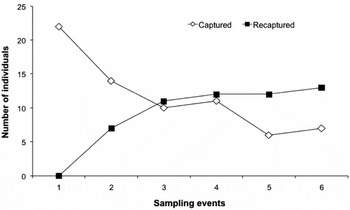
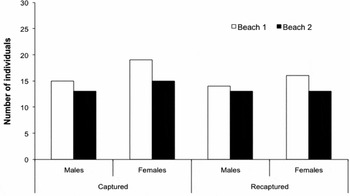
In total, 62 individuals were captured on the two beaches during the six sampling events (Figure 1). No significant differences were found between the numbers of individuals being collected at beach 1 (n = 34) and beach 2 (n = 28) (χ2 = 0.581, df = 1, P > 0.05). A total of 56 individuals were recaptured (males = 27, 96.4% and females = 29, 85.2%) (Figure 2). Twenty-eight males and 34 females were collected, giving a sex ratio of 1:1.21, however, no significant differences were found (χ2 = 0.581, df = 1, P > 0.05). Schnabel's model estimated a population size (mean ± SD) of 71 ± 1.86 individuals and a range of 70–78 individuals (95% CI) for the study area. Beach 1 had a population density of 0.0024 ind. m−2, while beach 2 had a density of 0.003 ind. m−2. Eight individuals that were initially marked on one beach were recaptured on the other beach (12.9%): two males and three females dispersed from beach 2 to beach 1 (8.1%; from smaller to larger patch size) and one male and two females dispersed from beach 1 to beach 2 (4.8%).
Number of Sulcophanaeus leander individuals being captured and recaptured throughout the six capture events (combining the two beaches), CIEM, Meta, Colombia.

Number of Sulcophanaeus leander individuals (males and females) being captured and recaptured on beaches 1 and 2, CIEM, Meta, Colombia.

An assortment of techniques generates some bias when they estimate population size in dung beetles (Arellano et al. Reference ARELLANO, LEÓN-CORTÉS and OVASKAINEN2008, Escobar Reference ESCOBAR2003, Peck & Forsyth Reference PECK and FORSYTH1982). Capture–recapture using an appropiate sampling effort may produce a better estimate of population size in S. leander as indicated in this study (90% of recapture from the total individuals marked) (Figure 2). The low population size found in S. leander might be explained by one or more of the following: (1) they are restricted to the beach habitat, i.e. they do not disperse to or colonize the adjacent riparian forest or other habitats; (2) the beaches are only present during the dry season; (3) the beetles are only active for a few hours per day; and (4) the dung resource in this habitat is ephemeral and scattered; dung is rare on the beaches and rapidly dries with the latter effect reducing its attractiveness to dung beetles (Noriega Reference NORIEGA2002). The average population density recorded for both beaches is relatively low (0.0027 ind. m−2) when compared to other scarab species (Dajoz Reference DAJOZ1972, Desière Reference DESIÈRE1970, Peck & Forsyth Reference PECK and FORSYTH1982). Further studies are required in order to explain the low density of S. leander that may be due to lower fecundity and/or a higher mortality rate.
Despite the initial assumption that each beach contains an isolated population, the dispersal of individuals between beaches reveals connectivity. The distance between two beaches varies between 400 and 600 m, a potential barrier that is possible for an individual to cross. Taking into account displacement reports of 1 km (in 2 d) for Oxysternon conspicillatum (Peck & Forsyth Reference PECK and FORSYTH1982), it is possible to suggest that the maximum dispersal ability may be even greater than what was recorded in this study. The spatial structure of beaches in the landscape and their average distance could promote a network of connectivity, implying a unique and large population of S. leander, due to considerable exchange of individuals among populations along the river.
With a dispersal rate over 11% of individuals in 11 days, the population structure at each beach could dramatically change during the 3 mo the beach is available for use, before it becomes inaccessible when flooded by the river. This scenario represents a dynamic ecosystem, where beaches represent temporary aggregations of individuals, coinciding with the results obtained by Roslin (Reference ROSLIN2000). Hence S. leander could be functioning like a classical metapopulation, defined as the set of local populations (in a patchy habitat) interconnected by dispersion (Hanski Reference HANSKI1999). Dispersal will allow the population to move up or downriver to maximize the consumption of resources (food, space and mates). In consequence, the metapopulation could extend as far as the Duda and Guayabero rivers (oriental plains).
The spatial and temporal structure of the food resource may also be a strong influence that explains the number of individuals moving from beach to another. The resource is controlled by a set of abiotic (size and distance between beaches) and biotic (food availability, mate accessibility and predation rate during displacement) factors that might affect dispersion and needs to be explored (Lumaret et al. Reference LUMARET, KADIRI and BERTRAND1992). At an evolutionary level, the high dispersal ability could help S. leander to use a limited short-term resource present in the riverine beach habitat and to cope with a changing and heterogeneous environment (Davis & Scholtz Reference DAVIS and SCHOLTZ2001).
It would be worth studying the degree of genetic differentiation and genetic flow between local populations to test our hypothesis, as has been done for Aphodius fossor (Roslin Reference ROSLIN2001). This would clarify the degree of population cohesion that exists between geographic units (regional scale) and allow for better understanding of the vulnerability of S. leander due to genetic drift or bottle-neck effects.
ACKNOWLEDGEMENTS
We would like to express our gratitude to CIEM, Tinigua National Natural Park, Laboratorio de Zoología y Ecología Acuática of the Universidad de Los Andes, Unidad de Sistemática y Ecología of the Pontificia Universidad Javeriana and to Carlos Arturo Mejia. To Keith Phillips, Conrad Gillet, David Edmonds, Trond Larsen, Darren Mann, Ricardo Botero-Trujillo, Carolina Vizcaíno and two anonymous reviewers for their constructive comments. To Keith Phillips and Nora Martinez for her corrections to the English version. To the Scarabaeinae Research Network (ScarabNet), which contributed in the development of better mechanisms of communication among researchers.