Introduction
Seed dispersal studies are vital to understand plant distribution and community resilience, and they guide conservation and restoration activities (Török et al., Reference Török, Helm, Kiehl, Buisson and Valkó2018). A useful way of studying seed dispersal is to estimate seed rain – that is, the number and diversity of new seeds reaching a given area (Baskin and Baskin, Reference Baskin and Baskin2014) – using seed traps to collect propagules at particular locations, then identifying and counting them. However, measuring seed rain is challenging, and a lack of methodological standardization persists, compromising the accuracy of seed rain estimates and impairing comparison of data between studies (Arruda et al., Reference Arruda, Buisson, Poschlod and Silveira2018; Wolfe et al., Reference Wolfe, Macchiavelli and Van Bloem2019). Seed rain has long been used by ecologists to address ecological succession and factors limiting regeneration in tropical forests (Saulei and Swaine, Reference Saulei and Swaine1988; Holl, Reference Holl1999). In open environments, however, seed dispersal by wind and water run-off poses additional challenges to estimate seed rain. For example, despite the fact that seed rain in temperate grasslands has been relatively well studied, we not only need more research in other grasslands types (e.g. tropical grasslands) but also to improve many crucial aspects related to methods standardization and data reporting (Arruda et al., Reference Arruda, Buisson, Poschlod and Silveira2018). Determining the effectiveness of seed traps, and of seed sorting methods for samples, is crucial for improving reproducibility, but it is rarely tested in seed rain studies (Thompson and Mcginnes, Reference Thompson and McGinnes1963; Jackel and Poschlod, Reference Jackel and Poschlod1994; Kollmann and Goetze, Reference Kollmann and Goetze1998; Stevenson and Vargas, Reference Stevenson and Vargas2008).
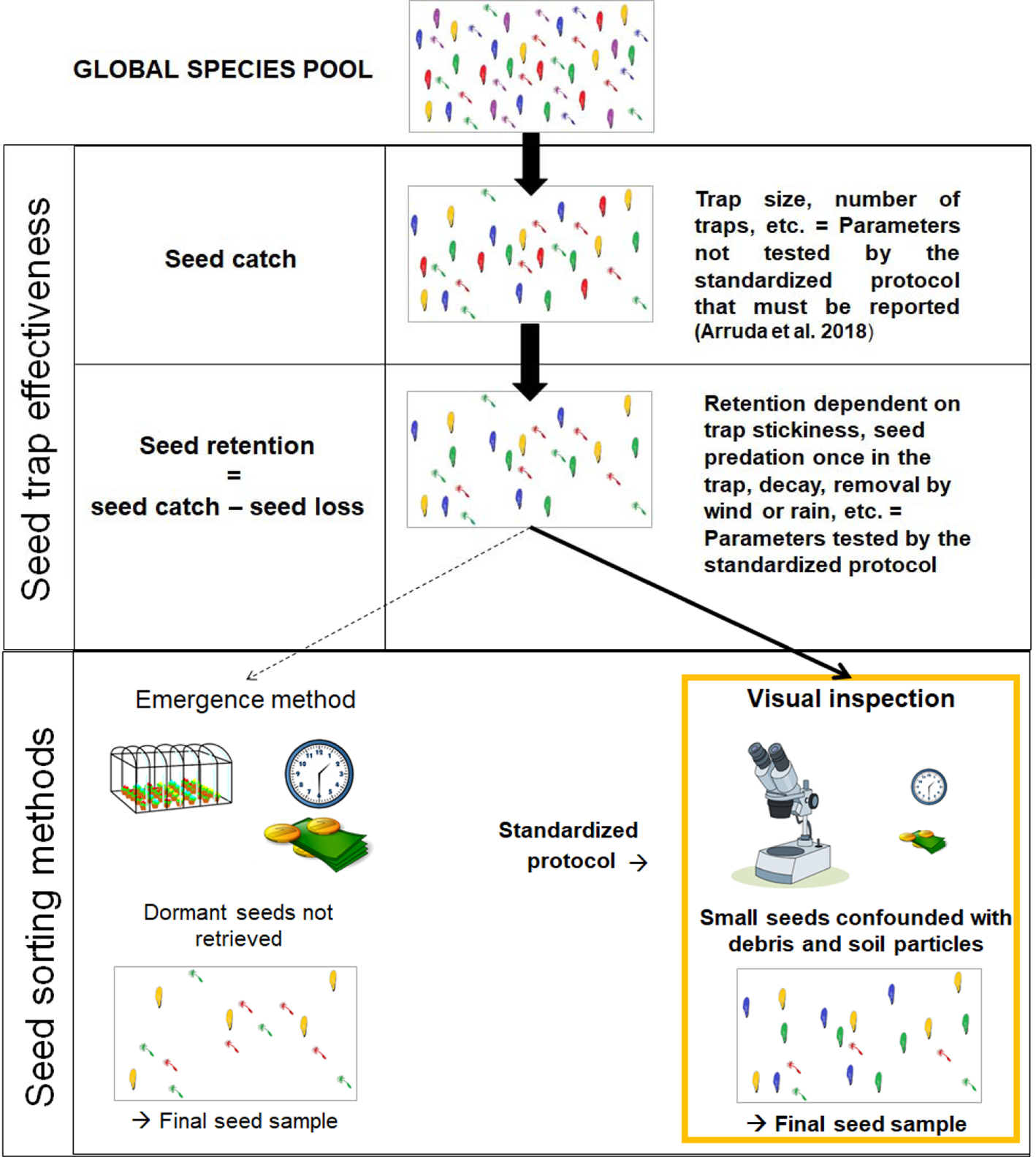
Evaluation of seed trap effectiveness involves the evaluation of two processes: trap capacity to capture seeds (seed catch), and trap capacity to retain seeds (seed retention) and avoid seed loss (Box 1; Fig. 1). Additionally, the accuracy of seed sorting methods for trap samples depends not only on seed size – small seeds are harder to find – but also on the ability to separate seed material from debris, which can strongly affect seed retrieval rates (Cottrell, Reference Cottrell2004). Knowing the seed retrieval rate of seed sorting is important for determining the influence of seed size, of observer effect and of sample composition, or more precisely, the colour and size of soil particles, debris and litter often present in samples (Debussche and Isenmann, Reference Debussche and Isenmann1994).
Definitions of terms related to seed rain estimates
Seed dispersal – the horizontal movement of diaspores away from the mother-plant
Seed rain – the number and diversity of seeds reaching a given area
Seed trap effectiveness – the ability of seed traps to accurately and precisely estimate seed rain. Seed trap effectiveness is determined by seed catch and seed retention.
Seed catch – a property of seed traps that refers to its ability to trap seeds from the seed rain. The final number of seeds captured by a seed trap is affected by both seed retention and seed loss.
Seed retention – a property of seed traps that refers its capacity to maintain seeds on/in traps after seed catch until seed retrieval.
Seed loss – process caused by seed predators, pathogens and unknown causes that decreases seed trap effectiveness and produce the final trap sample.
Seed decay - the progressive deterioration of the structures and functions of the seed over time, and which will ultimately lead to seed death.
Conceptual framework showing two key stages of seed rain measurements needing standardization. Each stage is composed of sequential steps in which the number and richness of seeds is potentially decreased (the direction of the black arrow, Box 1). There are two possible methods for seed sorting in trap samples. The grow-out method involves transferring the collected material to trays in greenhouses and identifying species from growing seedlings. This method is time- and labor-consuming, and underestimates dormant seeds. In the direct seed inspection method, each sample is processed for seed separation and identification using a magnifying glass. Standardizing seed counting at the seed sorting stage is essential to decrease the likelihood of scoring bias.

Among other invertebrates, ants are known for their ability to collect large amounts of seed and can have a major impact on seed trap effectiveness (Predavec, Reference Predavec1997). Seed decay can vary greatly between seed types and is also modulated by other biotic and abiotic conditions such as pathogens, humidity and the amount of litter/soil accumulated within traps (Roberts, Reference Roberts and Roberts1972; Box 1). Additionally, seed loss by wind or water run-off can vary greatly between trap types, seasons and plant communities, thereby influencing seed retrieval rates. Therefore, to maximize seed catch and minimize seed loss in open ecosystems, the use of complementary seed trap types is recommended (Chabrerie and Alard, Reference Chabrerie and Alard2005).
Funnel traps can be used to study local seed rain and the transportation of seeds by water run-off (Jackel and Poschlod, Reference Jackel and Poschlod1994). Funnel traps are effective in seed catch, but seed loss to predation and to decay caused by excessive moisture arise as potential problems (Schott, Reference Schott1995; Jensen, Reference Jensen1998; Kollmann and Goetze, Reference Kollmann and Goetze1998). Sticky traps, in turn, are more suitable for studying wind-dispersed species (Jefferson and Usher, Reference Jefferson and Usher1989). While sticky traps carry a lower risk of seed predation, checking them is often hindered by trapped insects and debris (Kollmann and Goetze, Reference Kollmann and Goetze1998). Both sticky and funnel traps may also bias the seed catch towards larger seeds that are more easily detected by visual assessment, while soft seeds may easily rot, and smooth seeds may be lost through rain or wind action (Kollmann and Goetze, Reference Kollmann and Goetze1998; Cottrell, Reference Cottrell2004). Despite the current state of knowledge, the influence of seed size and weight on the retention rate of seed traps is still overlooked.
Among the possible methods for sorting seeds in funnel trap samples, the most effective is direct seed inspection after sieving to separate seeds from debris (Kollmann and Goetze, Reference Kollmann and Goetze1998; Cottrell, Reference Cottrell2004). Seed identification requires training; however, one's capacity to find and sort seeds also depends on seed traits, such as size and colour (Martin and Barkley, Reference Martin and Barkley1961; Cottrell, Reference Cottrell2004). Considering that results can be biased by differences in one's capacity to find and sort seeds from the samples, it is important to obtain, prior to data interpretation in seed rain studies, an estimate of how many seeds are missed in the sorting procedure. Our goal is to propose and describe a simple standardized protocol to evaluate the effectiveness in seed retention of two types of seed trap (Box 1; Fig. 1), and the accuracy of a seed sorting method in assessing seed rain. The standardized protocol should be run along with every seed rain study using these traps to allow more reliable comparisons between studies. We tested these standardized protocols in a tropical grassland as a proof-of-concept.
Materials and methods
Seed traps
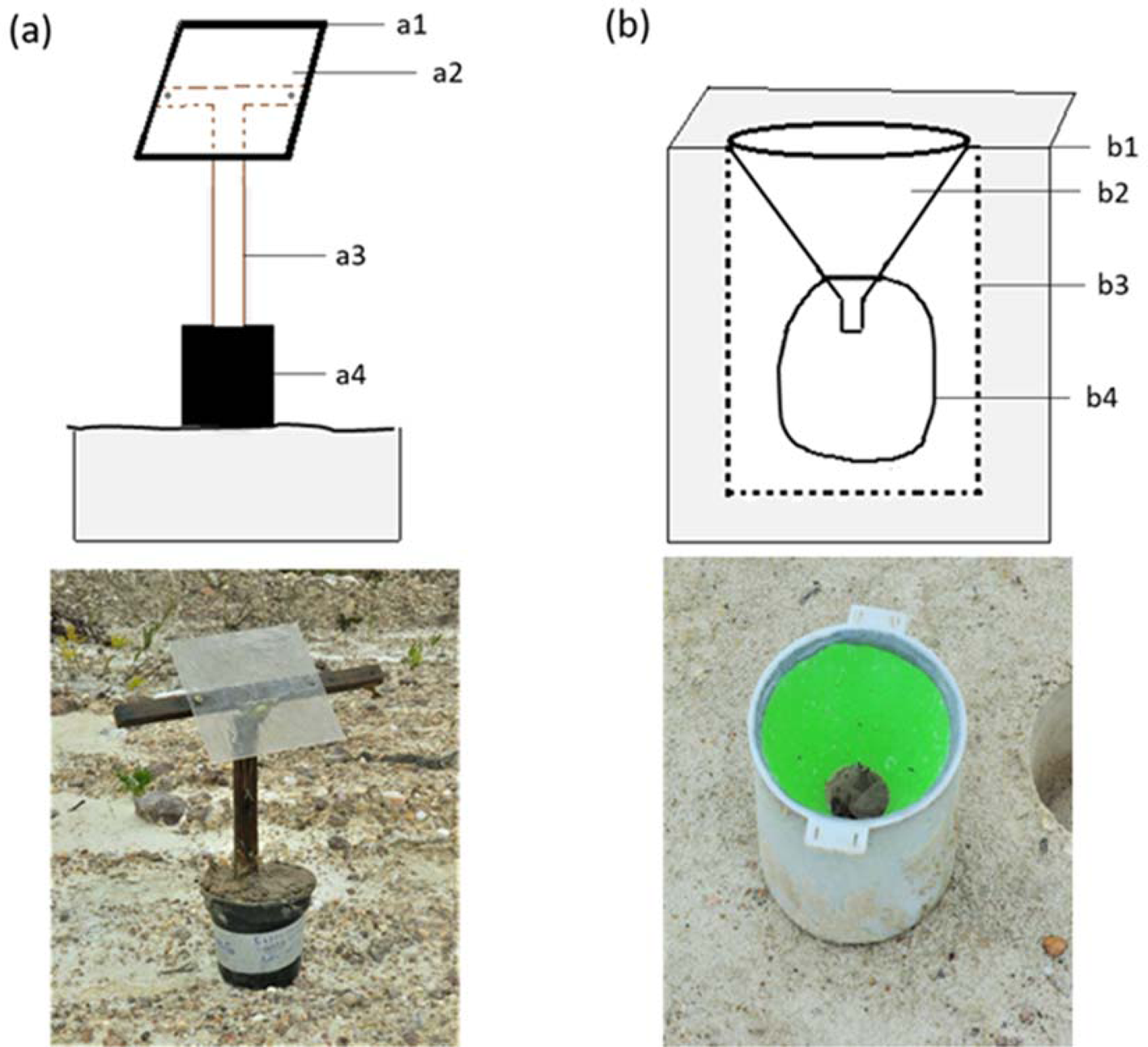
We tested sticky and funnel traps (Fig. 2), which capture complementary processes of seed rain (Chabrerie and Alard, Reference Chabrerie and Alard2005) and are the most common traps used to estimate seed rain in grasslands (Arruda et al., Reference Arruda, Buisson, Poschlod and Silveira2018). We provide detailed instructions on how these two seed traps can be built using low-cost and readily available material (supplementary Data S1 and S2).
(a) Sticky trap. a1: clear Plexiglas® plate (0.0225 m²); a2: sticky gel over a thin plastic film placed over the Plexiglas plate; a3: wooden pole; a4: plastic pot filled with concrete and (b) funnel trap. b1: ground level; b2: PVC plastic funnel section (0.01 m²); b3: white PVC pipe with bore holes 1 cm diameter; b4: bag of <0.1 mm mesh size.

Standardized protocol
We used four species: arugula (Eruca sativa), quinoa (Chenopodium quinoa), sesame (Sesamum indicum) and sunflower (Helianthus annuus). Here, the sunflower achenes are called seeds to facilitate the terminology throughout the manuscript. These seeds are available in most market or garden centre worldwide and provide variation in size, weight and colours that can be tested across ecosystems (Table 1). To assess seed retention, the number of traps and the length of time that traps should be left in the field can be adapted to each study. Killing the seeds before using them in the field is a mandatory step to (1) prevent the seeds from germinating on the seed traps, (2) avoid contamination by pathogens that may be associated with these seeds (Godefroid et al., Reference Godefroid, Van De, Stoffelen and Vanderborght2017) and (3) prevent the invasion of exotic species (Estévez et al., Reference Estévez, Anderson, Pizarro and Burgman2015). We placed all seeds in a drying oven at 120°C for an hour, as treatments heating seeds above 85°C for more than 8 min have shown to kill most seeds (Hess et al., Reference Hess, De Wilde, Yavercovski, Willm, Mesléard and Buisson2018). We conducted all seed measurements (e.g. weight and size) after the heat treatment.
Seed average width, length and weight after heat treatment at 120°C for an hour for the four species that should be used in the protocol. We made the measurements from 15 seeds of each species

On each trap, we gently dropped 10 seeds of each species, totalling 40 seeds per trap (Table 1). On funnel traps, we put all seeds straight into the bag collectors. It is best to run the standardized protocol either during the same season(s) as the study or, if run over 1 year, during the season in which conditions are most challenging for the preservation of the seeds on the traps. For the sticky traps, we examined all samples collected from each trap under magnification. For the funnel traps, we collected the bags separately from each trap. We washed the bags’ content in a 250-μm sieve to reduce the amount of fine soil particles, and then examined under a magnifying glass to count and identify seeds. All seeds were counted, and any signs of damage recorded.
To evaluate seed loss during the seed sorting of funnel traps samples, a second experiment examines the sorting accuracy with funnel traps samples. We chose to test the seed sorting accuracy with only funnel trap samples because the traps can accumulate much litter and soil in the field, making it difficult to retrieve seeds. For this test, a given number of seeds of the four species are mixed in soil, in a proportion equal to that commonly found inside the funnel trap bags. The soil used must be taken from the study area to control for colour, debris and litter composition. The number of seeds in each sample (with a minimum of 3 and maximum of 30 seeds per species) should be randomized and noted; this number is not known to the observers. A minimum of three previously trained observers then sort the samples, searching for, identifying and counting the seeds. For ethical aspects, observers’ anonymity must be respected when collecting and reporting the data.
The proportion of seeds retrieved at the end of the experiments (retrieval success) is obtained by calculating the percentage of seeds retrieved by each observer. Both experiments are analysed using generalized linear models that assume a quasibinomial distribution and use retrieval success as the response variable. For the seed trap effectiveness experiment, trap type and species are the categorical variables (interaction was tested). For the seed sorting experiment, species and experimenters are the categorical variables (interaction was tested). In both cases, pairwise contrast comparisons with a Tukey adjustment can be run. We here performed these analyses with R (R Core Team, 2018), packages base and emmeans.
Proof of concept
In order to proof-of-concept our protocol, we conducted fieldwork in the southern part of the Espinhaço mountain range, southeastern Brazil (43°35′W, 19°17′S). The annual precipitation averages around 1400 mm, and climate is markedly seasonal, with most rainfall occurring in the hot summers (Silveira et al., Reference Silveira, Negreiros, Barbosa, Buisson, Carmo, Carstensen, Conceição, Cornelissen, Echternacht, Fernandes, Garcia, Guerra T, Jacobi, Lemos Filho, LeStradic, Morellato, Neves, Oliveira, Schaefer, Viana and Lambers2016). We conducted the experiment in March 2017, at the end of the raining season, when high temperatures, strong winds and rainy days prevail, creating the most challenging conditions in the study area. The main vegetation comprises the mountaintop campo rupestre, fire-prone open grasslands that establish on quartzite-derived rocks, with shallow and severely nutrient-poor sandy soils (Silveira et al., Reference Silveira, Negreiros, Barbosa, Buisson, Carmo, Carstensen, Conceição, Cornelissen, Echternacht, Fernandes, Garcia, Guerra T, Jacobi, Lemos Filho, LeStradic, Morellato, Neves, Oliveira, Schaefer, Viana and Lambers2016).
We randomly placed six of each type of seed trap on a pristine site (50 m2) and retrieved seeds after a period of 1 month, as this the most common timeframe used to sample seed rain in grasslands (Arruda et al., Reference Arruda, Buisson, Poschlod and Silveira2018). For the second experiment, testing seed sorting accuracy with funnel trap samples, we ran the protocol with three previously trained observers in the laboratory.
Results
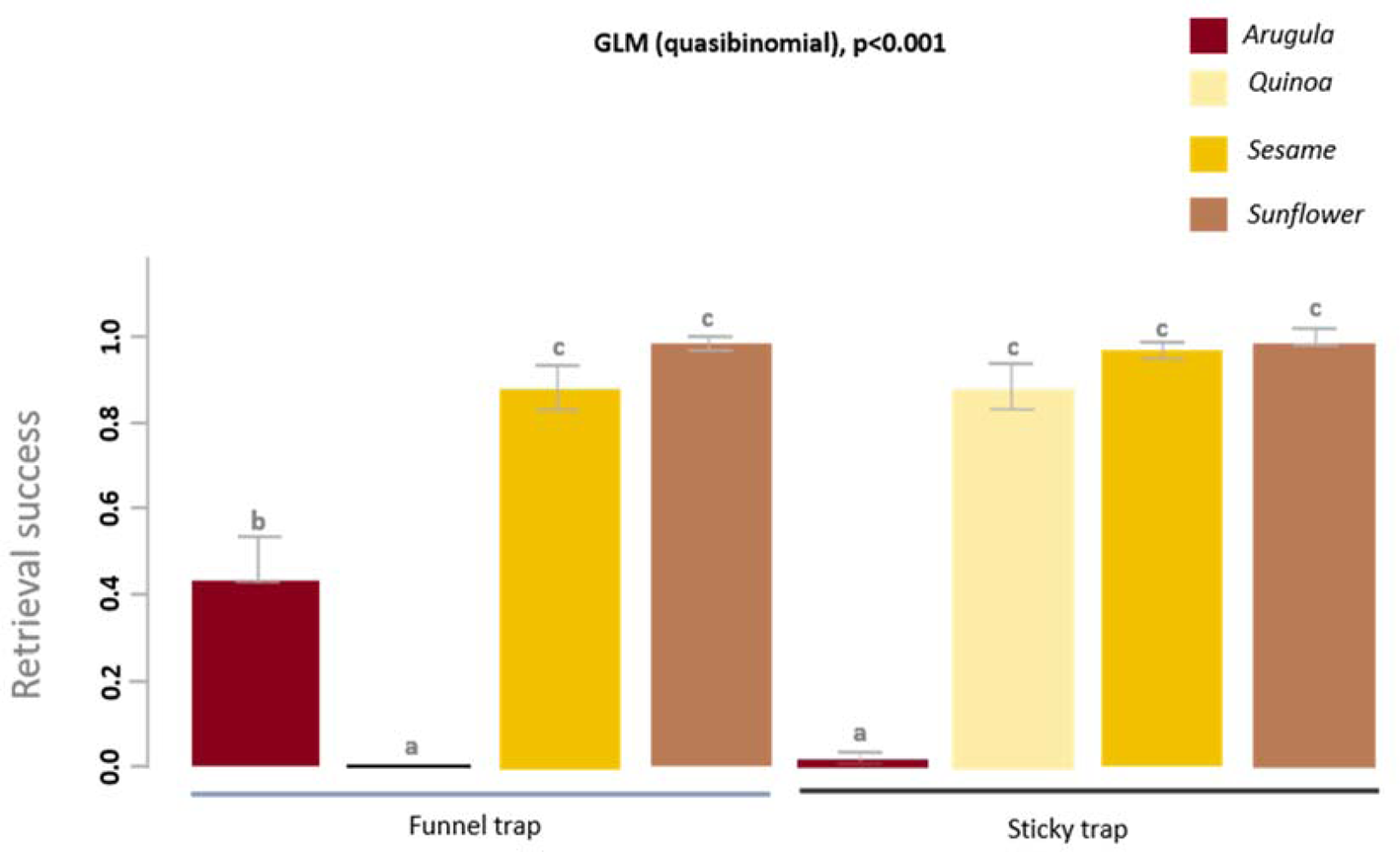
In the proof-of-concept experiment, we found no difference between the two trap types in sunflower seed retention, with both performing well (98. 6% for funnel trap and 100% for sticky trap; Fig. 3). Funnel traps were ineffective in retaining quinoa seeds under the field conditions, while the sticky trap had a good retention rate for quinoa seeds (88.6%; LM quasibinomial, P < 0.001; Fig. 3). We found no significant difference in the performance between seed traps for sesame seeds (Fig. 3). Funnel traps performed better than sticky traps in the retention of arugula seeds (41.4% more efficient than sticky traps; Fig. 3). Quinoa and arugula seeds had the lowest retention rates, with only 1.4 and 42.9% of the arugula seeds on sticky and funnel traps, respectively, and no quinoa seeds retrieved from funnel traps, after 1 month in the field. Most sesame and sunflower seeds were retrieved from both sticky and funnel traps (>88%; Fig. 3).
Retrieval success for four species in two seed trap types over a 30-day period (***=P < 0.001). For each species, ten seeds were placed in each trap type (indicated by the dashed line).

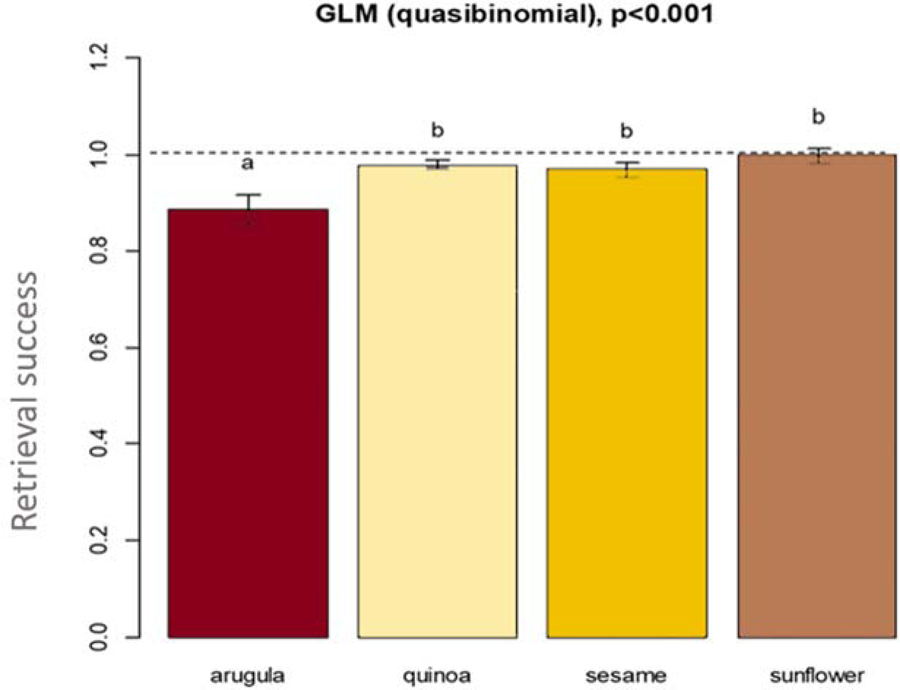
We found no evidence to support an observer effect (GLM quasibinomial, P > 0.05), but, while finding most seeds during seed sorting, there was a slight difference in retrieval success between species, with arugula being significantly lower: 88.6% of arugula seeds, 97.9% of quinoa seeds, 96.9% of sesame seeds and 100% of sunflower seeds (Fig. 4; GLM quasibinomial, P < 0.001).
Retrieval success on the sorting accuracy test of the funnel trap samples for the four species.

Discussion
Improving the accuracy and precision of seed rain estimates is necessary to further our understanding of both seed dispersal and seed limitation, and to support ecological restoration (Török et al., Reference Török, Helm, Kiehl, Buisson and Valkó2018). However, few studies tested seed trap effectiveness in open ecosystems (Arruda et al., Reference Arruda, Buisson, Poschlod and Silveira2018), thus precluding attempts to understand these processes on a global scale. Our results show that, under the tested field conditions, both trap types underperformed for species having seeds smaller than 2 mm width, and so that we are underestimating seed dispersal of small seeds. Despite finding no observer bias on seed sorting for funnel trap samples, we found that accuracy tended to decline for seeds under 2 mm width size, suggesting that size-dependence in seed retrieval success is more common than previously thought (Kollmann and Goetze, Reference Kollmann and Goetze1998).
Despite the lower risk of seed predation with sticky traps, due to the strong glue over the Plexiglas® plate, the seeds on sticky traps are more exposed, and thus more vulnerable to removal by wind and precipitation, than seeds in funnel traps. Sticky traps may also be problematic because insects, dust and litter can easily accumulate on the trap's glue, hindering the visual search for seeds. Traps near the ground are more vulnerable to contaminants, catching large quantities of dust and litter, especially during the rainy season. We believe that the height of our sticky traps (25 cm above the soil) greatly reduced their contamination by soil particles, but it did not prevent contamination by insects. Notably, many of the insects were mere incidental captures rather than active seed predators. In contrast, contamination by insects was negligible for funnel traps.
The high loss rates found for quinoa and arugula seeds in funnel traps indicate alarming losses for small seeds in general. The weak structure of the quinoa seed coat can make these seeds more vulnerable to mechanical stress, fluctuations in humidity and temperature, and growth of microorganisms (Mohamed-Yasseen et al., Reference Mohamed-Yasseen, Barringer, Splittstoesser and Costanza1994). The loss of quinoa seeds are thus probably linked with humidity within the funnel traps, and seed decay is likely the main cause of seed loss in funnel traps (seed removal by animals is unlikely due to the shape of the funnel trap). It shows that when reporting results, one should be aware that seed rain may present diaspores vulnerable to decay resulting in underestimation on seed rain surveys, especially during data collection in rainy seasons. Seeds with hard seed coats, such as sesame and arugula, are generally long-lived and have high retention rates by funnel traps (Priestley, Reference Priestley1986). Hard seed coats may negative influence the retention capacity of small seeds on sticky traps, as most arugula seeds were probably washed off by rain or removed by strong winds from the glue.
Despite finding no observer bias on seed sorting for funnel trap samples, we found that accuracy tended to decline with decreasing seed size and for seeds of darker colour. Soils with high content of organic particles, like where we tested the proof-of-concept, may directly impact the accuracy of seed sorting methods because soil particles are similar in colour to some seeds; sorting methods should account for this similarity.
Conclusions
Our study clearly demonstrates that the traits of seeds can influence their retrieval from seed traps used in seed rain studies. We provide a detailed standardized protocol that can be easily implemented in any seed rain study in grasslands using sticky and funnel traps that can be tested and used in globally distributed experiments (Borer et al., Reference Borer, Harpole, Adler, Lind, Orrock, Seabloom and Smith2014). When discussing the results of a seed rain study using the proposed protocol, one must offer the caveat that the methodology applied likely underestimates seed rain considering seed traits, trap types and environmental conditions. Under our field conditions, our seed rain study would not allow us to conclude that small, soft seeds cannot be dispersed by water run-off, as they may decay in funnel traps; nor could we infer anything regarding small, dark, smooth seeds, as they can be lost from sticky traps or not found by observers. Finally, we argue that our standardized protocol addressing trap effectiveness and seed sorting methods will increase the reliability of data obtained in seed rain studies in grasslands and allow more reliable comparisons between datasets.
Supplementary material
To view supplementary material for this article, please visit: https://doi.org/10.1017/S0960258520000392.
Acknowledgements
We thank the three anonymous volunteers for assisting in the seed sorting accuracy tests, and M. King for language editing and review. We thank the three anonymous reviewers for their helpful comments. A.J.A. receives a scholarship from CAPES and FAPEMIG and F.A.O.S. receives grants from CNPq and FAPEMIG. This work was also supported by CNRS PICS 2018–2020[RESIGRASS].
Conflict of interest
The authors declare no conflict of interest.
Authors’ contributions
All authors conceived the ideas and designed methodology; A.J.A. and E.B. collected the data; A.J.A. and E.B. analysed the data; A.J.A. led the writing of the manuscript. All authors contributed critically to the drafts and gave final approval for publication.