Women are making important strides as presidents in Latin America as of late. This trend became evident in 2006 when Michelle Bachelet gained the Chilean presidency. Cristina Fernández followed shortly thereafter in Argentina. In 2010, Dilma Rousseff (popularly referred to as “Dilma”) joined this small yet growing group of women when she was elected the first female president of Brazil. Dilma's victory was no surprise since she had the support of the very popular outgoing president Luiz Inácio “Lula” da Silva.Footnote 1 Nevertheless, the fact that Dilma is a woman is noteworthy given that Brazil's political system is overwhelmingly male dominated at all levels of government (Araújo Reference Araújo2010; Bohns Reference Bohns2007; Miguel Reference Miguel2008). Dilma's significance also stems from the fact that, unlike most women national leaders around the world, she occupies a relatively strong presidency, gained office through popular election, and lacked family ties to power (Jalalzai Reference Jalalzai2013).
Moving beyond the historic 2010 election, in this article we use Dilma's tenure as president (2011 to present) to investigate the connection between gender and representation throughout her presidency. Focusing on descriptive and substantive representation, we argue that Dilma's presidency has had a direct impact in certain areas related to gender representation—most notably women's descriptive representation in the executive branch—while having limited impact in others. More specifically, we elaborate on how complex the connection between gender and representation is, especially when looking at the multiple facets of representation in relation to the decisions of a country's executive branch. The analysis recognizes the difficulty in separating Dilma's representation of women from her partisanship and status as Lula's heir apparent. Any enhanced tendency of Dilma's to represent women may indeed stem from gender but is mitigated by myriad factors.
This article is divided as follows. First, we provide a brief description of the significance of Dilma's election and the possible contributions to the literature stemming from her election. Secondly, we discuss the theoretical and methodological implications of a study on presidential gender representation, elaborating on how we define and connect gender with discussions of descriptive and substantive representation. Third, we investigate Dilma's presidency in the context of its impact on descriptive and substantive representation of women in Brazil. We conclude by providing an overview of our arguments as well as recommendations for future research on women presidents in a comparative perspective.
SIGNIFICANCE
Totaling only 76 cases to date, women prime ministers and presidents are political rarities but vastly increased their numbers over the last two decades.Footnote 2 Overall, they exercise somewhat limited powers and arise from a very narrow array of circumstances, contexts, and backgrounds (Jalalzai Reference Jalalzai2008, Reference Jalalzai2013). Seven of the twenty-eight presidents coming to power to date hail from Latin America; of these, slightly over half ascended since 2006.Footnote 3 Latin American countries nearly universally adopted systems investing a great deal of authority to the executive, hence affording women elected in the region more power than women gaining national executive offices in other parts of the world (Franceschet Reference Franceschet2011). Decree, amendatory observations, and unilateral appointment of their cabinet (not requiring congressional approval) provide an agenda-setting influence that is considerably higher than most presidents, including their American counterpart (Aleman and Tsebelis Reference Aleman and Tsebelis2005; Cox and Morgenstern Reference Cox and Morgenstern2001). In the specific case of Brazil, policy making generally initiates at the executive level with cabinets sending bill proposals for Congress to accept, reject, or amend. Among many legislative powers, the president can evoke a medida provisoria (provisory measure, an executive decree), subject to legislative confirmation. Presidents appoint cabinet officials unilaterally though they must weigh various considerations in their selections including coalition partners' preferences. Brazilian (and to a certain extent, Latin American) presidential power and its direct influence on policy making raises an array of questions regarding the role of gender in presidential politics. More specifically, the recent rise of women presidents sparks debate about the role of gender in a president's policy-making priorities, political appointments, and political rhetoric.
When connecting Dilma's presidency with representation, we rely on well-established concepts that are widely used in the growing literature of gender representation. We view representation as the combination of factors that ultimately lead to political leaders acting on behalf of citizens. Pitkin (Reference Pitkin1967) conceptualizes representation as four interrelated dimensions: formalistic, descriptive, symbolic, and substantive. In this article we focus on two of these four interconnected concepts: descriptive and substantive. Descriptive representation, defined by Pitkin, is when a political representative “stands” for her/his constituency “by virtue of a correspondence or connection between them, a resemblance or reflection” (1967, 61). In the gender and politics literature, this resemblance is associated with sex: women share specific attributes that would make sense for a woman to “stand for” other women. Therefore, studies regarding women's descriptive representation have focused on the election of women, emphasizing the election of women to legislative positions (Franceschet, Krook, and Piscopo Reference Franceschet, Krook and Piscopo2012; McAllister and Studlar Reference McAllister and Studlar2002; Schwindt-Bayer Reference Schwindt-Bayer2010). Substantive representation has come to be understood in the gender and politics literature as the ability (or willingness) to promote “women's issues” when elected to office. Nevertheless, how to measure substantive representation and deciding what exactly constitutes women's interests is a prominent scholarly debate (Celis Reference Celis2009; Celis et al. Reference Celis, Childs, Kantola and Krook2008; Childs and Krook Reference Childs and Krook2009; Franceschet, Krook, and Piscopo Reference Franceschet, Krook and Piscopo2012; Htun and Weldon Reference Htun and Weldon2010; Pitkin Reference Pitkin1967; Schwindt-Bayer Reference Schwindt-Bayer2010), one that we seek to explore.
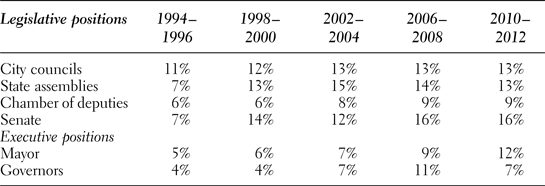
Adding to the historic underrepresentation of women in executive power in Latin America, Dilma's rise seems especially puzzling, as the percentage of women in Brazilian politics continues to be one of the lowest in South America at all levels of government and varies only slightly between legislative and executive positions, as well as among levels of government (local, state, and national) despite the fact that Brazil has a very vibrant women's movement (dos Santos Reference dos Santos2012; Htun Reference Htun2002). Efforts from women activists, women politicians, and male elites sympathetic to the issue of women's descriptive representation led to the implementation of a gender quota law in 1995.Footnote 4 Women legislators, however, increased only slightly (see Table 1). Brazil's 8.6% of women in the Chamber of Deputies (national lower house) rank 130th in the world, well below the Americas' average of 23.8% (Inter-Parliamentary Union 2014). Therefore, the election of a woman president in an environment that has been widely unwelcoming to women can have widespread representational effects.
Percentage of women elected 1994–2012

The dates reflect the elections for local, state, and national level elections. Local elections (city council and mayor) happened in 1996, 2000, 2004, 2008, and 2012. State and national elections (chamber of deputies, senate, and governor) happened in 1994, 1998, 2002, 2006, and 2010. The first year that the gender quota law was implemented for city council elections was 1996, and 1998 was the first year for quotas in the chamber of deputies elections. Source: TSE 2013.
By connecting the presidency of Dilma Rousseff with the concepts of descriptive and substantive representation in Brazil, this article seeks to contribute to the literature on women's representation. Most research on gender and representation has focused on legislative politics (Franceschet, Krook, and Piscopo Reference Franceschet, Krook and Piscopo2012; Schwindt-Bayer Reference Schwindt-Bayer2010). As more women are elected to the highest executive offices across the world, scholars must explain the effects women elected to executive positions can have on women's representation as it is broadly defined. The complexities of particular case studies (each woman president in a particular context at a specific time) must be considered while also generating general theories and utilizing comparative approaches. Moreover, the connection between the election of a woman president (descriptive representation) and the substantive representation of women becomes even more critical with greater quantities of women elected to executive positions. Therefore, this article seeks to add to the literature on women's substantive representation (Celis Reference Celis2009; Celis and Childs Reference Celis and Childs2008; Celis et al. Reference Celis, Childs, Kantola and Krook2008; Childs and Krook Reference Childs and Krook2009; Franceschet and Piscopo Reference Franceschet and Piscopo2008; Mackay Reference Mackay2008; Mansbridge Reference Mansbridge2003), paying special attention to the role of women presidents in the process of establishing policy priorities and developing women-related policies. Using the case of President Dilma Rousseff of Brazil to drive these deliberations, this article contributes to scholarship by discussing some of these potential theoretical and methodological approaches to studying the effects of gender on women executives and representation.
GENDER AND REPRESENTATION
Because Dilma Rousseff's election marks the first-ever election of a woman to Brazil's most powerful political office, questions surrounding the impact a woman president will have on the political system were constant in the media and in the political circuit ever since she was rumored to be Lula's handpicked candidate. Therefore, her sex has been the starting point to many political debates. But in reality it is not her sex that matters, but the gender identities that she brings to office. In this article we define gender as the complex process of the social construction of men's and women's identities in relation to each other (Beckwith Reference Beckwith2010). As a category, gender is a “multidimensional mapping of socially constructed, fluid, politically relevant identities, values, conventions, and practices conceived as masculine and/or feminine” (Beckwith Reference Beckwith2005, 131) that do not necessarily correspond to a person's sex or biological characteristics. The indisputable male dominance in governments worldwide strongly suggests that the nature of government and politics is gendered and biased against women. Political institutions are gendered in the sense that the processes, practices, ideologies, and distributions of power are directly related to the relationship (negotiation) between men, women, and their gendered identities. Therefore, when a woman is elected for the first time to the country's most powerful position, her own gender identity is likely to influence discourse and policy making. A president's female gender identity may affect what representation means for the president, for society, and for the political system as a whole.
The vast majority of scholarship exploring the difference women make in office links women's descriptive and substantive representation but with a clear emphasis on women in legislative, not executive, positions. Several suggest that women legislators do act more on behalf of women's interests (Bratton and Ray Reference Bratton and Ray2002; Childs Reference Childs2002; Dodson Reference Dodson2006; Swers Reference Swers2002). Factors shaping women's tendency to act for women include party dynamics and the priorities of individual political actors (see Franceschet, Krook, and Piscopo Reference Franceschet, Krook and Piscopo2012, 8–9). Growing research questions the claim that women's policy representation follows the achievement of critical mass (Childs and Krook Reference Childs and Krook2006). Instead, scholars assess under which circumstances women act on behalf of women's interests (Childs and Krook Reference Childs and Krook2009). Among findings, legislators hailing from liberal parties and espousing feminist views place greater emphasis on women's substantive representation (Franceschet, Krook, and Piscopo Reference Franceschet, Krook and Piscopo2012). However, few studies have attempted to connect descriptive and substantive representation to the election of women as heads of state.Footnote 5
When discussing concepts of representation, especially in regard to substantive representation, it is important to also elaborate on the heavily debated definition of “women's interests.” One general area relates to women's practical interests encompassing private sphere issues. Another focuses on women's status in the public domain, particularly their employment and ties to the welfare state (Molyneux Reference Molyneux1985). “Strategic” interests arise from assessing the subordination of women and possible challenges to women's inequality and lack of autonomy when utilizing a feminist lens (Molyneux Reference Molyneux1985). Criticisms of conceptions of women's interests include the narrowness of definitions and essentialism—the “assumption that members of certain groups have an essential identity that all members of that group share and of which no others can partake. Insisting that women represent women or blacks represent blacks, for example, implies an essential quality of womanness or blackness that all members of that group share” (Mansbridge Reference Mansbridge1999, 637).
In response, instead of defining a laundry list of women's interests a priori, some scholars employ an inductive method of analyzing claim articulation of representing women by political actors, which may then be applied to different contexts and policy areas worldwide (Celis et al. Reference Celis, Childs, Kantola and Krook2008; Squires Reference Squires2008). Htun and Weldon (Reference Htun and Weldon2010) seek to better delineate the nature of women's interest by creating a typology that separates gender-status policies (affecting all women) from class-based policies (affecting a specific sector of the population). The authors also typify women's issues as doctrinal (policies that contradict explicit religious doctrine, codified tradition, or sacred discourse) and nondoctrinal policies (Htun and Weldon Reference Htun and Weldon2010, 210). This typology also employs an inductive process of determining women's interests beyond a solely gendered approach to one recognizing the intersectionality between gender, race, class, religion, and other key cultural constructions present in modern society. In this article we acknowledge the complexities surrounding women's substantive representation (Celis et al. Reference Celis, Childs, Kantola and Krook2008; Childs and Krook Reference Childs and Krook2009; Mackay Reference Mackay2008; Mansbridge Reference Mansbridge2003) and seek to propose an approach to explain the impact executive leaders, especially women leaders, have on women-related policy making based on Htun and Weldon's typology on women's interests.
The case of Dilma Rousseff presents scholars a unique opportunity to examine the potential representational effects offered by strong women presidents. There is no disputing the fact that Dilma's climb to power resulted from Lula's mentorship, recruitment, and popularity. Dilma and Lula both hail from the leftist Worker's Party (PT), and Lula actively campaigned by her side. As such, we would expect them to behave fairly similarly. Dilma's presidency was intended to be more of the same rather than a departure from the past eight years; voters demanded policy continuation when they voted her into power. We argue that any enhanced tendency of Dilma's to represent women, however, may stem from gender, though this is mitigated by various factors. Given the strength of her position, Dilma has the power to represent women, if she so desires. As such, Dilma's ascension presents an important opportunity to examine potential representational effects for women and evaluate how gender shapes executive governance.
We find that Dilma's tenure as president reveals a complex relationship between gender and representation. Descriptively, presidenta Dilma has shown a strong tendency to increase female representation at the high level of cabinet appointees. Changing the makeup of the government, Dilma has appointed record numbers of women to high offices, including some of the most important cabinet positions. Substantively, Dilma's impact is visible but complicated. While Dilma has expanded many of the policies established by former president Lula to explicitly benefit women, most of the changes to women's substantive representation have been connected to previously established policies, and the president has stayed away from controversial gender-related policies, such as abortion. Dilma's policies have benefited women, but none of her actions so far indicate innovative or “revolutionary” policies, making most of Dilma's substantive changes in gender-related policies arguably class-based. Even with the complex relationship between Dilma Rousseff's policies and women's substantive representation, we argue that her presidency has shown evidence of what came to be known in Brazil as the Dilma Effect: the Brazilian president affords women enhanced descriptive and substantive representation.
REPRESENTING WOMEN
This section analyzes whether or not Dilma represents women descriptively and substantively. By the sheer fact that she is biologically female, Dilma offers women descriptive representation. However, is the president doing anything distinct from previous presidents that show a clear focus on enhancing other women's descriptive representation? Substantively, does she work on behalf of policies that improve the lives of women? To understand Dilma's descriptive and substantive representation of women, we rely on findings from fieldwork interviews and analysis of descriptive information of the president's tenure. Twenty-one respondents, political elites, and experts of diverse party leanings were interviewed in Brazil during the spring and summer of 2012.Footnote 6 We also analyze her appointments and supplement findings derived from interviews with media analysis.
Descriptive Representation
Descriptive representation relates to the extent to which representatives possess the same physical or social characteristics of their constituencies (Pitkin Reference Pitkin1967) and have shared experiences (Mansbridge Reference Mansbridge1999). The bulk of the literature on women's descriptive representation focuses on the election of women to legislative positions and the profiles of these women (Franceschet, Krook, and Piscopo Reference Franceschet, Krook and Piscopo2012; Hughes Reference Hughes2013; McAllister and Studlar Reference McAllister and Studlar2002; Schwindt-Bayer Reference Schwindt-Bayer2010; Thames and Williams Reference Thames and Williams2010). When thinking about women in the executive, especially women in national executive positions, the focus has also been on the election of women to such positions. To measure women's descriptive representation, scholars have relied mostly on the number of women elected, making descriptive representation in its most simple form the most straightforward measureable form of representation in the gender and politics literature. While we acknowledge that descriptive representation is not only a matter of sex and gender (race, ethnicity, social status, and other aspects of intersectionality matter), we believe that looking at Dilma's efforts to increase the representation of women as a whole in her government is something worth pursuing. Dilma's ability to appoint her cabinet allows her to focus on sex and gender as key determinants for nomination. In general, rather than resulting from deliberate actions, women's descriptive representation is simply a byproduct of women executives' ascensions. However, by appointing women to high levels of office, we can see how committed Dilma is to fundamentally transforming the political landscape.
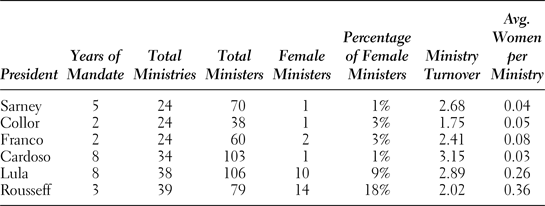
While the president appoints and dismisses cabinet ministers at will, these selections balance the interests of the PT and other parties. As Dilma formed her government on January 1, 2011, the PT claimed 17 ministries (45%). The Party of the Brazilian Democratic Movement (PMDB) held six (16%), and another eight (21%) lacked party affiliations (Frayssinet Reference Frayssinet2010). According to four (19%) of our interview respondents, because Dilma owed Lula a special debt of gratitude for her election, she needed to be mindful of his preferences. Thirteen of her initial ministers (slightly more than one-third) served as part of Lula's cabinet, some holding very important posts, such as finance and chief of staff (Frayssinet Reference Frayssinet2010). Given these cross and intraparty pressures, Dilma's ability to select women appeared constrained. Her commitment, however, to positioning women in the highest offices in spite of these potential constraints appears unparalleled and generally increased throughout her tenure. Nine (24%) of her appointees in her first cabinet were women, and this increased to ten (26%) during the first half of her four-year term. Overall, 14 (18%) of total appointments of her cabinet appointments have been women (see Table 2). Her cabinets have been comprised of 12 distinct women. Currently, women's numbers (eight) and percentages (21%) have declined but still remain relatively high.Footnote 7 Rather than this slight reduction resulting from Dilma's dismissals, some of her women ministers decided to run for other offices. In fact, while Dilma has altered the makeup of her cabinet, many of her women appointees remain.
Female ministers since the return to democracy
While 21% hardly represents record highs for women in cabinet in positions worldwide, this is a record for Brazil. Fourteen (67%) of our respondents highlighted the importance of gender in Dilma's cabinet selection—the most frequently cited factor involved in her cabinet formation.Footnote 8 Because Dilma was Lula's protégé, it was widely anticipated that her actions would not diverge much from his when time came to appoint her cabinet. She, however, selected more women than Lula did in his whole administration (Frayssinet Reference Frayssinet2010). Moreover, while Lula appointed a total of 10 female ministers during his eight-year tenure, more than all other democratic elected presidents combined, Dilma has selected 14 women as ministers in less than four years (see Table 2).
Perhaps even more important than quantity of women in cabinets is their placement. While women worldwide are increasingly securing more high-profile and “masculine” posts, including finance, state, and even defense, they are still underrepresented in “masculine” ministries and overrepresented in all “feminine” positions. High prestige appears synonymous with many “masculine” ministries. This is not the case for “feminine” portfolios such as family and women's issues, health, and education, which garner low or medium levels of prestige (Escobar-Lemmon and Taylor-Robinson Reference Escobar-Lemmon and Taylor-Robinson2005; Kunovich and Paxton Reference Kunovich and Paxton2005). Women's tendency to head less prestigious and more “feminine” ministries with weaker connections to the president or prime minister reinforces the “masculine” structure of cabinet office. Still, women appear to be gaining ground in obtaining more “masculine” cabinet posts worldwide (see Bauer and Tremblay Reference Bauer and Tremblay2011). As a continuation of this larger trend, not only has Dilma enhanced the quantities of women appointees, she does not relegate women to the weak positions; some hold the most authoritative portfolios in the administration, especially evident in her most recent appointments.
As noted, cabinet changes have occurred; by 2014, some cabinets have been led by four different ministers. Many of the ministers no longer serving represented holdovers from the Lula regime, with several essentially sacked because of corruption allegations against them.Footnote 9 Most respondents viewed the chief of staff (casa civil) as the most powerful position in the Brazilian cabinet. With Palocci, Lula's finance minister, out of office due to corruption allegations, room opened up for Dilma to appoint Gleisi Hoffmann as her chief of staff. Other critical positions held by women include minister of planning and minister of institutional relations. Thus, three of the four most powerful cabinet members, with the exception of finance, have been headed by women during Dilma's tenure.
Other ministers resigned to compete for other offices, a fairly common practice in Brazil. Party affiliation, when applicable, seemed to play an important role in the naming of their replacements. Dilma tended to appoint people from the same party as the outgoing minister. As stated, the continuity among her female ministers is quite noteworthy.Footnote 10
Since she has not appointed women to defense and finance, we must question the extent to which Dilma has “regendered” cabinet selections. However, some of her most high-profile appointments are indeed to other highly “masculine” positions. For example, her selection of Maria das Graças Foster as the first female head of the Brazilian energy company Petrobras is highly significant (Hennigan Reference Hennigan2012). In the fall of 2012, Dilma appointed the first female admiral in Brazil, Dalva Maria Carvalho Mendes. Her appointment of women throughout various sectors in the country has been lauded by politicians, academics, and journalists alike.
According to then senator Marta Suplicy (PT) who is now the minister of culture,
I feel very comfortable now because I feel we have a president that's taking care of everybody. We see numbers we have now and the numbers we had before and anytime she has a man and a woman of the same quality, she nominates a woman. …What is making her different (from Lula) is her sensitivity in regards to women. Definitely. And sometimes we have women who get power and don't show that quality.Footnote 11
Minister Ideli Salvatti (PT) noted: “President Dilma has made it clear early on in her management that it is necessary to have a feminine stamp on her government and she was firm on nominating about ten women ministers to compose her cabinet of trust.”Footnote 12
Her dedication to improving the status of women has been dubbed by the media as the “Dilma Effect.”
Rousseff continues to work towards establishing women in positions of power and making their presence a normality in Brazilian society. What's more, having appointed women to three of the four key political ministerial positions within her government, it would seem that Rousseff has begun to fulfill the promises she laid out to her people a year ago (Pollack Reference Pollack2012).
At the same time, Dilma has still faced criticism. According to Thelma de Oliveira, national secretary for public policy for women from the opposition Brazilian Social Democratic Party (PSDB), “Since she [Dilma] put women ministers in office, this shows her agenda of concern for women. But what really affects women is to improve women lives—like [with] health, labor, violence.”Footnote 13 While she acknowledged the important strides Dilma has made in promoting women to office, she still questioned whether Dilma is making a positive difference in women's status, a point we address more fully subsequently.
Dilma's election and the spotlight put on the issue of women in politics may have also had other more subtle effects on the Brazilian political scene. Some speculated that the number of women mayoral candidates in 2012 also resulted from the Dilma Effect. Essentially, women were no longer viewed as outsiders, particularly since Dilma broke through the presidential glass ceiling. She increased quantities of visible women in her administration and may have directly and indirectly inspired more women to vie for mayoral positions. The 2012 elections saw an increase both in the percentage of female mayoral candidates (13.39% compared to 11.02% in 2008) and the percentage of women elected mayors (12.03% compared to 9.15% in 2008). This corresponds to an increase of 21.3% of female mayoral candidates and a 31.5% increase in the number of women elected as mayors (Kometani Reference Kometani2012). This rise in the number of female mayors cannot be attributed solely to Dilma's ascension to the presidency, but it should spark debate regarding the importance of having a woman in the country's highest executive office. The Dilma Effect, in the case of mayoral elections in 2012, may have contributed to the descriptive representation of women in Brazil's political system.
When thinking about the effect Dilma's election had on women's descriptive representation in Brazil, we see direct and indirect impacts. Dilma Rousseff has, since her election, made clear that women would play an important role in her administration. The president has increased the number of female cabinet members to unprecedented levels in Brazil. She has been consistent in her appointment of female ministers and has appointed women to key strategic, even “masculine,” appointments. The Dilma Effect is still not as clear in other elected positions. Nevertheless, the rise in female mayoral candidates and elected mayors may indicate a new trend in Brazilian politics, where female candidates (as a whole and as winning candidates) become more common throughout the country for all levels and branches.
Substantive Representation
Early research exploring substantive representation among female Latin American legislators found that they viewed themselves primarily as wives and mothers and worked on issues that related to their supremadres' identities (see Chaney Reference Chaney1979). Decades later, with increased social and political opportunities, subsequent research challenges this conception. Instead, female legislators register a concern with feminist rather than just feminine issues (Schwindt-Bayer Reference Schwindt-Bayer2006). Feminine issues comprise the private domain arising from women's traditional roles as caregivers. In contrast, feminist issues seek to combat women's discrimination and inequality, ultimately challenging women's traditional status (see Schwindt-Bayer Reference Schwindt-Bayer2010, 14). The line between feminist and feminine issues blurs, however, when considering Htun and Weldon's (Reference Htun and Weldon2010) typology on sex equality policies. The authors divide such policies into four categories: gender status, or issues that affect all women; class based, addressing inequalities among women; doctrinal, or policies that contradict or go against religious, traditional, or tribal authorities; and nondoctrinal, or policies that do not affect the religious doctrine or tradition. Taking all these aspects of policy making into consideration, any discussion of substantive representation requires scholars to acknowledge the complexity of women politicians' policy goals and outcomes and women's interests and the difficulty in identifying a clear line between feminine and feminist issues.
In this section we propose that an in-depth analysis of Dilma's key policy decisions that can be considered gender related is essential to understanding the connection between her presidency and women's substantive representation. Here we provide an overview of a few of the most clear gender-related policies as well as some controversial decisions, identifying such policies based on Htun and Weldon's (Reference Htun and Weldon2010) typology on sex equality policies.
Several comparative studies suggest that women legislators do act more on behalf of women's interests, even after controlling for other relevant dynamics such as party (Bratton and Ray Reference Bratton and Ray2002; Childs Reference Childs2002; Dodson Reference Dodson2006; Swers Reference Swers2002). Similar investigations of women executives offer less decisive claims regarding women's tendencies to act as substantive representatives (Sykes Reference Sykes and Genovese1993). A continued lack of research on women national executives, however, limits forming clear conclusions. Based on comparative findings and those specific to Latin America, we expect Dilma Rousseff to offer representational benefits to women-related concerns, though this tendency is mitigated by numerous factors including partisanship, ideology, feminist consciousness, and degree to which she has support from various feminist organizations. When thinking about Htun and Weldon's typology, we expect Dilma to be successful promoting issues revolving around class-based issues that are nondoctrinal in nature.
Assessing the impact of gender on Dilma's substantive representation is complicated. Dilma's closeness to Lula, which hastened her PT nomination and ultimate victory, would lead us to expect she would offer more of the same when it comes to women. Several of her current programs extend back to Lula's administration. As such, many policies deriving from the PT correspond closely to her party's socialist ideology rather than from the fact that, as a woman, Dilma is more interested in providing women increased rights and improving their status as a group.Footnote 14 Nevertheless, evidence seems to indicate that she has gone a bit further than other presidents, including Lula, in promoting women's substantive representation in some specific areas, especially those dealing with poor women.
Dilma's position as a woman who has risen through the ranks of her political party without the tacit support from feminist groups generates further complexity. Critics within the women's movement and the women's secretary claim Dilma has focused on previously established programs, failing to propose or support new women-related policies or to tackle controversial issues involving women's health and rights. This criticism is especially strong among feminist groups who may have expected more from a female president and not just an extension of the previous administration. We acknowledge this criticism, but we also believe that, given the fact that she and Lula governed together and that voter satisfaction with their policies was high, they were willing to elect Dilma in the first place; expecting her to somehow to go above and beyond Lula might be subjecting her to undue scrutiny. Nevertheless, such criticism must be taken into account when studying the relationship between Dilma and women's substantive representation in Brazil. Further, feminists similarly scrutinized Lula—hoping he would be more progressive on gender issues than the PT. Indeed, the role of feminist organizations is to analyze whether leaders craft policies that move the feminist agenda forward.
Even if Dilma is doing “more of the same,” it is clear that she is doing so while evoking gendered objectives. Dilma uses speeches on symbolic dates to emphasize the increased attention her administration is paying to protect and better the livelihood of women in the country, which may indicate her objectives with women-related policies is more connected to personal ambitions (such as reelection) than a real political goal of promoting women's position in Brazilian society. Bolsa Familia (Family Allowance) is a highly popular cash-transfer program—created by Lula in 2003 as part of the Zero Hunger program to eradicate poverty—which combined three of President Cardoso's (1998–2002) income-transfer programs. In Dilma's weekly radio show, Café com a Presidenta (Coffee with the President), right before International Women's Day in 2011, she stated that Bolsa Familia is made for “women, for their families, and their sons and daughters” (Rodrigues Reference Rodrigues2011). In a 2012 speech to the Brazilian Senate commemorating International Women's Day, Dilma argued that her administration has done more for women than any other in Brazilian history, reiterating that Bolsa Familia is “made for women” and stating that “93 percent of all Bolsa Familia cards were emitted in the name of women, who always show their care for the family and budget” (Rousseff Reference Rousseff2012). While Dilma neither created this program nor was responsible for Bolsa Familia's citizen cards being issued to women, her public addresses claim that her administration's concern for women's empowerment is unparalleled. In a 2013 speech, Dilma announced tax cuts on all products in what is called cesta básica (basic basket), which is a government-sanctioned description of the basic staples used by a family throughout the month. While this policy change affects all sectors (and genders) of the population, Dilma used her speech to reiterate the importance of women (especially mothers) to family finances and to reinforce how important policies like these are to women to combat ongoing inequities (especially women from lower socioeconomic sectors of society) in Brazil (Mendes Reference Mendes2013). Even in supporting policies that are seemingly gender neutral, Dilma is aware of the role that gender plays in the implementation and success of such policies.
Among government initiatives with a clear gendered objective and message, three are worth noting. First, on March 28, 2012, Dilma announced the establishment of Rede Cegonha (Stork Network), a program that would invest up to nine billion reais (four billion dollars) until 2014 in increasing social assistance to expectant mothers and newborn babies with the intent to diminish infant and maternal mortality (Aquino Reference Aquino2011). This ambitious program was established with the sole goal to protect low-income women and infants. This is one of the few programs that targeted women specifically, and it shows the complexity of women-related policy making and the concept of substantive representation. Dilma and her administration were clearly targeting women as a group—more specifically, low-income women. However, a number of women's organizations, scholars, and practitioners have criticized this program, stating that it is a “30 year regression in gender policies, women's health, and reproductive rights” (Lemes Reference Lemes2011). Critics claim that this program returns the focus of public health officials to the baby and not the woman, which undermines women's health rights. The program also calls for the registration of all pregnant women into a national database, something that critics see as a clear privacy issue for these low-income women. Moreover, critics claim that the program is based on concepts of motherhood that are archaic, sexist, and religiously based (Lemes Reference Lemes2011). The criticism seemed to have influenced the government to not pursue the program after the provisory measure expired on May 31, 2012 (Medida Provisória 557/2011). While Rede Cegonha was directed toward women, the nature of the policies implemented created a complex relationship between “protecting” women and “representing” women, something that critics—especially those aligned with feminist groups that did not necessarily support Dilma in her campaign—see as problematic.
The second “gendered” policy promoted by Dilma was announced on March 8, 2012 (International Women's Day). The president announced the enactment of a Medida Provisória (Provisory Measure, an executive decree), which later was enacted into law, (Lei Ordinária 12693/2012) stating that in the case of divorce, a house acquired through the Minha Casa Minha Vida program (My House, My Life, a program established by Lula with the intent to provide home loans and grants to low-income families) would be the property of the woman in the relationship (Stuckert Filho Reference Stuckert Filho2012). The program favors women in an attempt to further protect especially low-income women. Regardless of the legal ramifications of this program (some question the constitutionality of it since it alters the way assets are divided in a divorce), most proponents of women's rights have applauded the government's effort to protect the rights of women in another program that is an extension of Lula's presidency.
The third program worth noting was also announced on a symbolic date. On May 13, 2012, while making a speech commemorating Mother's Day, Dilma announced the program Brasil Carinhoso (Caring Brazil, using a word that is normally used to express a mother's care and love for a child), a complement to Bolsa Familia's cash transfers for families with children under six years old and in extreme poverty (Macedo Reference Macedo2012).Footnote 15 In her speech announcing this program, Dilma directed her attention to all mothers, especially the ones “who suffer.” Dilma went further to say that “when a president speaks for the poorer mothers, all mothers listen with heart and soul” (G1 2012). Once again Dilma focused on low-income women, something that can be seen as a continuation of Lula's policies, to outline the importance of women in Brazilian society. Critics see this policy and, to a certain extent, all other policies discussed above as a political move by the president to gain the low-income female vote for her reelection bid in 2014. Nevertheless, it is impossible to separate these policies, proposals, and speeches from the fact that Dilma is a woman and the president of Brazil. The use of symbolic dates to announce gender-related policies is something no other Brazilian president took advantage of prior to Dilma. Even if these policies have a hint of reelection strategy, Dilma uses her identity as a woman to pursue policies affecting the livelihoods of other women, especially those of low income.
The evidence from Dilma's actions and speeches shows her awareness as a leader to protect and improve women's livelihood in Brazil. The bulk of Dilma's actions has targeted Brazil's poor (her overwhelming vote base) and has generally followed Lula's projects. Dilma has not moved too far from Lula's established programs, something that is predictable given his popularity, the party's programmatic goals, and the limits of what can be done to promote women's rights in Brazilian society. Abortion is one of the issues that Dilma has limited influence in changing national policy. Abortion became a prominent debate topic in the last weeks of the first-round presidential elections in 2010, and Dilma positioned herself in support of dealing with abortion as a public health matter rather than a criminal issue. She was quoted a few times before becoming a candidate in favor of abortion legalization (Warth Reference Warth2010). This position put Dilma at odds with a number of Congress members and with the majority of the population, including many in her voting base (Camargo Reference Camargo2010; Lazaro Reference Lazaro2011). Women's rights advocates and groups criticized Dilma's inaction on the issue of abortion and criticized some of her policies, including Rede Cegonha, and lack of support of LGBT issues (CLAM 2013). The abortion debate, as in most Latin American countries, proves highly controversial. The strength of religious lobbies (through the Catholic Church and the growing Evangelical movement) makes it a tough political cause for any politician, male or female, to take on (Baltar da Rocha Reference Baltar da Rocha2006; Htun and Power Reference Htun and Power2006). Moreover, Dilma has, like her predecessor, aligned with evangelical churches and leadership during the campaign process (Alves Reference Alves, Pinto, Alves and Jordao2012). This diminishes her ability to take strong stances on religiously controversial issues such as abortion. Given the political difficulty of making abortion more available, Dilma has kept a fairly low profile regarding the issue since her election. Nevertheless, the inability to influence this discourse shows the limits to Dilma's power of influencing women's substantive representation in certain gender-related areas.
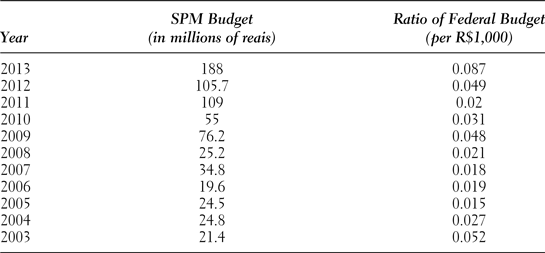
Another example of Dilma's effort to substantively represent women is the allocation of funds to Brazil's secretariat for women's policies (SPM). After allocating a budget for SPM in 2012 that was lower than its previous budget allocation during Lula's tenure—R$105.7 million in 2012 as opposed to R$109 million allocated in 2011—Dilma has increased this year's (2013) budget to R$188 million. This is a rise not only in absolute numbers, but also in the proportion of funds as a proportion of the country's whole federal budget. As Table 3 shows, the budget allocated for SPM in 2013 is the highest of all the years since the inception of the secretary in 2003, and it is also the highest ratio of funds allocated to the institution in relation to the whole federal budget. The increase in the budget for SPM is an important step in increasing the creation, implementation, and monitoring of gender-related policies. However, the budget for SPM fluctuated greatly during Lula's term, both in terms of absolute reais and as a proportion of the federal budget. It is hard to conclusively assert whether the president is giving SPM more “purchasing power” or if this is just a reflection of other political dynamics within the government. Nevertheless, budget allocation to SPM may indicate that Dilma is going to pursue women-related policies with greater intensity.
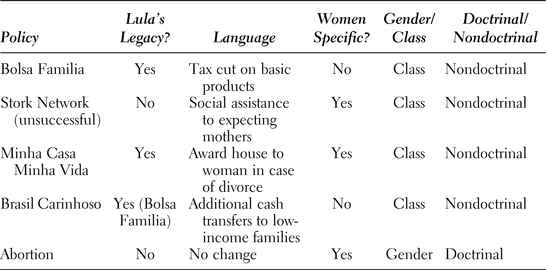
In conclusion, Dilma's contribution to the substantive representation of women in her government is complex. Successful policies were all expansions or extensions of policies implemented during Lula's tenure as president. Not all policies are women specific, but the rhetoric coming from the presidency, either through Dilma herself in speeches (most of them given on symbolic days for women) or through SPM and press releases, shows that the focus on gender is present in their strategy. Moreover, when thinking about these policies and using Htun and Weldon's (Reference Htun and Weldon2010) gender/class and doctrinal/nondoctrinal typology, we see that Dilma's rhetoric and actions are targeted mostly at class and nondoctrinal policies (see Table 4). By pushing for such policies, Dilma is focusing on issues that mobilize her (and PT's) most important voter base: low-income families. While Dilma has been visibly active in promoting women's rights, both symbolically and substantively, most of this support can be seen as an extension of Lula's government. Dilma's actions relate to both her PT affiliation and status as Lula's successor, and many of the popular programs and policies are part of a continuity project that dates back to Lula's administration. Dilma's presidency so far, however, has shown dedication to furthering women's rights (in selected areas) and quality of life. Therefore, we argue that Dilma has offered clear indications of increased substantive representation compared to previous administrations (including Lula's) for women in Brazil. This increased representation does not mean that the president was able (or willing) to tackle controversial women-related issues or that the Brazilian women's movement approves her tenure as president, but it does mean that women (especially low-income women) as a group form an important target for the political rhetoric and policy making under Dilma's presidency.
Dilma Rousseff's policies
CONCLUSIONS
With this article, we have sought to investigate the role of gender in Dilma's election and offer some preliminary arguments regarding the role of gender in her tenure as president. This investigation contributes to the overall discussion on women in executive power and more specifically to the literature on Dilma's presidency. Taken together, this research provides evidence for a complex “Dilma Effect”: more than Lula and other previous presidents, Dilma Rousseff does indeed aid women's descriptive and substantive representation.
This article also contributes to the literature on gender and representation in relation to women elected to national executive positions. The theoretical and methodological discussions engaged can facilitate more comparative research on the descriptive and substantive representation of women in countries governed by women prime ministers or presidents. Further research on Dilma's descriptive representation should focus on the percentage of women appointed to cabinets, other influential positions within such cabinets (cargos de confiança, or positions of trust in Brazil), and high-profile appointments outside of the cabinet. Such research can be expanded beyond Brazil to compare such appointments among Latin American presidencies (with and without women presidents) in both present-day and historical perspectives.
Research on substantive representation can also move forward from the results discussed in this article. In the specific case of Brazil and Dilma's presidency, in further research we seek to extend the analysis of Htun and Weldon's typology to include a more comprehensive list of women-specific related policies proposed by the executive (through the women's secretariat or through executive orders) as well as any other policy that President Dilma herself uses gendered rhetoric to promote. When thinking about women in the executive and substantive representation in a comparative perspective, the inclusion of Htun and Weldon's typology can be helpful. A comparative case in South America, for example, comparing policies pursued (and policies that were not changed) by the Bachelet (Chile), Fernandez de Kirchner (Argentina), and Rousseff (Brazil) presidencies, using the typology above, can help us understand in more detail the different approaches these presidents have taken when tackling women-related issues. Another area that must be explored in more detail is the connection between the enactment of such laws and the implementation of such policies, especially in federal or decentralized systems like the one we see in Brazil and most of Latin America (Franceschet Reference Franceschet2011).
This article did not analyze Dilma's symbolic representation of women or how women's presence in politics affects the perceived legitimacy of elected bodies (Franceschet, Krook, and Piscopo Reference Franceschet, Krook and Piscopo2012, 9) and the conditions under which women's presence alters voters' beliefs about the nature of politics as a male domain (Alexander Reference Alexander2012). While a limited but growing literature tackles the question of the symbolic effects of female parliamentarians (Alexander Reference Alexander2012; Morgan and Buice Reference Morgan and Buice2013), no large-scale comparative studies link symbolic representation to the presence of a female head of state or government. Future research should consider such connections. There is every reason to believe that the presence of a woman president or prime minister offers as much or even more symbolic representation considering her sheer visibility.
We have experienced a significant rise in the number of women elected to powerful executive positions across the globe. Scholars must acknowledge this change in political dynamic to expand theoretical and methodological approaches to understanding representation. Keeping in mind the interconnectedness and complexities surrounding the measurement of descriptive and (especially) substantive representation, scholars must continue to seek explanations about the impact the presence of female policymakers and leaders have on the policy-making process. We sought to contribute to the current development of the study of descriptive and substantive representation of women by focusing on the impact a woman president can have on the presence of women in the formal political structure and in the implementation of women-related policies. The results of our research show how complex gender can be in the analysis of executive presence and policy making, and we hope to help in the development of better and more comparative ways to measure such complexities.
APPENDIX A
Women in Dilma Rousseff's cabinet (as May 29, 2014)
APPENDIX B
Interviews
Respondents were provided the option of anonymity, but none of the political elites (senators, deputies, cabinet officials, party officials, and other presidential staff) minded being on the record. Therefore, when quoted in the text, their identities are revealed and sourced in the interview, but their names are not listed here.
We chose respondents from Dilma's inner circle, such as ministers, advisors, and academics, who would have a deeper understanding of Dilma's time in office thus far and could comment on some of the decisions she made. However, we also selected respondents who could directly comment on her relationship with Congress, which necessitated interviews with senators and deputies as well. We went beyond analyzing fellow partisans (PT) to include opposition and coalition party representatives. The ultimate sample, to be sure, is nonrepresentative of all the potential views and results from snowballing. However, we feel that since this is balanced with multiple perspectives, problems arising are limited.