An effective medical response to a mass-casualty incident requires planning and preparation for the substantial space, resources, and suppliesReference Hick, Koenig, Barbisch and Bey1Reference Kaji, Koenig and Bey2 required to meet the needs.Reference Knebel, Coleman and Cliffer3 In a very large incident in which needs would exceed the available resources, conditions of scarcity would be inevitable at the outset,Reference Knebel, Coleman and Cliffer34 particularly close to the center of the incident, where major disruption of the physical infrastructure would be greatest. Emergency medical management requires timely application of a range of treatments including medical countermeasures (MCMs) that have a limited window of opportunity for effective administration. Damage to the transportation system would produce difficulties in delivering supplies during the first few critical days.
The Division of the Strategic National Stockpile (SNS) within the Centers for Disease Control and Prevention (CDC) has a central role in providing medical resources. Their response includes the following features (descriptions from the SNS website)5:
CDC's Strategic National Stockpile (SNS) has large quantities of medicine and medical supplies to protect the American public if there is a public health emergency (terrorist attack, flu outbreak, earthquake) severe enough to cause local supplies to run out. Once federal and local authorities agree that the SNS is needed, medicines will be delivered to any state in the US in time for them to be effective. Each state has plans to receive and distribute SNS medicine and medical supplies to local communities as quickly as possible.
The SNS is a national repository of antibiotics, chemical antidotes, antitoxins, life-support medications, IV administration, and airway maintenance supplies, and medical/surgical items. The SNS is designed to supplement and resupply state and local public health agencies in the event of a national emergency anywhere and at any time within the US or its territories.
The SNS is organized for flexible response. The first line of support lies within the immediate-response 12-hour Push Packages. These are caches of pharmaceuticals, antidotes, and medical supplies designed to provide rapid delivery of a broad spectrum of assets for an ill-defined threat in the early hours of an incident. These Push Packages [push-packs] are positioned in strategically located, secure warehouses ready for immediate deployment to a designated site within 12 hours of the federal decision to deploy SNS assets.
If the incident requires additional pharmaceuticals and/or medical supplies, follow-on vendor-managed inventory (VMI) supplies will be shipped to arrive within 24 to 36 hours. If the agent is well defined, VMI can be tailored to provide pharmaceuticals, supplies, and/or products specific to the suspected or confirmed agent(s). In this case, the VMI could act as the first option for immediate response from the SNS Program.
The SNS currently uses a range of approaches to support national MCM needs for a public health emergency including stockpile-managed inventory (SMI, at a variety of locations; eg, smallpox vaccines), vendor-managed inventory (VMI) by which the manufacturer or vendor provides the supplies on short notice (eg, antineutropenic cytokines), and forward placement of drugs that are needed within minutes (eg, the CHEMPACK program for antidotes to toxic nerve agents; CHEMPACKs are SNS-managed collections of MCMs that have very short time windows for effective use after chemical exposure, kept in more than 1900 unique locations around the country to be available in emergency departments and/or first responder vehicles for immediate use).6 The SNS can provide push-packs or other more focused MCMs for a mass-casualty incident to sites designated by state and local response planners, within 12 hours after the decision is made. Before MCMs can be administered to patients, further distribution to treatment facilities or points of dispensing is required; this action requires personnel, time, security, and functioning transportation and communications infrastructures. Even though cost-saving tools are used—such as the US Food and Drug Administration's (FDA’s) shelf life extension program (SLEP)7 for components of CHEMPACKs and other SNS-stored products—ultimately the products expire, and significant expense is incurred for replacement. Between the local distribution of CHEMPACKs for immediate use and the realistic ability for the SNS supplies to be ready for medical responders within a day or two is a potential gap for some disaster scenarios that could be filled by supplies locally predeployed for availability within hours of an incident.
The Office of the Assistant Secretary for Preparedness and Response in the US Department of Health and Human Services develops and coordinates plans for mass-casualty medical response including planning and emergency operations, MCM development and purchase, and the necessary supporting policy.8 For some large-scale incidents such as a hurricane, the needs and potential shortfalls can be projected in advance so that supplies can be brought forward and people can be evacuated. However, for large-scale, unexpected incidents such as a nuclear detonation or a catastrophic earthquake in which the infrastructure necessary to a response has been affected, a limited quantity of resources including personnel and supplies may be available at the site of need within the first hours. However, the majority of the federal response will take 1 to 3 days to deploy. Some MCMs must be available almost immediately to be effective, as with nerve-agent antidotes.9 Others, such as bone marrow cytokinesReference DiCarlo, Maher and Hick10Reference Weinstock, Case and Bader11 for those at risk of acute radiation syndrome (ARS), are best administered within 24 hours.
Detailed modeling done as part of a recent effort to address the scarce resources setting following a 10-kiloton nuclear detonationReference Knebel, Coleman and Cliffer3Reference Coleman, Knebel and Hick12Reference Hick, Weinstock and Coleman13 projected that many thousands of people might benefit from the administration of cytokines within 24 hours of exposure, based on current studies of the effects of cytokines on irradiated bone marrow.Reference DiCarlo, Maher and Hick10 In spite of damage to the infrastructure, many persons exposed to a dose of radiation sufficient to cause the bone marrow component of ARS (>2 Gy) could shelter in place, as recommended, and then reach medical care at the remaining local and regional medical facilities within the window of time to benefit from MCM administration. A user-managed inventory (UMI) may only partially fill the entire requirement; nonetheless, the sooner the drugs are available, the more people can receive them in time to mitigate or treat injury. Furthermore, while many people may not be able to reach medical care within the most advantageous window of opportunity, having supplies for those who can could save additional lives.
Forward deployment involves the following considerations: (1) the roles and responsibilities of local responders for the initial response; (2) the best use of the surge and resupply capacity of the SNS; (3) the expense of stockpiling and then discarding expired drugs; (4) resource-sharing strategies within a region and the benefit to having multiple caches; (5) the expense, space requirements, and logistics of agents selected for the UMI; and (6) the efficacy and expense of moving resources to where the casualties are and transporting casualties to the resources.
By enhancing the supply of MCMs that can be readily available when and where they are needed, the UMI can contribute toward providing the needed capacity in a cost-effective manner, avoiding both disposal of unused supplies and repurchasing of supplies that may not be used. In the UMI, a health care entity (eg, hospital, clinic, pharmacy, or distributor) creates a supply-line bubble for emergency MCMs that are routinely used in health care as part of a regional plan. The MCMs would be available in modest surge-supply quantities in multiple sites within a city and region. In the absence of a mass-casualty emergency incident, drugs would be cycled through a pharmacy (first-in, first-out) so that they would be used for their routine indication before expiration. In addition, MCMs might be available from the local pharmaceutical or medical supply distributor to constitute a variation of the UMI called the distributor-managed inventory (DMI).
This model does not displace the need for the SNS response. It can, however, enhance the SNS by establishing a dispensing and possible local/regional distribution network and by having accessible more emergency MCM resources than are present at sites of medical care under the common approach of just-in-time availability of resources. Among the compelling possibilities for developing a UMI network are the extensive system of US Department of Veterans Affairs (DVA)14 facilities and the Radiation Injury Treatment Network (RITN)Reference Weinstock, Case and Bader1115 that has been organized through the National Marrow Donor Program (NMDP). Resources of the DVA (July 2012) include 152 VA hospitals, 817 community-based outpatient clinics, 152 hospital-based outpatient clinics, 133 VA community living centers, 11 mobile outpatient clinics, 6 independent outpatient clinics, 300 veteran centers, 70 mobile veteran centers, and 7 community mail-order pharmacies.14 Resources of RITN recently included 47 transplant centers, 7 donor centers, and 7 umbilical cord blood banks15 and fluctuate with developments in the NMDP.
Terrorist Attacks and the Timing of Attendant Medical Needs: Where the UMI Fits
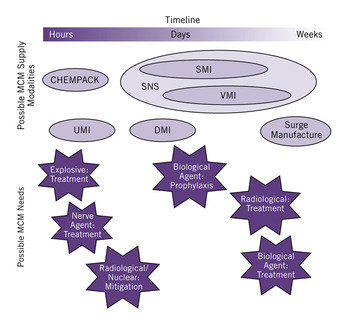
The medical needs resulting from a terrorist attack depend on the mode of the attack and the specific agent. Federal systems can deliver needed medical resources in hours or days depending on the type of supply modality (Figure 1). Conventional attacks produce casualties with a spectrum of traumatic and burn injuries that need treatment immediately, which may require surgery and resources for fluid replacement. Attacks with chemical weapons using nerve agents will produce casualties immediately thereafter. To prevent death and disability, victims need nerve agent antidotes (eg, oxime), anticholinergic agents (atropine), and anticonvulsant agents (eg, midazolam) within minutes or hours.
The Relative Timing of Medical Countermeasure (MCM) Delivery by Various Modalities and the Surge of MCM Needs by Types of Terrorist Attacks.
The main need for MCMs is either in progress or possibly has expired before the Strategic Nuclear Stockpile (SNS) is expected to deliver MCMs to an attack site. The stockpile-managed inventory (SMI) is a component of the SNS; additional resources are provided through the private sector (ie, vendor-managed inventory (VMI), distributor-managed inventory (DMI), and surge manufacturing). Abbreviation: UMI, user-managed inventory.

UMI for Nuclear Detonation
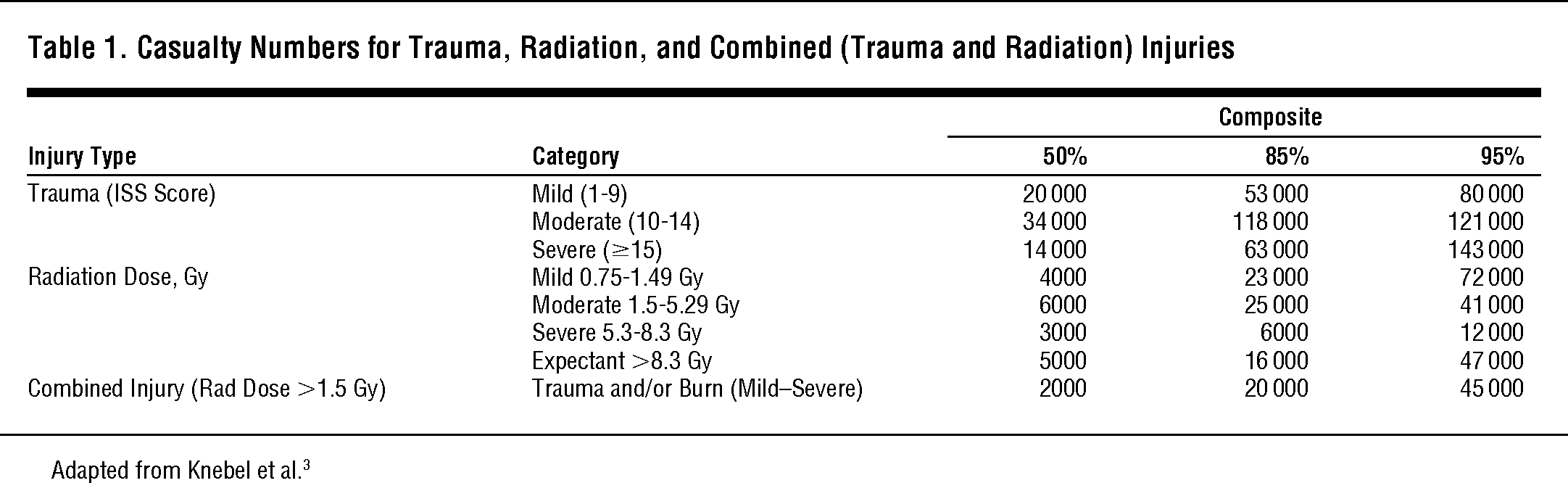
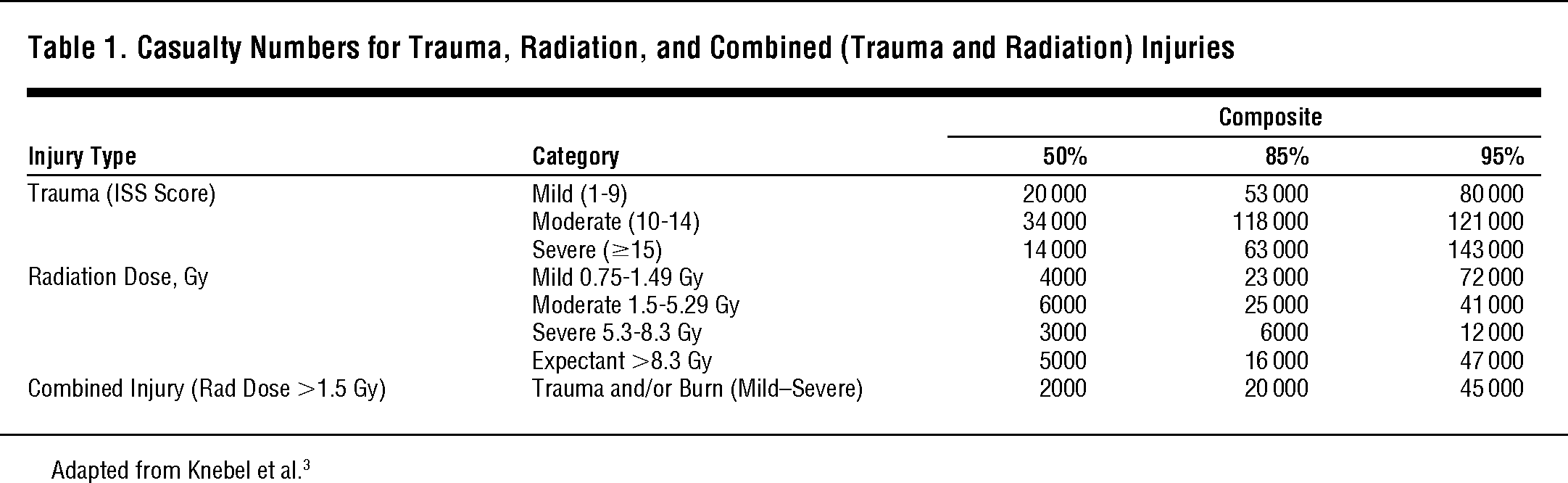
The estimation of casualty numbers in Table 1 is adapted from Knebel et al.Reference Knebel, Coleman and Cliffer3 The numbers of casualties for trauma, radiation, and combined injuries (trauma/burn plus radiation) are derived from 185 different 10-kiloton detonation scenarios. Excluding the highest 5% scenarios, approximately 50 000 to 100 000 people might benefit from myeloid cytokines (radiation dose 1.5-8.3 Gy and combined injury).
Casualty Numbers for Trauma, Radiation, and Combined (Trauma and Radiation) Injuries
Many of those with a significant dose of radiation (>1 Gy) will suffer nausea and vomiting in the hours after exposure, even if the level of radiation itself is not life threatening. The rapid application of antiemetic medications not only would alleviate suffering in these victims but would increase the efficiency of the medical system by rapidly relieving victims' symptoms and decreasing their need for ongoing medical observation or care.
Regarding ARS, at extremely large doses (>10 Gy) radiation causes death through damage to the central nervous and cardiovascular systems and, at approximately 6 Gy, to the gastrointestinal tract. At doses greater than 2 Gy, victims may die from the hematological component of ARS due to damage to the blood-forming organs, with consequent bleeding and infection. While the damage occurs immediately on exposure, a latency period may last up to 3 weeks between the time of exposure and the depression of cells in the peripheral blood. Many persons exposed to a potentially lethal dose of radiation might be saved by treatment with myeloid cytokines (such as granulocyte colony-stimulating factor [G-CSF]), which foster the regrowth of white blood cells and are routinely used to aid marrow recovery after chemotherapy and radiotherapy for cancer. For those with significant trauma plus radiation exposure (>2 Gy), mortality will be much higher than that for either trauma or radiation alone.Reference DiCarlo, Maher and Hick10 (This use of myeloid cytokines would be an off-label use based on oncology experience, as they are not approved by the FDA for use after a nuclear detonation.)
Timing of Myeloid Cytokine Administration
In canine models of radiation exposure, antineutropenic agents are extremely effective at preventing death from neutropenia if given up to 24 hours after radiation exposure; if given 7 days after exposure, these drugs are no longer effective.Reference Schuening, Storb and Goehle16 Precisely when the efficacy of myeloid cytokines is lost beyond 24 hours after exposure is still unknown, but the sooner the administration, the better.Reference DiCarlo, Maher and Hick10 Many persons who would not receive MCMs in time to mitigate the neutropenia would ultimately need treatment with those drugs to help marrow recovery after blood counts have declined. Therefore, a myeloid cytokine in the UMI would not be wasted (and could be used for its normal use in cancer care). Mitigation not only helps the individual, but also can relieve a burden on the already stressed health care system by reducing the treatment these people will need. Although not everyone who could benefit from cytokines would receive treatment, due to logistical challenges, the sooner supplies can be available, the greater the number of people who would be able to be treated before effectiveness diminishes. Thus, the immediate availability of myeloid cytokines would save more lives than could be saved by waiting.
Nuclear Detonation Damage Zones and Medical Response Organization
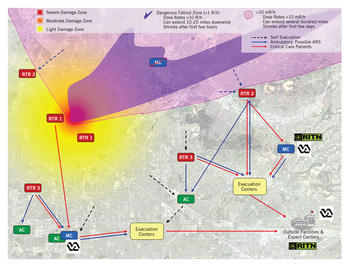
Figure 2 illustrates how a UMI could help provide effective MCM distribution following a nuclear detonation.Reference Knebel, Coleman and Cliffer31517Reference Hrdina, Coleman and Bogucki18 Considerable damage would occur near the center of the detonation, and rubble and motor vehicle accidents would impair transportation. However, facilities within the region, such as RITN centers and DVA facilities, would be functional and could serve as UMI facilities.
Physical Damage Zones and Functional Radiation Treatment, Triage, and Transport (RTR) Response System.
Adapted from Knebel et al,Reference Knebel, Coleman and Cliffer3 the Homeland Security Council,17 and Hrdina et al.Reference Hrdina, Coleman and Bogucki18 Physical damage zones include severe, moderate, and light damage zones; the dangerous fallout zone, where radiation is sufficient to induce acute radiation syndrome (ARS) within a relatively short time; and an adjacent radiation caution zone,Reference Knebel, Coleman and Cliffer317 which extends farther and where responders could work but with caution and time limitations that could be determined by environmental monitoring. RTR medical response sites include 3 types of spontaneously forming response sites: RTR1 (radiation and physical damage); RTR2 (radiation with infrastructure intact); and RTR3 (spontaneous collection points where environmental radiation is not increased). Predetermined sites include medical care (MC) facilities (eg, temporary facilities), assembly centers (ACs), evacuation centers, and outside facilities, and expert centers. Medical centers include Radiation Injury Treatment Network (RITN) sites and Department of Veterans Affairs facilities.

The UMI is a Cost-Effective Means of Forward Deploying Critical Resources
UMI would stockpile medical resources in a number of sites within selected cities without the cost associated with discarding and replacing expired material, because the size of the UMI will be such that the local medical system will use it while providing care for routine illness. Several examples of such MCMs with non-mass-catastrophic use are (1) atropine for the treatment of cardiac arrest; (2) anticonvulsants as sedatives for various conditions; (3) antiemetics often prescribed after surgery; and (4) myeloid cytokines commonly used in cancer treatment.
The cost savings of a UMI system in which dual-utility MCMs in a supply bubble are rotated through normal stocks vs a traditional stockpiling system such as SMI or CHEMPACK, which disposes of expired MCMs, depends on the incremental cost of routine maintenance of the UMI supply bubble vs cost implications of the shelf life and cost of the product. The shorter the shelf life and more costly the product, the more costly is traditional stockpiling, due to the more frequent replacement that is necessary on expiration. However, for the UMI to be viable, the shelf life must be great enough to allow the amount of material in the supply bubble to be consumed by the medical system during normal operations before the product would begin to expire within the UMI itself.
Once the UMI supply bubble is established, the costs are associated with holding additional drugs in a hospital, rotating the inventory, and managing the UMI program. The costs also would depend on the characteristics of the product (eg, space, temperature control). These costs would likely be small relative to the savings accrued by foregoing the periodic disposal and replacement of expired drugs required by a nonrotating warehousing system. The SMI (including the VMI component) has the potential to stockpile and distribute the stockpiled drug before expiration. However, the issue here is having access to drugs before the SMI arrives, so that the roles for the various resource strategies (CHEMPACK, UMI, and SMI) are complementary.
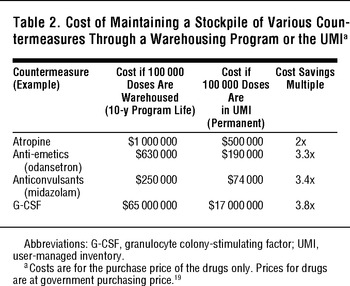
Table 2 shows potential cost savings multiples over a 10-year life cycle for several MCMs included in emergency preparedness planning. The cost of each dose (based on DVA costs) was multiplied by the total number of doses acquired.19 When the material reached its shelf life in the conventional warehousing system, the entire lot would be repurchased. Therefore, a product with a 5-year shelf life would be purchased twice in a 10-year program and cost twice as much. In a UMI-based system, the MCM would only need to be purchased once, no matter how long the system is deployed. In reality, a warehousing system would also suffer from costs to destroy expired product, and a UMI system would suffer costs of rotating a stockpile, which probably would not be conducted with perfect efficiency. Both systems would require storage costs, which would be a consideration for sizing the UMI.
Cost of Maintaining a Stockpile of Various Countermeasures Through a Warehousing Program or the UMIa

Table 2 also shows that even for less-expensive drugs, a comprehensive UMI program could save millions of dollars when caches are deployed to several cities. This potential unit cost advantage of the UMI model is counterbalanced by the increased overall requirement to assure that necessary quantities are prepositioned in multiple locations. By definition, UMI (or any disseminated stockpiling model) seeks to store product in a wide range of facilities in diverse geographic locations, anticipating a potential initial demand in a small number of sites in the impacted zone. The CHEMPACK program is a clear example in which several million doses of nerve agent antidote were acquired and are stored in forward locations around the country to facilitate the very rapid treatment of a few hundred casualties in any one of the jurisdictions. Determining whether the potential unit cost savings sought with the UMI model will outweigh the costs of increasing the overall requirement to store any meaningful quantity forward requires further city- and region-specific analyses.
UMI has several other advantages over other resource supply systems. In the UMI, resources held at local medical centers would be available at the point of use, as victims are transported to hospitals. Local authorities would not need to coordinate the transport of material from an airport or other central distribution site to the point of use in the middle of an emergency. This feature becomes critical in incidents in which transportation infrastructure has been compromised.
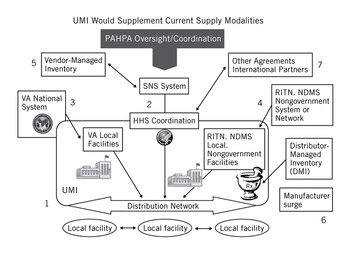
While it is not intended to fulfill the entire medical need, the UMI would allow providers to initiate treatment and meet some of the surge needs that would otherwise not be possible due to economic considerations with just-in-time inventory management practices. Figure 3 illustrates how the UMI could also facilitate distribution of resources from the SNS, the DVA system, the RITN, and the National Disaster Medical System20 medical facilities, particularly in local regions. The UMI would augment MCM needs and not be the entire solution for a large surge capacity.
Schematic of the User-Managed Inventory (UMI).
The initial medical countermeasures are available in (1) local supply bubbles including those of hospitals, pharmacies, and distributors (eg, DMI). The UMI network can include (3) the Department of Veterans Affairs (VA) medical system, and (4) Radiation Injury Treatment Network (RITN) and National Disaster Medical Systems (NDMS) facilities. The (2) Strategic National Stockpile (SNS) system would deploy as rapidly as possible, including (5) vendor-managed inventory. Although sufficient US resources are likely to be available, (6) manufacturing surge capacity and (7) agreements with international partners could provide additional resources when needed. Abbreviations: HHS, US Department of Health and Human Services; PAHPA, Pandemic and All-Hazards Preparedness Act.

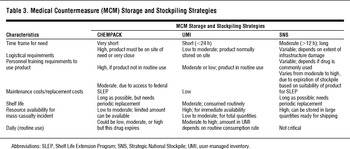
The strategy for MCM availability uses a number of components working as a system. The utilization strategy depends on the MCM, based on its window of efficacy, routine use in medical care (dual utility), and local/regional decisions on resource sharing. The UMI model incorporates the substantial DVA health care system and specialty-care networks, such as RITN. Table 3 highlights the characteristics and potential roles of the various components of this strategy
Medical Countermeasure (MCM) Storage and Stockpiling Strategies

The best possible medical response requires ongoing progress in a complex multicompartmental systemReference Coleman, Hrdina and Bader21 that includes detailed planning, medical management,22 MCM development, diagnostics,2324 subject matter expertise, and continuing improvement from lessons learned from simulated and real-world incidents. Improvements in one aspect of the overall UMI system require adjustments to the other components to create a dynamic entity that evolves as its capabilities improve.
CONCLUSIONS
The UMI is a developing concept that can enhance MCM distribution and dispensing by supplementing the activity of the SNS and increasing the capacity of state and local responses. Drugs/agents to consider for the UMI would be those for which there is a critical need and a window of efficacy/utility before resources can arrive from outside the disaster region. While the UMI may not serve all needs, it will enhance the supply of resources available to medical responders, delaying or avoiding depletion of supplies to inadequate levels before more supplies can be provided from remote sources. Moreover, it involves the DVA health care system, specialty care networks, medical centers, and pharmacies, and close collaboration with state and local response planners who manage distribution and dispensing of MCMs from all sources, including the SNS. Further approaches for the forward deployment of MCMs will be considered by those developing national response strategies, including a project by the Institute of Medicine for prepositioning resources.25
The goal is to have the best seamless response possible with regard to cost, realistic concepts of operations, and ongoing research and development for improved MCMs, including diagnostics. The participation by state and local experts in further development of storage and stockpiling of MCMs that offer utility in routine medical practice and a limited window of opportunity in a disaster will help ensure a proactive and resilient society that can prepare for and respond to natural and man-made disasters.
Disclaimer: The contents of the article represent the personal views of the individual authors and do not necessarily express the opinion or policy of the US Department of Health and Human Services (HHS) or the US Department of Veterans Affairs (DVA) or their components. No statement in the articles should be construed as an official position of HHS or DVA or their components.
Acknowledgments: The Public Health Emergency Medical Countermeasures Enterprise (PHEMCE) Executive Committee and the Radiological/Nuclear and Blood & Tissue Working Groups provided ongoing comments to and discussion with the UMI Concept Development Group; Alicia Livinski, from the National Institutes of Health Library assisted with editing and manuscript preparation; Craig Robinson, MSA, Director of the National Acquisition Center, Department of Veterans Affairs, supplied cost data; and Elizabeth Kramer assisted with the contribution of Gryphon Scientific.