Introduction
Wings: Social and emotional wellbeing in the early years (Miller, Reference Miller2015) is a professional development programme designed for educators working with children between birth and 5 years of age. Addressing the importance of interactions with children and the role of the learning environment in fostering their wellbeing, Wings encourages reflection on practice by educators. It was one of the key programmes adopted by the Pathways to Resilience Trust in partnership with Anglicare, Southern Queensland, as part of service delivery in drought-affected communities in the shires of Bullo, Paroo, Balonne, Maranoa, Murweh, Quilpie and Goondiwindi. The aim of the partnership's initiative, called the Community Wellbeing Project, was to engage both indigenous and non-indigenous community members in the resilience-building process. It was also designed to develop social and emotional wellbeing and resilience across the lifespan by building individual and community capacity in order to sustain skills growth beyond the duration of the Project.
A snapshot of available data from the Australian Early Developmental Census (AEDC) (Australian Government, 2015) shows considerable vulnerability amongst children across the seven shire regions, with an increase in children's social and emotional vulnerability noted between 2009 and 2015. Concurrently, the introduction of Belonging, Being and Becoming-The Early Years Learning Framework (DEEWR, 2009) and the National Quality Framework and National Quality Standard (Australian Education and Quality and Care Authority (ACECQA), 2012) for the education and care of children have stressed the importance of children's social and emotional wellbeing, with statements recognising that ‘when children feel safe, secure and supported they grow in confidence to explore and learn’ (DEEWR, 2009, p. 20). For educators, the result has been a focus on their capacity to support children's social and emotional wellbeing. The Wings programme acknowledges the importance of the early years for the future mental health and wellbeing of individuals and the wider community, and has therefore been designed to assist educators to maximise positive outcomes based on current research insights.
The Pathways to Resilience Trust began the Community Wellbeing Project by conducting pre-tour visits and listening to the needs of the communities. Programmes were customised by the Trust to meet identified needs in relation to wellbeing and resilience. The Trust also elected to build community capacity by conducting additional training sessions and workshops to train key people within the community to take on mentoring roles as wellbeing ‘champions’. Wings was delivered in three locations, and education and community champions from across the seven shires attended.
The Wings programme was formulated using a combination of factors including deductive and inductive processes and mental models (Funnell & Rogers, Reference Funnell and Rogers2011). Deductive development involved developing the programme theory from a review of the research literature on how the programme was understood or expected to work. Inductive development encompassed inferring the programme theory from how the programme was expected to operate in practice based on observations or interviews with staff on aspects of the implementation of the programme. The interviews and systematic reviews together provided data that were used to formulate the programme theories. Wings had been trialled in 2015 with six Queensland sites (Cartmel, Reference Cartmel2015). There had been gains in educators’ knowledge and increased use of strategies that were observed in the changes in the physical environment and subsequently the behaviour of children.
Wings provided information about child development, with a strong emphasis on current understandings of brain development, as well as suggested activities and learning experiences for educators to implement with children. The programme fostered critical reflection by encouraging educators to reflect on the question ‘How will I be with children?’, rather than ‘What will I do with children?’ Wings also used the strategies of workshops and mentoring to develop educators’ understandings and skills in supporting children's social and emotional wellbeing, and providing support to families and the community in turn.
As Kendall-Taylor and Lindland (Reference Kendall-Taylor and Lindland2013) have indicated, adults working with young children need to understand the importance of emotional and social wellbeing for children's ability to function, as well as the significance of environments that encourage ‘positive mental states and adaptive functioning’. One of the challenges to nurturing children's social and emotional wellbeing is often an underlying assumption ‘that very young children are not aware of, and do not understand, their thoughts, emotions and desires’, and therefore cannot be understood to ‘actually experience mental health’ (Kendall-Taylor & Lindland, Reference Kendall-Taylor and Lindland2013, p. 16). Presented in the form of ten modules, Wings follows the lead of Kendall-Taylor and Lindland, redressing these challenges by providing educators with the practical experiences and guidance needed to build children's wellbeing through interpersonal interactions, and tips for building an emotional and physical environment that supports children's developing mental functions and communication abilities. Wings also explores some of the current approaches to conceptualising children's emotional and social ‘wellbeing’. For example, Statham and Chase (Reference Statham and Chase2010) conceptualise children's wellbeing as multi-dimensional, incorporating physical, emotional and social wellbeing and focussing on children's immediate as well as their future lives. Andrews, Sullivan and Minichiello (Reference Andrews, Sullivan, Minichiello, Minichiello, Sullivan, Greeenwood and Axford2004) also conceptualise wellbeing as multi-dimensional, stressing the importance of contextual relationships that is consistent with the reality of children's lives using a social ecological approach.
The Wings modules contained a variety of recommended activities to enhance the children's learning and skills development, and directly related to the Australian Early Years Learning Framework (DEEWR, 2009). The activities and suggested experiences are intended to build interactions and communication between adults and children in order to enhance the development of children's self-regulation, resilience and emerging emotional and social competencies. The training manuals and resource packs given to Wings participants included examples of the language that can be used to initiate and maintain positive interactions, as well as children's stories and puppets that can be used as part of the suggested strategies.
Evaluating the success of Wings as part of the Community Wellbeing Project posed challenges, however. A particular difficulty was assessing the programme's outcomes in a short timeframe, which meant some traditional methods of review and evaluation were unlikely to yield reliable information as to what worked or did not work. As Pawson (Reference Pawson2006) argues, programmes, like Wings, are often introduced within complex social systems that are in constant transformation. Evaluation therefore needs to take account of the context within which programmes are implemented. Pre- and post-training surveys were therefore identified as the most effective means to gain data about participants’ knowledge and skills following their involvement in Wings.
Participants (n = 24) were educators, social workers, family support workers and manager/leaders from a range of children's’ services. Pre- and post-training surveys, abridged from a survey used to examine childcare educators’ confidence in addressing children's mental health problems (Davis et al., Reference Davis, Corr, Ummer-Christian, Gilson, Waters, Mihalopoulos and Sims2014), asked participants to rate their knowledge and confidence in supporting the emotional and social wellbeing of children. Questions included: ‘How would you rate your level of understanding of key learning concepts for building resilience?’ and ‘How do you rate your repertoire of strategies?’ In addition, there were open-ended questions about expectations and knowledge relevant to supporting children's wellbeing. Whilst it was not possible to include responses from parents and children in this instance, their views on how effectively Wings enhanced the knowledge and practice of educators might also be sought by a further, more in-depth evaluation.
Findings
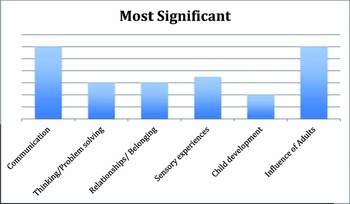
The training and resources provided to Wings participants appear to facilitate positive changes in terms of educators’ confidence in supporting children's social and emotional wellbeing. Wings also appears to have been successful in enhancing educators’ knowledge base and strategies for working with children. For example, in the pre-training survey, participants indicated a lack of confidence in their understandings of key learning concepts for building resilience. However, responses to the post-training survey included statements such as having ‘More confidence in myself, more strategies and different ideas about how to deal with situations’ (Participant 325). As part of the post-training survey, the participants also recorded the most significant information that they had learnt during the training session. Their responses indicated that they had gained a better understanding of the importance of communication strategies, and that they had a deeper understanding about the impact adults have on children's behaviour. One response, for instance, referred to the ‘discovery that we can make a difference in children's lives by the way we think, act and behave’ (Participant 323).
In addition, the participants noted that the strategies provided were not complicated, and were easy to implement in their classrooms or practice with children. Participant 335 valued Wings for giving ‘ideas. . . to teachers to change the way they talk to kids’, whilst another expressed appreciation for the ‘simple yet powerful things you can do to build social and emotional wellbeing in the early years’ (Participant 330).
The most significant areas of learning identified by participants related to the influence of adults on children, and communication more broadly (Figure 1). The module on maintaining calm and relaxation in order to defuse rather than escalate children's behaviour was rated particularly highly by all participants. Comments made by participants referred to learning how to ‘[connect] correctly with the children in helping to understand and accept their emotions’ (Participant 331) and the value of having ‘more strategies and the “words” to use in situations with young children such as mindfulness activities, positive thinking, self-talk, developing empathy’ (Participant 323). Perhaps, the most positive statement overall came from Participant 176, who enthused, ‘Actually [I] would love my whole Centre to have done [the training] so they can support my actions gained during Wings sessions when I bring it to the class’.
FIGURE 1
Most significant elements of knowledge gained during training.
Another benefit raised by participants was access to ideas to support their own wellbeing and the value of this for their capacity to offer support to others. ‘Filling our own bucket is as important as filling others’, responded Participant 182, whilst Participant 331 alluded to have a better grasp of ‘the importance of my role in helping’. Finally, participants indicated improvements in their knowledge of and confidence in using effective strategies recommended by the training. Participant 132 reported feeling much more able ‘to translate unhealthy thought to healthy thoughts’. The post-training survey conveyed a general sense that the educators felt better equipped to spend more time engaging children in learning opportunities that fostered social and emotional wellbeing, and less time on ‘managing’ behaviours.
Discussion
Research continually points to the quality of the care environment as a leading factor for increasing the resilience and wellbeing in of children aged 0–8 years (Hall et al., Reference Hall, Sylva, Melhuish, Sammons, Siraj-Blatchford and Taggart2009). Facilitating the capacity and competency of educators and teachers in early years contexts-child care, kindergartens and schools – is therefore vital for improving outcomes for the children. The Wings programme, though small in scale, has shown that it does have potential to enhance the quality of the care environments and provide staff with greater confidence in their skills, understandings, and personal and professional capacities. At a time when high staff turnover amongst child educators is recognised as a significant problem, Wings is also able to play a small part in supporting staff morale. As Gable, Rothrauff, Thornburg and Mauzy (Reference Gable, Rothrauff, Thornburg and Mauzy2007) indicate, high staff turnover has far-reaching and potentially long-lasting consequences on the wider community, often by affecting and disrupting the quality of relationships between educators and children in their care. Furthermore, high staff turnover can affect the quality of professional practice within services for children (Whitebook & Ryan, Reference Whitebook and Ryan2011), undermining professional culture and further contributing to the levels of stress and depression amongst remaining employees (Groeneveld, Vermeer, van Ijzendoorn, & Linting, Reference Groeneveld, Vermeer, van Ijzendoorn and Linting2012).
However, the Wings programme may also have achieved some of its beneficial outcomes through the way in which it was designed to bring educators together from across a drought-affected region noted for having a significant population of vulnerable children. There was a high level of motivation and commitment amongst all staff members involved, who joined together to undertake the training as part of the overall Community Wellbeing Project. In addition, it helped that there were community ‘champions’ as part of the Project, who led different staff teams involved in services for children in a collaboration effort. Clearly, having educators from across these communities come together with the common goals of supporting children's wellbeing and enhancing the social and physical environments of their services for children was likely to increase the potential of positive impacts on wellbeing for children and their communities.
Conclusion
This paper has described the Wings training offered to children's services staff in regional and remote areas of south-west Queensland and the feedback received through evaluation. Benefits such as an increase in the knowledge of professionals working with children and families, and their capacity to use effective strategies within their programmes to support children's social and emotional wellbeing, clearly emerged from the participants’ responses. The training also provided a valued opportunity for staff to reflect on their abilities to impact positively on children's development, not only by employing specific, practical activities, but more subtly through language and modelling calm. In this manner, Wings provided insights into the relatively simple steps that can be taken to support the development of children's resilience in vulnerable communities, alongside specific, directed activities. As educators working with children in group settings, the Wings participants needed to have a deep understanding of and confidence in their practice, and Wings training was able to support this by enhancing their knowledge, promoting professional culture and linking educators’ actions to the development of children's positive mental health. In turn, the Wings training does appear to have helped empower participants to contribute to the life-long welfare and future skill acquisition of the children in their care.





 You have
Access
Introduction
Wings: Social and emotional wellbeing in the early years (Miller, Reference Miller2015) is a professional development programme designed for educators working with children between birth and 5 years of age. Addressing the importance of interactions with children and the role of the learning environment in fostering their wellbeing, Wings encourages reflection on practice by educators. It was one of the key programmes adopted by the Pathways to Resilience Trust in partnership with Anglicare, Southern Queensland, as part of service delivery in drought-affected communities in the shires of Bullo, Paroo, Balonne, Maranoa, Murweh, Quilpie and Goondiwindi. The aim of the partnership's initiative, called the Community Wellbeing Project, was to engage both indigenous and non-indigenous community members in the resilience-building process. It was also designed to develop social and emotional wellbeing and resilience across the lifespan by building individual and community capacity in order to sustain skills growth beyond the duration of the Project.
A snapshot of available data from the Australian Early Developmental Census (AEDC) (Australian Government, 2015) shows considerable vulnerability amongst children across the seven shire regions, with an increase in children's social and emotional vulnerability noted between 2009 and 2015. Concurrently, the introduction of Belonging, Being and Becoming-The Early Years Learning Framework (DEEWR, 2009) and the National Quality Framework and National Quality Standard (Australian Education and Quality and Care Authority (ACECQA), 2012) for the education and care of children have stressed the importance of children's social and emotional wellbeing, with statements recognising that ‘when children feel safe, secure and supported they grow in confidence to explore and learn’ (DEEWR, 2009, p. 20). For educators, the result has been a focus on their capacity to support children's social and emotional wellbeing. The Wings programme acknowledges the importance of the early years for the future mental health and wellbeing of individuals and the wider community, and has therefore been designed to assist educators to maximise positive outcomes based on current research insights.
The Pathways to Resilience Trust began the Community Wellbeing Project by conducting pre-tour visits and listening to the needs of the communities. Programmes were customised by the Trust to meet identified needs in relation to wellbeing and resilience. The Trust also elected to build community capacity by conducting additional training sessions and workshops to train key people within the community to take on mentoring roles as wellbeing ‘champions’. Wings was delivered in three locations, and education and community champions from across the seven shires attended.
The Wings programme was formulated using a combination of factors including deductive and inductive processes and mental models (Funnell & Rogers, Reference Funnell and Rogers2011). Deductive development involved developing the programme theory from a review of the research literature on how the programme was understood or expected to work. Inductive development encompassed inferring the programme theory from how the programme was expected to operate in practice based on observations or interviews with staff on aspects of the implementation of the programme. The interviews and systematic reviews together provided data that were used to formulate the programme theories. Wings had been trialled in 2015 with six Queensland sites (Cartmel, Reference Cartmel2015). There had been gains in educators’ knowledge and increased use of strategies that were observed in the changes in the physical environment and subsequently the behaviour of children.
Wings provided information about child development, with a strong emphasis on current understandings of brain development, as well as suggested activities and learning experiences for educators to implement with children. The programme fostered critical reflection by encouraging educators to reflect on the question ‘How will I be with children?’, rather than ‘What will I do with children?’ Wings also used the strategies of workshops and mentoring to develop educators’ understandings and skills in supporting children's social and emotional wellbeing, and providing support to families and the community in turn.
As Kendall-Taylor and Lindland (Reference Kendall-Taylor and Lindland2013) have indicated, adults working with young children need to understand the importance of emotional and social wellbeing for children's ability to function, as well as the significance of environments that encourage ‘positive mental states and adaptive functioning’. One of the challenges to nurturing children's social and emotional wellbeing is often an underlying assumption ‘that very young children are not aware of, and do not understand, their thoughts, emotions and desires’, and therefore cannot be understood to ‘actually experience mental health’ (Kendall-Taylor & Lindland, Reference Kendall-Taylor and Lindland2013, p. 16). Presented in the form of ten modules, Wings follows the lead of Kendall-Taylor and Lindland, redressing these challenges by providing educators with the practical experiences and guidance needed to build children's wellbeing through interpersonal interactions, and tips for building an emotional and physical environment that supports children's developing mental functions and communication abilities. Wings also explores some of the current approaches to conceptualising children's emotional and social ‘wellbeing’. For example, Statham and Chase (Reference Statham and Chase2010) conceptualise children's wellbeing as multi-dimensional, incorporating physical, emotional and social wellbeing and focussing on children's immediate as well as their future lives. Andrews, Sullivan and Minichiello (Reference Andrews, Sullivan, Minichiello, Minichiello, Sullivan, Greeenwood and Axford2004) also conceptualise wellbeing as multi-dimensional, stressing the importance of contextual relationships that is consistent with the reality of children's lives using a social ecological approach.
The Wings modules contained a variety of recommended activities to enhance the children's learning and skills development, and directly related to the Australian Early Years Learning Framework (DEEWR, 2009). The activities and suggested experiences are intended to build interactions and communication between adults and children in order to enhance the development of children's self-regulation, resilience and emerging emotional and social competencies. The training manuals and resource packs given to Wings participants included examples of the language that can be used to initiate and maintain positive interactions, as well as children's stories and puppets that can be used as part of the suggested strategies.
Evaluating the success of Wings as part of the Community Wellbeing Project posed challenges, however. A particular difficulty was assessing the programme's outcomes in a short timeframe, which meant some traditional methods of review and evaluation were unlikely to yield reliable information as to what worked or did not work. As Pawson (Reference Pawson2006) argues, programmes, like Wings, are often introduced within complex social systems that are in constant transformation. Evaluation therefore needs to take account of the context within which programmes are implemented. Pre- and post-training surveys were therefore identified as the most effective means to gain data about participants’ knowledge and skills following their involvement in Wings.
Participants (n = 24) were educators, social workers, family support workers and manager/leaders from a range of children's’ services. Pre- and post-training surveys, abridged from a survey used to examine childcare educators’ confidence in addressing children's mental health problems (Davis et al., Reference Davis, Corr, Ummer-Christian, Gilson, Waters, Mihalopoulos and Sims2014), asked participants to rate their knowledge and confidence in supporting the emotional and social wellbeing of children. Questions included: ‘How would you rate your level of understanding of key learning concepts for building resilience?’ and ‘How do you rate your repertoire of strategies?’ In addition, there were open-ended questions about expectations and knowledge relevant to supporting children's wellbeing. Whilst it was not possible to include responses from parents and children in this instance, their views on how effectively Wings enhanced the knowledge and practice of educators might also be sought by a further, more in-depth evaluation.
Findings
The training and resources provided to Wings participants appear to facilitate positive changes in terms of educators’ confidence in supporting children's social and emotional wellbeing. Wings also appears to have been successful in enhancing educators’ knowledge base and strategies for working with children. For example, in the pre-training survey, participants indicated a lack of confidence in their understandings of key learning concepts for building resilience. However, responses to the post-training survey included statements such as having ‘More confidence in myself, more strategies and different ideas about how to deal with situations’ (Participant 325). As part of the post-training survey, the participants also recorded the most significant information that they had learnt during the training session. Their responses indicated that they had gained a better understanding of the importance of communication strategies, and that they had a deeper understanding about the impact adults have on children's behaviour. One response, for instance, referred to the ‘discovery that we can make a difference in children's lives by the way we think, act and behave’ (Participant 323).
In addition, the participants noted that the strategies provided were not complicated, and were easy to implement in their classrooms or practice with children. Participant 335 valued Wings for giving ‘ideas. . . to teachers to change the way they talk to kids’, whilst another expressed appreciation for the ‘simple yet powerful things you can do to build social and emotional wellbeing in the early years’ (Participant 330).
The most significant areas of learning identified by participants related to the influence of adults on children, and communication more broadly (Figure 1). The module on maintaining calm and relaxation in order to defuse rather than escalate children's behaviour was rated particularly highly by all participants. Comments made by participants referred to learning how to ‘[connect] correctly with the children in helping to understand and accept their emotions’ (Participant 331) and the value of having ‘more strategies and the “words” to use in situations with young children such as mindfulness activities, positive thinking, self-talk, developing empathy’ (Participant 323). Perhaps, the most positive statement overall came from Participant 176, who enthused, ‘Actually [I] would love my whole Centre to have done [the training] so they can support my actions gained during Wings sessions when I bring it to the class’.
Most significant elements of knowledge gained during training.
Another benefit raised by participants was access to ideas to support their own wellbeing and the value of this for their capacity to offer support to others. ‘Filling our own bucket is as important as filling others’, responded Participant 182, whilst Participant 331 alluded to have a better grasp of ‘the importance of my role in helping’. Finally, participants indicated improvements in their knowledge of and confidence in using effective strategies recommended by the training. Participant 132 reported feeling much more able ‘to translate unhealthy thought to healthy thoughts’. The post-training survey conveyed a general sense that the educators felt better equipped to spend more time engaging children in learning opportunities that fostered social and emotional wellbeing, and less time on ‘managing’ behaviours.
Discussion
Research continually points to the quality of the care environment as a leading factor for increasing the resilience and wellbeing in of children aged 0–8 years (Hall et al., Reference Hall, Sylva, Melhuish, Sammons, Siraj-Blatchford and Taggart2009). Facilitating the capacity and competency of educators and teachers in early years contexts-child care, kindergartens and schools – is therefore vital for improving outcomes for the children. The Wings programme, though small in scale, has shown that it does have potential to enhance the quality of the care environments and provide staff with greater confidence in their skills, understandings, and personal and professional capacities. At a time when high staff turnover amongst child educators is recognised as a significant problem, Wings is also able to play a small part in supporting staff morale. As Gable, Rothrauff, Thornburg and Mauzy (Reference Gable, Rothrauff, Thornburg and Mauzy2007) indicate, high staff turnover has far-reaching and potentially long-lasting consequences on the wider community, often by affecting and disrupting the quality of relationships between educators and children in their care. Furthermore, high staff turnover can affect the quality of professional practice within services for children (Whitebook & Ryan, Reference Whitebook and Ryan2011), undermining professional culture and further contributing to the levels of stress and depression amongst remaining employees (Groeneveld, Vermeer, van Ijzendoorn, & Linting, Reference Groeneveld, Vermeer, van Ijzendoorn and Linting2012).
However, the Wings programme may also have achieved some of its beneficial outcomes through the way in which it was designed to bring educators together from across a drought-affected region noted for having a significant population of vulnerable children. There was a high level of motivation and commitment amongst all staff members involved, who joined together to undertake the training as part of the overall Community Wellbeing Project. In addition, it helped that there were community ‘champions’ as part of the Project, who led different staff teams involved in services for children in a collaboration effort. Clearly, having educators from across these communities come together with the common goals of supporting children's wellbeing and enhancing the social and physical environments of their services for children was likely to increase the potential of positive impacts on wellbeing for children and their communities.
Conclusion
This paper has described the Wings training offered to children's services staff in regional and remote areas of south-west Queensland and the feedback received through evaluation. Benefits such as an increase in the knowledge of professionals working with children and families, and their capacity to use effective strategies within their programmes to support children's social and emotional wellbeing, clearly emerged from the participants’ responses. The training also provided a valued opportunity for staff to reflect on their abilities to impact positively on children's development, not only by employing specific, practical activities, but more subtly through language and modelling calm. In this manner, Wings provided insights into the relatively simple steps that can be taken to support the development of children's resilience in vulnerable communities, alongside specific, directed activities. As educators working with children in group settings, the Wings participants needed to have a deep understanding of and confidence in their practice, and Wings training was able to support this by enhancing their knowledge, promoting professional culture and linking educators’ actions to the development of children's positive mental health. In turn, the Wings training does appear to have helped empower participants to contribute to the life-long welfare and future skill acquisition of the children in their care.
Acknowledgements
This project team was engaged by Anglicare Southern Queensland and funded as part of the Commonwealth Government's Drought Assistance Program.