INTRODUCTION
The distribution patterns of tropical plants have been well described over the years (Clark et al. Reference CLARK, CLARK and READ1998, Reference CLARK, PALMER and CLARK1999; Gentry Reference GENTRY1988, Paoli et al. Reference PAOLI, CURRAN and ZAK2006), along with theories to explain such patterns (Bell Reference BELL2001, Hubbell Reference HUBBELL2001, Wright Reference WRIGHT2002). In contrast, few studies have evaluated the causal processes behind these observed patterns (Engelbrecht et al. Reference ENGELBRECHT, COMITA, CONDIT, KURSAR, TYREE, TURNER and HUBBELL2007). In Amazonia, for example, several studies at the mesoscale have shown the distribution pattern of understorey herbs to be associated with topographic features, such as altitude and slope (Costa Reference COSTA2006, Costa et al. Reference COSTA, MAGNUSSON and LUIZÃO2005, Tuomisto & Poulsen Reference TUOMISTO and POULSEN1996, Zuquim et al. Reference ZUQUIM, COSTA, PRADO and BRAGA-NETO2009) and with soil texture and fertility (Gentry & Emmons Reference GENTRY and EMMONS1987, Tuomisto et al. Reference TUOMISTO, RUOKOLAINEN, AGUILAR and SARMIENTO2003). However, the causal mechanisms of herb distribution are not expected to be directly related to topography itself, but to environmental features linked to topography, which are unknown or rarely evaluated.
Recent studies in Panama have addressed this issue and showed that water availability is one of the factors linked to topography that affects tree and shrub distributions (Comita & Engelbrecht Reference COMITA and ENGELBRECHT2009, Engelbrecht et al. Reference ENGELBRECHT, COMITA, CONDIT, KURSAR, TYREE, TURNER and HUBBELL2007). In tropical forests, litter amount (Luizão & Schubart Reference LUIZÃO and SCHUBART1987, Luizão et al. Reference LUIZÃO, LUIZÃO, PAIVA, MONTEIRO, SOUZA and KRUIJTS2004), soil texture (Chauvel et al. Reference CHAUVEL, LUCAS and BOULET1987), light or disturbance rate (Gale Reference GALE2000) and soil water potential (Becker et al. Reference BECKER, RABENOLD, IDOL and SMITH1988, Daws et al. Reference DAWS, PEARSON, BURSLEM, MULLINS and DALLING2005) vary with topography. Thus, it becomes necessary to dissociate these variables from topography in order to better understand the causal mechanisms of plant distribution.
As pteridophytes depend on water for reproduction and are resistant to pathogens favoured by high humidity (Page Reference PAGE2002), it is expected that areas associated with watercourses would have a greater richness and abundance of pteridophytes. However, Costa (Reference COSTA2006) showed that greater richness and abundance are associated with slopes, and hypothesized that smaller amounts of litter in this environment could be one reason for this pattern. Slopes may favour litter displacement, therefore creating patches of bare soil, which may be better microsites for seed/spore germination. However, there are still no studies addressing the role of litter as a potential determinant of Amazonian herb distribution patterns.
Litter may facilitate or inhibit seed germination and seedling emergence (Facelli Reference FACELLI1994, Hovstad & Ohlson Reference HOVSTAD and OHLSON2009). High amounts of litter reduce the red : far-red ratio (Vázquez-Yanes et al. Reference VÁZQUEZ-YANES, OROZCO-SEGOVIA, RINCÓN, SANCHEZ-CORONADO, HUANTE, TOLEDO and BARRADAS1990), which inhibits germination of positively photoblastic species (Facelli & Pickett Reference FACELLI and PICKETT1991a) and may represent a limiting physical barrier hindering seedling emergence (Bosy & Reader Reference BOSY and READER1995, Facelli & Pickett Reference FACELLI and PICKETT1991b, Sayer Reference SAYER2006, Sydes & Grime Reference SYDES and GRIME1981). In addition, litter may favour the development of pathogenic fungi and encourage physical damage by herbivores (Benítez-Malvido & Kossmann-Ferraz Reference BENÍTEZ-MALVIDO and KOSSMANN-FERRAZ1999, Facelli Reference FACELLI1994, García-Guzmán & Benítez-Malvido Reference GARCÍA-GUZMÁN and BENITEZ-MALVIDO2003). On the other hand, litter may ensure adequate moisture during short periods of drought (Fowler Reference FOWLER1988), decrease the likelihood of predators finding seeds (Cintra Reference CINTRA1997), and ensures availability of nutrients to seedlings (Brearley et al. Reference BREARLEY, PRESS and SCHOLES2003). In general, species responses to the litter amount are variable and it may be an important factor in promoting diversity and distribution of plants.
Since the herb distribution in central Amazonia is related to topography (Costa Reference COSTA2006, Costa et al. Reference COSTA, MAGNUSSON and LUIZÃO2005, Zuquim et al. Reference ZUQUIM, COSTA, PRADO and BRAGA-NETO2009) and litter cover is expected to vary along a topographical gradient, we expected that: (1) sites with less litter would have higher initial herb establishment, (2) these environments would occur on slopes, (3) species with smaller propagule mass would respond more strongly to litter manipulation, and (4) the local availability of propagules would affect the number of emerging seedlings. We addressed these predictions with a manipulative experiment in a 25-km2 study site.
METHODS
Study area
The experiment was conducted in the Ducke Forest Reserve (RFD), which is managed by the National Institute for Amazon Research (INPA). The RFD covers an area of 100 km2 (10 × 10 km) of dense lowland terra firme forest, situated on the outskirts of Manaus, in Amazonas State, Brazil (2°55′S, 59°59′W). Canopy height is between 30–35 m with emergent trees reaching 55 m in height (Ribeiro et al. Reference RIBEIRO, HOPKINS, VICENTINI, SOTHERS, COSTA, BRITO, SOUZA, MARTINS, LOHMANN, ASSUNÇÃO, PEREIRA, SILVA, MESQUITA and PROCóPIO1999). The average annual rainfall is between 1700–2400 mm, and the dry season, defined as months with average rainfall ≤ 100 mm, occurs between July and September (Marques-Filho et al. Reference MARQUES-FILHO, RIBEIRO and SANTOS1981). The climate is tropical wet and average annual temperature is 26 °C ± 3 °C (Marques-Filho et al. Reference MARQUES-FILHO, RIBEIRO and SANTOS1981). The altitude varies from 40–140 m asl, and soil texture is strongly related to altitude, being almost pure clay in the ridges to almost pure sand in valleys (Chauvel et al. Reference CHAUVEL, LUCAS and BOULET1987).
Experimental design
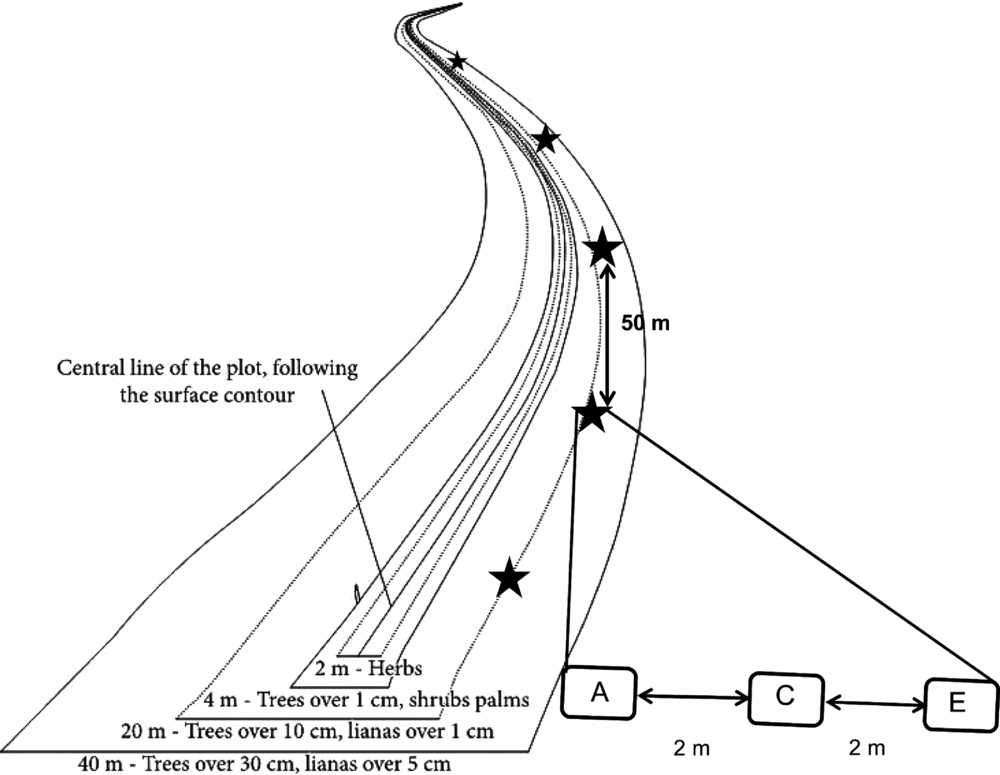
The experiment was conducted in 30 vegetation plots distributed over a grid of trails covering 25 km2 (Figure 1), managed by the Brazilian Biodiversity Research Program (PPBio). Each vegetation plot is 1 km away from neighbouring vegetation plots, and follows the contour of the terrain (Costa & Magnusson Reference COSTA and MAGNUSSON2010, Magnusson et al. Reference MAGNUSSON, LIMA, LUIZÃO, LUIZÃO, COSTA, CASTILHO and KINUPP2005). Vegetation plots are 250 m long, but width varies according to the size of studied organisms (more details in Costa & Magnusson Reference COSTA and MAGNUSSON2010). The soil data were obtained from the PPBio database (http://ppbio.inpa.gov.br/Port/inventarios/ducke/pterrestre/).
Schematic diagram of the 30 plots used in the experiment on emergence in the litter treatments. Each plot is 250 m long and follows the terrain contour. The stars represent the points where the experimental blocks were installed. A = Litter addition, C = Control, E = Litter exclusion. Figure adapted from a line drawing by Karl Mokross.

Data collection
Measurements of litter depth were done during the rainy and dry seasons, in April and September 2010 respectively. We measured depth using an instrument developed by Marimon-Júnior & Hay (Reference MARIMON-JÚNIOR and HAY2008), which was shown to be a less subjective method for comparative measures. Litter depth was measured at every 5 m in each vegetation plot, at the left side along the central line of 250 m, totalling 51 measurements per vegetation plot.
The experiment was composed of three treatments: litter removal, litter addition, and a control where the area was delimited but litter depth was not manipulated. Treatment plots measured 0.4 × 0.6 m and were organized into experimental blocks, each block composed of one of each of the three treatment plots. Within blocks, each treatment plot was separated from neighbouring plots by a distance of 2 m. Experimental blocks were equally distributed along the main axes of thirty 250-m long vegetation plots. Each vegetation plot contained five experimental blocks separated from neighbouring blocks by a distance of 50 m.
Litter depth measurements were taken in five points located at the edges and the centre of each plot assigned to the litter-addition treatment. The average litter depth and treatment plot area were then used to calculate the amount of litter present, and an equivalent amount taken from the surrounding area was added. The treatment plots with litter addition and exclusion were surrounded by PVC plates to prevent the input or loss of litter from the sides. Moreover, the litter-exclusion treatment plot was located beneath a litter collector, in order to avoid the vertical input of litter. The collector was 0.25 m2 and was made of a 1-mm green nylon mesh. The collector was emptied every month, so there was no accumulation of leaves above the treatment for a period greater than 15 d. Light measurements carried out over and below the green mesh showed that the presence of the collector does not alter the light red : far red ratio (t = 0.46, P = 0.65, n = 10).
Before monitoring, all the seedlings and pteridophytes established within the treatment plots were marked, to avoid including data related to individuals already established. Given the alternation of generations in pteridophytes, we considered as emerging individuals the young sporophytes with any visible vegetative parts. During the monthly monitoring of emerging herbs, which occurred between December 2009 and September 2010, we marked the first noticeably emerging vegetative part of each individual with aluminium tags, mostly attached to the ground, with continuous numbering. Identification was achieved with the help of experts in the herbaceous taxa and a database of photographs. In addition, we monitored the development of individuals, which allowed reliable identification of most of them to the species or genus level.
To understand how the availability of seeds affected seedling emergence, we quantified the number of reproductive individuals in the vegetation plots from February to September 2010. Plants with maturing and/or ripe fruits were counted in a 10-m strip along the 250-m central line of each vegetation plot, which contained the experimental treatment plots. Each clump of clonal species was treated as an individual. Clumps were defined as groups of stems or leaves arising from the soil less than 20 cm from each other.
Data analysis
To determine the relationship between topographic features and the amount of litter in plots, we used multiple regression models. The average litter depth and the frequency of bare-soil points (defined as those with less than 1 cm of litter) were the response variables, and clay content and terrain slope the predictors. Separate regressions were run for rainy and dry seasons.
Emerging plants were grouped as pteridophytes and monocot herbs for the purpose of analysis. Covariance analysis, run with Poisson GLM, was used to analyse the effects of the litter treatments on (1) total emergence, (2) the emergence of pteridophytes and (3) the emergence of monocot herbs. Models for total emergence and pteridophytes included the litter treatments as fixed factor, clay content as a covariate, and their interaction. Models for monocot herbs also included the number of fruiting individuals as a covariate. We also analysed the correlation between clay content and number of fruiting individuals from monocot herbs, and a path analysis was run as a way to understand the effective contribution of clay content on the emergence of seedlings from monocot herbs. We performed all statistical analyses in R 2.10.1.
RESULTS
Variation in litter depth with topography
The average litter depth during the rainy season was not related to the soil clay content, but was negatively related to the terrain slope (R2 = 0.13, t = −2.31, P = 0.029, n = 30). Similarly, the frequency of sites with a litter depth lower than 1 cm was not related to clay content but was negatively associated with slope (R2 = 0.13, t = −2.29, P = 0.030, n = 30). During the dry season, litter depth was not associated with the slope (t = −1.59, P = 0.123, n = 30), nor with the soil clay content (t = −0.39, P = 0.703, n = 30). Likewise, the frequency of sites with litter depth lower than 1 cm was not associated with slope (t = −1.62, P = 0.117, n = 30), nor with the content clay soil (t = 0.47, P = 0.644, n = 30).
Litter effects on herbaceous seedling emergence
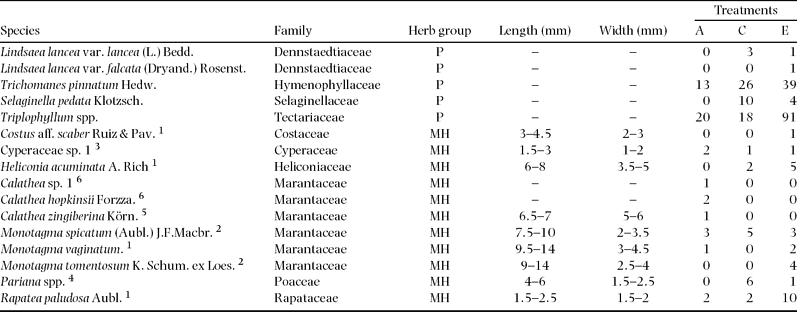
A total of 281 individuals belonging to 16 herbaceous species emerged during 10 mo of monthly monitoring in the Reserva Ducke (Table 1). Among the 16 species, 13 occurred in the litter-exclusion treatment, and three species were restricted to this treatment. Nine species each were found in the litter-addition treatment and controls, and three species were restricted to the addition treatment (Table 1).
List of species, morphometric measurements and the absolute number of pteridophyte sporophytes emerging (P) and seedlings emerging of monocot herbs (MH) in the litter treatments. A = Litter addition, C = Control, E = Litter exclusion. Species with morphometric measurements based on INPA herbarium collections (1); on field collections at Reserva Ducke (2); and the literature: Simpson (Reference SIMPSON2006) (3); Davidse et al. (Reference DAVIDSE, JUDZIEWICZ, ZULOAGA, Berry, Yatskievych and Holst2004) (4); Kennedy et al. (Reference KENNEDY, ANDERSON, HAGBERG, Harling and Andersson1988) (5). Species without information (6).

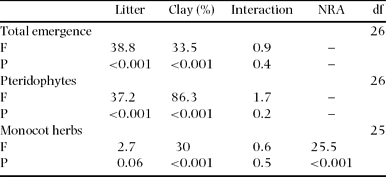
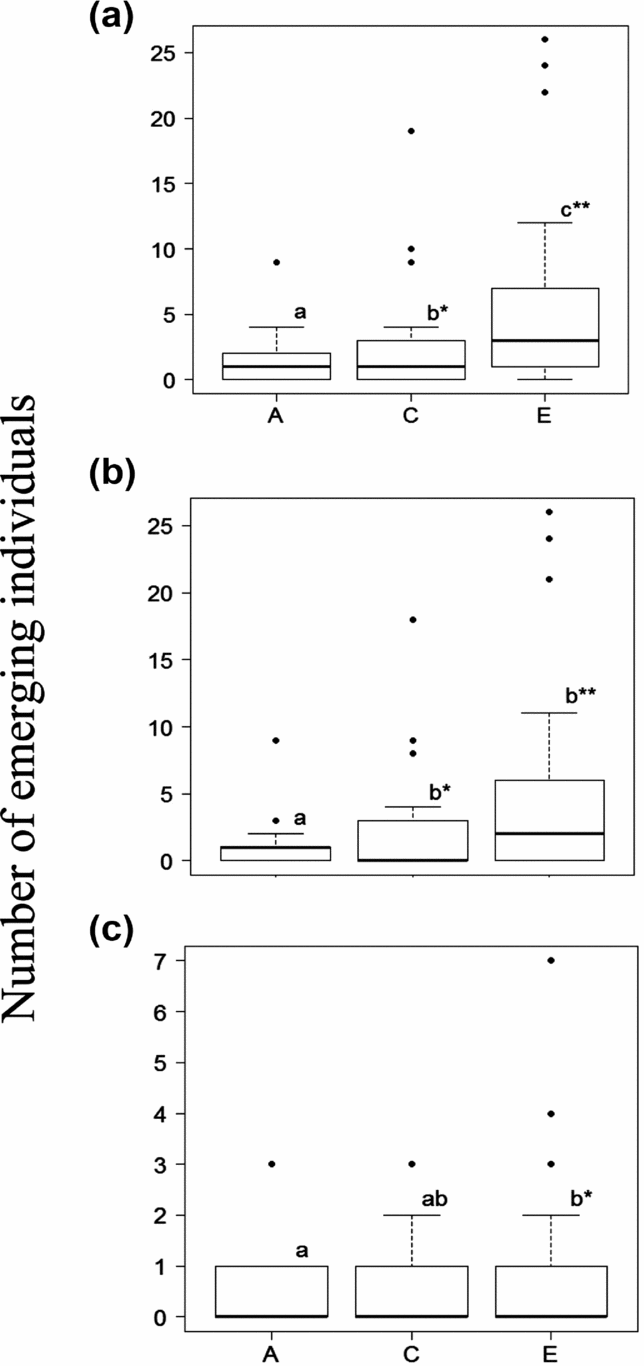
The total number of emerging plants (ferns plus monocots) varied among the litter treatments and in relation to the soil clay content (Table 2). The total number of individuals emerging in the litter-exclusion treatment was 2.2 times higher than in the control and 3.6 times greater than in the litter-addition treatment (Figure 2a), and was higher in sandy soils than in soils with high clay content.
Effects of the litter amount (experimentally manipulated), soil clay content, number of reproductive adults (NRA) and the interaction between treatments and clay content on the number of emerging herb seedlings and pteridophyte sporophytes. The table shows the results of an ANOVA (Emergence = Litter + Clay Content + Interaction (Clay content × Litter) + NRA), using GLM, with 30 replicates of the litter treatments. Litter was a categorical variable with three levels: litter addition (A), control (C) and litter removal (E). Clay content was treated as a covariate independent of treatments.

Number of emerging individuals among treatments for the total emergence (a), pteridophytes (b) and monocot herbs (c). A = Litter addition, C = Control, E = Litter exclusion. The boxes represent the interval between 25th and 75th percentiles in the number of emerging individuals. The median (horizontal lines inside boxes) represent 50th percentile and whiskers minimum and maximum values of the data. The points above the boxes represent outliers. Different letters indicate treatments with significantly different averages. * < 0.05; ** < 0.01.

Emergence in relation to litter differed depending on the plant group. The number of emerging pteridophytes was 4.1 times higher in the litter-exclusion than in the addition treatment (Figure 2b). Emergence also increased with the soil clay content, but there was no interaction between soil texture and litter treatments (Table 2).
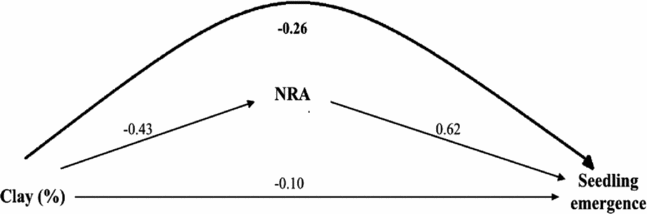
The number of emerging seedlings of monocot herbs in the litter-exclusion treatment was twice that in the litter-addition treatments, and was not related to the clay content (Table 2, Figure 2c). Emerging seedlings also increased with the number of reproductive individuals in the plots (Table 2) and the number of fruiting individuals was negatively associated to the soil clay content. The potential seed production of herbaceous monocots, estimated by the number of fruiting individuals, was higher in sandier plots, falling dramatically in areas with higher clay contents. Although the number of fruiting plants and soil texture were correlated, a path analysis indicated that the direct and indirect effects of clay content on seedling emergence were lower than the direct effect of the number of fruiting individuals (Figure 3).
The path analysis model for the emergence of seedlings from monocot herbs. Arrows indicate a direct relationship, followed by the standardized regression coefficient. The indirect effects are shown by bold lines. NRA = Number of reproductive adults.

DISCUSSION
How litter depth varies with topography
The litter depth and the frequency of litter-free areas were not associated with the soil clay content, but with the terrain slope in the rainy season. We expected that clayey areas would have less litter accumulation, since litter decomposition is generally faster on more fertile soils (Takyu et al. Reference TAKYU, AIBA and KITAYAMA2003) and clayey ferralsols tend to be more fertile than the sandy podzols (Quesada et al. Reference QUESADA, LLOYD, ANDERSON, FYLLAS, SCHWARZ and CZIMEZIK2011). This result is probably a consequence of the balance between litter production and decomposition, since higher production is also associated with clayey soils (Luizão et al. Reference LUIZÃO, LUIZÃO, PAIVA, MONTEIRO, SOUZA and KRUIJTS2004). At the same time, the lower accumulation of litter in the slopes suggests that litter displacement by rain and/or wind can generate a shallower litter layer and a higher proportion of litter-free areas in these environments. In the dry season, there was no relationship between depth and frequency of litter-free areas with soil clay content and terrain slope. This result suggests that higher litterfall during this period outweighs the effect of litter transport on sloping areas, possibly due to low rainfall to carry the litter. Shallower litter layers are therefore present in the slopes during the rainy season, which is the more favourable season for seedling establishment, especially of pteridophytes (Page Reference PAGE2002).
How litter affects herbaceous seedling emergence
The total number of emerging seedlings was higher in the litter-exclusion treatment compared with control and litter addition treatments. Our results indicate that litter, in the amounts found naturally in the forest, here represented by the control treatment, does restrict the emergence of herbaceous plants. The addition of more litter did not cause a stronger inhibition than that generated by the natural amounts. The fact that all seeds of herbaceous species studied here have a mass considered small (< 0.5 g) is the most plausible explanation for this pattern. Thus, our results are consistent with the hypothesis that litter represents a physical barrier impeding the process of germination and seedling emergence from small propagules (Jensen & Gutekunst Reference JENSEN and GUTEKUNST2003, Metcalfe & Turner Reference METCALFE and TURNER1998, Sydes & Grime Reference SYDES and GRIME1981, Xiong & Nilsson Reference XIONG and NILSSON1999).
For pteridophytes, the removal of litter caused a significant increase in the emergence of sporophytes in relation to the litter-addition treatment. The very small mass of pteridophyte spores (< 10−2 mg) may represent a limitation to the development of the gametophyte and therefore to the emergence of the sporophyte in areas with a physical barrier, such as litter. Alternatively the gametophyte may develop under litter, but the sporophyte may not be able to develop or to emerge. Also, several pteridophyte species, including tropical ones, are dependent on a high red : far-red ratio for activation of the phytochrome associated spore germination mechanism (Banks Reference BANKS1999, Furuya et al. Reference FURUYA, KANNO, OKAMOTO, FULUDA and WADA1997, Pérez-García et al. Reference PÉREZ-GARCÍA, MENDOZA-RUIZ, SÁNCHEZ-CORONADO and OROZCO-SEGOVIA2007, Wada Reference WADA2007). As litter can reduce substantially the red : far-red ratio (Facelli & Pickett Reference FACELLI and PICKETT1991b, Schimpf & Danz Reference SCHIMPF and DANZ1999, Vázquez-Yanes et al. Reference VÁZQUEZ-YANES, OROZCO-SEGOVIA, RINCÓN, SANCHEZ-CORONADO, HUANTE, TOLEDO and BARRADAS1990), we suggest that shallow litter layers or litter-free patches represent favourable microsites for the emergence of seedlings from pteridophytes. These results, together with the significant decrease in the average litter depth and increased frequency of litter-free patches in the slopes, are consistent with the hypothesis of Costa (Reference COSTA2006), that higher richness and abundance of pteridophytes on the slopes are a consequence of shallow litter layers. Poulsen (Reference POULSEN1996) also found pteridophytes associated with litter-free areas in a lowland rain forest in Borneo and was the first to suggest that litter-free sites could affect the germination process of some species, but did not evaluate the issue. The present study indicates that at least the two most abundant pteridophytes at RFD, Triplophyllum spp. and Trichomanes pinnatum, are litter-free area demanders, as has been shown for small-seeded trees and shrubs (Metcalfe & Grubb Reference METCALFE and GRUBB1997, Metcalfe & Turner Reference METCALFE and TURNER1998).
This pattern may be further reinforced by the directional local air circulation, which flows from the high ridges to the valleys during the day and from the valleys to the slopes at night (Tóta Reference TÓTA2009). Thus, the slopes between ridges and valleys may receive spores from all over the topographic gradient. Overall, slopes represent the sites with the most favourable environment for pteridophyte establishment, given dispersal and favourable litter-free microsites.
Seedling emergence of monocot herbs were not related to the soil clay content and differed only moderately between the litter exclusion and addition. Litter absence was recognized as a facilitator of the emergence of Heliconia acuminata (Bruna Reference BRUNA1999, Reference BRUNA2002; Bruna & Ribeiro Reference BRUNA and RIBEIRO2005). However little is known about the germination of tropical herbs, making it difficult to point light increases, light quality changes or lower chances of attack by fungi or pathogens as the causal mechanisms behind litter effects.
Our results also show that the most important predictor of seedling emergence for monocot herbs was the number of reproductive individuals in the plots, which was higher in sandier areas. Even considering the direct and indirect effects of soil texture, the emergence of seedlings was most strongly associated with the abundance of fruiting individuals in the plots. Thus, control of germination and initial establishment of monocot herbaceous plants seems to be directly linked to the availability of propagule sources, and secondarily to the microsite properties given by the amount of litter.
Indirectly, the control of germination and initial establishment can be linked to water availability during the dry season, which is higher in the sandy valleys with shallow groundwater, and should allow better development and better reproduction of this particular group of herbaceous species. Drucker et al. (Reference DRUCKER, COSTA and MAGNUSSON2008) showed that many of the same herb species studied are associated with or restricted to stream margins. These results also are consistent with the pattern of greatest abundance and cover of Marantaceae, Poaceae and Cyperaceae in the sandy valleys found by Costa (Reference COSTA2006) in the same study site. We suggest that reproduction of large-leaved herbs may be physiologically constrained in drier areas, and therefore a greater production of seeds occurs in the valleys.
Higher emergence linked to the local availability of seeds is in accordance with the hypothesis that herbaceous species have dispersal restricted to short distances (Ehrlén & Eriksson Reference EHRLÉN and ERIKSSON2000). Given that most of the studied species are probably dispersed by ants, a pattern of restricted dispersal associated with better establishment conditions in more humid areas seems to be the mechanism generating the pattern of distribution of monocot herbs. However direct studies of dispersal limitation are necessary to understand the extent of the contribution of seed dispersal and water availability.
Conclusions
In this study we have shown that litter can restrict the emergence of herbaceous species, especially pteridophytes, and there is a lower litter accumulation and more litter-free zones in the slopes. These results support the hypothesis that litter is the mediator of the greater richness and abundance of pteridophytes in the slopes. We also demonstrated that the emergence of herbaceous monocot species is limited by the abundance of seed sources. Since dispersal mechanisms of Amazonian herbs are still largely unknown, future experiments to understand how limited it is and to what extent the environment changes the distribution pattern set by dispersal will help to further clarify the mechanisms controlling herb distribution in tropical forests.
ACKNOWLEDGEMENTS
The authors thank Brazilian National Research Council (CNPq) for the concession of a scholarship to the first author, R. A. Azevedo, C. E. Barbosa, C. G. Freitas for help in the field, and E. Bruna, J. Benítez-Malvido, I. D. Kossmann-Ferraz and an anonymous reviewer who contributed to a previous version of this manuscript.