Introduction
Cardiac rhythm disturbances are among the most frequent complications observed after paediatric cardiac surgery. Reported incidences of early post-operative arrhythmias range from approximately 12.4 to 31.0%, depending on how arrhythmia was defined and diagnosed in each study.Reference Öztürk, Kafalı and Tanıdır1–Reference Jain, Alam and Viralam6 Although these events are often transient, they may substantially increase morbidity and mortality.Reference Hoque, Sultana and Mia4,Reference Rehman, Khan and Chand7 Previous studies have documented mortality rates linked to post-operative arrhythmias from 0.7% up to 15.0%.Reference Nezafati, Abbasi and Soltani8,Reference Chaiyarak, Soongswang and Durongpisitkul9
Post-operative arrhythmias are broadly categorised into tachyarrhythmias or bradyarrhythmias. Junctional ectopic tachycardia is frequently reported as the predominant early post-operative tachyarrhythmia.Reference Öztürk, Kafalı and Tanıdır1–Reference Hoque, Sultana and Mia4,Reference Rehman, Khan and Chand7–Reference Chaiyarak, Soongswang and Durongpisitkul9 This arrhythmia is thought to arise from mechanical or inflammatory injury to the atrioventricular conduction tissue during procedures such as closure of Ventricular Septal Defect, and it is commonly seen after Tetralogy of Fallot repair.Reference Öztürk, Kafalı and Tanıdır1,Reference Hoque, Sultana and Mia4,Reference Ganea, Cinteza and Filip10 Other early post-operative tachyarrhythmias include supraventricular tachycardia, atrial fibrillation or flutter, and ventricular tachycardia. Inflammatory and ischaemia-reperfusion changes associated with cardiopulmonary bypass, sympathetic activation from catecholamines, and hemodynamic stress related to pressure and volume overload are additional proposed mechanisms.Reference Ganea, Cinteza and Filip10,Reference Joye, Beghetti and Wacker11
Complete heart block is the most frequently encountered bradyarrhythmia following congenital heart surgery.Reference Yasa, Katritama and Harta5 Both genetic and environmental factors have been implicated, including mutations affecting ion channel conduction.Reference Ganea, Cinteza and Filip10 Other post-operative bradyarrhythmia include sinus node dysfunction, first- or second-degree heart block.
Risk factors for early post-operative arrhythmia can be grouped into patient-related and procedure-related variables. Patient characteristics such as age, weight, and underlying cardiac diagnosis have been described as potential contributors.Reference Öztürk, Kafalı and Tanıdır1,Reference Hoque, Sultana and Mia4,Reference Jain, Alam and Viralam6,Reference Ganea, Cinteza and Filip10 Intraoperative parameters, particularly extended cardiopulmonary bypass time and aortic cross-clamp times, have consistently been associated with higher arrhythmia risk.Reference Öztürk, Kafalı and Tanıdır1–Reference Rehman, Khan and Chand7,Reference Chaiyarak, Soongswang and Durongpisitkul9,Reference Ganea, Cinteza and Filip10 Perioperative factors such as serum electrolyte concentrations and inotrope scores immediately after surgery have also been implicated.Reference Öztürk, Kafalı and Tanıdır1,Reference Ishaque, Akhtar and Ladak3–Reference Rehman, Khan and Chand7
The objective of this study is to determine the incidence of early post-operative arrhythmia following open-heart surgery for congenital and acquired heart diseases in a large paediatric cohort. In addition, this study sought to identify the risk factors for arrhythmia development and to evaluate its impact on ventilation duration, length of ICU, hospital length of stay, and mortality. The significant findings will aid paediatric cardiologists, intensivists, cardiovascular surgeons, and anaesthesiologists to recognise, prevent, and manage arrhythmias in the immediate post-operative period more effectively.
Methods
This retrospective single-centre cohort study was conducted in the Paediatric Cardiac ICU at the National Heart Institute, Kuala Lumpur, Malaysia. All patients younger than 18 years who underwent open-heart surgery for congenital or acquired heart disease between 1 January 2022 and 31 December 2024 were included. Patients who underwent closed-heart procedures or had a pre-existing or intraoperative arrhythmia were excluded.
Demographic characteristics, primary cardiac diagnoses, and surgical procedures were obtained from medical records. Cardiac lesions were classified as simple or complex, and surgical complexity was graded using the Risk Adjustment for Congenital Heart Surgery-1 (RACHS-1) classification.Reference Cavalcanti, De Oliveira and Dos Santos12 Simple lesions included Atrial Septal Defect, Atrioventricular Septal Defect, Ventricular Septal Defect, and Tetralogy of Fallot. Intraoperative and perioperative parameters recorded included cardiopulmonary bypass duration, aortic cross-clamp time, serum electrolyte levels at ICU admission (potassium, ionised calcium, magnesium), and duration of inotropic support. Electrolytes were categorised as low (<4 mmol/L potassium, <1.3 mmol/L ionised calcium, <1.0 mmol/L magnesium) or normal/high.
Early post-operative arrhythmia was defined as any rhythm disturbance occurring within 72 hours post-surgery resulting in hemodynamic instability that required medical intervention. Sinus bradycardia, sinus tachycardia, and isolated ectopic beats without instability were excluded. Junctional ectopic tachycardia was defined as narrow-complex tachycardia with atrioventricular dissociation and a heart rate >150 beats/min, whereas accelerated junctional rhythm had a similar morphology but a rate <150 beats/min and stable hemodynamics.
Continuous variables were summarised as median with interquartile range and compared using the Mann–Whitney U test. Categorical variables were expressed as counts and percentages, and compared using the Chi-square test. Univariate and multivariate logistic regression analyses were performed to identify risk factors independently associated with early post-operative arrhythmia. Analyses were performed using IBM SPSS Statistics, version 30. A p-value <0.05 was considered statistically significant.
Results
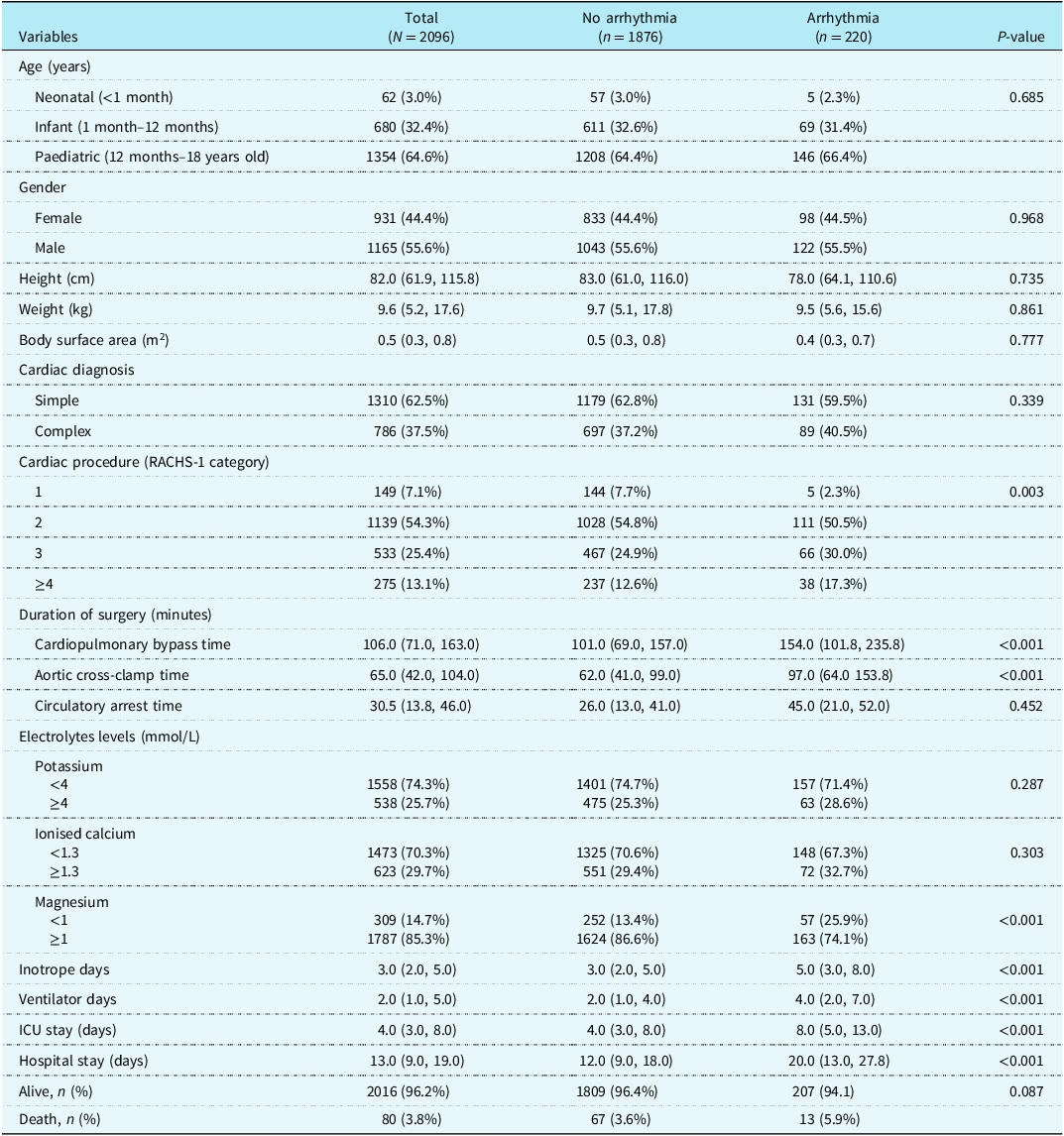
During the study period, 2,135 paediatric patients underwent open-heart surgery. After excluding 39 cases with pre-operative or intraoperative arrhythmias, 2,096 patients remained for analysis. Most of the patients were in the paediatric age group (64.6%) and male (55.6%). Height, weight, and body surface area did not differ significantly between those who did and did not develop arrhythmia, as seen in Table 1. The majority of the procedures were RACHS-1 category 2 (54.3%), with Ventricular Septal Defect closure (34.2%) and Tetralogy of Fallot correction (11.6%) as the most common surgeries.
Demographic, clinical characteristics, and outcomes of paediatric patients after open-heart surgery

Values are presented as mean ± SD, median (IQR), or n (%). ICU = intensive care unit; SD = standard deviation.
Overall, 220 patients (10.5%) developed early post-operative arrhythmia. Tachyarrhythmias (56.8%) were more common than bradyarrhythmia. The most common arrhythmias were complete heart block (3.2% of total surgeries, 30.0% of total arrhythmia), followed by accelerated junctional rhythm (2.8% of total surgeries, 26.8% of total arrhythmia) and junctional ectopic tachycardia (1.9% of total patients, 18.2% of total arrhythmia). Other significant arrhythmias observed were sinus node dysfunction (0.8%), slow junctional rhythm (0.4%), atrial flutter and supraventricular tachycardia (0.3% each), ventricular tachycardia (0.3%), ectopic atrial tachycardia (0.2%), 1st degree heart block (0.1%), 2nd degree heart block (0.1%), ventricular ectopic beats and ventricular fibrillation (0.1% each) (Figure 1).
Distribution of early post-operative arrhythmia.

The distribution of arrhythmia types by surgical procedure is summarised in Figure 2. Although the majority of the patients underwent Ventricular Septal Defect closure, the most common cardiac procedure associated with post-operative arrhythmia was Tetralogy of Fallot correction (20.2%). This was followed by Fontan operation (16.5%) and Atrioventricular Septal Defect repair (14.8%). Post-operative arrhythmia was only associated with 7.7% of Ventricular Septal Defect closures.
Distribution of arrhythmia types by surgical procedure.

Risk factors for arrhythmia
Complete heart block was observed in 5.4% (n = 13) of patients following Tetralogy of Fallot repair and 4.6% (n = 4) after Atrioventricular Septal Defect repair. Among other procedures, the Double Switch operation for Congenitally Corrected Transposition of the Great Arteries showed the highest rate, with 33.0% of patients affected. Although Ventricular Septal Defect closure accounted for the largest number of complete heart block cases, its incidence within the group was relatively low (2.9%).
Accelerated junctional rhythm occurred most frequently after Fontan operation (7.3%, n = 8), followed by Tetralogy of Fallot repair (6.2%, n = 15) and Atrioventricular Septal Defect repair (4.6%, n = 4). Junctional ectopic tachycardia was also most commonly associated with Tetralogy of Fallot repair (6.2%, n = 15).
Patient characteristics, including weight, height, body surface area, and primary diagnosis, were not significantly associated with the development of post-operative arrhythmia. In contrast, the type of cardiac procedure, as categorised by the RACHS-1 classification, demonstrated a significant association (p = 0.003). Tetralogy of Fallot repair carried the highest incidence of arrhythmia (20.2%), followed by the Fontan procedure (16.5%) and Atrioventricular Septal Defect repair (14.8%). Although most arrhythmia cases occurred in RACHS-1 Category 2 procedures due to higher surgical volume, the proportion increased with surgical complexity, 3.4% in RACHS-1 Category 1, 9.7% in RACHS-1 Category 2, 12.4% in RACHS-1 Category 3, and 13.8% in RACHS-1 Category ≥ 4, indicating greater risk with more complex surgeries.
Intraoperatively, the mean durations of cardiopulmonary bypass and aortic cross-clamp were significantly longer in the arrhythmia group compared with those without arrhythmia (154 vs. 101 minutes and 97 vs. 62 minutes, respectively; both p < 0.001). Circulatory arrest time showed no significant difference between groups. Among serum electrolytes, only low magnesium levels (<1.0 mmol/L) were significantly associated with arrhythmia (25.9% vs. 13.4%; p < 0.001). Analysis showed that patients with low serum magnesium (<1.0 mmol/L) had nearly double the incidence of arrhythmia (18.4%) compared with those with normal or higher levels (9.1%, p < 0.001). Duration of inotropic support was also longer in affected patients (median 5 vs. 3 days; p < 0.001) (Table 1).
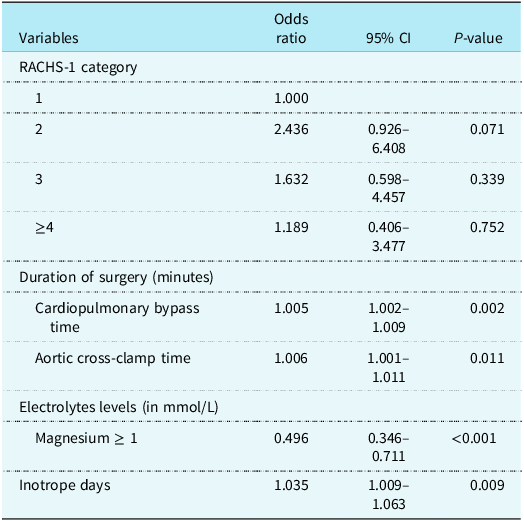
Multivariate logistic regression confirmed prolonged cardiopulmonary bypass time (OR 1.005, 95% CI: 1.002–1.009, p = 0.002), prolonged aortic cross-clamp time (OR: 1.006, 95% CI: 1.001–1.011, p = 0.011), and extended inotropic duration (OR 1.035, 95% CI: 1.009–1.063, p = 0.009) as independent predictors as seen in Table 2. On the contrary, a normal to increased magnesium level was seen as a protective factor (OR 0.496, 95% CI: 0.346–0.711, p < 0.001) in the development of early post-operative arrhythmia.
Multivariate logistic regression analysis of risk factors

Management of arrhythmia
Amiodarone was the most frequently used anti-arrhythmic for post-operative tachyarrhythmias. Amiodarone infusion was given at 25 mcg/kg/min for 4 hours, then titrated to 5–15 mcg/kg/min depending on the patient’s heart rate. It was administered in 22 of patients who developed junctional ectopic tachycardia (55.0%), 15 patients with accelerated junctional rhythm (25.4%), three patients who developed atrial flutter (42.9%), five patients who had supraventricular tachycardia (71.4%), three patients who had ventricular tachycardia (50.0%), one patient who developed ectopic atrial tachycardia (25.0%), and one patient who had significant ventricular ectopic beat (100.0%). Beta Blockers (Propranolol, Carvedilol, and Bisoprolol) were the most common oral anti-arrhythmic medication. It was given to 10 patients who developed junctional ectopic tachycardia (25.0%), nine patients with accelerated junctional rhythm (15.2%), two patients with atrial flutter (28.6%), and one patient with ectopic atrial tachycardia (25.0%). Ivabradine was prescribed to four patients diagnosed with junctional ectopic tachycardia (10.0%) and one patient with accelerated junctional rhythm (8.5%).
Cardioversion and defibrillation were administered to 12 patients who developed tachyarrhythmia. Four patients who had atrial flutter (57.1%) underwent synchronised cardioversion, while the one patient with ventricular fibrillation was given defibrillation. Cardioversion was done in one patient who had supraventricular tachycardia (14.3%) and all patients who developed ventricular tachycardia.
For bradyarrhythmia, the majority of patients received temporary pacing, and subsequently permanent pacing implantation. Fifty-one patients who developed complete heart block and three patients with sinus node dysfunction underwent permanent pacemaker implantation. Most of the patients underwent Tetralogy of Fallot correction (4.5%) and Ventricular Septal Defect closure (2.0%). Six patients who developed slow junctional rhythm were supported initially with temporary pacing, but eventually resolved and did not require permanent pacemaker implantation. All the patients who had 1st degree and 2nd degree heart blocks had spontaneous resolution of their bradyarrhythmia.
Outcome of arrhythmia
The presence of arrhythmia significantly influenced post-operative recovery and outcomes. Patients who developed arrhythmia required a longer duration of mechanical ventilation (p < 0.001), with a maximum of seven days compared to four days among those without arrhythmia. Similarly, both ICU and total hospital stays were significantly prolonged in the arrhythmia group (p < 0.001). The mean ICU stay for patients with arrhythmia was eight days, and the mean hospital stay was 20 days, whereas patients without arrhythmia had mean stays of four and 12 days, respectively (Table 1). The mortality rate was higher among patients with arrhythmia (5.9%), although most deaths were not directly attributable to the arrhythmia itself. The predominant causes of death were myocardial failure, followed by severe sepsis and respiratory failure. Three patients required extracorporeal membrane oxygenation, and none of the deaths were directly linked to post-operative arrhythmia.
Discussion
The incidence of early post-operative arrhythmia has been variable according to the underlying cardiac diagnosis and duration criteria used. Studies demonstrated an incidence of 12.4–31.0%.Reference Öztürk, Kafalı and Tanıdır1–Reference Jain, Alam and Viralam6,Reference Chelo, Ateba Ateba and Tantchou Tchoumi13 The incidence in our cohort is 10.5%, which is low despite having the largest number of participants enrolled in the study. The relatively low incidence of early post-operative arrhythmia in the study may be attributed to the definition used. The study intentionally focused on clinically significant arrhythmias requiring medical intervention and associated with hemodynamic instability to better reflect arrhythmias with clinical relevance in the paediatric cardiac intensive care setting, consistent with prior studies.Reference Chaiyarak, Soongswang and Durongpisitkul9,Reference Abdelaziz and Deraz14,Reference Kabbani, Al Taweel and Kabbani15
Cardiopulmonary bypass time, aortic cross-clamp time, serum magnesium levels, and inotropic support duration were significant intraoperative and perioperative risk factors. Inflammation of the myocardium and ischaemia-perfusion injury secondary to prolonged cardiopulmonary bypass time and aortic cross-clamp time contribute to the development of post-operative arrhythmia.Reference Öztürk, Kafalı and Tanıdır1,Reference Ganea, Cinteza and Filip10 Electrolyte abnormalities including potassium, ionised calcium, and magnesium are associated with the development of arrhythmias as these are important in the conduction of action potential in the myocardium.Reference Ganea, Cinteza and Filip10 Duration of inotropic support has not been previously studied. Adelaziz et al. and Abdel Gawad et al. have shown that there is a strong relationship between post-operative use of inotropic support and development of early arrhythmia.Reference Abdelaziz and Deraz14,Reference Abdel Gawad, Elguindy and Youssef16
Complete heart block was the most common type of arrhythmia post-cardiac surgery with an incidence of 3.2% out of all patients. This is most common after Tetralogy of Fallot and Atrioventricular Septal Defect repair. This finding is similar to other studies that noted complete heart block as the most common post-operative arrhythmia in children.Reference Yasa, Katritama and Harta5,Reference Jain, Alam and Viralam6 In the study done by Yasa et al., they noted the incidence of complete heart block at 35.7%.Reference Yasa, Katritama and Harta5 Development of complete heart block post-operatively has been linked with both genetic and environmental factors. A mutation in the connexin-40 gene results in alteration of the gap junction with subsequent effect on action potential conduction.Reference Ganea, Cinteza and Filip10,Reference Garcia, Safa and Karpawich17 Association of complete heart block with Congenitally Corrected Transposition of the Great Arteries was seen in this study. Congenitally Corrected Transposition of the Great Arteries was the 3rd most common diagnosis in patients who developed complete heart block. Diagnosis of Congenitally Corrected Transposition of the Great Arteries puts patients at risk of complete heart block because of the different location of the atrioventricular node and abnormal conduction system development.Reference Kabbani, Al Taweel and Kabbani15
The second most common arrhythmia was accelerated junctional rhythm (2.8%), followed by junctional ectopic tachycardia (1.9%). Previous studies have reported junctional ectopic tachycardia incidences as high as 45–51.4%.Reference Öztürk, Kafalı and Tanıdır1,Reference Alotaibi, Saleen and Alsharef2 Post-operative junctional ectopic tachycardia is attributed to direct trauma or inflammation involving the atrioventricular node, leading to abnormal automaticity and accelerated ventricular conduction.Reference Ganea, Cinteza and Filip10,Reference Abdelaziz and Deraz14,Reference Lapmahapaisan, Sateantantikul and Maisat18 This results in atrioventricular dissociation and reduced ventricular filling, causing hemodynamic instability.Reference Kabbani, Al Taweel and Kabbani15 Tetralogy of Fallot repair was the most frequent surgical procedure among patients who developed junctional ectopic tachycardia.
Anti-arrhythmic medications are used in the control and termination of tachyarrhythmias. Amiodarone was the most common anti-arrhythmic drug therapy prescribed. It is the most efficacious medication used in the treatment of post-operative junctional ectopic tachycardia.Reference Kabbani, Al Taweel and Kabbani15 It reduces automaticity by inhibiting hyperpolarization-activated cyclic nucleotide-gated channels at both the sinus node and atrioventricular node.Reference López Fernández, Montañes Delmas and Granados Ruiz19 Ivabradine, on the other hand, is an emerging drug used in the control of abnormal heart rate and rhythm. Ivabradine was used in five patients who developed junctional ectopic tachycardia post-operatively. Studies have shown its efficacy comparable to Amiodarone, especially in paediatric patients who developed junctional ectopic tachycardia but without hemodynamic instability.Reference Kamali, Öztürk and Çiftçi20,Reference Arvind, Kothari and Juneja21 Arvind et al. have shown that in patients who developed post-operative junctional ectopic tachycardia, 95.8% who were given Ivabradine had conversion of arrhythmia, while this was seen in 93.8% of patients given Amiodarone. Although the time of conversion was longer in Ivabradine than in Amiodarone.Reference Arvind, Kothari and Juneja21
In our study, children who developed early post-operative arrhythmias experienced longer mechanical ventilation, ICU, and hospital stay. In a recent study by Lapmahapaisan et al., they noted that post-operative tachyarrhythmias were independently associated with longer ventilation duration, prolonged ICU and hospital stay.Reference Lapmahapaisan, Sateantantikul and Maisat18 Longer ICU stay associated with the presence of post-operative arrhythmia was also noted in the studies of Rehman et al., Chelo et al, and Adelaziz et al. Reference Rehman, Khan and Chand7,Reference Chelo, Ateba Ateba and Tantchou Tchoumi13,Reference Abdelaziz and Deraz14
Perioperative risk stratification should be used to intensify monitoring and early treatment in high-risk patients. Standardised post-operative bundles to rapidly identify and correct reversible causes, e.g. electrolytes and acid-base balance correction, catecholamine use, and temperature control, are likely to reduce both the incidence and severity of early arrhythmias. Selective use of Dexmedetomidine in high-risk infants, especially in post-Tetralogy of Fallot repair, has been reported to be effective in reducing the incidence of junctional ectopic tachycardia.Reference El Amrousy, Elshmaa and El-Kashlan22 Epicardial atrial and ventricular pacing wires placed intraoperatively for high-risk patients are crucial for managing post-operative cardiac arrhythmias.
Mortality rate of post-operative paediatric patients was higher in those who developed arrhythmia (5.9% vs. 3.6%). In other studies, there was a higher mortality rate in patients who developed arrhythmia, although it was not directly related to the cause of death.Reference Lapmahapaisan, Sateantantikul and Maisat18
Study limitation
This is a retrospective single-centre study, which may limit generalizability to centres with different case mixes or monitoring practices. Surveillance intensity and diagnostic threshold done at the bedside may affect the observed incidence, as it may result in the lack of documentation of arrhythmia events. Finally, our outcome was focused on early in patients’ events, and the study was not designed to evaluate long-term arrhythmia recurrence or pacemaker dependance.
Conclusion
This study showed a low incidence of post-operative arrhythmia. The most common was tachyarrhythmia (accelerated junctional rhythm and junctional ectopic tachycardia) post-Tetralogy of Fallot repair. Prolonged cardiopulmonary bypass and aortic cross-clamp time, hypomagnesemia, and high inotropic support are significant risk factors which were associated with significant morbidity and mortality.
Data availability
The data are available from the corresponding author upon reasonable request.
Acknowledgements
The authors would like to thank Mr. Mohd Faizal bin Ramli and Miss Nurul Fazira bt Basran from the institution’s Clinical Research Department for their assistance in the statistical analysis and results.
Author contributions
K.G.S. Tria: writing main manuscript conceptualisation, data curation.
M.M.J. Munusamy: assist in methodology and study design.
K.F. Mohd Khalid: supervision, reviewing, and editing the main manuscript.
Financial support
This research received no specific grant from any funding agency, commercial, or not-for-profit sectors.
Competing interests
None.