The most widely accepted origin of the word ‘Pidgin’ is that it is a Chinese pronunciation of the English word business (etymonline.com). Pidgin English in mainland China has another popular localised nickname, i.e. yangjingbang 洋泾浜 English, a trade jargon term often used in Shanghai. However, this popular Pidgin English has been played down in linguistic research in mainland China because of the assumption of colonial connotations (Jin, Reference Jin2011). Although it did not thrive or even survive in mainland China, Pidgin English has influenced to no small degree both contemporary culture and language in Shanghai, as well as other Chinese varieties.
This paper reviews the historical background of the interaction between English and the Shanghai dialect, and aims to identify and trace the linguistic marks that this history has imprinted on the cultural and linguistic evolution of a major metropolis that aspires to be an international city. Previous studies have usually focused on what has been borrowed from English by Putonghua (PTH)Footnote 1 or Mandarin (Hu, P., Reference Hu2004; Wang, Reference Wang2004; Zhou & Jiang, Reference Zhou and Jiang2004), and on the nativisation of English by Mandarin speakers (Wei & Fei, Reference Wei and Fei2003). The heavy presence of English loanwords in other Chinese varieties, especially in the Shanghai dialect, has not been particularly studied. This paper also endeavours to extend the loanword study through analysis of the English loanwords in the Shanghai dialectFootnote 2 and to examine its connection with yangjingbang English.
The history of yangjingbang English: Its growth and decline
Pidgin English started taking form in China in the Canton area in the eighteenth century, when British merchants started using it as a business language while trading with the local Chinese (Shi, Reference Shi1991: 2). In the wake of the First Opium War, the unequal Nanking Treaty forced the Qing government to open up Shanghai as the biggest treaty port in China in 1843 for trade to the West (Jiang, Reference Jiang1933: 96). Owing to its special geographic location, Shanghai began to prosper as an industrial and commercial hub.
Shanghai became a flourishing market where the English language began to emerge as the means of communication between local Chinese and foreigners (Si, Reference Si2013: 41). Cantonese agents of foreign traders brought in the early Chinese Pidgin English developed around the Canton area, which soon fused with linguistic features of the local Shanghai dialect. Yangjingbang English had become a practical tool of oral communication for compradors and merchants by the end of the nineteenth century. As trade boomed, the use of this Pidgin English soon expanded to the lower working class, because having this linguistic ability could ‘help them survive better’ (Si, Reference Si2013: 58–9). However, the English used by local Shanghai ‘common people’, as depicted by Westerners, sounded very different to that used by native speakers (Storfer, Reference Storfer1939; Si, Reference Si2013: 59). The sentences were broken, ungrammatical and full of unusual words. In addition, the phonetic system adopted was closer to that of the Shanghai dialect (Simpson, Reference Simpson1877: 45). As Thomason (Reference Thomason2001: 159) summarises, ‘owing to their limited social functions, Pidgins have less linguistic material (…) fewer words, limited grammatical and stylistic resources in syntax and discourse’.
This simplification, resilience and adaptability of yangjingbang English invited different views from different people. Local people and foreign traders showed a preference for it and an open attitude towards its spread, since neither side could have acquired the other's language. However, English ‘educationists’ held the belief that ‘their Shakespeare's sacred speech’ should not be polluted or ‘murdered’ by this imperfect production of English (Storfer, Reference Storfer1939: 431). In the 1930s, the Young Men's Christian Association in Shanghai debated whether Pidgin English should be taught in the schools of Shanghai. The motion was finally vetoed because of opposition from English educationists (Storfer, Reference Storfer1939: 431). Their opposition constituted one of the reasons why Pidgin English did not thrive in Shanghai.
In addition, there are two factors that directly led to the decline of yangjingbang English. The first one is the longstanding discrimination against the compradors and merchants, who constituted the biggest community of Pidgin English speakers, by Chinese officials and literati (Si, Reference Si2013: 55; Thomason, Reference Thomason2001:161). The other one is the closure of Shanghai International Settlement forced by the Japanese invasion in 1943.
The influences on culture and language
Although yangjingbang English did not expand into a creole, like Tok Pisin in New Guinea or Macanese Pidgin Portuguese, its development from the 1840s to the 1920s in Shanghai helped shape the new local culture and language style. It is no accident that the growth of yangjingbang English coincided with the formation of the well-known Haipai Wenhua ‘Shanghai Regional Culture’ (SRC). SRC was created by a large number of cultural intellectuals and local citizens, a mixture of the basic Southern Yangtze Culture and the imported Western modern civilisation after Shanghai's opening as a treaty port; SRC is usually characterised by openness and diversity, a blending of Chinese and foreign cultures (Hu, L., Reference Hu2009: 48). SRC, which is distinct from any other local cultures in China, is well known as the icon of this metropolitan city.
Language and culture are always interrelated and impact and interact with each other. As Gao (Reference Gao2015: 474) argues, Chinese dialects or varieties ‘have helped sustain the vitality of various cultural forms in specific regions’. The Shanghai dialect does not only promote SRC, but also serves as a mirror to its practice. It embodies the characteristics of SRC, i.e. openness and diversity, with substantial phonemic and lexical importations from surrounding dialects and foreign languages. Unexceptionally, Pidgin English had been influencing Shanghainese attitudes towards cultural identity and language borrowing (Qian, Reference Qian2007a: 91,104). After over half a century of proliferation, yangjingbang English was given an extended meaning well beyond the original linguistic interpretation by Shanghainese in their daily lives. Starting from the early 20th century, yangjingbang English has become a tag with a jocular, or sometimes ironic tone to refer to imperfect learning or use in restricted social circumstances, such as trade. Yangjingbang English also indexes other two contact-induced phenomena in the language, i.e. language-mixing and borrowing (Wen, Reference Wen1932).
English loanwords in the Shanghai dialect
Another direct influence of Pidgin English on common Shanghainese is the change of attitudes towards the English alphabetic writing system, which is radically different from the Chinese logographic system. In the early 20th century, English words started to infiltrate local people's daily lives through Chinese characters’ transcription of the English pronunciation. The indigenous people became accustomed to signboards in English or Roman letters (Si, Reference Si2013: 60). Smart local businessmen and investors usually gave their businesses both an English name and a transcribed Chinese one phonemically adapted from the English pronunciation in order to attract both Chinese and foreign customers of high status. The biggest and the most famous entertainment centre in the 1930s in Shanghai was baǎilèmén百乐门 (/paʔ.loʔ.men/Footnote 3 in the Shanghai dialect), where the first two syllables were adapted phonemically from the first word of its English name Paramount Hall. Another famous example is PéngLù, the first word of which was the Shanghainese phonemic adaptation of Boone Street, named after an American missionary who had strived to erect an American settlement in the Hongkou District of Shanghai in 1848 (Hudson, Reference Hudson1927: 77). The local Shanghai people preferred this phonemically transcribed name to its official semantic translated version, WénJiānshìlù. This reflects the fact that the influence of this English-lexifier language helped reshape the linguistic landscape of Shanghai, which may ‘contribute to social psychological aspects of bilingual development’ (Landry & Bourhis, Reference Landry and Bourhis1997: 23).
The most prominent change induced by this intense English-Shanghainese contact is the direct importation of linguistic features from the source language to the recipient Shanghai dialect. Among the linguistic features, the lexicon is the most fluid part that is vulnerable to superstratic influence in a language contact situation (Thomason & Kaufman, Reference Thomason and Kaufman1988: 50). Therefore, the biggest heritage that yangjingbang English has endowed to the contemporary Shanghai dialect is the rich superstratic vocabulary, since its words are derived mostly from English, while the morphological and syntactic structures are those of the Shanghai dialect. Loanwords are usually introduced into the recipient language by bilinguals, while many borrowed words in the Shanghai dialect are directly from Pidgin English, which is induced by imperfect learning of the superstratic language. Therefore, the borrowings display some features that are not compliant with the general patterns for loanwords due to this distinctive background.
In order to identify the features of the English lexical borrowings in the contemporary Shanghai dialect, this study collected 140 English loans in the Shanghai dialect from two sources, i.e. Qian's Shanghai Fāngyán (lit. Shanghai dialect) (Qian, Reference Qian2007a) and Shanghaihuà Dàcídiaǎn (lit. Shanghai dialect dictionary) (Qian, Reference Qian2007b). As the Chinese government consistently promotes PTH as the standard national language, the scope of Shanghai dialect use has been reduced progressively2 (Guo, Reference Guo and Zhou2004: 46). Diglossia is formed in the Shanghainese community, although it has different lexicons, and phonological and even syntactic grammar from PTH. The Shanghai dialect, as a low variety, is not taught in schools and is only used on informal occasions in daily life and passed down from mouth to mouth. The access to or the availability of dictionaries and standardised texts of the Shanghai dialect is also quite limited. In this context, Shanghaihuà Dàcídiaǎn, which includes 15,000 entries classified into 26 types on the basis of lexical meanings, has been acclaimed as the most complete dictionary of the Shanghai dialect since 1949. This collection also contains many proverbs, idioms and slang words frequently used in the spoken Shanghai dialect.
Types of lexical borrowings from English
There is no consensus among researchers about the typologies of borrowings into Chinese because multiple adaptation strategies work to fill in the gaps between the source and the recipient languages. In terms of the adaptation approach, I summarise the classification into four groups: phonemic loanwords (including purely phonetic loanwords and phonetic loanwords with semantic associations [Miao, Reference Miao2005: 29; Shi, Reference Shi2000: 140]); loan blends (compounds that contain a borrowed base and a native base [Wiebusch & Tadmor, Reference Wiebusch, Tadmor, Haspelmath and Tadmor2009: 593]); graphic loanwords (writing borrowings from Japanese, or alphabetic words); and semantic loanwords (also called calques or loan translation [Zhou & Jiang, Reference Zhou and Jiang2004: 46]). In this paper, loans or loanwords refer to only the first two types, i.e. phonemic loans and loan blends, which involve phonetic transliteration of varying degrees.
PTH is noted for its resistance to phonemic transliteration as an approach to adapt the source word. Both Chinese administrative authorities and researchers of language planning and policy insist on promoting loan translation instead of transliteration in order to purify the official language and facilitate comprehension (Chen, S., Reference Chen2014). There are literally few English loanwords in PTH except for the names of English persons, companies, institutes, places and medicines. For example, the English word taxi, which is phonemically adapted into /dik.si/ in Cantonese, is borrowed into PTH as /tʂhu1.tsu1.tʂhə1/, which literally means ‘hired car’. The phonemically adapted version yīmèiěr /i1.mei4.ɚ3/Footnote 4 from ‘email’ was finally replaced by its semantically translated version diànzǐ yóujiàn /tiεn4.tsɿ3.jou2.tɕiεn4 / ‘electronic mail’.
In contrast to PTH's anti-loan-transliteration strategy, the Shanghai dialect is open and tolerant of transliterated loanwords in which the written characters do not contribute to any meaning of the words, primarily because of the influence of Pidgin English. The statistics show that 101 out of the 140 loanwords are phonemically adapted; the remaining 39 are loan blends.
Example (1) shows that the characters of the loanwords are semantically opaque to Shanghainese. Although one or more characters of some loanwords are somewhat semantically associated with the referent, e.g. /moʔ/木 ‘wood’ in /a.moʔ.lin/ 阿木林 ‘Ø-wood-forest’ < ‘moron’ and /de.jɪɲ/台型 ‘platform-model/type’ < ‘dashing’, the final outputs cannot lead us directly to the meaning of the source words. Moreover, some syllables lack equivalent written forms or characters in the Shanghai dialect. The character in PTH that sounds like the Shanghai pronunciation was selected to represent the syllable, although it has rarely been used in the spoken Shanghai dialect, e.g. /ʑi/ 忌 ‘envy’ in /bɪʔ. sɿ.ʑi/ 别司忌. This reveals another reason why the loanwords in the Shanghai dialect are more often phonemically adapted: the messages that characters convey are diminished since the lexical borrowings have always been used in spoken discourse rather than in the written medium.
(1) Examples of phonemic loans in the Shanghai dialect (Adapted from Qian, Reference Qian2007a & Reference Qian2007b)

Loan blends refer to lexical borrowings with components of English and Chinese origins, also called [phonemic + semantic] hybrids (Miao, Reference Miao2005: 34; Zhou & Jiang, Reference Zhou and Jiang2004: 48). Example (2) shows that there are two kinds of English loan blends in the Shanghai dialect. Each word in (2a) contains a component that is phonemically based on the English source and a component that is semantically translated from the English source. For example, in /ɦɪʔ.mij.mij/一弥弥 the first syllable /ɦɪʔ/ – ‘one’ is translated from ‘a’, while the last two syllables /mij.mij/ 弥弥 ‘full-full’ are phonemically adapted from ‘mini’ in ‘minimum’, semantically unrelated to the English source. Words in (2b) represent the other sub-type of loan blends, i.e. a native morpheme is added before or after the phonemic transliteration of the source form, indicating the semantic category or feature of the object to facilitate understanding (Chen, P., Reference Chen1999: 103–4; Masini, Reference Masini1997: 154). The morphemes /lo/ 佬 ‘fellow’, /dɑŋ/ 糖 ‘candy’ and /ɲjεʔ/热 ‘hot’ are inserted into the phonemically adapted correspondents to help Shanghainese know what the object is or looks like.
(2) Examples of loan blends in the Shanghai dialect (Adapted from Qian, Reference Qian2007a & Reference Qian2007b)

The analysis of the loans by semantic field
Besides the adaptation strategy being different from that of the loanwords in PTH, the semantic features of the loanwords in the Shanghai dialect also betray the heavy influence from Pidgin English.
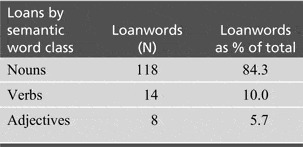
Based on the statistics of the World Loanwords Database (comprising 41 language sub-databases), Tadmor (Reference Tadmor, Haspelmath and Tadmor2009: 61) claims that nouns are more borrowable than verbs, partly because ‘verbs constitute complex and rigid systems that inhibit borrowings’ and partly because ‘things and concepts are easily adopted across culture (along with the words for them)’. In the Shanghai dialect loanword data that I collected from Qian (Reference Qian2007a, Reference Qian2007b), the proportions of the loan verbs, nouns and adjectives also prove this cross-linguistic principle. The distribution is illustrated in Table 1.
Loans by semantic word class, total figures

Basic or core vocabulary, such as words used for common household items, kinship terms and farm animals, is believed to be more resistant to borrowing than non-basic terms (Nagy, Reference Nagy2011: 371). However, it is surprising that some English source words have entered the core vocabulary of the Shanghai dialect. For example, the most common kinship term, ‘husband’, was borrowed phonemically into the Shanghai dialect as /heʔ.tɕhɪʔ.pe.ten/ 黑漆板凳. The written form 黑漆板凳 is semantically opaque to Chinese, impeding the understanding of non-Shanghai dialect speakers. Although it has gradually been replaced by other native Chinese terms since 1949, this term had been prevailing for over half a century in Shanghai (Qian, Reference Qian2007a: 101). And it is still known to local elderly Shanghainese. Two other examples are both loan verbs, which have replaced the native ones and are well preserved in daily life speech: the first one is /gaʔ/ 轧 from ‘get’, commonly used in many collocations; the second one is /ga.sε.wu/ 茄三河 from ‘gossip’. Basic words are borrowed in intense contact situations. But the overall data of English loanwords in the Shanghai dialect cannot demonstrate that the contact between the two languages reached this high level of intensity. Instead, these loans in the basic vocabulary of the Shanghai dialect are the marks that Shanghai Pidgin English has left.
The second semantic feature that betrays the influence of yangjingbang English on the loanwords is the large number of loanwords with derogatory meanings. From Example (3), we can easily notice that the loanwords have undergone a semantic shift from the original English meaning. Two English source phrases, i.e. on sale and one cent, are neutral, while the outputs in the recipient language have negative associations. The first loan in Example (3) was used to describe ‘those who relied on begging, stealing and swindling to survive’. Now it extends to all ‘despicable, wretched or shameful people’. Although languages sometimes do borrow words from other languages for derogatory reasons (Campbell, Reference Campbell2004: 65), it is rare to find a language borrowing so many words with negative connotations from English as the Shanghai dialect has. We may interpret this phenomenon as a reflection of the city's dark side in the semi-colonial era almost a century ago. As Qian (Reference Qian2007a: 6) said in his book Shanghai Dialect, SRC is a complex system, embodying both elegant and vulgar cultural elements. Shanghai had emerged as an oriental metropolitan city, attracting high officials and moguls from home and abroad, as well as refugees and poor immigrants from all over China. The spread of these loans with derogatory meanings mirrored the society in terms of discrimination and social stratification. The words that had been used by compradors and foreign businessmen, sometimes with no negative meanings in the donor language and which entered the lexicon of the Shanghai dialect for derogatory reasons gradually replaced the native words and are well preserved, primarily because the use of borrowed curse words may ease the embarrassment of the speakers and mask profanity (Qian, Reference Qian2007a: 102).
(3) Examples of English loanwords with derogatory connotations (Adapted from Qian, Reference Qian2007a & Reference Qian2007b)

The third semantic feature that connects English loanwords in the Shanghai dialect and Pidgin English is the most distinctive and evident: 11% of the loanwords are derived from the business domain, where the original language contact happened (see example 4).
(4) Examples of loans from business domain (Adapted from Qian, Reference Qian2007a & Reference Qian2007b)

Example (4a) shows that some English business words were borrowed to fill in gaps in the native business vocabulary in the late 19th century. As Shanghai grew into a centre of finance, economics and trade in China, it became natural that a great number of new business words were needed to enrich the native lexicon. And since borrowing is one of the tools for achieving this, Pidgin English became a rich resource. The data in Example (4b) demonstrate that many of the loanwords derived from yangjingbang English have undergone semantic shift or widening. /du.pe/大班 is a loan blend which first appeared with the more specific meaning of ‘a banker’ and then widened to include all big bosses (Qian, Reference Qian2007a: 102). The last three examples in (4b) show the creative use of English words by Shanghainese. These derived meanings are far from the original English meanings. Although the loanwords have their equivalents in the native Shanghai dialect vocabulary, creative use of the loanwords does not only enrich the colloquial native language, but also adds a comic tone and a localised taste to the words with some negative connotations. For example, the English source kite originally means ‘a bank cheque that has been fraudulently altered to increase its face value’. The adapted loan blend (/ɕio/)./khe/ (小)开 shifted to mean a son of a boss, who lives a rich but idling life. This type of young fellow is different from those whom the native Chinese usually describe with words like wánkùzǐdì ‘playboy’ or èshào ‘young ruffian from rich families’. Although it is definitely not a positive word, (/ɕio/)./khe/ (小)开 contains a jocular tone to describe those young fellows who rely on their parents but are still ideal fiancés in the eyes of some young ladies.
The influence on PTH
Some of the loanwords in the Shanghai dialect that entered Mandarin lexicon before 1949 survived the Ideological Remolding Campaign in the 1950s, ‘during which some leading translators advocated free translation to avoid the foreign tone’ (Hu, P., Reference Hu2004: 37). These loanwords borrowed from English via Shanghai dialect were preserved in PTH and were wrongly assumed to be loanwords directly borrowed from English into PTH by many Chinese loanword researchers (Hsie, Kenstowicz & Mou, Reference Hsie, Kenstowicz, Mou, Calabrese and Wetzels2009; Paradis & Tremblay, Reference Paradis., Tremblay, Calabrese and Wetzels2009: 218; Shi, Y., Reference Shi2000: 77), thus contaminating the data of phonemic loanwords and complicating the study of the PTH loanword phonology (Li, Reference Li2011: 159).
(5) Examples of phonemic English loans from the Shanghai dialect into PTH (Adapted from Qian, Reference Qian2007a & Reference Qian2007b)

For example, the first syllable of the loanword 沙发 for ‘sofa’ is pronounced as /so/ in the Shanghai dialect, much closer to the sound of the source word than that in PTH. These loanwords passed into PTH by the Shanghai dialect constitute the bulk of the phonemic transliterations in PTH except for the names of English persons, companies, institutes, places and medicines.
Conclusion
This paper has explored the influence of yangjingbang English on Shanghai Regional Culture and the contemporary Shanghai dialect. Although yangjingbang English went out of use in the 1940s in mainland China, the language contact situation had a marked impact on Shanghainese attitudes towards English, which is reflected in the openness to English borrowings, especially in the form of phonetic transliteration. This empirical study of English loanwords in the contemporary Shanghai dialect reveals that many of the phonemically adapted English words in yangjingbang English entered directly into the Shanghai dialect and have been well preserved until now. And a few of them were even borrowed again into PTH, which disfavours phonetic transliteration in lexical borrowings, and have been adopted by all Chinese varieties. These English loans in the Shanghai dialect are not only regarded as a great asset to Shanghai Regional Culture, but also provide abundant data for the study of Chinese loanword phonology.
 JIAN LI is currently a lecturer in the School of Foreign Studies at Shanghai University of Finance and Economics, China. She holds a Ph.D. in Linguistics at the Graduate Center of City University of New York. Her research areas are language contact and change, loanword phonology and SLA phonology. Now she is devoted to the project of Phonological Adaptation of English Loanwords in Shanghai Dialect, which is supported by Shanghai Pujiang Program. Email: li.jian@shufe.edu.cn