Case report
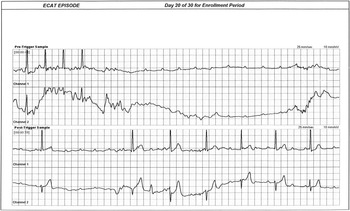
A 4-year-old boy with pulmonary atresia and intact ventricular septum presented with syncope over a year after he underwent a fenestrated extracardiac Fontan procedure. Previously, several near-syncopal episodes occurred with no clear aetiology. Prior Holter monitoring revealed no sinus pauses or atrioventricular block. External cardiac ambulatory telemetry was placed for further evaluation. Two weeks later, the patient experienced a syncopal episode while walking and the telemetry recording of this event revealed paroxysmal complete atrioventricular block. There was an abrupt transition from sinus rhythm to complete atrioventricular block and an asystolic pause of 9.6 seconds followed by junctional escape beats and eventual return to sinus rhythm (Fig 1).
The rhythm was sinus with abrupt transition to complete atrioventricular block and an asystolic pause of 9.6 seconds followed by junctional escape beats and eventual return to sinus rhythm.

The patient was admitted to the cardiac intensive care unit for observation and evaluation. A 15-lead electrocardiogram showed normal sinus rhythm with T-wave inversion and Q-waves in the inferior leads, which were unchanged from previous electrocardiograms. The echocardiogram was unchanged from baseline and demonstrated normal ventricular function with trivial mitral insufficiency and no aortic insufficiency. Based on this event, an epicardial single-chamber ventricular pacemaker was placed and the patient was discharged home without further episodes.
The patient’s past medical history is noteworthy for development of right ventricular dependent coronary circulation. A cardiac catherisation at 2 days of age revealed a diminutive right coronary system. The right coronary artery filled not only from the aorta but also from several coronary cameral fistulae. No areas of discrete stenosis were identified. Repeat angiography prior to the Fontan procedure showed no right coronary artery originating from the right sinus of valsalva, suggesting acquired coronary ostial occlusion.
Discussion
The spectrum of disease in pulmonary atresia and intact ventricular septum is quite variable depending on the adequacy of right-sided structures, degree of tricuspid regurgitation, and extent of coronary abnormalities that can lead to variations in management and surgical approach.Reference Hanley, Sade and Blackstone1, Reference Asburn, Blackstone and Wells2 Currently, pulmonary atresia and intact ventricular septum have a reported actuarial survival of approximately 81% at 5 years, which is comparable to other cardiac conditions undergoing staged univentricular palliation.Reference Guleserian, Armsby, Thiagarajan, del Nido and Mayer3, Reference Rychik, Levy, Gaynor, Decampli and Spray4 Previous studies, however, suggest increased early mortality when associated with significant coronary artery abnormalities.Reference Hanley, Sade and Blackstone1, Reference Freedom, Anderson and Perrin5
There are 31–68% of patients with pulmonary atresia with intact ventricular septum who have associated coronary artery abnormalities including coronary-cameral fistulae, coronary stenoses, and coronary atresia.Reference Guleserian, Armsby, Thiagarajan, del Nido and Mayer3, Reference Freedom, Anderson and Perrin5 In the setting of coronary obstruction, the coronary perfusion becomes dependent upon the right ventricle. This so-called right ventricular dependent coronary circulation can lead to acute myocardial ischaemia, if the right ventricle is decompressed as part of surgical palliation or occurs over time due to progression of coronary arterial stenoses.Reference Freedom, Anderson and Perrin5
To date, there has been no evidence that the underlying conduction system, coronary pattern, and coronary distribution are abnormal in this disease state.Reference Ansari, Goltz, McCarthy, Cook and Yen Ho6–Reference Daubney, Delany and Anderson8 This may be significant, however, because the atrioventricular nodal artery, the coronary branch that supplies the atrioventricular node, arises from the right coronary artery 90% of the time.Reference Pejkovic, Krajnc, Anderbuber and Kosutic9 In this setting, the blood supply to the atrioventricular node could be significantly diminished. An analogous situation occurs in adults following myocardial infarction in the right coronary distribution. An increased incidence of atrioventricular block has been described in these patients.Reference Mehta, Eikelboom and Natarajan10
We postulate that patients with pulmonary atresia and intact ventricular septum with right ventricular dependent coronary circulation may be at risk for paroxysmal atrioventricular block due to diminished coronary perfusion to the atrioventricular node. This may be an underappreciated mechanism of sudden death in this population.
Acknowledgements
This study received no financial support. The authors have not disclosed any potential conflicts of interest.