INTRODUCTION
This is a case study of the acquisition of causatives based on the longitudinal data of a girl (LYC, 1 ; 2–3 ; 3) acquiring Taiwan Southern Min (TSM) as her first language. Causation is a necessary and fundamental concept to act and live by for human beings. Every human language has some constructions to express causation. According to Comrie (Reference Comrie1981), the meaning of causative constructions consists of the cause component and its effect (result) component, and the forms can be classified into three types: analytic, morphological and lexical, as illustrated in (1).
(1a) analytic
I caused him to go. [English]
(1b) morphological
öl-dür [Turkish]die-CAUS‘kill/cause-to-die’
(1c) lexical
kill [English]
(1a) is a case of analytic causative in English, where two separate verbs cause and go indicate cause and effect, respectively. The Turkish word öl-dür ‘kill/cause-to-die’ in (1b) is a morphological causative, which is derived after the causative suffix -dür is attached to öl ‘to die’. In (1c) kill in English encodes both the meaning of cause and effect in one form while holding no regular formal relationship with the word denoting the effect ‘to die’.
The examples in (1) represent the ideals of each type of causative. However, not all causatives can be easily classified as one of these three types. Some may come close to one of them on the continuum – lexical … morphological … analytic (Comrie, Reference Comrie1981; Shibatani & Pardeshi, Reference Shibatani, Pardeshi and Shibatani2001). For instance, in English, many causatives are formed without any morphological change to the verb. Melt in English is both a causative transitive as in (2a) and an intransitive as in (2b).
(2a) The sun melted the ice.
(2b) The ice melted.
Causatives differ from intransitives in that the former assign an extra theta-role, Cause, which is lacking with intransitives. The causative verb melt in (2a) assigns the theta-role Cause to the NP the sun. Since the intransitive melt in (2b) does not assign the theta-role Cause, an NP bearing this particular theta-role is thus not available in (2b). With/Without assigning the theta-role Cause is the feature distinguishing causative transitives from intransitives, and therefore it is often stated that a causative verb has an intransitive as its non-causative counterpart.
In the study of children acquiring causatives, there have long been discussions on two related issues. One of the issues is about the nature of the children's errors involving the overgeneralized use of intransitive verbs as causative verbs. For instance, a child may produce come it closer to mean ‘make it come closer’. Bowerman (Reference Bowerman1974) proposes lexical misclassification to explain such errors of overgeneralization in causatives. That is, a child may misclassify an intransitive verb such as come as allowing the addition of a semantic element CAUSE and use it as a transitive verb. Braine (Reference Braine, Levy, Schlesinger and Braine1988), Pinker (Reference Pinker1989) and Pye (Reference Pye and Levy1994), however, propose that the overgeneralization errors are due to difficulties in lexical retrieval. That is, when children have difficulty with retrieving the correct word, they replace it with another word with similar meaning. The difference between these two approaches lies in the direction of overgeneralization. Under Bowerman's hypothesis, only intransitive-to-causative overgeneralization will take place, while Braine, Pinker and Pye predict that both intransitive-to-causative and causative-to-intransitive overgeneralizations may occur.
The other issue of equal importance is whether overgeneralization of causatives shows an ‘intransitive-to-causative bias’, a term used by Cheung (Reference Cheung and Clark1998) to indicate the mistake of using intransitive verbs to express causative meanings. This type of mistake is shown to exist in the speech of children learning languages such as Cantonese (Cheung, Reference Cheung and Clark1998), Hebrew (Berman, Reference Berman1993) and Portuguese (Figueira, Reference Figueira1984), as illustrated in (3)Footnote 1 (chi in (3) stands for ‘child’ and inv for ‘investigator’; PRT stands for ‘particle’).
(3) Cantonese (Cheung, Reference Cheung and Clark1998: 155 (7a))
chi: *ceot1 lei4 a3.come out PRT ‘Come out.’ inv: ling1 ceot1 lei4 a4? take come out PRT ‘Take it out?’
This type of bias, however, is not found in the speech of children speaking Hungarian (Clark, Reference Clark1993) and K'iche' (Pye, Reference Pye and Levy1994). In the studies of Lord (Reference Lord1979) and Braine, Brody, Fisch, Weisberger & Blum (Reference Braine, Brody, Fisch, Weisberger and Blum1990) of children acquiring English, the overgeneralizations in both directions, intransitive-to-causative and causative-to-intransitive, did occur.
The case study reported here aims to investigate whether causative acquisition in TSM also demonstrates an intransitive-to-causative bias. Results of this study show that LYC made errors of overgeneralization in acquiring causatives. However, unlike the errors discussed in the literature, which mainly occur with lexical causatives, the errors made by LYC are with morphological and analytic causatives. Moreover, LYC's errors demonstrated a different overgeneralization pattern, that is, resultative-to-causative. We claim that the difference in the overgeneralization patterns results from the properties of TSM. TSM abounds with resultative compounds. Furthermore, being an analytic language, TSM tends to spell out the causative meaning by means of morphological and analytic causatives and thus most errors are found in using these two types of causative. In contrast, lexical causatives, which contain a semantic element CAUSE, are acquired late and used less commonly; in the data collected (1 ; 2–3 ; 3) lexical causatives are not yet used by the child.
Causative constructions in Taiwan Southern Min
Taiwan Southern Min is the variety of Southern Min spoken in Taiwan. Different varieties of Southern Min are spoken in Fujian and Kuangdong provinces in China. TSM is spoken by more than 80% of the people in Taiwan (Cheng, Reference Cheng1985). The causatives in TSM can be classified into the three types defined by Comrie (Reference Comrie1981).
Analytic causatives
Sentences involving the use of causative verbs such as hoo ‘cause1’, kio ‘cause2’, su ‘cause3’, etc. are analytic, as shown in (Reference Braine, Levy, Schlesinger and Braine4), where the verb hoo ‘cause’ denotes cause while the verb sng ‘play’ indicates the effect. Even though these three verbs hoo, kio and su are all causative, they do slightly differ in their meaning. The exact meaning for kio is ‘order someone to do something’, and su is used in a rather formal and literary context. Among these three, hoo is used most often and it does not carry any extra meaning other than causativity.
(4) analytic
hoo gua sng.Footnote 2cause I play‘Let me play.’Footnote 3
Example (4) has a covert NP as the subject; that is, the causer is a person. Another type of analytic causative which has an event as the causer is available in TSM, as shown in (5). In (5) hoo is preceded and also followed by a clause, so Cheng (Reference Cheng1974) takes this hoo to be a conjunctive connecting the cause and consequence clauses. Cheng, Huang, Li & Tang (Reference Cheng, Huang, Li, Tang and Ting1999), however, consider (5) a type of serial verb construction. No matter how example (5) is termed, the causative verb hoo is used, and (5) differs from (4) only in the status of the causer, event vs. person. Therefore, example (5) is also considered an analytic causative in this paper (CL stands for ‘classifier’).
(5) analytic
gua chiunn cit siu kua hoo li thiann.I sing one CL song cause you listen‘I'll sing a song for you to listen to.'
Morphological causatives
Compounds with the form V-hoo-V, such as ciah-hoo-liau ‘eat-CAUS-up’ in (6), are considered morphological causatives for the following reason. As Comrie (Reference Comrie1981) argues, morphological causatives must demonstrate two characteristics. One is that ‘the causative is related to its non-causative predicate by morphological means’. The other is that ‘this means of relating causative and non-causative predicates is productive’ (1981: 167). V-hoo-V forms in TSM are argued to be related to resultative V-V compounds in derivation (Lin, Reference Lin, Liou and Chung2001, Reference Lin, Chung, Liou, Hsu and Ho2006). For instance, ciah-hoo-liau ‘eat-CAUS-up’ is derived from ciah-liau ‘eat-up’ by inserting the infix -hoo-. Moreover, this type of derivation is highly productive as most, if not all, resultative compounds have causative counterparts.
(6) morphological
li png ai ciah-hoo-liau.you meal must eat-CAUS-up‘You must eat up your meal.’
Resultative compounds such as ciah-liau ‘eat-up’ are in nature causative since the first verbal element often denotes an event while the second element denotes the result caused by the event. However, they are to be distinguished from morphological causative compounds on the basis of form, meaning and usage. In terms of form, morphological causatives involve the use of a morphological causative marker, -hoo-, which is lacking in resultative compounds. Even though a resultative compound seems to be composed of an action and a result aspect, its meaning focuses on the result aspect only. For instance, pai-ho ‘arrange-neat’ means ‘things are neat after they are arranged’. As to morphological causatives, with the help of the causative marker -hoo-, the causal action meaning becomes salient. The meaning of the morphological causative pai-hoo-ho ‘arrange-CAUS-neat’ is ‘arrange to make things neat’, which does not have a simple equivalent in English. With the causal action meaning, a morphological causative thus can co-occur with the durative aspect marker leh. As shown in (7), the resultative compound pai-ho is not compatible with leh, while the co-occurrence of leh with the morphological causative pai-hoo-ho is perfectly acceptable (DUR stands for ‘durative’).
(7a) *i leh ciong mihkiann pai-ho.he DUR CIONG thing arrange-neat‘He is arranging things neat.’
(7b) i leh ciong mihkiann pai-hoo-ho.he DUR CIONG thing arrange-CAUS-neat‘He is arranging things neat.’
Moreover, as discussed in Allen (Reference Allen1998) and Shirai, Miyata, Naka & Sakazaki (Reference Shirai, Miyata, Naka, Sakazaki and Clark2000), imperatives are often related to causatives. As such, causative forms are often used to express the imperative meaning. To illustrate, ciah-hoo-liau ‘eat-CAUS-up’ in (8) expresses an imperative meaning, while its resultative counterpart ciah-liau ‘eat-up’ in (9) lacks such an imperative meaning and thus is not compatible with the second person subject li ‘you’. Example (9) is improved after the subject is changed to other persons such as gua ‘I’ or i ‘he’, as in (10).
(8) (li) png ciah-hoo-liau.(you) meal eat-CAUS-up‘Eat up your meal.’
(9) ?li png ciah-liau.you meal eat-up‘You finished eating your meal.’
(10) gua/i png ciah-liau a.I/he meal eat-up PRT‘I/he finished eating the meal.’
Lexical causatives
Like melt in English, causative verbs/compounds such as kiann ‘scare’ and kiann-si ‘scare (sb) to death’ in (11a) in TSM come closer to the category of lexical causatives, since they have intransitives as their non-causative counterparts, as shown in (11b).
(11a) lexical causative transitive verb/compound
li mai kiann/kiann-si lang a.you not scare/scare-dead people PRT‘Don't scare people/scare people to death.'
(11b) intransitive verb/compound
i e kiann/kiann-si.he will feel-scared/scare-dead‘He will feel scared/feel scared to death.’
As argued in Cheng, Huang, Li & Tang (Reference Cheng, Huang, Li, Tang and Tseng1997), causative compounds differ from their non-causative counterparts in that the former contain a semantic element CAUSE in the semantic structure. As shown in (11) the causative kiann-si ‘scare (sb) to death’ does have a non-causative counterpart kiann-si ‘feel scared to death’, and the semantic structure of the causative kiann-si is actually CAUSE+intransitive kiann-si. Even though lexical causatives such as kiann-si also bear the form of a resultative compound, they are specifically termed as lexical causatives as they meet the criterion that causatives have intransitives as their non-causative counterparts. Resultative compounds, however, do not have causative/non-causative alternation. For example, phah-si ‘hit-dead’ in (12a) is a resultative compound. At first glance, it seems to have an intransitive form as its non-causative counterpart in (12b) since the noun phrase Ong-e occurs as the object of the transitive verb in (12a) but as the subject in (12b). However, phah-si ‘hit-dead’ in (12b) is not really intransitive. Ong-e in (12b) is the agent who performs the action of hitting and the object of the compound is omitted.Footnote 4 Sentences with null objects are common in Sinitic languages such as Mandarin Chinese, as discussed in Huang (Reference Huang and Freidin1991), and TSM is also a Sinitic language.
(12a) i phah-si Ong-e a.he hit-dead Ong-e PRT‘He hit Ong-e to death.’
(12b) Ong-e phah-si a.Ong-e hit-dead PRT‘Ong-e hit someone/something to death.’
In Lien's (Reference Lien1999) typological study of causatives in TSM, lexical causatives are further classified into two subtypes: labile causatives and suppletive causatives. Labile causatives are simplex verbs used as causatives with zero derivation, such as melt in English and kiann ‘scare’ in TSM, as illustrated in (11). Suppletive causatives refer to causatives such as kill in English, which denote both cause and result while holding no morphological relationship with the word denoting the result. Examples of suppletive causatives in TSM given by Lien are verbs such as thau ‘untie’ and si ‘die’. However, in the TSM spoken by the authors, who are native speakers of TSM, these so-called suppletive causatives either do not denote result or do not denote cause. That is, they have either the cause or the result meaning only. For instance, thau ‘untie’ alone as in (13) does not denote result and that is why the result can still be negated by the following clause thau-bo-khui ‘do not succeed in untying it’. To express that the result is achieved, one has to add a stative verb such as khui ‘open’ to denote the result of untying as in thau-khui ‘untie-open’. With the addition of the stative verb khui, thau-khui does denote that a result is achieved and thus the negation of the result renders the sentence unacceptable, as illustrated in (14).
(13) i thau te-a thau nng pai a, mko long thau-bo-khui.he untie bag untie two time PRT but all untie-not-open‘He tried to untie the bag twice but did not succeed.’
(14) *i te-a thau-khui nng pai a, mko long thau-bo-khui.he bag untie-open two time PRT but all untie-not-open‘He untied the bag twice but did not succeed.’
As a result, in this paper the lexical causatives in TSM only refer to the melt-type causatives, that is, verbs such as kiann ‘scare’ in (11).
Functions of hoo
As can be seen from the previous discussion, hoo occurs in both analytic and morphological causatives. Other than these two occurrences, hoo has other functions as well. According to Cheng (Reference Cheng1974), hoo in TSM has five functions, as listed below:
(a) hoo is a conjunctive connecting cause and consequence clauses;
(b) hoo is a cause verb in causative constructions;
(c) hoo is a verb meaning ‘give’;
(d) hoo is the dative case marker;
(e) hoo is the agent case marker in the passive construction.
Cheng (Reference Cheng1974) does not use terms like analytic causatives and morphological causatives in his classification. Among these five types, types (a) and (b) are taken to be analytic causatives in this paper, since they both involve the use of the causative verb hoo; they differ only in whether the causer is an event or person/object. Morphological causatives as defined in this paper are not singled out by Cheng to be a different type. Rather, they are classified as type (a) by Cheng. The logic behind Cheng's classification is that for those examples where hoo is (immediately) followed and (immediately) preceded by a verb, hoo is used as a conjunctive connecting the two verbs (clauses). However, when nothing intervenes between hoo and the verbs before and after it, V-hoo-V forms are defined as morphological causatives in this paper since they are closely related to V-V resultative compounds in derivation, as argued by Lin (Reference Lin, Liou and Chung2001, Reference Lin, Chung, Liou, Hsu and Ho2006).
DATA AND RESULTS
Data description
The data for this case study were from the Taiwan Child Language Corpus developed by Tsay (Reference Tsay2005, in preparation). The data are mainly a child's (LYC) natural conversations with the caregiver and/or the investigator. The child was from a TSM-speaking family. The conversations were recorded every two weeks through home visits and the investigation lasted for 26 months (1 ; 2–3 ; 3). Each recording was forty to sixty minutes long,Footnote 5 and the total length of the recordings is 2295 minutes.
In this longitudinal study the three types of causative in both the correct and wrong usages were collected and then analyzed by the authors, who are native speakers of TSM. Productivity is defined as a word/phrase being used more than twice in a particular month, e.g. 2 ; 1, and continuously used in the following month, e.g. 2 ; 2. Examples of the child imitating the adult's speech are not counted in this study.
Results
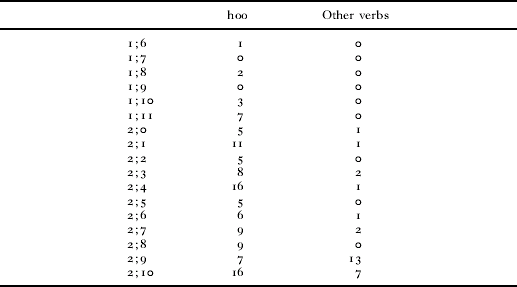
The results reveal that both analytic and morphological causatives occurred at an early stage in LYC's speech. In the data collected, analytic causatives first occurred at 1 ; 6, as shown in (15), where the concept ‘cause’ is denoted by the causative verb hoo while the effect is expressed by the verb lim ‘drink.’ In (15) the child code-switched between TSM and Mandarin Chinese; [≔m] is used to indicate that this particular word was pronounced in Mandarin Chinese, not in TSM, by the child.
(15) bo ai hoo da[≔m] niao[≔m] jiejie[≔m] lim. (1 ; 6)not want cause big bird sister drink‘(I) don't want to let Sister Big Bird drink (it).'
Morphological causatives first occurred at 1 ; 10, as shown in (16), where pai-hoo-suisui is a morphological causative as the infix -hoo- is inserted into the compound pai-suisui to form the causative.
(16) gua beh pai-hoo-suisui. (1 ; 10)I want arrange-CAUS-pretty‘I want to arrange them pretty.’
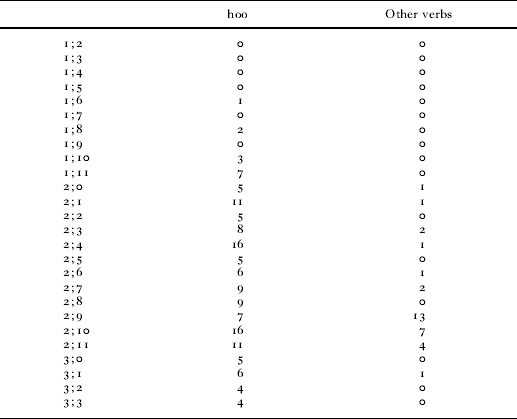
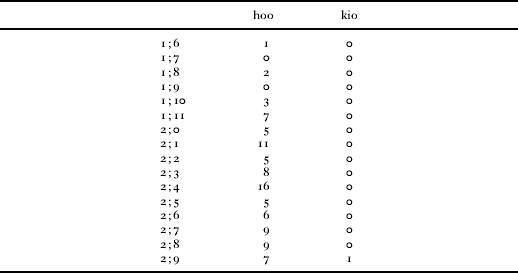
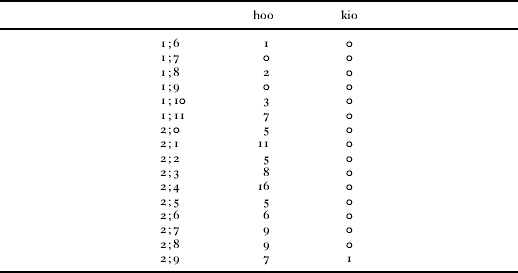
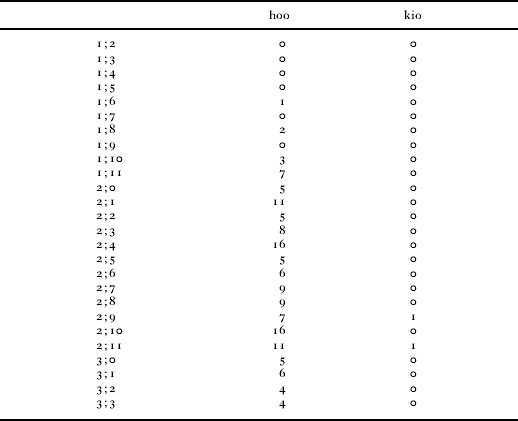
After their first occurrence, analytic causatives continued to occur in LYC's speech, as listed in Table 1.Footnote 6 However, they were not productively used until 1 ; 10. In this month, LYC used the causative verb hoo three times, and in the following month (1 ; 11) the causative hoo even occurred seven times in LYC's speech.
Occurrences of analytic causatives between 1 ; 6 and 2 ; 9
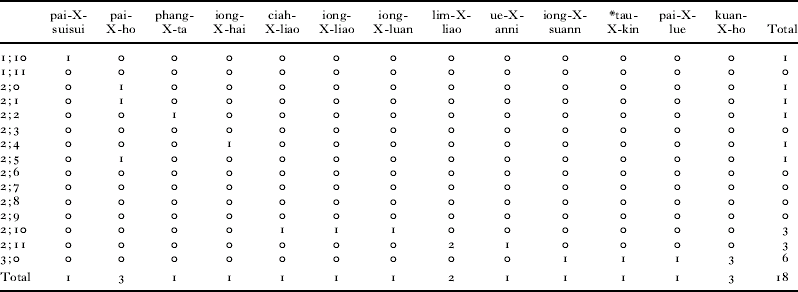
As to morphological causatives, they were not productively used by LYC until 2 ; 10, when three morphological causatives were used as listed in Table 2. The production of the overgeneralized form *tau-hoo-kin ‘assemble-CAUS-fast’ at 3 ; 0 further proves that by this age LYC has productively used the rule of inserting the infix -hoo- to form morphological causatives and as a result produced the overgeneralized form.
Occurrences of morphological causatives between 1 ; 10 and 3 ; 0
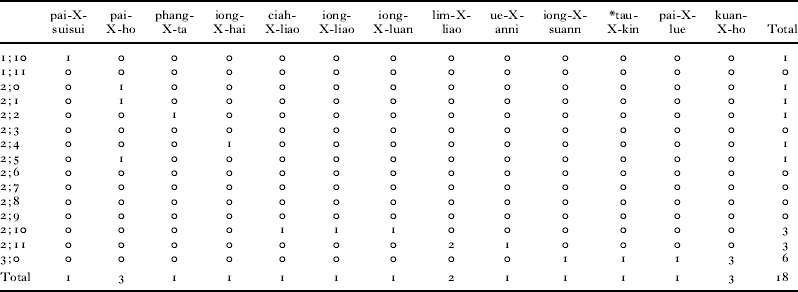
X represents hoo.
* indicates that this is not a possible morphological causative in TSM.
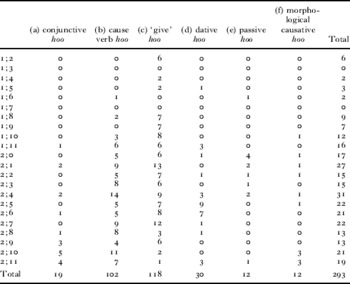
As discussed earlier, in addition to being a causative verb and a morphological causative marker, hoo has other functions. Among the various functions, hoo was first used as a verb meaning ‘to give’ by LYC at 1 ; 2, as shown in Table 3. Then its usage was extended to being a causative verb at 1 ; 6, and hoo was productively used as a causative verb from 1 ; 10. Even though the dative and passive use first occurred as early as 1 ; 5 and 1 ; 6, hoo was not productively used as a dative and passive marker until 1 ; 11 and 2 ; 0. As to the morphological causative hoo, it was not productively used until 2 ; 10.
Occurrences of various hoo between 1 ; 2 and 2 ; 11

According to Cheng's (Reference Cheng1974) classification, (a) hoo: a conjunctive connecting two clauses; (b) hoo: a cause verb; (c) hoo: ‘to give’; (d) hoo: the dative case marker; (e) hoo: ‘by’. Different from Cheng's classification, (f) hoo refers to the hoo in V-hoo-V morphological causatives.
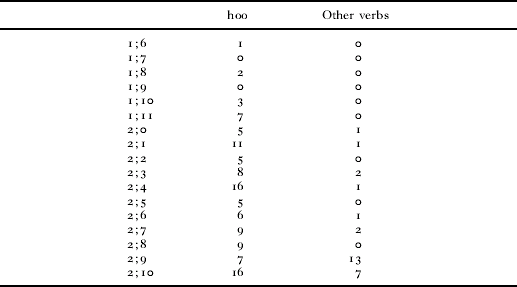
As mentioned above, Cheng (Reference Cheng1974) classifies analytic causatives into two types: conjunctive (with an event as the causer) and cause verb (with a person/object as the causer). According to the data collected, LYC did not productively use the conjunctive hoo until 2 ; 9, as shown in Table 3, while by 1 ; 10 the cause verb hoo was already productively used. At 1 ; 10 when bi-clausal (multi-clausal) structures involving the use of the analytic causative verb hoo were productively used by LYC, bi-clausal structures involving other verbs such as ai ‘like’, as exemplified in (17), were not yet found in the data collected. As indicated in Table 4, bi-clausal structures involving verbs other than hoo were not productively used by LYC until 2 ; 9.
(17) gua ai ciah. (2 ; 9)I like eat‘I like to eat.’
Occurrences of bi-clausal structures between 1 ; 6 and 2 ; 10
The collected data also indicate that lexical causatives were not yet acquired by LYC up to 3 ; 3. In the data (1 ; 2–3 ; 3), lexical causatives only occurred in the intransitive form but not yet in the causative form, as shown in (18), where kiann ‘feel scared’ was used as an intransitive taking no object.
(18) gua e kiann la. (2 ; 0) (cf. (11))I will feel-scared PRT‘I will feel scared.’
A seemingly causative use did occur once in the data, as shown in (19), where + … indicates that this is not a complete sentence. However, whether the child's use of kiann-si is indeed causative is doubtful as the child's utterance is not complete; that is, kiann-si is not followed by an object and thus it is not clearly a causative verb. Moreover, this example of kiann-si occurred right after the investigator's use of this verb, and thus the child might be just imitating the adult's speech. Also, kiann-si lang ‘scare self/people to death’ is an idiomatic expression in TSM. The fact that the child could not imitate the expression completely can be attributed to the child's lack of knowledge of lexical causatives at this stage.
(19) inv: kiann-si lang. scare-dead people ‘Scare self/people to death.’chi: kiann-si + … (2 ; 0)scare-dead
DISCUSSION
This section will present and explain the errors made by LYC to show the overgeneralization pattern in the speech of a child acquiring the causatives in TSM.
Lexical causatives
As shown above, LYC was not yet using lexical causatives in the period of 1 ; 2–3 ; 3; therefore, no mistakes in using lexical causatives could be observed. The late occurrence of lexical causatives in TSM could be due to the productivity of the other two types of causative: morphological and analytic causatives. Typologically, TSM is an analytic language, whose words have invariant forms and each form denotes a piece of semantic information. TSM thus tends to spell out every piece of semantic information in overt forms. Both morphological and analytic causatives have the causativity spelt out by overt markers of causativity, the causative morpheme -hoo- or causative verbs such as hoo ‘cause1’ and kio ‘cause2’. Therefore, these two types, especially analytic causatives, are more commonly adopted to express causativity, as shown in Tables 1 and 2. In contrast, lexical causatives, which contain an abstract semantic element CAUSE, are acquired late and used less commonly.
Morphological causatives
When using V-hoo-V morphological causatives, LYC did demonstrate errors of overgeneralization. For instance, the child sometimes omitted the causative marker -hoo-, resulting in V-V sequences, which are resultative compounds in TSM. That is, the child sometimes misused resultative compounds as morphological causatives. For instance, luah-tit ‘comb-straight’ was wrongly used to replace luah-hoo-tit ‘comb-CAUS-straight’, as in (20).
(20) inv: koh thaumng koh khiukhiu ne. still hair still curly PRT ‘The hair is still curly.’chi: Target: luah-hoo-tit. Error: *luah-tit e. (2 ; 2) comb-straight PRT ‘Comb it straight.’
In (20), the child meant to express the imperative meaning; however, the resultative compound luah-tit ‘comb-straight’ cannot serve as an imperative. It thus proves that in TSM resultative compounds are not causatives and only morphological causatives such as luah-hoo-tit can serve the imperative function.
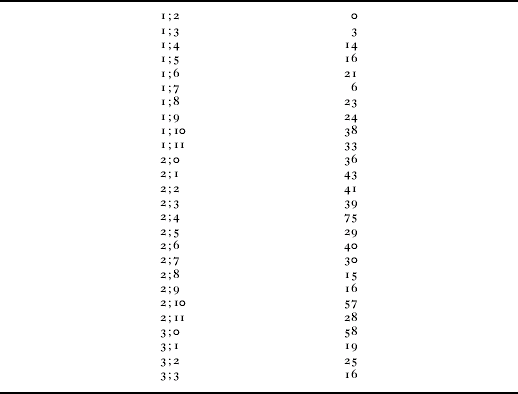
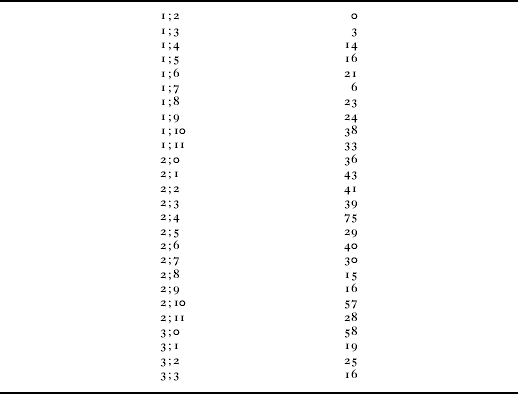
Table 5 shows that LYC started to productively use V-V resultative compounds at a very early stage, 1 ; 3. By 1 ; 10 LYC also used the analytic causative verb hoo productively, as indicated in Table 1, and at around the same time (1 ; 10) the first instance of a V-hoo-V morphological causative occurred in the data collected. While both resultative compounds and analytic causatives were productively used at an early stage, the morphological causatives, which are derived from resultative compounds with the insertion of the infix -hoo-, were used much less commonly. The child was confused about the usage of the two related forms, V-V resultative compounds and V-hoo-V morphological causatives; therefore, resultatives were mistakenly used to replace morphological causatives to express the causative meaning, as in (20).
Occurrences of resultative compounds between 1 ; 2 and 3 ; 3
As the formation of causatives in TSM greatly differs from that in other languages, it is not surprising if the pattern of overgeneralization found in TSM is not present in other languages. Different from the intransitive-to-causative pattern observed in some other languages, the overgeneralization pattern in TSM is that resultative compounds are used to replace causative compounds. However, the overgeneralization pattern demonstrated in TSM can still be considered to be parallel to that discussed in the earlier literature. That is, the bias can be seen to be resultative-to-causative, or in more general terms, non-causative-to-causative.
Analytic causatives
As to analytic causatives, in some cases LYC replaced the causative verb hoo with the preposition ka, which denotes ‘disposal’, as in (21).
(21) Target: li iong hoo gua khuann.Error: *li iong ka gua khuann. (2 ; 0)you use KA I see‘You let me see (it).’
These errors show that the child did not master the use of the causative verb yet. She mixed up the use of the causative verb hoo with another semantically related disposal marker ka, which occurs in the same syntactic position as hoo; they both are followed by an object. Sometimes, when the child was not sure which one to use, she simply used both ka and hoo when only the use of ka is needed. According to the data collected, the period of confusion lasted from 2 ; 0 to 2 ; 10. In other wrong uses, the child simply omitted the causative verb hoo, as in (22).
(22) Target: gua beh phang hoo ai ciah.Error: *gua beh phang ai ciah. (2 ; 1) I want carry aunt eat ‘I want to bring (it) for aunt to eat.’
In the case of LYC's errors in using analytic causatives, what is involved is not overgeneralization. Rather the child is confused about two semantically related words which occur in identical syntactic positions. Even though LYC started to use ka as early as 1 ; 5, her usage of ka followed by an object occurred at 1 ; 9. After the occurrence of ka followed by an object, the child started to get confused about the usage of hoo and ka for a period of time (from 2 ; 0 to 2 ; 10).
CONCLUSION
This case study of a child acquiring the causatives in TSM has demonstrated an overgeneralization pattern different from those observed in the literature. The difference, however, is expected since this language has different morphology. Sinitic languages are often considered to be impoverished in morphology; nevertheless, in the aspect of compound formation, the morphology is very rich. As such, the overgeneralization is found to occur the most with compounds. As to the analytic causatives, this type of error is peculiar to the language itself, again due to the language-specific features. That is, TSM has a disposal marker ka, which occurs in similar positions as the causative verb hoo. As a result, children mistakenly use one for the other.
Being Sinitic languages, both Cantonese and TSM are analytic in nature. Therefore, it is expected that the children acquiring these two languages would demonstrate the same type of error. However, as presented above, the overgeneralization patterns in the acquisition of these two languages are different. The difference, nevertheless, does not come as a surprise because the analyticity of the two languages differs in degree. TSM is more analytic than Cantonese as both the causative infix -hoo- and the negative marker bo can be inserted into a resultative compound to show causativity and negation in TSM, but not in Cantonese. Cheung (Reference Cheung and Clark1998) notes that the children did not use resultative compounds incorrectly in her study,Footnote 7 and that could be because they did not have the opportunity to do that. It can also be speculated that Cantonese does not have morphological causatives and thus Cantonese-speaking children do not wrongly use resultative compounds to express causativity.
This is a case study of causative acquisition in TSM. Even though the data come from one child only, the overgeneralization pattern found in this study reveals what the overall pattern might be like, and it is hoped that more case studies can further confirm our findings in the acquisition patterns of TSM.
APPENDIX A
Occurrences of analytic causatives between 1 ; 2 and 3 ; 3
APPENDIX B
Occurrences of morphological causatives between 1 ; 2 and 3 ; 3

X represents hoo; * indicates that this is not a possible morphological causative in TSM.
APPENDIX C
Occurrences of various hoo between 1 ; 2 and 3 ; 3

According to Cheng's (Reference Cheng1974) classification, (a) hoo: a conjunctive connecting two clauses; (b) hoo: a cause verb; (c) hoo: ‘to give’; (d) hoo: the dative case marker; (e) hoo: ‘by’. Different from Cheng's classification, (f) hoo refers to the hoo in V-hoo-V morphological causatives.
APPENDIX D
Occurrences of bi-clausal structures between 1 ; 2 and 3 ; 3