I. INTRODUCTION
Oxide semiconductors and insulators are currently found in a broad range of products and are on the horizon for future optical, electronic, and energy applications. The diverse range of physical properties exhibited by oxides offer nearly limitless possibilities for electronic devices.Reference Ramesh and Schlom1 Oxides show novel phenomena such as high-temperature superconductivity,Reference Bednorz and Müller2 ferroelectricity,Reference Dawber, Rabe and Scott3 and colossal magnetoresistance.Reference Ramirez4 These materials exhibit complex phase behavior that depends on temperature, doping, or the application of stress. Furthermore, interfaces between different oxides produce unexpected properties. The interface between insulating strontium titanate (SrTiO3) and lanthanum aluminate (LaAlO3), for example, forms a highly conductive layer.Reference Ohtomo and Hwang5
One class of material, transparent conducting oxides (TCOs), combines two features that are not typically found in the same substance, electrical conductivity and optical transparency.Reference Facchetti and Marks6 Whereas p-type TCOs do exist,Reference Kawazoe, Yanagi, Ueda and Hosono7n-type conductivity is more common. Tin oxide (SnO2), doped n-type with antimony on the substitutional tin site or fluorine on the oxygen site, is used as a coating on low-emissivity windows and heated freezer windows.Reference Ginley and Bright8 A dominant market for TCOs is provided by flat-panel displays. These ubiquitous devices use indium (III) oxide (In2O3) doped with tin (Sn) donors, referred to as indium tin oxide (ITO), as a transparent electrode. ITO is also used as the front contact in photovoltaic solar cells.Reference Tiwari, Khrypunov, Kurdzesau, Bätzner, Romeo and Zogg9 The market for ITO is so large that demand for indium has caused the price of that scarce commodity to increase significantly. The high cost of indium has stimulated interest in alternative materials such as SnO2, gallium (III) oxide (Ga2O3), and zinc oxide (ZnO).Reference Minami10
The origin of n-type conductivity in TCOs is a subject of controversy.Reference King and Veal11 Thin films of In2O3 without intentional doping often show free-carrier concentrations in the 1020 cm−3 range.Reference Hartnagel, Dawar, Jain and Jagadish12 The prevalence of such high carrier concentrations has historically been explained by native defects; namely, oxygen vacancies and cation (indium) interstitials. However, the culpability of these “usual suspects” has been challenged by density functional theory (DFT) calculations. For a range of TCOs, these calculations indicate that the oxygen vacancy is a deep donor, whereas interstitials are too mobile to be stable at room temperature.Reference Varley, Peelaers, Janotti and Van de Walle13 As discussed further in this article, hydrogen is a common contaminant that can lead to n-type doping.
A second possible source of n-type conductivity is surface defects. Photoemission spectroscopy experiments have shown that the surface Fermi level lies within the conduction band in In2O3.Reference King, Veal, Payne, Bourlange, Egdell and McConville14 This means that donor defects on or near the surface contribute to a highly conducting accumulation layer. A combined theoretical and experimental study suggested that such surface defects might dominate the conduction properties of thin-film In2O3.Reference Lany, Zakutayev, Mason, Wager, Poeppelmeier, Perkins, Berry, Ginley and Zunger15 Specifically, an oxygen vacancy on the surface was calculated to have a donor level nearly degenerate with the surface conduction band minimum. Surface conduction layers have also been measured in ZnO.Reference Schmidt, Kiesel, Van de Walle, Johnson, Nause and Döhler16, Reference Look, Mosbacker, Strzhemechny and Brillson17
Surface states are especially important in nanocrystals, due to their high surface-to-volume ratio. The sensitivity of these states to the surrounding environment provides the basis for gas-sensing applications.Reference Eranna18 In general, surface states are complicated, and probably involve impurities such as hydrogen. In ZnO nanocrystals, a red luminescence band has been attributed to intra-gap surface states.Reference Shalish, Temkin and Narayanamurti19, Reference Teklemichael and McCluskey20 The electrical conductivity of such nanocrystals is extremely sensitive to hydrogen exposure, which increases free-electron concentrations by several orders of magnitude.Reference Hlaing Oo, McCluskey, Huso and Bergman21
In addition to electronic applications, oxides are also used in hydrogen fuel cells. In a solid-oxide fuel cell (SOFC), oxygen ions (O2-) are produced at the air electrode. The O2- ions migrate through the solid oxide electrolyte until they reach the fuel electrode, where they combine with hydrogen to produce water. Oxide materials with high concentrations of oxygen vacancies are desirable, for high oxygen conductivity.Reference Singhal22 Yttria-stabilized zirconia (YSZ) is a preferred material for SOFCs. Another type of electrolyte is a proton conductor, which is typically a perovskite oxide such as barium cerium oxide (BaCeO3).Reference Norby and Ishihara23 Oxides may also provide a means of hydrogen production, via photochemical splitting of water. In this process, a solar photon produces an electron and hole, which catalyze the formation of H2 and O2. Titania (TiO2) was the first oxide used for this purpose.Reference Fujishima and Honda24 Other materials include titanates, tantalates, and niobates.Reference Osterloh25
Hydrogen is usually present in oxide materials and can have a strong effect on the electrical conductivity. Two types of hydrogen donors are interstitial hydrogen, in which the proton forms an O–H bond with a host oxygen atom, and substitutional hydrogen, where the proton occupies an oxygen vacancy. Hydrogen may also exist as H2 molecules, which are electrically neutral and, unlike O–H pairs, do not absorb infrared (IR) light. Finally, hydrogen can form complexes with acceptor dopants and cation vacancies. By attaching to dangling bonds, hydrogen fully or partially passivates the acceptor levels. The resulting reduction in ionized impurity scattering improves electrical mobility in n-type samples.
Depending on the position of the Fermi level, the equilibrium charge state of interstitial hydrogen is +1 or −1. The position of the H(+/−) level defines the point at which hydrogen goes from being a donor to an acceptor. If the Fermi level is above the H(+/−) level, then hydrogen acts as an acceptor and assumes a −1 charge state. If the Fermi level lies below the H(+/−) level, hydrogen is a donor and has a charge of +1 (i.e., it is a proton). Theoretical studies have suggested that the H(+/−) level is “universal” and does not depend on the details of the host lattice.Reference Van de Walle and Neugebauer26, Reference Kiliç and Zunger27 Qualitatively, the low conduction band (high electron affinity) of oxide semiconductors means that hydrogen tends to act as a donor. Muons, which act as analogs of hydrogen, have been used to probe this property in many semiconductors.Reference Lichti, Chow and Cox28 Muonium was shown to be a shallow donor in In2O3 and SnO2,Reference King, Lichti, Celebi, Gil, Vilão, Alberto, Piroto Duarte, Payne, Egdell, McKenzie, McConville, Cox and Veal29 cadmium oxide (CdO),Reference Cox, Lord, Cottrell, Gil, Alberto, Keren, Prabhakaran, Scheuermann and Stoykov30 and Ga2O3.Reference King, McKenzie and Veal31
Figure 1 shows the H(+/−) level according to two theoretical studies and muon-implantation experiments. The valence-band offsets were taken from the theoryReference Van de Walle and Neugebauer26, Reference Kiliç and Zunger27 whereas the energy values are relative to vacuum, according to Ref. Reference Lichti, Chow and Cox28. One can see that there is a spread of almost 1 eV in the reported H(+/−) values. Furthermore, a recent theoretical study suggests that H(+/−) levels in various oxides are not well aligned, but are scattered over ∼2 eV.Reference Xiong, Robertson and Clark32 Resolving these apparent discrepancies will be an important topic for future research.
Alignment of the H(+/−) level for interstitial hydrogen in various semiconductors. LDA calculations were performed by Kiliç and ZungerReference Kiliç and Zunger27 and Van de Walle and Neugebauer.Reference Van de Walle and Neugebauer26 Muon implantation experiments are from Lichti, Chow, and Cox.Reference Lichti, Chow and Cox28

Section II discusses the presence of hydrogen in several oxide materials, with an emphasis on the microscopic structure of hydrogen complexes in bulk crystals. Fourier transform infrared (FTIR) spectroscopy is the preferred method for studying hydrogen vibrational modes. In this article, vibrational frequencies are the values at low temperatures (5–12 K) unless noted otherwise.
II. SPECIFIC MATERIALS
A. ZnO
ZnO has the wurtzite crystal structure and is relatively easy to grow in bulk or thin-film form.Reference Özgür, Alivov, Liu, Teke, Reshchikov, Doğan, Avrutin, Cho and Morkoç33, Reference Pearton, Norton, Ip, Heo and Steiner34 As noted in Sec. I, ZnO is an alternative to ITO for transparent contacts in solar cellsReference Nuruddin and Abelson35 and transparent electronics.Reference Wager36 It is also an efficient light emitter, with a band gap of ∼3.4 eV at room temperature, making it a candidate for solid-state lighting. The past decade of research has uncovered many interesting defect properties, most of which are also relevant to other oxides.
The status of available information on defects in ZnO was reviewed in 2009 by McCluskey and Jokela.Reference McCluskey and Jokela37 As discussed in their article under reference, numerous calculations have revealed that oxygen vacancies are deep double donors (e.g., Refs. Reference Kohan, Ceder, Morgan and Van de Walle38–Reference Paudel and Lambrecht41). The oxygen vacancy is an example of a “negative U” defect, in which the neutral or +2 charge state is always energetically preferred over the +1 charge state. When the Fermi level is above the (0/2+) donor level, the oxygen vacancy is occupied and neutral. When the Fermi level is below the (0/2+) level, the donor is empty and has a charge of +2. The (0/2+) level is estimated to lie 1–2 eV below the conduction band minimum. At thermal equilibrium, such a deep level contributes essentially zero free electrons at room temperature. Electron paramagnetic resonance (EPR) experiments,Reference Vlasenko and Watkins42 combined with illumination by visible light,Reference Evans, Giles, Halliburton and Kappers43 have supported the theoretical claim that oxygen vacancies are deep donors.
Another native defect, the zinc interstitial, has also been proposed as a source of n-type conductivity in ZnO. Whereas it is probably indeed a shallow donor, calculations have shown that the zinc interstitial has a low migration barrier.Reference Janotti and Van de Walle44 At room temperature, it will simply migrate to the surface or become trapped by a defect. This is in agreement with EPR experiments that show zinc interstitials to be unstable at room temperature.Reference Vlasenko and Watkins42
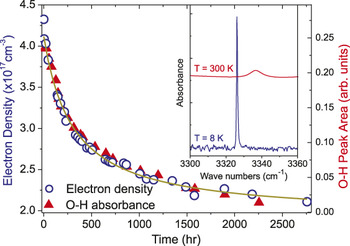
With native defects out of the picture, hydrogen is considered to be an important contributor to n-type conductivity. There are two forms in which hydrogen acts as a shallow donor, interstitial and substitutional hydrogen. Interstitial hydrogen forms an O–H bond that gives rise to a bond-stretching peak in the IR absorption spectrum. There are two different interstitial hydrogen donors, with peaks at 3326 cm−1 (McCluskey et al.Reference McCluskey, Jokela, Zhuravlev, Simpson and Lynn45) and 3611 cm−1 (Lavrov et al.Reference Lavrov, Weber, Börrnert, Van de Walle and Helbig46). Whereas it has been proposed that the 3326 cm−1 line may be an O–H pair adjacent to a calcium impurity,Reference McCluskey and Jokela47–Reference Bang, Choi and Chang49 this model has not been established experimentally. Both interstitial hydrogen donors are unstable at room temperature, decaying away after a few weeks (Fig. 2).Reference Jokela and McCluskey50 Some of the hydrogen atoms form H2 molecules, which are electrically neutral and “hidden” from IR spectroscopy.Reference Shi, Saboktakin, Stavola and Pearton51, Reference Lavrov, Herklotz and Weber52 Since interstitial donors are unstable, they are not responsible for the prevailing n-type conductivity in ZnO samples.
Free-electron density and O–H peak area for interstitial hydrogen donors in ZnO, at room temperature. The decay over time shows that interstitial donors are unstable.Reference Jokela and McCluskey50 Inset: O–H absorption peak at 8 K and 300 K.

Substitutional hydrogen, in contrast, is believed to be a shallow donor that is stable to ∼500 °C.Reference Shi, Saboktakin, Stavola and Pearton51 First-principles calculations showed that the hydrogen atom sits in an oxygen vacancy and forms weak bonds with the neighboring zinc atoms.Reference Janotti and Van de Walle53 Because the bonds are weak, its predicted vibrational frequency is low (∼800 cm−1), lying in a spectral region with strong IR two-phonon and free-carrier absorption. For this reason, detecting substitutional hydrogen by IR spectroscopy presents a technical challenge. To our knowledge, substitutional hydrogen has not been observed with IR spectroscopy in other oxides either, presumably for the same reason. Photoluminescence spectra at low temperatures show several sharp lines corresponding to substitutional donors in ZnO.Reference Meyer, Alves, Hoffman, Kriegseis, Forster, Bertram, Christen, Hoffman, Strassburg, Dworzak, Haboeck and Rodina54 The “I 4” line has been assigned to substitutional hydrogen donors.Reference Janotti and Van de Walle53, Reference Lavrov, Herklotz and Weber55
Along with its role as a shallow donor, hydrogen also passivates acceptors. In ZnO, the zinc vacancy is a double acceptor and is fully passivated by two hydrogen atoms. In essence, the hydrogen atoms provide the electrons that were taken away by the missing zinc atom. The protons then bind to oxygen atoms, resulting in two IR absorption peaks.Reference Lavrov, Weber, Börrnert, Van de Walle and Helbig46 Hydrogen also has been known to passivate the deep acceptors copperReference Gärtner and Mollwo56 and lithium.Reference Halliburton, Wang, Bai, Garces, Giles, Callahan and Wang57, Reference Shi, Stavola and Beall Fowler58 In both complexes, hydrogen attaches to an oxygen atom, forming an O–H bond.
Nitrogen acceptors are passivated by hydrogen in bulk ZnO grown in ammonia by chemical vapor transportReference Jokela and McCluskey59 and in thin films grown by metalorganic chemical vapor deposition.Reference Kumar, Watanabe, Nakai, Nishimoto and Fujita60 Through isotopic substitution, Jokela and McCluskey showed that the IR absorption peak at 3151 cm−1 corresponds to the bond-stretching mode of a N–H pair (Fig. 3).Reference Jokela and McCluskey61 The local vibrational mode frequency agreed with a theoretical model, in which the hydrogen attaches to the nitrogen acceptor in an “antibonding” orientation.Reference Li, Keyes, Asher, Zhang, Wei, Coutts, Limpijumnong and Van de Walle62
IR spectra (8 K) of N–H pairs in ZnO, for samples grown in Reference King, Veal, Payne, Bourlange, Egdell and McConville14NH3, Reference Lany, Zakutayev, Mason, Wager, Poeppelmeier, Perkins, Berry, Ginley and Zunger15NH3, or a mixture of Reference King, Veal, Payne, Bourlange, Egdell and McConville14ND3 and Reference Lany, Zakutayev, Mason, Wager, Poeppelmeier, Perkins, Berry, Ginley and Zunger15NH3.Reference Jokela and McCluskey61 The higher mass of the Reference Lany, Zakutayev, Mason, Wager, Poeppelmeier, Perkins, Berry, Ginley and Zunger15N isotope results in a slightly lower vibrational frequency. N-D peaks are not shown. Inset: ball-and-stick model.Reference Li, Keyes, Asher, Zhang, Wei, Coutts, Limpijumnong and Van de Walle62

The study of N–H complexes was essential for understanding the nature of nitrogen acceptors in ZnO. As reviewed in Ref. Reference McCluskey and Jokela37, numerous theoretical and experimental reports claimed that nitrogen is a shallow acceptor dopant that could produce p-type material. However, more recent calculations have indicated that nitrogen is a deep acceptor with a (0/-) level over 1 eV above the valence-band maximum.Reference Lyons, Janotti and Van de Walle63, Reference Lany and Zunger64 To test the theory, experiments were performed on bulk, single-crystal ZnO:N samples that were grown in an ammonia ambience.Reference Tarun, Zafar Iqbal and McCluskey65 In these samples, the majority of the nitrogen acceptors were passivated. To activate the nitrogen acceptors, the samples were annealed, causing the N–H pairs to break up. This led to a decrease in the N–H peak intensity and an increase in “red” luminescence centered at ∼730 nm (1.70 eV). The red luminescence is in agreement with the predictions of the deep-acceptor model.Reference Lyons, Janotti and Van de Walle63 These results provided evidence that nitrogen is a deep acceptor in ZnO and cannot lead to p-type conductivity.
Regarding hydrogen diffusion, experiment and theory are at odds. Experimentally, a hydrogen migration barrier of ∼1 eV has been found by Mollwo,Reference Mollwo66 Thomas and Lander,Reference Thomas and Lander67 and Nickel.Reference Nickel68 This value concurs with the temperature-dependent decay of interstitial hydrogen donors, which has activation energy of 0.96 eV.Reference Jokela and McCluskey50 However, local density approximation (LDA) calculations predict a much lower migration barrier of 0.4–0.5 eV.Reference Wardle, Goss and Briddon69, Reference Bang and Chang70 The reason for this major discrepancy is not currently known.
B. SnO2
Tin oxide, also known as stannic oxide or cassiterite in its mineral form, has the rutile crystal structure and a direct band gap of 3.6 eV.Reference Batzill and Diebold71 Fluorine-doped SnO2 is used as a transparent electrode for thin-film amorphous silicon– and cadmium telluride (CdTe)-based solar cellsReference Delahoy, Guo, Luque and Hegedus72 and dye-sensitized solar cells.Reference Anscombe73 Transparent thin-film transistors have also been fabricated.Reference Presley, Munsee, Park, Hong, Wager and Keszler74 As discussed in Sec. I, SnO2 coatings are used to improve the energy efficiency of windows, by transmitting visible light while reflecting IR light.Reference Lewis and Paine75 They are also used as transparent electrodes in electrochromic windows, in which the window transparency is controlled by an applied voltage.Reference Gordon76 Finally, SnO2 is used in gas-sensing applications, in which the conductivity changes in the presence of specific gas molecules.Reference Göpel and Schierbaum77 The sensitivity to molecules such as carbon monoxide increases significantly when SnO2 particles have a diameter smaller than 10 nm.Reference Lu, Liu, Dong and Wang78
As with many other oxides, the prevailing assumption that oxygen vacancies are responsible for n-type conductivity was challenged by DFT calculations.Reference Singh, Janotti, Scheffler and Van de Walle79 These calculations estimated that the (0/2+) donor level is ∼1.8 eV above the valence band maximum, which is in the middle of the band gap. Such a deep level cannot contribute an appreciable concentration of free electrons to the conduction band. The tin interstitial was calculated to have high formation energy in n-type material, resulting in a negligible concentration. The authors proposed instead that substitutional and interstitial hydrogen could act as shallow donors in SnO2.
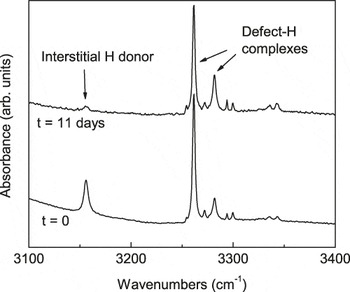
The theoretical predictions were tested experimentally by annealing bulk, single-crystal SnO2 in H2 gas at 600 °C.Reference Hlaing Oo, Tabatabaei, McCluskey, Varley, Janotti and Van de Walle80 An IR peak observed at 3156.1 cm−1 was attributed to interstitial hydrogen, with the O–H bond aligned perpendicular to the c-axis. The hydrogenated samples showed free-carrier absorption and an increase in electrical conductivity, consistent with the shallow-donor nature of interstitial hydrogen. As in ZnO, the O–H peak is unstable, decaying away after a few weeks at room temperature (Fig. 4).
IR spectra (10 K) of O–H peaks from interstitial hydrogen donors and defect-hydrogen complexes in SnO2.Reference Hlaing Oo, Tabatabaei, McCluskey, Varley, Janotti and Van de Walle80 The top spectrum was taken after an 11 day “anneal” at room temperature.

Along with interstitial hydrogen donors, hydrogenated SnO2 also showed a series of O–H peaks in the 3250–3350 cm−1 range. From first-principles calculations, it was proposed that two of these peaks arise from tin vacancies decorated with one hydrogen atom.Reference Hlaing Oo, Tabatabaei, McCluskey, Varley, Janotti and Van de Walle80 Two different orientations of the O–H bond result in two different vibrational frequencies (3261.7 and 3282.0 cm−1). The hydrogen atom partially passivates the tin vacancy, converting it into a triple acceptor. The calculated formation energies for these (V Sn-H)−3 defects is low for n-type material.
Experiments by Bekisli et al.Reference Bekisli, Stavola, Beall Fowler, Boatner, Spahr and Lüpke81 confirmed the assignment of the 3156.1 cm−1 peak to hydrogen donors. By correlating the strength of this peak with that of free-carrier absorption, the authors determined that a second donor, probably substitutional hydrogen, was stable to 600 °C. The properties of interstitial and substitutional hydrogen donors are remarkably similar to those in ZnO. Through systematic IR polarization spectroscopy, they assigned the peaks in the 3250–3350 cm−1 range to defects containing one or two hydrogen atoms. All but two lines were polarized perpendicular to the c-axis.
First-principles calculations by Varley et al.Reference Varley, Janotti, Singh and Van de Walle82 showed that the acceptors aluminum, gallium, and indium readily substitute for tin, perhaps providing a way toward p-type doping in SnO2. They are all passivated by hydrogen, resulting in O–H bonds that should give rise to well-defined vibrational peaks in the IR spectrum. To our knowledge, however, these acceptor-hydrogen complexes have not been observed experimentally.
C. TiO2
Titanium dioxide or titania has an indirect band gap of 3.0 eV in the rutile structure and 3.2 eV in the anatase structure.Reference Kavan, Grätzel, Gilbert, Klemenz and Scheel83 It is widely used as a white pigment in paint. TiO2 surfaces, especially the well-characterized rutile (110) surface, are used in photocatalytic processes such as water splitting (Sec. I) and photodegradation of organic molecules.Reference Diebold84 The surface adsorption of various organic species has been studied extensively with FTIR spectroscopy.Reference Ojamäe, Aulin, Pedersen and Käll85 TiO2 is a preferred material for photoelectrochemical solar cells.Reference Grätzel86 In these devices, sunlight creates an electron and hole in the TiO2. The electron travels through an external circuit whereas the hole is “scavenged” by a molecule in the electrolyte. Dye-sensitized solar cells use a monolayer of dye molecules to push the absorption profile into the visible.Reference O’Regan and Grätzel87
Rutile TiO2 shows various hydrogen vibrational modes, including one with a frequency 3290 cm−1 that corresponds to an O–H bond aligned perpendicular to the c-axis.Reference Soffer88 Herklotz et al.Reference Herklotz, Lavrov and Weber89 investigated the fine structure of this mode and its temperature dependence. They attributed two IR absorption peaks, at 3288.3 and 3292.0 cm−1, to the neutral charge state, and a mode at 3287.4 cm−1 to the +1 charge state. As the sample was warmed up, the increase in the 3287.4 cm−1 line was correlated with an increase in free-carrier absorption. These results suggest a shallow donor with ionization energy of 10 meV. The experimental work is in contrast to the calculations of Filippone et al., which predicted that interstitial hydrogen should be a deep donor.Reference Filippone, Mattioli, Alippi and Amore Bonapasta90 Other calculations, however, found that interstitial hydrogen is a shallow donor in TiO2.Reference Kiliç and Zunger27, Reference Peacock and Robertson91, Reference Bjørheim, Stølen and Norby92
The vibrational lifetime of the O–H bond-stretching mode provides information that is relevant to hydrogen diffusion. IR pump-probe experiments measured the temperature dependence of the ground-state recovery lifetime.Reference Spahr, Wen, Stavola, Boatner, Feldman, Tolk and Lüpke93 The shape of the lifetime-versus-temperature curves suggest that the O–H stretch mode quickly couples to a wag mode, which enables it to migrate to a neighboring oxygen site. This model implies that IR light can lead to a giant enhancement of hydrogen migration in TiO2.
The theoretical situation for oxygen vacancies is an area of some disagreement. DFT calculations using the generalized gradient approximation (GGA) show that the +2 charge state of the oxygen vacancy is energetically preferred for all values of the Fermi level within the band gap; i.e., it acts as a shallow double donor.Reference Bjørheim, Stølen and Norby92, Reference Cho, Han, Ahn, Lee, Kim and Hwang94 However, DFT calculations, using a local spin density + U method, find that the oxygen vacancy is a deep donor. We note that this latter technique was the same one that also found hydrogen to be a deep donor.Reference Filippone, Mattioli, Alippi and Amore Bonapasta90
D. In2O3 and Ga2O3
As discussed in Sec. I, In2O3 is the preferred TCO for flat-panel displays and other applications. Despite its popularity and success, relatively little is known about the properties of hydrogen impurities. In2O3 has the bixbyite crystal structure, with 80 atoms in the conventional cell. Although it has a direct band gap of 2.7 eV,Reference Bourlange, Payne, Egdell, Foord, Edwards, Jones, Schertel, Dobson and Hutchison95 strong dipole-allowed absorption occurs ∼1 eV above this value, making it quite transparent up to ∼3.7 eV. Koida et al.Reference Koida, Fujiwara and Kondo96 demonstrated that hydrogen doping of sputtered films resulted in free-electron concentrations of 3 × 1020 cm−3 and mobilities as high as 130 cm2/V·s. Calculations by Limpijumnong et al.Reference Limpijumnong, Reunchan, Janotti and Van de Walle97 indicated that substitutional and interstitial hydrogen act as shallow donors, in agreement with experiment. Researchers have exploited the effect of hydrogen on conductivity, using nanocrystalline In2O3 thin films as hydrogen gas sensors.Reference Shukla, Seal, Ludwig and Parish98 The (0/2+) donor level of the oxygen vacancy was calculated to lie close to the experimental conduction-band minimum, suggesting that it may act as a shallow donor.Reference Reunchan, Zhou, Limpijumnong, Janotti and Van de Walle99
β-Ga2O3 has a monoclinic crystal structure and a direct band gap of 4.9 eV, giving it transparency well into the UV.Reference Orita, Ohta, Hirano and Hosono100 DFT calculations indicate that oxygen vacancies are deep donors, whereas interstitial and substitutional hydrogen are shallow donors.Reference Varley, Weber, Janotti and Van de Walle101 Whereas isolated cation vacancies are energetically unfavorable in SnO2 and In2O3, gallium vacancies have low formation energy in Ga2O3.Reference Varley, Peelaers, Janotti and Van de Walle13 In the presence of hydrogen, however, the formation energies are reduced and vacancy-hydrogen complexes may form in all three materials.
E. SrTiO3
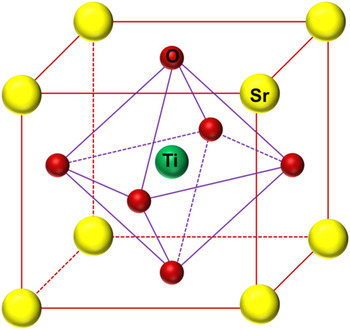
SrTiO3 is a perovskite oxide (Fig. 5) with an indirect band gap of 3.25 eVReference van Benthem, Elsässer and French102 and is commonly used as a substrate for oxide thin films, including high-Tc superconductors.Reference Kawai, Watanabe and Hanada103 The observation of blue light emission in irradiated SrTiO3 suggests potential optoelectronic applications.Reference Kan, Terashima, Kanda, Masuno, Tanaka, Chu, Kan, Ishizumi, Kanemitsu, Shimakawa and Takano104 The cubic perovskite structure undergoes a symmetry-lowering transition to a tetragonal phase below 105 K, which involves a rotation of the oxygen octahedron with respect to the strontium cage.Reference Houde, Lépine, Pépin, Jandl and Brebner105 Its dielectric constant depends strongly on temperature, increasing from a few hundred at room temperature to tens of thousands at low temperatures. The dielectric screening of ionized impurities at low temperature contributes to excellent free-electron mobilities.Reference Son, Moetakef, Jalan, Bierwagen, Wright, Engel-Herbert and Stemmer106 Although p-type SrTiO3 has been reported via doping with scandiumReference Higuchi, Tsukamoto, Sata, Ishigame, Tezuka and Shin107 and indium,Reference Fix, Bali, Stelmashenko and Blamire108 the evidence–as with claims of p-type ZnO–is far from conclusive.
Perovskite structure of SrTiO3.

In as-grown SrTiO3, hydrogen forms an O–H bond with a host oxygen atom, resulting in an IR absorption peak near 3500 cm−1 due to the bond-stretching vibration.Reference Houde, Lépine, Pépin, Jandl and Brebner105 In samples annealed in hydrogen gas, Tarun and McCluskeyReference Tarun and McCluskey109 investigated this peak, labeled HI, along with a pair of peaks at 3355 and 3384 cm−1, labeled HII. All the peaks showed an expected isotope shift to lower frequency when samples were annealed in deuterium. When samples were annealed in a mixture of hydrogen and deuterium, new HII peaks appeared. These peaks corresponded to HD centers, showing unambiguously that the HII center contains two hydrogen atoms.
The structures of the hydrogen complexes are not known definitively. Theoretical studies have suggested that the HI line arises from an isolated hydrogen interstitialReference Villamagua, Barreto, Prócel and Stashans110 whereas HII represents a pair of hydrogen interstitials that are attracted to each other via lattice strain.Reference Bork, Bonanos, Rossmeisl and Vegge111 Tarun and McCluskeyReference Tarun and McCluskey109 attributed HII to a strontium vacancy that is fully passivated by two hydrogen atoms. However, the experimental results cannot exclude the possibility that HII is a titanium vacancy decorated by two hydrogen atoms,Reference Thienprasert, Fongkaew, Singh, Du and Limpijumnong112, Reference Varley, Janotti and Van de Walle113 or two neighboring hydrogen interstitials.Reference Bork, Bonanos, Rossmeisl and Vegge111 Furthermore, one must consider the possibility that the HI configuration is a defect-hydrogen complex rather than simply isolated hydrogen.Reference Thienprasert, Fongkaew, Singh, Du and Limpijumnong112
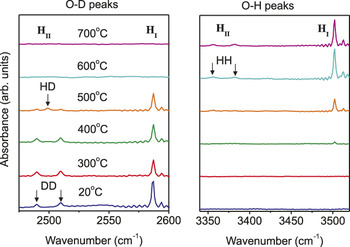
By monitoring the evolution of peaks in deuterated SrTiO3, Tarun and McCluskeyReference Tarun and McCluskey109 provided evidence for “hidden hydrogen,” possibly H2 molecules, in the sample. As shown in Fig. 6, the deuterated sample contains O–D peaks corresponding to the HI and HII configurations. When the sample is annealed at 500 °C, one can see the appearance of an HD peak. This occurs because a hydrogen atom has come out of its reservoir and replaced a deuterium atom. At the same time, the HI O–H peak increases, for the same reason. At 600 °C, the released hydrogen atoms have totally replaced the deuterium atoms. Future studies, perhaps involving Raman spectroscopy, will be performed to determine the identity of the hidden hydrogen.
IR absorption spectra (200 K) of O-D and O-H peaks in deuterated SrTiO3.Reference Tarun and McCluskey109 Two different complexes are labeled HI and HII. Above 500 °C, the D atoms are replaced by H, which come from a “hidden hydrogen reservoir” in the sample.

III. CONCLUSIONS
Hydrogen is an impurity that is present in essentially all oxide materials and can have a major effect on electrical properties. Several “universal” phenomena are observed in many, if not all, oxide semiconductors. Interstitial and substitutional hydrogen act as shallow donors, with the substitutional form being much more stable. Oxides often contain “hidden hydrogen,” possibly H2 molecules, that can become mobile and electrically active upon annealing. Hydrogen readily passivates dangling bonds in cation vacancies. In ZnO and SrTiO3, for example, vacancy defects with two hydrogen atoms have been observed. Finally, hydrogen passivates substitutional acceptors such as nitrogen in ZnO. Whereas theories have proposed the existence of a universal donor level for interstitial hydrogen, there is significant disagreement over where this level lies and whether it is really constant for oxide semiconductors.
In the future, improving our understanding of hydrogen in oxide semiconductors could lead to a host of new applications. The challenge of p-type doping, in particular, will need to take hydrogen into account, since hydrogen can be expected to aggressively passivate any acceptors in the material. Deliberate passivation of compensating acceptors, on the other hand, could lead to higher electron mobilities in n-type TCOs. The structural, electronic, and vibrational properties of vacancy-hydrogen complexes in oxides such as titanates are still not well known. These complexes could have a major influence on carrier mobilities and, at high concentrations, may affect phenomena such as ferroelectric phase transitions.
ACKNOWLEDGMENTS
The authors would like to thank A. Janotti, S. Lumpijumnong, J.B. Varley, C.G. Van de Walle, and S.B. Zhang for helpful insights into the theory of oxide semiconductors. Financial support was provided by National Science Foundation Grant No. DMR-1004804 (MDM, MCT) and Department of Energy Grant No. DE-FG02-07ER46386 (STT).