Introduction
The number of persons with dementia is rising rapidly. It is estimated that at this moment, worldwide, 44 million people suffer from dementia and that this number will further increase to 135 million by 2050 (Prince et al., Reference Prince, Guerchet, Prina and International2013). Dementia has an enormous impact on the autonomy and quality of life of both the patient and his environment. Ideally, interventions, both pharmacological and psychosocial, targeting the disease and the quality of care, should be initiated at the earliest stages of dementia (Prince et al., Reference Prince, Bryce and Ferri2011; Reference Prince, Guerchet, Prina and International2013). In order to capture this early phase of dementia, the concept of MCI has been developed. MCI refers to a transitional state between normal cognitive function and probable dementia and is characterized by subjective and objective memory impairment in the absence of functional decline (Winblad et al., Reference Winblad2004). The “amnestic” MCI (a-MCI) subtype, with objective memory impairment (with single or multiple neurocognitive domains involved) (Petersen, Reference Petersen2004) is considered as the subtype with the highest risk to convert to Alzheimer's disease (AD) (Petersen, Reference Petersen2011).
Diagnostic criteria for MCI have been formulated and are widely accepted in research and clinical practice. Nevertheless, substantial criticism has been put forward, particularly regarding the criterion “absence of functional decline.” Initially, the ADL were required to be intact (Petersen et al., Reference Petersen, Smith, Waring, Ivnik, Tangalos and Kokmen1999); later the Working Group on MCI proposed to include the criterion “preserved self-care, but minimal impairment in more complex ADL” (Petersen, Reference Petersen2004; Winblad et al., Reference Winblad2004). Presently, there is a body of evidence showing that changes in daily functioning, although mild in nature, are noticeably present in MCI. (Farias et al., Reference Farias, Mungas, Reed, Harvey, Cahn-Weiner and Decarli2006; Giovannetti et al., Reference Giovannetti2008; Pedrosa et al., Reference Pedrosa2010; Yeh et al., Reference Yeh, Lin, Chen, Lin, Chen and Wang2011). It is, however, unclear what has to be considered as “minimal ADL impairment,” as at this moment, there is no consensus on the level of impairment and there are no normative data available. Also, it remains unclear whether a minimal impairment is part of the MCI syndrome or is predictive for the conversion to dementia (Peres et al., Reference Peres, Chrysostome, Fabrigoule, Orgogozo, Dartigues and Barberger-Gateau2006; Reference Peres2008).
Despite the importance of the functional criterion, there is a major problem with the measurement of ADL (Law et al., Reference Law, Barnett, Yau and Gray2012).
The earliest MCI studies often used variations of the Lawton Scale (Peres et al., Reference Peres, Chrysostome, Fabrigoule, Orgogozo, Dartigues and Barberger-Gateau2006; Reference Peres2008; Jefferson et al., Reference Jefferson2008), sometimes with a dichotomous rating system (Tabert et al., Reference Tabert2002). As a consequence, whether a functional deficit was shown or not, the result was mainly related to the sensitivity of the applied ADL tool. In order to enhance the diagnostic validity, the ADL scales were adjusted for use in MCI. More complex and “up to date” activities were added, which relied on more complex cognitive skills and executive functioning, as in the ADCS/MCI/ADL scale (Pedrosa et al., Reference Pedrosa2010). In most cases, however, these adaptations cannot be regarded as correctly assessing functional impairments, since they do not asses solely ADL but added also neurocognitive items. Other studies focused only on one ADL in particular, such as driving (Wadley et al., Reference Wadley2009) or the use of everyday technology (Malinowsky et al., Reference Malinowsky, Almkvist, Kottorp and Nygard2010); however, this provides no comprehensive view on functioning and thus no sufficient support for a diagnosis. Moreover, no pre-morbid level of functioning was taken into account. Finally, the majority of the tools evaluate only the outcome of an ADL task, by rating the success or failure to complete the task. Generally, the process of completing a task (e.g. errors made in performance, duration of the activity, etc.) is not reflected in the scores, although it is evident that this information could be meaningful for diagnostic purposes.
Hence, an all-encompassing evaluation tool for complex activities – and only activities – is still lacking. For this reason, we developed a new a-ADL tool, encompassing the complex activities one can perform, such as using (household) technology, driving, going on holidays, doing sports, practice hobbies, or arts, etc. The a-ADL are considered as the most difficult activities and accordingly are most vulnerable to cognitive decline (Reuben and Solomon, Reference Reuben and Solomon1989). The tool uses the terminology and scoring system of the International Classification of Functioning, Disability and Health (ICF), as previously described by De Vriendt et al. (Reference De Vriendt, Gorus, Cornelis, Velghe, Petrovic and Mets2012, Reference De Vriendt, Gorus, Cornelis, Bautmans, Petrovic and Mets2013). The new a-ADL tool is based on the total number of a-ADL relevant for a specific person, the way he or she performs these activities, and the underlying cause of impairment. The ICF scale ranging from 0 (no problem) to 4 (total problem) was operationalized for the a-ADL tool. In particular, the score 1 (mild problem in functioning) was suitable for identifying the mild functional limitations in MCI. The tool has been designed as a semi-structured interview for both self-report and proxy-report, since observation-based assessment is time-consuming and difficult to implement in a clinical setting (Farias et al., Reference Farias, Mungas and Jagust2005). By taking the pre-morbid functioning of each participant as the reference, it is possible to compute several disability indices, of which the global, the cognitive, and the physical indices are validated for use in an older population with cognitive disorders. The indices are expressed as percentages with lower scores representing more independence. The tool showed excellent feasibility, reliability (test-retest, patient-proxy), face and content validity, and construct validity (De Vriendt et al., Reference De Vriendt, Gorus, Cornelis, Bautmans, Petrovic and Mets2013). In an explorative study, healthy control participants performed more activities and reported less limited activities than patients with a-MCI or with mild to moderate AD; a-MCI patients reported more activities and less limited activities than AD patients. As hypothesized, a-ADL-DI and a-ADL-CDI scores were related to the cognitive tests scores such as the Mini-Mental State Examination (MMSE) and the Cambridge Examination for mental disorders of the elderly, Cognitive part (CamCog) (r between 0.688 and 0.714; p > 0.01), while a-ADL-PDI scores were unrelated. The inter-rater reliability was excellent and, moreover, the questioning was perceived by the participants as enjoyable and by the investigators as feasible. Questioning took in average 30 minutes.
In the present study, the discriminative power of the a-ADL tool is evaluated in cognitively healthy control persons and in patients with a-MCI and AD in order to establish diagnostic accuracy.
Participants and methods
The study protocol was based on the STARD criteria (Bossuyt et al., Reference Bossuyt2003), which are developed to improve truthfulness and completeness of studies on diagnostic accuracy of assessment tools. Two groups of consecutive geriatric day hospital patients, 65 years or older and community dwelling were recruited: (1) patients with a-MCI (criteria of the International Working Group on MCI (Winblad et al., Reference Winblad2004)) and (2) patients with mild to moderate AD (according to Diagnostic and Statistical Manual of Mental Disorders Fourth version (DSM-IV) or National Institute of Neurological and Communicative Disorders and Stroke and the Alzheimer's Disease and Related Disorders Association (NINCDS-ADRDA). All patients underwent a diagnostic procedure including cognitive (MMSE (Folstein et al., Reference Folstein, Folstein and McHugh1975) and CamCog (Gallagher et al., Reference Gallagher2010)), emotional (Geriatric Depression Scale (GDS) (Yesavage et al., Reference Yesavage1982)), behavioral (Neuro Psychiatric Inventory (Cummings et al., Reference Cummings, Mega, Gray, Rosenberg-Thompson, Carusi and Gornbein1994)), and functional assessment. A modified Katz scale (Katz et al., Reference Katz, Ford, Moskowitz, Jackson and Jaffe1963) was used, with scores expressed as percentage where 100% represents complete dependency. The i-ADL were measured by a modified gender-specific Lawton scale (Lawton and Brody, Reference Lawton and Brody1969), scores expressed as percentage where 100% represents complete dependency; for men a six-item version (ability to use telephone, shopping, transportation, handling medication, handling finances, and handyman work), for women an eight-item version (food preparation, housekeeping, laundry, ability to use telephone, shopping, transportation, handling medication, and finances). The standardized diagnostic work was completed by physical evaluation, inventory of co-morbidities and medication use, extensive laboratory blood testing, and imaging of the brain (Mets et al., Reference Mets2000). Assessments were administered by the usual multidisciplinary team. Decisions on diagnostics groups were taken very carefully, based on this multidisciplinary evaluation and independently from this study.
The control group was recruited – separately from the diagnostic process at the day hospital – among cognitively healthy volunteers, living in the community. Volunteers were excluded if any objective cognitive deficit (MMSE <26, CamCog<80 or CamCog memory section <18 (Gallagher et al., Reference Gallagher2010)) could be suggestive for the diagnosis of MCI or AD. Any acute pathology, sensory, or communicative impairments which hampered participation, and any other pathology of the central nervous system, were exclusion criteria for all groups.
The a-ADL tool (De Vriendt et al., Reference De Vriendt, Gorus, Cornelis, Bautmans, Petrovic and Mets2013) was not a part of the diagnostic process and was carried out immediately after the reference tests by trained and experienced investigators who were blinded for the results of the other tests and the diagnosis of the participants. In this study, for the patient groups, the a-ADL tool was administered as proxy-report, which is considered to be reliable in our study as well in others (Farias et al., Reference Farias, Mungas and Jagust2005; De Vriendt et al., Reference De Vriendt, Gorus, Cornelis, Bautmans, Petrovic and Mets2013), for the controls self-report was used. The questionnaire encompasses 49 advanced activities, divided in 15 clusters according to the ICF (e.g. using internet, everyday technology, household devices, and sophisticated kitchen activities beyond preparing daily meals, etc.). Only the activities considered as relevant for the person are taken into account. “Relevant” in this context means “if the activity is currently performed or if it has been performed previously”. After asking how the activities that have been identified as relevant are performed, the observer assigns a score. The rating system adopted the performance qualifiers of the ICF, a five-point scale ranging from 0 to 4. Based on the results of the previous qualitative study (De Vriendt et al., Reference De Vriendt, Gorus, Cornelis, Velghe, Petrovic and Mets2012), the qualifiers were operationalized as follows: 0 (no difficulty to perform an activity), 1 (mild problems in functioning, slower, less frequently), 2 (sometimes help is needed), 3 (continuous help is needed) and 4 (the person does not perform the activity anymore). The respondent is asked to elaborate on the activities and the way they are performed. Based on the narratives of the respondent, the investigator assigns a score and by doing so, the process of performing the activity is reflected in the scores. Finally, the underlying reason (mental or physical) of a limited performance is rated, based on the history of the person. Taking into account the underlying reasons of the functional problem and the severity of the problem, the indices are calculated. The a-ADL tool makes a distinction between a total a-ADL-DI by taking into account all the activities which are limited and the severity of the limitation, an a-ADL-CDI by taking into account only the limited activities due to cognitive problems, and an a-ADL-PDI, by taking into account the limited activities due to physical problems.
Statistical analyses were performed with the Statistical Package for Social Sciences (version 22) with an α level set two sided at p < 0.05 for all analyses. Differences between subject groups were evaluated by one-way ANOVA with Bonferroni post hoc tests, followed by ANCOVA with the variables which differed significantly between groups entered as confounders. For the discriminative validity, receiver operating characteristic (ROC) analysis was performed. ROC curves were computed for the indices and the specificity, sensitivity, AUC, the positive and negative predictive value (PPV and NPV) were calculated.
Ethical considerations
The study was approved by the local Ethical Committee of the involved hospitals. All data were collected in accordance with the Declaration of Helsinki.
Results
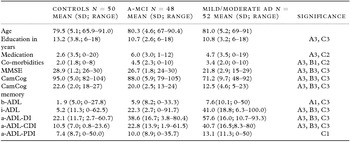
One hundred and fifty participants were included (92 women and 58 men) with an average age of 80.3 years (range 66.0–91.0; SD 5.0). No significant difference for gender ratio was observed between the three groups. The groups differed significantly not only for all cognitive and functional measures, as expected, but also for the educational level (controls were more educated), and for co-morbidities and medication use (patients with a-MCI had more co-morbidities and used more medication than the other groups), as illustrated in Table 1.
Participants’ characteristics

a-MCI: amnestic mild cognitive impairment; mild AD: mild Alzheimer's disease; MMSE: Mini-Mental State Examination (0–30); CamCog: Cambridge Examination for mental disorders of the elderly, cognitive part (0–105); CamCog memory: Cambridge Examination for mental disorders of the elderly, cognitive part memory section (0–27); b-ADL a-ADL-DI: advanced activities of daily living-Disability Index; a-ADL-CDI: advanced activities of daily living-Cognitive Disability Index; a-ADL-PDI: advanced activities of daily living-Physical Disability Index; SD: standard deviation.
Differences between healthy control and MCI: A; Differences between MCI and AD: B; Differences between healthy control and AD: C; Level of significance: 1 p < 0.05, 2 p < 0.01, 3 p < 0.001.
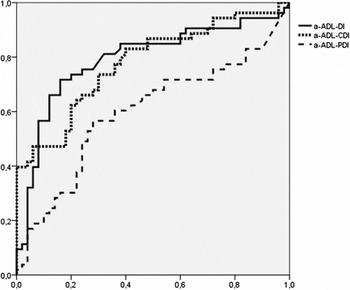
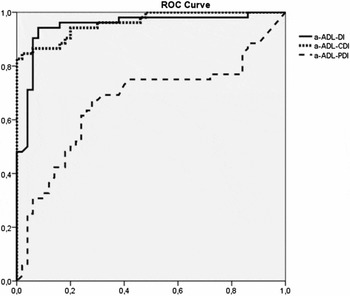
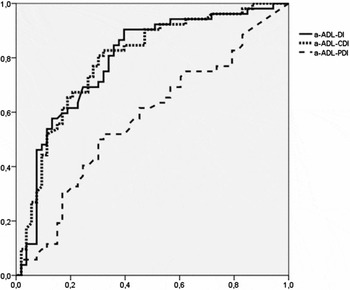
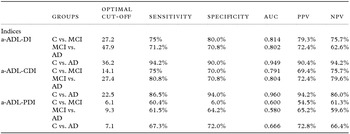
Figures 1–3 and Table 2 show the results of the computed ROC curves with cut-offs, sensitivity, specificity, PPV, and NPV for the different indices. Both the a-ADL-DI and the a-ADL-CDI – of interest in this population – showed promising results and differed significantly between the groups; in contrast, the a-ADL-PDI did not. In general, the indices showed a sensitivity and specificity ranging from 70% to 94.2% and were found to be at least “moderately accurate” with an AUC between 0.791 (which can be considered as satisfactory) and 0.960 (which can be considered as excellent). Particularly of clinical interest is the discriminative value between healthy controls and MCI and MCI and AD. The PPV for the a-ADL-DI between controls and MCI and MCI and AD was respectively 79.3% and 72.4%; the a-ADL-CDI was 69.4% and 72.4%. The NPV was respectively 75.7 and 62.6% and 75.7 and 79.7%.
Receiver-operating characteristics (ROC) curve and corresponding area under the curve (AUC) statistics for the risk of having the mild cognitive impairment (MCI)-condition versus healthy controls. a-ADL-DI: advanced activities of daily living Disability Index; a-ADL-CDI: advanced activities of daily living Cognitive Disability Index; a-ADL-PDI: advanced activities of daily living-Physical Disability Index.

Receiver-operating characteristics (ROC) curve and corresponding area under the curve (AUC) statistics for the risk of having the Alzheimer's disease (AD)-condition versus healthy controls. a-ADL-DI: advanced activities of daily living Disability Index; a-ADL-CDI: advanced activities of daily living Cognitive Disability Index; a-ADL-PDI: advanced activities of daily living-Physical Disability Index.

Receiver-operating characteristics (ROC) curve and corresponding area under the curve (AUC) statistics for the risk of having the mild cognitive impairment (MCI)-condition versus Alzheimer's disease (AD). a-ADL-DI: advanced activities of daily living Disability Index; a-ADL-CDI: advanced activities of daily living Cognitive Disability Index; a-ADL-PDI: advanced activities of daily living-Physical Disability Index.

Discriminative validity of the a-ADL indices between controls, patients with MCI and AD

C: controls; MCI: mild cognitive impairment; AD: Alzheimer's disease; a-ADL-DI: advanced activities of daily living Disability Index; a-ADL-CDI: advanced activities of daily living Cognitive Disability Index; a-ADL-PDI: advanced activities of daily living-Physical Disability Index; AUC: area under the curve; PPV: positive predictive value; NPV: negative predictive value.
Discussion
This study investigated the diagnostic accuracy of a newly developed a-ADL tool among healthy controls, patients with a-MCI and patients with mild to moderate AD. The a-ADL tool was able to detect the diagnostic distinction between cognitively healthy older persons, patients with a-MCI, and patients with AD.
Overall, the clinical use of the a-ADL tool looks promising, since it can discriminate between the study groups with satisfactory validity. As expected, its discriminative value was strong between controls and patients with AD with an AUC of 0.949 for the a-ADL-DI and of 0.960 for the a-ADL-CDI. The ability to discriminate between controls and MCI (with an AUC of 0.814 for the a-ADL-DI and 0.791 for the a-ADL-CDI) was weaker, but still comparable with the discriminative value of assessment tools from other areas, such as cognitive measures. For instance, in a study by Gallagher, the CamCog and in particular its memory section, demonstrated a sensitivity and specificity of 78% and 74% respectively (Gallagher et al., Reference Gallagher2010). As expected, the a-ADL-PDI did not discriminate between the groups, probably reflecting the most interesting feature of the tool. Its usefulness, indeed, lies in its power to discriminate between underlying causes of ADL-limitations, which is not the case for the other currently available ADL tools.
The a-ADL tool completes the gap that existed in the triad of “basic, instrumental, and advanced ADL” as launched by Reuben in the 1980s (Reuben and Solomon, Reference Reuben and Solomon1989). Although other promising tools to evaluate mild functional problems in MCI have recently been developed, the a-ADL tool is the first to focus on activities only and does not include neuropsychological domains like Pedrosa et al., (Reference Pedrosa2010); the tool is also the first to focus on a-ADL solely and not on i-ADL like the Amsterdam questionnaire of Sikkes et al. (Reference Sikkes2012). Although questionnaires have been “expanded”, they do not reflect the idea of “luxury items” as defined by Reuben et al. According to the typology of Reuben et al. (Reuben and Solomon, Reference Reuben and Solomon1989) that is why the a-ADL are the most complex activities one can perform (no routine in performance) and the assumption is that these are subsequently most vulnerable for early cognitive decline, compared to i-ADL (Nygard, Reference Nygard2003). In this way, the a-ADL tool contributes to an all-encompassing and transparent evaluation of a person's functioning. In the previous study of De Vriendt et al. (Reference De Vriendt, Gorus, Cornelis, Velghe, Petrovic and Mets2012) this triad showed to be the best-fitting model to capture all ADL's a person can perform, since it provides a straightforward distinction between the three levels of ADL, stratified according to difficulty and the cognitive organization required. Also, the a-ADL tool applies the full scope of the ICF, including the detailed scoring system, allowing a more sensitive evaluation of high-level functioning, which is, as far as we know, the first tool to investigate the usefulness of the full content of the ICF.
Some remarks have to be made concerning the sample. A possible weakness in the study is in the conceptualization of MCI itself and the fact that a consensus on definition and standardized assessment is still lacking (Gerstenecker and Mast, Reference Gerstenecker and Mast2014). It is generally accepted that the boundaries between healthy, MCI, and mild AD are vague and overlapping and further exploration is recommended, in particular of the MCI concept (Petersen et al., Reference Petersen, Caracciolo, Brayne, Gauthier, Jelic and Fratiglioni2014).
Although it was clinically a relevant sample, it has to be noted that the number of co-morbidities and the medication use were higher in the MCI-group than in the other groups, suggesting that the MCI group was somehow frailer. However, this difference has not influenced the results of the discriminative validity analysis. Moreover, it is recommended not to exclude strictly all participants with co-morbidities since this could lead to biased case finding in older populations (Stephan et al., Reference Stephan, Brayne, Savva and Matthews2011). Also, the control participants had a higher education level than the patients groups and it is possible that this influenced their activity level. However, since the a-ADL tool takes the person as his own reference, this influence should be minimal. Although the control participants were “apparently” cognitively healthy, it is, nevertheless, still possible that mild cognitive decline was present in some of them. However, stricter cut-offs of MMSE and CamCog were combined in order to rule out cognitive deficits.
Another limitation, recently suggested (Gerstenecker and Mast, Reference Gerstenecker and Mast2014) is that ADL evaluation should be performance based. Since in a clinical setting ADL evaluation has time constraints, we have opted for report-based assessment, although biases could be expected. The a-ADL tool did not appear to be time-consuming, questioning took on average 30 minutes. Real-life testing would take much longer. Moreover, in previous studies (Farias et al., Reference Farias, Mungas, Reed, Harvey, Cahn-Weiner and Decarli2006; Pedrosa et al., Reference Pedrosa2010), it has been shown that reporting is as accurate as cognitive testing. We have performed reliability evaluations and have found that proxy- and self-reporting correlated highly in this population with an overall agreement between patient and proxy of 0.908 (De Vriendt et al., Reference De Vriendt, Gorus, Cornelis, Bautmans, Petrovic and Mets2013).
In this study, a mono-disciplinary and mono-variable approach was used. The combination of different domains, functional assessment, and cognitive assessment and also the inclusion of other variables such as biomarkers or functional and structural brain imaging could enhance the accuracy and reliability of pre-clinical identification. In clinical work with established cognitive and mood measures and biomarkers, the a-ADL tool can be of “added value” in multidisciplinary diagnostics of cognitive disorders. ADL evaluation is less invasive and acceptable for patients.
Functional problems in geriatric patients, particularly when related to cognitive disorders, are an interaction of biological (e.g. physical and mobility problems), psychological (e.g. cognitive, emotional, adaptation, and coping problems), and social (e.g. having an informal caregiver) aspects. The ability of the a-ADL tool to distinguish between different underlying causes of limitations appears to be a major advantage. The different underlying causes will not only be important for diagnostic purposes, but they will also determine interventional strategies, since functional problems due to physical or cognitive reasons will require a different approach. Functional limitations due to physical revalidation require physical revalidation, exercise and training, advise of assistive devices, and environmental adaptations; while in functional limitations due to cognitive problems, cognitive rehabilitation, training and the use of memory aids might be more appropriate. The results of the a-ADL tool can establish an individualized multidisciplinary intervention plan.
Conclusion
In conclusion, the evaluation of a-ADL can contribute to the distinction between normal aging, MCI, and AD. Moreover, follow-up assessment of high-level functioning might constitute an important predictor of conversion towards AD. So, the a-ADL could add knowledge to the issue of whether minimal ADL impairment is part of the MCI syndrome or is predictor of conversion to dementia, since it is likely that functional decline occurs over the course of MCI and that this cumulative change leads to dementia. Future research – longitudinal prospective follow up study of the MCI group – should address this issue.
Conflict of interest
None.
Author contributions
All authors have agreed to be listed as authors. They all designed the study, analyzed and interpreted the data, and wrote the paper. P. De Vriendt and E. Gorus collected data, supervised the data collection of the geriatric day hospital teams involved in the study. All authors have seen the final version and approved it.
Acknowledgment
The authors are indebted to the geriatric day hospital teams of the Vrije Universiteit Brussel and Ghent University Hospital for their contribution in the data collection.