Bullying has been identified as a serious problem in Australian schools, and subsequent government advice provided to academic institutions has pointed to the development and implementation of school-wide proactive initiatives and field-tested interventions for dealing with victimisation (Dedousis-Wallace & Shute, Reference Dedousis-Wallace and Shute2009; Murray-Harvey & Slee, Reference Murray-Harvey and Slee2006). To this end, school counsellors may serve as a valuable source of support for schools in their efforts to execute anti-bullying policies. They are expected to assume a key role in preparing both students and teachers for the implementation of evidence-based practices in combating bullying (Bhat, Reference Bhat2008; Jacobsen & Bauman, Reference Jacobsen and Bauman2007; McCormac, Reference McCormac2014). Existing evidence shows that in actual conditions, the initiatives attempted by counsellors with regard to the prevention and treatment of violent and aggressive conduct in schools are relatively limited (Bhat, Reference Bhat2008). Accordingly, students tend to be hesitant about seeking support from counsellors for handling violent incidents and are also sceptical about the effectiveness of their response to acts of victimisation (Jacobsen & Bauman, Reference Jacobsen and Bauman2007; Lund, Blake, Ewing, & Banks, Reference Lund, Blake, Ewing and Banks2012). Therefore, by all accounts, there seems to be plenty of scope for the counsellors appointed in schools to improve their practices and interventions in addressing bullying (Jacobsen & Bauman, Reference Jacobsen and Bauman2007; Lund et al., Reference Lund, Blake, Ewing and Banks2012).
Recent empirical evidence relating to coping strategies employed by children and adolescents in the handling of bullying within the school context appears to have been productive in combating this particular problem and has influenced many of the core components of anti-bullying programs implemented in Australian schools (Skrzypiec, Roussi-Vergou, & Andreou, Reference Skrzypiec, Roussi-Vergou, Andreou, Shute, Slee, Murray-Harvey and Dix2011; Skrzypiec, Slee, Roussi-Vergou, & Andreou, Reference Skrzypiec, Slee, Roussi-Vergou and Andreou2013). Students’ personal accounts and perspectives in coping with victimisation can serve as a resource for counsellors in their promotion of practices aimed at tackling bullying and in the effectiveness of services provided to schools. Under this conceptual framework, the present study aims to capture the authentic voices and experiences of young people dealing with school bullying and add to the pertinent research regarding the role that counsellors might play in its elimination.
More specifically, it reports on strategies used by Australian middle school students, some of whom were victims of bullying. Prior to the students being interviewed, they were provided with an 8-week training program focusing on adopting coping strategies for dealing with incidences of victimisation (see Skrzypiec et al., Reference Skrzypiec, Slee, Roussi-Vergou and Andreou2013). The core components of the program, as well as the practices adopted by school teachers participating in this research with the aim of delivering it to their students, have been drawn from and are based on the well-known anti-bullying P.E.A.C.E. Pack intervention program (Slee, Reference Slee1996). The prime objectives of the implemented program focused on: (a) raising student awareness about the nature of bullying and its dynamics, (b) providing education and explicitly teaching students strategies for coping with bullying, and (c) evaluating program outcomes and relevant school anti-bullying practices. The principals of these schools were concerned about addressing reported incidents of bullying within their institutions and approached the researchers with a view to seeking ways of implementing effective practices. It was on this basis that the students in these schools participated in the 8-week educational program for coping with bullying.
Coping Strategies
Existing evidence indicates that young students who experience bullying have their own mechanisms of coping and their own perspective of their victimisation experience (Black, Weinles, & Washington, Reference Black, Weinles and Washington2010; Kanetsuna, Smith, & Morita, Reference Kanetsuna, Smith and Morita2006; Varjas, Meyers, Bellmoff, Lopp, Birckbichler, & Marshall, Reference Varjas, Meyers, Bellmoff, Lopp, Birckbichler and Marshall2008). Young people may become long-term victims because of the ineffective or unproductive ways they use to cope with aggression, since coping is highly related to an individual's social-emotional adaptation and wellbeing (Murray-Harvey & Slee, Reference Murray-Harvey and Slee2006). Generally, effective coping includes accurate assessment of the stressful situation, the implications for one's wellbeing, and the availability of one's capacity for managing the consequences of the stressful occasion (Lazarus & Folkman, Reference Lazarus, Folkman, Lazarus and Folkman1984). In spite of the fact that there is no consolidated theory with respect to fundamental components of child and adolescent coping, the dimensions that are most commonly used to categorise coping strategies include problem-focused versus emotion-focused coping, also referred to in the literature as approach versus avoidance or engagement versus disengagement coping (Newman, Reference Newman2008). Problem-focused approaches typically encompass strategies that minimise the likelihood of facing repeated victimisation, such as seeking social support from others to put an end to being bullied. On the other hand, emotion-focused approaches are deemed to be rather ineffective and incorporate strategies like running away fearfully or not accepting the occurrence of an incident (Skrzypiec, Slee, Murray-Harvey, & Pereira, Reference Skrzypiec, Roussi-Vergou, Andreou, Shute, Slee, Murray-Harvey and Dix2011).
Likewise, avoidant approaches may involve cognitive distancing, or internalising and externalising ways of coping considered to be counterproductive (Tenenbaum, Varjas, Meyers, & Parris, Reference Tenenbaum, Varjas, Meyers and Parris2011). Cognitive distancing involves disengaging one's mental state from a stressful situation by downplaying its significance (i.e., pretending that nothing serious is happening). Further, coping by internalising involves concealing any negative feelings and not communicating these to others in any way (e.g., looking unhappy). By contrast, coping by externalising involves releasing the distressing emotions by directing them at others (e.g., cursing at someone loudly; Tenenbaum et al., Reference Tenenbaum, Varjas, Meyers and Parris2011).
Despite inconsistencies in the various terms and classification categories of coping strategies, a critical examination of their dimensions and content may nevertheless reveal some commonalities (Skrzypiec, Slee, Murray-Harvey et al., Reference Skrzypiec, Slee, Murray-Harvey and Perreira2011). For example, the so-called problem-focused and the approach-oriented categories of coping appear to incorporate similar types of strategies. This also seems to be the case with strategies included in the emotion-focused and the avoidant approaches, respectively (Tenenbaum et al., Reference Tenenbaum, Varjas, Meyers and Parris2011).
In response to school bullying, no definitive set of strategies have been found to apply for all students, or for coping with all types of bullying (Murray-Harvey, Skrzypiec, & Slee, Reference Murray-Harvey, Skrzypiec and Slee2012). Kanetsuna et al. (Reference Kanetsuna, Smith and Morita2006) found that different types of strategies were used by high school students for different victimisation experiences. Moreover, research by Tenenbaum et al. (Reference Tenenbaum, Varjas, Meyers and Parris2011) showed that victims’ self-reported coping strategies may not always be accurately classified into the categories of ‘emotion-focused’ and ‘problem-focused’ coping and that young people often applied multiple strategies simultaneously.
Generally, help-seeking is one of the most researched and important strategies used to cope with peer bullying and is encouraged by many researchers and intervention programs (e.g., Skrzypiec, Slee, Roussi-Vergou et al., Reference Skrzypiec, Roussi-Vergou, Andreou, Shute, Slee, Murray-Harvey and Dix2011; Terranova, Reference Terranova2009). However, seriously victimised young people report that they did not always tell someone about being bullied (Dowling & Carey, Reference Dowling and Carey2013).
Ignoring the bully or nonchalance is also considered an effective coping strategy, whereas passive and helpless behaviour or fighting back appear to be less successful (Kanetsuna et al., Reference Kanetsuna, Smith and Morita2006). However, the effectiveness of coping strategies may depend on the victimisation status of the child. Problem-solving strategies seem to be beneficial for non-victimised, but not for victimised young people (Kochenderfer-Ladd & Skinner, Reference Kochenderfer-Ladd and Skinner2002).
Avoidant strategies (i.e., cognitive distancing, internalising and externalising coping) may help young people manage cognitive and emotional reactions when confronting a stressful situation, but they do not stop their victimisation. Both internalising and externalising responses to victimisation are strongly discouraged as these responses are thought to generate increased victimisation after some time (DeRosier & Marcus, Reference DeRosier and Marcus2005). Young people should therefore minimise the use of unproductive coping strategies and learn new effective strategies in response to peer victimisation at school.
However, learning is a very complex and personal process and can be influenced by a young person's age, gender, and bully/victim status. In order to promote and facilitate productive coping strategies, student-informed interventions, based on students’ implementation of learned effective coping strategies, are a way forward. Within the context of the reasoning outlined above, we set out to collect data that would answer the following research questions: ‘What did students learn?’ and furthermore, ‘How do students deal with bullying?’
Method and Procedures
A mixed method descriptive study was conducted to facilitate the collection of data relating to the perceptions and experiences of Australian middle school students who were being bullied. Mixed method studies employ both qualitative and quantitative approaches of inquiry and are considered more reliable in providing a comprehensive understanding of real-life contextual issues (Creswell, Reference Creswell2003; Creswell & Plano-Clark, Reference Creswell and Plano-Clark2007). They are regarded as being especially efficient in enriching the meaning of the individuals’ divergent ideas on complex research problems such as those of bullying in schools (e.g., Guerra, Williams, & Sadek, Reference Guerra, Williams and Sadek2011; Kulig, Hall, & Kalischuk, Reference Kulig, Hall and Kalischuk2008).
Accordingly, an exploratory survey on school bullying was conducted involving the collection of relevant numeric and supplemental qualitative information in four public metropolitan middle schools in Adelaide, South Australia. More specifically, participating students were administered a 68-item Likert-style, self-report questionnaire entitled Living and Learning at School: Bullying (LLSQ:B; Skrzypiec, Slee, Murray-Harvey et al., Reference Skrzypiec, Slee, Murray-Harvey and Perreira2011). It aimed to elicit their views on: (a) the prevalence and the variety of bullying experiences, (b) their duration, (c) their perceived ability to cope with bullying and safeguards against being bullied, and (d) their approaches to coping with bullying. More specifically, the LLSQ:B questionnaire incorporates some known scales and subscales, such as the:
-
1. Peer Relations Scale (Slee & Rigby, Reference Slee and Rigby1993);
-
2. Bullying and Learning Scale (e.g., Askell-Williams & Lawson, Reference Askell-Williams and Lawson2015);
-
3. Mental Health Status Scale (Goodman, Reference Goodman1997, Strengths and Difficulties Questionnaire);
-
4. Students’ Coping with Bullying Strategies Scale, adapted from Frydenberg & Lewis's (Reference Frydenberg and Lewis1993) Adolescent Coping Scale.
A confirmatory factor analysis of the subscales included in the LLSQ was conducted to ensure an acceptable model fit of the items included in the subscales (Joreskog & Sorbon, Reference Joreskog and Sorbom1996). Information on the construction process of the LLSQ and its variables is available elsewhere (e.g., Murray-Harvey, Reference Murray-Harvey2010; Skrzypiec, Reference Skrzypiec2008). Statistical findings of data collected by the LLSQ questionnaire have been described in detail elsewhere (Skrzypiec, Slee, Murray-Harvey et al., Reference Skrzypiec, Slee, Murray-Harvey and Perreira2011).
Two open-ended questions were included in the final part of the instrument that required answers in the form of brief texts and comments. These questions were aimed at eliciting students’ qualitative subjective responses to handling school bullying. In particular, the first question asked students whether they had learnt any new strategies for coping with bullying during the last term, and if so, what those were. The second one asked students to write about a time when they needed to take action against a bullying situation and describe what they did. This article focuses on the presentation of these qualitative findings of the survey that was conducted.
Participants
The four middle schools from which student participants (N = 171) were drawn were serving districts with similar levels of socio-economic disadvantage as indicated by the SEIFA ranking (Socio-Economic Index for Area; Australian Bureau of Statistics, 2008), and were typical of relative low disadvantage. Only a small number of participants (11.1%) indicated that they spoke a language other than English at home. The majority of participants were female (56.7%), aged from 11 to 15 years (M = 12.78, SD = 0.97). To serve the purpose of the research, the schools involved could therefore be regarded as a convenience sample.
Analysis and Coding Procedures
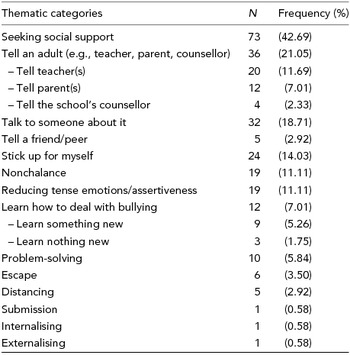
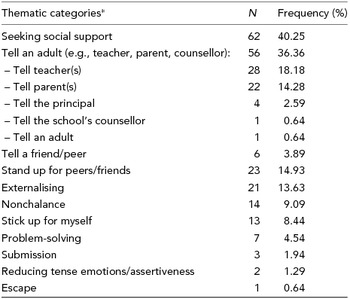
The qualitative technique of content analysis was undertaken for processing the participants’ written responses. Students’ comments were imported into NVivo/10.0 coding software, which allows researchers to analyse the content of qualitative data. This software permits a data classification system through applying codes, organising them in order of appearing categories, and revealing relationships between different categories (Bazeley & Jackson, Reference Bazeley and Jackson2013). The content analysis process described by Wilkinson (Reference Wilkinson and Smith2004) was followed whereby participants’ open-ended responses were coded into closed categories derived from the data itself. An advantage of this process, Wilkinson states, is that ‘it also allows for the conversion of qualitative data into a quantitative form’ (p. 197). Moreover, each category may be described using representative quotations and presented in a table. One of the authors started the process of primary level coding by applying codes to explicit units of written information throughout the pool of data (Bazeley, Reference Bazeley2009). Subsequently, the number of codes was minimised by grouping them into inductive categories and subcategories according to broader themes that arose, based on their content (Welsh, Reference Welsh2002). Finally, the relationships among content themes in terms of common and distinct characteristics were detected and addressed. The prevalence rate of each content theme is numerically presented in Table 1 and Table 2.
Thematic Categories of Learning Coping Strategies

Note: *Several responses fell into more than one thematic category.
Thematic Categories of Action Taken Against a Bullying Situation

Note: *Several responses fell into more than one thematic category.
In order to reinforce the credibility of the emergent categories, initial interrater reliability was carried out by two of the researchers for 10% of the total cases (randomly selected) until a 100% agreement was reached for all the coding levels. Accordingly, the revised set of codes was applied to the entire sample.
The numerical presentation of the content categories, which were extracted from the written comments of students below, is further analysed and exemplified in the following section in which the personal narratives of the students have been included.
Results
Our first task was to examine whether the participating students had learnt any strategies for coping with bullying after the completion of a relevant educational program. The themes that emerged from students’ responses (N = 90) in relation to recently acquired coping techniques for managing peer harassment are presented in Table 1. In many cases student responses incorporated more than a single thematic category. Based on the descriptive data, 11 key categories of strategies were identified. According to the frequency of being reported, these included: (a) seeking social support, (b) sticking up for oneself, (c) nonchalance, (d) reducing tense emotions/assertiveness, (e) learning how to deal with bullying, (f) problem-focusing, (g) escapism, (h) distancing, (i) submission, (j) internalising, and (k) externalising.
The most frequent response was that of seeking social support and advice from an adult or peer. The majority of participants who reported learning to turn to an adult for help specified that their teacher(s) would be their first choice. Other participants mentioned that their choice would be their parents or the school counsellor. Approximately one third of the participants said they had learned to reach out for support on how to cope with bullying, yet they did not clarify whether this individual was an adult or a peer. With reference to those participants who learned to request social support for handling bullying, only a very small number of students mentioned that they learnt to rely on friends or peers.
The second most commonly mentioned learnt strategy was sticking up for oneself. A sizeable number of students in the sample reported this particular line of action. The third most frequently reported strategy was ignoring the matter, with an equal proportion of students reporting that they had learnt to demonstrate assertiveness as a means for coping with bullying.
In addition to the coping mechanisms cited above, fewer than 10% of the participants mentioned that they had acquired general information about bullying dynamics, whereas in three cases it was stated that nothing new had been learnt. Furthermore, some of the students associated the recently learnt strategies with approaches to problem-focused coping. A relatively small number of students indicated that they had learnt to handle bullying by ‘escaping’ and evading the bullies. An almost equivalent percentage of participants did so by distancing themselves from incidents of bullying. Finally, the following three strategies were mentioned only by three individuals: (a) internalising, (b) externalising, and (c) submission.
Our second task was to examine the kind of action that students needed to take when faced with bullying. Seventeen responses out of a total of 133 (12.8%) had to be excluded from the data analysis because they were irrelevant. In a large number of cases, students quoted more than a single thematic category. As Table 2 shows, nine key categories of the action taken were identified. According to the frequency of being reported, these included: (a) seeking social support, (b) standing up for peers/friends, (c) externalising, (d) nonchalance, (e) sticking up for oneself, (f) problem-solving, (g) submission, (h) reducing tense emotions/assertiveness, and (i) escapism.
More specifically, ‘seeking social support’ was reported by the participants as the most frequent action taken when faced with bullying. Those participants who turned to an adult for help showed a preference for their teachers, with a second preference for parents, followed by the school's principal, the school's counsellor, and any adult in general without specifying who. The second most frequently reported course of action was to stand up for their peers, followed by externalising coping and nonchalance about any provocation. Yet a marginally smaller number of the sampled students had to defend themselves by reacting directly to the bully.
Moreover, only a few participants reported utilising problem-solving processes. Finally, there was a very small group of students who took action against bullying in one of the following coping approaches: (a) submission, (b) reducing tense emotions/assertiveness, and (c) escapism.
Student responses accord with evidence-based practices encouraging victimised students to report their experiences to teachers, parents or peers (Dowling & Carey, Reference Dowling and Carey2013; Slee & Murray-Harvey, Reference Slee and Murray-Harvey2008). As the following students so characteristically stated:
Tell a teacher if bullying happens. (Female, 11 years)
To talk to parents and teachers about the problem. (Female, 13 years)
Tell the teacher. Tell a family member. Tell someone. (Female, 11 years)
Many participants placed emphasis on learning assertive strategies that helped them to stand up for themselves by ignoring the bullies. As the following students argued:
I think that this survey has helped kids that have been bullied learn how to cope with bullying and now it will help them stand up for themselves. So thank you. (Female, 11 years)
To stick up for yourself and walk away or don't talk to the bully. (Female, 12 years)
Ignore them and keeping going. Don't give them the reaction they want. (Male, 13 years)
Other students emphasised the benefits of learning assertiveness enhancement as a means for coping with feelings of distress resulting from facing a threatening situation and acknowledged the effectiveness of this method for increasing confidence. As the following participants stated:
To feel and act more confident . . . (Male, 13 years)
Not feel scared, try to be confident. (Male, 12 years)
Within this context of reasoning, some students went a step further by recommending useful methods for curbing negative emotions and achieving a calm emotional state. These techniques included listening to music, controlling externally directed anger or fear, as well as applying self-encouragement techniques. As the following students indicated:
Listen to calm music. (Male, 13 years)
Don't make yourself feel bad. (Male, 14 years)
To not let the bullies get me down. (Female, 13 years)
Stay cool calm and collected. (Female, 11 years)
A small number of students addressed the benefits of school-wide anti-bullying programs for obtaining general information about bullying dynamics and its manifestations, which enabled them to become more competent in handling such incidents. The following statements are examples of this reasoning:
How to take care of the bullying. (Female, 13 years)
I learnt all kinds of bullying names and I learnt how I can stop the bullying people by telling teachers, parents and friends. (Male, 12 years).
Only an extremely limited number of participants reported that they had recently learned some problem-solving coping mechanisms. As the following students pointed out:
To use the school program. (Female, 13)
To turn off electrical devices if it is cyber bullying. (Female, 14 years)
That you should try to make new friends. If it gets worse talk to someone you trust about it. (Male, 14 years)
There were a few cases where participants reported that they had learnt emotion-centred approaches for handling bullying. These approaches principally included: avoiding the stressful situation of being targeted by evading the bullies, detaching themselves from the stressful circumstance by pretending that bullying never occurred, or by imaging that the bullies did not actually exist. As the students stated:
Walk away. Ignore the bully. (Female, 12 years)
Pretend they are a rainbow unicorn wearing bright pink underwear. (Female, 13 years)
To pretend that I never heard what they said and pretend to not be affected by it. (Female, 13 years)
Pretend they are not there. (Male, 11 years)
Specific courses of action taken for handling instances of bullying ranged from those viewed as approach-centred coping mechanisms, which were the most frequently reported, to those identified as emotion-oriented methodologies. More specifically, the majority of those participating favoured ‘seeking social support’ from their teachers or parents when faced with bullying. As the following participants pointed out:
There's someone in my class that picks on the disabled class because he thinks that they won't do anything and unfortunately they don't but I once saw him bully someone and I told the teacher. (Male, 12 years)
My friend was being bullied for being Asian and I told the bully to not be racist and told the teacher. The teacher talked to the bully and it continued so my friend and I told the principal and the bully got internally suspended. (Female, 14 years)
A small proportion of bystanders reported that on witnessing a threatening episode between peers, they intervened in favour of the victims by telling the bullies to stop or informing a teacher. As the following students put it:
In primary school my best friend was being bullied by a guy in our class. She let it go for a while but we could tell something was wrong. She talked to our close group of friends and we decided that we would confront him and let him know what he was doing was not right. (Female, 13 years)
My friend's presentation was being laughed at and I told them to stop. (Female, 13 years)
One time when I was playing soccer with my friends and other people and someone wanted to play with us but someone didn't want him to, and I said come on let him play it won't hurt anyone and the other guy said shut it to me, and I told the guy just play, it won't hurt you. (Male, 13 years)
Some participants reported that they had relied on counterproductive externalising strategies in handling instances of bullying. As the following students remarked:
I had a medical condition in my leg that went on for a year and a half but my ‘friend’ didn't seem to get that so after weeks of him kicking my leg and tripping me up I finally turned around and punched him so hard in the chest and cracked his rib. This was the last time he verbally or physically abused me. (Female, 13 years)
He wanted to fight so I did. I won, then it stopped. (Male, 13 years)
I beat up a kid who was attacking my friends and I broke his nose. (Male, 14 years)
Some students acted against bullying by ignoring any threatening occasion, downplaying its importance, letting it go, and continuing with everyday life. As the following students stated:
Sometimes I get called names but I just ignore it. It does not happen very often. (Female, 14 years)
I ignored them and they left. (Female, 14 years)
My friend was being called names, so I told her to ignore them. (Female, 13 years)
Defending themselves by reacting directly and making the bully aware of their objection to being bullied and requesting that the bullying stop was another common response made by participants, as the following statements show:
When someone was calling me names, I told them to stop, so they did. (Female, 14 years)
If they pick on you and you stand proud, they will back off. (Female, 14 years)
When someone was ignoring me I just went up to them and asked them why, they didn't have a reason. (Male, 14 years)
Only a very small number of students reported utilising problem-solving processes for handling bullying. In the majority of cases the problem-solving strategies included: (a) making new friends, (b) behaving nicely towards the bullies, (c) hindering the bullies from having access to other people's personal electronic gadgets, (d) waiting for the bully to make a mistake before getting back at him, and (e) learning from mistakes. As the students below argued:
Try and make new friends. (Female, 11 years)
I slowly waited for the bully to make her mistake. She did, she got expelled. (Female, 12 years)
I was on Facebook, some person kept saying I will find you so I blocked them. (Female, 14 years)
Someone was talking about me behind my back. Unfortunately for them I happened to be there at the time (they just didn't realise) and the massive shock they got from seeing me there and the fact that I was nice to them about it solved the problem. (Female, 14 years)
Discussion
The participating students reported that they had learnt a variety of new coping tactics for managing incidents of bullying. In particular, recently learnt approach-centred coping mechanisms, such as seeking social support, confronting bullies in an assertive manner, ignoring provocations, and following problem-solving procedures when handling episodes of bullying were among the most frequently reported. Hence, the participants’ accounts appear generally to be in alignment with both governmental policy advice provided to Australian teachers and many of the prominent components of comprehensive school-based anti-bullying initiatives implemented within schools (Dowling & Carey, Reference Dowling and Carey2013; Skrzypiec, Slee, Murray-Harvey et al., Reference Skrzypiec, Slee, Murray-Harvey and Perreira2011).
One interesting finding of the present study concerns the extremely small number of participants reporting that they sought support from the school counsellor when confronted with bullying from peers. Nevertheless, this evidence accords with that of previous studies indicating that counsellors have typically taken a limited role in preventing and addressing bullying in schools (Jacobsen & Bauman, Reference Jacobsen and Bauman2007). Hence, significant implications emanate from this finding in terms of promoting school counsellors’ participation in carrying out anti-bullying initiatives and familiarising students with evidence-based practices for ending victimisation.
Yet, only a very small number of students reported that they learnt how to rely on friends and peers in tackling bullying. Students’ views might be considered in line with previous evidence demonstrating that students generally do not favour peer-centred support strategies for counteracting victimisation (Fekkes, Pijpers, & Verloove-Vanhorick, Reference Fekkes, Pijper and Verloove-Vanhorick2005; Frisen, Hasselblad, & Holmqvist, Reference Frisen, Hasselblad and Holmqvist2012) and perceive their teachers’ interventions as more effective in ending bullying than the intervention of their school mates.
Adopting interpersonal assertive strategies has been found to be appealing and hence frequently used by bullied students (Camodeca & Goossens, Reference Camodeca and Goossens2005; Tenenbaum et al., Reference Tenenbaum, Varjas, Meyers and Parris2011). Nonetheless, evidence suggests that the effectiveness of the strategies mentioned above is likely to vary according to the type of bullying and bully/victim status of the students involved (Elledge et al., Reference Elledge, Cavell, Ogle, Malcolm, Newgent and Faith2010; Kanetsuna et al., Reference Kanetsuna, Smith and Morita2006).
Despite the emphasis of many school-based anti-bullying prevention strategies delivered by teachers on students’ problem-solving skills training, it is quite distressing that only a limited number of the participants involved in this study reported that they had recently learned some problem-solving coping mechanisms.
This finding further endorses recommendations by Frydenberg et al. (Reference Frydenberg, Lewis, Bugalski, Cotta, McCarthy, Luscombe-Smith and Poole2004) that there is a need for students to be directly taught precise skills for handling adverse social problems and resolving peer alterations.
Contrary to the aforementioned constructive approach-oriented strategies, there were a few cases in which the participants reported that they had learnt emotion-centred approaches for handling bullying. Overall, it is truly promising that, as it was the case with students surveyed by Kristensen and Smith (Reference Kristensen and Smith2003), the participants in this study also reported the aforementioned emotion-oriented strategies less regularly than the approach-centred adapting mechanisms cited previously. This implies that students are receptive to learning productive strategies that will equip them with sufficient skills for handling bullying successfully and therefore these particular coping approaches need to be further promoted in prospective anti-bullying training programs to be delivered by school counsellors and teachers.
Action Taken Against Victimisation
The participating students’ responses cited above are further endorsed by their reports on the specific courses of action taken for handling instances of bullying. Yet, an intriguing finding from this study is that the vast majority of the participants appear to be reluctant to get advice from school counsellors on how to tackle incidents of victimisation. Nonetheless, hesitation on the part of the participating students might be partially explained if it is viewed in relation to the distinct practices and strategies that teaching staff and counsellors typically utilise for handling bullying in schools. More specifically, educators seem, by all accounts, to be better equipped to work with the bullies rather than the victims, and to utilise mainly punitive measures, enforcing discipline and sanctions on the perpetrators of aggressive behaviour (Harris & Willoughby, Reference Harris and Willoughby2003). On the other hand, counsellors tend to focus on supporting those who have been victimised by expressing empathy for their anguish, providing emotional support through both individual and group counselling, and rebuilding the victim's self-confidence consequent to a traumatic experience (Bauman, Rigby, & Hoppa, Reference Bauman, Rigby and Hoppa2008). The aforementioned methods may gradually result in the development of skills in how to cope and may lead to positive outcomes in the long run, but they do not offer instant solutions to the victims’ problems, nor do they provide any radical means for terminating their suffering, which is what most sufferers would expect after having reported bullying to the support personnel in their schools.
Considering the emphasis placed on problem-focused methodologies in most anti-bullying activities actualised in Australian schools, it is disturbing that fewer than half of the participants in the study reported asking an adult for help to counteract an incidence of bullying. Still, common parallels can be identified between the participants’ responses and those of their counterparts in Australia (Fekkes et al., Reference Fekkes, Pijper and Verloove-Vanhorick2005) and other contexts, who, likewise, tend to count less on teachers’ assistance (Crothers et al., Reference Crothers, Kolbertb and Barker2006). Adolescent students, in particular, often do not feel comfortable in approaching school staff and those who do report problems feel that teachers and counsellors do not always act according to their expectations (Jacobsen & Bauman, Reference Jacobsen and Bauman2007; Kanetsuna et al., Reference Kanetsuna, Smith and Morita2006; Tenenbaum et al., Reference Tenenbaum, Varjas, Meyers and Parris2011).
Though only a small minority of participants confided in a friend about their experience of victimisation, it is, at the same time, very promising that a small yet noteworthy proportion of bystanders reported that on witnessing a threatening episode between peers, they intervened in favour of the victims by telling the bullies to stop, or informing a teacher. The response from participants in these instances reflects the positive outcomes of peer-led strategies against aggressive interactions (Paul, Smith, & Blumberg, Reference Paul, Smith and Blumberg2012; Terranova, Reference Terranova2009). Despite the moderate effectiveness of these approaches (Paul et al., Reference Paul, Smith and Blumberg2012), they still represent the most favourable means for schools to build a peer ecology that fosters everyone's right to feel safe within a learning community.
Contrary to the aforementioned constructive approach-oriented strategies, a noteworthy proportion of participants reported that they had relied on counterproductive externalising strategies in handling instances of bullying. Although the evidence here may depart somewhat from past research of outcomes of sampled European middle-school students (Kristensen & Smith, Reference Kristensen and Smith2003), at the same time it is in line with other findings that suggest that, regardless of the emphasis placed by schools on constructive strategies, students ultimately rely on externalising approaches (Black et al., Reference Black, Weinles and Washington2010).
Within this context of counterproductive coping mechanisms, some students acted against bullying by ignoring any threatening occasion, downplaying its importance, letting it go, and continuing with everyday life. As previous evidence suggests, ignoring the bullies has been identified among the most favoured strategies employed by students for countering victimisation (Kristensen & Smith, Reference Kristensen and Smith2003). However, its reported effectiveness is debatable and likely to vary according to the type of victimisation and students’ gender. For example, the results of the bi-national study conducted by Kanetsuna et al. (Reference Kanetsuna, Smith and Morita2006) in England and Japan demonstrated that students recommended ‘ignoring’ as a means of counteracting verbal confrontations only. Yet the study by Elledge and his associates (Reference Elledge, Cavell, Ogle, Malcolm, Newgent and Faith2010) documented that nonchalance was an effective strategy for handling verbal victimisation only for bullied females, but not for bullied males.
Some participants reported that they had to defend themselves by reacting directly and making the bully aware of their objection to being bullied and requesting that the bullying stop. Responding assertively has generally been highly rated by students in hypothetical scenarios (Elledge et al., Reference Elledge, Cavell, Ogle, Malcolm, Newgent and Faith2010; Frisen et al., Reference Frisen, Hasselblad and Holmqvist2012; Tenenbaum et al., Reference Tenenbaum, Varjas, Meyers and Parris2011) and it is truly promising that a small proportion of participants relied on such a strategy in acting against victimisation. As found in other studies (Frisen et al., Reference Frisen, Hasselblad and Holmqvist2012), regularly victimised and particularly male students seem to be reluctant to employ self-reliant coping strategies. Consequently, special provision for these two particular groups of Australian students needs to be made, with emphasis being placed on school-based instructional courses involving assertive coping techniques.
It is of concern that only a very small number of students reported utilising problem-solving processes for handling bullying. Such a low proportion may therefore suggest that students have neither learnt nor accepted some of the recommended strategies included in various anti-bullying initiatives implemented within Australian middle schools. Hence, this last finding has implications in terms of content formulation and the implementation of prospective preventive instructional programs aimed at coping with bullying and which school counsellors and teachers may be called upon to deliver to Australian students.
Conclusions and Implications
The findings are built on the authentic voices and experiences of young students dealing with school bullying, whose reported accounts lend strength and credence to the legitimacy and trustworthiness of the data. Certainly, the evidence presented here remains unique to the particular sample of Australian participants. Nevertheless, this should not be viewed as a methodological drawback since it serves fully the purpose of the present qualitative analysis. The personal accounts of the sample of students add depth to what has already been reported in existing literature relevant to coping with school bullying. At the same time they highlight some noteworthy implications about the professional role of Australian school counsellors, their responsibilities in supporting students in need, and their addressing of incidents of victimisation. It became evident that the participants in this study neither reported incidents of victimisation to school counsellors, nor did they seek advice on how to put a stop to the torment inflicted on them by their peers. Students valued the support and assistance provided by teaching staff or relatives more than the professional aid and formal support available from systems operating within their schools.
This preference could thus be indicative of a lack of faith in the professional skills of their school counsellors and the perceived effectiveness of the support provided. Nevertheless, these findings need to be seen within the wider perspective, one that takes into account factors that may influence a student's perception of instances of bullying and the reporting of such incidents. As previously noted, the approaches that school counsellors typically employ for providing their services are not deemed to offer immediate solutions to students’ urgent problem when experiencing victimisation. It is also possible that students, in seeking retribution or punishment for those who bully them, are aware they are not likely to receive this from school counsellors and so look to other adults to advocate on their behalf. The considerations above may therefore make students sceptical about the effectiveness of school counsellors’ practices in ending their victimisation. Such scepticism may be further compounded by the stigma that is typically associated with referrals to the school mental health practitioners and services; this is more the case with adolescents who fear having their personal weaknesses exposed, due to a lack of confidentiality (Raviv, Raviv, Vago-Gefen, & Fink, Reference Raviv, Raviv, Vago-Gefen and Fink2009).
Overall, we argue that it would be beneficial for Australian teachers and students if counsellors were proactive leaders in carrying out anti-bullying initiatives. Their key role would be to implement preventive school-wide policies and to deliver training to teaching staff and students on relevant areas including: (a) raising awareness about the salient devastating psychosocial effects of victimisation, (b) setting up positive supportive peer networks, and (c) endorsing non retaliatory productive responses and coping strategies.
Acknowledgments
None.
Financial Support
This research received no specific grant from any funding agency, commercial, or not-for-profit sectors.
Conflict of Interest
None.