INTRODUCTION
Productivity has been the main goal of traditional agricultural systems. Currently, there is increased concern about the quality of both crop production and the environmental contamination that the over-utilized inputs may produce. In this context, the nitrogen economy of crops acquires great relevance, and particularly when wheat is grown in Mediterranean environments that are characterized by drought and high temperatures during the grain filling period (Bidinger et al. Reference Bidinger, Musgrave and Fischer1977; Shepherd et al. Reference Shepherd, Cooper, Allan, Drennan and Keatinge1987; Papakosta & Gagianas Reference Papakosta and Gagianas1991), which limit yield (Acevedo et al. Reference Acevedo, Silva, Silva, Solar, Satorre and Slafer1999) and consequently nitrogen use efficiency (R. Savin, personal communication).
In wheat and other cereal crops, yield and grain nitrogen concentration (GNC; Pepe & Heiner Reference Pepe and Heiner1975; Day et al. Reference Day, Paulsen and Sears1985; Heitholt et al. Reference Heitholt, Croy, Maness and Nguyen1990; Naylor & Stephen Reference Naylor and Stephen1993; Calderini et al. Reference Calderini, Dreccer and Slafer1995a, Reference Calderini, Torres-León and Slaferb; Oury et al. Reference Oury, Berard, Brancourt-Hulmel, Depatureaux, Doussinault, Galic, Giraud, Heumez, Lecompte, Pluchard, Rolland, Rousset and Trottet2003; Triboi et al. Reference Triboi, Martre, Girousse, Ravel and Triboi-Blondel2006) or grain protein content (Simmonds Reference Simmonds1996; Triboi & Triboi-Blondel Reference Triboi and Triboi-Blondel2002; Guarda et al. Reference Guarda, Padovan and Delogu2004) are commonly negatively correlated. In fact, Benzian & Lane (Reference Benzian and Lane1981) and Jenner (Reference Jenner1991) reported that while starch deposition lies on an asymptotic region of a rate v. supply relationship (source is higher than grain growth capacity), protein deposition lies on a linear region (source is clearly limiting grain nitrogen accumulation (GNA)). This was later confirmed by Triboi & Triboi-Blondel (Reference Triboi and Triboi-Blondel2002), Martre et al. (Reference Martre, Porter, Jamieson and Triboi2003) and Triboi et al. (Reference Triboi, Martre, Girousse, Ravel and Triboi-Blondel2006), who showed that the grain itself limits starch synthesis more than protein synthesis, while protein synthesis is more source-limited than starch synthesis. Thus, understanding the basis of GNA could help breeders to determine whether they can break the negative relationship between yield and GNC to improve both traits simultaneously (or at least improve one without negative effects on the other). For this purpose, studying the pre-anthesis nitrogen accumulation and further remobilization to grains in cultivars released at different breeding periods may be relevant. Studies reporting results of breeding effects on the capacity of wheat cultivars to uptake and remobilize nitrogen (e.g. Fischer & Wall Reference Fischer and Wall1976; Austin et al. Reference Austin, Bingham, Blackwell, Evans, Ford, Morgan and Taylor1980; Slafer et al. Reference Slafer, Andrade and Satorre1990; Papakosta & Gagianas Reference Papakosta and Gagianas1991; Canevara et al. Reference Canevara, Romani, Corbellini, Perenzin and Borghi1994; Calderini et al. Reference Calderini, Torres-León and Slafer1995b; Foulkes et al. Reference Foulkes, Sylvester-Bradley and Scott1998; Muurinen et al. Reference Muurinen, Kleemola and Peltonen-Sainio2007) generally found that GNC decreased with the year of release of cultivars.
GNC depends mainly on the remobilization of nitrogen accumulated before anthesis and stored in vegetative tissues (Spiertz & De Vos Reference Spiertz and De Vos1983; Van Sanford & MacKown Reference Van Sanford and MacKown1987). The ability of the crop to export nitrogen from vegetative tissue may come either from improved capacity of the grain to accumulate nitrogen or from greater nitrogen supply to the grains (Triboi & Triboi-Blondel Reference Triboi and Triboi-Blondel2002). In fact, reports in wheat and other cereals have shown that GNA may depend upon an intrinsic grain control (Borghi et al. Reference Borghi, Corbellini, Cattaneo, Fornasari and Zucchelli1986; Wyss et al. Reference Wyss, Czyzewicz and Below1991; Mattsson et al. Reference Mattsson, Lundborg and Larsson1993) or, more importantly, by the nitrogen source-strength (Barlow et al. Reference Barlow, Donovan and Lee1983; Wyss et al. Reference Wyss, Czyzewicz and Below1991; Barneix & Guitman Reference Barneix and Guitman1993; Ma et al. Reference Ma, MacKown and Van Sanford1995, Reference Ma, MacKown and Van Sanford1996; Dreccer et al. Reference Dreccer, Grashoff and Rabbinge1997; Voltas et al. Reference Voltas, Romagosa and Araus1997; Martre et al. Reference Martre, Porter, Jamieson and Triboi2003). Breeding has decreased the post-anthesis source-sink balance of wheat by noticeably increasing grain number/m2, while crop growth capacity was not clearly altered (Calderini et al. Reference Calderini, Reynolds, Slafer, Satorre and Slafer1999), even under Mediterranean growing conditions such as those of Spain (Acreche & Slafer Reference Acreche and Slafer2009). This fact could imply changes within improved cultivars in the degree of nitrogen source-limitation for GNA that wheat is generally reported to have (Radley & Thorne Reference Radley and Thorne1981; Koshkin & Tararina Reference Koshkin and Tararina1989; MacKown et al. Reference MacKown, Van Sanford and Zhang1992; Ma et al. Reference Ma, MacKown and Van Sanford1995, Reference Ma, MacKown and Van Sanford1996; Martre et al. Reference Martre, Porter, Jamieson and Triboi2003). To the best of our knowledge, the only experiment studying the GNA of cultivars differing considerably in grain number/m2 (the main yield component improved by breeders) subjected to different source-sink ratios during grain filling was by Martre et al. (Reference Martre, Porter, Jamieson and Triboi2003). They reported increased nitrogen source-limitation (from 0·09 in the cultivar with the lowest number of grains/m2 to 0·29 in the cultivar with the highest grain number/m2) for grain nitrogen content (GN content). However, the study of Martre et al. (Reference Martre, Porter, Jamieson and Triboi2003) was not conducted under Mediterranean conditions, such as those of southern Europe, where successful cultivars may depend on better reserve accumulation rather than fruiting efficiency (grain number/unit of spike dry matter at anthesis; Acreche et al. Reference Acreche, Briceño-Félix, Martín Sánchez and Slafer2008). The fact that the accumulation of nitrogen in the grains was expressed as GN content (mg N/grain) and not as GNC (mg N/g grain) is due to the fact that altering the source-sink balance generally produced changes in the average grain weight that could lead to a confused interpretation of the accumulation of nitrogen in the grains if expressed as GNC.
As nitrogen absorption occurs mainly during pre-anthesis (Austin et al. Reference Austin, Ford, Edrich and Blackwell1977; Loffler et al. Reference Loffler, Rauch and Busch1985; Heitholt et al. Reference Heitholt, Croy, Maness and Nguyen1990), and due to the fact that during this period the number of grains/unit area is being determined (Kirby Reference Kirby1988; Slafer Reference Slafer2003), altering the growing conditions during this period may allow further exploration of the basis of GNA. It has been widely reported that pre-anthesis shading dramatically reduces the number of grains/m2 (e.g. Fischer & Stockman Reference Fischer and Stockman1980; Thorne & Wood Reference Thorne and Wood1987; Savin & Slafer Reference Savin and Slafer1991; Wang et al. Reference Wang, Yin, He, Zhang, Lu, Li and Shi2003; Demotes-Mainard & Jeuffroy Reference Demotes-Mainard and Jeuffroy2004; González et al. Reference González, Slafer and Miralles2005) and that the main genetic gains in yield were due to increased number of grains/m2 (see Slafer et al. Reference Slafer, Satorre, Andrade and Slafer1994; Calderini et al. Reference Calderini, Reynolds, Slafer, Satorre and Slafer1999), even under Mediterranean conditions (Acreche et al. Reference Acreche, Briceño-Félix, Martín Sánchez and Slafer2008). However, to the best of our knowledge no study has been conducted combining, in a factorial design, the effects of pre-anthesis shading and cultivars of different potential number of grains/m2 on the GNA. Only Slafer et al. (Reference Slafer, Satorre, Andrade and Slafer1994), Wang et al. (Reference Wang, Yin, He, Zhang, Lu, Li and Shi2003) and Acreche et al. (Reference Acreche, Briceño-Félix, Martín Sánchez and Slafer2009) have conducted experiments on the effect of pre-anthesis shading treatments on cultivars of different potential number of grains/m2 but none of them reported results on GNC or on the nitrogen economy of the crop.
The present study aimed at clarifying the main physiological determinants of GNA in wheat under a wide range of Mediterranean conditions (low, moderate and high inputs) and to analyse how breeding has affected them. For this purpose, old and modern genotypes were compared and their responses to treatments of source-sink ratios (pre-anthesis shading or post-anthesis spike trimming) were analysed in Mediterranean conditions.
MATERIALS AND METHODS
General
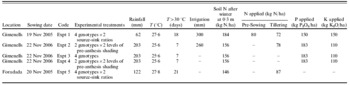
Five field experiments were carried out at the province of Lleida (Catalonia, north-eastern Spain) during the 2005/06 and 2006/07 growing seasons. Two of the experiments were conducted at Gimenells (41°37′N, 0°22′E, 248 m asl) under high inputs and well irrigated conditions, one in 2005/06 and the other in 2006/07 (hereafter Expt 1 and Expt 2, respectively). Another two experiments at Gimenells were carried out in 2006/07 under moderate inputs, mainly conducted under rainfed conditions but within an irrigated area (hereafter Expt 3 and Expt 4). The last experiment was conducted at Foradada (41°51′N, 1°0′E, 407 m asl) under low inputs and rainfed conditions in 2005/06 (hereafter Expt 5). Table 1 summarizes the main characteristics of the five experiments.
Trial description, rainfall, mean temperature (T) during grain filling, days with temperatures over 30°C (T>30°C) during grain filling, irrigation and fertilization for five experiments conducted in Gimenells or Foradada during 2005/06 and 2006/07 growing seasons with cultivars Aragon 03 (1940), Estrella (1960) and Anza (1978), and line ID-2151

Plots were kept weed- and pest-free with recommended products in all experiments. To prevent lodging, nets that did not modify the canopy architecture were installed at Gimenells near the boot stage for the oldest and tallest cultivar (Aragon 03). All experiments were sown in mid-November (Table 1) and at a sowing density of 350 seeds/m2. Sowing times (Table 1) and plant densities were those most common in the region.
Treatments and design
Each experiment used either four or two bread wheats (Table 1). When four genotypes were used, they were a widely grown landrace (Aragon 03) reported to be cultivated since 1940, cultivars Estrella and Anza (released in 1960 and 1974, respectively) and the advanced line ID-2151 developed by the bread wheat programme of the Institut de Recerca i Tecnologia Agroalimentàries (IRTA) selected for its good performance since 2005 in several comparative experiments of the ‘National Variety Testing and Registration Yield Trials’ run by the Spanish Office of Vegetable Variety (OEVV). When there were two genotypes, they were the oldest (Aragon 03) and the most modern (ID-2151) ones. These genotypes were selected from a previous study (Acreche et al. Reference Acreche, Briceño-Félix, Martín Sánchez and Slafer2008) because they represent different periods of cultivation well, as well as the overall trends of breeding effects from 1940 to 2005 on crop yield in Mediterranean Spain. Additional details of these genotypes can be found in Acreche et al. (Reference Acreche, Briceño-Félix, Martín Sánchez and Slafer2008).
In the two experiments including post-anthesis spike trimming (Expts 1 and 5), treatments consisted of the factorial combination of the four genotypes and two source-sink ratios during grain filling. All the spikelets from the upper half of the spikes of every single shoot in an area 1·2 m2 were hand removed (trimmed spikes) at 7–10 days after anthesis (Decimal Code [DC] 7.1, Zadoks et al. Reference Zadoks, Chang and Konzak1974), while the other part of the plots remained unaltered as controls. Both experiments were arranged in a split-plot design where genotypes were the main plots and the source-sink ratios the subplots. Main plots (eight rows, 0·15 m apart and 5 m long) were randomized in three blocks.
In the two pre-anthesis shading experiments (Expts 2 and 4), treatments consisted of the factorial combination of the two most contrasting wheats (Aragon 03 and ID-2151) and two pre-anthesis shading treatments: unshaded control and shaded from jointing (DC 3.1) to anthesis (DC 6.5). Shading treatments were imposed by a black shade cloth that decreased light intensity by 0·75±0·023. Shades were suspended at least 0·1 m above the top of the canopy. Hobo Canopy Temperature Sensors (Onset Computer Corporation, Bourne, MA, USA) were installed 0·2 m below the top of the canopy in order to monitor possible changes in air temperature due to the shades. Both experiments were arranged in a split-plot design where genotypes were the main plots and the pre-anthesis shading treatments the subplots. Main plots (16 rows, 0·15 m apart and 5 m long) were randomized in three blocks, while eight of the 16 rows were completely shaded generating the sub-plots.
Experiment 3 compared the four genotypes in a randomized complete block design with three replications. Plots consisted of eight rows, 0·15 m apart and 5 m long.
Sampling and measurements
At anthesis and maturity (DC 9.2) all plots and subplots, depending on the experiment, were sampled. Samples consisted of all plants in 0·5 m of central rows at anthesis or 1 m at maturity. As the subplots were relatively small, extreme care was taken to maintain the reliability of the results. Plots were not only sown with experimental machinery that is normally very uniform but also soon after seedling emergence many sectors of the plots in which plants were at the exact density and uniformity expected were tagged and then random sampling was restricted to these tagged sectors. Leaf blades, stems (including leaf sheaths), spikes and grains (the latter only at maturity) were oven-dried and weighed separately. Then samples were milled and the nitrogen content was determined in each case by a micro-Kjeldahl method.
Data from the experiments were subjected to analysis of variance with the SAS system (SAS Institute 2003). The degree of association between different traits was estimated by linear regression models.
RESULTS
Breeding effects on nitrogen accumulation and partitioning
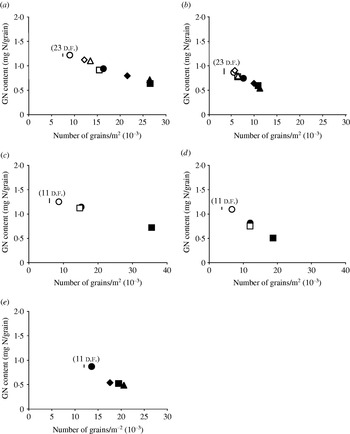
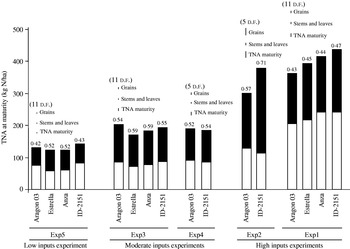
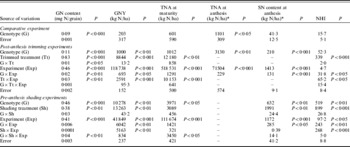
GN content was significantly different between genotypes in all experiments (Table 2). In general, the newer the genotype (and so the higher the number of grains/m2), the lower the GN content (Fig. 1). These differences were not evident for grain nitrogen yield (GNY) and total nitrogen accumulated (TNA) in the above ground biomass at maturity. While GNY was only significantly different between genotypes in the high inputs experiments (Expts 1 and 2), the TNA at maturity was, in general, not significantly different between genotypes (Table 2). In those cases in which GNY was significantly different, there was a trend to increase with the year of release of the genotype (Fig. 2).
Relationship between the GN content and the number of grains/m2 of cultivars Aragon 03 (•, ○), Estrella (◆, ◊) and Anza (▴, ▵), and line ID-2151 (▪, □) in: (a) and (c) high (fertilized and irrigated); (b) low (without fertilization and rainfed), (d) and (e) moderate (fertilized and rainfed) inputs experiments. Panels (a) and (b) also show the response to the trimming treatment (white symbols), while panels (c) and (d) show the response to the shading treatment (white symbols). The bar and the number in brackets on the left side of each panel are the standard error of the mean and the degrees of freedom.

Total nitrogen absorbed (TNA) at maturity in grains (black columns) and vegetative tissues (stems and leaves: white columns) of cultivars Aragon 03, Estrella and Anza, and line ID-2151 in the low (not fertilized and rainfed; Expt 5), moderate (fertilized and rainfed; Expts 3 and 4) and high (fertilized and irrigated; Expts 1 and 2) inputs experiments. The numbers above the columns stand for the NHI (proportion). The bar and the number in brackets on the left side of each experiment are the standard error of the mean and the degrees of freedom.

Mean squares for GN content, GNY, total nitrogen absorbed (TNA) at anthesis and maturity, SN content at anthesis and NHI of cultivars Aragon 03, Estrella and Anza and line ID-2151 in three groups of experiments: comparative experiments (including one experiment with four genotypes under moderate inputs conditions), post-anthesis spike trimming experiments (including four genotypes and two spike trimming treatments in two experiments, low and high inputs conditions) and pre-anthesis shading experiments (including two genotypes and two pre-anthesis shading treatments in two experiments, moderate and high inputs conditions)

* The TNA and SN content at anthesis for the post-anthesis spike trimming experiments was analysed as a complete randomized block design with genotypes as treatment, because the treatment began after anthesis. In the case of TNA at anthesis of the pre-anthesis shading experiments, no samples were taken from vegetative tissues.
The nitrogen harvest index (NHI; GNY as a proportion of TNA at maturity) showed differences between genotypes only in the high inputs experiment of the 2006/07 season (Expt 2; Fig. 2). In this case, the modern line ID-2151 had higher NHI (0·71) than the old genotype Aragon 03 (0·57).
Although there were no major trends for TNA at maturity, clear differences at anthesis were observed in those experiments in which this was measured (Expts 1, 3 and 5; Table 2). Aragon 03 had higher TNA at anthesis than the mean value of TNA at anthesis of the other genotypes: 300 v. 250, 163 v. 126 and 131 v. 107 kg N/ha in the high (Expt 1) and low (Expt 5) inputs experiments of the 2005/06 season and in the moderate inputs experiment of the 2006/07 season (Expt 3), respectively. However, due to their constitutive differences in partitioning, the spike nitrogen content (SN content) at anthesis was 55% higher in Anza and 22% higher in ID-2151 than the mean value of SN content at anthesis of the other genotypes in the high inputs experiment of the 2005/06 season (Expt 1) and moderate inputs experiment of the 2006/07 season (Expt 3), respectively.
GNA as affected by trimming the spikes after anthesis
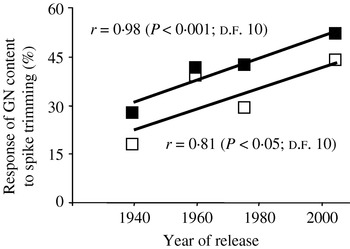
The GN content of all genotypes increased significantly in the high (Expt 1) and low (Expt 5) inputs experiments of the 2005/06 season in response to halving the grain number per spike (Table 2), showing an increase in GN content of 0·21 and 0·32 mg N/grain (mean of all genotypes) of the GN content in Expts 1 and 5, respectively (Fig. 1 a, b). The degree of source-limitation (relative increase, in percentage, of the GN content of trimmed plots with respect to controls) for GNA increased with the year of release of the genotypes (and so with the number of grains/m2) in both experiments from 23% (mean of both experiments) in the oldest cultivar to 48% (mean of both experiments) in the most modern line (Fig. 3). This indicates that the main effect of breeding on GN content was due to a dilution of a limited amount of nitrogen in an increased number of grains/m2.
Relationship between the response of GN content to the spike trimming and the year of release of the genotypes in the low (not fertilized and rainfed; Expt 5: ▪) and high (fertilized and irrigated; Exp1: □) inputs experiments. Each point in the figure represents the mean value of three replications.

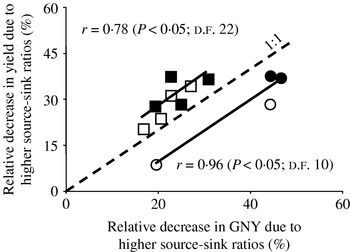
The increase in GN content did not compensate for the GNY loss due to trimming the spikes and so control plots had 41·9 (mean of all genotypes) and 13·2 (mean of all genotypes) kg N/ha more than trimmed plots in Expts 1 and 5, respectively. The relative decrease of GNY due to the trimming treatment was lower than the relative decrease of grain yield due to the same treatment, showing that GNY is less sink-limited than grain yield (Fig. 4, squares).
Relationship between the relative decrease of grain yield and the relative decrease of GNY due to spike trimming (▪, □) or pre-anthesis shading (•, ○) treatments in the low (not fertilized and rainfed; Expt 5: □), moderate (fertilized and rainfed; Expt 4: ○) and high (fertilized and irrigated; Expt 1: ▪ and Expt 2: •) inputs experiments. The dashed line represents the 1:1 relationship. Each point in the figure represents the mean value of three replications.

The significant interaction between trimming treatments and experiments (Table 2) for TNA at maturity showed that there were differences between control and trimmed plots only in Expt 1, where control plots had higher (73 kg N/ha, mean of all genotypes) TNA at maturity than trimmed plots. In the low inputs experiment, the control had higher GNY than trimmed plots but similar TNA at maturity, indicating that under stressful conditions wheat removed more of the stored nitrogen to the grains. This was corroborated by the higher decrease in NHI due to trimming the spikes in Expt 5 (0·24, mean of all genotypes) than in Expt 1 (0·11, mean of all genotypes).
Pre-anthesis shading effects on nitrogen balance
Pre-anthesis shading increased GN content significantly (Table 2) in both Aragon 03 and ID-2151 in Expts 2 and 4. GN content increased by 0·20 mg N/grain (mean of both experiments) in the landrace and by 0·32 mg N/grain (mean of both experiments) in the modern line (Fig. 1 c, d). Again, when the number of grains/m2 increased (modern line) the degree of source-limitation for GN content was also increased, producing a stronger response to a reduced sink-strength.
The increase in GN content did not compensate for the GNY loss due to the pre-anthesis shading and so GNY was 51 kg N/ha (mean of both genotypes and experiments) higher in the unshaded control than in shaded plots. The relative decrease of GNY due to the pre-anthesis shading treatment was higher than the relative decrease of grain yield (Fig. 4, circles). This could imply that GNY was more sink-limited than grain yield. However, in this case, the shaded plots absorbed at anthesis less than 0·60 of the TNA at maturity, while unshaded controls absorbed at anthesis c. 0·80 of TNA at maturity. Thus, the higher relative reduction of GNY due to pre-anthesis shading treatments was affected by the lower N absorbed by the crop.
Again, the treatment that reduced the number of grains/m2 (shaded plots) had lower GNY and similar TNA at maturity than unshaded control (237 v. 263 kg N/ha, mean of both genotypes and experiments). This was evident in the higher NHI of unshaded controls with respect to the shaded plots in Expts 3 and 4, respectively.
DISCUSSION
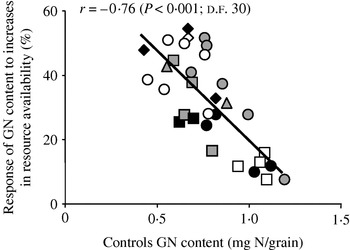
The results of the present study revealed that GNA in wheat under Mediterranean conditions is strongly source-limited. There was a clear breeding effect in reducing the GN content through increases in grain number/m2, producing an important dilution of the nitrogen absorbed by the crop into more grains. Although this was a clear trend in the different experiments of the present paper, the magnitude of the dilution effect differed depending on the agronomic condition of each experiment. The present results corroborate those from other wheat growing areas (e.g. Naylor & Stephen Reference Naylor and Stephen1993; Calderini et al. Reference Calderini, Torres-León and Slafer1995b; Oury et al. Reference Oury, Berard, Brancourt-Hulmel, Depatureaux, Doussinault, Galic, Giraud, Heumez, Lecompte, Pluchard, Rolland, Rousset and Trottet2003; Guarda et al. Reference Guarda, Padovan and Delogu2004), opposing the speculation that successful cultivars in Mediterranean areas would have developed a more conservative determination of grain number/m2, in which case GNA would be less source-limited than modern wheats of non-Mediterranean regions. The fact that wheat is mainly source-limited for GNA agrees with Radley & Thorne (Reference Radley and Thorne1981), Koshkin & Tararina (Reference Koshkin and Tararina1989), MacKown et al. (Reference MacKown, Van Sanford and Zhang1992), Ma et al. (Reference Ma, MacKown and Van Sanford1995, Reference Ma, MacKown and Van Sanford1996), Martre et al. (Reference Martre, Porter, Jamieson and Triboi2003) and Triboi et al. (Reference Triboi, Martre, Girousse, Ravel and Triboi-Blondel2006). The response to improved nitrogen source-sink ratios was generally greater when GN content was lower (Fig. 5), as low GN content probably reveals strong source-limitation for GNA. It is notable that the spike trimming treatment could alter the photosynthetic rate of the plants, which would lead to an incorrect estimate of the nitrogen source-limitation. In fact, Acreche & Slafer (Reference Acreche and Slafer2009) showed that there was a higher leaf maximum photosynthesis rate (A max) in control than in trimmed wheat plants. However, the increase in A max was not proportionally related to the decrease of the number of grains/m2. The present results also agree with those reported by Martre et al. (Reference Martre, Porter, Jamieson and Triboi2003), in that GN content in genotypes with higher numbers of grains/m2 is more responsive to increases in nitrogen availability per grain, further confirming that GNA in wheat is strongly source-limited and that the magnitude of this limitation is positively related to the number of grains/m2.
Relationship between the response of GN content to increases in resource availability (pre-anthesis shading or post-anthesis spike trimming) and the GN content of control plots in the low (not fertilized and rainfed; Expt 5:  ), moderate (fertilized and rainfed; Expt 4:
 ) and high (fertilized and irrigated; Expts 1 and 2:
 ) inputs experiments, and in other experiments from the literature conducted under different environmental backgrounds (Radley & Thorne Reference Radley and Thorne1981: ▪; Koshkin & Tararina Reference Koshkin and Tararina1989: □; MacKown et al. Reference MacKown, Van Sanford and Zhang1992: ◊; Ma et al. Reference Ma, MacKown and Van Sanford1995: ○; Ma et al. Reference Ma, MacKown and Van Sanford1996: ◆; Martre et al. Reference Martre, Porter, Jamieson and Triboi2003: •).

While GNY was unaltered by breeding when wheat was grown under low or moderate inputs conditions, breeding increased GNY under high inputs conditions ranging from 155 to 265 kg N/ha. These values are similar to those reported in other wheat growing areas (e.g. Calderini et al. Reference Calderini, Torres-León and Slafer1995b; Foulkes et al. Reference Foulkes, Sylvester-Bradley and Scott1998; Martre et al. Reference Martre, Porter, Jamieson and Triboi2003) and also to those reported under Mediterranean conditions by Papakosta & Gagianas (Reference Papakosta and Gagianas1991) in Greece as well as from what can be inferred from results of Canevara et al. (Reference Canevara, Romani, Corbellini, Perenzin and Borghi1994) in Italy. However, the NHI in many treatments of the present experiment was lower than that reported in those studies. This could be related to the low harvest index (HI) in the present experiment (Acreche et al. Reference Acreche, Briceño-Félix, Martín Sánchez and Slafer2008), which showed a reduced partitioning of resources under Mediterranean conditions. Both NHI and HI values would have been reduced by the high and stressful temperatures during grain filling, which reduced crop growth (Schenk Reference Schenk1996) or by the terminal drought. The similar GNY and lower HI and NHI in the Spanish Mediterranean region show that there is an important part of the carbohydrate and nitrogen absorbed by the crop that was not remobilized to grains. This might be behind the relatively low success of newer cultivars released in Mediterranean Spain during the last few decades, particularly under low-yielding conditions (Acreche et al. Reference Acreche, Briceño-Félix, Martín Sánchez and Slafer2008).
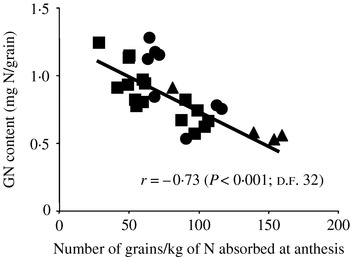
As the main source of nitrogen for the grains is the stored nitrogen accumulated in vegetative organs before anthesis (Spiertz & De Vos Reference Spiertz and De Vos1983; Van Sanford & MacKown Reference Van Sanford and MacKown1987), and since GN content decreased in the present work due to a dilution effect revealed that final GN content depends strongly on the source-sink ratio established at anthesis between the number of grains set and the amount of nitrogen absorbed at this stage (Fig. 6). However, under favourable conditions, there may be an important part of nitrogen absorbed by the crop during post-anthesis that could increase GNC (e.g. Mi et al. Reference Mi, Tang, Zhang and Zhang2000; Woolfolk et al. Reference Woolfolk, Raun, Johnson, Thompson, Mullen, Wyn and Freeman2002; Bly & Woodward Reference Bly and Woodward2003). Nevertheless, this source of nitrogen can only be relatively important when soil humidity remains high during grain filling in order to allow the absorption of nitrogen during this period, a fact that is not common under Mediterranean conditions.
Relationship between the GN content and the ratio of number of grains/m2 to the amount of nitrogen absorbed at anthesis for comparative (▴; Expt 3), post-anthesis spike trimming (▪; Expts 1 and 5) and pre-anthesis shading (•; Expts 2 and 4) experiments.

Thus, it would be necessary to increase the amount of nitrogen absorbed at anthesis more than the number of grains to overcome the negative relationship between yield and GNC. As nitrogen uptake can be converted into grains/m2 (Fischer Reference Fischer1993; Prystupa et al. Reference Prystupa, Savin and Slafer2004), simultaneous improvement of yield and GN content would be required to reduce the nitrogen use efficiency. This is probably why breeding has consistently and systematically reduced GNC whenever it was successful in boosting potential yields.
We thank Josep A. Betbesé and the field team of IRTA for their technical assistance. M. M. Acreche held a pre-doctoral scholarship from the Departament d' Educació i Universitats de la Generalitat de Catalunya i del Fons Social Europeu. The study was partially funded by grants from Ministry of Science and Technology of Spain (AGL 2001-3824-C04-01 and AGL 2006-07814/AGR).