INTRODUCTION
Several challenges have to be met concerning the radiocarbon (14C) dating of modern music instruments made between the 16th and 19th centuries. Dendrochronology cannot be carried out on modern music instruments as the tree-ring record is too short and 14C dating may be a priori rejected for historical periods as a 14C physical measurement may result in several equiprobable age ranges. Several samplings and independent expertise are then required to make a well-considered choice between these intervals. Owing to the new generation of 14C dating instruments, a compact 14C dating system such as the Mini Carbon Dating System (MICADAS) (Synal et al. Reference Synal, Stocker and Suter2007) allows some hundreds of micrograms of material to be sampled. For wood, the sample is thus as small as a pinhead. This new technology opens the door to multisampling without it being visible and without it affecting the instrument’s playing quality. This might at least partly resolve issues of multi-interval calibration. Beyond the physical analysis, museum studies are another reliable means of investigation to attempt to find clues to the manufacturing period and history of the instrument. This approach involves the gathering of documents, the expertise of curators and restorers, and reports of scientific analyses used in cultural heritage institutions that are required for the study of instruments using 14C dating. The interdisciplinary framework makes it possible to combine any ante quem or post quem information on the age of relics or music instruments. In this approach, we will draw on an ongoing project on modern music instruments involving radiocarbon dating specialists and museum experts. There are three challenges to be overcome: (1) the sample size, which will not extend beyond a few hundred micrograms, (2) the composite constitution of the instrument (varnishes, glues, restored parts), which requires specific and complex chemical protocols to extract the carbon to be dated, and (3) the historical period which is not favorable to radiocarbon dating due to complex calibration curves. Our goal here is to date two amazingly well-preserved vina about which little information is available and possibly contribute to scientific knowledge about their origin and the history of their making.
MATERIAL AND METHOD
Material
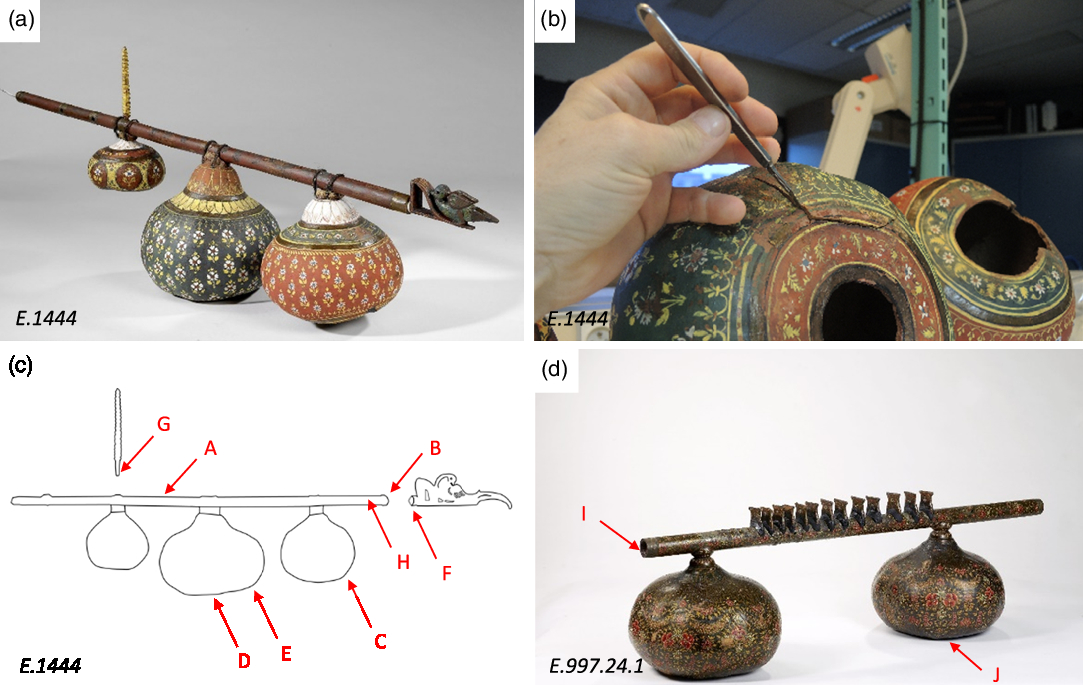
Our study focuses on two vina, Indian stringed instruments belonging to the tube zither family and kept at the Musée de la musique in Paris. The first one is a kinnari vina (E.1444, Figure 1a,b). The second one is a bin (also called today rudra vina) (E.997.24.1, Figure 1d), which was played for centuries in North Indian princely courts. Vina are composed of a wooden tube onto which are fixed gourds which act as resonators. The conservation state of both vina is exceptional, although the constitutive and painted parts are very fragile and the storage conditions under the initial tropical climate were unfavorable, according to museum studies. Visual inspections under an optical microscope, endoscopic analysis, x-ray digital radiography, and XRF investigations were performed during museum studies and showed no visible evidence to suspect that certain parts had been replaced. None of the vina showed visible surface contamination. The decorations are original and it is very likely that gourds were chosen with care according to their acoustic properties (Bruguière et al. Reference Bruguière, Echard, Le Conte, Haegele and Vaiedelich2008).
Indian vina from the museum collections and sampling locations: (a) kinnari vina E.1444, (b) close up of sampling in a crack from kinnari vina E.1444, (c) schematic view of the kinnari vina E.1444 and location of the 8 samples, (d) bin or rudra vina E.997.24.1 and sample locations. Pictures by Claude Germain (a, d) and Stéphane Vaiedelich (b) © Musée de la musique-Philharmonie de Paris.

The kinnari vina (E.1444, Figure 1a,b) is made of three gourds (Lagenaria siceraria) fixed under a reed tube, made of Arundo donax, a species found in East and Southeast Asia. This makes this kinnari vina singular. A piece of wood from a Dalbergia latifolia, named “Indian rosewood,” was carved in the form of a bird (a parrot) and inserted at the end of the tube. This part was used as a string holder and a bridge. The upper nut painted yellow with orpiment is made of Artocarpus chama Buch, a wood commonly called “terap” and found in Southeast Asia. An ancient iconography (Day Reference Day1891) presents a kinnari vina showing the same singular features without any decoration. The kinnari vina E.1444 entered the collections in 1892. It was sold to the museum by Gand and Bernardel, renowned Parisian violin makers and valuable music instrument dealers of the 19th century, who may have bought it in a public sale. The floral pattern of this kinnari vina is a motif found on 17th and 18th century artifacts produced in the region of Hyderabad (Andhra Pradesh) situated in Southeast India. According to the curator who relies on organological features and the painted patterns, this musical instrument could have been made in the 18th century.
The bin or rudra vina (E.997.24.1, Figure 1d) consists of two resonators made of gourds, a tube made of teak wood (Tectona grandis), and 13 wooden frets. The pegs and the string holder are missing. A mixture of beeswax and plant resin was traditionally used to stick the frets onto the tube. The highly sophisticated decoration of this vina comprises five successive layers: an undercoat of clay with iron oxides, a support of metallic sheet in tin, an organic layer with resin and paint layers. This bin was acquired by the museum in 1997. It is referenced as coming from Rajasthan, Northwest India, and it has been tentatively dated from the first half of the 17th century.
Method
Sampling
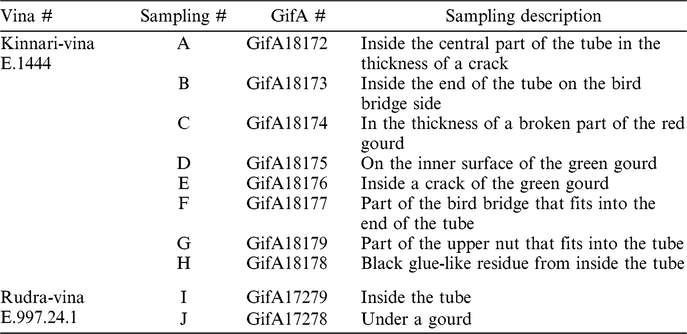
The 14C activity was measured on 7 subsamples, representative of each of the constituent elements, of the kinnari vina (Figure 1c, Table 1) and on two subsamples of the bin (Figure 1d, Table 1). An eighth sample was taken on the kinnari vina: a black glue residue found inside the tube (Figure 1c, sample H). All the samples were of less than a few hundred micrograms of carbon. Samples taken from both vina belong to original components of the instruments. Each of them is devoid of any traces of varnish, painting, and wax and protected from other environmental contamination. They were taken in nonvisible areas inside the gourds or the tube, inside cracks, etc. (Figure 1b).
List of samples from kinnari vina and rudra vina (refer to Figure 1 for locations).

Treatment
As no visible surface contamination was highlighted through previous investigations and samples were extracted from hidden, uncolored parts of the instruments, a simple chemical treatment was enough to prepare the samples for 14C dating.
The samples were treated with the classical AAA chemical pretreatment for wood and charcoal samples (Van Klinken and Hedges Reference Van Klinken and Hedges1998). All chemicals were of ultrapure quality, and water was ultrapure (MilliQ grade). Chemical glasses were pre-combusted at 500ºC overnight prior to use and were preserved in Al foil (burnt at the same time). The procedure is as follows:
HCl 0.5M, ambient temperature, sample is rinsed until pH = 5
NaOH 0.1M, ambient temperature, sample is rinsed with hot water until pH = 5 (80ºC)
HCl 0.5M, ambient temperature, sample is rinsed until pH = 5
Clean samples were transformed into CO2 by flame-combustion with pure O2. Evolved gases were passed through a trap kept at –80ºC (ethanol–dry ice mixture) and on Cu/Ag to get rid of water, O2 excess and sulfur and nitrogen oxides. The amount of pure carbon was evaluated by a pressure transducer. Pure CO2 was then flame-sealed, under vacuum, in one or several Pyrex tubes until measurement. No more than 140 µg of C were preserved per tube.
To control the impact of chemical treatment and of the combustion, we also ran “blank” and international standards (SIRI G—Scott et al. Reference Scott, Naysmith and Cook2017). As a “blank,” we used a F14C = 0 charcoal, known as “Afrique du Sud,” from inside the Border cave (South Africa) in a Paleolithic level (Middle Stone Age) dated to more than 70 kya.
Physical Measurements
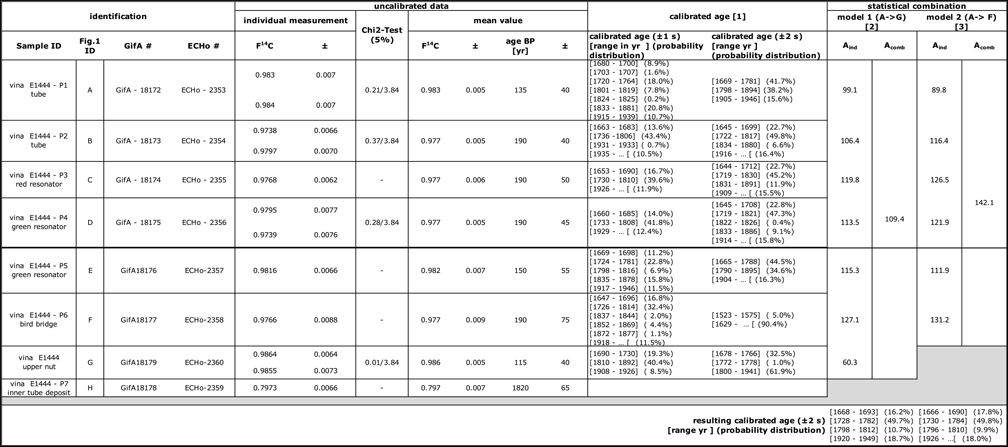
The mass spectrometer ECHoMICADAS (14C AMS) was used to measure the 14C activity of each sample (Synal et al. Reference Synal, Stocker and Suter2007; Tisnérat-Laborde et al. Reference Tisnérat-Laborde, Thil, Synal, Cersoy, Hatté, Gauthier, Massault, Michelot, Noret and Siani2015). The gaseous samples (from 30 to 140 µgC) were directly injected into the MICADAS gas source through the gas ion source interface (GIS) (Ruff et al. Reference Ruff, Fahrni, Gaggeler, Hajdas, Suter, Synal, Szidat and Wacker2010) by tube cracking. Ages were obtained from 14C measurements using Bats software by comparing 14C/12C ratios with OXII standards (Wacker et al. Reference Wacker, Christl and Synal2010). Most of the samples provided several tubes of gas. All the tubes were separately measured, but results were statistically combined. The mean age of the sample then derives from the mean of the individual measurements, which pass the Chi2 test, and is associated to the maximum between the Chi2 reduced error and the standard deviation between the median of the individual measurements. Results are expressed in F14C as recommended by Reimer et al. (Reference Reimer, Brown and Reimer2004) and provided as 14C ages (yr BP) following Stuiver and Polach’s (Reference Stuiver and Polach1977) convention. Probability distributions of calibrated 14C ages were generated using OxCal v4.3.2 (Bronk Ramsey Reference Bronk Ramsey2009) based on the IntCal13 calibration curve (Reimer et al. Reference Reimer, Bard, Bayliss, Beck, Blackwell, Bronk Ramsey, Buck, Hai, Edwards and Friedrich2013). All data are provided in Tables 1 and 2.
Conventional, calibrated and modeled 14C ages obtained for the kinnari vina E.1444. Statistical results of Bayesian modeling are shown in the last four columns: for all vina pieces first and for the original pieces of the vina thereafter. Individual agreement (Aind) and combined agreement (Acomb) are provided. Resulting modeling intervals are provided under the main part of the table.

RESULTS AND DISCUSSION
Vina resonators are made of gourds that are fast growing and quickly dried plants. The same is true for the reed used as the tube for the kinnari vina. This means that the 14C dating will correspond to the year of manufacture to the nearest 1 to 3 years. The rudra vina tube, in contrast, is made of teak that is either a fast or a slow growing species depending on the environment. Examination of the tube revealed that it cannot have come from a branch but from a piece of turned wood. It comes from a beam that was drilled all along its length. We do not know a priori if it was extracted from the external part (the youngest part) or from the internal part (the oldest part) of the tree.
Kinnari Vina (E 1444)
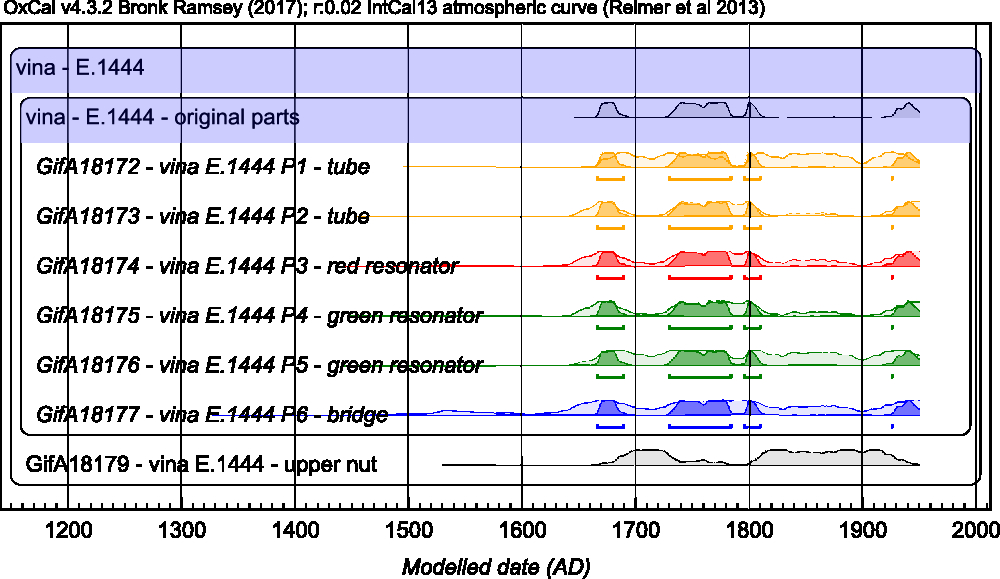
14C data obtained for each sample are shown in Table 2 and Figure 2. The F14C data recorded for six samples (GifA18172 to GifA18177) were unexpectedly very similar: 0.983 ± 0.005 (GifA18172), 0.977 ± 0.005 (GifA18173), 0.977 ± 0.005 (GifA18174), 0.977 ± 0.006 (GifA18175), 0.977 ± 0.005 (GifA18176), 0.982 ± 0.007 (GifA18176), 0.977 ± 0.009 (GifA18177). Hence, they correspond respectively to similar 14C dates: 135 ± 40 yr BP, 190 ± 40 yr BP, 190 ± 50 yr BP, 190 ± 45 yr BP, 150 ± 55 yr BP, 190 ± 75 yr BP. This result supports the conclusions of the museum studies that these pieces are original, and therefore correspond to the period when the instrument was made. The result for the upper nut (GifA18179) is an exception: 0.986 ± 0.005, i.e., a 14C date of 115 ± 40 yr BP. Unlike the first investigations carried out in the laboratory of the Musée de la Musique, this piece does not seem to be original.
Calibrated 14C ages of the kinnari vina E.1444. The upper probability distribution diagram, underlined in blue corresponds to the Bayesian modeling of the combination of the vina’s original parts. The probability distribution diagram of the restored piece (upper nut) is shown in the last line.

Combining the results of this series (7 samples) using the “combine” option of Bayesian modeling (Bronk Ramsey Reference Bronk Ramsey2009) shows that the individual agreement index (A) for the upper nut sample (GifA18179) is 60.4% whereas it is between 90 and 125% for the other six samples. It was therefore decided to perform the Bayesian modelling without the nut, i.e. using only the six subsamples labeled GifA18172 to GifA18177 (Tables 1 and 2). The resulting equiprobable calendar ranges are (Figure 2, Table 2): [1666 AD–1690 AD] (17.8%), [1730 AD–1784 AD] (49.8%), [1796 AD–1810 AD] (9.9%) (the last one, [1926 AD– … ] is outlier data due to the Suess effect). The three main ranges of calibrated dates are defined as the end of the 17th century and the 18th century.
As mentioned above, the upper nut may not be contemporaneous of the vina manufacture. It could be a replacement of the original nut that was probably lost or broken. This fragile part is subject to breakage and was likely changed during the period when the vina was played. The main probable ranges for the upper nut are: [1678 AD–1766 AD] (32.5%), [1772 AD–1778 AD] (1.0%), [1800 AD–1941 AD] (61.9%).
The instrument was acquired in 1892 and no restoration has been carried out since it entered the museum. Any replacement was thus done before. The use of terap in 19th-century Europe in cabinet making and instrument making is not attested and remains highly unlikely. European instrument makers of this era probably did not have the organological knowledge of traditional Indian instruments to accurately reproduce this part, either. It is very likely that the replacement was done while the instrument was still in India and was made by an Indian instrument maker. The only few slight traces of (musical) use on the upper nut seem to reveal that it was not played as much as the other parts of the vina. It is thus assumed that the nut was replaced during the [1678 AD–1766 AD] interval, towards the end of the musical use of the vina. Consequently, the instrument was made (age of the original pieces) during the [1666 AD–1690 AD] interval. It appears that the instrument is a little older than initially thought by the curator, who expected it to date from the 18th century.
Residue sampled in the vina tube shows quite different results, with F14C equal to 0.797 ± 0.007, equivalent to an age of 1820 ± 65 BP (Table 2). Chemical characterization (chromatography, XRF … ) of a new sample of the same black residue is in progress. It is known that bitumen-derived glue was used to maintain the tube when aligning elements and perforating holes. A balance equation between expected age (F14C = 0.979, the modeled average of original pieces’ F14C) and a null 14C content for a potential bitumen-derived component would result in a mixture containing about 20% of dead carbon in the resulting black residue, which is quite likely.
Rudra Vina (E 997.24.1)
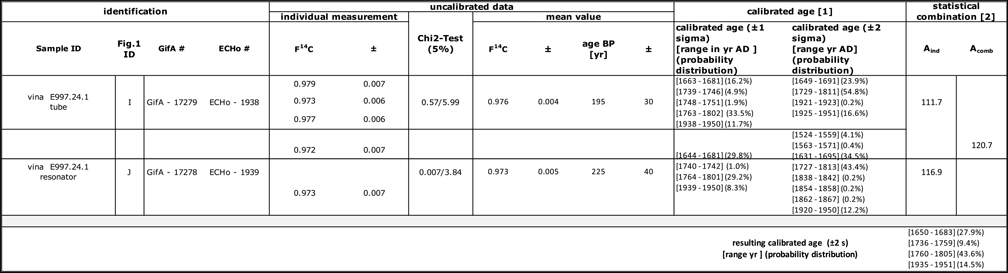
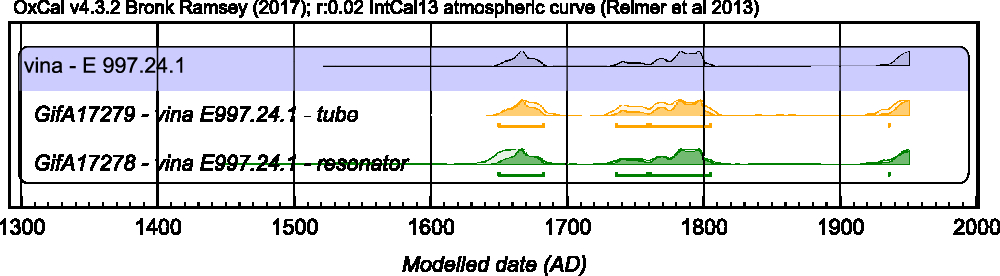
14C data obtained for each sample are shown in Table 3. Samples from the vina tube (GifA-17279) and the vina resonator (GifA-17280) provided very similar F14C data: 0.976 ± 0.004 and 0.973 ± 0.005, respectively, equivalent to 195 ± 30 yr BP and 225 ± 40 yr BP, respectively. Calibrated ranges of dates of both samples are thus also very close (Table 3 and Figure 3) yielding three major ranges of dates, during the 17th century, the 18th century and associated to the Suess effect modern period. This concomitance of ages reveals that the tube was extracted from the external part of the tree and this allows Bayesian modeling to combine dating and reduce uncertainties.
Conventional, calibrated, and modeled 14C ages obtained for the bin E.997.24.1. Statistical results of Bayesian modeling are shown in the last two columns. Individual agreement (Aind) and combined agreement (Acomb) are provided. Resulting modeling intervals are provided under the main part of the table.

Calibrated 14C ages for the two gaseous micro-samples from the bin or rudra vina E.997.24.1. The upper probability distribution diagram, underlined in blue, corresponds to the Bayesian modeling obtained by combination of bin 14C results. (Please see electronic version for color figures.)

Bayesian modeling with OxCal (Bronk Ramsey Reference Bronk Ramsey2009) reinforced the view that the two elements were associated at the same time and thus very likely correspond to the making of the instrument (Figure 3). Individual agreements, A, are 111.7% and 116.9%, respectively, resulting in a combined agreement factor of Acomb = 120.7%. Modeling results in four equiprobable ranges of dates: [1650 AD–1683 AD] (28.1%), [1737 AD–1759 AD] (8.8%), and [1761 AD–1805 AD] (43.9%) and the last one ([1936 AD– … ]) corresponding to the modern period that we ruled out.
According to the very accurate iconographical evidence and descriptions given in textual sources dating from the end of the 16th century and early 17th century, the curator speculated that the vina could have been made in the first half of the 17th century. The [1650 AD–1683 AD] interval is presumably that when the instrument was made. This interval is slightly more recent than expected.
CONCLUSION
Based on information from both geochronological analyses and museological resources, we were able to provide key elements on two vina from the Musée de la Musique The making of the rudra vina E.997.24.1 is now known and corresponds to [1650 AD–1683 AD]. The history of the kinnari vina E.1444 is now known: it was made during the [1666 AD–1690 AD] interval and its upper nut was changed before its arrival in France, likely during [1678 AD–1766 AD]. Furthermore, we have highlighted the use of bitumen-derived glue used to assemble and make the instrument.
To sum up, in this first combined museological-geochronological study performed on legacy musical instruments, we have shown that like analysis performed on archeological musical instruments, 14C dating can be a powerful tool to inform not only on the creation of a musical instrument but also on its use.
ACKNOWLEDGMENTS
This research was supported by the Domaine d’Intérêt Majeur “Patrimoine” of the Île-de-France region. This work was made possible by DIM Analytics of the Île-de-France region, the BNP Paribas foundation, the European FEDER, the BCDiv Labex that contributed to the ECHoMICADAS acquisition. This is a LSCE contribution #6717.