Children are now using mobile phones and computers at a younger age and more frequently than ever before, which means they can communicate with people outside of the control of parents and schools. One side effect of the availability and usage of these technologies has been the potential for cyberbullying. Currently, most of the research on cyberbullying has focused on adolescents in secondary schools, but very few studies have investigated cyberbullying among primary school-aged children in Australia. Since primary school-aged children are increasingly more likely to encounter cyberbullying, there are concerns as to whether this age group may be equipped with the necessary resources to cope with being targeted. In particular, whether they have the necessary external coping resources in the form of attachment with parents, teachers and peers, and internal coping resources such as locus of control and self-esteem. The purpose of this exploratory study was to investigate the prevalence of cyberbullying victimisation among Australian primary school students and ascertain whether victims in this age group have fewer coping resources and use more non-productive coping strategies compared to non-victims.
Cyberbullying refers to the use of technologies such as mobile devices and computers to intimidate or harass an individual or group (Bhat, Reference Bhat2008; Kowalski, Giumetti, Schroeder, & Lattanner, Reference Kowalski, Giumetti, Schroeder and Lattanner2014). It includes, but is not limited to, behaviours such as sending threatening text messages and emails, making prank and/or abusive phone calls, developing a website or blog to target an individual, posting embarrassing photos or videos on websites, masquerading as others, and excluding others from chat-rooms (Vanderbosch & Van Cleemput, Reference Vandebosch and Van Cleemput2009). The use of such technologies is problematic as they enable almost unlimited access to potential targets, the option for anonymity on the part of the perpetrator, and a much wider audience compared to traditional bullying. Furthermore, a relative lack of supervision online by parents, teachers, and other authority figures is also problematic. Most importantly, cyberbullying has been associated with adverse educational and psychological outcomes, including poor academic performance, school disengagement, absenteeism, school dropout, low self-esteem, anxiety, depression, and even suicidal ideations (Kowalski et al., Reference Kowalski, Giumetti, Schroeder and Lattanner2014; Tokunaga, Reference Tokunaga2010).
Although there is still debate about the fundamental aspects of cyberbullying and measurement issues surrounding the operationalisation of cyberbullying, a review of several studies has revealed that cyberbullying is a real issue for young people (Modecki, Minchin, Harbaugh, Guerra, & Runions, Reference Modecki, Minchin, Harbaugh, Guerra and Runions2014; Kowalski et al., Reference Kowalski, Giumetti, Schroeder and Lattanner2014; Tokunaga, Reference Tokunaga2010). For instance, Modecki et al. (Reference Modecki, Minchin, Harbaugh, Guerra and Runions2014) conducted a meta-analysis on 80 studies that reported the prevalence rates of traditional bullying and cyberbullying among 12- to 18-year-olds and revealed a cyberbullying prevalence rate of 15%. In Australia, previous studies have revealed cyberbullying prevalence rates ranging from 7% to 25% (Campbell, Reference Campbell2005; Campbell, Spears, Slee, Butler, & Kift, Reference Campbell, Spears, Slee, Butler and Kift2010; Cross et al., Reference Cross, Shaw, Hearn, Epstein, Monks and Lester2009), with prevalence estimates typically based on secondary school or adolescent samples. Although several international studies have demonstrated that cyberbullying is a common occurrence among 11- to 12-year-olds (Baas, Menno, de Jong, & Drossaert, Reference Baas, Menno, de Jong and Drossaert2013; Devine & Lloyd, Reference Devine and Lloyd2012; Monks, Robinson, & Worlidge, Reference Monks, Robinson and Worlidge2012), little research has investigated the prevalence of cyberbullying among Australian primary school-aged children. This is despite the fact that almost 50% of primary school-aged children (aged 5–14 years) now have their own mobile devices, and around 80% have access to the internet via computers and gaming technology (Australian Bureau of Statistics [ABS], 2009). In one of the few Australian studies that included primary school and high school students, approximately 11% of males aged between 9–11 years reported having experienced cyberbullying during the school year (Sakellariou, Carroll, & Houghton, Reference Sakellariou, Carroll and Houghton2012), though data on females were not reported. It is clear that more research is needed to address the paucity of studies regarding cyberbullying among Australian primary school-aged children.
Cyberbullying and Coping
Not all targets of cyberbullying report experiencing negative educational and psychological outcomes, suggesting that the association between cyberbullying and negative outcomes varies according to how effectively one copes with being the target of such behaviours (Raskauskas & Huynh, Reference Raskauskas and Huynh2015). Researchers have found that victims of cyberbullying are often less inclined to seek help compared to victims of traditional bullying (Smith et al., Reference Smith, Mahdavi, Carvalho, Fisher, Russell and Tippett2008), with at least 90% of victims failing to report being targeted to an adult (Dooley, Gradinger, Strohmeier, Cross, & Spiel, Reference Dooley, Gradinger, Strohmeier, Cross and Spiel2010; Juvonen & Gross, Reference Juvonen and Gross2008). This may be due to victims’ perceptions that adults will not understand the situation and that parents will restrict or ban the use of technologies so that the remedy from bullying would be to disconnect from mobile technologies (Bass, Menno, de Jong, & Drossaert, Reference Baas, Menno, de Jong and Drossaert2013; Cross et al., Reference Cross, Shaw, Hearn, Epstein, Monks and Lester2009; Sleglova & Cerna, Reference Sleglova and Cerna2011). It may also be that children believe parents would not intervene at all (Li, Reference Li2007a). To this end, more information is needed on the influence of parents and teachers on how children cope with being targeted by cyberbullying behaviours.
In general, previous investigations on coping with cyberbullying have either referred to the use of specific technological responses or general coping behaviours to deal with being cyberbullied. For example, technological responses include increasing privacy settings on internet-based technologies, changing user names and passwords, blocking users or logging off devices (Tokunaga, Reference Tokunaga2010). While some studies have indicated that young people are aware of these strategies, it appears that many do not actually employ them when needed (Price & Dalgleish, Reference Price and Dalgleish2010; Tokunaga, Reference Tokunaga2010). With regard to general coping behaviours, previous research has suggested that cyberbullying victims are inclined to depend on avoidance and emotion-focused coping strategies, such as ignoring the problem, keeping it to themselves, and self-blaming in order to deal with stress (Juvonen & Gross, Reference Juvonen and Gross2008; Li, Reference Li2010; Lodge, Frydenberg, Freeman, & Care; Slonje & Smith, Reference Slonje and Smith2008). Yet a limitation of the available research on cyberbullying and general coping behaviours has been the lack of utilising a theoretical framework to explain how children cope with the stress associated with cyberbullying (Raskauskas & Huynh, Reference Raskauskas and Huynh2015). As such, there is a need to draw upon a coping theoretical framework in order to help guide research in this area.
The model for general stress and coping offered by Hobfoll (Reference Hobfoll1988), called Conservation of Resources (COR), is a resource-based model that can provide valuable insight into the links between cyberbullying and coping behaviours. The basic underlying premise of COR theory is that people strive to retain, protect, and build resources, and that what is threatening to them is the potential or actual loss of these valued resources (Hobfoll, Reference Hobfoll1988). Resources refer to objects (e.g., house, clothes), personal characteristics (e.g., self-esteem, control), conditions (e.g., marriage, social supports), or energies (e.g., time, money) that are valued by the individual. They can also be broadly classified into internal and external resources, which refer to resources within the individual and from the environment respectively. The COR theory posits that stress is experienced when an individual is faced with circumstances that threaten to result in resource loss, actually results in resource loss, or fails to result in resource gain when significant resources are invested. With regard to cyberbullying, loss may be in the form of decreased self-worth due to embarrassment and shame, as well as reduced status in one's social network, and so on. As a result of the loss of perceived, actual, or expected resources, people become susceptible to impaired functioning and psychological problems (Hobfoll, Reference Hobfoll1988; Hobfoll & Jackson, Reference Hobfoll and Jackson1991). In other words, the extent to which children cope with cyberbullying will depend on the adequacy of external resources at their disposal, such as their attachment with important others (e.g., parents, teachers, and peers), as well as on the level of their internal resources (e.g., locus of control and self-esteem). In this regard, technological expertise could also be considered an internal resource.
Attachment as an External Resource
Bowlby (Reference Bowlby1969) defined attachment as a ‘lasting psychological connectedness between human beings’ (p. 194). Indeed, past research has highlighted that the secure emotional bond between parent and child is essential to the development of children's interpersonal skills and relationships (Madden-Derdich, Estrada, Sales, Leonard, & Updegraff, Reference Madden-Derdich, Estrada, Sales, Leonard and Updegraff2002). More broadly, attachment has been redefined from originally focusing on parent attachment to including all other important relationships throughout the lifespan (Armsden & Greenberg, Reference Armsden and Greenberg1987). For example, student-teacher relationships are important and have been associated with academic and social/emotional outcomes (Baker, Grant, & Morlock, Reference Baker, Grant and Morlock2008; Lodge & Baxter, Reference Lodge and Baxter2013; Pianta, Reference Pianta1994). Furthermore, peer relationships are vital for social and emotional development because they help children to acquire communication skills and self-regulating behaviours that are not possible in the family. According to Murray and Greenberg (Reference Murray and Greenberg2006), students who experience peer relationships characterised by alienation and rejection tend to experience emotional and behavioural problems. Taken together, it appears that parent, teacher and peer attachment are resources that can promote positive outcomes for young people.
With regard to cyberbullying, it has been suggested that factors indicative of poor parental attachment, such as low family involvement, permissive parental style, and maternal overprotectiveness are associated with peer victimisation (Georgiou, Reference Georgiou2008; Jeynes, Reference Jeynes2008). Moreover, Hodges, Malone, and Perry (Reference Hodges, Malone and Perry1997) found that the lack of supportive friends and the presence of peer rejection were correlated with bullying victimisation. Based on these findings, it was expected that cyberbullying victims would report lower levels of parent, teacher, and peer support compared to non-victims.
Locus of Control as an Internal Resource
Not only are external resources in the form of parent, teacher, and peer attachment important for young people's ability to cope with stress, internal resources such as locus of control and self-esteem are also important for coping. For instance, an individual's locus of control is used to describe a person's tendency to attribute life circumstances to either internal or external causes (Kaslow, Rehm, Pollack, & Siegel, Reference Kaslow, Rehm, Pollack and Siegel1984). In particular, Rotter (Reference Rotter1966) proposed that people with an internal locus of control believe that outcomes or events are a direct result of their own efforts, capacities, and attributes. Conversely, an external locus of control refers to the belief that a behavioural or situational outcome is contingent on external factors, such as another person's efforts, luck, or chance (Rotter, Reference Rotter1966). An internal locus of control has been associated with multiple positive outcomes that are critical to adolescent development, including school attendance and achievement (Edstrom, Goertz, Pollack, & Rock, Reference Edstrom, Goertz, Pollack and Rock1986), as well as improved overall health and reduced mental health issues (Lachman & Weaver, Reference Lachman and Weaver1998).
According to the COR model (Hobfoll, Reference Hobfoll1988), locus of control is considered to be a key resource for coping. It is not only viewed as an individual resource in its own right, but as a building block from which other resources can be established or utilised (Hobfoll, Banerjee, & Britton, Reference Hobfoll, Banerjee, Britton, Maes, Leventhal and Johnston1994). More specifically, individuals who possess an internal locus of control are more likely to utilise productive and problem-focused coping behaviours (Hobfoll et al., Reference Hobfoll, Banerjee, Britton, Maes, Leventhal and Johnston1994). That is, individuals who believe that their response to a stressor will be effective in eliminating the problem are more likely to appraise a stressor as controllable and will utilise productive coping strategies. This view is supported by Trivitis (Reference Trivitis2005), who found that locus of control influenced how adolescents cope with stressful events. Moreover, Andreou (Reference Andreou2000) found that children who are both perpetrators and victims of bullying tend to possess an external locus of control. Currently, there is very little research that has examined the relationship between cyberbullying victimisation and locus of control.
Self-Esteem as an Internal Resource
Self-esteem is an important coping resource and refers to the extent to which an individual respects and likes oneself as a person (Harter, Reference Harter1990), or forms favourable or unfavourable attitudes towards the self (Rosenberg, Reference Rosenberg1965). Self-esteem is recognised as an influential variable for the adaptive development of children and adolescents (Mullis & Chapman, Reference Mullis and Chapman2000; Rosenberg, Reference Rosenberg1989). That is, high self-esteem can also be considered a key resource that can be used to help children cope with stressful life events, as well as help to gain other valued and important resources. For example, individuals who possess high levels of self-esteem are more capable of investing these resources in the use of productive coping responses, and are potentially better equipped to deal with the loss of resources or lack of resource following investment.
Several studies have identified a relationship between traditional bullying and self-esteem (see Bond, Carlin, Thomas, Rubin, & Patton, Reference Bond, Carlin, Thomas, Rubin and Patton2001; Pollastri, Cardemil, & O'Donnell, 2010; Salmivalli, Kaukiainen, Kaistaniemi, & Lagerspetz, Reference Salmivalli, Kaukiainen, Kaistaniemi and Lagerspetz1999; Seals & Young, Reference Seals and Young2003). These studies indicate that victims of bullying tend to report lower self-esteem compared to non-victims, though it is unclear whether low self-esteem is a predictor or outcome of victimisation. Surprisingly, there is limited research that has examined the relationship between cyberbullying and self-esteem (Brewer & Kerslake, Reference Brewer and Kerslake2015). In one of the earlier studies to explore this relationship, Patchin and Hinduja (2010) found that cyberbullying victimisation was associated with low self-esteem in a sample of middle school students. That is, low self-esteem was found to be a potential negative outcome of cyberbullying. More recent studies have also revealed a negative association between cyberbullying victimisation and self-esteem among adolescents (Brewer & Kerslake, Reference Brewer and Kerslake2015; Cenat et al., Reference Cénat, Hébert, Blais, Lavoie, Guerrier and Derivois2014; Ozdemir, Reference Özdemir2014). According to Brewer and Kerslake (Reference Brewer and Kerslake2015), it may be that adolescents with low self-esteem are considered ‘easy targets’ by perpetrators, or alternatively that being the victim of cyberbullying may result in low self-esteem. However, the absence of longitudinal data makes it difficult to determine the direction of this association. Nonetheless, these findings are especially important for school-aged children since research on self-esteem has demonstrated that low self-esteem is a significant predictor of numerous academic and psychological problems. Given the use of primarily adolescent samples to investigate the relationship between cyberbullying and self-esteem, there is a need for researchers to obtain more information about the nature of this relationship among primary school students.
The Current Study
The first aim of this study was to examine the prevalence of cyberbullying among a sample of Australian primary school students. The second aim was to identify specific technological responses employed by cyberbullying victims. The final aim was to examine whether there were mean differences in the levels of coping resources and coping styles used between non-victims and victims of cyberbullying. In particular, it was hypothesised that cyberbullying victims would have fewer external resources (parent, peer, and teacher attachment), fewer internal resources (locus of control and self-esteem), and would tend to use less productive coping strategies and more non-productive coping strategies compared to non-victims.
Method
Participants
A total of 107 Grades 5 and 6 students who ranged in age from 10 to 12 years participated in the study. Females comprised 50.5% (n = 54) of the sample. Participants were from four Victorian government and one Catholic primary school in the southern and eastern regions of Melbourne, Australia. The response rate was approximately 25%.
Measures
The measures administered in the current research included six self-report questionnaires used to assess students’ experience with cyberbullying, attachment relationships, locus of control, self-esteem, and coping strategies.
An adapted version of the Cyberbullying Scale (CS)
The adapted version of the Cyberbullying Scale (Menesini, Nocentini, & Calussi, Reference Menesini, Nocentini and Calussi2011) consists of 10 items asking questions about how often in the past 3 months participants have experienced different behaviours related to cyberbullying victimisation. Participants responded to each item using a 5-point Likert scale, ranging from 1 (never) to 5 (several times a week). The scale includes items such as ‘Nasty text messages’ and ‘Insults on websites’. For the purposes of this study, ordinal scores for cybervictimisation were computed. For example, respondents who never reported experiencing cyberbullying were coded as 1 (never); respondents who reported some occasional attacks but no repeated attacks (i.e., reported experiencing one or more types of cyberbullying, but only once or twice) were coded as 2 (single episode); respondents who reported experiencing repeated episodes of cyberbullying (i.e., frequencies of 1–2 attacks per month to daily attacks) were coded as 3 (repeated). The scale has demonstrated acceptable internal consistency for the different behaviours in the past (Menesini et al., Reference Menesini, Nocentini and Calussi2011).
The People in My Life (PIML)
The PIML (Cook, Greenberg, & Kusche, Reference Cook, Greenberg and Kusche1995) is a scale that is designed to be administered to children aged from 10 to 12 years, and provides a measure of children's attachment to their parents, teacher, and peers, and their connectedness to their school and neighbourhood. The PIML measures attachment in terms of scores on three specific dimensions (Trust, Communication, and Alienation) that are combined into a summative Attachment score (Ridenour, Greenberg, & Cook, Reference Ridenour, Greenberg and Cook2006). Participants responded to each item using a 4-point Likert scale, ranging from 1 (almost never) to 4 (almost always). Such items included statements such as ‘My parents respect my feelings’, ‘I trust my friends’, and ‘I feel safe at my school’.
Nowicki -Strickland Locus of Control Scale for Children (N-SLOCSC)
The N-SLOCSC (Nowicki & Strickland, Reference Nowicki and Strickland1973) is a widely used 40-item generalised perceived control scale that measures the degree to which children feel they have control over their lives (i.e., internal locus of control) as opposed to being controlled by external circumstances (i.e., external locus of control). Participants responded to each item with either a yes or no answer. The scale is scored by adding up the number of items where higher scores on the scale reflect a higher degree of external control, whereas lower scores indicate a higher internal control.
Modified-Rosenberg Self-Esteem Scale (RSES)
The Modified-RSES (Rosenberg, Reference Rosenberg1965) is a 10-item self-report measure of global self-esteem, and is one of the most widely used self-esteem measures (Gray-Little, Williams, & Hancock, Reference Gray-Little, Williams and Hancock1997). The items are answered on a 4-point Likert scale ranging from 0 (strongly agree) to 4 (strongly disagree). Scores are calculated by summing all 10 items, with items 2, 5, 6, 8, 9 reversed scored. Higher scores on the scale reflect higher levels of self-esteem.
Children's Coping Scale (CCS)
The CCS (Cunningham, Reference Cunningham2002) is adapted from the Adolescent Coping Scale (Frydenberg & Lewis, Reference Frydenberg and Lewis1993) and requires students to respond to 45 items about how they cope with problems. The items used in the scale comprise the strategies of focus on solving the problem, seek recreational diversions, work hard to achieve, and focus on the positive from the productive coping domain and worry, wishful thinking, not coping, ignore the problem, tension reduction, keep to self, and self-blame from the non-productive domain. Participants responded indicating the frequency in which they employ each coping strategy, using a 5-point Likert scale, ranging from 1 (never) to 5 (a lot). Responses for each coping strategy were averaged to form a coping strategy score. Higher scores reflect greater use of that particular coping strategy.
Checklist of Specific Technological Responses
Based on the specific strategies reported in the existing literature on cyberbullying, a checklist of specific technological responses was devised by the researchers to obtain more specific information about how children deal with cyberbullying. This checklist comprised nine different types of response strategies such as ‘I contacted the Internet administrators to report the cyberbullying’ and ‘I changed my password’. Participants responded by ticking the box to indicate whether they had used a particular strategy. There was also one open-ended question included to obtain information about the effectiveness of the technical coping strategies used (e.g., ‘If you used any of these strategies to cope with being cyberbullied, did they work? Why/Why not?’).
Procedure
Ethics approval was obtained from the Swinburne University Human Research Ethics Committee, as well as the Department of Education and Early Childhood Development (DEECD) and the Catholic Education Office (CEO), Melbourne. Participants were recruited via letters sent to school principals of selected Victorian government and Catholic primary schools in the southern and eastern regions of Melbourne. Once individual school approval was obtained, a coordinator nominated by the principal was established for each school. This coordinator was briefed on the aims and objectives of the research project, and assisted with organising the briefing of teachers. Information letters and consent forms for parents were then sent home with the students and the completed consent forms were returned to their classroom teachers. A suitable date/time to collect the data was prearranged with each participating school. On the day of data collection, those students for whom parental permission had been obtained were briefed regarding the aims and objectives of the project and the voluntary nature of their contribution. In addition, individual information and consent forms were provided to each student participant.
Results
Prior to analysis, data were screened for out-of-range values, outliers and missing data. Moreover, assumption testing was conducted for normality, linearity, homogeneity of variance-covariance matrices, and multicollinearity, with no serious violations revealed. Exploratory factory analysis (EFA) was used to assess whether each subscale and/or overall scale from the PIML scale, N-SLOCSC scale, Modified-RSES and the CCS were unidimensional. Items that did not fit the data were omitted. Another EFA was used to test the factor structure of coping and revealed a two-factor structure in which solve the problem, work hard, focus on the positive, physical recreation, relax, and ignore the problem were associated with productive coping, and tension reduction, not cope, self-blame, and keep to self were associated with non-productive coping. Furthermore, it is important to note that no significant mean differences were revealed in self-esteem, locus of control, productive coping and non-productive coping strategies between males and females.
Prevalence of Cyberbullying
In this sample, 13.1% of participants (11.1% female and 15.1% male) reported single episodes of cyberbullying victimisation, while nearly half (48.6%) of the participants (55.6% female and 41.5% male) reported being repeatedly cyberbullied. The remaining 38.3% (33.3% female and 43.4% male) of participants reported that they had never been cyberbullied. Overall, phone-based behaviours were the most common method of cyberbullying, with 21.5% receiving nasty text messages and 19.6% experiencing silent/prank phone calls at least once or twice. Internet-based behaviours were also prevalent, with 16.8% receiving nasty/rude emails, 19.6% receiving insults on websites, and 16.8% receiving insults in chat-rooms. Notably, receiving silent/prank phone calls (8.4%) and having unpleasant photo/videos posted on websites (6.5%) were reported to be the most repeated cyberbullying behaviour. Females were also found to be more likely to receive repeated nasty text messages, insults on websites, and insults on instant messaging compared to males.
Cyberbullying and Specific Technological Responses
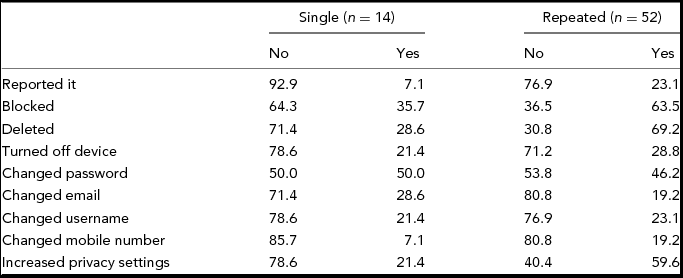
For those who reported being cyberbullied as a single episode or repeatedly, the frequency distribution for the use of each type of technological response is shown in Table 1. The most commonly used responses for a single episode of cyberbullying were changing a password (50%) or blocking (35.7%). For repeated cyberbullying, the most commonly used strategies were deleting (69.2%) and blocking (63.5%), as well as increasing privacy settings (59.6%). With regard to the effectiveness of technological responses, 78.8% of those cyberbullied reported that the use of such responses was effective in thwarting cyberbullying attempts. However, 10.6% reported that utilising technological strategies did not stop the cyberbullying from occurring.
Proportions of Specific Technological Responses

Note: N = 66.
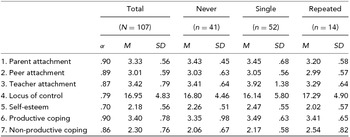
Means, Standard Deviations and Cronbach's Alphas for Coping Resources and Coping Styles by Cybervictimisation Group

Note: The α value for the Cyberbullying scale was .70.
Mean Differences in Coping Resources and Coping Styles
A one-way, between-groups MANOVA with parent, teacher and peer attachment as the dependent variables and cyberbullying victimisation (never, single episode, repeated) as the independent variable was performed and did not reveal a significant difference in external resources across the different cyberbullying victimisation groups, Wilks = .85, F(10, 200) = 1.63, p = .102.
Two separate one-way, between-groups ANOVAs were performed (due to a non-significant correlation between locus of control and self-esteem required for a MANOVA) with locus of control and self-esteem as the dependent variables respectively, and cyberbullying victimisation as the independent variable. Although there was no significant difference in locus of control across the different cyberbullyinging victimisation groups, F(2, 104) = .34, p = .714, there was a significant difference in self-esteem, F(2, 104) = 4.73, p = .011. Post hoc analyses based on Student-Newman Keuls comparisons of mean scores revealed that those who reported a single episode of cyberbullying had significantly higher levels of self-esteem than those who were never or repeatedly cyberbullied.
A second one-way, between-groups MANOVA with the productive coping strategies work hard, focus on the positive, physical recreation, relax, and ignore the problem as the dependent variables and cyberbullying victimisation as the independent variable was performed and did not reveal a significant difference, Wilks = 0.93, F(12, 198) = .64, p = .804. A final MANOVA with the non-productive coping strategies tension reduction, not cope, self-blame, and keep to self as the dependent variables and cyberbullying victimisation as the independent variable was performed and did not reveal a significant difference, Wilks = 0.88, F(8, 202) = 1.66, p = .111.
Discussion
The first aim of this study was to examine the prevalence of cyberbullying among a sample of Australian primary school students. It was revealed that 13.1% of participants reported single episodes of cyberbullying victimisation, while nearly half of the participants reported being repeatedly cyberbullied in this sample. The specific technological responses employed by cyberbullying victims included blocking, deleting and changing passwords, and these were found to be effective most of the time. The final aim was to examine whether or not there were mean differences in the levels of coping resources and coping styles between non-victims and victims of cyberbullying. The results partially supported the hypotheses. Although there was a significant mean difference in self-esteem between the cyberbullying groups with those who reported a single episode of cyberbullying found to have higher levels of self-esteem compared to the never cyberbullied or repeatedly cyberbullied groups, no significant mean differences were found in attachment, locus of control, and coping styles between the different cyberbullying groups.
The prevalence rates of cyberbullying in this study exceeded those reported in previous research (see Baas et al., Reference Baas, Menno, de Jong and Drossaert2013; Modecki et al., Reference Modecki, Minchin, Harbaugh, Guerra and Runions2014; Monks et al., Reference Monks, Robinson and Worlidge2012; Price & Dalgleish, Reference Price and Dalgleish2010; Sakellariou et al., Reference Sakellariou, Carroll and Houghton2012), suggesting that being the target of cyberbullying behaviours is a common occurrence among Australian primary school-aged children. Although cyberbullying is a real problem for some students in schools, it is possible that the higher than expected prevalence rate reported in this sample has more to do with the type of measurement tool used to assess cyberbullying. In general, two methods have been used to assess bullying behaviours (Menesini & Nocentini, Reference Menesini and Nocentini2009). The first method involves an evaluation of the presence of bullying behaviour on the basis of a general definition using a single-item, self-report questionnaire. For example, participants are presented with a definition of bullying and asked to respond on the frequency of bullying behaviours across a particular duration period. The second method for measuring bullying utilises multi-item scales or descriptions of specific behaviours that are assumed to be indicators of bullying. However, the use of multi-scales that list behaviours, such as the one used in this study, are often associated with higher prevalence rates as participants endorse items about experiencing certain behaviours but do not necessarily interpret these behaviours to be cyberbullying. To this end, it is possible that the single episode and repeated cyberbullying prevalence rates found in this study are an overestimation of the actual prevalence of cyberbullying in the sample.
The most common behaviours experienced by students in this sample were receiving nasty text messages, rude emails, and insults in chat-rooms, which was the case for both males and females. While this is in line with the literature, which has demonstrated that almost half of children aged between 5 and 14 years own a mobile phone (Australian Bureau of Statistics, 2009), the results contrast with previous research, which has found chat-rooms and emails to be the primary method of cyberbullying for this population (Price & Dalgleish, Reference Price and Dalgleish2010). Perhaps the differences between the two studies reflect an increasing mobile phone ownership among young children in 2013 compared to 2009–2010. This, combined with the increasing capabilities of mobile phones that have progressed to include rapid text messaging along with built-in cameras and video recorders (Sullivan, Reference Sullivan2004), make it easier for children to engage in multiple forms of cyberbullying. Future research should also explore whether these bullying behaviours are from peers or older people, as this was unknown.
Interestingly, the findings also highlighted that receiving silent/prank phone calls (8.4%) and having unpleasant photo/videos posted on websites (6.5%) were the most repeated cyberbullying behaviours for this age group. While there has been little exploration of cyberbullying via the posting of photos/videos, particularly in relation to a primary school population, these findings are comparable to the 8.6% of early secondary school students reported by Slonje and Smith (Reference Slonje and Smith2008). A possible explanation for this can be attributed to an increase in the use of applications such as Instagram and SnapChat, which provide a platform for sharing photos/videos and posting these online. It is also the case that images and videos are shared with others via reposting and forwarding. Indeed, Slonje and Smith (Reference Slonje and Smith2008) have suggested that the reported frequencies of this method of cyberbullying are potentially underreported due to victims potentially being unaware that picture/videos of them are being shared and reposted by others online, though this raises a question about whether one has been bullied if he or she is unaware of the behaviour. Given the increased capability of technological devices that take photos and videos and the use of applications that allow these to be easily shared, further research examining the prevalence and consequences of these types of cyberbullying behaviours is warranted.
Specific Technological Responses
With regard to specific technological responses, the majority of students in this sample who had been cyberbullied were found to be aware of online interventions. Students who utilised technological strategies to manage being targeted typically reported that they were effective in preventing the cyberbullying from repeatedly occurring. This finding mirrors that of previous research (Juvonen & Gross, Reference Juvonen and Gross2008; Li, Reference Li2007b; Price & Dalgleish, Reference Price and Dalgleish2010) and suggests that technological responses may be an effective way for young people to thwart attempts at cyberbullying victimisation. However, a smaller percentage of participants reported that the perpetrator continued to inflict abuse online, despite active use of specific technological responses. It is possible that these students only attempted to implement one response strategy and when that failed, did not attempt additional strategies, through lack of knowledge or technical skills. Although speculative, perhaps specific training and reinforcement regarding the use of different forms of technological responses by parents and teachers is likely to be a useful approach to supporting children to respond to and cope with cyberbullying.
Cyberbullying and External Resources
Contrary to expectations, the study found no significant mean differences in overall attachment across the different cyberbullying victimisation groups. Therefore, findings from previous studies that have suggested that those victimised were likely to report poorer attachment relationships could not be supported (Georgeiou, Reference Georgiou2008; Hodges et al., Reference Hodges, Malone and Perry1997; Jeynes, Reference Jeynes2008). An inspection of the distribution of each of the attachment variables revealed that students in this sample tended to report higher levels of parent, teacher, and peer attachment, regardless of whether they had been cyberbullied or not. One plausible interpretation of this finding is that students in this sample were in late childhood and that parents and teachers of children in this stage have more of a direct influence and role in regulating children's behaviour compared to those in early adolescence (Hoffnung et al., Reference Hoffnung, Hoffnung, Seifert, Burton-Smith, Hine, Ward and Swabey2013). Equally, it may be the case that strong parental and teacher attachment is problematic for children who require parents and teachers to mediate negative peer interactions. Furthermore, children during this stage are also more selective about which peers they interact with and therefore will often form a peer group comprising people similar to them.
Cyberbullying and Internal Resources
Partially consistent with the hypothesis for internal resources, this study found no significant difference in mean levels of locus of control, but a significant difference in self-esteem was revealed across the different cyberbullying victimisation groups. The finding in relation to locus of control is important, considering the limited research that has previously explored this relationship. It may be that the measurement of locus of control used in this study was not the most appropriate measure to ascertain the nature of this variable in relation to cyberbullying victimisation. That is, it may be that in the cyberbullying context, one may feel like they have more control over what happens to them compared to the external environment, but this is less relevant if they are not able to control the actions of others. A qualitative research design offering participants open-ended questions and opportunities to discuss the concept with others may be useful in eliciting information about their perceived and actual levels of control in the context of cyberbullying.
Interestingly, those students who reported a single episode of cyberbullying victimisation were found to have significantly higher levels of self-esteem than those who were either never or repeatedly cyberbullied. This provides partial support for the study conducted by Patchin and Hinduja (2010), who found a relationship between cyberbullying victimisation and lower self-esteem. Based on the COR model (Hobfoll, Reference Hobfoll1988), perhaps students who reported only a single episode of cyberbullying were able to draw on their self-esteem resources to utilise productive coping strategies and prevent future attacks. Alternatively, it may be that successfully dealing with a single episode of cyberbullying not only minimised resource loss and expenditure, but also resulted in a resource gain in terms of increased confidence and self-esteem. However, as mentioned previously, data in this study were cross-sectional and a longitudinal research design is necessary to determine whether low levels of self-esteem are a cause, co-occurrence, or consequence of being cyberbullied. It should also be noted that self-esteem levels for those never targeted and those repeatedly targeted were not significantly different, which was unexpected and a finding that requires replication.
Cyberbullying and Coping Styles
While it was expected that those students who had experienced cyberbullying would utilise more non-productive coping strategies, it was found that there was no significant difference in the use of either productive or non-productive coping styles across the different cyberbullying victimisation groups. This is in contrast to previous research that has suggested that cyberbullying victims tend to overly depend on non-productive coping skills to cope with attacks (Juvonen & Gross, Reference Juvonen and Gross2008; Li, Reference Li2010; Slonje & Smith, Reference Slonje and Smith2008). One possible explanation for this is that the ACS (Frydenberg & Lewis, Reference Frydenberg and Lewis1993), like most coping measures, captures usage and not effectiveness. Therefore, it is likely that students will initially try using productive coping strategies, and if this is unsuccessful, resort to the use of non-productive coping strategies. This has been referred to as the fallback hypothesis (Rothbaum, Weisz, & Snyder, Reference Rothbaum, Weisz and Snyder1982) and is consistent with the COR model where students use the most potent resources they have available.
Limitations of the Current Study
There are several methodological issues that require consideration when interpreting the results from the current study. For instance, inherent difficulties in conducting school-based research meant that the sample size was restricted to those students for whom parental consent could be obtained. Although five schools were successfully recruited, with a combined student population of approximately 420 students, only 107 signed parent consent forms were returned. Despite numerous efforts to overcome this barrier, including repeated dissemination of parent consent forms and reminders from school staff, the response rate remained poor. Given that this small sample was obtained via convenience sampling, interpretation of the prevalence of cybervictimisation should be made with caution. According to a power analysis for the type of between-groups analyses used in this study, a sample size of 156 was required in order to be 80% effective in detecting a moderate strength effect size (Cohen, Reference Cohen1992), though data were only collected from 107 participants. The small sample size also prohibited the inclusion of sex as an independent variable in the ANOVAs and MANOVAs. While this is one of the very few Australian studies to have collected data on cyberbullying in primary schools and does make an important contribution to the research, future research should address possible sex differences in cyberbullying victimisation, coping resources, and coping styles.
As with previous research, the lack of consensus regarding the operational definition of cyberbullying posed another limitation. A self-report questionnaire in which participants reported the frequency of cyberbullying behaviours in the last 3 months was utilised in this study. Although this scale was transformed to generate never, single, or repeated victim categories, this method only denotes the frequency and not necessarily the severity of the cyberbullying behaviour. More importantly, there was no way in the current study of validating whether the students who were classified in the single episode or repeated cyberbullying group based on their self-reported experience of behaviours on the CS (Menesini et al., Reference Menesini and Nocentini2009) were actual victims of cyberbullying, or even if they labelled themselves as victims of cyberbullying. It is possible that students who were targeted using one or more of the behaviours on the CS (Menesini et al., Reference Menesini and Nocentini2009) did not perceive such behaviours as hostile or intended to harm and therefore do not identify as a victim. This may also explain the some of the null findings in this study. Accordingly, researchers are recommended to include a single item asking whether participants would consider themselves as a ‘target’ or ‘victim’ of bullying, with a forced-choice yes or no response format. That is, a target would recognise that others are intending to harm them, but this may have not the desired effect. In contrast, a victim would report being hurt by these behaviours.
Data were also not collected on traditional bullying victimisation or cyberbullying perpetration, though previous research has shown cyberbullying victimisation to share significant overlap with traditional bullying victimisation (Modecki et al., Reference Modecki, Minchin, Harbaugh, Guerra and Runions2014; Vanderbosch & Van Cleemput, Reference Vandebosch and Van Cleemput2009) and cyberbullying perpetration (Li, Reference Li2007a). To this end, interpretations of the findings from the current study and how they apply to other situations should consider the contextual factors in which these behaviours have been reported.
Lastly, a resource-based stress and coping model (COR; Hobfoll, Reference Hobfoll1989, Reference Hobfoll2001) was used as a theoretical framework to help explain how children cope with being cyberbullied. Resources were selected by integrating past research investigating how children cope with stress in general with research on the correlates of cyberbullying. However, the lack of significant mean differences in coping resources (i.e., attachment, locus of control) and coping styles (i.e., productive, non-productive) in the current study suggests the COR model, with its general stress and coping approach, may not be directly applicable to cyberbullying. Alternatively, perhaps researchers should place less emphasis on mean differences in coping resources and coping styles between victims and non-victims and instead examine the pattern of coping resources that predict coping styles and strategies associated with cyberbullying victimisation. Indeed, Raskauskas and Huynh (Reference Raskauskas and Huynh2015) have published a systematic review on the process of coping with cyberbullying and proposed that researchers investigate the entire coping process, including stressor, appraisal, self-efficacy, coping strategy, and outcome. Therefore, it is recommended that future research build on the current study by including measures of appraisal (e.g., threat-controllable), self-efficacy, and psychological outcomes (e.g., anxiety, depression, loneliness, conduct problems, emotional problems, somatic symptoms). This could then be tested as a process model using multiple regression or structural equation modelling.
Implications
The findings from the current study have a number of implications for students, teachers and other professionals who work in schools, schools’ administrators, parents, and researchers. Given the high prevalence of cyberbullying behaviours in this sample, especially repeated behaviours, it is evident that greater awareness and education about cyberbullying needs to be provided to primary school-aged children, not only in relation to how to prevent or reduce cyberbullying, but also with reference to what behaviours are considered cyberbullying and whether this leads to the misinterpretation of behaviours as cyberbullying.
One of the implications of this research is the need to develop or enhance coping resources in the form of technological expertise. It was revealed that victims were aware of and keen users of specific technological responses, and for a majority of those, these strategies were effective. As such, we argue that helping students to improve their conceptual understanding of different technologies (e.g., affordances, protocols, interpretation of cues and behaviours) and technical skills (e.g., privacy and security settings) may increase their sense of control and perceived efficacy of dealing with being targeted. As mentioned previously, successfully dealing with a single episode of cyberbullying was associated with higher self-esteem compared to not being targeted or experiencing repeated behaviours. In this regard, a psychoeducational approach of building coping resources is the preferred option compared to dealing with the negative psychological and educational outcomes associated with cyberbullying.
The findings from this study also have important implications for schools and parents, and whether the safety aspects of owning a mobile phone outweigh the unsafe aspects of exposure to cyberbullying. Further education of school staff and parents to raise their awareness of this growing issue is a critical step toward ensuring younger children's technology-related activities are not overlooked or dismissed as harmless. Improved parental involvement could be fostered through schools by providing relevant and current information about cyberbullying through mediums such as newsletters, parent information sessions, and school websites or blogs. This would serve to not only heighten parents’ understanding of the issue and promote collaboration with the school regarding effective responding to reports of cyberbullying, but could also encourage improved supervision practices within the home environment.
Conclusion
In conclusion, the study has revealed that primary school students experience behaviours frequently associated with cyberbullying, including nasty text messages, rude instant messages, and insults on websites, Moreover, blocking and deleting were strategies often used to deal with being cyberbullied, with more than three quarters of victims reporting these strategies to be effective. Contrary to expectations, only self-esteem differed between victims and non-victims, with the lowest self-esteem associated with repeated victimisation. The findings from this study have important implications for teachers, parents, and researchers in terms of defining and operationalising cyberbullying, as well as providing appropriate cyberbullying education and interventions for all young people in primary schools.
Acknowledgements
This manuscript is an original work that has not been submitted to nor published anywhere else. All authors have read and approved the paper and have met the criteria for authorship listed above.