Introduction
Plasma polymerization (PP) technique is an environmentally friendly, low cost, highly reproducible, and versatile method to obtain more stable thin films compared with films prepared by chemical methods such as self-molecular assembly, layer-by-layer, or spin coating.[Reference Mutlu, Mutlu, Rosenberg, Kane, Jones and Vadgama1] This process is capable of creating thin films, which control films’ growth down to angstrom (Å) size and it provides uniform coating by preserving bulk properties of the substrate material. Until today, plasma-polymerized thin films (PPTFs) have been investigated for use in many areas especially biomedical applications and biotechnology. Besides, PP technique has been studied by our group and the others to modify physical, chemical, electrical, or biologic properties of materials mainly for biotechnological applications.[Reference Mutlu, Mutlu, Rosenberg, Kane, Jones and Vadgama1–Reference Tur, Onal-Ulusoy, Akdogan and Mutlu8] In particular, adjustable chemical composition of thin films achieved by plasma modification has become vital over the years, which indirectly influences the performance and the functionality of polymers for suitable applications.[Reference Zhao, Li, Guo and Zheng9] Within PPTFs, amino-group functionalized ones (NH2-PPTFs) have been frequently used owing to their promising applicability especially in biomedical application. In particular, NH2-PPTFs should possess some specific features such as adaptive responses toward biologic components (biocompatibility) and functionality,[Reference Förch, Zhang and Knoll10–Reference Kaleli Can, Özgüzar, Kabay, Kömürcü and Mutlu12] so that, thin films derived from different precursors by various system parameters have been used in these areas to meet all these expectations anticipated from NH2-PPTFs. However, their low stability in air/aqueous environments mainly caused by molecular reorganization, oxidation, and hydrolysis interrupts their usage in biotechnological applications.[Reference Ruiz, St-Georges-Robillard, Thérésy, Lerouge and Wertheimer13] To date, many researchers have made an effort to overcome this problem and to find a balance between stability and functionality by using different monomers (allylamine,[Reference Denis, Cossement, Godfroid, Renaux, Bittencourt, Synders and Hecq14–Reference Ryssy, Prioste-Amaral, Assuncao, Rogers, Kirby, Smith and Michelmore16] diaminocyclohexane,[Reference Choukourov, Biederman, Slavinska, Trchova and Hollander17,Reference Gölander, Rutland, Cho, Johansson, Ringblom, Jönsson and Yasuda18] ethylenediamine (EDA),[Reference Gengenbach, Chatelier and Griesser19] heptylamine,[Reference Vasilev, Britcher, Casanal and Griesser20] and cyclopropylamine[Reference Manakhov, Zajickova, Elias, Cechal, Polcak, Hnilica, Bittnerova and Necas21,Reference Denis, Marsal, Olivier, Godfroid, Lazzaroni, Hecq, Cornil and Synders22] ), gas mixtures (ethylene/ammonia,[Reference Ruiz, St-Georges-Robillard, Thérésy, Lerouge and Wertheimer13,Reference Buddhadasa and Girard-Lauriault23] 1-3-butadiene/ammonia,[Reference Contreras-Garcia and Wertheimer24] and acetylene-ammonia[Reference Buddhadasa and Girard-Lauriault23]), and pre-coating layers (n-hexane/EDA).[Reference Kaleli Can25]
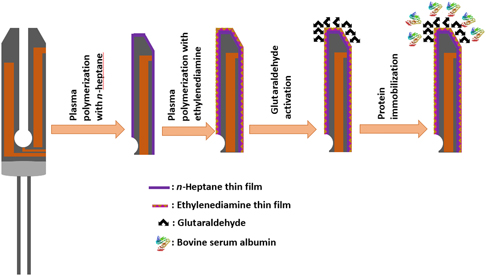
Hydrocarbon groups were selected for increasing the stability of NH2-PPTFs due to their well-known thermal and chemical stabilities and the high degree of crosslinking capacity characteristics.[Reference Guimond, Hanselmann, Amberg and Hegemann26,Reference Robertson27] A bi-layer formation of hydrocarbon and amino-groups followed by the PP technique enables the main goal of this study: to use hydrocarbon groups as a backbone for increasing the stability of NH2-PPTFs without affecting the amino groups' concentration on the surface. In this study, n-heptane (hep) was used as a precursor to create stable hydrocarbon groups on the substrate surface. Then, EDA was used as a precursor for obtaining amine-rich thin films on the substrate surface as well.
Quartz-tuning forks (QTFs) are commonly used in several areas such as time-frequency standard systems, atomic force microscopy (AFM) sensors, gas pressure, density determination studies, etc.[Reference Atia and Davis28–Reference Schmidt, Bergander and Eng33] Quartz prongs of a QTF transducer provide piezoelectric characteristic to those types of sensors. A piezoelectric substrate allows the mechanical excitation of the QTF to be replaced by an electrical excitation.[Reference Friedt and Carry34] Due to this fact, an increased mass load causes a change in the measured frequency as a response. In other words, we benefit from mass sensitive nature of QTF transducers to observe aging or detachment caused mass loss in terms of the frequency shift. Besides, the high mechanical “quality factor” (Q) around 103–105 of tuning fork transducers allows us to reach up to picogram level detection.[Reference Su, Dai, Zhang and O'Shea35] The utilization of QTF prongs as a carrier for the biologic recognition element is the main motivation of this research. However, as mentioned above, direct binding of amine groups has a stability problem and our approach was shifted to a bilayer film formation including a stable hydrocarbon film and an amino group-containing functional film.
In this paper, we reported the production of a bi-layer film formation on QTF prongs, including plasma-polymerized films of hep and EDA to achieve NH2-PPTFs, respectively. The functionality of amino groups was monitored by the immobilization of a model protein, bovine serum albumin (BSA). The interaction and binding were assessed in terms of frequency shift dependent on the mass change on the prongs of QTF.
Experimental
Sample preparation
Samples were prepared by selected substrates: QTFs with 32,768 Hz resonance frequency and 3rd class soda lime glass microscope slides. Both of them were cleaned by immersing into ethanol and distilled water and drying at room temperature (25°C) before surface coating. QTFs and glass microscope slide were purchased from Shoulder Crystal (China) and InterLab (Turkey), respectively. hep and EDA were purchased from Sigma-Aldrich (St. Louis, MO, USA).
During the study, only prongs of QTFs were carefully modified and activated. To achieve this, QTFs were placed in a plasma chamber using Styrofoam as only two prongs were exposed to plasma.
Bi-layer film modification
Before the PP process, the reactor was cleaned with an oxygen plasma (100 W, 30 min, 0.14 mbar) six times to provide constant initial growth and eliminate impurity effect as previously described.[Reference Rupper, Vandenbossche, Bernard, Hegemann and Heuberger36]
Plasma depositions of the substrates were achieved by using radio frequency/low pressure) plasma equipment (Pico, Diener Electronic GmbH, Germany). PP was performed by varying power (25–100 W) and exposure time (1–10 min) at a constant pressure of 0.14 mbar. Evacuation of the chamber, which has a stainless-steel plasma chamber of 150 mm radius/320 mm length, was achieved by a vacuum pump (Trivac 2.5E, Leybold Vacuum GmbH, Germany).
A hydrocarbon-based precursor hep was selected for the creation of stable pre-coating layer on substrates and this step was followed by secondary layer formation based on amine-rich precursor, EDA, in turn. Contact angle measurements and frequency shift studies were carried out for detecting the best conditions for these PPTFs. First step was completed by choosing the single out condition from 16 different q-hep-PPTFs. On the other hand, single layer coating samples which we mentioned q-EDA-PPTFs and bi-layer coating samples q-hep-EDA-PPTFs were examined for 30 days, just like q-hep-PPTFs. Again, we determined the best samples using the results of contact angle measurements and frequency shift.
Activation of the functional thin films
Glutaraldehyde (GA) is a saturated dialdehyde, having two carboxyl groups at each end of the molecule and serves as an amine reactive homobifunctional cross-linker. In this study, GA was chosen for cross-linking the amine groups of EDA films with one of its carboxyl groups and the other carboxyl group located at the end was used to immobilize the model protein, BSA.
To test the binding ability of the amine groups existing in PPTFs, plasma-modified QTF substrates were rinsed with 25% (v:v) GA solution for 2 h at room temperature (25°C). After the activation step, all samples were washed three times with phosphate buffer (pH 7.4, 4°C) and double-distilled water to remove unbounded GA from prongs of QTF. Unmodified QTFs were also activated with GA as a negative control.
Preparation of mass sensitive biosensor platform
To evaluate surface functionality, BSA was selected as a model protein and prongs of QTFs produced by optimum plasma parameters were used as a functional surface. To achieve this, all activated unmodified- (q-base) and single-plasma-modified (q-EDA), and bi-layer plasma-modified (q-hep-EDA) QTF substrates were tested against 50 µg/ml of BSA (0.1% v/v in PBS, pH 7.4) solution for 2 h using a dip-and-dry method. After the protein immobilization process, QTFs were washed three times with PBS (pH 7.4, 4°C) to remove unbounded BSA and then, air-dried. Frequency shifts before and after BSA immobilization were recorded by using a QTF controller.
Characterization
Contact angle measurement is an easier and faster surface characterization technique to basically understand wettability, aging process of thin film in ambient air, and topographies of surfaces before and after plasma modification. The wettability behavior of the surface varies according to the ratio of polar or nonpolar functional groups and topographies of the surface and aging process of thin film in ambient air depend on the crosslinking degree of the PPTF. These studies were conducted with unmodified- and plasma-modified glass microscope slides because the geometry of QTFs is not suitable for CA measurements. Frequency measurement and chemical composition changing behavior before and after plasma modification were studied using unmodified and modified QTFs.
First, air stability (aging) of the films was analyzed in terms of wettability by contact angle measurements to figure out optimum plasma processing parameters. Static water contact angles (WCAs) of the unmodified- (q-base) and PPTF-modified glass slides (q-EDA, q-hep, and q-hep-EDA) were assessed with an analyzer (KSV Instruments Ltd., Finland) and recorded. This procedure was replicated three times to calculate the average and standard deviation (±SD) of WCA values.
The water aging behavior (detachment and/or degradation) and functionality of plasma-modified quartz substrates (q-EDA and q-hep-EDA) were analyzed by using an Asensis Q Master frequency controller device (Asensis, Ankara, Turkey) in terms of frequency shifts. The resonance frequency values of unmodified (b-QTF) and modified (q-EDA and q-hep-EDA) QTF substrates were measured after each modification step and then frequency shifts between modifications were calculated. Meanwhile, as mentioned before the high Q factor property of QTFs was calculated before and after each step of the procedure for examining the change by all these steps. For this purpose, to calculate the quality factor of modified and unmodified QTFs, ten data from different locations of the frequency–time curve were collected, and OriginLab v.6 software (Wellesley Hills, MA, USA) was used to calculate quality factors using the following equation:
 $$Q = \displaystyle{{X_{\rm c}} \over {{\rm FWHM}}}$$
where X c is the maximum peak value of frequency–time signal and FWHM is full width at half maximum.
The evolution of the chemical composition of the selected PPTFs (25 W-10 min, 50 W-10 min, 75 W-1 min for hep and 75 W-5 min for EDA) was achieved by x-ray photoelectron spectroscopy (XPS). For each sample, a randomly chosen spot was analyzed using a microfocused x-ray beam with a diameter of 50.0 µm. Survey scan spectra (0–1100 eV) were recorded with an energy step width of 0.8 eV, an acquisition time of 160 ms per data point, and an analyzer pass energies of 187.85 eV. Data treatment and peak fitting procedures were performed using OriginLab v.6 software (Wellesley Hills, MA, USA).
Finally, all selected samples were examined by AFM (ez-AFM, NanoMagnetics Instruments, Oxford, UK) to analyze topographical features and measure film thickness of the PPTFs (q-EDA, q-hep, and q-hep-EDA) in comparison with reference q-base. The respective instruments used were model “JSM-7600 TFE” field-emission SEM, and a Digital Instruments “Dimension 3100” AFM, with a “Nanoscope V” control unit, used in tapping mode with a PPP-type cantilever. Root mean square roughness (R q) of the q-EDA, q-hep, and q-hep-EDA coatings were calculated as an average of three replicated measurements.
Results
Physical and chemical characterization of PPTFs
Contact angle measurement of PPTFs in ambient air
As mentioned above, process parameters in PP has a vital role in the chemical and physical properties of PPTFs. For that reason, different (25, 50, 75, and 100 W) plasma powers and (1, 2, 5, and 10 min) exposure times were applied at constant pressure (0.14 mbar) to understand the surface behavior and stability of PPTFs. Unmodified glass samples were used as a reference.
Heptane (hep)
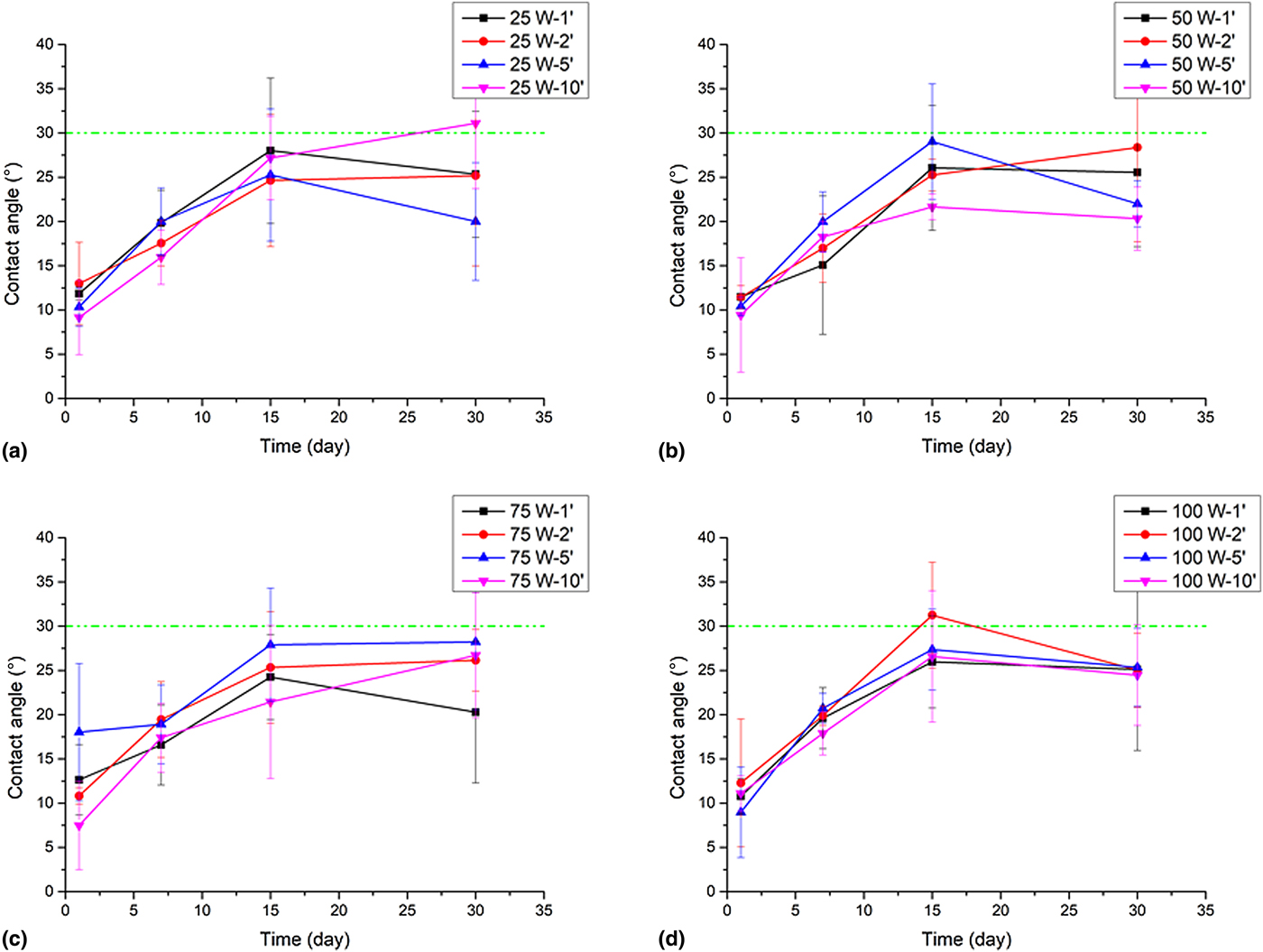
The stability of the plasma-polymerized heptane films over the QTF prongs was the main motivation of this research. Due to this fact, the change of CA of q-hep-PPTF glass slides from 1 to 30 days were examined and presented in Fig. 1. On their first day of thin films that were produced by 1-min exposure time, all CA results were found to be approximately 11°. It showed that plasma power and several level increments in plasma power did not cause a significant change in the surface energy level. When exposure time was increased to 2, 5, and 10 min, similar surface wettability was observed. Therefore, it can be concluded that surface wettability of q-hep-PPTFs was independent of plasma power and exposure time. These results were supported by the studies of Lyakhovich and coworkers, which showed that a hydrophilic but unstable (low crosslinking density) thin film was produced at short plasma treatment times and high plasma power. Similarly, Holländer et al. conducted extensive research to understand stability of PPTFs and they found that there is a direct relation between stability and the amount of incorporated oxygen and trapped radical. In particular, the presence of carbonyl (–C=O) and carboxyl/ester [–C(=O)OH/(–C(=O)OR)] that gives hydrophilic characteristic to thin film decreases the stability of thin film.[Reference Vandenbossche and Hegemann37]
Aging behavior of q-hep-PPTFs which were prepared at different plasma powers: (a) 25 W, (b) 50 W, (c) 75 W, and (d) 100 W (n = 10).
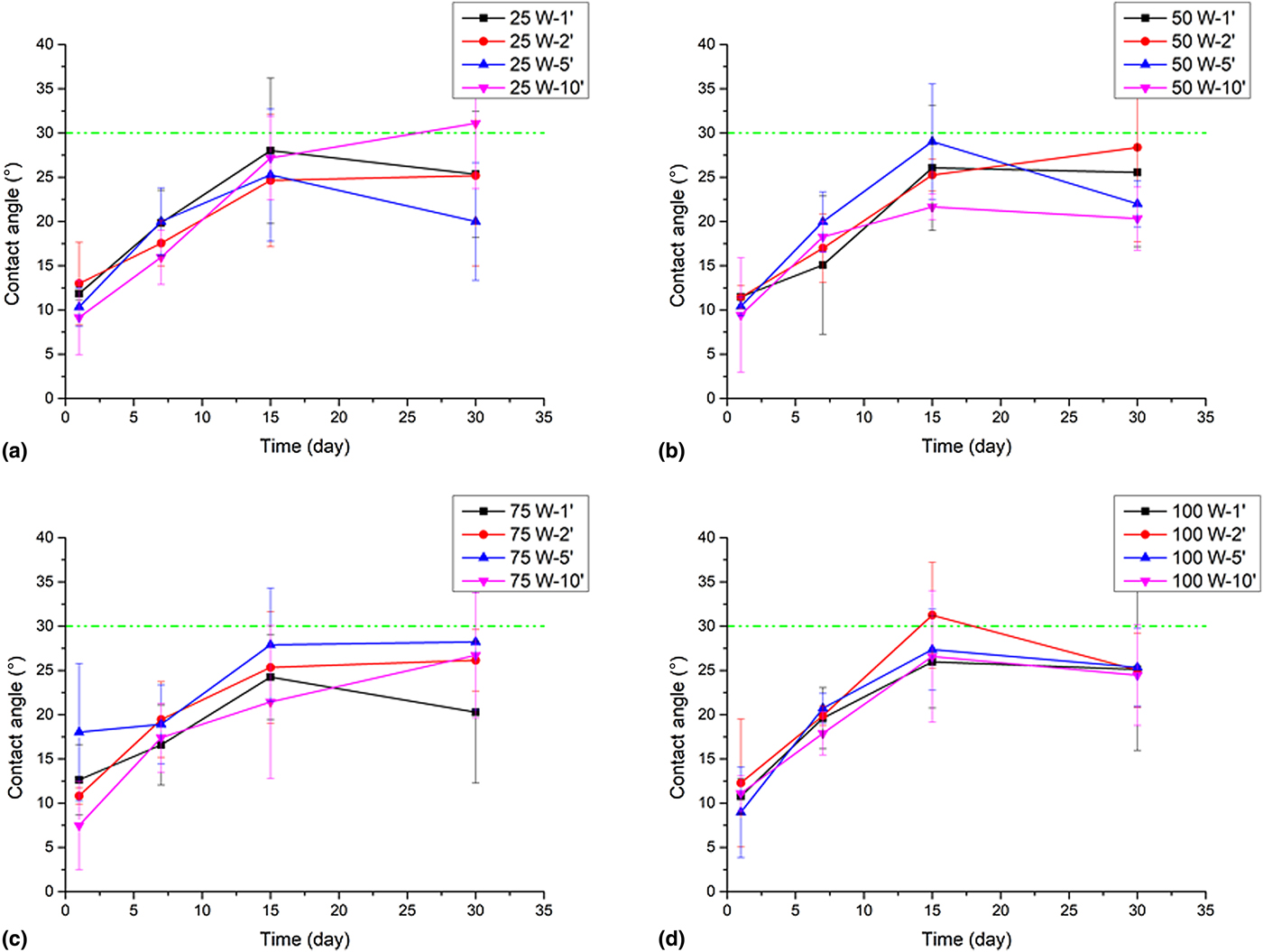
The degradation behavior of q-hep-PPTFs is presented in Fig. 1. The most stable thin film in ambient air was obtained with the process parameters of 50 W plasma power and 10 min exposure time.
Ethylenediamine (EDA)
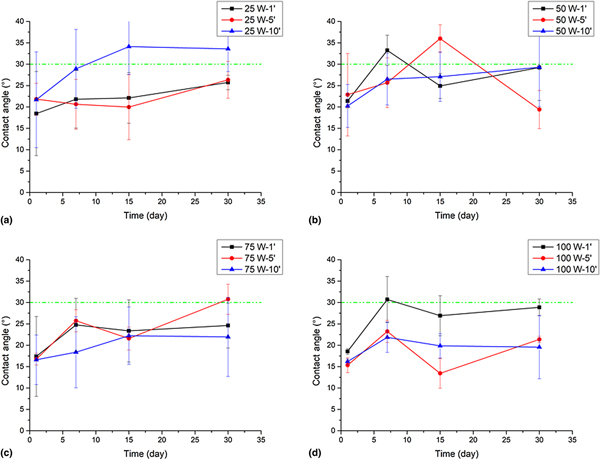
Direct coating of glass surfaces by EDA at different plasma parameters and their time dependent CA values are presented in Fig. 2. According to Fig. 2, EDA thin film samples have some stability issues. All of the EDA samples were started with hydrophilic characteristic at the beginning, but most of them become hydrophobic due to re-orientation of the functional groups created by the plasma process. Therefore, the utilization of these surfaces for biosensor preparation becomes impossible.
Aging behavior of q-EDA-PPTFs which were prepared at different plasma powers: (a) 25 W, (b) 50 W, (c) 75 W, and (d) 100 W (n = 10).
Heptane-ethylenediamine bilayer (q-hep-EDA)
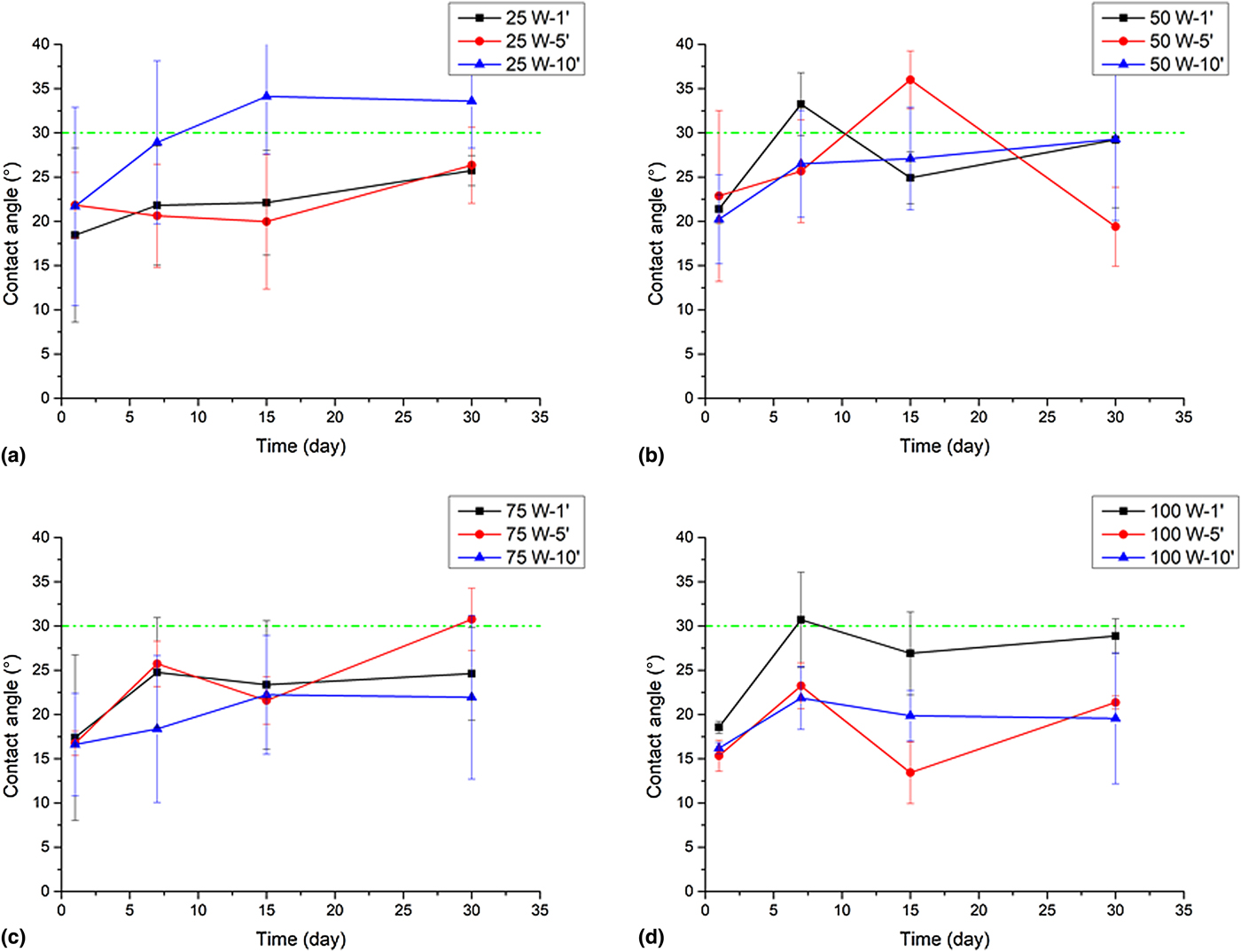
The bi-layer coating of glass slides, heptane and then EDA, was also examined by time dependent contact angle measurements at ambient air and the results are presented in Fig. 3. The figure clearly shows that the ambient air stability of all samples was below the CA boundary value of 30°. It means that during 30 days, almost every sample protected their characteristics as hydrophilic.
Aging behavior of q-hep-EDA-PPTFs which were prepared at different plasma powers: (a) 25 W, (b) 50 W, (c) 75 W, and (d) 100 W (n = 10).

Frequency shift measurements of PPTFs in aqueous medium
It is also important to monitor the thin film stability in aqueous environment mainly for biotechnological applications. Stable thin films in liquid can only be provided if there is a strong interaction between the substrate and the film.
The working principle of QTF is like a quartz crystal microbalance that can be summarized as a mass loading which causes a decrement (ΔF), whereas degradation by aging or loss of material results in increment (−ΔF) in the measured frequency response. All commercially available QTFs are calibrated to 32,768 Hz resonance frequency in vacuum. After decapsulation, QTF resonant frequency shifts 10.29 ± 2.52 Hz (n = 50) because of air damping. It means that frequency shift around 10 Hz does not indicate any significant difference during experiments. In this study, all stability measurements in liquid medium were performed by taking into account this assumption.
In this group of experiments, we monitored the frequencies before and after dipping into PBS (pH: 7.4) to calculate the frequency shifts. In the first group, unmodified QTFs were tested to avoid wrong calculations in liquid and the frequency shift was found to be 12.64 ± 0.66 Hz (n = 12), which was very close to the standard error that would be caused by air damping. It was indicated that there is no interaction between QTF and buffer medium.
In the second group, directly coated QTF prongs by EDA, q-EDA-PPTFs, at different plasma parameters were immersed into a similar aqueous environment, PBS (pH: 7.4) for about 1 min. It was observed visually and the response of controller on the basis of frequency shift showed that all thin films were detached from the QTF surfaces.
In the third group, directly coated QTF prongs by hep, q-hep-PPTFs, were exposed to a similar aqueous environment. As expected from the characteristics of hydrocarbon films under plasma-processed conditions, most of the q-hep-PPTFs have shown a stable response in the aqueous environment and their frequency change remained in the limits of standard error. The plasma processing parameters of most stable heptane films in aqueous environment were used to prepare primary coating of QTF in further studies.
In the final stage, the bi-layer films over the QTF prongs were prepared by using heptane as a primary stable film and then EDA film. These amine-rich prongs were immersed into the same aqueous PBS solution for 1 min. The response of controller on the basis of frequency shift showed that there were no significant changes in the base frequencies. It means that a bi-layer formation of plasma films of heptane and EDA over the QTF prongs has a quite stable behavior in a liquid environment.
AFM analysis of PPTFs
In this study AFM analysis showed that with decreasing plasma power from 75 to 25 W, roughness values increase from 1.65 to 1.04, respectively. The reason for this result might be because of the plasma power parameters; that means depending on the plasma power value, surface mobility and plasma density will vary. Thus, higher plasma power means, higher plasma density as well and this power can break monomers in the gas phase. On the other hand, it is possible to interpret the relation of roughness with hydrophilic/hydrophobic characteristics of selected PPTFs. The increasing roughness values at these plasma powers are consequently considered to provide increasing hydrophobic characteristic of the PPTF surface.[Reference Nasrin, Hossain and Bhuiyan38]
Q (quality) factor studies of QTF
Quality (Q) factor is used to construe the influence of applied external forces on the resonator behavior of QTFs. It can also be defined as the ratio of the energy amount stored in the resonator to the energy gain/loss during the oscillation period.[Reference Friedt and Carry34] In this study we had carried out Q factor studies for each step from beginning to the end. Generally, there are no sharp differences between the following applications. At the same time there is no pattern that associates with neither the plasma power nor exposure time parameters. But, it is promising that there is no sharp decrease in Q factor values and until the protein immobilization and detection step, range of QTFs Q factor values was narrow (Table I).
Q factor results of the best condition PPTFs: (i) untreated QTF substrates, (ii) plasma-polymerized QTF substrates, (iii) GA-activated QTF substrates and (iv) BSA immobilized QTF substrates (n = 10).

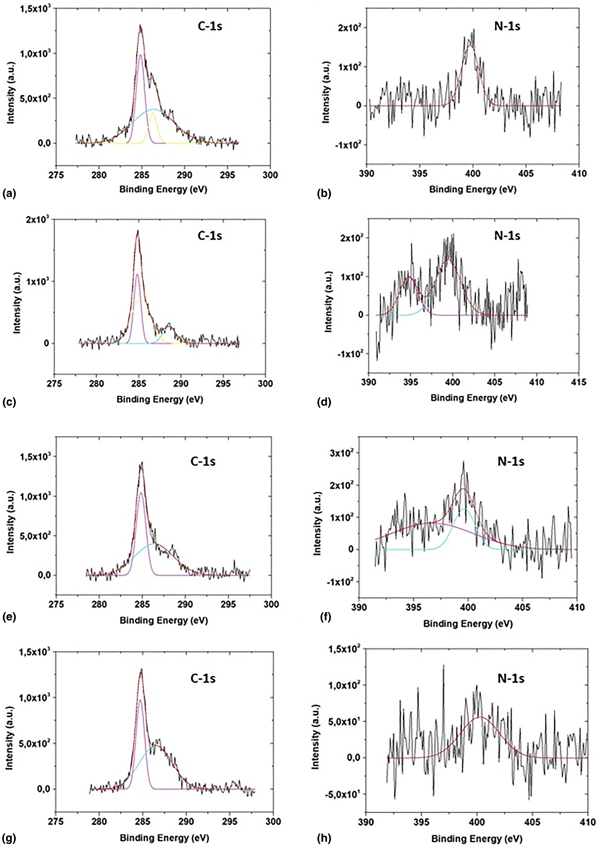
XPS analysis of PPTFs
The surface chemistry of q-hep-EDA and q-EDA was determined using XPS. The high-resolution XPS spectra of the C and N elements are shown in Fig. 4. The deconvolution peaks of the C-1s spectrum of q-hep-EDA produced by 25 W plasma power and 10 min exposure time were resolved into two components: 286.3 and 284.8 eV. The C-1s core-level peak at 286.3 eV corresponds to the COC/COH group. The 284.8 eV peak indicated the presence of C=C. When the C-1s spectrum of q-hep-EDA produced using 50 W plasma power and 10 min exposure time was analyzed, the peaks located at 288.6, 285.2, and 294.8 eV were characteristic peaks indicating the C=O– group, C–O or C–NH group, and C=C, respectively. The deconvolution peaks of the C-1s spectrum of q-hep-EDA produced using 75 W plasma power and 1 min exposure time and q-EDA produced using 75 W plasma power and 5 min exposure time were found to be similar to those of the C-1s spectrum of q-hep-EDA produced using 25 W plasma power and 10 min exposure time. They resolved into two components at 286.4 and 284.7 eV, which indicated the COC/COH group and C=C, respectively.
XPS analysis of selected PPTF samples: (a) q-hep-EDA-25 W-10 min C-1s, (b) q-hep-EDA-25 W-10 min N-1s, (c) q-hep-EDA-50 W-10 min C-1s, (d) q-hep-EDA-50 W-10 min N-1s, (e) q-hep-EDA-75 W-1 min C-1s, (f) q-hep-EDA-75 W-1 min N-1s, (g) q-EDA-75 W-5 min C-1s, and (h) q-EDA-75 W-5 min N-1s spectra.
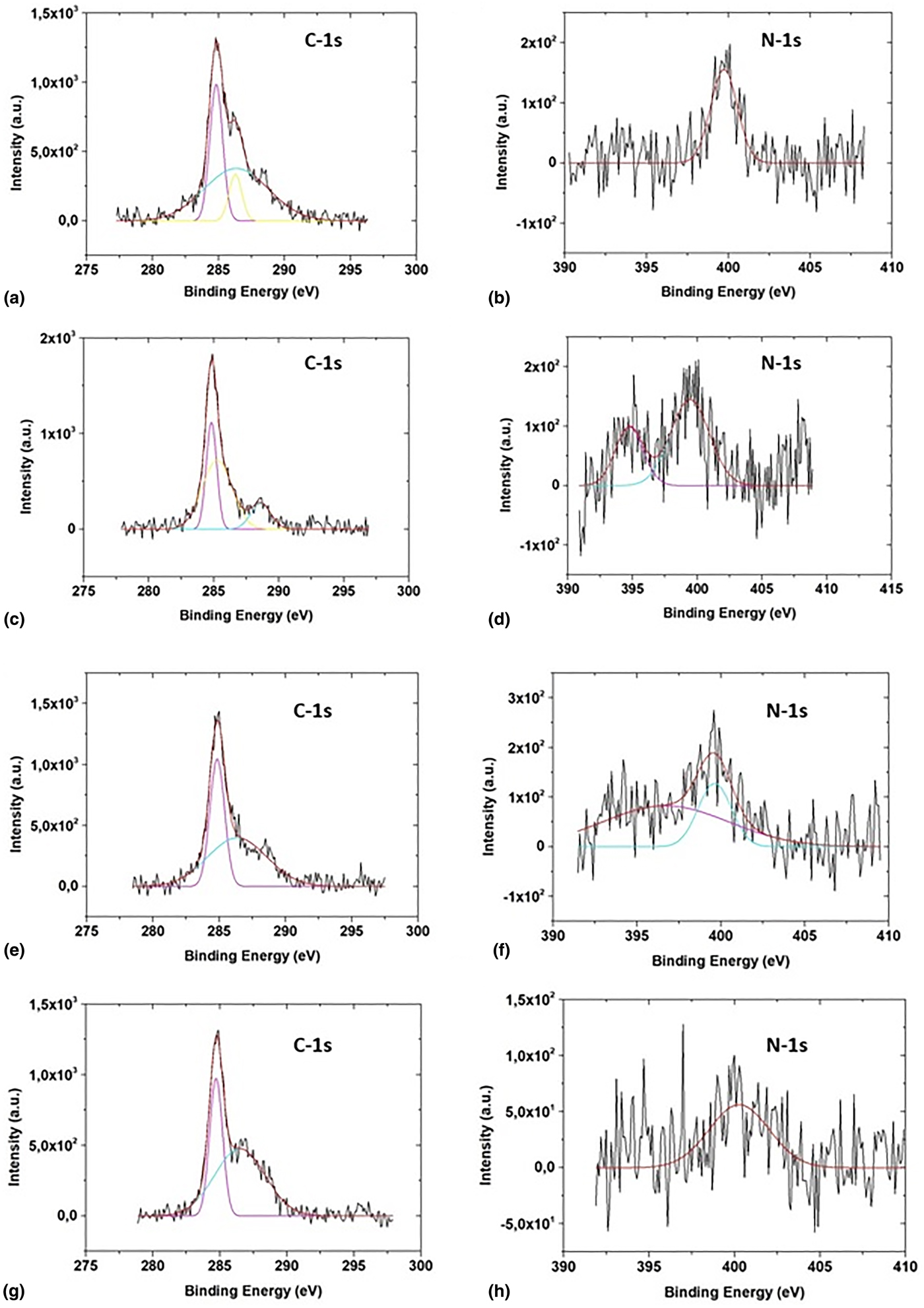
The high-resolution N-1s spectra in q-hep-EDA produced using 25 W and q-EDA produced using 75 W plasma power and 5 min exposure time showed one peak which was attributed to the NSi2O at around 399.5 eV. Interestingly, only one peak was seen in the N-1s spectrum of q-hep-EDA produced using 75 W plasma power and 1 min exposure time at 396.7 eV, which indicated the presence of metal nitrides.
Preparation of mass sensitive biosensor platform
A mass sensitive biosensor, mostly used as an immunosensor or a DNA sensor, could be prepared by the immobilization of antibody (or single strand of DNA) to the amine-rich surface to form a biologic recognition layer. Therefore, to check the binding capacity of amine-rich groups located on the QTF prongs they were tested with a model protein BSA. However, the binding between those surface agents and the biomolecule could be arranged by the presence of a bifunctional crosslinker, so called “GA.” For this purpose, QTF prongs were rinsed with 25% (v/v) GA solution for 2 h at room temperature (25°C).[Reference Mutlu, Çökeliler, Shard, Göktaş and Ozansoy4]
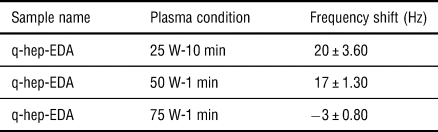
Finally, as a model protein, BSA immobilization on the QTF prongs was investigated. These substrates were treated with 50 µg/ml BSA (0.1% in PBS (v:v), pH 7.4) and then rinsed with phosphate buffer and distilled water. Frequency shift values of high-performance samples are tabulated in Table II.
Frequency shift results after BSA immobilization (n = 10).

Conclusion
In this paper, we had examined the effect on a bi-layer film modification for enhancing the stability of amine-rich coatings via PP. QTFs were used as a template for a new biosensor platform, due to its mass-sensitive nature. On the basis of contact angle and frequency shift results, the q-hep-EDA-25 W-10 min, q-hep-EDA-50 W-10 min, q-hep-EDA-75 W-1 min, and q-EDA-75 W-5 min plasma conditions were selected to be used further in mass sensitive biosensor studies. After these four conditions were obtained as the best parameters, surface activation and model protein studies were carried out. Frequency shift and quality (Q) factor analysis were carried out for utilizing QTF transducer behavior during surface activation and model protein studies. In conclusion, this study showed that it is possible to enhance the stability of amine-rich thin films and decreasing their aging behavior in air and aqueous media as a result of a strong interaction between the substrate and PPTFs thus can be adapted for various biotechnological applications.
Supplementary material
The supplementary material for this article can be found at https://doi.org/10.1557/mrc.2019.55