INTRODUCTION
Biomphalaria glabrata and B. tenagophila are Brasilian fresh water Planorbids of great medical relevance as intermediate hosts of Schistosoma mansoni, a trematode parasite that causes human schistosomiasis, a disease that affects about 8 million people in Brazil (Paraense, Reference Paraense2001).
B. glabrata has an internal defence system (IDS) consisting of soluble components of haemolymph and circulating cells, termed haemocytes, which work in association during the snail responses against infectious agents (van der Knaap and Loker, Reference Van Der Knaap and Loker1990). In snails, circulating haemocytes, especially the phagocytic cell population, are the principal line of cellular defence involved in destruction of S. mansoni larvae inside the intermediate host (Bayne et al. Reference Bayne, Buckley and Dewan1980; Noda and Loker, Reference Noda and Loker1989a; Zelck and Becker, Reference Zelck and Becker1992; Ottaviani, Reference Ottaviani1992; Adema et al. Reference Adema, Van Deutekom-Mulder, Van Der Knaap and Sminia1994; Sapp and Loker Reference Sapp and Loker2000; Negrão-Corrêa et al. Reference Negrão-Corrêa, Pereira, Rosa, Martins-Souza, Andrade and Coelho2007). Therefore, the characterization of circulating haemocytes is fundamental for understanding differences in the resistance of Biomphalaria species to S. mansoni. Most of the studies (Harris, Reference Harris1975; Lo Verde et al. Reference Lo Verde, Gherson and Richards1982; Lie et al. Reference Lie, Jeong, Heyneman and Soulsby1987; Barraco et al. Reference Barraco, Steil and Gargioni1993) have reported that B. glabrata circulating haemocytes are composed of at least 2 cell populations, based mainly on morphological and functional aspects: the hyalinocytes and the granulocytes. However, ultrastructural (Matricon-Gondran and Letorcart, Reference Matricon-Gondran and Letorcart1999) and biochemical (Granath and Yoshino, Reference Granath and Yoshino1983) analyses indicated that circulating granulocytes are very heterogeneous cells and could be involved in different processes during snail infection.
In agreement with the studies on B. glabrata, previous studies reported that circulating haemocytes from B. tenagophila are also composed of hyalinocytes and granulocytes (Martins-Souza et al. Reference Martins-Souza, Pereira, Coelho and Negrão-Corrêa2003). Further analysis showed that injection of silica into B. tenagophila resulted in temporary reduction of the granulocyte subset and increase in the snail susceptibility to S. mansoni infection (Martins-Souza et al. Reference Martins-Souza, Pereira, Coelho and Negrão-Corrêa2003), supporting the participation of these cells in the protective mechanism against S. mansoni infection. However, even with a high dose of silica only part of the granulocyte population was affected by the treatment, demonstrating that circulating granulocytes are an heterogeneous cell population.
Using flow cytometric analysis, we have now profiled, during S. mansoni infection, the circulating haemocyte populations from B. glabrata BH, a snail strain that is highly susceptible to S. mansoni infection (Paraense and Corrêa, Reference Paraense and Corrêa1963), haemocytes from B. tenagophila Cabo Frio, a snail that is moderately susceptible to S. mansoni, and B. tenagophila Taim that is completely resistant to the parasite infection (Bezerra et al. Reference Bezerra, Nogueira-Machado, Chaves, Martins and Coelho1997: Martins-Souza et al. Reference Martins-Souza, Pereira, Coelho and Negrão-Corrêa2003; Coelho et al. Reference Coelho, Carvalho, Andrade, Martins-Sousa, Rosa, Barbosa, Pereira, Caldeira, Jannotti-Passos, Godard, Moreira, Oliveira, Franco, Teles and Negrao-Correa2004; Rosa et al. Reference Rosa, Godard, Azevedo and Coelho2005).
MATERIALS AND METHODS
Parasite
LE strain of S. mansoni (isolated in 1968 by Pellegrino and Katz from a patient in Belo Horizonte, MG, Brazil) was used in all the experiments. The parasite has been maintained by successive passages through B. glabrata and hamsters (Mesocricetus auratus) in the laboratories of the Schistosomiasis Research Unit, Federal University of Minas Gerais, Brazil.
Snails
Two species of Biomphalaria were selected for the study, B. glabrata and B. tenagophila. The strain of B. glabrata was the BH strain (BG-BH), collected at Belo Horizonte, State of Minas Gerais, Brazil, which is highly susceptible to S. mansoni infection (Paraense and Corrêa Reference Paraense and Corrêa1963; Corrêa et al. Reference Corrêa, Coelho and Freitas1979; Santos et al. Reference Santos, Freitas, Correia and Coelho1979; Bezerra et al. Reference Bezerra, Nogueira-Machado, Chaves, Martins and Coelho1997; Souza et al. Reference Souza, Borges, Santana and Andrade1997; Martins-Souza et al. Reference Martins-Souza, Pereira, Coelho and Negrão-Corrêa2003). Two strains of B. tenagophila were also used, the Cabo Frio strain collected at Cabo Frio (BT-CF), State of Rio de Janeiro, Brazil, moderately susceptible to the LE strain of the parasite (Martins-Souza et al. Reference Martins-Souza, Pereira, Coelho and Negrão-Corrêa2003), and the Taim strain collected at the Ecological Station of Taim (BT-Taim), State of Rio Grande do Sul, Brazil, that is totally resistant to S. mansoni infection (Corrêa et al. Reference Corrêa, Coelho and Freitas1979; Santos et al. Reference Santos, Freitas, Correia and Coelho1979; Bezerra et al. Reference Bezerra, Nogueira-Machado, Chaves, Martins and Coelho1997: Martins-Souza et al. Reference Martins-Souza, Pereira, Coelho and Negrão-Corrêa2003; Coelho et al. Reference Coelho, Carvalho, Andrade, Martins-Sousa, Rosa, Barbosa, Pereira, Caldeira, Jannotti-Passos, Godard, Moreira, Oliveira, Franco, Teles and Negrao-Correa2004; Rosa et al. Reference Rosa, Godard, Azevedo and Coelho2005). Both B. glabrata (BH) and B. tenagophila (Taim and Cabo Frio) were bred and maintained in the mollusc room of the Schistosomiasis Research Unit, Institute of Biological Sciences, Federal University of Minas Gerais, Brazil, for at least 25 years, according to the procedures previously described by Pellegrino and Katz (Reference Pellegrino and Katz1968) . The snails used in the experiments measured 12–14 mm in shell diameter at the time of miracidium exposure.
S. mansoni infection
The infection of B. glabrata and B. tenagophila with S. mansoni followed the procedure described by Pellegrino and Katz (Reference Pellegrino and Katz1968). The eggs were obtained from homogenized livers of 45 to 50 day-infected hamsters. After several washes in cold saline, the miracidia were stimulated to hatch under artificial light. Samples of miracidia were collected, counted under a stereomicroscope, and 20 miracidia were added to each flask containing 1 snail to a final volume of 10 ml and incubated for at least 5 h under artificial light. Schistosoma mansoni cercaria emergence was examined after 4 h of stimulation with artificial light in each snail that survived after 40–45 days after infection, as previously described by Pellegrino and Macedo (Reference Pellegrino and Macedo1955) .
Haemolymph collection and haemocyte count
Whole haemolymph was collected from BG-BH, BT-CF and BT-Taim at different times during S. mansoni infection. Each snail shell was cleaned with 70% alcohol, dried with absorbent tissue paper and the haemolymph was collected by cardiac puncture using a 21-G needle (Zelck and Becker, Reference Zelck and Becker1992; Bezerra et al. Reference Bezerra, Nogueira-Machado, Chaves, Martins and Coelho1997). To avoid cellular agglutination, whole haemolymph was collected and diluted 1:1 in Chernin's balanced salt solution (CBSS) (Chernin, Reference Chernin1970) [47·7 mm of NaCl, 2·0 mm of KCl, 0·49 mm of Na2 HPO4 anhydrous, 1·8 mm of MgSO4. 7 H2O, 3·6 mm of CaCl2. 2 H2O, 0·59 mm of NaHCO3, 5·5 mm glucose and 3 mm trehalose], containing citrate/EDTA [50 mm sodium citrate, 10 mm EDTA, and 25 mm sucrose] pH 7·2. After individual collection, the haemolymph from 3 snails of the same experimental group was pooled and 3 separated pools were prepared and tested for each experimental group in each point. The triplicates of pooled whole haemolymph were transferred to 3 separated 1·5 ml Eppendorff tubes. After sedimentation of small shell fragments for 2 min, the whole haemolymph was transferred to another 1·5 ml Eppendorff tube. Whole haemolymph was used for total haemocyte counts performed using 10 μl of whole pooled haemolymph diluted 1/10 in CBSS buffer containing 0·4% Trypan Blue. Viable haemocytes, i.e cells that did not stain with Trypan Blue, were counted immediately in a Neubauer's chamber. In parallel, each sample of whole haemolymph was also used for cytometric analysis described bellow.
Flow cytometry analysis
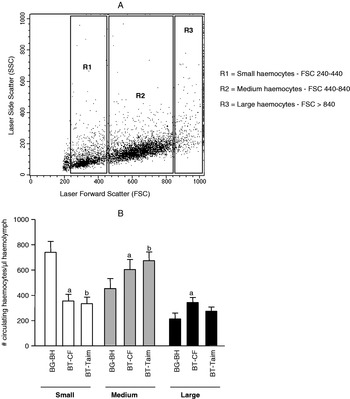
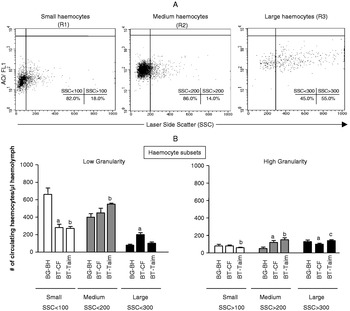
Flow cytometry analysis was performed after incubation of 200 μl of pooled whole haemolymph with an equal volume of ethidium bromide (Et-Br) and acridine orange (AO) solution (stock solution Et-Br=12·5 mg/ml, and AO=4 mg/ml) diluted 1:1000 in CBSS citrate/EDTA (Parks et al. Reference Parks, Bryan, Oi and Herzenberg1979). Haemocyte suspension was incubated for 1 h on ice, in the dark. After incubation, haemocyte suspension was immediately analysed using a FACScan flow cytometer (BD Bioscience, San Jose, CA, USA). Flow cytometry analysis of whole haemolymph cellular components was performed using instrument settings to capture the fluorescence signals from ethidium bromide and acridine orange, respectively at FL3 and FL1 detectors, using log amplification scales. In total, 20 000 events were analysed for each haemolymph pooled sample. CellQuestTM software package (BD Bioscience, San Jose, CA, USA) was used for data acquisition and analysis. Data analysis was initially performed using FL1 versus FL3 dot plot distribution graphs to differentiate live cells (AO positive/Et-Br negative cells) from dead cells (AO negative/EtBr positive cells) from debris (AO and Et-Br negative events). After gating on live haemocytes, cells were selected on size (forward laser scatter – FSC) versus internal complexicity (side laser scatter – SSC) as illustrated in Fig. 1. Three major haemocyte supopulations were selected based on their laser forward scatter, referred to as small (R1=FSC channels between 240–440), medium (R2=FSC channels between 440–840) and large (R3=FSC channels >840). Each of the three haemocyte subpopulations was further analysed based on the internal complexity properties, refereed as SSCLow or less granular and SSCHigh or more granular profiles (Fig. 2A). For this purpose, SSC versus AO/FL1 dot plots were constructed for small, medium and large gated haemocytes and quadrant statistical analysis applied to quantify the less granular and more ganular haemocytes within each subset as illustrated in Fig. 2A. As the small, medium and large haemocytes presented distinct SSC properties, specific cut-off edges were used to categorize SSCHigh subsets within small (SSC channels ⩾100), medium (SSC channels ⩾200) and large (SSC channels ⩾300) haemocyte subpopulations. Percentages of haemocyte subsets obtained from the flow cytometric analysis were further converted on absolute counts taking into account the total viable haemocyte counts (haemocytes not stained by Trypan Blue) performed on Neubauer's chamber obtained with the same haemolymph sample.
(A) Profile of circulating haemocyte population in Biomphalaria snails. Three major haemocyte subpopulations (R1=small – FSC between 240–440, R2=medium – FSC between 440–840 and R3=large – FSC >840) can be identified by flow cytometric dot plot distributions based on their laser forward scatter (FSC) versus laser side scatter properties (SSC). (B) Absolute counts of small (R1=□) medium (R2= ) and large (R3=▪) haemocyte subpopulations in non-infected B. glabrata (BG-BH), B. tenagophila of Cabo Frio strain (BT-CF) and B. tenagophila of Taim strain (BT-Taim) snails. Data are presented as mean number±standard deviation of circulating haemocyte subpopulations. (a) Represents significant differences (P<0·05) in the number of haemocytes of each subset (small, medium, and large) in BT-Cabo Frio compared to the number of haemocytes obtained in BG-BH. (b) Represents significant differences (P<0·05) in the number of haemocytes of each subset (small, medium, and large) in BT-Taim compared to the number of haemocytes obtained in BG-BH. There were no differences in the number of haemocytes of each subset between BT-Taim and BT-Cabo Frio (One – way. ANOVA, post-test Tukey).

Analysis of 3 major circulating haemocyte subpopulations in Biomphalaria snails, based on their laser side scatter properties (SSC) versus acidine orange fluorescence intensity (FL-1) profiles. (A) Two subsets referred to as SSCLow and SSCHigh haemocytes can be identified in all 3 haemocyte subpopulations. (B) Absolute counts of haemocyte subsets categorized as SSCLow and SSCHigh subsets in small (R1=□) medium (R2=) and large (R3=▪) haemocyte subpopulations of B. glabrata (BG-BH), B. tenagophila Cabo Frio (BT-CF) and B. tenagophila Taim (BT-Taim) snails. Data are presented as mean±standard deviation of low and high granular haemocytes within the 3 major circulating haemocyte subsets. (a) Represents significant differences (P<0·05) in the number of haemocytes of each subset (small, medium, and large) in BT-Cabo Frio compared to the number of haemocytes obtained in BG-BH. (b) Represents significant differences (P<0·05) in the number of haemocytes of each subset (small, medium, and large) in BT-Taim compared to the number of haemocytes obtained in BG-BH. There were no differences in the number of haemocytes of each subset between BT-Taim and BT-Cabo Frio (One-way. ANOVA, post-test Tukey).

Statistical analysis
Data referring to the numbers of circulating haemocytes within each cell-subset are reported as mean±standard deviation (S.D.), and analysed by using one-way analysis of variance (ANOVA). A two-way analysis of variance (ANOVA) was used to compare each haemocyte subtype between the 3 Biomphalaria strains during the infection with S. mansoni.
RESULTS
Haemolymph incubation with ethidium bromide and acridine orange solution allowed the separation of the viable circulating haemocytes from the dead cells and small fragments. As observed in Fig. 1A, viable circulating haemocytes from Biomphalaria snails could be separated into 3 major cell subpopulations based mainly on size (forward scatter – FSC) and granularity (side scatter – SSC) dot plot distribution. The haemocyte subpopulations have been denominated small haemocytes (R1 – FSC channels between 240–440), medium haemocytes (R2 – FSC channels between 440–840) and large haemocytes (R3 – FSC channels >840).
Analysis of absolute counts of haemocyte subpopulations demonstrated distinct profiles in B. glabrata (BG-BH), B. tenagophila Cabo Frio (BT-CF) and B. tenagophila Taim (BT-Taim) snails (Fig. 1B). In non-infected B. glabrata, the majority of circulating cells were small haemocytes (740±150 cells/μl of haemolymph) while in non-infected B. tenagophila medium haemocytes represented the majority of circulating haemocytes (590±140 cells/μl haemolymph in BT-CF and 670±120 cells/μl of haemolymph in BT-Taim). Large haemocytes were detected in similar numbers in circulating haemolymph of B. glabrata and B. tenagophila (Fig. 1B). There was no detectable difference in circulating haemocyte profiles in non-infected B. tenagophila of Cabo Frio strain and B. tenagophila of Taim strain.
Fig. 2A shows analysis of 3 major circulating haemocyte subpopulations in Biomphalaria snails, based on their laser side scatter (SSC) versus acridine orange fluorescence intensity (FL1). Two subsets, referred to as less granular and more granular haemocytes, were identified in all 3 haemocyte subpopulations. The analysis of side-scatter properties of circulating haemocytes from the Biomphalaria spp., revealed that most of the small and medium haemocytes were confined within the less granular subset while the large haemocyte population shows a similar amount of cells with less granular and more granular properties (Fig. 2A). The most striking difference in haemocyte SSC properties between non-infected snails of different species was the fact that the higher number of small haemocytes observed in B. glabrata was due to the less granular cell subset compared to B. tenagophila. In contrast, both strains of B. tenagophila (BT-CF and BT-Taim) had a significantly higher frequency of more granular medium haemocytes than B. glabrata, as reflected in higher numbers of this cell type (Fig. 2B).
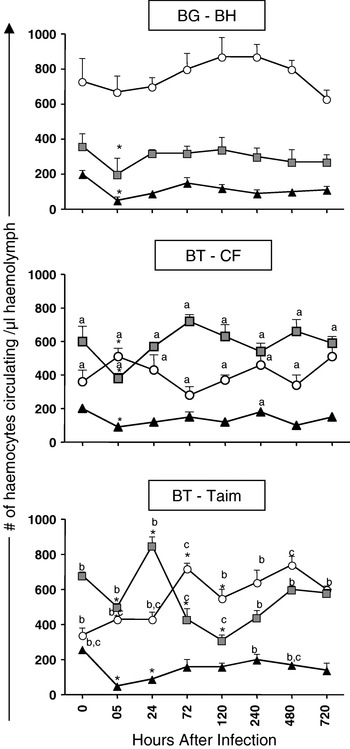
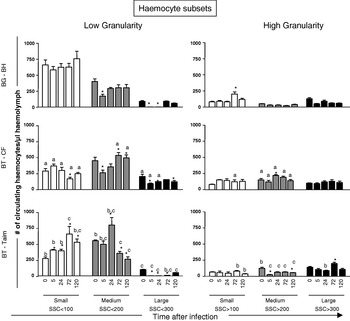
At 40 days after S. mansoni infection, cercariae were found in 58% of infected B. glabrata and 20% of B. tenagophila Cabo Frio strain. As reported previously (Martins-Souza et al. Reference Martins-Souza, Pereira, Coelho and Negrão-Corrêa2003), cercariae were not found in S. mansoni-infected B. tenagophila of Taim strain. Schistosoma mansoni infection in Biomphalaria resulted in a significant reduction of large and medium circulating haemocytes as early as 5 h after the parasite infection (Fig. 3). However, in B. glabrata the cell reduction was transient, returning to non-infected levels briefly after parasite infection (Fig. 3A). In contrast, the parasite infection in B. tenagophila resulted in intense alteration of circulating haemocytes, especially in Taim strain. Infected B. tenagophila of Cabo Frio strain showed a significant decrease in number of medium and large circulating haemocytes only at 5 h after infection, followed by a gradual increase in medium-sized circulating cells (Fig. 3B). The parasite infection induced a more intense modification of the circulating haemocyte profile of B. tenagophila of Taim, the snail strain that is resistant to S. mansoni infection (Fig. 3C). In this strain, the number of large circulating haemocytes was significantly lower at 5 and 24 h after infection. Medium circulating haemocytes from infected Taim snails had an initial reduction, especially due to low numbers of the less granular cell subsets 5 h after parasite infection (Fig. 4), followed by a significant increase in less granular cells 24 h after infection, that reduced again at 72 h and 120 h after infection. The number of small circulating haemocytes in infected Taim snails gradually increased after S. mansoni infection, being significantly higher than the non-infected snails after 72 h post-infection (p.i.), when the number of small circulating haemocytes reached 720 cell/ μl of haemolymph compared to 340 detected before infection (Fig. 3C). The analysis of the SSC properties of circulating haemocytes during the S. mansoni infection revealed that most of the cellular alteration was due to less granular haemocyte subsets (Fig. 4). The number of circulating haemocytes with more granular profile, within the different haemocyte populations, (small, medium or large) was relatively constant after parasite infection in all the snail strains tested.
Kinetic analysis of 3 major circulating haemocyte subpopulations in Biomphalaria glabrata (BG-BH), B. tengophila Cabo Frio (BT-CF) and B. tenagophila Taim (BT-Taim) snails following S. mansoni infection. Data are presented as mean number±standard deviation of circulating haemocyte subpopulations, including small (ο), medium () and large (▴) haemocytes during 30 days after infection. (a) Represents significant differences (P<0·05) in the number of haemocytes in BT-Cabo Frio compared to the number of haemocytes obtained in BG-BH. (b) Represents significant differences (P<0·05) in the number of haemocytes in BT-Taim compared to the the number of haemocytes obtained in BG-BH. (c) Represents differences in the number of haemocytes of each subset between BT-Taim and BT-Cabo Frio, during the infection (two–way ANOVA). * Represents significant differences (P<0·05) in the number of haemocytes of each subset in each snail strain compared to non-infected (time 0) (One-way ANOVA, post-test. Tukey).

Kinetic analysis of SSCLow and SSCHigh haemocyte subsets within the 3 major circulating haemocyte subpopulations in Biomphalaria glabrata (BG-BH), B. tenagophila Cabo Frio (BT-CF) and B. tenagophila Taim (BT-Taim) snails following Schistosoma mansoni infection. Data are presented as of SSCLow and SSCHigh haemocytes within the 3 major circulating haemocyte subpopulations, including small (□), medium () and large (▪) haemocytes during 30 days after infection. (a) Represents significant differences (P<0·05) in the number of haemocytes of each subset of SSCLow and SSCHigh in BT-Cabo Frio compared to the number of haemocytes obtained in BG-BH. (b) Represents significant differences (P<0·05) in the number of haemocytes of each subset of SSCLow and SSCHigh in BT-Taim compared to the number of haemocytes obtained in BG-BH. (c) Represents differences in the number of haemocytes of each subset between BT-Taim and BT-Cabo Frio, during the infection (two-way ANOVA, post-test Tukey). * Represents significant differences (P<0·05) in the number of haemocytes of each subset of SSCLow and SSCHigh in each snail strain compared to non-infected (time 0).

DISCUSSION
The characterization of circulating haemocytes in Biomphalaria has been described by various authors (Sminia Reference Sminia1981; Barraco et al. Reference Barraco, Steil and Gargioni1993; Bezerra et al. Reference Bezerra, Nogueira-Machado, Chaves, Martins and Coelho1997; Matricon-Gondran and Letorcart, Reference Matricon-Gondran and Letorcart1999 and Johnston and Yoshino, Reference Johnston and Yoshino2001), focusing on morphological and biochemical aspects of these cells. Using a flow cytometry-based methodology, Johnston and Yoshino (Reference Johnston and Yoshino2001) described 2 major haemocyte subpopulations, referred as R1 and R2 type cells, in circulating haemocytes from B. glabrata snails free of infection. In the present experimental work, we also used flow cytometry analysis to characterize circulating haemocytes from B. tenagophila. The difference between this work and earlier reports is that the characterization of haemocytes was performed in living cells, and it was possible to examine alterations in the circulating haemocyte profile during S. mansoni infection. Moreover, we compared the effects of the parasite infection on numbers of circulating haemocytes in snails of different species (B. glabrata and B. tenagophila) and strains with different levels of susceptibility to S. mansoni infection.
Most of the earlier reports (Harris, Reference Harris1975; Yoshino, 1976; Lo Verde et al. Reference Lo Verde, Gherson and Richards1982; Lie et al. Reference Lie, Jeong, Heyneman and Soulsby1987; Barraco et al. Reference Barraco, Steil and Gargioni1993) differentiated 2 cell types in circulating haemocytes from Biomphalaria spp., designated as hyalinocytes (cells of smaller size and without granularity) and granulocytes (cells of greater size and high granularity). Using neutral red differential staining, previous studies from our laboratory (Bezerra et al. Reference Bezerra, Nogueira-Machado, Chaves, Martins and Coelho1997; Martins-Souza et al. Reference Martins-Souza, Pereira, Coelho and Negrão-Corrêa2003) also identified 2 types of cells within circulating haemocyte populations from Biomphalaria: haemocytes that were not stained by neutral red (also called hyalinocytes), and red-stained granulocytes. However, red-stained haemocytes are a very heterogeneous cell population that includes both small and large cells (Negrão-Correa et al. Reference Negrão-Corrêa, Pereira, Rosa, Martins-Souza, Andrade and Coelho2007).
In the present work, cytometric analysis revealed that circulating haemocytes from Biomphalaria species consist of 3 major cell types, small, medium and large haemocytes. In fact, the analysis of the laser forward scatter versus laser side scatter dot plot distribution allowed us to identify a minor haemocyte subset, herein referred to as large haemocytes (P3) with FSC >840. The R3 haemocytes indicated here were also present in the cytometric profile of circulating haemocytes of B. glabrata reported by Johnston and Yoshino (Reference Johnston and Yoshino2001), but those authors did not separate them from the R2 subset. The 3 circulating haemocyte subsets reported here are in agreement with the results of Matricon-Gondran and Letorcart (Reference Matricon-Gondran and Letorcart1999) who, based on their size and ultrastructural aspects, also identified 3 subpopulations of haemocytes in whole haemolymph of B. glabrata free of infection. The results also corroborated the earlier data of Martins-Souza et al. (Reference Martins-Souza, Pereira, Martins Filho, Coelho, Corrêa and Negrão-Corrêa2006) that identified 3 circulating haemocyte subsets in Biomphalaria using optical microscopy. Moreover, the authors showed that these cell subsets are differentially labelled by FITC-conjugated lectins and respond differently to S. mansoni infection, suggesting a functional role for them.
The analysis also showed that all the 3 subpopulations of haemocytes are heterogeneous with regard to their laser side scatter properties. Each haemocyte subset, in B. glabrata and B. tenagophila, is composed of 2 subpopulations of cells with different granularity profiles, referred to as less granular and more granular haemocytes. More importantly, the cytometric analysis allowed us to differentiate circulating haemocyte profiles of B. glabrata and B. tenagophila. In B. glabrata most of the circulating haemocytes were small cells with lower granularity profile while in B. tenagophila the majority of cells were medium, low granular haemocytes.
Another interesting finding of the present experimental work was the significant changes induced by S. mansoni infection in each snail strain or species. Bezerra et al. (Reference Bezerra, Nogueira-Machado, Chaves, Martins and Coelho1997) and Martins-Souza et al. (Reference Martins-Souza, Pereira, Coelho and Negrão-Corrêa2003) showed that, 5 h after infection by S. mansoni, there was a significant reduction in the number of cells circulating in all the snails studied, and the decrease was more intense in resistant strains. The authors also demonstrated that after the initial reduction of circulating haemocytes, there was an increase in total number of cells between 1–3 and 15 days after infection. Biomphalaria glabrata infected with the trematode Echinostoma paraensei showed an increased number of circulating haemocytes. The increased number of circulating cells was mainly due to the increase in the number of round small cells and the partially spread granulocytes (Noda and Loker, Reference Noda and Loker1989a). However, phagocytic activity of circulating haemocytes was statistically lower in 8-day infected B. glabrata compared to non-infected haemocytes (Noda and Loker, Reference Noda and Loker1989b), a result that would suggest that activated cells had migrated out of circulation. In this study we found that the reduction in circulating haemocytes induced by parasite infection was due to a significant decrease in the number of medium and large cells with more granular profile. Moreover, in S. mansoni-susceptible snails, such as B. glabrata (BG-BH) and B. tenagophila (BT-CF), the modified haemocyte profile was not intense and was transient. In contrast, in B. tenagophila of Taim strain, the resistant snail strain, the alteration in circulating haemocyte profile was very intense and prolonged until 120 h after infection. In these snails, large circulating haemocytes of less granular profile almost disappeared from the haemolymph, while small haemocytes gradually increased in number during the parasite infection. Moreover, medium haemocytes were very responsive during the first few days of S. mansoni infection in B. tenagophila of Taim, increasing in number, followed by a decrease that persisted throughout the infection. According to Sminia (Reference Sminia1981), the small haemocytes, called hyalinocytes, have great mitotic activity and low phagocytic activity. He suggested that this cell type is a precursor for granulocytes – cells that have little mitotic activity, but high phagocytic activity. This hypothesis could explain the haemocyte response to parasite infection: mature cells, consisting of large and medium circulating haemocytes, migrate out of the haemolymph to the infection site. In parallel, immature small haemocytes proliferate and differentiate into the mature cells. Alternatively, it is possible that the infections may be inducing a degranulating effect on some cells or the formation of new granules in others. In previous work, Martins-Souza et al. (Reference Martins-Souza, Pereira, Martins Filho, Coelho, Corrêa and Negrão-Corrêa2006) had shown that medium and large circulating haemocytes, recovered from B. tenagophila of Taim strain, were intensively labelled by FITC-conjugated lectins, especially WGA and PNA. In addition, this cell population may be sequestred in the infection site. The participation of lectins in the haemocyte-sporocyst interaction has been well documented in the literature, most of them showing that lectins produced and secreted by haemocytes could facilitate binding of haemocytes to the larval tegument of trematodes (Van der Knaap and Loker Reference Van Der Knaap and Loker1990; Loker and Bayne, Reference Loker and Bayne2001; Yoshino et al. Reference Yoshino, Boyle and Humphries2001 and Martins-Souza et al. Reference Martins-Souza, Pereira, Martins Filho, Coelho, Corrêa and Negrão-Corrêa2006). Moreover, lectin-carbohydrate binding possibly leads to a structural change of the complex, that could induce haemocyte activation (Bayne, Reference Bayne1990), resulting in an increase of the phagocytic activity (Fryer et al. Reference Fryer, Hull and Bayne1989) and/or of production of reactive oxygen species (ROS) (Hahn et al. Reference Hahn, Bender and Bayne2000). Therefore, an intense circulating haemocyte response induced by S. mansoni infection would be associated with strong cellular infiltration around the parasite larvae and, consequently, with snail resistance against the infection.
In conclusion, our data clearly demonstrated that cytometric analysis is a useful tool for the characterization of circulating haemocytes in Biomphalaria, allowing us to quantify the changes in circulating haemocytes induced by parasite infection, such as S. mansoni. The comparison between haemocyte responses to S. mansoni infection in resistant and susceptible snail strains suggested that resistance observed in Taim strain is associated with intense haemocyte activation, and migration of medium and large haemocytes of less granular profile to the infection site.
The work has financial support from Pronex (FAPEMIG and CNPq). Acknowledgement is also due to the Schistosomiasis Research Group staff and Sra. Vera de Paula Ribeiro for the technical support. The author is also very grateful to Dr John R. Kusel for reviewing the text and for valuable suggestions.