Introduction
Parkinson's disease (PD) is a progressive neurodegenerative disorder characterized by motor, cognitive, and psychiatric symptoms, which lead to a variety of adverse functional outcomes. Individuals with PD demonstrate impairment in basic (bADLs) and instrumental (iADLs) activities of daily living (e.g., Cahn et al., Reference Cahn, Sullivan, Shear, Pfefferbaum, Heit and Silverberg1998). Functional disability in PD is associated with a variety of factors, such as severity of motor symptoms, depression, global cognitive decline, and older age at onset (e.g., Bouwens, van Heugten, & Verhey, Reference Bouwens, van Heugten and Verhey2009; Post et al., 2011; Sabbagh et al., Reference Sabbagh, Silverberg, Bircea, Majeed, Samant, Caviness and Adler2005; Starkstein, Mayberg, Leiguards, Preziosi, & Robinson, Reference Starkstein, Mayberg, Leiguards, Preziosi and Robinson1992). A specific area of iADLs that has growing interest in PD is medication non-adherence, which has been associated with complex drug regimens, depression, and poorer quality of life (e.g., Grosset et al., Reference Grosset, Antonini, Canesi, Pezzoli, Lees, Shaw and Grosset2009; Valldeoriola et al., Reference Valldeoriola, Coronell, Pont, Buongiorno, Cámara, Gaig and Compta2011).
Few studies have examined the specific cognitive predictors of everyday functioning in PD. Cahn and colleagues (1998) found that executive dysfunction was an independent predictor of iADLs, whereas motor slowing was uniquely associated with bADLs. ADLs have also been linked to deficits in verbal fluency, visual memory, visuoperception, and inattention in PD (Bronnick et al., Reference Bronnick, Ehrt, Emre, De Deyn, Wesness, Tekin and Aarsland2006; Maeshima, Itakura, Makagawa, Nakai, & Komai, Reference Maeshima, Itakura, Nakagawa, Nakai and Komai1997; Muslimovic et al., Reference Muslimovic, Post, Speelman, Schmand and de Haan2008; Uc et al., Reference Uc, Rizzo, Anderson, Qian, Rodnitzky and Dawson2005).
The majority of studies examining everyday functioning in PD have used self-report or informant-report scales, whose validity are limited by cognitive impairment, depression, anosagnosia, and reporter bias (e.g., Argüelles, Loewenstein, Eisdorfer, & Argüelles, Reference Argüelles, Loewenstein, Eisdorfer and Argüelles2001; Blackstone et al., Reference Blackstone, Moore, Heaton, Franklin, Woods, Clifford and Grant2012; DeBettignies, Mahurin, & Pirozzolo, Reference DeBettignies, Mahurin and Pirozzolo1990; Marino et al., Reference Marino, Meador, Lorin, Okun, Fernandez, Fesller and Werz2009). Only two studies have examined functional decline using performance-based measures (Manning et al., 2012; Shulman et al., Reference Shulman, Pretzer-Aboff, Anderson, Stevenson, Vaughan, Gruber-Baldini and Weiner2006). Shulman et al. (Reference Shulman, Pretzer-Aboff, Anderson, Stevenson, Vaughan, Gruber-Baldini and Weiner2006) found that individuals with PD were impaired in both bADLs and iADLs. Although Manning et al. (2012) did not include a comparison group, they found that over half (54%) of PD subjects failed two performance-based medication management tasks. A few studies also have reported medication non-adherence in PD using electronic monitoring (e.g., Grosset et al., Reference Grosset, Antonini, Canesi, Pezzoli, Lees, Shaw and Grosset2009).
One area of cognition that may be particularly relevant to the prediction of functional decline in PD is prospective memory (PM). PM describes the ability to perform an intended action at some designated point in the future (McDaniel & Einstein, Reference McDaniel and Einstein2000), or “remembering to remember”. PM is a multi-faceted cognitive construct that involves several consecutive phases: (1) intention formation, (2) intention retention, (3) intention initiation: detection and recognition of the cue and self-initiated retrieval of the intention, and (4) intention execution (e.g., Kliegel, Martin, McDaniel, & Einstein, Reference Kliegal, Martin, McDaniel and Einstein2002). PM is critically involved in many aspects of everyday functioning and failures can result in severe consequences (Woods et al., Reference Woods, Dawson, Weber, Gibson, Grant and Atkinson2009). Indeed, PM dysfunction predicts iADL decline beyond general cognition, depression, and demographics in other populations (Twamley et al., Reference Twamley, Woods, Zurhellen, Vertinski, Narvaez, Mausbach and Jeste2008; Woods, Iudicello et al., Reference Woods, Iudicello, Morn, Carey, Dawson and Grant2008, Reference Woods, Weinborn, Velnoweth, Rooney and Bucks2012).
Compared to healthy adults, PD patients endorse more frequent everyday PM failures (Foster, McDaniel, Repovîs, & Hershey, Reference Foster, McDaniel, Repovîs and Hershey2009) and show impairment on laboratory measures of PM (e.g., Foster et al., Reference Foster, McDaniel, Repovîs and Hershey2009). Studies have demonstrated event-based (EB) PM (i.e., triggered by an external cue) impairment in PD, particularly for non-focal cues, that correlate with deficits in planning, strategic attentional monitoring, and working memory (Altgassen, Zöllig, Kopp, Mackinlay, & Kliegal, Reference Altgassen, Zöllig, Kopp, Mackinlay and Kliegal2007; Foster et al., Reference Foster, McDaniel, Repovîs and Hershey2009; Katai, Maruyama, Hashimoto, & Ikeda, Reference Katai, Maruyama, Hashimoto and Ikeda2003; Kliegal, Phillips, Kopp, Reference Kliegal, Phillips and Kopp2005). Individuals with PD show a disproportionate deficit in TB (i.e., triggered by a specific time or time interval cue) compared to EB PM tasks (Costa et al., Reference Costa, Peppe, Caltagirone and Carlesimo2008; Raskin et al., Reference Raskin, Woods, Poquette, McTaggart, Sethna, Williams and Tröster2011, but see Katai et al., Reference Katai, Maruyama, Hashimoto and Ikeda2003), which is consistent with McDaniel & Einstein's (2000) notion that TB PM relies more heavily on strategic processes and frontostriatal systems.
Although PM impairment is a risk factor for impairment in everyday function (e.g., Woods, Iudicello et al., Reference Woods, Moran, Carey, Dawson, Iudicello, Gibson and Atkinson2008), no study to our knowledge has investigated the functional correlates of PM dysfunction in PD. Thus, the current study aimed to extend the literature in two important ways: (1) extend the limited research on everyday functioning in PD using well-validated performance-based measures of medication and financial management; and (2) investigate the associations between PM and everyday functioning using a multimodal approach that included both self-report and performance-based measures. It was hypothesized that (1) individuals with PD would show poorer performance on the performance-based measures of everyday function relative to healthy controls and (2) PM would be associated with everyday function measures in PD.
Methods
Participants
All participants gave verbal consent and signed the university-approved consent document. The study sample consisted of 33 PD patients (26 non-demented PD participants, 7 PD with dementia participants based on a formal diagnosis of dementia or scoring lower than 130 on the Dementia Rating Scale; DRS; Mattis, Reference Mattis1976). PD patients were recruited from the Parkinson's Disease Research Subject Database of the San Diego VA Health Care System/University of California at San Diego and were diagnosed by a board-certified neurologist who specializes in movement disorders using UK Brain Bank criteria (Hughes, Daniel, Kilford, & Lees, Reference Hughes, Daniel, Kilford and Lees1992). Disease staging was assessed using the modified Hoehn and Yahr's (H&R; Hoehn & Yahr, Reference Hoehn and Yar1967) PD rating scale (N = 31). All PD patients were prescribed antiparkinsonian medications and were on their normal regimen of dopaminergic agents at the time of testing. Twenty-eight patients were on levodopa treatment (levodopa/carbidopa or levodopa/carbidopa/entacapone), 28 were taking a dopamine agonist (Requip or Mirapex), 14 patients were on a MAO inhibitor (Azilect or Selegiline), 9 were on Amantadine, 2 were using an Exelon patch, and 1 patient was on Kemadrin. Exclusion criteria for PD participants in the study included history of neurologic conditions other than PD, major depressive disorder before the diagnosis of PD, severe psychiatric disorders (e.g., schizophrenia), or substance use disorders.
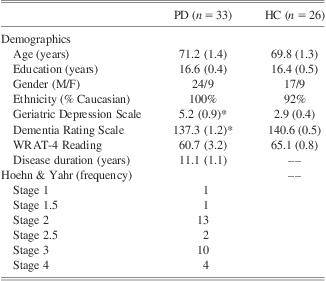
The healthy controls (HC) were recruited from a longitudinal study at SDSU. Exclusion criteria for HC participants in the study included a history of neurologic conditions, any major psychiatric disorders (e.g., major depressive disorder, schizophrenia) or substance use disorders. The PD and HC groups did not differ significantly in demographics or WRAT-4 scores (see Table 1). The PD group had significantly lower DRS scores and greater Geriatric Depression Scale (GDS; Yesavage et al., Reference Yesavage, Brink, Rose, Lung, Huang, Adey and Leirer1982) scores than the HC participants (see Table 1).
Demographic characteristics of study participants

Note. Data for demographics represent means and standard errors. Data for Hoehn & Yahr ratings represent frequencies.
HC = Healthy Controls; PD = Parkinson's disease patients; WRAT-4 Reading = Reading subtest from the Wide Range Achievement Test – Fourth Edition.
*p < .05.
Procedures
Prospective Memory Measures
The Memory for Intentions Screening Test (MIST) is a standardized, performance-based measure of PM with scores ranging from 0 to 48 (Raskin et al., Reference Raskin, Buckheit and Sherrod2010). We used the 30-min research version of the test (Woods, Moran, Dawson et al., Reference Woods, Moran, Dawson, Carey and Grant2008) that includes eight PM trials balanced on the following characteristics: (1) TB cue (e.g., “In 15 minutes, tell me that it is time to take a break”) or EB cue (e.g., “When I show you a post card, self-address it”); (2) 2-min or 15-min delay interval; and (3) verbal or physical response modality. During the MIST, participants are engaged in word search puzzles that serve as ongoing distracter tasks. Studies support the reliability (Woods, Moran, Dawson et al., Reference Woods, Moran, Carey, Dawson, Iudicello, Gibson and Atkinson2008c) and construct validity (e.g., Gupta et al., Reference Gupta, Woods, Weber, Dawson and Grant2010) of the MIST.
The Prospective and Retrospective Memory Questionnaire (PRMQ) is a 16-item questionnaire that measures the frequency of self-reported daily prospective and retrospective memory failures (Smith, Della Sala, Logie, & Maylor, Reference Smith, Della Sala, Logie and Maylor2000). Eight of the questions ask about the frequency of retrospective memory failures (e.g., “Do you fail to recognize a place you have visited before?”) and the other eight pertain to PM failures (e.g., “Do you forget to buy something you planned to buy, like a birthday card, even when you see the shop?”). The items are rated on a 5-point scale ranging from 1 (never) to 5 (very often). The questionnaire includes equal numbers of self-cued (e.g., “Do you decide to do something in a few minutes’ time and then forget to do it?”) and environmentally-cued (e.g., “Do you fail to mention or give something to a visitor that you were asked to pass on?”) prospective and retrospective memory items. The scores for the self-cued and environment-cued PM scales range from 4 to 20. The PRMQ has adequate psychometric properties, including internal consistency (Smith et al., 2010), and discriminative (Smith et al., Reference Smith, Della Sala, Logie and Maylor2000), structural (i.e., Crawford, Smith, Maylor, Della Sala, & Logie, Reference Crawford, Smith, Maylor, Della Sala and Logie2003), and ecological (e.g., Woods, Iudicello et al., Reference Woods, Moran, Dawson, Carey and Grant2008) validity.
Everyday Functioning Measures
Performance-based measures of everyday functioning
Medication Management
The Medication Management Ability Assessment (MMAA; Patterson et al., Reference Patterson, Lacro, McKibbin, Moscona, Hughs and Jeste2002) is a performance-based role-play task in which the examiner presents a standardized description of the medication regimen for four mock medications. Participants are shown four plastic pill bottles with standardized labels stating the name of the medication, the frequency and amount of medication to be taken daily, as well as whether the medication should be taken with food or on an empty stomach. Following the description of the medication regimen, there is a 1 hour delay in which the medication bottles are set aside. After the delay, participants are given the four medication bottles and prompted to walk through their day, saying when they would wake up, eat their meals, and take their medications, handing over the correct number of mock pills (beans) to the examiner. The total number of correct responses for all of the pills (scores ranging from 0–33) was used for analyses. The MMAA task is different from a PM task in that the participants are not asked to remember to take the medications at a specific time or when a specific environmental cue is present. The MMMA has shown excellent test–retest reliability (Patterson et al., Reference Patterson, Lacro, McKibbin, Moscona, Hughs and Jeste2002) and predictive validity (Patterson et al., Reference Patterson, Lacro, McKibbin, Moscona, Hughs and Jeste2002).
Managing Finances
In the Advanced Finances Test (AFT; Heaton et al., Reference Heaton, Marcotte, Mindt, Sadek, Moore, Bentley and Grant2004), participants are handed blank checks, a checkbook register, a check to deposit, three bills to pay, and a calculator. Participants are instructed to deposit the check, pay the bills, and calculate their checkbook balance. The participants also are instructed to pay as much of their credit card bill as possible but to leave $100 in their checking account. The total score ranges from 0 to 13 points. There is evidence to support the reliability (internal consistency) and discriminative validity (Heaton et al., Reference Heaton, Marcotte, Mindt, Sadek, Moore, Bentley and Grant2004) of the AFT.
Self-report measures of everyday functioning
IADLs
A modified version of the Lawton & Brody Activities of Daily Living (1969) measure was used to examine IADL decline (Heaton et al., Reference Heaton, Marcotte, Mindt, Sadek, Moore, Bentley and Grant2004). The self-report measure includes ratings for current as well as best past level of functioning for several daily living skills. IADLS were defined as a subset of items involving areas of functioning that are less likely to reflect motor symptoms of PD. Thus, basic ADLs (e.g., bathing, dressing) were not used in the analysis. The IADL items that were used for analyses were: (1) housekeeping; (2) finances; (3) groceries; (4) telephone use; (5) shopping; and (6) medication management. A total IADL decline score was calculated by subtracting past from current functioning and summing the difference scores on all of the IADL items (range of −18 to 0, with lower scores indicating greater severity of IADL decline; as described in Woods, Iudicello et al., Reference Woods, Moran, Dawson, Carey and Grant2008).
Medication management efficacy
The Medication Management Efficacy Scale (MMES) from the Beliefs Related to Medications Adherence (BERMA) questionnaire (McDonald-Miszczak, Maris, Fitzibbon, & Ritchie, Reference McDonald-Miszczak, Maris, Fitzibbon and Ritchie2004) is a 20-item self-report measure asks participants to rate medication management ability, including memory abilities related to medication management (e.g., “I am good at remembering to take my medications”), on a 5-point Likert scale ranging from 1 (strongly disagree) to 5 (strongly agree). The total score for the MMES ranges from 20 to 100. The BERMA shows evidence of good internal consistency, split-half reliability, and construct validity (McDonald-Miszczak et al., Reference McDonald-Miszczak, Maris, Fitzibbon and Ritchie2004; Woods, Moran, Carey et al., Reference Woods, Iudicello, Morn, Carey, Dawson and Grant2008).
Hr-QoL Measure
The PD Questionnaire 39-item version (PDQ-39; Peto, Jenkinson, Fiztpatrick, & Greenhall, Reference Peto, Jenkinson, Fitzpatrick and Greenhall1995) was administered to the PD patients. This PDQ-39 contains 39 items on a five-point rating scale (never, occasionally, sometimes, often, or always) and consists of eight subscales (mobility, activities of daily living, emotional well-being, stigma, social support, cognitions, communication, and bodily discomfort). A total score using the average of the eight subscales linearly transformed into a 0–100 scale was used for the analyses. Higher scores on the PDQ-39 reflect lower Hr-QoL. The PDQ-39 is a well-validated measure of Hr-QoL in PD, showing evidence of reliability and construct validity in multiple studies (for review, see Marinas, Ramaker, van Hilten, & Stiggelbout, Reference Marinas, Ramaker, van Hilten and Stiggelbout2002).
Statistical Analyses
Data were checked for normality using the Shapiro-Wilk test of normality (p < .05) and appropriate non-parametric statistics were used for non-normally distributed data. Based on those analyses, Mann-Whitney U tests were used to examine group differences on the non-normal MIST, PRMQ, MMAA, AFT, and IADL measures. A one-way analysis of variance (ANOVA) was used to examine group differences on the normally distributed MMES. Since the performance of the patients with dementia may have impacted the findings, follow-up analyses excluding the PD patients with dementia were conducted. The MIST summary score, AFT, MMES, and PRMQ scales were normally distributed in the PD group when excluding the PDD participants (PD without dementia group); therefore, group differences on these measures were examined with one-way ANOVAs. The other measures were non-normally distributed in the PD without dementia group and were analyzed using Mann-Whitney U tests. Since depression could confound relationships between PM and everyday functioning, another set of follow-up analyses examining correlations between PM and everyday functioning excluding PD patients with clinically elevated self-reported depression scores (>10 on the GDS) were conducted. The relationships between variables of interest were examined using Spearman rank correlational analyses (and Mann Whitney U test and Cohen's d effect size estimates for dichotomous variables). The critical alpha level in the current study was set at .05 and trend level findings (p < .07) are reported.
Results
Prospective Memory
PD participants demonstrated significantly lower scores on the MIST summary score, TB trial, EB trial and trend level lower scores on the PRMQ self-cued scale compared to the HC group (see Table 2). There were no significant correlations between any of the MIST variables and PRMQ scales in either group (p > .05). An analysis examining MIST and PRMQ performance when excluding the PDD patients revealed results that were generally consistent with the above findings with the exception that no significant differences were detected between the PD without dementia and HC groups on the EB scale (p > .07; with a substantially smaller effect size, d = .17) or the PRMQ self-cued PM scale (p > .07).
Performance on prospective memory measures in study participants

Note. Data represent medians and interquartile ranges.
MIST = Memory for Intentions Screening Test; PRMQ = Prospective and Retrospective Memory Questionnaire; d = Cohen's d effect size estimate.
Everyday Functioning
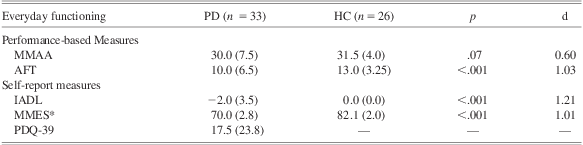
Analyses revealed significant differences between the PD and HC groups on the AFT, IADL, and MMES, and trend level differences on the MMAA (see Table 3). An analysis examining performance on the everyday function measures after excluding the 7 PDD patients revealed results that were generally consistent with the above findings, except that there were no significant differences between the PD without dementia and HC groups on the MMAA (p > .07)
Performance on everyday functioning measures in study participants

Note. Data represent medians and interquartile ranges. *MMES data represent means and standard errors.
MMAA = Medication Management Ability Assessment; AFT = Advanced Finances Test; IADL = modified version of the Lawton & Brody Instrumental Activities of Daily Living Scale; MMES = Medication Management Efficacy Scale (MMES); PDQ-39 = PD Questionnaire 39-item version; d = Cohen's d effect size estimate.
Relationships Between Prospective Memory and Everyday Function
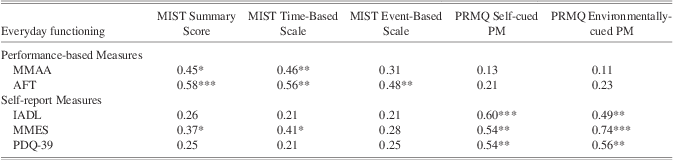
MIST summary score significantly correlated with the AFT, MMAA, and MMES in the PD group (see Table 4). Correlations between the individual EB and TB scales and functional measures were generally comparable to correlations found between the MIST summary score and the functional measures (except the correlations between EB scale and the MMAA and MMES were not significant, p > .07). The MIST did not significantly correlate with the IADL or PDQ-39 (see Table 4) in the PD group. In the HC group, there was a trend level correlation between the MIST summary score and AFT (ρ = .38; p = .05), and significant correlations between the MIST TB scale and the AFT (ρ = .49; p < .05), and between the MIST EB scale and the MMAA (ρ = .40; p < .05). There were no other significant correlations between the MIST and functional measures in the HC group (p > .07). A follow-up analysis was conducted comparing correlation coefficients between the MIST variables and the everyday function measures in the PD and NC group. Fisher's r to z transformation analyses found no significant differences between these correlations coefficients in PD and HC group (p > .07).
Relationships between PM and everyday functioning measures in the Parkinson's disease sample

Note. Data represent Spearman's rho correlation coefficient (presented in absolute values). PRMQ = Prospective and Retrospective Memory.
MMAA = Medication Management Ability Assessment; AFT = Advanced Finances Test; IADL = modified version of the Lawton & Brody Instrumental Activities of Daily Living Scale; MMES = Medication Management Efficacy Scale; PDQ-39 = PD Questionnaire 39-item version.
*p < .05.
**p < .01.
***p < .001.
A follow-up analysis was conducted to examine whether the MIST correlated with any of the individual self-reported iADL items in the IADL measure. The results revealed that the MIST EB scale correlated with self-reported declines in grocery shopping (ρ = .55; p < .01) and telephone use (ρ = .39; p < .05). The MIST summary score also correlated with self-reported declines in grocery shopping (ρ = .45; p < .05) and telephone use (ρ = .39; p < .05). There were no other significant correlations between the MIST scales and individual self-reported iADLs.
PRMQ self-cued and environmentally-cued PM scales correlated with all of the self-report functional measures in the PD group, including the IADL, MMES, and PDQ-38 measures, but not AFT or MMAA (see Table 4). There were no significant correlations between PRMQ and any of the everyday functioning measures in the HC group (p > .07).
A follow-up analysis excluding the 7 PDD participants from the PD group found a significant correlation between the TB Scale and the MMAA (ρ = .39; p < .05) in the PD without dementia group. However, there were no other significant correlations between the MIST and functional outcome measures in the PD without dementia group. There were significant correlations between the PRMQ self-cued and the IADL scale (ρ = .56; p < .01), MMES (ρ = .40; p < .001), and PDQ-39 (ρ = .59; p < .001) in the PD without dementia. There were significant correlations between the PRMQ environmentally-cued scale and the IADL scale (ρ = .48; p < .05), MMES (ρ = .77; p < .001), and PDQ-39 (ρ = .61; p < .001) in the PD without dementia group. There were no other significant correlation between the PRMQ and functional outcome measures in the PD without dementia group (p > .07).
Another set of follow-up analyses examining relationships between PM and everyday functioning after excluding PD participants with clinically elevated GDS scores were conducted. There were 4 PD participants with GDS scores above 10 (12% of the PD sample). When excluding these 4 participants, there were significant correlations between MIST summary score and AFT (ρ = .43; p < .05) and MMAA (ρ = .37; p < .05), between MIST TB scale and AFT (ρ = .53; p < .05) and MMAA (ρ = .39; p < .05). There were no significant correlations between MIST EB scale and AFT or MMAA. There were no significant correlations between any of the MIST variables and MMES. There were significant correlations between PRMQ self-cued scale and the IADL scale (ρ = .62; p < .01), MMES (ρ = .51; p < .01), and PDQ (ρ = .53; p < .01). The PRMQ environmentally-cued scale significantly correlated with the IADL scale (ρ = .46; p < .05), MMES (ρ = .74; p < .001), and PDQ (ρ = .58; p < .05).
Relationships Between Everyday Function and Other Variables of Interest
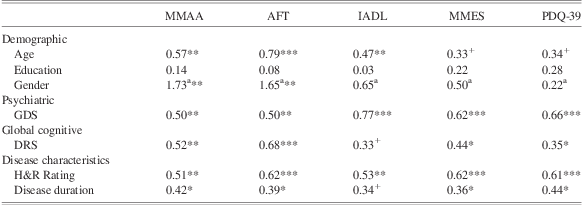
All of the functional measures significantly (or at a trend level) correlated with age, GDS, DRS, disease duration, and H&R ratings in the PD group (see Table 5). There were significant gender differences on the performance-based measures, but not the self-report measures of everyday function (see Table 5).
Relationships between everyday functioning measures and demographic, psychiatric, cognitive, and disease characteristics in the Parkinson's disease sample

Note. Data represent Spearman's rho correlation coefficient (presented in absolute values). MMES data represent Pearson r correlations (as this measure was normally distributed).
aValue represents Cohen's d effect size and p value based on between group Mann Whitney U test.
AFT = Advanced Finances Total; MMAA = Medication Management Ability Assessment; MMES = Medication Management Efficacy Scale; GDS = Geriatric Depression Scale; DRS = Dementia Rating Scale; H&R = Hoehn & Yar.
+p = .06.
*p < .05.
**p < .01.
***p < .001.
Discussion
Although there is growing evidence of the relationship between PM impairment and functional declines in various neurological populations (e.g., Woods, Iudicello et al., 2008; Woods, Moran, Carey et al., 2008; Woods et al., 2009), this is the first study to our knowledge to investigate the functional correlates of PM deficits in PD. PD patients demonstrated significantly lower scores on a performance-based measure of PM (MIST summary score and the TB and EB scales) and endorsed more self-cued PM complaints than HC participants (PRMQ, at a trend level, with a medium effect size, d = .50). These results are consistent with previous studies that examined PM in PD patients using the performance-based and self-report PM measures used in the current study (Foster et al., Reference Foster, McDaniel, Repovîs and Hershey2009; Raskin et al., Reference Raskin, Woods, Poquette, McTaggart, Sethna, Williams and Tröster2011). The results of the present study revealed that PD patients also showed significantly lower scores compared to HC participants on the performance-based and self-report measures of everyday functioning (AFT, IADL, MMES, and trend level lower scores on the MMAA), suggesting that the PD sample experienced deficits in a wide range of daily activities.
Medication management is an area of everyday function that may be particularly dependent on PM. Suboptimal medication adherence in PD has implications for poor health outcomes, lower Hr-QoL, and increased health care costs (Davis, Edin, & Allen, Reference Davis, Edin and Allen2010). The present study found that overall PM (MIST summary score) impairment significantly correlated with both performance-based medication management capacity (MMAA) and self-reported medication management measure (MMES) in the PD sample. An examination of the components of PM that correlated with medication management showed that the TB scale, but not the EB scale, was related to the medication management measures. These findings are consistent with a prior study that found that TB PM, not EB PM, was associated with medication non-adherence in an HIV sample (Woods et al., Reference Woods, Dawson, Weber, Gibson, Grant and Atkinson2009). Medication non-adherence in PD patients may be related to difficulty strategically allocating attention to performing ongoing daily tasks while concurrently monitoring time. Studies have found that healthy adults strategically increase the frequency of time monitoring (clock checking) as the target time to perform a PM intention approaches (Mäntylä & Carelli, Reference Mäntylä and Carelli2006). Costa et al. (Reference Costa, Peppe, Caltagirone and Carlesimo2008) found that PD patients monitored time less frequently than healthy controls as the time to execute an intention neared, and time monitoring was associated with the number of intentions recalled in both groups, suggesting a relationship between TB PM impairment and difficulties implementing efficient time-monitoring strategies (but see Katai et al., Reference Katai, Maruyama, Hashimoto and Ikeda2003). In other words, PD patients might have difficulty strategically monitoring the time for the appropriate moment to take medication (e.g., take medication every 4 h) while engaged in other daily tasks, which leads to delayed or missed doses.
Deficits in overall PM also related with lower scores on the performance-based measure of financial capacity (Advanced Finances Task) in the PD sample. In addition, the TB scale significantly correlated with the financial capacity measure. In contrast to the non-significant correlations between the EB scale and medication management measures, the EB scale significantly correlated with financial capacity in the PD sample. Although a prior study involving patients with schizophrenia examined relationships between PM and a global performance-based measure of everyday functioning that included a financial management component (Twamley et al., Reference Twamley, Woods, Zurhellen, Vertinski, Narvaez, Mausbach and Jeste2008), this is the first study to our knowledge to specifically investigate the relationship between financial capacity and PM in any population. PM likely is involved in various aspects of managing finances, such as remembering to pay bills on time (TB PM) or to stop at the bank on the way home from work (EB PM).
In the HC group, there was a trend level correlation between overall PM and performance-based financial capacity, which was driven by significant correlations between the TB scale and performance-based financial capacity. In addition, there was a significant correlation between the EB scale and performance-based medication management. There were no other significant correlations between performance-based PM and everyday functioning measures in the HC group. Follow-up analyses showed that the correlations between performance-based PM and everyday functioning were not statistically different between HC participants and PD patients. This suggests that relationships between performance-based PM and everyday function are not specific to PD, and is consistent with prior studies showing relationships between PM and everyday function in various samples, including healthy older adults (Woods et al., Reference Woods, Weinborn, Velnoweth, Rooney and Bucks2012), HIV (Woods, Iudicello et al., Reference Woods, Moran, Carey, Dawson, Iudicello, Gibson and Atkinson2008), and MCI (Schmitter-Edgecombe, Woo, & Greenly, 2009).
The results of the present study did not show a relationship between performance on the PM task and Hr-QOL in the PD sample. Furthermore, we were surprised to find that scores on the performance-based PM task did not correlate with a self-report measure of global iADL decline, which diverges from prior studies in healthy adults (Woods et al., 2012) and HIV (Woods, Iudicello et al., Reference Woods, Moran, Dawson, Carey and Grant2008). This could be related to methodological issues that result from self-report measures (e.g., self-report bias, discussed in more detail below). An alternative explanation is that PM differentially predicts across functional outcomes in PD. Thus, PM may be related to specific IADLs, but not other daily activities. We investigated this possibility by examining correlations between the MIST and the individual items in the self-reported IADL measure. MIST summary score and the EB scale correlated with self-reported declines in grocery shopping and telephone use, but the MIST did not correlate with other items on the IADL measure. EB PM may play a role in various aspects of grocery shopping, such as remembering to stop at the grocery on the way home from work. It is less clear how PM may affect ability to use the telephone. Future research studies may wish to examine relationships between PM and these aspects of everyday function.
A finding that emerged from this study was that self-reported PM complaints related to self-reported declines in everyday functioning (IADLs, medication management, Hr-QOL), but were not associated with performance-based measures of everyday function (medication management and financial capacity) in the PD sample. In addition, self-reported PM complaints were not related to laboratory PM, as measured by the MIST. A lack of association between self-report measures and performance on objective neuropsychological testing is a common finding (Chaytor & Schmitter-Edgecombe, Reference Chaytor and Schmitter-Edgecombe2003), including discrepancies in self-reported versus laboratory PM in various populations (e.g., Woods et al., Reference Woods, Carey, Moran, Dawson, Letendre and Grant2007; Zeintl, Kliegal, Rast, & Zimprich, Reference Zeintl, Kliegal, Rast and Zimprich2006). Studies in PD also have shown a divergence between self-report and objective cognition (Marino et al., Reference Marino, Meador, Lorin, Okun, Fernandez, Fesller and Werz2009; Sitek, Soltan, Wieczorek, Robowski, & Slawek, Reference Sitek, Soltan, Wieczorek, Robowski and Slawek2011), including a discrepancy between self-reported and laboratory PM (Foster et al., Reference Foster, McDaniel, Repovîs and Hershey2009). Additionally, research suggests that there are inconsistencies between subjective ratings and performance-based measures of iADL function in PD (Shulman et al., Reference Shulman, Pretzer-Aboff, Anderson, Stevenson, Vaughan, Gruber-Baldini and Weiner2006). Self-reported assessment of cognition and everyday functioning may be influenced by several confounding factors such as depression, cognitive impairment, social desirability bias, and metacognitive deficits, which may lead to overestimation or underestimation of PM and functional abilities (Morgan & Heaton, Reference Morgan and Heaton2009). For example, Marino and colleagues (2009) found that subjective ratings of cognition were more influenced by depressive symptoms than objective cognitive performance in a sample of PD patients. In the current study, depression significantly correlated with all of the self-report measures (PM complaints, self-report measures of everyday functioning) in the PD sample (ρ ranging from .57 to .77). Given the limitations associated with self-report, these types of measures should be interpreted with caution and these findings emphasize the importance of including more objective measures of PM (e.g., laboratory or semi-naturalistic measures) and everyday function (e.g., performance-based measures, molar outcomes, direct observation) in future studies examining functional consequences of PM impairment.
As discussed previously, there are many predictors of everyday function impairment in PD, including motor and non-motor symptoms (e.g., Cahn et al., Reference Cahn, Sullivan, Shear, Pfefferbaum, Heit and Silverberg1998). The current study found that all of the measures of everyday function significantly (or at a trend level) correlated with age, level of depressive symptoms, global cognitive functioning, and disease characteristics (disease duration and H&R rating). There also were significant gender differences in the performance-based measures of everyday function, but not the self-reported measures. Thus, as expected, PM was one of many predictors of functional impairment in the PD sample.
The current study conducted a preliminary investigation of the relationship between PM and everyday functioning in PD; however, a limitation of the present study was that it was not powered to examine the relative contribution of PM in relation to other predictors of functional impairment in regression analyses. However, we conducted analyses examining relationships between PM and everyday functioning in the PD group after excluding PD participants with dementia and a separate analysis examining these relationships after excluding PD participants with clinically elevated GDS scores. Overall, the relationships between performance-based PM and everyday function in the PD without dementia group were comparable to the original analyses including these patients, with the exception of a lack of significant correlation between TB PM and self-reported medication management measure and between performance-based PM and performance-based financial management. The relationships between PM and everyday function after excluding PD patients with clinically elevated GDS scores were generally comparable to the original analyses, with the exception of non-significant relationships between performance-based PM and self-reported medication management. Associations between self-reported PM and self-reported everyday functioning remained significant in analyses excluding the PD with dementia participants and from analyses excluding PD participants with clinically elevated GDS scores. Among the relationships between PM and everyday function that were no longer significant after excluding those with global cognitive decline or clinically elevated depression scores, this may suggest that either global cognitive decline or clinically elevated depression may have accounted for these correlations. An alternative explanation for the lack of significant correlations is that excluding participants with global cognitive decline or depression resulted in a smaller sample size and therefore lowered the power to detect significant relationships. Overall, many of the relationships were comparable when excluding those with global cognitive decline or clinically elevated depression, suggesting that the relationship between PM and many of the everyday function measures may not be due to global cognitive decline or clinical levels of depression.
There is evidence from other populations (healthy older adults, HIV, amnestic MCI, schizophrenia) that PM significantly predicts everyday function over and above other predictors of everyday function (e.g., mood, global cognitive decline, age, gender; Schmitter-Edgecombe et al., Reference Schmitter-Edgecombe, Woo and Greenley2009; Twamley et al., Reference Twamley, Woods, Zurhellen, Vertinski, Narvaez, Mausbach and Jeste2008; Woods, Iudicello et al., Reference Woods, Iudicello, Morn, Carey, Dawson and Grant2008; Woods et al., 2012). In HIV and schizophrenia, this was found using the same performance-based measure of PM that was used in this study (MIST), but in much larger study samples (Twamley et al., Reference Twamley, Woods, Zurhellen, Vertinski, Narvaez, Mausbach and Jeste2008; Woods, Iudicello et al., Reference Woods, Iudicello, Morn, Carey, Dawson and Grant2008, Reference Woods, Weinborn, Velnoweth, Rooney and Bucks2012). While these populations differ from PD, these prior studies provide some evidence for the validity of the current findings in a sample of PD patients.
Future studies with larger sample sizes should examine the incremental ecological validity of PM relative to other known predictors of everyday function in PD. Furthermore, future studies should include other predictors of everyday function that were not assessed in the current study, such as use of compensatory strategies, motivation (especially since apathy is common in PD), and environmental demands on the patient. Future studies also may wish to further examine the relationship between PM and deficits in medication management and financial capacity using other ecologically valid measures such as actual records of medication adherence (e.g., medical records) and financial management (e.g., late payments, bounced checks), virtual reality tasks that mimic online banking, and electronic medication monitoring.
Acknowledgments
We thank Brittnie Bloom, Genevive Brusati, Shea Gluhm, and Heather Holden for their assistance with data collection. We also thank all of the participants for their contributions to this study. This work was supported by a VA Merit Award to J. Vincent Filoteo, and MH073419 to Steven Woods. The authors have no conflict of interest. Please address all correspondence to Dr. Paul Gilbert, SDSU-UCSD Joint Doctoral Program in Clinical Psychology, 6363 Alvarado Court, Suite 103, San Diego, CA 92120. Tel: (619) 594-7409; Fax: (619) 594-3773; Email: pgilbert@sciences.sdsu.edu.