1. Introduction
A general pattern in the development of Central and Eastern Europe (CEE) and the former Soviet Union (FSU) is that countries geographically close to Western Europe have fared significantly better in both expanding and diversifying exports and in developing more credible legal and judicial institutions. Drawing on transaction cost literature combined with the observation that neighboring countries frequently have a higher volume of bilateral trade consisting of more complex products (Rauch, Reference Rauch1999), this article examines how international trade influences the emergence of legal and judicial institutions. The higher potential to export in countries proximate to large markets increases the value of contract trade relative to the alternatives of costly inspection and reliance on relationships. The higher value of contract trade induces businesses to lobby for more credible institutions that support contracts. While not a complete explanation for the development of legal and judicial institutions, this model can account for much of the variation in institutional quality among transition countries observed today.
Currently, three strands of literature attempt to explain institutional development, each emphasizing different factors motivating change. The first category draws on the political economy literature and focuses on the political difficulties of providing institutional reform. Because changing institutions and property rights constitute a transfer of wealth, many politicians and businesses have a vested interest in maintaining the status quo. For example, Rodrik (1995) develops a model where politicians are constrained in their policy options by the relative sizes of the public and private sector.Footnote 1 However, the fact that transition countries have passed numerous legislative reforms as a result of both foreign and domestic pressure casts doubt on political economy as a complete explanation for institutional reform.Footnote 2
Separate from the political economy of institutional reform, a second category is agnostic about the role of agents, focusing instead on history as an explanation for institutional structures. Path dependency, developed by North (Reference North1981), posits that institutions are dependent on history; change occurs only at the margin and is driven by changes in prices. History alone, however, cannot fully explain the varied changes in countries appearing to have similar starting points. Eastern European countries, for example, share many historical characteristics, yet their relative success since Communism's collapse has been anything but uniform (Weder, Reference Weder2001).
Looking specifically on institutional development in CEE and FSU, Winiecki (Reference Winiecki2004) argues that distinct informal rules developed in Western Civilization (Catholic and Protestant) and Eastern Civilizations (Orthodox and Muslim). These informal rules influenced how well countries made it through transition. Hodgson (Reference Hodgson2006) looks closer at religion and ethnic divisions and finds that both Western Christendom and ethnic fractionalization had a significant influence on economic growth during transition, while other indices such as property rights, corruption, and economic freedom were statistically insignificant in explaining growth. Hodgson explains these results in terms of the inherited institutions developed around different religious traditions, as well as the increase reliance on ethnic networks during transition.
This article explores an additional influence on legal and judicial institutions – international trade. This approach is an extension of path dependency, in that changes in the marginal benefits from better institutions drive reform, but the focus is on how the current and potential users of institutions influence their development. Several recent studies within this category analyze the interaction between international trade and institutions. Looking at Western European development, Acemoglu et al. (Reference Acemoglu and Robins2005) argue that Atlantic trade strengthened the new merchant class. The economic strength enabled the new merchant class to demand the institutional changes needed to protect their wealth. Acemoglu et al. stop short, however, of considering the direct benefits of institutions for international trade.
In contrast, Wei (Reference Wei2000) empirically examines the direct effect of trade on corruption, one component of institutions. In his model, corruption has a larger negative effect on international trade than on domestic trade, because transactions are subject to additional loss due to corruption at the border. Wei concludes that high trade countries choose to devote more resources to fighting corruption because they have more to lose from corruption. Looking more broadly at institutional development, Barzel (Reference Barzel2002) takes a broader view of institutional development. Starting from a position of no government, Barzel posits that individuals hire a protection specialist in order to lower transaction costs, ultimately resulting in greater trade with more established and predictable rules. However, the current literature lacks refutable implications about the causes behind the variation in institutional quality observed around the world today.
To create a more complete picture, this article incorporates search costs, or the cost of identifying and establishing new trading relationships, into Barzel's model of transaction costs in order to help explain the variation in institutional reform. In addition, Wei's empirical observations on international trade and corruption are extended to include the relative effect of legal and judicial institutions on different types of products. Ultimately, by incorporating international trade, this model is able to account for at least some of the variation in the quality of legal and judicial institutions observed throughout the region. It also helps explain the seemingly limited desire for higher quality institutions in many countries. While limited data permits only suggestive results, the totality of evidence offers support for international trade as an additional factor in explaining the development of legal and judicial institutions.
The paper is organized as follows. Section 2 examines the value of contract enforcement institutions and develops a theory explaining the relative demand for institutions. Section 3 formalizes the theory in a model adapted from Wei (Reference Wei2000). Applying the model to transition economies, Section 4 provides a variety of evidence consistent with exporters demanding institutional reform. Section 5 concludes.
2. The theory
2.1. Trade-off between inspection, relationships and contracts
Institutions create gains from trade by reducing the cost of transacting. To see how institutions facilitate transactions, consider Barzel's (Reference Barzel2002) model in which goods differ in the number of important attributes, or complexity, that they possess. Buyers enforce exchange agreements through a combination of inspection, relationships, and legal contracts. For easy to observe, or low complexity, homogeneous products, inspection fills the role of ensuring the agreed upon quality is met.Footnote 3 For example, a German fur and leather importer can inspect raw leather, a homogeneous good, sufficiently to ensure the quality.Footnote 4
As the complexity of the product or transaction increases, the cost of inspection will generally also increase. Long-term relationships and reputation can fill the gap left by prohibitively costly inspection. One German importer interviewed is not able to fully inspect purchases of machine parts, a complex good, to determine quality; rather he relies on feedback from his consumers after the parts are used.Footnote 5 This importer works extensively with a limited number of foreign partners, visiting them frequently and supplying technology. Reliance on this type of existing, long-term relationship is valuable because buyers avoid the costs of finding and evaluating new suppliers, as well as the uncertainty of learning each other's capabilities.
However, just as the cost of inspection limits the exchange of complex goods, reliance on existing relationships hinders new firms from entering the market. Egan and Mody (Reference Egan and Mody1992) find a reluctance by US managers to replace satisfactory long-term relationships and a skepticism about the capabilities of suppliers from newer, less developed countries. Egan and Mody's study demonstrates how reliance on relationships impedes producers without reputations from expanding into new markets.
The low complexity level needed for inspection and the high cost of building long-term relationships leads to a third option – legal contracts. Legal contract are defined here as an agreement that can, if necessary, be mediated by a third party (courts or adjudication) and enforced through government-sanctioned means. Because both parties expect the legal contract to be enforceable, contract trade provides an immediate guarantee that a new supplier is capable of fulfilling the agreement. When trading partners negotiate a legal contract, they can specify important attributes of the product or transaction in the contract. Each party can then anticipate that the other will comply with the contract because it is backed by the threat of legal sanctions. Thus, contracts are a substitute for relationship building, reputation, and inspection. Furthermore, as products become more complex, possessing more attributes of value, generally they become more costly to inspect, thereby raising the relative value of contracts relative to inspection.
Because legal contracts are relatively more valuable for complex products, countries that have a larger share of complex exports benefit more from the use of enforceable contracts. Wanchek (Reference Wanchek2003), in fact, finds that the quality of legal and judicial institutions significantly influences the level of complex, but not homogeneous, exports from transition economies to Western Europe. A concurrent study by Berkowitz et al. (Reference Berkowitz, Moenius and Pistor2006) also finds intuitions are particularly important for complex exports among a more diverse sample of countries.
2.2. The relationship between institutions and proximity
If contract-enforcing institutions facilitate complex exports, why do countries that claim to want to increase exports not improve their institutions? One possibility is that it is too costly. Building and maintaining judicial institutions capable of enforcing contracts is by no means a small task. The judicial system must maintain sufficient power through competent judges, minimal corruption, effective bailiffs, and swift procedures to create a credible threat of enforcement. Countries likely face differences in the cost of institutional development, depending on a variety of factors, such as the education of the population. Because the precise components that go into production function for institutions are far from clear, we are limited in our ability to estimate those costs. What is clear, however, is that all countries face high costs.
Unlike costs, the variation in the benefits accruing to credible institutions is observable. One source of variation comes from the level of complex exports – better institutions benefit complex exporters relatively more than homogeneous exporters. Much of the variation in complex exports, in turn, is determined by a country's geographic proximity to large markets. Proximity lowers the search costs involved with finding a trading partner because neighboring countries have greater knowledge of each other's language, preferences, and culture (Rauch, Reference Rauch1999). The lower search costs in proximate countries (and consequently higher level of complex exports) results in a greater value accruing to institutions in countries proximate to large markets.
3. The model
A basic model by Wei (Reference Wei2000), modified to incorporate product complexity, formalizes how international trade could induce institutional reform.Footnote 6 Sellers (as a unified group) pay for legal and judicial institutions. In practice, judicial systems are primarily funded through taxes, with supplemental funding coming through per use court fees.Footnote 7 Higher payments for institutional reform result in more credible institutions and, consequently, greater use of legally enforceable contracts. Greater use of contracts occurs through delineating more attributes in the contracts. In other words, buyers can specify more attributes in the contract, which both parties expect the government to enforce, and, therefore forego inspection. Alternatively, lower taxes results in less reliance on contracts and higher inspection costs. Ultimately, the product's complexity and the likelihood of exporting determine the seller's willingness to pay the institutional tax.
A seller's expected net profit is the gross profit, Y(x), less the cost of inspection and the institutional tax. The extent of contracting between buyers and sellers is determined in part by the seller's payment, t, for credible institutions.Footnote 8 The probability that contracts are enforced is a function of the tax τ(t) ~ (0,1). The probability of enforcement increases with tax, but at a diminishing rate τ′(t) > 0 and τ″(t) < 0. For simplicity, the fraction of attributes specified in the contract is equal to the probability of enforcement, τ(t), while the fraction relegated to inspection or reputation is (1 − τ(t)).
Sellers pay a fraction of the inspection costs, I(x),Footnote 9 which increases with the complexity, x, because more attributes need to be inspected, I′(x) > 0.Footnote 10 Sellers have stronger reputations with buyers within their own country, where R represents the additional reputation that a business enjoys within its own country (1 > R > 0). Reputation assures buyers that a fraction R of the attributes are high quality, allowing buyers to economize on inspection costs. Trading domestically, buyers economize on inspection by utilizing sellers’ reputation. Domestic buyers save RI(x) on inspection.Footnote 11
Sellers vary in their country-specific search costs, which is a function of distance, D, historical ties, H, and the current level of exports, X. Search costs determine the probability of exporting, such that Prob(seller ∈ world) = f(D, H, X) where f 1ʹ < 0, f 2ʹ > 0 and f′3 > 0. The probability suppliers sell domestically is (1 – f(D, H, X)).Footnote 12
The total expected utility for a seller is
) - t.
\end{eqnarray*}](https://static.cambridge.org/binary/version/id/urn:cambridge.org:id:binary:20151027131906893-0341:S1744137408001239_eqnU1.gif?pub-status=live)
The first-order condition (f.o.c.) of the maximization problem is


The implicit function for a seller's desire for tax is

Differentiating the f.o.c. with respect to the probability of exporting, f, and the tax for institutions, t, yields


In other words, a higher probability of exporting (i.e. lower search costs), increases the tax producers are willing to pay.
Differentiating the f.o.c. with respect to complexity, x, and tax, t, yields

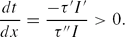
This result shows the desire for better institutions increases with complexity. For example, credible institutions assist manufacturers of machine parts or furniture, because legal contracts allow the manufacturers to break into new markets that might otherwise rely on relationships. Therefore, manufacturers of complex goods are more willing to pay for legal and judicial institutions. Alternatively, producers of homogeneous goods face lower inspection costs and, as a result, benefit less from institutions and are less willing to pay for them. Taken together, the model predicts that the expected level of complex exports is positively correlated with institutions, while the level of homogeneous exports is negatively correlated.Footnote 13
4. Evidence
The following section presents evidence consistent with the model. Background information on exports and institutions is presented in Section 4.1. The gravity model presented in Section 4.2 demonstrates that firms could have predicted the likelihood that they would export based on their proximity to the EU. Section 4.3 shows evidence of lobbying efforts could have allowed firms to demand better contract-enforcing institutions. The fitted values of the gravity are then used in a two stage least squares model to show a link from exports to legal and judicial institutional quality (Section 4.4).
4.1. The transition path of institutions
The quality of institutions as observed in CEE and FSU in 2000 largely reflects the reforms that were made during the first decade of transition. The enforcement mechanisms that did exist under Communism collapsed, leaving no credible institutions to predictably enforce contracts between international, private firms.
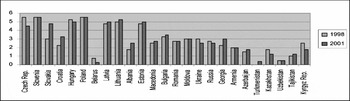
After a decade, the quality of institutions in CEE and FSU fell largely along geographic lines, with countries proximate to Western Europe having relatively better courts. Countries in Figure 1 are arranged according the their average distance from Western European capitals.Footnote 14 In general, the proximate countries, Czech Republic, Slovakia, Slovenia, Hungary, Poland, and the Baltic States, have relatively more credible institutions. Remote countries of the Caucuses and Central Asia had the least credible institutions. Countries in the mid-range geographically, such as Bulgaria and Romania, also tend to fall in the middle in terms of institutional quality.
Freedom House Index
Source: Freedom House Constitutional, Legislative and Judicial Framework (2001), reformulated with 7 the highest (best) possible score.

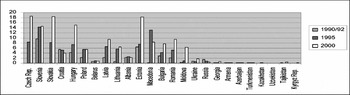
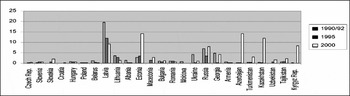
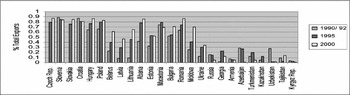
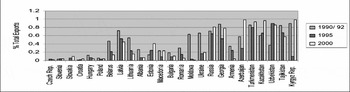
Like institutions, export structure varies by proximity to Western Europe. Throughout the 1990s, the countries bordering Western Europe increased complex exports both as a portion of GDP and as a percentage of total exports (Figures 2 and 4). More remote countries maintained low levels of exports composed of homogeneous products, which tend to reflect the natural resources available in a country (Figures 3 and 5).
Complex Exports % GDP

Homogeneous Exports % GDP

Complex Exports

Homogeneous Exports
Source: Trade data: OECD; GDP, population, and area: World Bank, World Development Indicators; trade categories: Rauch (Reference Rauch1999).

4.2. Estimating the influence of proximity on exports: a gravity model
An informal look at exports in Figures 1 through 5 suggests a positive relationship between the complexity of exports and proximity to Western Europe. Countries close to Western Europe had a larger share of complex exports. A gravity model provides a more formal method to test the relationship between exports and distance. A gravity model uses exogenous factors, including distance between trading partners, whether partners share a border, the area and population of each trading partner, and whether the exporter is landlocked, to determine the level of trade we would expect based solely on exogenous characteristics. Regression results are presented both with and without including dummy variables for religion. On the one hand, religion could provide a proxy for historical cultural and social ties, in which case they could be considered an exogenous factor that is influencing trade. On the other hand, religious traditions could be affecting trade through their influence on institutions, in which case they would be endogenous under the proposed hypothesis.


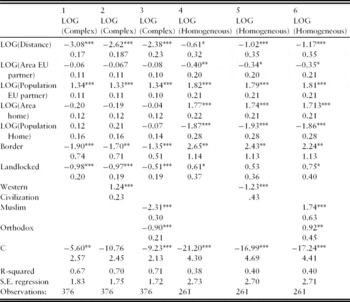
The results of the gravity model confirm the importance of a number of exogenous factors in explaining complex goods and, to a lesser extent, homogeneous goods. Exogenous factors explain 67% of the variation in complex exports, based on the R-squared, but only 38% for homogeneous exports (Table 1, equations (1) and (4)).Footnote 15 The area of the CEE or FSU exporter is significant for homogeneous, but not complex, goods, which is consistent with the importance of natural resources in homogeneous exports. The population of the importing EU countries is significant in all regressions, consistent with larger markets purchasing more products. Having a shared border is negatively correlated with the share of complex exports in GDP. This result is likely due to the fact that stronger exporting countries tend to sell to a wider range of EU countries, particularly larger EU countries, as well as the fact that we have already controlled for proximity and size of the trading partner. Alternatively, homogeneous exports are positively correlated with a shared border, which may be due to homogeneous products that being larger, natural resource-based products that are costly to transport.
Gravity model

Notes: Complex and homogeneous exports are a percent of GDP.
*** 1% significant; **> 5 % significance; * 10% significance;
Border no = 0, yes = 1; Landlocked no = 1 yes = 0.
Sources: Trade data: OECD; GDP: World Bank, World Development Indicators; trade categories: Rauch (Reference Rauch1999).
Western Civilization, measured by a dummy variable of ‘1’ for Catholic/Protestant countries and ‘0’ otherwise, is positively correlated with complex goods and negatively correlated with homogeneous exports (equations (2) and (4)). This is consistent with religion acting as a proxy for cultural and social networks that facilitate searching for a trading partner. The results are also consistent with the Winiecki and Hodgson hypothesis that historic differences in Eastern and Western civilization are influencing institutional quality. In either case, even after controlling for the division in Civilization, proximity to the EU continues to have a significant influence on exports. Furthermore, separating out predominantly Muslim and Orthodox nations, with Catholic/Protestant nations as the reference group (equations (3) and (6)), shows that there is also a variation in the coefficient for Muslim and Orthodox nations, raising the possibility of a more gradual change rather than a distinct divide between Eastern and Western civilization.
In sum, the results of the gravity model reject the null hypothesis that proximity was irrelevant to trade. Rather the results are consistent with the proposed hypothesis that businesses could forecast trade on the basis of proximity. The next question is whether the expectation of higher trade induced businesses to lobby for institutions that would facilitate contract trade.
4.3. Evidence of demand for reform
Business associations and collective action
Not only could proximity have provided businesses the ability to predict potential exports, but there is also evidence that businesses in proximate countries did participate more in lobbying activities. Business associations provide a mechanism through which firms could lobby. They provide exporters individual-specific benefits to membership – organizing trade fairs, help obtaining visas, information on foreign markets and firms, and supplying letters of credit. These benefits provide an incentive for firms to participate, thus providing an incentive to work collectively toward a common goal and avoid collective action problems.Footnote 16
Many CEE business associations did engage in lobbying activities. For example, the Budapest Chamber of Commerce explicitly acknowledges one of their activities is to lobby ‘intensely on the domestic level as well as on the international scene’.Footnote 17 Furthermore, there is evidence that much of the lobbying activities during the 1990s were to promote institutional reform, particularly in proximate CEE countries. In Slovakia, the Entrepreneurs Association concentrated on the legislative process. In 1994, the Entrepreneurs Association helped draft legislation in support of small businesses and in 1995 prevented an act from passing that would have interfered with ownership rights. By 1999, they had representation on various government committees. In Poland, the Polish Chamber of Commerce established the Institute for Private Entrepreneurs and Democracy in 1993, whose goal is to monitor the legislative process, report on business infrastructure, and represent businesses. By 1998, the Institute had reorganized into a more formal lobby. In Hungary, an independent evaluation of the Center for International Private Enterprise (CIPE), which works with 20 indigenous business associations, found a ‘surprising and effective lobby’.Footnote 18 These organizations demonstrate that business associations have access to policy-makers and lobby, at least informally, for reform.
Not only do business associations influence government, but they have explicitly recognized contract enforcement as an important policy issue. At the 1999 roundtable in Hungary, GKI Economic Research Company presented a report, which concluded that obstacles to enforcement of property rights and contractual obligations are ‘one of Hungary's most important and least tractable problems’.Footnote 19 More recently, organizations in the mid-range countries, such as Bulgaria and Romania, have increased their lobbying activities. A primary focus is on anti-corruption campaigns, such as Coalition 2000 in Bulgaria.Footnote 20
Although Chambers of Commerce or similar business associations formally exist in every country, remote countries tend to have low membership and the local Chambers are frequently inactive.Footnote 21 The weak collective action mechanism in remote countries suggests that few firms find it profitable to incur the high search costs of exporting, and therefore are unlikely to gain from membership in business organizations.
Evidence of lobbying
While business associations provide the ability to lobby, lobbying activities are typically unobservable, particularly when done informally through personal contracts and closed-door meetings. However, the effects of lobbying can be observed. Under the assumptions that businesses have the ability to lobby and that institutions today represent reforms implemented since transition began, the quality of institutions observed in 2000 at least partially reflects the outcome of lobbying efforts. In order to measure the extent that the reforms that we would expect businesses to lobby for materialized, three stages of contract trade are analyzed: (1) negotiation of the contract, (2) legislation providing for dispute settlement and recognition, and (3) credible enforcement. Although a country may excel at any one step, for instance, Ukraine's active arbitration court or Belarus’ low corruption ranking, the probability of obtaining effective legal recourse in an international dispute may still be low. Ultimately, the combined institutional quality from all three stages provides evidence of the relative intensity and success of lobbying for credible institutions.
Industry standards
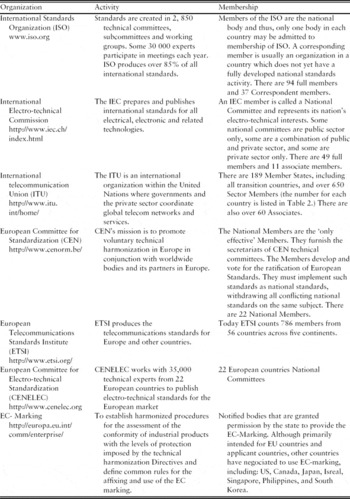
In the first stage, common industry standards facilitate contracting by decreasing information costs and clarifying expectations. Standards reduce information costs by allowing buyers to specify attributes simply by referring to the official standard.Footnote 22 Standards also clarify expectations, making it easier for the parties and courts to determine if the product has or has not met the agreement.Footnote 23 Although standards can be purchased by anyone, country membership in international standard's organizations allows participants to contribute in the development of standards, thereby avoiding the cost of changing production processes that differ from the international standard. The importance of standards is demonstrated by their enormous growth in Western Europe.Footnote 24
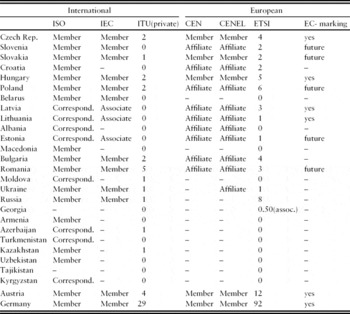
Most countries belong to the International Standards Organization (ISO), but membership declines in other organizations (Table 2). Higher trade countries, Hungary and Czech Republic, followed by Latvia, Lithuania, and Slovakia, use standards more frequently. On the other hand, remote countries are not members in organizations other than the ISO.
Use of industry standards, 2000

Notes: International Standards Organization (ISO), International Electrotechnical Commission (IEC) and the International Telecommunications Union (ITU). The European Committee for Standardization (CEN), European Committee for Electrotechnical Standardization (CENEL), and the European Telecommunications Standards Institute (ETSI). The EC-marking is a quality certification standard. See appendix for details.
Dispute resolution
The second stage of international contracting is impartial, timely, and affordable adjudication of disputes. According to the model, sellers with high potential exports demand credible dispute settlement because it facilitates finding foreign buyers. Three ways countries accommodate international dispute settlement are recognition and enforcement of foreign arbitration awards, establishment of local arbitration courts, and adherence to treaties recognizing foreign court rulings.
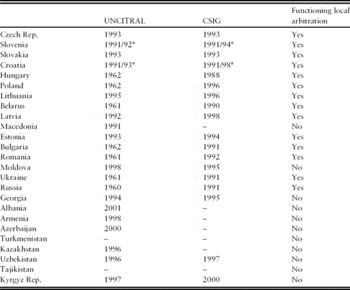
The record of CEE and FSU countries on recognition and enforcement of foreign arbitration awards is mixed. On the positive side, nearly all countries had signed the 1958 New York Convention on the Recognition and Enforcement of Foreign Arbitral Awards (UNCITRAL) by 2000, the largest international treaty recognizing foreign arbitration awards (Table 3). In addition, many countries had signed United Nations Convention on Contracts for the International Sale of Goods (CISG), a treaty providing for a common set of rules for international trade. These treaties indicate an explicit recognition by governments of the importance of international contract enforcement.
Adjudication and recognition

Sources: www.UNCITRAL.org; http://www.cisg.law.pace.edu/cisg/guide.html; Arbitration Court Source: Slovenia: www.sloarbitration.org; Croatia: Uzelac (Reference Uzelac1998); Czech Republic: interview with Milosh Pohunek, arbitrator at the Czech Arbitration Court; Hungary: Kengyel (Reference Kengyel2001); Belarus: Ruck (Reference Ruck1997); Ukraine: Slipachuk (2000); Baltic Countries: Complier Trade webpage: (http://www.compiler.fi/); Bulgaria: interview with Silvi Chernev, President of the Bulgarian Arbitration Court; Other countries: US Department of Commerce country investment guide (http://www.usatrade.gov); and USAID Reports, various countries.
On the negative side, countries have not consistently upheld the treaties they have signed, nor implemented the domestic legislation needed to support the treaties. Statistics on recognition of foreign court and arbitration awards are not collected, but case studies describe many of the problems with enforcement. For example, a Russian consultant to the Supreme Commercial Court wrote that it would be doubtful a decision would be enforced if it would have the effect of bankrupting an industry.Footnote 25 In Romania, a court refused to honor an arbitration award, citing insufficient documentation, which is not in accordance with the UNCITRAL treaty Romania signed.Footnote 26
Not only is the enforcement of international arbitration mixed, but the availability of local arbitration varies. Although most countries have technically set up such arbitration courts, many of the local arbitration courts rarely, if ever, hear cases. Most CEE countries, as well as Russia and Ukraine, have active local arbitration courts, while remote FSU countries do not. The range of options for dispute settlement in proximate and mid-range countries, contrasted against the minimal number of options in remote countries is consistent with greater demand for reliable dispute settlement in proximate countries.
Enforcement
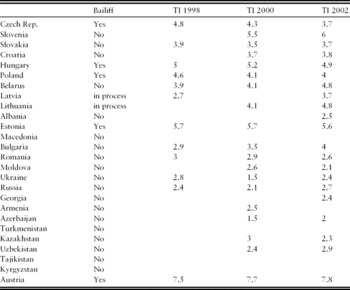
The final stage in creating reliable international contracts is the ability of national judicial institutions to enforce arbitration awards and court rulings. Credible dispute settlement is useless if it is not enforced. Competent bailiffs and low corruption are two crucial elements of enforcement. As low-paid public employees, bailiffs often lack the incentive to enforce orders. In Bulgaria, businesses cite ineffective bailiffs as the primary reason arbitration is not more popular.Footnote 27 Czech Republic, Estonia, and Hungary have privatized their bailiffs in order to provide better incentives for enforcement. Corrupt officials, including bailiffs, customs officers, and judges, also decrease the ability to rely on legal contracts. For example, in Armenia, an international lawyer said there was no bias in Armenian courts – whoever pays the most wins.Footnote 28 Slovenia, Estonia, Hungary, and Lithuania, followed by Czech Republic and Belarus are the least corrupt according to Transparency International (TI) (Table 4). The greater ability to enforce judgments is indicative of greater demand for contract enforcement institutions.
Enforcement

Sources: USAID Reports − respective countries; Transparency International, Corruption Perception Index; 10 highest possible.
The variation in ability to form and enforce contracts is consistent with the intensity of lobbying efforts that we would expect from exporters. The relatively high accommodation of international contracting that exists today in more advanced countries is consistent with exporters demanding institutional reforms. Alternatively, firms in remote countries rarely rely on legal and judicial institutions and, therefore, have little reason to lobby for reform.Footnote 29
4.4. Econometric analysis of lobbying effort
Following analyses by Frankel and Romer (Reference Frankel and Romer1999) and Wei (1999), we use a two-stage least squares (2SLS) model to test whether potential exports helped induce lobbying efforts and institutional reform. The first stage of the 2SLS model utilizes the gravity model presented in Table 1 to estimate potential exports by regressing exogenous proxies for search costs on complex and homogeneous exports in 2000. Religion is excluded from the first stage to avoid potential endogeneity problems. The fitted values from the first stage are then used as exogenous instruments for the amount of trade that firms could have predicted. The second stage regresses the fitted value of complex and homogeneous exports on institutional reform, measured by the Freedom House Constitutional, Legal and Judicial Index (Figure 1).Footnote 30 GDP per capita in 2000 is included in the regression to control for the ability of a country to be able to afford better institutions.
First stage


Second stage uses the fitted values from the first stage as an explanatory variable


The model predicts that the expected level of complex exports is positively correlated with the quality of legal and judicial institutions and homogeneous exports are either negatively correlated or uncorrelated with institutional quality, depending on the taxes homogeneous exporters are required to pay.
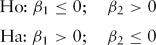
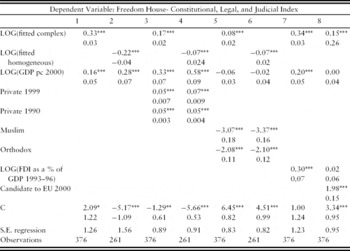
The results of the second stage reject the hypothesis that expected exports do not predict institutional quality at the 1% confidence level (equation (1), Table 5). Thus, the empirical results are consistent with the hypothesis that the potential to export complex goods induced higher quality institutions, β1 > 0, even after controlling for income in 2000. Also consistent with the alternative hypothesis, equation (2) shows that fitted homogeneous exports are negatively correlated with institutional quality, β2<0. The results imply that a 1% increase in expected complex exports will cause an increase of 0.33 (out of 7) in the FH index. Thus, the statistical evidence provides further support for potential complex exports inducing changes in institutional quality.
Explaining institutions − second stage

Notes: Instrument list: LOG(Distance) LOG(Area of EU country) LOG(Population of EU county) LOG(Areas home country) LOG(Population home country) Border Landlock.
*** 1% significant; ** 5 % significance; * 10% significance.
Sources: Trade data: OECD imports; Institutional index: Freedom House Constitutional, Legislative and Judicial Framework 2001, reformulated with 7 the highest (best) possible score. Private sector data from Consulting Assistance on Economic Reform II, Warner (Reference Warner2000); FDI: United Nations Economic commission for Europe.
4.5. Alternative explanations for the export-institutions link
Because trade interacts with many variables in the economy, it is worth considering how well the results hold against alternative explanations for the variation in institutional quality. If trade is merely correlated with the true variable affecting institutions, then trade would appear to be significant when in reality it would really be serving as a proxy for the true influence. The most likely alternatives are privatization, religious traditions, foreign direct investment (FDI), and EU candidacy.
In the early 1990s, the ‘Big Bang’ theory, which involves quickly implementing market reforms, gained notoriety. The idea is that privatization creates new property owners, who then demand protection from the government. The link between institutions and exports would be that greater efficiency in the domestic economy resulted in greater exports. In this case, private agents in the domestic economy are lobbying for institutions to protect their domestic property, not secure international contracts. To test for domestic use of legal and judicial institutions, the model uses the extent of privatization in 1990 and 1999. Privatization is used here as a proxy for the extent to which firms lobby to improve institutions in order to enhance domestic trade. Even after controlling for private property, complex exports continue to be highly significant in explaining institutions (equation (3), Table 5). Homogeneous exports continued to have a negative influence (equation (4)). These results are consistent with institutions increasing the security of private property both within the country and in the international arena.
To test for the significance of Winiecki's idea of a divide in civilization, we can also include Muslim and Orthodox dummy variables to control for the division between Eastern and Western Civilizations, with Catholic/Protestant as the reference group. While religion clearly has a significant effect on institutional quality, with Protestant and Catholic countries having better institutions, the predicted level of complex exports continues to have a significant influence on institutional quality (equations (5) and (7)).
Foreign firms that make large investments in a country and foreign governments undoubtedly played a role in pressuring CEE and FSU governments to improve the quality of their institutions. Equations (7) and (8) (Table 5) account for this outside influence by controlling for the percentage of foreign direct investment (FDI) out of GDP in a country between 1993 and 1996 (the earliest years available for all the countries) and whether the country was a candidate to join the EU in 2000. We would expect countries with large inflows of FDI to be more susceptible to influence as they attempt to retain the investment funds. Similarly, the incentive of joining the EU and well as the assistance that the EU gave candidate countries could also motivate better institutions.
Even after controlling for foreign influence, expected complex exports continue to have a positive correlation with the quality of legal and judicial institutions. FDI during the start of transition is significant when candidacy to the EU is excluded, but becomes insignificant when candidacy is included. This suggests that pressure from foreign businesses investing in a country did improve institutions, but direct aid from the EU or pressure to reform in order to join the EU had a much more significant influence on institutions. Trade in complex goods, however, continues to be significantly correlated with institutions, consistent with the hypothesis that trade is an independent influence on institutions and not just a proxy of FDI or potential EU membership.Footnote 31
Exports to Western Europe provide an attractive case study due to the massive restructuring of exports towards Western Europe and the large number of new trade relationships. However, the theory should hold for other trade relationships, not just those with the EU. To test whether the theory holds for other samples of countries or is simply an anomaly of Western Europe, we look at whether CEE and FSU trade within the region influences institutions. Due to data limitations, we are confined to looking at exports from CEE and FSU to Hungary, Poland, Czech Republic and Slovakia.
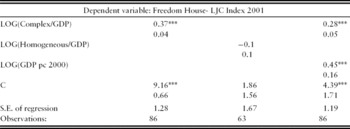
Nonetheless, even with this small sample, the model's predictions hold. Table 6 demonstrates that the predicted level of complex exports causes institutional quality, while homogeneous goods are now insignificant. Reference price goods continue to be significant, but with a smaller coefficient than complex goods. Even after controlling for income in the exporting countries, the expected level of complex exports to the four CEE countries continues to influence institutional quality.
Hungarian, Polish, Czech, and Slovak imports: second stage results

Notes: Instrument list: LOG(Distance) LOG(Area of EU country) LOG(Population of EU county) LOG(Areas home country) LOG(Population home country) Border Landlock; Trade data: OECD imports.
*** 1% significant; **> 5 % significance; * 10% significance.
5. Conclusion
We present evidence consistent with businesses predicting their potential to export complex goods, which induced them to lobby for more credible institutions that could lower the cost of exporting. Using Barzel's (Reference Barzel2002) model of transaction costs, the model presented addresses how reputation, inspection, and contracts provide alternative means of enforcing quality of a good. As goods become more complex and costly to inspect, the relative value of contracts and contract-enforcing institutions increases. Incorporating Rauch's (Reference Rauch1999) model of search costs, which are correlated with proximity, explains why firms in proximate countries could have predicted a high potential to export complex goods. Putting the pieces together results in the hypothesis that nearness to the EU was an important predictor of future exports of complex goods, which induced the businesses to lobby for more credible legal and judicial institutions.
While the limited time-series data on institutional quality prevents a comprehensive test of this model, the combined weight of the evidence provides motivation to consider the role of trade in inducing institutional reform. In addition to the aggregate correlation between institutions and exports, the increased use of standards, greater options for adjudication, and more credible enforcement are consistent with exporters lobbying for higher quality institutions. Furthermore, business associations could have provided the means for businesses to lobby for institutional reform.
International trade is clearly not a complete explanation for the quality of legal and judicial institutions. It is, however, capable of explaining at least some of the variation in intuitional quality observed across the CEE and FSU. This strength provides hope that future research into the factors that contribute to institutional development will take into account the role of trade and proximity, thereby producing greater insight into the process of transition specifically and economic development more generally.
Appendix I
Standards

Appendix II: Zero trade information/Tobit specification
A source of potential bias resulting from the economic specification is due to information not being utilized in the observations where there is zero bilateral trade. This can be resolved by adding 1 to every bilateral trade relationships, then for small values ln(1 + trade) ≈ trade and for large values ln(1 + trade) ≈ ln (trade), approximating the semi-log Tobit relationship (Greene, 1993 and Eichengreen and Irwin, 1996). Similar method is also used by Rauch, with the explanation that trade must reach a minimum threshold level to cover transportation costs. The coefficient for distance continues to be significant for complex goods, but is now insignificant for homogeneous goods (Stage 1). Furthermore, the results show that complex goods significantly influence institutions, but homogeneous goods are now insignificant (Stage 2). The results continue to support the central prediction that complex exports predict institutions.