Introduction
Alzheimer's disease (AD) is characterized by cognitive and functional decline and the presence of neuropsychiatric symptoms, but there is a substantial amount of variability in rates of decline among individuals with AD (Folstein et al., Reference Folstein, Folstein and McHugh1975; Aguero-Torres et al., Reference Aguero-Torres, Fratiglioni and Winblad1998; Cortes et al., Reference Cortes2008; Tschanz et al., Reference Tschanz2011). Knowing which factors influence rate of decline will be useful for understanding disease progression and treatment, as well as for resource planning and prognosis. Previously reported demographic factors associating with rate of decline include age (Wilkosz et al., Reference Wilkosz2010), age of dementia onset (Xie et al., Reference Xie, Ewbank, Chittams, Karlawish, Arnold and Clark2009), sex (Tschanz et al., Reference Tschanz2011), and education and occupational complexity (Wilson et al., Reference Wilson2004; Andel et al., Reference Andel, Vigen, Mack, Clark and Gatz2006). Brain imaging predictors of decline include cerebral atrophy and white matter hyperintensity burden (Mungas et al., Reference Mungas2002; Brickman et al., Reference Brickman2008). Cerebrospinal fluid (CSF) biomarkers of tau and amyloid have also been shown to predict rate of decline (Buerger et al., Reference Buerger2005; Kester et al., Reference Kester2009). Presence of one or more APOE ε4 alleles has been associated with greater decline in some studies (Martins et al., Reference Martins, Oulhaj, Jager and Williams2005; Bracco et al., Reference Bracco2007) but not all (Hoyt et al., Reference Hoyt, Massman, Schatschneider, Cooke and Doody2005).
While these findings are interesting, these risk factors are not modifiable. For example, knowing that age is associated with faster decline is not of practical, immediate significance because we cannot control whether or not people get older. Considering the enormous burden of AD (Alzheimer's Association, 2010), identifying modifiable risk factors for more precipitous decline would have substantial public health impact (Colantuoni et al., Reference Colantuoni, Surplus, Hackman, Arrighi and Brookmeyer2010). One potentially modifiable predictor of rate of decline is health status. In one cross-sectional study, greater medical comorbidity was significantly associated with more severe AD after controlling for age and other covariates (Doraiswamy et al., Reference Doraiswamy, Leon, Cummings, Marin and Neumann2002). In another very large cross-sectional study comparing individuals with AD to demographically matched controls, individuals with AD had significantly more medical comorbidity and higher medical expenditures (Kuo et al., Reference Kuo, Zhao, Weir, Kramer and Ash2008). In an earlier nested case-control study in Cache County comparing individuals with AD to those without, individuals with AD were taking more medications, were more likely to have a serious illness, and had worse General Medical Health Ratings (GMHR; Lyketsos et al., Reference Lyketsos2005). In a different small cohort study, fast progressors had significantly more medical diagnoses (6.0 vs. 3.9) than slow progressors (Boksay et al., Reference Boksay, Boksay, Reisberg, Torossian and Krishnamurthy2005). However, in a larger study of 289 participants from Alzheimer's Disease Research Center (ADRC), individuals taking five or more medications at baseline declined more slowly than those taking fewer (Storandt et al., Reference Storandt, Grant, Miller and Morris2002). To date, there have been no longitudinal, population-based studies of the relationship between health status and AD progression.
This paper aims to characterize the course of health status (as measured by GMHR, number of non-psychiatric prescription medications, and number of medical comorbidities), to determine whether baseline health status is predictive of cognitive, functional, and behavioral change, and to examine relationships between time-varying measures of those three domains and time-varying measures of health status. This last aim is particularly important because it speaks to our ability to alter the course of dementia-related decline through increased attention to patients’ medical health. The Cache County Dementia Progression Study (DPS), with its well-characterized, community-based sample of participants, followed longitudinally before and after dementia onset, is an ideal setting to address these questions.
Methods
The Cache County Dementia Progression Study began in 2002, and is a follow-up study of incident cases of dementia identified from the Cache County Study on Memory in Aging (CCSMA) (Tschanz et al., Reference Tschanz2011). The CCSMA is a longitudinal, population-based study examining the prevalence, incidence, and risk factors for dementia in Cache County, Utah (Breitner et al., Reference Breitner1999). In its first wave in 1995, the CCSMA enrolled 90% of the 5,677 county residents who were aged 65 years or older. Three subsequent “incidence” waves were completed: 1999, 2003, and 2006. Nineteen incident AD cases were identified during wave 1, 108 in wave 2, 156 in wave 3, and 52 in wave 4. CCSMA participants diagnosed with incident dementia were followed prospectively by the DPS, approximately every six months, until death or administrative censoring. As such, DPS, though a case-only follow-up, can also be considered population-based. These analyses include DPS participants with a diagnosis of possible or probable AD.
Participants and dementia diagnoses
Details on the methods used in CCSMA are published elsewhere (Breitner et al., Reference Breitner1999; Lyketsos et al., Reference Lyketsos, Steinberg, Tschanz, Norton, Steffens and Breitner2000). In brief, dementia cases from CCSMA were ascertained via a multi-stage procedure (Breitner et al., Reference Breitner1999). First, participants were screened for cognitive disorders using the Modified Mini-Mental State Examination (Teng and Chui, Reference Teng and Chui1987), which was further adapted for use in epidemiological studies (Tschanz et al., Reference Tschanz, Welsh-Bohmer, Plassman, Norton, Wyse and Breitner2002). Individuals who screened positive, along with a weighted, stratified subsample, were further screened using an informant-based telephone interview (Kawas et al., Reference Kawas, Segal, Stewart, Corrada and Thal1994). Participants who screened positive on the interview then underwent a clinical assessment (CA) by a trained research nurse and psychometrician, which included a structured physical and neurological exam and a neuropsychological battery (Tschanz et al., Reference Tschanz2000). Additional information on each participant's medical history, cognitive and functional impairment, and psychiatric symptoms was obtained from a knowledgeable informant. Next, a study geriatric psychiatrist and a neuropsychologist reviewed data from the clinical assessment and preliminary diagnoses of dementia were made using DSM-III-R criteria (American Psychiatric Association, 1987). The age of onset was estimated as the age the individual met DSM-III-R dementia criteria. Individuals with preliminary dementia diagnoses were then examined in person by a geriatric psychiatrist and underwent neuroimaging and laboratory studies for a differential diagnosis of dementia. A panel of experts with expertise in neurology, geriatric psychiatry, neuropsychology, and cognitive neuroscience then reviewed all data and assigned diagnoses of probable or possible AD according to the National Institute of Neurological Disorders and Stroke and Alzheimer's Disease and Related Disorders Association (NINCDS–ADRDA) criteria (McKhann et al., Reference McKhann, Drachman, Folstein, Katzman, Price and Stadlan1984). Incident cases of dementia identified at CCSMA waves 1–4 were invited to join the DPS. Institutional review boards at Utah State, Duke, and the Johns Hopkins universities reviewed and approved all study procedures.
Demographics
Education and gender were determined at wave 1 of the CCSMA. Apolipoprotein E (APOE) genotype was determined at that time from buccal DNA using previously published methods (Breitner et al., Reference Breitner1999).
Measures of dementia progression and medical comorbidity
Trained neuropsychological technicians administered the Mini-Mental State Examination (MMSE), a measure of global cognitive functioning (Folstein et al., Reference Folstein, Folstein and McHugh1975). Scores were adjusted for items missing due to sensory or motor impairment (Breitner et al., Reference Breitner1999). The Clinical Dementia Rating (CDR; Hughes et al., Reference Hughes, Berg, Danziger, Coben and Martin1982) measures functional ability in the following six domains: memory, orientation, judgment/problem-solving, community affairs, participation in home/hobbies, and personal care. We used the extended version (Dooneief et al., Reference Dooneief, Marder, Tang and Stern1996), which rates subjects on an ordinal scale ranging from 0 (no impairment) to 5 (terminal), producing a summed score ranging from 0–30. The ratings from 0–3 have the same interpretation as the traditional CDR, but the additional two categories, profound and terminal, extend the floor of the measure. Such an extension is important for DPS, which follows subjects to death. CDR was administered by a trained research nurse at each visit, taking into account a caregiver's report of symptoms as well as the participant's performance on neuropsychological tests. The Neuropsychiatric Inventory (NPI; Cummings, Reference Cummings1997) assesses neuropsychiatric symptoms (NPS) that commonly occur in dementia, including delusions, hallucinations, agitation/aggression, depression, apathy, elation, anxiety, disinhibition, irritability, and aberrant motor behavior. The instrument first screens for symptoms in each domain. If positive, NPI rates the individual by frequency (0–3) and severity (0–4). Individuals currently on antipsychotic medication for either hallucinations or delusions automatically received severity scores of 4 for that domain. Those two scores are then multiplied to obtain scores for each domain (0–12), and summed across all 10 domains for a total score ranging from 0 to 120.
At each visit, participants were asked whether they had used any prescription medications in the previous two weeks. If they answered yes, they were asked to produce the medication containers and, for each, the name, indication, strength, dosage form, age at first use, and duration of use were recorded. The list of medical comorbidities or events specifically assessed by targeted questions included asthma, emphysema, bronchitis, pneumonia, transient ischemic attack, cerebrovascular accident, myocardial infarction, Parkinson's disease, epilepsy, hypertension, hypercholesteremia, diabetes, coronary artery bypass graft, angioplasty, headache, chronic pain, head injury, brain injury, arthritis, ulcers, constipation, thyroid conditions, cancer, and angina. The first four were assessed only at baseline; the remaining conditions were also reassessed at each follow-up visit.
The General Medical Health Rating (GMHR) is a rapid bedside global rating of health status in dementia patients (Lyketsos et al., Reference Lyketsos1999). Ratings are derived through an interview with the patient and their caregiver, including current and past medical history and a review of systems. To receive a rating of 4 (excellent), patients typically have no unstable illnesses, no more than two stable illnesses, and are on no more than two medications. To receive a rating of 3 (good), patients typically have one unstable but treated illness, no more than four stable illnesses, and are on no more than four medications. To receive a rating of 2 (fair), patients typically have no more than three unstable illnesses. Very ill patients receive a rating of 1 (poor). It is important to note that these are only rules of thumb, and the clinician's overall general impression plays a significant role in determination of the rating. The GMHR has demonstrated excellent inter-rater reliability (weighted kappa (κ) = 0.93) and has been shown to be a stronger predictor of mortality than either age or dementia severity (Lyketsos et al., Reference Lyketsos1999).
Statistical analysis
Descriptive analyses of demographics, medical variables, and outcomes were performed to test distributional assumptions of the proposed analyses. Time was measured in years from the baseline visit. All longitudinal regression models included random effects for both intercept and time (Laird, Reference Laird and Ware1982). We chose random effects models over the method of generalized estimating equations (GEE), as the latter entails an assumption that all loss to follow-up occurs completely at random. In the present study, we expected loss-to-follow-up to be more likely among individuals who are older or in poorer health, and therefore not completely at random. In reporting findings from these models, when we refer to “decline,” this will refer to worsening of symptoms, not necessarily numerical decreases in scale scores, as increases in both CDR and NPI scores imply greater severity.
The first set of analyses examined change in MMSE, Clinical Dementia Rating – sum of boxes (CDR-sb), and NPI total as a function of baseline GMHR rating. GMHR at baseline was included as a set of two binary covariates (4 – excellent, 3 – good, 2/1 – fair/poor). GMHR values of 1 and 2 were combined due to the very small number of individuals with ratings of 1. A value of 4 (representing excellent health) was the reference group. Interactions between GMHR and time (measured in years) were also included. For example, the interaction between time and the GMHR = 3 indicator variable represents the expected difference in rate of change between two individuals, one with a baseline GMHR of 3 and another with a baseline GMHR of 4. Previous DPS analyses had demonstrated that the trajectories of many individuals were not straight lines, but instead typically appeared to curve downward over time (Tschanz et al., Reference Tschanz2011). To model this downward curvature appropriately, we included a quadratic (time-squared/time2) term and terms for its interaction with GMHR in each of the models. We used likelihood ratio tests to compare models with and without these quadratic terms (Casella, Reference Casella and Berger2002). Previous DPS analyses have reported associations between MMSE, CDR-sb, and NPI totals and the following variables: baseline age, male sex, years of education, dementia duration at baseline visit, and presence of one or more APOE ε4 alleles. These variables were therefore included in all models. Analogous models were also fit using number of baseline comorbid medical conditions, number of baseline non-psychiatric prescription medication, and both, rather than GMHR.
The second set of models used time-varying measurements of health status as predictors of change in each outcome. Using time-varying covariates allows for estimation of the effects of those measurements on the outcome variables as measured at each visit (e.g., not lagged) rather than on overall rate of decline. As before, linear and quadratic time terms were included, but interactions between the time variables and the health measures were not included. Analyses were conducted using STATA Version 11.1 (Stata Corp LP, 2009).
We conducted post-hoc power analyses based on the formulae of Jung and Ahn (Reference Jung and Ahn2003), because they account for missing data due to attrition. Based on these formulae and attributes of our observed data, we would expect to have 80% power to detect a between-GMHR group difference in rate of decline of 0.79 MMSE points per year. Details of the power calculations are available from the first author on request.
Results
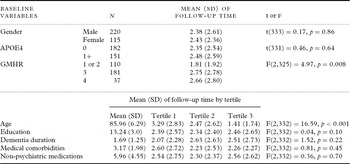
All 335 individuals with incident possible or probable AD and without a vascular dementia component who were identified as part of the four waves of CCSMA were included in these analyses. The means and standard deviations of the baseline scores on the three outcomes were MMSE: 21.96 (4.62), CDR-sb: 5.93 (3.39), and NPI: 4.66 (9.25). Of the 335 participants, 70 (21%) were still active (alive and completing visits) at the time of close of the study. During the study, 217 (65%) individuals died and 48 (14%) moved away or withdrew from the study. Of the 335 participants, 105 (31.3%) had only one study visit. Among the 230 with at least one follow-up visit, the total number of visits ranged from 2 to 13 with a median of 4. The lengths of observation ranged from 0.65 to 11.18 years with a median of 3.07 years. Table 1 shows mean number of years of follow-up by presence or absence of each dichotomous baseline variable or tertile of each continuous variable. As anticipated, both GMHR and age were significantly associated with length of follow-up time. There was no clear relationship between length of follow-up and education, dementia duration, number of medical comorbidities, or medications at baseline.
Follow-up time by baseline variables

APOE = Apolipoprotein E; GMHR = General Medical Health Rating.
There was considerable variability (both up and down) in GMHR over time within individuals. At the second visit, of the 226 subjects for whom we had GMHR ratings at both visits 1 and 2, 135 (60%) had the same rating as they had at visit 1, 26 (12%) had gotten worse, and 65 (28%) had improved. At the third visit, of the 149 subjects for whom we had GMHR ratings at both visits 2 and 3, 100 (67%) had the same rating as they had at visit 2, 32 (21%) had gotten worse, and 17 (11%) had improved.
Ordinal logistic regression models demonstrated modest, but statistically significant associations between baseline GMHR and number of comorbidities (p < 0.001, pseudo-r 2 = 0.08) and number of non-psychiatric prescription medications (p < 0.001, pseudo-r 2 = 0.03). Pseudo-r 2 values represent scaled improvements in log likelihood values of the models with predictors as compared to a model with only an intercept (Agresti, Reference Agresti1999).
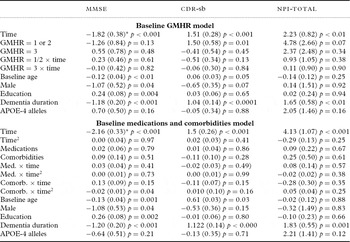
Table 2 shows results from the first set of models used to determine the effect of baseline GMHR rating on decline. For each of the three outcomes, likelihood ratio tests suggested that quadratic time effects were not needed. Both time and dementia duration were significantly associated with worse scores on all three outcomes. Baseline GMHR ratings of 1 (poor) or 2 (fair) were significantly associated with higher (worse) CDR-sb scores, as compared with individuals with a baseline GMHR rating of 4, implying that, on average, individuals with GMHR ratings of 1 or 2 had CDR-sb scores, which were approximately 1.8 points higher than individuals with GMHR ratings of 4. Older age at baseline was associated with lower MMSE and higher CDR-sb scores. Male sex was associated with lower MMSE, and higher education was associated with higher MMSE. There were no statistically significant interactions between GMHR and time, suggesting that baseline GMHR ratings are not predictive of subsequent rate of decline.
Baseline GMHR, non-psychiatric medications, comorbidities, and AD outcomes

* β coefficient (standard error), p-value.
MMSE = Mini-Mental State Examination; CDR-sb = Clinical Dementia Rating – sum of boxes; NPI = Neuropsychiatric Inventory; GMHR = General Medical Health Rating; APOE = Apolipoprotein E.
Table 2 also shows models with number of comorbid medical conditions and number of non-psychiatric medications as predictors of change in AD outcomes. The model for NPI total contains only a random effect for the intercept, as the model with random effects for both intercept and time failed to converge. For all three outcomes, likelihood ratio tests showed that the time2 terms were necessary. Therefore, these terms were retained even when they were not statistically significant individually. Both time and dementia duration were statistically significantly associated with lower scores on all three outcomes. Older age at baseline was associated with lower MMSE and higher CDR-sb scores. Male sex was associated with lower MMSE, and higher education was associated with higher MMSE. With the exception of the interaction between number of comorbid medical conditions and time2 for MMSE, neither comorbidities nor medications appeared to be associated with differences in rates of decline.
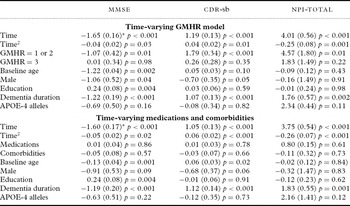
The next set of models, shown in Table 3, used GMHR as a time-varying covariate. All three outcomes were statistically significantly associated with time and time2. For the MMSE and CDR-sb, individuals declined over time, and the mean rate of decline increased with time. For the NPI, the positive time term but the negative time2 term suggests that NPI worsens over time, but that this worsening slows, or levels out, over the course of illness. As in the previous models, longer dementia duration was associated with worse ratings on all three outcomes. Male sex was associated with worse MMSE scores but better CDR-sb scores. For all three outcomes, having a GMHR of 1 or 2 (fair or poor) was statistically significantly associated with worse ratings.
Time-varying GMHR, non-psychiatric medications, comorbidities, and AD outcomes

* β coefficient (standard error), p-value.
GMHR = General Medical Health Rating; MMSE = Mini-Mental State Examination; CDR-sb = Clinical Dementia Rating – sum of boxes; NPI = Neuropsychiatric Inventory; APOE = Apolipoprotein E.
Table 3 shows results from a similar set of models, but with the number of medical comorbidities and number of non-psychiatric medications as time-varying covariates. The parameter estimates show a similar pattern to the time-varying GMHR analyses in Table 3, with time and time2 being statistically significantly associated with all three outcomes, and with accelerating decline for both MMSE and CDR-sb, but decelerating decline (amelioration of worsening) for NPI total.
Discussion
In this population-based longitudinal study, health status (as measured by the GMHR) appeared to fluctuate over time rather than to decline monotonically for many of the participants. This may explain why baseline measures of health were not clear predictors of rates of dementia progression, and also suggests that GMHR may be a risk factor that can be altered, thus altering the course of patients’ AD-related decline. GMHR at baseline was only associated with CDR-sb scores, and was not associated with rate of decline on any of the three outcomes. Neither number of comorbidities nor number of non-psychiatric medications at baseline was associated with decline on any of the three domains. By contrast, having a GMHR of 1 or 2 at a DPS visit was strongly associated with worse scores in all three domains at that same visit, though this was not true for medications or comorbidities. This suggests that GMHR, whose scoring is only partly based on number of comorbidities and medications, is capturing something above and beyond just simple counts. It further suggests that there is a dynamic relationship between medical and cognitive health, since the effect appears to be immediate and GMHR fluctuates in a substantial portion of the sample.
The literature on the relationship between general medical health and dementia is somewhat sparse. The majority of papers to date describe cross-sectional studies. Of the two previously published cohort studies, one found that fast progressors had significantly more comorbidities (Boksay et al., Reference Boksay, Boksay, Reisberg, Torossian and Krishnamurthy2005), while the second found that a larger number of medications were associated with slower decline (Storandt et al., Reference Storandt, Grant, Miller and Morris2002). We found no association between decline in any domain with either comorbidities or prescriptions, as measured at baseline. Neither study reported on health variables measured longitudinally.
For the most part, our findings confirmed previously reported risk factors for poorer outcomes, including older age and greater dementia duration at baseline. Female sex is generally associated with worse prognosis; we found that female sex was associated with higher MMSE scores but worse CDR-sb scores. Several studies have found an association between higher education and poorer outcomes, but in our sample we found associations with higher scores on MMSE and no associations with either CDR or NPI. Contrary to some published reports, presence of one or more APOE-4 alleles was not significantly associated with any of the outcomes in either the baseline or time-varying models.
The strengths of this study include its population-based cohort and its capture of incident cases, thus allowing for observation over the full course of illness. The high participation rates and longevity of Cache County residents (Tschanz et al., Reference Tschanz2011) serve to reduce potential biases as a result of selection or competing risks. Another strength is the wealth of information collected, including measures of dementia progression in three domains, detailed health status assessment, and medication use data.
Potential limitations include the lack of follow-up in approximately one-third of the sample and the association between low GMHR and shorter follow-up time. This association likely resulted in estimates of associations between poor health and faster dementia progression that were biased toward the null hypothesis, as the sicker individuals were less likely to be observed. Hence, our findings of an association between GMHR ratings and dementia progression are probably conservative. Health status is complex and difficult to measure, particularly because it is a dynamic process. Though it has demonstrated excellent reliability and validity, the GMHR is a global measure, which does not allow for differential weightings of conditions that may have a greater or lesser impact on health status as other ratings do. In the majority of follow-up visits, CDR and GMHR ratings were performed by the same nurse, thus introducing the possibility that scores on one instrument influenced scores on the other. This study only enrolled individuals aged ≥65 years, therefore these findings may not apply to those with early onset AD. The Cache County population is predominantly white, well-educated, and of northern European descent, thus potentially limiting the generalization of the findings to other populations. Further, the majority of the study sample belong to the Church of Jesus Christ of Latter Day Saints, which prohibits tobacco, caffeine, and alcohol use, thus limiting our ability to assess the effects of these substances on dementia progression. This may also have altered the relationship between dementia progression and medical comorbidities known to be associated with these behaviors, such as cardiovascular disease and certain cancers (Breitner et al., Reference Breitner1999). Despite this potential limitation, atrial fibrillation, systolic hypertension, and angina have been associated with faster decline on MMSE and CDR-sb in this sample (Mielke et al., Reference Mielke2007).
Our findings show that health status, as measured by GMHR, can fluctuate both up and down, and they suggest that the course of decline might be improved through better medical care. This lends additional support to recent recommendations and practice guidelines calling for increased attention to general medical care among individuals with AD (Lyketsos et al., Reference Lyketsos2006; Rabins et al., Reference Rabins, Lyketsos and Steele2006; Lyketsos, Reference Lyketsos2012). One potential barrier to this is the fragmentation and lack of continuity of health care provision in the USA (Bartels, Reference Bartels2003). One solution is the adoption of more collaborative models of care; several recent studies have demonstrated their efficacy in improving some outcomes (Vickrey et al., Reference Vickrey2006; Counsell et al., Reference Counsell2007; Callahan et al., Reference Callahan2011) without additional net costs (Counsell et al., Reference Counsell, Callahan, Tu, Stump and Arling2009).
It is important to note that while we have demonstrated an association between GMHR and dementia progression, we have not demonstrated a causal relationship. Establishing such a relationship in an observational study is difficult, in part because it is not possible to determine the temporal order in cases where both medical and cognitive declines (or gains) occurred between study visits. It is reasonable to suggest that poorer physical health would lead to poorer cognitive/mental health by placing an additional stressor on the brain, but the reverse is also plausible. Poorer cognition and function or increased psychiatric symptoms could lead to physical decline through self-neglect, improper medication administration and monitoring of chronic conditions, such as diabetes or asthma, decreased access to health services, or decreased social and physical activity. It is likely that mechanisms in both directions are at work. Given the paucity of potentially modifiable factors affecting the course of dementia, further study of this relationship is warranted.
Conflict of interest
None.
Description of authors’ roles
Dr. Jeannie-Marie S. Leoutsakos had full access to all the data and takes responsibility for data integrity and accuracy of the data analysis, performed and interpreted the analyses, drafted the paper, and gave the approval for final version to be published. Dr. Dingfen Han performed and interpreted analyses, edited the paper for content, and gave approval for final version to be published. Dr. Michelle M. Mielke contributed to design and interpretation of analyses, edited the paper for content, and gave approval for final version to be published. Sarah N. Forrester assisted in the performance of analyses and drafting of the paper, and gave approval for final version to be published. Dr. JoAnn T. Tschanz participated in study design and oversaw data collection, edited the paper for content, and gave approval for the final version to be published. Dr. Chris D. Corcoran contributed to interpretation of analyses, edited the paper for content, and gave approval for final version to be published. Dr. Robert C. Green, Dr. Maria C. Norton, Dr. Kathleen A. Welsh-Bohmer and Dr. Constantine G. Lyketsos participated in study design and analysis interpretation, edited the paper for content, and gave approval for the final version to be published.
Dr. Tschanz and Dr. Lyketsos were the co-senior authors.
Acknowledgments
The work was supported by the following NIH grants: R01AG21136, R01AG11380, R01AG18712, R01HG02213,30AG028377, K24AG027841, and P30AG13846.