

Apologia
There is an assumption amongst some historians that one might easily compare the Spanish colonisation of different parts of the world in a similar framework, but the Philippines seems a counterexample; colonisation there was very different from those experiences and also from earlier Spanish experiences in the Americas.
In this article I explore the attitudes of the elite of the indigenous people and how they managed to survive, indeed flourish under the colonisers. Unlike Mexico where inquisitorial and other courts gave at least some expression to the local voices (albeit mainly interpreted), there are essentially no direct records of the local voices in the Philippines:Footnote 1 virtually everything that is recorded was recorded by the Spaniards.Footnote 2 Generally the reports are official ones, usually written by administrators or priests,Footnote 3 and large numbers are now preserved in the Archivo General de Indias in Seville. Many were published, albeit selectively and generally in translation, by the Americans at the turn of the twentieth century.Footnote 4 There is, however, a long manuscript, apparently not official and probably not written by a cleric but a lay person, probably a soldier or administrator, that records the history of the early Spanish Philippines from 1565 to 1596, which is now in the Lilly Library in Bloomington, Indiana, and will be used.Footnote 5
Despite the one-sided, that is only Spanish, reporting it is nevertheless possible to discern currents in the thinking and behaviour of the local elite. William Henry Scott said, long ago, that we have to look through the “cracks in the parchment curtain”.Footnote 6
Brunei and Manila
The Spanish soldiers were amazed to walk through the palace where Dionisio Capulong's family had walked fifty years or so earlier. “The house of the king is very fine and large.” After the 150-metre bridge from the bay, they encountered a warehouse full of supplies and then four other large rooms in front of which was a storehouse full of supplies. There was also another storehouse full of weapons. All the rooms were richly ornamented with carved wood.Footnote 7 This was the palace of the king in Brunei and the occasion of the description was the attempt by Governor Sande to bring the ruler to subjection under the Spaniards in 1578.Footnote 8 The dwelling described above was almost certainly grander than that where Dionisio and his family lived in Manila, but there would have been echoes of the Bruneian palace.Footnote 9 The houses in Manila and its surroundings were built of wood and roofed with nipa, the leaves of a local palm Nypa fructicans.Footnote 10 Manila itself was encircled by a wooden palisade, probably made of sharpened bamboo poles.Footnote 11
Fifty-seven years earlier, in 1521, when what remained of Magellan's ships left the Philippines after he had been killed at Mactan Island, off Cebu, the replacement leader, Juan Sebastián de Elcano, sailed to Brunei. On the way they “touched at an almost uninhabited island”, which we afterwards learned was called Cagayan. The few people there are Moors,Footnote 12 who have been banished from Burné [Brunei].Footnote 13 They then came to Palawan. Across ten leagues (55 km or 30 miles) of sea they arrived at the island of Borneo whose northern extremity they went around, arriving, after another fifty leagues (about 275 km or 165 miles), at Brunei.
Long before the Spaniards arrived, Manila had been a trading port, receiving trade from, amongst other places, China, only eight days to the north, and Brunei to the west. This latter city-state had long had connections with the Philippines and not only with the south such as in Tawi-Tawi, Jolo and Mindanao. Brunei is crucial to understanding the early years of the Spaniards in Manila. Unfortunately we have no written documents from Brunei or even Muslim sources that can be used.Footnote 14 Yet the ruling family in Manila when the Spanish arrived in 1570 had had very strong contacts, indeed relations, with Brunei for more than fifty years.
“It was common knowledge among Spaniards during Legazpi's timeFootnote 15 that the ruling family of Manila was not only related to the Bornean Sultan but was of Bornean origin. The famous Rajah Sulayman of Manila, a nephew of Rajah Matandá, was also reported to have married a daughter of a Borneo sultan and to have been of Bornean origin”.Footnote 16 Indeed it was Siripada (or Bulkeiah),Footnote 17 Sultan of Brunei and, according to the chronicler Pigafetta grandfather of Dionisio Capulong, who was the “conqueror of Manila” in the early sixteenth century and had married the daughter of Batara of Sulu.Footnote 18
While in Brunei in 1521 the Spaniards saw a mass of praos coming towards them so they hurriedly set sail. A minor battle ensued resulting in the capture of “a son of the king of the isle of Luzon”.Footnote 19 The boy was Dionisio's uncle, Ache who was then a young boy. He had journeyed to his grandfather's realm to marry a cousin.Footnote 20 The “king of Luzon” was the captain-general acting for the Rajah of Brunei. “The Moorish king having heard of the ill-treatment by us of his junks, hastened to send to say, by means of one of our men who was on shore to traffic, that those vessels had not come to do any harm to us, but were going to make war against the Gentiles”, meaning non-Muslims.Footnote 21 It would be nearly fifty years before the “young prince” met Spaniards again, by which time Ache would have been close to seventy and had become known as Rajah Matandá, literally the “old Rajah”.Footnote 22
The Spaniards arrive
Legazpi had arrived in the Philippines in 1565 and this was the first colonisation by the Spaniards despite their having “discovered” the Philippines more than forty years earlier. He was based in Cebu and Panay in the Visayas from his arrival in 1565 and the situation there was very different from those the Spaniards had originally faced in the Americas. The legacy of Bartolomé de las Casas meant that instructions from the King about how to act in the Philippines were changed: the Spaniards were supposed to proceed with peace and friendship rather than armed force. Military might was to be replaced by efforts at conversion to the (Catholic) Christian faith. Of course the instructions were not always obeyed and the Spaniards did use force at times. They certainly defended themselves vigorously when attacked and clearly demonstrated their superior firepower on occasion. Spanish martial conquest and domination was a separate issue although the dominance of Spanish firepower was nothing like as evident as it had been in the Americas.
Conversion to Christianity, specifically the Catholicism of Spain, in the Philippines, with the exception of parts of the south,Footnote 23 would not be from highly developed religious practices as had been experienced in the Americas, but from animistic beliefs. Perhaps because of this it was not difficult for the inhabitants of the Philippines to adopt and accept the Christian pantheon as part of their spiritual landscape. Even today the local anitos and spirits dwell beside the Christian saints in the minds of people as one moves around the Philippines.
Although Islam had reached Southeast Asia centuries before, Islamisation of the whole region accelerated in the fifteenth and sixteenth centuries.Footnote 24 It is well known, on the other hand, that Muslims first got a foothold in the Philippines in the southwest island of Sulu.Footnote 25 The motivations of the Muslims are unclear, though there are many possibilities.Footnote 26 Trade was clearly one of the motivations. On the other hand, and very much in contrast to the Spanish approach, religious conversion seems not to have been a high priority, at least around Manila, as will be seen.
Legazpi learnt about Manila in that same year of 1565, when he encountered a “Moor from Luzon” and in 1566 he met seven or eight more, including one named Mahomat.Footnote 27 While there may well have been Muslims in Manila at that time, it is by no means clear that Manila comprised a Muslim community.Footnote 28 The relations between Brunei and Manila do “not necessarily imply that the majority of the inhabitants on both sides of the mouth of the Pasig River were Muslims. Actually, the process of Islamisation [there] had only begun [shortly before the Spaniards arrived] with some inhabitants starting to evince Islamic habits like circumcision and the avoidance of pork”.Footnote 29 An unknown Spanish author, but perhaps Diego de Herrera, OSA, who was on Legazpi's expedition to Manila wrote: “it is quite certain that the natives of this island of Luzón, whom we Spaniards commonly call Moros, are not so; for the truth is that they do not know or understand the law of Mahoma–only in some of the villages on the seacoast they do not eat pork, and this for the reason that they have had dealings with the Moros of Burney [Brunei], who have preached to them a little of the teaching of Mahoma”.Footnote 30 Artieda reported, “In this island of Luzon are three settlements of Moros, who do not know the law of Mahoma in its entirety. They eat no pork, and pay reverence to the said Mahoma”.Footnote 31 There were, however, many people who drank alcohol.Footnote 32 Again, the Augustinian Herrera, writing in 1570, but about Cebu and before he went to Manila, also said:
The statement that [the Moros] were preventing the preaching of the gospel was false, for they have never prevented it nor do so at present. On the contrary, there is an increase to be observed in families where the husband is a Moro and the wife a pagan, who come in order to beg the religious to baptise their son and make him a Christian; for they do not at all object to each one living according to the belief that he likes best. For all the Moros who live in these islands have been Moros for but few years back. Many of them, such as those of Luçon [Luzon], have nothing except the name, and the fact that they do not eat pork; for they have no mosque or cacique [sic]Footnote 33 (who are their priests).Footnote 34 This worship is only a trifle more firmly established among those of the island of Burney than in the other, although they are also of recent date there.Footnote 35 Not all the island is Moro, but only certain villages along the coast, for the inhabitants of the interior are heathens. None of them possess the lands of Christians or wage war on them, or do them any injury; although we do to them, and much, for four or five ships of Burneo [Brunei] have been pillaged and many people killed, while many more from Luçon have been killed, although excellent friends to us. As to the chiefs, they made the land friendly to us, or at least exerted a great influence in that direction.Footnote 36
Despite Herrera's condemnation of attacks by Spaniards on “Moros”, relations between Legazpi and the “Moros” that he encountered in the Visayas seem to have been very practical, not to say, cordial, at this time: one of the surprising aspects of the career of Dionisio Capulong is how little antagonism is evident between Muslims and Christians (in terms of religion or otherwise).Footnote 37
The Spaniards come to Manila
Legazpi sent Mahomat, the “Moor from Luzon,” whom he had known for four years, as a guide with the first expedition to Manila in 1570.Footnote 38 The motivation for the expedition was clear: food supplies had always been a problem when Legazpi was based in the Visayas.Footnote 39 The expedition was under the command of his master-of-camp Martín de Goiti who took with him ninety soldiers and twenty sailors on “the junk ‘San Miguel’, of about fifty tons’ burden with three large pieces of artillery; the frigate ‘La Tortuga’; and fifteen praus Footnote 40 manned by natives of Cubu [Cebu] and of the island of Panay” to reconnoitre Manila on 1 May 1570.Footnote 41
Manila was different from the other places Legazpi had experienced in the Philippines. Most settlements in the Philippine Islands were relatively small, comprising at most a hundred or so dwellings and presided over by a local chief.Footnote 42 Frequently there would be attacks between neighbouring settlements. The situation was very different around Manila since members of the same family ruled Manila and its environs and the number of houses in Manila alone was a thousand or more. There was therefore some sort of political organisation already in place, and there were clearly identified leaders with whom the Spaniards could negotiate. The people in Manila and Tondo, just across the River Pasig from Manila, already knew about the Spaniards and there is evidence that cannon had been constructed there in the preceding years.Footnote 43 When Martin de Goíti arrived, the people in Manila and Tondo already had news of him.
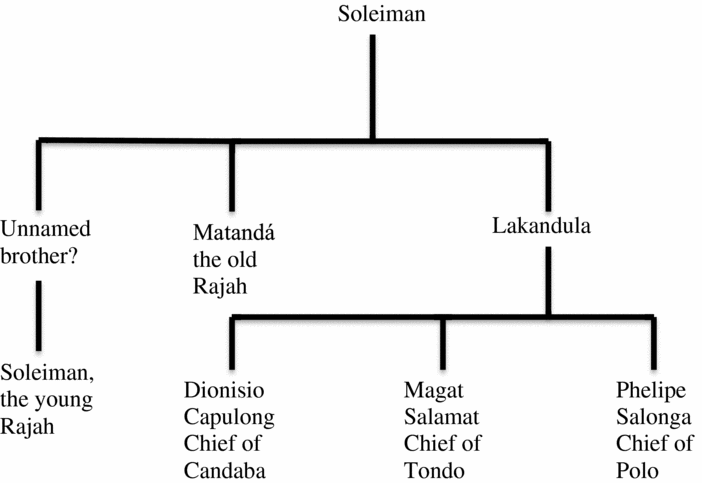
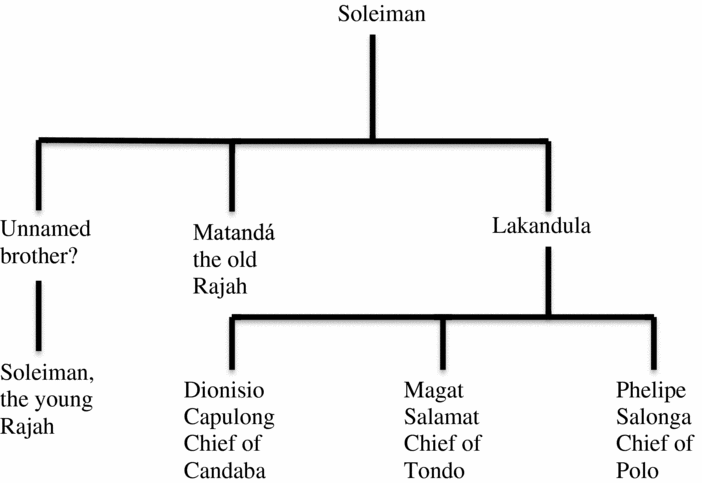
The Spaniards encountered three local rulers: Rajah Matandá,Footnote 44 the “old Rajah”,Footnote 45 Lakandula, who was almost certainly his brother, and Soleiman, the young Rajah, whose father was also most probably a brother of Rajah Matandá. Soleiman, who was known as Rajah Muda or Mura (“young Rajah”), was Rajah Matandá’s heir but probably not his son. Lakandula, a brother of Rajah Matandá, had three sons, one of whom was Dionisio Capoulong (see Figure 1). Rajah Matandá and Soleiman were chiefs of Manila, but Lakandula was chief of Tondo. At that time (and later) Tondo was an important trading port competing with Manila, but the rulers seem to have put aside their differences to present a united front to the Spaniards. Rajah Matandá’s wise counsel prevailed and the leaders made a blood pact with Goiti.Footnote 46
Part of the Manila rulers’ family tree (after Santiago, ‘The Houses’, pp. 46 and 48).
In a blood compact the principals of the two sides drink one another's blood and pledged eternal peace.Footnote 47 Blood pacts had been made between Spaniards and Filipinos ever since Magellan's arrival.Footnote 48 The interpretations of these pacts seem, however, to have been very different on the two sides. The Spaniards took them as a sign of vassalage and willing subjection, whereas the local leaders regarded them as partnerships between equals. As Aguilar has noted, “it is interesting that, in the early Spanish accounts, the blood oath was not described in a disparaging manner. Certainly it was not condemned as a heathen practice”.Footnote 49
Soon afterwards an incident, in which a slave of one of the rulers was killed in retaliation for an attack on an individual, led to a larger uprising by the local people.Footnote 50 The result was that Goiti regarded the pact as broken and a battle ensued in which the locals were defeated and Manila burnt.Footnote 51 The fire took hold rapidly since the houses were of wood roofed with nipa. Rajah Matandá put out a white flag, but the other leaders sided with the young Soleiman. The account in the Lilly Historia then goes on to say that the Spaniards found jewels and gold and also a large supply of arms together with a foundry; Manila was described as being “large and the richest town of all the Philippines”.Footnote 52 So it seems as though what the Spaniards found in Manila was similar to what was described above about the palace in Brunei. The dozen cannon they also found were taken back to Legazpi in Panay.
Tondo, on the other side of the river, was left in peace because Lakandula, its ruler, had not broken his pact with the Spaniards. Moreover, after Goiti had left Manila and was replenishing his water and supplies in Cavite, about 10 km (six miles) across the bay, Chinese from Manila came complaining about the mistreatment they had been receiving from the rulers. Goiti said he would soon return and right the wrongs, but he actually departed because the winds were already changing and would shortly be against him.Footnote 53
The second sortie Legazpi made into Manila, which he himself commanded, took place in the following year–actually against the advice of his senior commanders.Footnote 54 It should be recalled that Legazpi's expedition had only a couple of hundred or so Spanish soldiers, and although they had–and Goiti had demonstrated–superior firepower, political manoeuvring was clearly advantageous. On Legazpi's arrival Lakandula sailed out onto Manila Bay to meet and greet him. According to the Spanish sources, Lakandula and his relatives again rendered obedience to the King of Spain as they had done when Goiti had arrived, or at least that is the Spanish interpretation.Footnote 55 The submission seems to have been remarkably rapid but the firepower previously demonstrated by Goiti may have been one influence. The prudent–the Spanish used that wordFootnote 56–local rulers achieved a modus vivendi with the Spaniards that was as fluid as it was effective; the Indigenes shifted from acquiescence to rebellion and vice versa with remarkable dexterity. One suspects that the main aim of the local rulers who achieved this was simply the maintenance of their own status. They not only succeeded in that aim, they even persuaded the Spaniards to accord them privileges that meant they would retain their local pre-eminence.Footnote 57 The local elites became the agents of Spanish control–and the Spaniards clearly benefitted from this. Spanish tolerance and forgiveness of early rebellions actually reinforced the status of the local rulers and relieved the Spaniards of the burden of enforcing their own regime entirely. This elite would continue to maintain their positions of power and influence but, as will be seen, they exhibited a remarkable degree of fluidity in their attitude to the Spaniards and the events that unfolded.
On the occasion of negotiating with Legazpi, although the Spanish rituals were accomplished, the local ritual of a blood pact was not. It is reported that the three rulers said that they were content with the Spanish way of formalising their pact and that they did not wish to also have a blood pact.Footnote 58 The reasons are unclear, but perhaps it was because the local people did not consider their commitment to the Spanish king as binding, and also because of the astute influence of Rajah Matandá, who had much experience and seems to have survived many ups and downs in his life, but remained ruler.Footnote 59 His ready adaptability, in particular to change sides depending on which was in the ascendancy, seems to have been handed down for it is reflected in the later behaviour of his son, Dionisio Capulong. The people living around Manila Bay subsequently also showed a degree of fickleness, on occasion following local rulers and supporting rebellions against the Spaniards despite the avowed allegiance.
Nevertheless the Spaniards continued with their usual ritual, Legazpi explaining that the Castilian custom was for people to swear an oath in writing [sic] in front of a notary (escribano) and this was duly done.Footnote 60 The people who partook were the old and the young Rajahs, Lakandula and “all the most principal people of Manila and its environs”.Footnote 61 What Legazpi had not seen when he met Lakandula and the others was the burnt state of Manila, and he was later saddened to see the destruction.Footnote 62
All three rulers had sons; Lakandula had three: Dionisio Capulong, Magat Salamat, and Phelipe Salonga. These sons were very quickly baptised almost immediately Legazpi had arrived. It would appear that Dionisio and Phelipe were the Christian names given at the baptisms. It is not clear how deep or sincere the conversion was–it seems plausible that Lakandula's flexibility was also in evidence here. There is no indication as to how sincere the “conversion” of Dionisio was. Further, it is not known how old the boys were, but it seems consistent to assume Dionisio was a teenager or thereabouts and it therefore seems unlikely that he had any understanding of the Christian faith at his baptism. Only one of the later Spanish reports offers any comment on his Christian observance and that was in 1609 as will be detailed below. He had at least one son, Juan Gonzalo Capulong, whose forenames again are Christian and who sired the famous family later known as Macapagals.Footnote 63 The old Rajah was baptised on his deathbed within a year or so.Footnote 64
Lakandula shortly afterwards went to Pampanga to assist Martín de Goiti and was instrumental in persuading Kapampangans to support the Spaniards.Footnote 65 Little more is heard of the above rulers until 1574 by which time Guido de Labezaris had become governor-general (governed 1572–5).Footnote 66 In that year “the king of Borney [Brunei] undertook to attack Manila, and to plunder and kill the Spaniards, launching for the purpose a fleet of one hundred galleys and one hundred small vessels”.Footnote 67 However the son of the king ordered the fleet back to Brunei because he was afraid the Spaniards would attack other parts of Borneo and his father was there.
In that same year, the Chinese pirate, Limahong, attacked Manila and other parts of Luzon.Footnote 68 The local people made two mistakes. First, they thought the attackers were from Brunei and secondly, they thought that the invaders had defeated the Spaniards. They were wrong on both counts. The winds at that time (the very end of November) were not in favour of sailing from Brunei,Footnote 69 and secondly it was the Spaniards who were the victors. The attackers were a fraction of Limahong's men while he himself had waited outside Manila Bay. The advance party was driven off, but Labezaris had provoked the local people when he “ordered that two of the principal Moros be arrested and imprisoned, saying that, by means of them, the Moros would supply him with food”.Footnote 70 “They all rebelled on the second day. In that short space of time there gathered around the city of Manila more than ten thousand Moros, in their little boats, ready to obey the commands of the corsair. . . . When the Moros knew that the Sangleyes [Chinese] had gone, and that the Spaniards had been victorious, they set the friars free; and, little by little, they again became submissive–apologising for their revolt because of the chiefs who had been slain in prison”.Footnote 71 Gaspar de San Agustin has a slightly different version, saying that Lakandula was prevailed upon to come and see Legazpi and that there he “had no reply other than some frivolous excuses and the imprisonment and death of the two leaders Numanatan and Rajabago”.Footnote 72 Nevertheless Legazpi forgave him and allegiance was restored. One misunderstanding was corrected, but here again we see Lakandula being wily and he seems to have continually managed to put himself on the winning side. This opportunistic oscillation between enmity and friendship with the Spaniards was to continue with his son Dionisio Capulong.
In 1579 Governor de Sande sent Gabriel de Rivera to subdue Brunei having already written to the King Philip on 30 May about Brunei, “I am quite sure that that king will quietly submit, if we effect a settlement there”.Footnote 73 The claim was premature, since eventually Brunei made a response that “was a last effort by the old Brunei aristocracy in Manila and Tondo to overthrow the Spanish with assistance from Brunei, Jolo, and Sulu, and also from Japan”.Footnote 74 This should not be interpreted as meaning there was a coalition between all those parties, but only that any one or more, of possibly different enterprises, might join together. In fact in 1588 all such attempts came to naught for various reasons, as will shortly be revealed.
It is claimed that Lakandula died in 1589.Footnote 75 At or before that time his three sons became rulers of neighbouring parts of Luzon. Phelipe Salonga, the youngest became chief of Polo, Bulacan, about 15 km (10 miles) northwest of Tondo, Magat Salamat, the second son, succeeded his father as chief of Tondo and Dionisio Capulong became chief of Candaba in Pampanga,Footnote 76 about 80 km (50 miles) from Manila, up the Great Pampanga River.Footnote 77
The Revolt of the Lakáns
The revolt in Manila that the Bruneians wanted to see finally took place in 1588 when all three sons of Lakandula were involved in a thwarted rebellion generally known as the Revolt of the Lakáns. Agustín de Legazpi,Footnote 78 whom Soleiman had adopted when a brother of his died,Footnote 79 Martin Panga, governor of the village of Tondo, and Magat Salamat, son of Lakandula, were the ringleaders. We have only Governor de Vera's report,Footnote 80 but it appears that the group were setting themselves up to secure aid from any one of a number of potential allies.Footnote 81 These were people in Japan, the king of Brunei and the English adventurer Sir Thomas Cavendish, who had captured the Santa Ana off the coast of California and was now threatening Manila where he arrived on 14 January 1588.Footnote 82
There had been, as noted above, close connections between Brunei and Manila before the Spaniards arrived and the local elite had marital connections. The Spaniards had unrealistic expectations of subduing Brunei and, already in 1576, Governor de Sande had written to the king:Footnote 83
The witnessFootnote 84 has heard that the king of Borney [Brunei] wrote letters to Raxa Soliman and Lacandora, chiefs of Manila, so that they might revolt against the Spaniards, and saying that all would be protected. Likewise he has heard his relatives and other Moros tell how in former times the king of Borney has sent preachers of the sect of Mahoma to Cebu, Oton, Manila, and other districts, so that the people there might be instructed in it as were those of Borney [Brunei].
The Japanese were a more serious threat. In 1587 a certain Captain Joan Gayo and many Japanese arrived in Manila from Japan with merchandise; “Don Agustin de Legaspi became very friendly to him, inviting him many times to eat and drink at his house which is on the other side of the river of this city [i.e. in Tondo]”.Footnote 85 Agustín connived with Magat Salamat, Agustín Manuguit, Phelipe Salalila, his father, and Jerónimo Bassi, Don Agustín de Legazpi's brother, for Gayo to come to Manila under pretext of peace and commerce, but actually intending to defeat the Spaniards. These people had met in prison: Panga had been accused of adultery and it appears Agustín de Legazpi had committed some financial irregularity. The local rulers were very unhappy “because their wives were being taken away from them, and given to others to whom, they claimed, they had been first married”; their slaves were demanding and it appears, getting their liberty and in addition the elite were also losing their wealth. Sitoy wrote, “Martin Panga was Legazpi's first cousin and successor as gobernadorcillo of Tondo. Panga himself had been exiled by the Spaniards to Tambobong on a charge of adultery, apparently because he had refused to live by the Christian concept of monogamy”.Footnote 86 The conspirators had the support of the local people who would help the Japanese to kill the Spaniards, and would supply the provisions and everything necessary, “After they had conquered the Spaniards, they would make him [Agustín de Legazpi] king of the land, and collect the tribute from the natives, which would be divided between Don Agustin and the Japanese”.Footnote 87
The group of conspirators was subsequently expanded so that it now included Dionisio Capulong, his brother, Phelipe Salonga, and about a dozen others. The Englishman Cavendish had arrived in the vicinity and was a possible ally, but he felt he was not adequately equipped to attack the Spaniards and, after staying around the Philippine Islands for a fortnight, departed.Footnote 88 So the group resolved to act without help from Japanese or English. Although they solicited the aid of other chiefs from Pampanga those overtures were rebuffed, but they also approached the Bruneians.Footnote 89 Given the size of the group it is not surprising that there was a leak and the ringleaders were arrested.Footnote 90
The Spaniards tried them and exacted punishments of varying degrees. The principals, Agustín and Panga were “condemned to be dragged and hanged”; and their heads cut off.Footnote 91 In addition their goods were to be confiscated. The punishment of the others varied a great deal and some escaped much more lightly. Eight were exiled to New Spain (Mexico) for periods of up to eight years. Others were exiled to prescribed places and yet others to “exile from this jurisdiction”.Footnote 92
Dionisio Capolo, chief of Candava, was sentenced to prescribed exile from this jurisdiction for eight years, and was condemned to pay fifteen taels of orejeras gold,Footnote 93 half of which was to be set aside for the treasury of his Majesty, and half for judicial expenses. He and the fiscal appealed to the royal Audiencia, which, after having examined the report of the trial, remitted it to the captain-general, in order that justice might be done–save that the whole penalty was to consist of four years of prescribed exile, and the payment of twelve taels of orejeras gold. The sentence was executed.Footnote 94
The people exiled to New Spain would be very unfortunate. De Vera wrote that they would shortly set sail, i.e. in July 1589, but their galleon, the San Martín, was lost at sea and all would have perished.Footnote 95 Dionisio's exile, however, was only “from this jurisdiction”.Footnote 96 He was therefore compelled to remain more than five leagues (roughly 28 km or 17 miles) outside Intramuros. He could easily have done that simply by going home to the region of Candaba where he was ruler.Footnote 97 Although the sentence of exile had already been reduced to four years, it appears he did not serve even that amount of time. De Vera is said to have pardoned Dionisio Capulong, and that must have been before the governor's term of office ended in June 1590.Footnote 98 This means that the pardon had to have happened a very short time after the amended sentence had been passed, which was recorded in July 1589.Footnote 99
Dionisio's usefulness to the Spaniards
What was the reason for the pardon? De Vera wanted to extend his influence northwards into the Magat Valley. Dionisio was lord of Candaba, which was on the route from Manila to the Magat Valley and, as will be noted later, he had dealings with the people in the valley. It would therefore seem that Dionisio was too useful to the Spaniards and this was surely why de Vera employed him. As de Vega later reported:
Doctor Santiago de Vera . . . having been informed of the same [Magat ValleyFootnote 100] region, sent an Indian chief, named Don Dionisio Capolo, who is still living.Footnote 101 He gave the latter one hundred Indians for the said exploration. This man returned after having gone sixty leguas [about 330 km or 200 miles] from Manila–twenty more than the former expeditionFootnote 102–on the said exploration. He reported that Indians of the country, his acquaintances, upon learning his errand, advised him not to proceed farther, for the people whom he was going to discover were numerous and warlike, and were hostile and would kill him. And inasmuch as he had no order to fight, and had but few men, he returned.Footnote 103
Within a year or so the new governor, Gómez Pérez Dasmariñas, who arrived on 1 June 1590,Footnote 104 sent the first of a new sequence of expeditions down the Magat Valley. According to William Henry Scott, Dionisio “regularly travelled that route [along the Pampanga River] to deal with Isinay chiefs in the upper Magat River valley”.Footnote 105 The governor's son, Luis Pérez, who was only about 24 years old, led the expedition.
Dionisio had a number of valuable abilities: he knew the country and he probably knew enough of the local languages to enable the Spaniards to communicate with the local people. It has been suggested that Dionisio Capolong probably spoke Tagalog and Kapampangan as a young person and travelled north from Candaba and, using Kampangan, was able to speak with some of the local people in the Magat Valley.Footnote 106
One of the people that Dionisio met on the first expedition was Chief Ybarat, who seems to have been a particularly powerful local ruler.Footnote 107 Luis Pérez had received [him] with great affection [con mucho amor] embracing him.Footnote 108 Dionisio would go on the next three expeditions “where he . . . served with great fidelity”.Footnote 109 In particular he accompanied an expedition led by Torribio de Miranda in 1594, when they again encountered Ybarat. This time Ybarat proved to be a slippery customer. He promised Miranda rice, but did not provide any. Miranda was suspicious and built a fort (called San Joseph) and then, when Ybarat eventually returned with “a sucking [sic] pig and four jars of rice”, Miranda took him prisoner.Footnote 110 Later Miranda released Ybarat in exchange for his two sons remaining as hostages, but does not seem to have kept them hostage for long because Ybarat had “fulfilled his word”. Later Ybarat joined the expedition for some time acting as a guide–apparently yet another person whose allegiance changed easily.Footnote 111 However Miranda was subsequently warned that Ybarat was planning to attack him, so Miranda imprisoned Ybarat and quickly dispatched him to Manila. There Luis Pérez met him and “had him feasted and delivered him to Don Dionizio Capolo. After some days Don Luis [Pérez] visited Ybarat and those who accompanied him, and then sent him back, well satisfied, to his own country, in charge of the same Don Dionisio”.Footnote 112
Miranda made a further excursion into Northern Luzon, ostensibly looking for gold mines, but became sick and then Governor Luis Pérez gave him permission to return to Manila. In his stead Luis Pérez sent Captain Clavijo to the Magat Valley but the latter followed this by going in search of Igorots and their gold. He turned back “because he was assaulted by more than one thousand Indians. The latter wounded his guide, Don Dionizio Capolo, very severely in the face; and it is reported that the captain was forced to return because he had no one to guide him”.Footnote 113 Dionisio's value as a guide is clear from this, though it is not clear that he recovered enough from his injury to do further guiding.
Dionisio Capulong as landowner
The next time there is a mention of Capulong is in 1602 when Dionisio was witness to the sale by Carlos Kálaw, mayor of Tondo, of a plot of land to Go Macabebe.Footnote 114 It is not clear whether Dionisio had moved back to Manila Bay from Candaba, but this seems quite likely since the deed of sale was drawn up in the “province of Tondo” and he is described in another document as being “principal of the pueblo of Tondo”.Footnote 115 The deed is interesting in many ways.
Before the coming of the Spaniards there was no sense of (monetary or proprietary) ownership of land in the Philippines; the local rulers had obeisance from the local people, they allocated land to their people for them to work and this was what defined the domains of the rulers. The first document shows that by 1602 the Spanish concept of land ownership had taken root, at least among some of the local people in Manila and its surroundings. Secondly the document is written in Tagalog, the language of Manila and its environs.Footnote 116 But not only did the Tagalogs have a local language they also had their own script, called Baybáyin. Now, the Spanish policy was for the priests to learn the language of the local people and then provide liaison.Footnote 117 In 1593 the Doctrina Christiana had been printed–written in Spanish and Tagalog–but the Tagalog in this book appeared in two versions: transliterated into Roman letters and spelt out in Baybáyin.Footnote 118 The land sale document of 1602 is written almost entirely in Tagalog using Roman letters, and ends with four signatures, three of which are written in Baybáyin. The second of these signatures is ou

i.e. Kapulo[ng].Footnote 119 The letters represent consonants and the vowels are usually marked (if at all) by diacritics called kudlit, which are included here.Footnote 120 So Dionisio was a knowing partner in these dealings and presumably had absorbed enough of the Spanish culture to become involved in such legal matters for his signature indicates he was a witness to the transaction.
Five years later, in 1607, Dionisio comes to our attention again. After the governorships of Luis Pérez Dasmariñas, who succeeded his father, Tello de Guzmán and Bravo de Acuña, there was a vacancy and the Audiencia governed instead of a governor.Footnote 121 By this time Dionisio was clearly a very important person. Two chiefs from the Magat region came to Manila to visit him. “[T]hose chiefs were coming to render homage to his Majesty, and wished to pay tribute, and would make others come”.Footnote 122 The Audiencia treated them patronisingly, feasting them to get information about their land. They then gave permission to Dionisio to return with the chiefs to their land, so that he would bring more chiefs with him. He succeeded very well, returning with seventeen chiefs, whom he took to the Audiencia. The council, however, treated them just as badly as before and that was the end of the matter.Footnote 123 No explanation has been found as to the lack of interest by the Audiencia, though the Magat Valley remained a problematic area for the Spaniards for over two centuries.Footnote 124
It is also recorded that “Don Dionizio attests that he has gone to the province of Tuy [Magat Valley] sometimes with seven or eight Indians; and as they were acquainted with him in the past, and knew that he had entertained Chief Ybarat, they have received him very hospitably and entertained him. They request him earnestly that some officer may go to protect them and receive their submission to his Majesty, and for fathers to teach them [Christian doctrine]”.Footnote 125 So Dionisio's baptism seems to have been followed by a life of active devotion to the Christian faith despite his Muslim connections with Brunei.
In later life Dionisio seems to have been in Tondo, since he is described as being “principal of the pueblo of Tondo” in 1620.Footnote 126 There are three more documents that bear his signature in Baybáyin, but the main texts of two are in Romanised Tagalog while the other two are entirely in Spanish with some signatures in Baybáyin. Fr Alberto Santamaría published two copies of Dionisio's signature in 1938,Footnote 128 but he did not publish the signature on an undated document.Footnote 129 That item contains only the surname “Capulong” and was recently found by Christopher Miller in 2015.Footnote 130
One document is dated January 1620 (no day is given). Dionisio is cited as “capitán y principal de Tondo” and he is selling land to Agustín Huyca.Footnote 131 In another document dated 7 October 1620 (which is a certified copy of the original) a dispute over land is settled between Agustín GuicaFootnote 132 and Dionisio Capulong, with the adjudicator deciding half should go to Capulong and the other half to Guica and his wife Mónica Sayan.Footnote 133 So by this time Dionisio Capulong was an entrenched landlord in Tondo. He had become part of the Spanish-centred establishment or perhaps was an early Filipino “balimbing”.Footnote 134
The signature of Don Dionisio Capulong from the document of 7 October 1620, courtesy of Christopher Miller and the Archivo de la Universidad de Santo Tomas, Manila. The text reads:

i.e. DO[N] [D]I YO NI S[I]O KA PO LO [NG].Footnote 127

Conclusions
Rajah Matandá, Lakandula and Dionisio Capulong were members of, or related to, the ruling family of Brunei and they ruled Manila and Tondo when the Spaniards first came to colonise in 1570. The Spaniards described Rajah Matandá as prudente and this seems to show a respect for his political astuteness. This quality was also demonstrated by his nephew Lakandula and Lakandula's son, Dionisio Capoulong. All three were opportunistic in their dealings with the Spaniards and the last two, in particular, demonstrated a remarkable ability to re-ingratiate themselves with the Spaniards even after participating in serious revolts. They also made themselves indispensable to the Spaniards in at least two ways. First, they were the intermediaries between the Spaniards and the local people and it is clear that they held the latter in check: there was early evidence that the local Chinese felt oppressed by their rulers; second, the local leaders’ knowledge of the geography and peoples was highly prized by the Spaniards, especially in the cases of Lakandula in Pampanga and Dionisio Capulong in the Magat Valley.
By accommodating to the Spaniards’ demands the local elite maintained their own position as is evidenced by Dionisio Capulong ultimately becoming a landowner–in the Spanish style–in Tondo where his father had ruled.
Acknowledgments
This is a heavily revised version of the paper originally presented at ICOPHIL (International Conference on the Philippines), 2016, Dumaguete, Philippines. Special thanks to two anonymous referees and Kathleen Neal for valuable comments that have led to a re-visioning of this article. I am extremely grateful to Christopher Miller and Jean-Paul Potet for their generous help and sharing of their deep knowledge of Baybáyin in the preparation of this paper, especially for the information about the documents that include Baybáyin script. Thanks to the Archivo de la Universidad de Santo Tomas and its archivist, Regalado Trota Jose, for assistance and reproduction permission. Finally thanks to my colleague Clive Griffin for ameliorations to an earlier draft.