Introduction
Noise-induced hearing loss involves permanent metabolic cochlear damage, which occurs as a result of long-term exposure to sound levels above 90 dB.Reference Clark1 It is estimated that there are 500 million people across the world who may be at risk of developing noise-induced hearing loss.Reference Alberti, Luxon and Prasher2 Studies have demonstrated the occurrence of noise-induced hearing loss in choristers,Reference Steurer, Simak, Denk and Kautzsky3 in symphony orchestra musicians,Reference Teie4 and in those attending rock concerts and those who listen to music through personal music players.Reference Meyer-Bisch5
Over the last few decades, the prevalence of hearing loss among adolescents has significantly increased.Reference Korpert6–Reference Shargorodsky, Curhan, Curhan and Eavey8 This trend is occurring in tandem with a rise in exposure to recreational noise. This is largely due to the increased use of ‘MP3’ music players, but also to a rise in attendance at live music concerts and nightclubs.Reference Shargorodsky, Curhan, Curhan and Eavey8, Reference Serra, Biassoni, Richter, Minoldo, Franco and Abraham9
There is a growing body of evidence that suggests excessive noise levels in nightclubs have an adverse effect on hearing, and may ultimately be responsible for noise-induced hearing loss. A study conducted by Bray et al. in 2004 examined noise exposure and associated otological symptoms in 23 disc jockeys working in nightclubs in Edinburgh.Reference Bray, Szymanski and Mills10 Sound levels of up to 108 dB were recorded in the venues, and the average sound level in nightclubs was 96 dB. This far exceeds the 85 dB level for which the provision of hearing protection in industry is mandatory. It was reported that 74 per cent of disc jockeys experienced tinnitus, whilst three interviewees showed evidence of noise-induced hearing loss on audiometry.Reference Bray, Szymanski and Mills10
Fortunately, the hearing of all employees in the music and entertainment sector is now protected by The Control of Noise at Work Regulations (2005), which require employers to prevent or reduce risks to employees' hearing in the workplace. Employers can be prosecuted if they fail to protect employees' hearing when exposed to noise levels above 85 dB.11 However, this law does not apply to members of the public attending nightclubs, as it is presumed they are making an informed decision to attend such venues.12
This study investigated the prevalence of symptoms related to noise-induced hearing loss that were experienced by students after attending nightclubs. It also aimed to explore students' awareness of the association between noise-induced hearing loss and nightclub attendance, and examine their attitudes towards this. We hoped this study would address the current lack of information linking symptoms of noise-induced hearing loss directly to nightclub attendance, in a bid to inform future legislation.
Materials and methods
Initially, a pilot questionnaire consisting of 28 questions (with fixed responses or requiring one-word answers) was given to 20 participants in a focus group setting. The questionnaire was then modified and refined on the basis of feedback received from the responders.
The final 18-item questionnaire (see Appendix 1) was distributed to students entering or leaving the University of Birmingham Medical School over a 5-day period during March 2012. Participants were recruited using a convenience sampling approach, whereby they were selected on the basis of accessibility and proximity to the researchers. Five researchers were involved in recruiting participants and care was taken to avoid any repeat completion of the questionnaire.
A total of 357 individuals completed the questionnaire. Participants were aged between 18 and 30 years (mean age of 21.05 years, standard deviation of 1.8); 60.2 per cent of participants were female and 76.8 per cent were medical students.
Demographic data such as sex, age and university course were collected. The presence of current hearing problems was evaluated with the question ‘Do you have any hearing problems? (If yes, please specify)’. This question aimed to identify risk factors other than nightclub attendance that might predispose an individual to noise-induced hearing loss. Smoking has also been shown to increase the risk of noise-induced hearing loss, and so a question on smoking status was included too (requiring a simple yes or no response).Reference Barone, Peters, Garabrant, Bernstein and Krebsbach13
Frequency of nightclub attendance was evaluated with a question asking how often the subject attended nightclubs (responses were: never, once a month or less, once a week, or twice a week or more). The frequency of symptoms related to noise-induced hearing loss experienced after attending a nightclub was evaluated by asking four key questions: ‘How often do you experience ringing in your ears after attending a nightclub?’; ‘Does this ringing persist until waking up the following morning?’; ‘How often do you experience muffled or reduced hearing after attending a nightclub?’; and finally ‘Does this change persist until waking up the following morning?’ (Responses to these four questions were: always, frequently, rarely or never.)
To evaluate whether subjects were aware of the link between tinnitus and irreversible hearing damage we asked ‘Do you think ringing in the ears is linked to permanent hearing loss?’ Attitudes towards potential hearing damage were assessed with the question ‘How do you feel about these changes in hearing?’ (Responses were: unconcerned, indifferent or concerned.)
We also sought to establish where subjects thought the threshold for hearing damage might lie on a decibel range chart, with everyday comparators such as noise levels from a typical home stereo and power tools included alongside for ease of reference. In addition, subjects were asked to indicate where on the chart they thought typical nightclub noise levels might lie.
To evaluate attitudes towards noise levels in nightclubs we asked ‘If you were told that noise levels in nightclubs could lead to permanent hearing loss, would this affect your attendance?’ and ‘Do you think that noise levels in nightclubs should be limited to a volume that is not damaging?’ The final question asked subjects whether or not they had ever received information about noise-induced hearing loss or had earplugs recommended.
Analysis
Data were initially entered into an Excel spreadsheet. The Statistical Package for the Social Sciences software version 19.0 was used to perform descriptive statistics and significance tests (SPSS; IBM, Armonk, New York, USA). Frequencies were reported as percentages with confidence intervals at the 95 per cent confidence level. Differences between independent categorical groups were calculated using the chi-square test and were considered significant when p ≤ 0.05. Participants who did not attend nightclubs or who had pre-existing hearing problems were excluded from evaluations of nightclub-related symptoms or opinions, to allow us to directly link nightclub attendance with otological symptoms.
Results
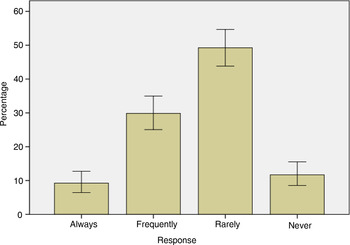
Almost half of the students surveyed, 46.2 per cent (165 out of 357 students), attended a nightclub at least once per week. After excluding those who never attended nightclubs and those with pre-existing hearing problems, 88.3 per cent of students (287 of 325) had experienced tinnitus after attending a nightclub (see Figure 1), whilst 66.2 per cent (215 of 325) had experienced reduced or ‘muffled hearing’. Furthermore, 47.7 per cent of students (155 of 325) frequently or always experienced symptoms after nightclub attendance; in 23.2 per cent of these students (36 of 155), symptoms always or frequently persisted until the following morning. (Many of the students experienced ringing in their ears and muffled or reduced hearing concurrently, and thus only counted as one student; hence, the number of students who experienced symptoms always or frequently (n = 155) is less than the number of individual symptoms experienced in total (n = 208).) A summary of the frequency and persistence of temporary tinnitus and reduced hearing experienced after attending nightclubs is given in Table I.
Students' responses regarding the frequency of ringing in ears experienced after nightclub attendance (excluding students with pre-existing hearing problems and those who did not attend nightclubs). (Error bars indicate 95 per cent confidence interval.)

Auditory symptoms following nightclub attendance*

* Excludes students with pre-existing hearing problems and those who did not attend nightclubs. CI = confidence interval
After excluding those students with pre-existing hearing problems (n = 7), 86.6 per cent (303 out of 350) of participants reported that they had never received information about noise-induced hearing loss or had earplugs recommended. With regard to awareness levels, 70.3 per cent of the students (251 of 357) were aware of the association between tinnitus and permanent hearing loss; awareness was significantly higher among medical students (74.1 per cent of medical students vs 57.8 per cent of non-medical students, chi-square = 8.064, p = 0.005).
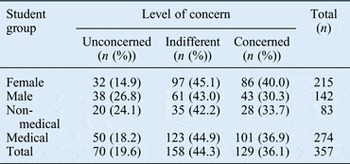
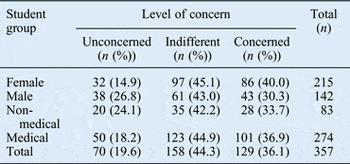
The majority of students (90.2 per cent) placed nightclub volume at a decibel level equal to or greater than the threshold for hearing damage. Over a third of all students, 36.1 per cent (129 out of 357), were concerned about potential damage to their hearing, with a significantly higher percentage of females expressing concern (40.0 per cent of females vs 30.3 per cent of males, chi-square = 8.477, p = 0.014). There was no significant difference in the level of concern found between medical and non-medical students (Table II).
Students' concern about hearing damage
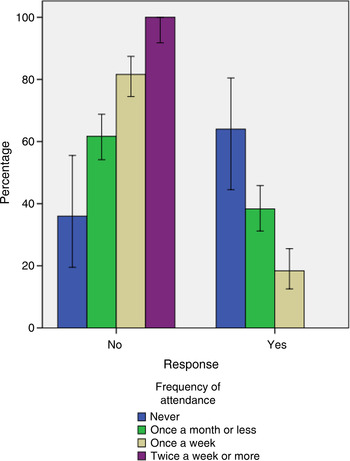
Of those students who attended nightclubs, 26.8 per cent (89 out of 332) said that knowledge of the link between nightclub noise levels and permanent hearing loss would affect their future nightclub attendance (Figure 2). Students who attended nightclubs more regularly were less likely to alter their attendance. Although the majority of students (73.2 per cent) would not change their nightclub attendance, 70.2 per cent of nightclub-attending students (233 of 332) thought that noise levels in nightclubs should be limited to a volume that is not damaging.
Percentages of students whose attendance would or would not be affected if told that nightclub levels could lead to permanent hearing loss, differentiated according to frequency of nightclub attendance. (Error bars indicate 95 per cent confidence interval.)

Discussion
The findings of this study indicate that a high proportion of students experience symptoms related to noise-induced hearing loss after attending a nightclub. It is concerning that almost half of those surveyed (47.7 per cent) always or frequently experienced tinnitus and/or muffled hearing after attending a nightclub, with just less than a quarter (23.2 per cent) of these individuals reporting that symptoms persisted until the following morning.
Tinnitus and threshold shift (muffled hearing) are widely accepted to be precursors of irreversible hearing damage.Reference Chen and Tsai14 Their presence is an important finding with regards to noise-induced hearing loss.Reference Chen and Tsai14 Tinnitus in the absence of hearing loss is often accompanied by cochlear and/or neural damage. This damage is not always recognised by the individual and may not be measurable on a classical audiogram.Reference Weisz, Hartmann, Dohrmann, Schlee and Norena15 Of those students surveyed in the present study (excluding those who never attended nightclubs and those with pre-existing hearing problems), 88.3 per cent had experienced transient tinnitus after attending a nightclub. This finding is important because transient tinnitus can also be a precursor to other noise-induced hearing loss symptoms, including permanent tinnitus, hyperacusis or irreversible hearing loss.Reference Weisz, Hartmann, Dohrmann, Schlee and Norena15–Reference Kujawa and Liberman17
Our findings demonstrate that excessive noise levels in nightclubs may be having an adverse impact on the hearing of the student population, and could well be a serious public health issue. This is consistent with a very recent study conducted by Beach et al., which found nightclub attendance to be by far the main source of high-risk leisure noise among young adults in Australia.Reference Beach, Williams and Gilliver18
The majority of students in our sample population (90.2 per cent) were aware that current nightclub noise levels are potentially damaging to hearing. However, most students who attended nightclubs (73.2 per cent) reported that they would not alter their attendance, despite being told that the noise levels could lead to permanent hearing loss.
Nonetheless, 70.2 per cent of nightclub attendees agreed that noise levels should be limited to volumes that are not damaging to hearing. This is contrary to the widely held preconception that high volume levels in nightclubs are demanded by young people. Indeed, this study suggests that the majority of students would rather see noise levels being lowered to within safe limits. This is encouraging for policy makers, as noise levels could potentially be lowered below the threshold for hearing damage without nightclub attendance being significantly compromised. The implementation of relevant legislation could therefore potentially reduce the long-term risks of irreversible hearing loss in this young age group without damaging the nightclub industry.
• Nightclub noise levels exceed the 85 dB limit that mandates hearing protection in industry
• Laws protecting nightclub employees' hearing do not extend to those attending nightclubs socially
• Most students questioned had experienced transient tinnitus after attending nightclubs
• Nearly half of the study population frequently or always experienced auditory symptoms
• Most students agreed that nightclub noise should be limited to safe levels, which is encouraging for policy makers
• Reduced nightclub noise levels are recommended, along with warning signs and earplug provision
We found that a significantly lower proportion of non-medical students (57.8 per cent) than medical students (74 per cent) were aware of the link between tinnitus and permanent hearing loss. We anticipate that awareness among a non-student group of the same age group would be lower still.
Our study also demonstrates that 86.6 per cent of students with normal hearing had never received information about noise-induced hearing loss or had earplugs recommended in the nightclub setting. Our findings and those of other research groups indicate that young people attending nightclubs are at high risk of noise-induced hearing loss, and it is therefore of the utmost importance that they should be provided with adequate information regarding the potential damage that excessive music levels in nightclubs may cause.
The sample population of the current study was limited to university undergraduate students. It consisted of a large proportion of female students (60.2 per cent), which is a reflection of the medical student population at the University of Birmingham. In addition, the prevalence of tinnitus should be interpreted with caution as recall bias and the consumption of alcohol that is often concurrent with nightclub attendance may have affected the accuracy of responses (in terms of the symptoms experienced).
Conclusion
Despite reduced occupational noise exposure and strict standards for hearing protection, noise-induced hearing loss remains a significant health and social problem in developed countries. Noise-induced hearing loss is irreversible; useful public health measures must therefore be preventative. A 2012 review of the literature on noise-induced hearing loss concluded that a reduction in incidence was dependent on: the identification of high-risk noise exposures, particularly in young people; improved noise legislation; and effective use of hearing protection.Reference Sliwinska-Kowalska and Davis19 Our pilot study indicated that nightclub attendees are a group often overlooked in public health initiatives.
These risks to hearing could be minimised by introducing legislation to limit nightclub noise levels. In addition, the offering of hearing protection and the provision of information highlighting the risks of excessive sound exposure could be made mandatory in nightclubs. We believe the current assumption implied by legislation, namely that nightclub attendees are consenting to the risks of hearing damage, is spurious, as the majority of young people in nightclubs are likely to be unaware of these risks.
Most previous studies on noise-induced hearing loss in nightclubs have focused on the occupational risks to nightclub staff rather than the risks posed to those who attend nightclubs socially. Further research implicating nightclub noise levels as a direct cause of noise-induced hearing loss would build a strong case for the legal protection of nightclub attendees, and ultimately help to determine the most appropriate course of action for public health providers and legislators.Reference Johnson20 The authors hope this study will contribute towards the growing body of evidence that supports imposing a limit on nightclub noise levels.
Acknowledgement
We would like to thank all those participants who took part in this study.
Appendix 1. Nightclub noise questionnaire
Age:
Sex: Male □ Female □ (tick appropriate box)
University course:
Are you a regular smoker? Yes □ No □
Do you have any hearing problems? (If yes, please specify)
Have you ever worked at or regularly attended any of the following environments: shooting range, building site, factory, motor sports track or live music venues?
Yes □ No □
How often do you attend a nightclub?
Never □ Once a month or less □ Once a week □ Twice a week or more □
How often do you experience ringing in your ears after attending a nightclub?
Always □ Frequently □ Rarely □ Never □
Does this ringing persist until waking up the following morning?
Always □ Frequently □ Rarely □ Never □
How often do you experience muffled or reduced hearing after attending a nightclub?
Always □ Frequently □ Rarely □ Never □
Does this change persist until waking up the following morning?
Always □ Frequently □ Rarely □ Never □
Do you think ringing in the ears is linked to permanent hearing loss?
Yes □ No □
How do you feel about these changes in hearing?
Unconcerned □ Indifferent □ Concerned □
On this decibel range chart, where do you think the threshold for hearing damage is? (Circle most appropriate.)
A B C D
On this decibel range chart, where do you think typical noise levels found in a nightclub are?
A B C D

If you were told that noise levels in nightclubs could lead to permanent hearing loss, would this affect your attendance?
Yes □ No □
Do you think that noise levels in nightclubs should be limited to a volume that is not damaging?
Yes □ No □
Have you ever received information about noise-induced hearing loss, or had earplugs recommended?
Yes □ No □