




No CrossRef data available.
A perspective on clonal phenotypic (antigenic) variation in protozoan parasites
Published online by Cambridge University Press: 29 May 2003
Abstract
Intra-clonal phenotypic (antigenic) variation is used by many pathogens to evade the consequences of immune-mediated killing by mammalian hosts. In this substantially theoretical article, I emphasise that antigenic variation (sensu stricto) involves no change in genotype; its importance as a mechanism for promoting pathogen transmission and its polyphyletic origin. From a functional perspective, antigenic variation is constrained by the requirement to meet five conditions. These are: capability to express several antigens against which functional immunity predominates; capability to interact with the environment; mutually exclusive expression of variable antigens in each cell within an infection; mutually exclusive expression in the within-host pathogen population and the capability for population growth within a host. Meeting these conditions leads to chronicity of infection and high rates of hierarchical and reversible switching of expression between variable antigens. The organisation of hierarchical expression is discussed in some detail.
Information
- Type
- Research Article
- Information
- Copyright
- © 2002 Cambridge University Press
INTRODUCTION
Several species of microorganisms undergo a form of intra-clonal phenotypic variation. Amongst these are some of the world's most important pathogens, notably those causing malaria and sleeping sickness. The molecules that vary in these pathogens are antigens crucially involved in recognition and clearance (or lack of it) by host immune responses and hence intra-clonal phenotypic variation is termed antigenic variation. Antigenic variation has deserved the considerable attention devoted to it for the last century, particularly by protozoologists. In the last 20 years however, marked features of the research effort on antigenic variation have been, to my mind, the focus on molecular mechanisms and the independence of the literature on different organisms. The focus on molecular machinery of these processes has been a reflection of the wider-scale revolution in molecular biology, was sorely needed and has been extremely successful. Success breeds success. Perhaps the best example of this is the literature on Trypanosoma brucei (for recent reviews see Borst et al. 1998; Cross, Wirtz & Navarro, 1998; Pays & Nolan, 1998; Barry & McCullough, 2001). The independence of the literature on different pathogens is partly a necessity and partly a reflection of the fact that cross-pathogen comparisons of molecular mechanisms of antigenic variation have not engendered notable progress (but for a thoughtful counter-example see Alred, 1998). The aim of this article is to redress the balance a little. By taking a holistic view of antigenic variation, I attempt to show that there are issues which could be productively addressed from an evolutionary perspective and where comparisons between organisms might be illuminating.
It is helpful at the outset to make a clear distinction between two senses of the term ‘antigenic variation’ when applied to pathogens. Antigenic variation, sensu lato, includes the classical genetic mechanisms of mutation and recombination for generating diversity. These mechanisms may have important consequences for effective immunity against parasites but they are much less so than the consequences of antigenic variation, sensu stricto which has, I would contend, evolved with the specific purpose of immune evasion. ‘Purpose’ in this context is taken to mean conferment of ecological advantage that is selectable by evolution. The distinction between the two senses is that the second involves no change in genotype. That is, the enzymatic and transcriptional machinery that enacts switching between variant antigens is heritable between generations as are genes encoding variant antigens. But, changes in expression of variant antigens are readily reversible within a cloned cell line and are not heritable. This article concerns antigenic variation sensu stricto.
ANTIGENIC VARIATION AND TRANSMISSION
The ecological advantage of antigenic variation to any parasite that evolves this system is almost certainly to promote transmission between hosts. There is remarkably little direct experimental evidence linking antigenic variation with increased transmission but no serious alternative hypotheses to explain the evolution of antigenic variation have been put forward. Indirect evidence supporting the link between antigenic variation and transmission is of variable quality in different model systems but, in trypanosomes at least, the evidence is compelling (Turner, 1999). The link between antigenic variation and transmission is illustrated in Fig. 1. The key features in this highly simplified view of an infection are determined by the relationship of the course of infection to two boundaries – an upper ‘lethality boundary’ and a lower ‘transmission boundary’ and assume that transmission is dependent on pathogen density within an infected host. There is potential for successful transmission to another host only when the density is between the two boundaries. In scenario 1 in Fig. 1, there is no control of pathogen growth, the lethality boundary is breached leading to death of the host and curtailing transmission to a very short time window. In scenario 2, an immune response resolves the infection and there is an increase in the transmission window. Antigenic variation occurs in scenario 3 and maintains the pathogen density between the two boundaries for a longer time period thus causing a consequently greater increase in the transmission window.

Fig. 1. A simplified diagrammatic representation of the relationship between antigenic variation and pathogen transmission. For explanation see text. Redrawn from Turner (1999).
Antigenic variation succeeds in extending an infection because there is a time delay between expression of an antigen and the development of a functional immune response against it. A ‘functional’ response would be one with cytotoxic or cytostatic effect on the pathogen, as opposed to a bystander response for example. During this time delay there is the opportunity for switching from expression of one variable antigen to that of another. Thus, during the first wave of an infection the pathogen population might comprise mainly of cells expressing one type of variable antigen but with antigenic switching occurring to generate a small sub-population expressing a different type. The immune response is directed against the numerically dominant type thus causing resolution of the first wave of infection, but this response is variable antigen-specific and thus ineffective against cells expressing other variable antigens which will grow causing recrudescence of infection as shown (Fig. 1, scenario 3). This process is repeated continually, dependent on the interaction between antigenic variation and population growth on the part of the pathogen and variable antigen-specific immunity on the part of the host. It has been described in a wide variety of protozoan species as indicated in Table 1. It has also been described in a number of bacterial species – Neisseria gonnorhoeae, Borrelia hermsii, B. recurrentis, Anaplasma marginale, and in the fungus, Candida albicans (Moxon et al. 1994; Donelson, 1995; Deitsch, Moxon & Wellems, 1997; Brayton et al. 2002). This wide phylogenetic distribution implies that it has evolved on multiple, independent occasions. The quality of the evidence differs considerably between pathogens, but this largely reflects the tractability of experimental analysis for any particular species.

It is interesting to note that ‘antigenic’ variation is not restricted to pathogens and has been described in two free-living species (Table 1). This observation is compelling evidence that clonal phenotypic variation can have a function other than to promote transmission and that the evolution of an infectious lifestyle does not necessarily predate the development of an ability to undergo this process. It is worth noting however, that both free-living species typically live in shallow freshwater habitats. An important variable in such habitats is temperature, changes in which lead to phenotypic variation in Paramecium aurelia. It is possible that phenotypic variation has a role in population survivorship in a capricious environment, analogous to that role of antigenic variation in parasites.
Comparing scenarios 1 and 2 in Fig. 1 could be construed as supporting a very traditional view in parasitology that ‘a good parasite does not harm its host’ (see for example Fantham & Porter, 1914) because it shows that evolution of a life history strategy by the pathogen that permits immune resolution of infection is of selective advantage to that pathogen. A comparison of scenarios 2 and 3 illustrates the fallacy of this view. Immune resolution of successive waves of pathogen population growth is essential to the success of antigenic variation as a transmission strategy, and yet chronic presence of the pathogen debilitates the host, lowering the lethality boundary (see Fig. 1). Clearly, this reduction of the boundary increases the possibility of it being breached as an infection progresses, but because an increased probability of host death is associated with improved transmission, harming the host can be of benefit to the pathogen.
Fig. 1 is an oversimplification of biological reality. It takes no account, for example, of the effects of co-infection either of different genotypes of the same species or of different species. It takes no account of the different courses of infection of zoonotic pathogens in different host species. The two boundaries (lethality and transmission) rarely represent simple step functions and trade-offs are to be expected between both probability of host death and transmission and between pathogen growth and transmission. Scenarios 2 and 3 envisage population size regulation by the immune response. However, regulation of growth rate, either by the pathogen itself or by the host, would be equally effective. All these factors would have evolutionary consequences that could impinge on the evolution of antigenic variation. Despite all these caveats, the essence of the link between antigenic variation and transmission remains, in my view, the most parsimonious explanation as to why phenotypic variation is of selective advantage to the host. However, I am not aware of any experimental evidence that directly tests this link and I fully accept that parsimony alone is insufficient reason to accept this hypothesis. This is a remarkable gap in the literature.
CONSERVED FEATURES OF ANTIGENIC VARIATION
A comparison of the mechanisms of antigenic variation in some of the organisms where it has been investigated supports the view of a polyphyletic origin for this process. At a superficial level there are shared features: reversible, mutually exclusive expression of members of gene family. But investigations of the mechanisms underlying antigenic variation reveal some stark contrasts. A good example of this contrast is the comparison of mechanisms of antigenic variation in the well studied prokaryotic and eukaryotic species, Borrelia hermsii and Trypanosoma brucei, respectively (Donelson, 1995).
If we take a functional rather than mechanistic perspective however, there is considerable similarity between systems used in different organisms. This similarity arises because there is, in my view, a restrictive set of five functional requirements that need to be met for antigenic variation to be of selective advantage to a parasite in evolutionary terms.
Firstly, a microorganism must have the capability to express several different antigens; minimally two. These variable antigens must be immunodominant over non-variable antigens, where the latter are defined as antigens that are identical in all cells in a clonal infection. ‘Immunodominance’ in this context indicates that functional immune responses to lower the numbers of pathogens (by killing them for instance) are directed preferentially to these antigens. Epitopes against which immune responses are generated must differ between variable antigens. The rate of switching between variable antigens per unit of time must be greater than the rate of immune clearance per unit of time.
Second, a microorganism must retain the capability to interact with its environment using non-variable antigens that must be immunologically ‘silent’ relative to variable antigens. To exploit the hosts' resources the parasite will need, for example, a glucose transporter to acquire glucose.
Third, individual cells within an infection must express variable antigens in a mutually exclusive manner. In the simplest scenario, if a cell expresses two variable antigens simultaneously, then the rate of immune clearance will be the same as if it had expressed only one of them. Thus the potential advantage of having the capability to express two variable antigens will have been lost.
Fourth, what applies to individual cells applies equally at the population level within an infection. Sub-populations, defined by their different variable antigens, must be expressed to minimise overlap in the timing of their expression (but see below).
Fifth, the pathogen must be capable of population growth within the mammalian host. For antigenic variation to occur successfully in the absence of growth, there would need to be a remarkable co-operativity between microorganisms to co-ordinate timing of switching and the order in which variable antigens were expressed. I find it difficult to conceive as to how such precise co-ordination could be initiated.
Taken together these five functional requirements give rise to four, ‘cardinal signs’ of antigenic variation – chronicity of infection, high rates of switching, hierarchical expression and reversible expression of variable antigens (Turner, 1999).
There are a number of issues that arise from these functional requirements and cardinal signs that should be highlighted in the context of evolution of antigenic variation. There will be a strong evolutionary drive towards divergence between variable antigens, at least for those epitopes that are immunodominant. This means that there is an expectation for much less sequence conservation between members of a gene family underlying antigenic variation than there would be for other gene families, potentially to the extent that identification of genes in any family using simple BLAST-based algorithms may fail. If there are regions or domains of genes that are conserved between family members this could be because of structural constraints on the proteins, lack of involvement in epitopes recognised by the immune system and/or because the proteins may combine a function for antigenic variation with a second function, such as cellular adhesion in malaria parasites.
There must, inevitably, be trade-offs between the first and second conserved features; variation and immunodominance versus conservation for interaction with the environment. It seems intuitively likely that such trade-offs would be important and interesting and yet they have been hardly explored from an evolutionary perspective. Indeed, I find it difficult to conceive of experimental approaches with the tools currently available in any protozoan parasite.
ANTIGENIC SWITCHING – RATES, HIERARCHIES AND REVERSIBILITY
A more tractable line of enquiry has been the investigation of rates of antigenic switching. It seems self evident that the rate of switching must be higher than the immune response rate (when measured in equivalent units of time) although this statement does raise the issue that the latter does not appear to have been quantified for any host-pathogen system. It could be envisaged that, theoretically, a parasite might either modulate its switching rate in response to cues from the host or switch spontaneously at a high rate. In practice, all pathogens that have been studied in this respect appear to use the second approach, and they do so at remarkably high rates – typically greater than 1 in 1000 cells switches in each generation, two to four orders of magnitude higher than ‘background’ mutation rates (Turner, 1999).
I have previously argued that, for trypanosome infections, the very high rates of switching may have evolved as a bifunctional transmission-enhancing strategy that both evades and depresses immune responses (Turner, 1999). This possibility applies to the other parasites where multiple infections of hosts with isolates of overlapping variable antigen repertoires occur. Holoendemic malaria would be an excellent example of such a scenario. Competition between genotypes has the potential to lead to increased parasitaemia and higher switching rates. This result comes about because expression of a large variety of variable antigens at high levels will increase the potential to avoid any pre-existing immunity to some of those antigens and cross-immunity between variable antigens common to both genotypes. Any impairment of functional immunity is potentially of selective advantage to the parasite if it promotes transmission.
There is a trade-off required between causing immunodepression and evading immunity, and one way in which this might be managed is by hierarchical expression as illustrated in Fig. 2. Switching is non-random and those variable antigens that are switched to most frequently will achieve highest prevalence earliest in an infection. These early variants will engender variant-specific immunity first and be eliminated leading to an inverse correlation of variant-specific switch rates and order of elimination. Because switching is a reversible process, there will continue to be many switch events later in infections back to expressions of variants against which effective immune responses are already in place and thus these switches will never be detected. In other words, there is massive redundancy in the system leading to progressively increasing numbers of suicide switch events and a concomitant reduction in the effective rate of switching which is the overall rate minus the suicide switches. The explanation shown in Fig. 2 would potentially explain mutually exclusive expression in pathogen populations (the fourth functional requirement in the previous section).

Fig. 2. A potential explanation of the relationship of hierarchical expression of variable antigens and the rate of antigenic switching. A. Switching between variable antigens is non-random and those that are switched to most frequently will appear first in an infection and generate variant-specific immune responses first. Thus there is predicted to be a negative correlation of VAT-specific switching rate and order of immune clearance. B. The effect of this is that, whilst the overall potential rate of antigenic variation remains high throughout an infection, in practice the effective rate of switching to expression of variants to which an immune response has not yet been generated will decline progressively.
Very few studies have investigated hierarchical rates of switching, as opposed to hierarchical (non-random) expression of variants in an infection. What evidence there is (Table 2) supports the notion of hierarchical switch rates. The per capita values for switching rates may differ between replicate experiments for each species, but the patterns are consistent.

Fig. 3 illustrates an important distinction in hierarchical expression of variable antigens between T. brucei and P. fragile. In African trypanosomes, reversion of expression is observed in vivo when parasites are transferred between hosts as shown. The linear hierarchy is ‘reset’ for each new infection. [It is also not usually quite as predictable as shown in this particular example (Kosinski, 1980).] Such reversion has been detected in other parasites such as G. lamblia in in vitro culture (Nash, Conrad & Merrit, 1990). In P. fragile infections however, the hierarchy is not reset in each new host. In vivo data for P. chabaudi and P. falciparum also indicate no resetting of the hierarchy (MacLean, Pearson & Phillips, 1982; Hommel et al. 1991). Reversion of expression has been shown by other routes – in in vitro culture under positive selection for P. falciparum (by panning using a variant-specific antibody, Roberts et al. 1992), after mosquito transmission for P. chabaudi (MacLean et al. 1987) and by passaging of P. fragile in splenectomised monkeys (Handunetti, Mendis & David, 1987). There may be a fundamental distinction therefore between switching in parasites such as trypanosomes and G. lamblia on the one hand and Plasmodium spp. on the other. The explanation of hierarchical expression shown in Fig. 2 could apply to the former but not to the latter.

Fig. 3. Hierarchical expression and reversion of variant antigen expression compared in T. brucei and P. fragile. ↓, indicates transfer of parasites between hosts. There is hierarchical expression in both species leading to variant antigens being expressed in sequence in an infection. In T. brucei the hierarchy is ‘reset’ each time parasites are transferred to a new host thus demonstrating reversion of expression, but in P. fragile the hierarchy is not reset. Reversion has been demonstrated by other means (see text). Data derived from Gray (1965) and Handunetti et al. (1987). Not all variant antigens were sampled in the recipient hosts infected with T. brucei.
The important conclusion from this comparison is that the data on reversion of variable antigen expression in Plasmodium needs strengthening. The in vivo evidence for non-reversion in P. falciparum is based on a single experiment (Hommel et al. 1991), as is the in vitro demonstration of reversion (Roberts et al. 1992). The in vivo data are supported by the evidence from two other species. Reversion does not appear to have been investigated in P. vivax (del Portillo et al. 2001), or in the phylogenetically related parasite, B. bovis (Alred, 1998).
PERSPECTIVE
I have focused on (1) the link between antigenic variation and transmission, (2) the high rates of switching and (3) on hierarchical expression to illustrate that we know remarkably little as to how and why these work the way they do despite being, in my view, aspects of the process that are central to our understanding of antigenic variation. Experimental testing of (1), the hypothesis linking antigenic variation and transmission, is sorely needed. Underlying (2) and (3) is the issue of mutually exclusive expression. The explanation I offer above may be a partial answer in terms of the within-host population biology of an infection for some pathogens. For other pathogens it may not, although hopefully the observation may help direct future studies more appropriately. At the level of the single cell, we do not understand how mutually exclusive expression is regulated in any protozoan parasite that I am aware of. This is despite the best efforts of many very talented colleagues. Addressing these issues experimentally is extremely difficult work to undertake but it is essential because antigenic variation is such an important determinant of virulence in several major pathogens. Surely a stronger input from evolutionary biologists could only help?
ACKNOWLEDGEMENTS
I am grateful to The Wellcome Trust for financial support of my research.
References
REFERENCES
AL-KHEDERY, B.,
BARNWELL, J. W. &
GALINSKI, M. R. (1999).
Antigenic variation in malaria: a 3′ genomic alteration associated with the expression of P. knowlesi variant antigen. Molecular Cell 3, 131–141.CrossRefGoogle Scholar
ALRED, D. R. (1998).
Antigenic variation in Babesia bovis: how similar is it to that in Plasmodium falciparum? Annals of Tropical Medicine and Parasitology 92,
461–472.Google Scholar
ALRED, D. R.,
CARLTON, J. M. R.,
SATCHER, R. L.,
LONG, J. A.,
BROWN, W. C.,
PATTERSON, P. E.,
O'CONNOR, R. M. &
STROUP, S. E. (2000). The ves multigene family of B. bovis encodes components of rapid antigenic variation at the infected erythrocyte surface. Molecular Cell 5,
153–162.Google Scholar
BARRY, J. D. (1986). Antigenic variation during Trypanosoma vivax infections of different host species.
Parasitology 92, 51–65.CrossRefGoogle Scholar
BARRY, J. D. & MCCULLOCH, R. (2001). Antigenic variation in Trypanosomes: Enhanced phenotypic variation in a eukaryotic parasite. Advances in Parasitology
49, 1–70.Google Scholar
BRANNAN, L. R.,
TURNER, C. M. R.
& PHILLIPS, R. S. (1994).
Malaria parasites undergo antigenic variation at high rates in vivo.
Proceedings of the Royal Society London B 256, 71–75.
CrossRefGoogle Scholar
BRAYTON, K. A.,
PALMER, G. H.,
LUNDGREN, A.,
YI, J.
& BARBET, F.
(2002). Antigenic variation of Anaplasma marginale msp2 occurs by combinatorial gene conversion. Molecular Microbiology
43, 1151–1159.CrossRefGoogle Scholar
BORST, P.,
BITTER, W.,
BLUNDELL, P. A.,
CHAVES, I.,
CROSS, M.,
GERRITS, H.,
VAN LEUVEN, F.,
MCCULLOUGH, R.,
TAYLOR, M.
& RUDENKO, G.
(1998). Control of VSG gene expression sites in Trypanosoma brucei. Molecular and Biochemical Parasitology
91, 67–76.CrossRefGoogle Scholar
CARON, F.
& MEYER, E.
(1989). Molecular basis of surface antigen variation in paramecia.
Annual Reviews of Microbiology 43,
23–42.CrossRefGoogle Scholar
CRAIG, A.
& SCHERF, A.
(2001). Molecules on the surface of the Plasmodium falciparum infected erythrocyte and their role in malaria pathogenesis and immune evasion.
Molecular and Biochemical Parasitology 115,
129–143.CrossRefGoogle Scholar
CROSS, G. A. M.,
WIRTZ, L. E.
& NAVARRO, M.
(1998). Regulation of VSG expression site transcription and switching in Trypanosoma brucei. Molecular and Biochemical Parasitology
91, 77–91.CrossRefGoogle Scholar
DEITSCH, K. W.,
MOXON, E. R.
& WELLEMS, T. E.
(1997). Shared themes of antigenic variation and virulence in bacterial, protozoal and fungal infections. Microbiology and Molecular Biology Reviews
61, 281–293.Google Scholar
DEL PORTILLO, H. A.,
FERNANDEZ-BECERRA, C.,
BOWMAN, S.,
OLIVER, K.,
PREUSS, M.,
SANCHEZ, C. P.,
SCHNEIDER, N. K.,
VILLALOBOS, J. M.,
RAJANDREAM, M.-A.,
HARRIS, D.,
PEREIRA DA SILVA, L.,
BARRELL, B.
& LANZER, M.
(2001). A superfamily of variant genes encoded in the subtelomeric region of Plasmodium vivax. Nature 410,
839–842.CrossRefGoogle Scholar
DONELSON, J. E.
(1995). Mechanisms of antigenic variation in Borrelia hermsii and African Trypanosomes. Journal of Biological Chemistry
270, 7783–7786.CrossRefGoogle Scholar
FANTHAM, H. B.
& PORTER, A.
(1914). Some Minute Animal Parasites.
London, Methuen & Co.
GRAY, A. R.
(1965). Antigenic variation in a strain of Trypanosoma brucei transmitted by Glossina morsitans and G. palpalis.
Journal of General Microbiology 41, 195–214.CrossRefGoogle Scholar
HANDUNETTI, S. M.,
MENDIS, K. N. &
DAVID, P. H.
(1987). Antigenic variation of cloned Plasmodium fragile in its natural host Macaca sinica. Journal of Experimental Medicine 165,
1269–1282.CrossRefGoogle Scholar
HOMMEL, M.,
HUGHES, M.,
BOND, P. &
CRAMPTON, J. M.
(1991). Antibodies and DNA probes used to analyse variant populations of the Indochina-1 strain of Plasmodium falciparum. Infection and Immunity
59, 3975–3981.Google Scholar
JONES, T. W.
& MCKINNELL, C. D.
(1985).
Antigenic variation in Trypanosoma evansi; variable antigen type development in mice, sheep and goats. Tropical Medicine and Parasitology
36, 53–57.Google Scholar
KOSINSKI, R. J.
(1980). Antigenic variation in trypanosomes: a computer analysis of variant order. Parasitology 80, 343–357.CrossRefGoogle Scholar
MASAKE, R. A.,
MUSOKE, A. J.
& NANTULYA, V. M.
(1983). Specific antibody responses to the variable surface glycoprotein of Trypanosoma congolense in infected cattle. Parasite Immunology
5, 345–355.CrossRefGoogle Scholar
MCLEAN, S. A.,
PEARSON, C. D.
& PHILLIPS, R. S.
(1982). Plasmodium chabaudi: Antigenic variation during recrudescent parasitaemias in mice. Experimental Parasitology 54,
296–302.CrossRefGoogle Scholar
MCLEAN, S. A.,
PHILLIPS, R. S.,
PEARSON, C. D.
& WALLIKER, D.
(1987). The effect of mosquito transmission of antigenic variants of Plasmodium chabaudi. Parasitology
94, 443–449.
CrossRefGoogle Scholar
MOXON, E. R.,
RAINEY, P. B.,
NOWAK, M. A.
& LENSKI, R. E.
(1994). Adaptive evolution of highly mutable loci in pathogenic bacteria. Current Biology 4,
24–33.CrossRefGoogle Scholar
NASH, T. E.,
CONRAD, J. T.
& MERRIT, Jr., J. W.
(1990). Variant specific epitopes of Giardia lamblia.
Molecular and Biochemical Parasitology 42,
125–132.CrossRefGoogle Scholar
PAYS, E.
& NOLAN, D. P.
(1998). Expression and function of surface proteins in Trypanosoma brucei. Molecular and Biochemical Parasitology
91, 3–36.CrossRefGoogle Scholar
PHILLIPS, R. S.,
BRANNAN, L. R.,
BALMER, P.
& NEUVILLE, P.
(1997). Antigenic variation during malaria infection – the contribution from the murine parasite Plasmodium chabaudi. Parasite Immunology
19, 427–434.CrossRefGoogle Scholar
PREER, J. R.
(1986). Surface antigens of Paramecium. In
The Molecular Biology of Ciliated Protozoa (ed.
J. G. Gull), pp. 301–339.
New York, Academic PressCrossRef
ROBERTS, D. J.,
CRAIG, A. G.,
BERENDT, A. R.,
PINCHES, R.,
NAHS, G.,
MARSH, K. &
NEWBOLD, C. I.
(1992). Rapid switching to multiple antigenic and adhesive phenotypes in malaria. Nature 357, 689–692.CrossRefGoogle Scholar
SVÄRD, S. G.,
MENG, T.,
HETSKO, M. L.,
MCCAFFERY, J. M.
& GILLIN, F. D.
(1998). Differentiation-associated surface antigen variation in the ancient eukaryote Gardia lamblia. Molecular Microbiology
30, 979–989.CrossRefGoogle Scholar
TURNER, C. M. R.
(1999). Antigenic variation in Trypanosoma brucei infections: a holistic view. Journal of Cell Science 112,
3187–3912.Google Scholar
TURNER, C. M. R.
& BARRY, J. D.
(1989). High frequency of antigenic variation in Trypanosoma brucei rhodesiense infections. Parasitology
99, 67–75.CrossRefGoogle Scholar

Fig. 1. A simplified diagrammatic representation of the relationship between antigenic variation and pathogen transmission. For explanation see text. Redrawn from Turner (1999).
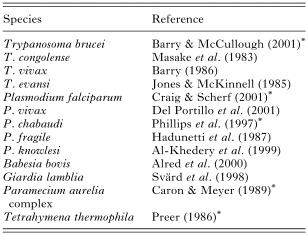
Table 1. Protozoa in which clonal phenotypic (antigenic) variation sensu stricto has been suggested. This is not an exhaustive list, but does illustrate the diversity of genera and species that appear to use this process. The last two species listed are free-living, whereas the others are all parasites. The quality of evidence varies considerably between organisms. *indicates review

Fig. 2. A potential explanation of the relationship of hierarchical expression of variable antigens and the rate of antigenic switching. A. Switching between variable antigens is non-random and those that are switched to most frequently will appear first in an infection and generate variant-specific immune responses first. Thus there is predicted to be a negative correlation of VAT-specific switching rate and order of immune clearance. B. The effect of this is that, whilst the overall potential rate of antigenic variation remains high throughout an infection, in practice the effective rate of switching to expression of variants to which an immune response has not yet been generated will decline progressively.

Table 2. Rates of switching between particular pairs of variable antigens differ, dependent on which antigen is being switched to. Data from Turner & Barry (1989) and Brannan et al. (1994). Switch rate values are switches/cell/generation for T. brucei and switches/schizont/generation for P. chabaudi; bld=below level of detection

Fig. 3. Hierarchical expression and reversion of variant antigen expression compared in T. brucei and P. fragile. ↓, indicates transfer of parasites between hosts. There is hierarchical expression in both species leading to variant antigens being expressed in sequence in an infection. In T. brucei the hierarchy is ‘reset’ each time parasites are transferred to a new host thus demonstrating reversion of expression, but in P. fragile the hierarchy is not reset. Reversion has been demonstrated by other means (see text). Data derived from Gray (1965) and Handunetti et al. (1987). Not all variant antigens were sampled in the recipient hosts infected with T. brucei.
 You have
Access
- 22
- Cited by