


%20--%3e%3c!DOCTYPE%20svg%20PUBLIC%20'-//W3C//DTD%20SVG%201.0//EN'%20'http://www.w3.org/TR/2001/REC-SVG-20010904/DTD/svg10.dtd'%3e%3csvg%20version='1.0'%20id='Layer_1'%20xmlns='http://www.w3.org/2000/svg'%20xmlns:xlink='http://www.w3.org/1999/xlink'%20x='0px'%20y='0px'%20width='64px'%20height='64px'%20viewBox='5.5%20-3.5%2064%2064'%20enable-background='new%205.5%20-3.5%2064%2064'%20xml:space='preserve'%3e%3cg%3e%3ccircle%20fill='%23FFFFFF'%20fill-opacity='0'%20cx='37.785'%20cy='28.501'%20r='28.836'/%3e%3cpath%20fill='%23595959'%20d='M37.441-3.5c8.951,0,16.572,3.125,22.857,9.372c3.008,3.009,5.295,6.448,6.857,10.314%20c1.561,3.867,2.344,7.971,2.344,12.314c0,4.381-0.773,8.486-2.314,12.313c-1.543,3.828-3.82,7.21-6.828,10.143%20c-3.123,3.085-6.666,5.448-10.629,7.086c-3.961,1.638-8.057,2.457-12.285,2.457s-8.276-0.808-12.143-2.429%20c-3.866-1.618-7.333-3.961-10.4-7.027c-3.067-3.066-5.4-6.524-7-10.372S5.5,32.767,5.5,28.5c0-4.229,0.809-8.295,2.428-12.2%20c1.619-3.905,3.972-7.4,7.057-10.486C21.08-0.394,28.565-3.5,37.441-3.5z%20M37.557,2.272c-7.314,0-13.467,2.553-18.458,7.657%20c-2.515,2.553-4.448,5.419-5.8,8.6c-1.354,3.181-2.029,6.505-2.029,9.972c0,3.429,0.675,6.734,2.029,9.913%20c1.353,3.183,3.285,6.021,5.8,8.516c2.514,2.496,5.351,4.399,8.515,5.715c3.161,1.314,6.476,1.971,9.943,1.971%20c3.428,0,6.75-0.665,9.973-1.999c3.219-1.335,6.121-3.257,8.713-5.771c4.99-4.876,7.484-10.99,7.484-18.344%20c0-3.543-0.648-6.895-1.943-10.057c-1.293-3.162-3.18-5.98-5.654-8.458C50.984,4.844,44.795,2.272,37.557,2.272z%20M37.156,23.187%20l-4.287,2.229c-0.458-0.951-1.019-1.619-1.685-2c-0.667-0.38-1.286-0.571-1.858-0.571c-2.856,0-4.286,1.885-4.286,5.657%20c0,1.714,0.362,3.084,1.085,4.113c0.724,1.029,1.791,1.544,3.201,1.544c1.867,0,3.181-0.915,3.944-2.743l3.942,2%20c-0.838,1.563-2,2.791-3.486,3.686c-1.484,0.896-3.123,1.343-4.914,1.343c-2.857,0-5.163-0.875-6.915-2.629%20c-1.752-1.752-2.628-4.19-2.628-7.313c0-3.048,0.886-5.466,2.657-7.257c1.771-1.79,4.009-2.686,6.715-2.686%20C32.604,18.558,35.441,20.101,37.156,23.187z%20M55.613,23.187l-4.229,2.229c-0.457-0.951-1.02-1.619-1.686-2%20c-0.668-0.38-1.307-0.571-1.914-0.571c-2.857,0-4.287,1.885-4.287,5.657c0,1.714,0.363,3.084,1.086,4.113%20c0.723,1.029,1.789,1.544,3.201,1.544c1.865,0,3.18-0.915,3.941-2.743l4,2c-0.875,1.563-2.057,2.791-3.541,3.686%20c-1.486,0.896-3.105,1.343-4.857,1.343c-2.896,0-5.209-0.875-6.941-2.629c-1.736-1.752-2.602-4.19-2.602-7.313%20c0-3.048,0.885-5.466,2.658-7.257c1.77-1.79,4.008-2.686,6.713-2.686C51.117,18.558,53.938,20.101,55.613,23.187z'/%3e%3c/g%3e%3c/svg%3e)
%20--%3e%3c!DOCTYPE%20svg%20PUBLIC%20'-//W3C//DTD%20SVG%201.0//EN'%20'http://www.w3.org/TR/2001/REC-SVG-20010904/DTD/svg10.dtd'%3e%3csvg%20version='1.0'%20id='Layer_1'%20xmlns='http://www.w3.org/2000/svg'%20xmlns:xlink='http://www.w3.org/1999/xlink'%20x='0px'%20y='0px'%20width='64px'%20height='64px'%20viewBox='5.5%20-3.5%2064%2064'%20enable-background='new%205.5%20-3.5%2064%2064'%20xml:space='preserve'%3e%3cg%3e%3ccircle%20fill='%23FFFFFF'%20fill-opacity='0'%20cx='37.637'%20cy='28.806'%20r='28.276'/%3e%3cg%3e%3cpath%20fill='%23595959'%20d='M37.443-3.5c8.988,0,16.57,3.085,22.742,9.257C66.393,11.967,69.5,19.548,69.5,28.5c0,8.991-3.049,16.476-9.145,22.456%20C53.879,57.319,46.242,60.5,37.443,60.5c-8.649,0-16.153-3.144-22.514-9.43C8.644,44.784,5.5,37.262,5.5,28.5%20c0-8.761,3.144-16.342,9.429-22.742C21.101-0.415,28.604-3.5,37.443-3.5z%20M37.557,2.272c-7.276,0-13.428,2.553-18.457,7.657%20c-5.22,5.334-7.829,11.525-7.829,18.572c0,7.086,2.59,13.22,7.77,18.398c5.181,5.182,11.352,7.771,18.514,7.771%20c7.123,0,13.334-2.607,18.629-7.828c5.029-4.838,7.543-10.952,7.543-18.343c0-7.276-2.553-13.465-7.656-18.571%20C50.967,4.824,44.795,2.272,37.557,2.272z%20M46.129,20.557v13.085h-3.656v15.542h-9.944V33.643h-3.656V20.557%20c0-0.572,0.2-1.057,0.599-1.457c0.401-0.399,0.887-0.6,1.457-0.6h13.144c0.533,0,1.01,0.2,1.428,0.6%20C45.918,19.5,46.129,19.986,46.129,20.557z%20M33.042,12.329c0-3.008,1.485-4.514,4.458-4.514s4.457,1.504,4.457,4.514%20c0,2.971-1.486,4.457-4.457,4.457S33.042,15.3,33.042,12.329z'/%3e%3c/g%3e%3c/g%3e%3c/svg%3e)
Introduction
Antimicrobial stewardship programs (ASPs) optimize antibiotic use in hospitalized patients, but core interventions such as prospective audit and feedback (PAF) and preauthorization are resource intensive and may be difficult to sustain across all departments. Reference Barlam, Cosgrove and Abbo1,Reference Heil, Justo and Bork2 When personnel are limited, stewardship targets must therefore be prioritized.
Piperacillin-tazobactam (PIPC/TAZ) is widely used for empirical therapy. Reference Holler, Printzlau and Jensen3 Inappropriate empirical use and unnecessary continuation are common. Reference Havey, Hull, Romney and Leung4,Reference Youssif, Aseeri and Khoshhal5 Internal benchmarking using the Japan Surveillance for Infection Prevention and Healthcare Epidemiology (J-SIPHE) identified PIPC/TAZ use as a local stewardship priority. 6 Therefore, optimizing PIPC/TAZ use became one of the institutional stewardship priorities at our hospital.
Antibiotic time-out is a relatively low-burden, prescriber-centered strategy that prompts reassessment of antibiotic indication, microbiologic data, and opportunities for discontinuation or de-escalation after empirical therapy begins. Reference Barlam, Cosgrove and Abbo1,Reference Graber, Jones and Glassman7 Prior studies suggest potential benefits including improved de-escalation, shorter treatment duration, and reduced use of selected target agents. Reference Lee, Frenette, Jayaraman, Green and Pilote8–Reference Adams, Ngo, Morphew and Babbitt10
However, effectiveness varies across settings and intervention formats. Reference Thom, Tamma and Harris11–Reference Ackley, Kuti, Bilinskaya, Linder and Dempsey14 Most studies have evaluated time-outs at 48–72 hours, when accumulating microbiologic and clinical information supports reassessment of empirical therapy and de-escalation. Reference Graber, Jones and Glassman7,Reference Wolfe, Bryant and Khoury9,Reference Adams, Ngo, Morphew and Babbitt10,Reference Richardson, Neuner and Athans12 Later decision points such as day 7 and day 14 instead address the need for continued broad-spectrum therapy and treatment duration, Reference Grant and Saux15 particularly when earlier de-escalation is difficult because of clinical instability or diagnostic uncertainty. Evidence for simple reminder-based approaches at these later milestones remains limited. This gap is relevant to ASPs operating with limited personnel resources. Reference Heil, Justo and Bork2
Therefore, we evaluated whether a simple, low-burden 7-Day and 14-Day Antibiotic Time-Out Reminder Alert (TORA), delivered through patient-level electronic medical record (EMR) message-board reminders and standardized documentation for ongoing PIPC/TAZ therapy, was associated with inpatient PIPC/TAZ use in targeted departments.
Methods
Study design and setting
We conducted a quasi-experimental study using interrupted time-series (ITS) analysis of monthly aggregated antimicrobial-use data at The University of Tokyo Hospital (UTH), Tokyo, Japan. UTH is a 1,208-bed tertiary-care teaching hospital. Physicians could consult infectious diseases specialists at any time. Monthly inpatient antimicrobial-use data were obtained from our institution’s J-SIPHE submissions and expressed as days of therapy (DOT) per 100 patient-days. Reference Kagami, Ishiguro and Iwasaki16,Reference Kagami, Ishiguro and Iwasaki17 The preintervention period was September 2018 through August 2021, and the postintervention period was September 2021 through August 2024.
ASP activities and TORA intervention
Throughout the study period, ASP pharmacists conducted weekday PAF for all patients receiving anti-MRSA agents or carbapenems and reviewed patients with positive blood cultures. Carbapenems required notification after initiation but not preauthorization; PIPC/TAZ, antipseudomonal cephalosporins, and quinolones required no preauthorization. Aggregate antimicrobial-use trends were reviewed every 2 months by the Infection Control Committee. ASP pharmacists also identified via the EMR patients receiving antipseudomonal agents for >14 consecutive days and discussed them weekly with ASP physicians. When intervention was warranted, recommendations were communicated directly to treating physicians by telephone or face-to-face discussion and documented in the EMR. These activities remained unchanged throughout the study period. After TORA implementation, PIPC/TAZ courses >14 days remained subject to this review in addition to the day-14 reminder.
Beginning in September 2021, we introduced TORA targeting prolonged PIPC/TAZ treatment in all departments except hematology and transplant surgery, where antipseudomonal therapy was often indicated and treatment decisions frequently required individualized consideration. Reference Freifeld, Bow and Sepkowitz18,Reference Silva, Fernández-Ruiz and Aguado19 TORA consisted of a standardized EMR note and a patient-level message-board reminder for PIPC/TAZ therapy exceeding 7 or 14 consecutive days; the reminder remained visible when the chart was opened until expiration. TORA itself did not routinely involve telephone or face-to-face communication with prescribers. Standardized day-7 and day-14 texts are provided in Supplementary Appendix 1. The texts reflected published guidance on usual treatment durations and situations requiring longer or individualized therapy and encouraged infectious diseases consultation when the stop date was uncertain. Reference Lee, Centor and Humphrey20,Reference Gilbert, Chambers, Saag, Pavia and Boucher21
Potential intervention candidates were identified on weekdays by automatically extracting current PIPC/TAZ users and consecutive treatment days from the EMR, followed by automated filtering with an Excel macro to exclude hematology and transplant surgery and to identify treatment episodes exceeding 7 or 14 consecutive days. Final eligibility was confirmed by manual chart review, and episodes with a formal infectious diseases consultation order already in place at the relevant threshold (day 7 or day 14) were excluded from reminder placement. Treatment days were counted as consecutive days from the first day of administration (day 1). If PIPC/TAZ was discontinued and later restarted, the restarted course was treated as a new treatment episode. A day-7 reminder was posted once when a treatment episode exceeded 7 consecutive days. If therapy subsequently exceeded 14 consecutive days, an additional day-14 reminder was posted once. For the message-board reminder, visibility was preset to expire 7 days after posting. When thresholds were reached on weekends or holidays, reminders were posted on the next business day. The intervention was delivered on weekdays by 3 ASP pharmacists who rotated responsibility. The entire workflow—from EMR extraction and Excel-based screening to manual chart review and posting of reminders—typically required approximately 15 minutes per weekday. The intervention was approved by the hospital Infection Control Committee and announced prior to implementation at a hospitalwide infection control liaison meeting attended by departmental representatives. During the analytic period, no major PIPC/TAZ-specific operational changes likely to substantially confound the intervention effect were identified, including PIPC/TAZ supply restrictions, formulary changes, or changes in administration-restriction rules.
Outcomes
The primary outcome was monthly inpatient PIPC/TAZ use, expressed as DOT per 100 patient-days, in the targeted departments. Carbapenems, antipseudomonal cephalosporins, and quinolones were assessed as balancing outcomes to examine potential substitution of PIPC/TAZ with other broad-spectrum intravenous antipseudomonal agents, using monthly DOT per 100 patient-days in the targeted departments. Use of aztreonam, piperacillin alone, and aminoglycosides was additionally examined descriptively as potential substitutable agents. Carbapenems comprised doripenem, biapenem, meropenem, panipenem/betamipron, imipenem/cilastatin, and imipenem/cilastatin/relebactam. Antipseudomonal cephalosporins comprised cefoperazone, ceftazidime, cefoperazone/sulbactam, ceftazidime/avibactam, cefepime, cefozopran, cefpirome, and ceftolozane/tazobactam. Quinolones comprised ciprofloxacin, pazufloxacin, and levofloxacin. Because the monthly J-SIPHE-based aggregated data did not allow exclusion of cases with infectious diseases consultation, such cases remained included in the department-level utilization outcomes.
Secondary outcomes were assessed as descriptive prepost comparisons at two levels of analysis. At the treatment-episode level, we evaluated the proportion of PIPC/TAZ treatment episodes lasting ≥7 consecutive days and ≥14 consecutive days. At the patient level, we evaluated 30-day and 90-day mortality among inpatients who received PIPC/TAZ during the study period, with follow-up starting on the date of PIPC/TAZ initiation. Mortality was ascertained from the EMR, including routinely recorded follow-up information after discharge when available. We also evaluated 30-day mortality in patients who had at least one positive blood culture within 48 hours before PIPC/TAZ initiation to assess clinical outcomes in a higher-risk subgroup with microbiologically documented bloodstream infection. In this subgroup, day 0 was defined as the date of blood culture collection.
Statistical analysis
Segmented regression models for ITS analyses were fitted using generalized least squares. Separate models were fitted for PIPC/TAZ, carbapenems, antipseudomonal cephalosporins, and quinolones. The model specification was:
 $\eqalign{ Y_{t} &= \beta_{0} + \beta_{1}\mathrm{time}_{t} + \beta_{2}\mathrm{post}_{t} + \beta_{3}\mathrm{time\_after}_{t} \cr &+ \sum_{m=2}^{12}\gamma_{m}\mathrm{Month}_{m,t} + \varepsilon_{t}}$
where Yt was the monthly outcome; time t was a continuous monthly variable with September 2018 coded as 0; post t was an indicator for the postintervention period (1 from September 2021 onward, 0 otherwise); time_after t was 0 before intervention and in September 2021, then increased by 1 each month (October 2021 = 1); and ϵ t was the error term. Month m , t was 1 for calendar month m and 0 otherwise, with January as the reference. Calendar-month fixed effects accounted for seasonality; a first-order autoregressive [AR(1)] error structure accounted for serial autocorrelation. For PIPC/TAZ, normalized residual diagnostics supported AR(1), showing reduced lag-1 autocorrelation and a nonsignificant Ljung–Box test at lag 12. The coefficient for post t represented the immediate level change at intervention implementation, and the coefficient for time_after t represented the change in postintervention slope. Treatment-episode-level and patient-level secondary outcomes, including the blood-culture-positive subgroup analysis, were compared between periods using Fisher’s exact test. There were no missing data for the monthly aggregated ITS outcomes. All tests were two-sided, and P < .05 was considered statistically significant. Analyses were performed using R version 4.3.1 (R Foundation for Statistical Computing, Vienna, Austria).
Ethics
This study was approved by the institutional review board of The University of Tokyo Hospital (approval no. 2529-[16]). The requirement for informed consent was waived because of the retrospective nature of the study.
Results
Intervention implementation
TORA was implemented on September 1, 2021, in all departments except hematology and transplant surgery. During the postintervention period, 1,716 reminders were posted, including 1,475 day-7 reminders and 241 day-14 reminders, corresponding to a mean of 2.3 reminders per weekday.
Monthly antibiotic use
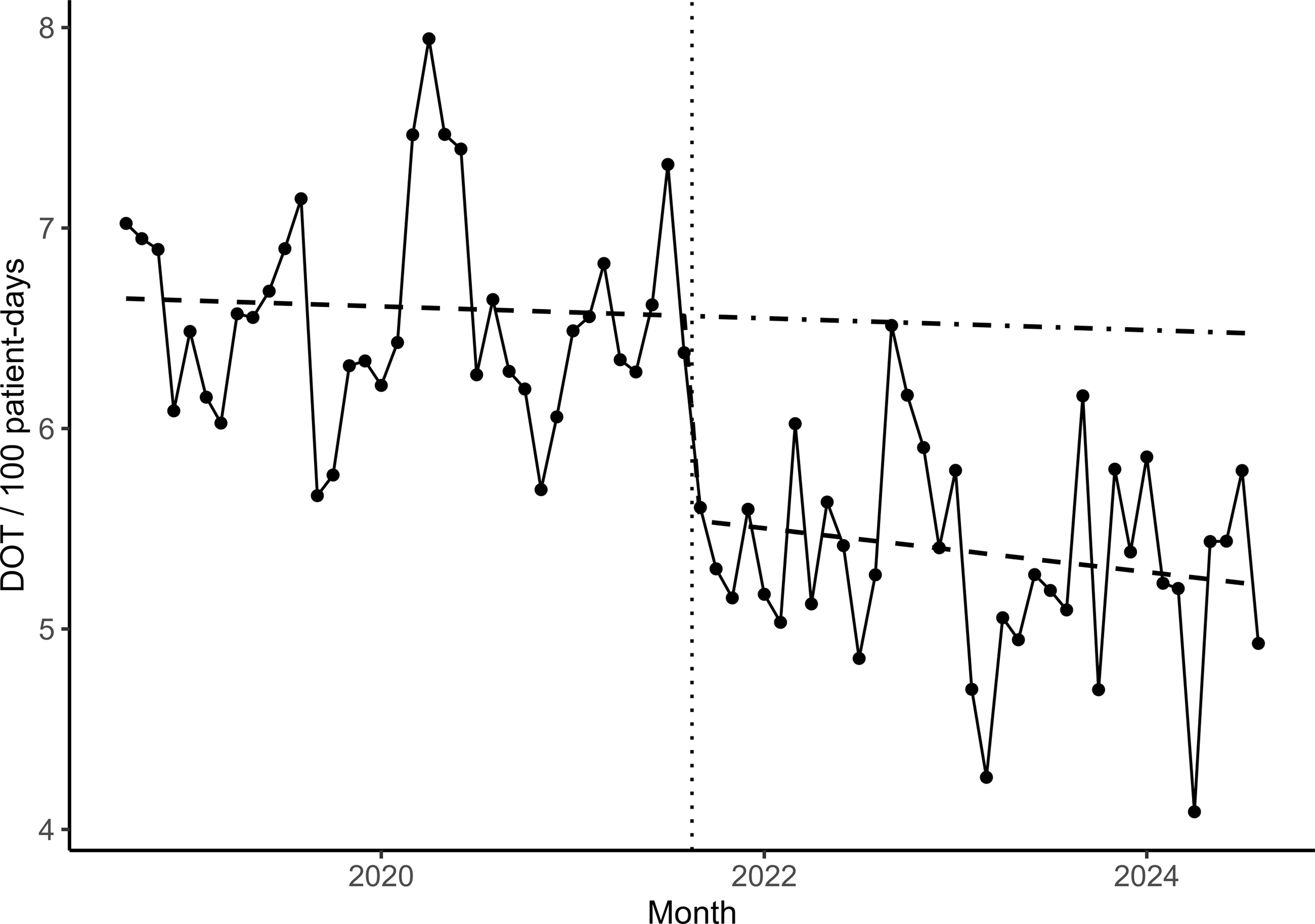
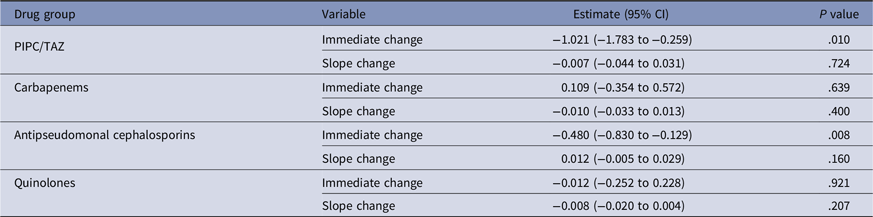
Figure 1 shows monthly inpatient PIPC/TAZ use in the targeted departments from September 2018 through August 2024. In segmented regression analysis, TORA implementation was associated with an immediate reduction in PIPC/TAZ use (estimate, −1.021 DOT per 100 patient-days; 95% CI, −1.783 to −0.259; P = .010), whereas the change in postintervention slope was not significant (estimate, −0.007; 95% CI, −0.044 to 0.031; P = .724) (Table 1). To assess possible therapeutic substitution to other antipseudomonal agents, we also examined carbapenems, antipseudomonal cephalosporins, and quinolones as balancing antibiotic-use outcomes. Carbapenem use showed no significant immediate change (estimate, 0.109; 95% CI, −0.354 to 0.572; P = .639) and no significant slope change (estimate, −0.010; 95% CI, −0.033 to 0.013; P = .400). Antipseudomonal cephalosporin use showed a significant immediate reduction (estimate, −0.480; 95% CI, −0.830 to −0.129; P = .008), but no significant slope change (estimate, 0.012; 95% CI, −0.005 to 0.029; P = .160). Quinolone use showed neither a significant immediate change (estimate, −0.012; 95% CI, −0.252 to 0.228; P = .921) nor a significant slope change (estimate, −0.008; 95% CI, −0.020 to 0.004; P = .207) (Table 1). Aztreonam and aminoglycoside use remained low and similar between periods, whereas piperacillin-alone use increased from 0.023 to 0.056 DOT per 100 patient-days but remained minimal relative to PIPC/TAZ use.
Monthly inpatient PIPC/TAZ use in the targeted departments is shown as days of therapy (DOT) per 100 patient-days from September 2018 through August 2024. The vertical dotted line indicates the boundary between the preintervention and postintervention periods, corresponding to TORA implementation on September 1, 2021; September 2021 was the first postintervention month. TORA consisted of standardized day-7 and day-14 reminders documented in the EMR and displayed as patient-level message-board reminders within the EMR for ongoing PIPC/TAZ therapy. Circles connected by the solid line represent observed monthly values. The dashed line represents the fitted segmented trend. The dot-dash line represents the counterfactual trajectory projected from the preintervention trend. DOT, days of therapy; PIPC/TAZ, piperacillin-tazobactam; TORA, 7-Day and 14-Day Antibiotic Time-Out Reminder Alert.

Estimated changes in monthly inpatient PIPC/TAZ use and balancing antibiotic-use outcomes after implementation of the 7-Day and 14-Day Antibiotic Time-Out Reminder Alert (TORA)

Table 1. Long description
A table with four rows and three columns comparing the effects of TORA implementation on different drug groups. The columns are labeled Drug group, Variable, Estimate (95% CI), and P value. The rows are labeled with different drug groups and variables. Row 1: Drug group: PIPC/TAZ, Variable: Immediate change, Estimate (95% CI): -1.021 (-1.783 to -0.259), P value: .010. Row 2: Drug group: PIPC/TAZ, Variable: Slope change, Estimate (95% CI): -0.007 (-0.044 to 0.031), P value: .724. Row 3: Drug group: Carbapenems, Variable: Immediate change, Estimate (95% CI): 0.109 (-0.354 to 0.572), P value: .639. Row 4: Drug group: Carbapenems, Variable: Slope change, Estimate (95% CI): -0.010 (-0.033 to 0.013), P value: .400. Row 5: Drug group: Antipseudomonal cephalosporins, Variable: Immediate change, Estimate (95% CI): -0.480 (-0.830 to -0.129), P value: .008. Row 6: Drug group: Antipseudomonal cephalosporins, Variable: Slope change, Estimate (95% CI): 0.012 (-0.005 to 0.029), P value: .160. Row 7: Drug group: Quinolones, Variable: Immediate change, Estimate (95% CI): -0.012 (-0.252 to 0.228), P value: .921. Row 8: Drug group: Quinolones, Variable: Slope change, Estimate (95% CI): -0.008 (-0.020 to 0.004), P value: .207.
CI, confidence interval; DOT, days of therapy; PIPC/TAZ, piperacillin-tazobactam; TORA, 7-Day and 14-Day Antibiotic Time-Out Reminder Alert.
Note. Estimates were obtained from separate single-group interrupted time-series models of monthly inpatient antibiotic use (DOT per 100 patient-days) in targeted departments from September 2018 through August 2024. TORA was implemented on September 1, 2021. Models were fitted using generalized least squares with an AR(1) error structure and calendar-month fixed effects. “Immediate change” indicates the level change at implementation, and “slope change” indicates the change in postimplementation monthly trend. Carbapenems comprised doripenem, biapenem, meropenem, panipenem/betamipron, imipenem/cilastatin, and imipenem/cilastatin/relebactam. Antipseudomonal cephalosporins comprised cefoperazone, ceftazidime, cefoperazone/sulbactam, ceftazidime/avibactam, cefepime, cefozopran, cefpirome, and ceftolozane/tazobactam. Quinolones comprised ciprofloxacin, pazufloxacin, and levofloxacin.
Secondary outcomes
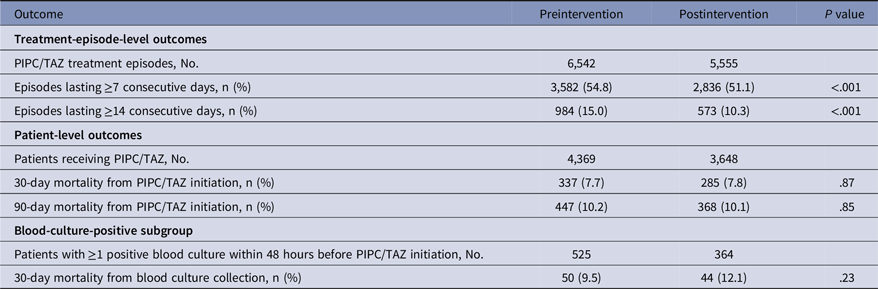
Secondary outcomes are shown in Table 2. At the treatment-episode level, the proportion of PIPC/TAZ treatment episodes lasting ≥7 consecutive days decreased from 54.8% (3,582/6,542) in the preintervention period to 51.1% (2,836/5,555) in the postintervention period (P < .001). The proportion of episodes lasting ≥14 consecutive days also decreased from 15.0% (984/6,542) to 10.3% (573/5,555) (P < .001). At the patient level, 30-day mortality from PIPC/TAZ initiation was 7.7% (337/4,369) in the preintervention period and 7.8% (285/3,648) in the postintervention period (P = .87). Ninety-day mortality was 10.2% (447/4,369) before the intervention and 10.1% (368/3,648) after the intervention (P = .85). Among patients with at least 1 positive blood culture within 48 hours before PIPC/TAZ initiation, 30-day mortality from the date of blood culture collection was 9.5% (50/525) in the preintervention period and 12.1% (44/364) in the postintervention period (P = .23) (Table 2).
Secondary outcomes before and after implementation of the 7-Day and 14-Day Antibiotic Time-Out Reminder Alert (TORA)

Table 2. Long description
A table with four rows and three columns comparing secondary outcomes before and after an intervention. The table is divided into three sections: Treatment-episode-level outcomes, Patient-level outcomes, and Blood-culture-positive subgroup. Column headers are Preintervention, Postintervention, and P value. Row labels include PIPC/TAZ treatment episodes, Episodes lasting ≥7 consecutive days, Episodes lasting ≥14 consecutive days, Patients receiving PIPC/TAZ, 30-day mortality from PIPC/TAZ initiation, 90-day mortality from PIPC/TAZ initiation, Patients with ≥1 positive blood culture within 48 hours before PIPC/TAZ initiation, and 30-day mortality from blood culture collection. Notable trends include a decrease in episodes lasting 7 or more consecutive days and 14 or more consecutive days postintervention. 30-day and 90-day mortality rates remain relatively unchanged. Among patients with positive blood cultures, 30-day mortality slightly increased postintervention.
PIPC/TAZ, piperacillin-tazobactam; TORA, 7-Day and 14-Day Antibiotic Time-Out Reminder Alert.
Note. Preintervention period, September 2018 through August 2021; postintervention period, September 2021 through August 2024. Treatment-episode-level and patient-level secondary outcomes were compared between periods using Fisher’s exact test. In the blood-culture-positive subgroup, day 0 was defined as the date of blood culture collection. For the blood-culture-positive subgroup analysis, duplicate patient IDs and patients transferred to another hospital were excluded.
Discussion
In this interrupted time-series study, implementation of a simple, low-burden TORA intervention was associated with an immediate reduction in inpatient PIPC/TAZ use in targeted departments. The proportions of PIPC/TAZ treatment episodes lasting ≥7 and ≥14 days were also lower after implementation. In contrast, we did not observe evidence of increased carbapenem or quinolone use after implementation, and 30- and 90-day mortality did not differ significantly between periods.
PIPC/TAZ use decreased immediately after TORA implementation, with no significant slope change. Heightened attention to a newly introduced reminder may have contributed to the immediate response, although message readership and prescriber responses were not measured. Conversely, TORA relied on unidirectional EMR reminders; unread or unacted-upon messages may have attenuated the immediate effect. Responsiveness may also have changed over time, including through alert fatigue, potentially influencing the subsequent trend. These mechanisms could not be directly evaluated. The observed pattern is compatible with a sustained level reduction, but the nonsignificant slope change alone cannot establish stable responsiveness or alert fatigue. Prior studies likewise suggest that time-outs may improve prescribing processes, while effects on aggregate antibiotic use vary across settings. Reference Wolfe, Bryant and Khoury9,Reference Thom, Tamma and Harris11,Reference Van Schooneveld, Rupp, Cavaleiri, Lyden and Rolek22
The balancing antibiotic-use outcomes did not suggest major therapeutic substitution to carbapenems or quinolones. Antipseudomonal cephalosporin use also decreased immediately, indicating that the reduction in PIPC/TAZ use was not accompanied by a compensatory increase in the use of this class. Because TORA specifically targeted PIPC/TAZ, however, the decrease in antipseudomonal cephalosporin use cannot be attributed to TORA and may have reflected concurrent changes in prescribing practice, patient case mix, or other unmeasured factors. No concurrent formulary changes or supply restrictions affecting antipseudomonal cephalosporins were identified. The reasons for the different temporal patterns across antibiotic classes could not be determined because patient-level indications, switching patterns, and prescribing appropriateness were not assessed.
The secondary outcomes add clinical interpretability to the utilization findings. The reduction in treatment episodes lasting ≥14 days is consistent with the overall aim of TORA to prompt reassessment of prolonged therapy, although the study design cannot distinguish the direct and indirect effects of the two reminder thresholds. Because the day-7 reminder was posted only after therapy exceeded 7 consecutive days, the reduction in episodes lasting ≥7 days cannot represent a direct effect of the reminder on the same treatment episode. It may, however, partly reflect broader indirect changes in prescribing behavior after TORA implementation, including earlier reassessment of subsequent PIPC/TAZ courses, although these mechanisms were not measured. Combining day-7/day-14 reminders with a 48–72-hour time-out may provide complementary opportunities to address both early antibiotic selection and prolonged treatment and warrants future evaluation. Thirty- and 90-day mortality were similar before and after implementation. In the blood-culture-positive subgroup, 30-day mortality was also not significantly different, although it was higher in the postintervention period than in the preintervention period (12.1% vs 9.5%). However, these comparisons were exploratory, unadjusted descriptive analyses, and the subgroup also included a clinically heterogeneous population. Therefore, this finding should be interpreted cautiously and does not provide definitive evidence regarding patient safety.
An important implication of this study is practical applicability. PAF and preauthorization remain core stewardship strategies, but both are resource intensive and can be difficult to sustain across all departments when stewardship personnel are limited. Reference Barlam, Cosgrove and Abbo1,Reference Heil, Justo and Bork2 In contrast, TORA was embedded into routine weekday workflow, required only standardized EMR documentation and a patient-level EMR message-board reminder, and was delivered by rotating ASP pharmacists in approximately 15 minutes per day. Candidate identification and initial filtering were largely automated, whereas final eligibility confirmation required pharmacist review. The transferable components of TORA are the predefined treatment-duration milestones and standardized prompts for reassessment, whereas the EMR extraction, filtering process, reminder interface, and staffing workflow are institution-specific and require adaptation to local resources. Further EMR-based automation could reduce manual workload and facilitate more timely implementation, including on weekends, although the incremental effect of these approaches requires evaluation. Thus, TORA may offer a pragmatic, adaptable complement to more personnel-intensive ASP activities, particularly where direct case-by-case review of all broad-spectrum antibiotic use is not feasible. Reference Heil, Justo and Bork2,Reference Ackley, Kuti, Bilinskaya, Linder and Dempsey14
This study has several limitations. First, it was conducted at a single tertiary-care hospital, which may limit generalizability, although the intervention was implemented across a broad range of inpatient departments other than hematology and transplant surgery. Second, the primary analysis used a single-group ITS design without a concurrent control group, limiting causal attribution to TORA. Although the models included calendar-month fixed effects to account for seasonality, unmeasured concurrent changes may still have influenced the observed associations. In particular, TORA implementation occurred shortly after the peak of the Delta variant–driven fifth wave of coronavirus disease 2019 in Japan, and pandemic-related changes in admission volume, surgical activity, patient severity, or case mix may have contributed to the observed immediate change. In addition, we did not systematically ascertain department-specific changes in antimicrobial-use protocols or clinical practice during the study period, although no concurrent hospitalwide antimicrobial-use policy changes were identified. Nevertheless, the concurrent reduction in prolonged PIPC/TAZ treatment episodes, particularly episodes lasting ≥14 days, and the absence of identified major PIPC/TAZ supply restrictions, formulary changes, or administration-restriction policy changes suggest that TORA may have contributed to the observed reduction. In addition, because aggregated J-SIPHE data included PIPC/TAZ use among patients with infectious diseases consultation who were not eligible for TORA reminders, the observed intervention-associated change may have been attenuated, although the magnitude of this effect could not be determined. Third, the secondary outcomes were exploratory, unadjusted prepost comparisons, and postdischarge deaths occurring outside our healthcare system may not have been completely captured. Fourth, we did not evaluate patient-level antibiotic switching or prescribing appropriateness, use of non-antipseudomonal agents, or oral step-down therapy, including oral fluoroquinolones. Thus, substitution outside the selected balancing outcomes could not be fully assessed, and reduced PIPC/TAZ exposure could reflect discontinuation, de-escalation, intravenous-to-oral switching, or changes in case mix. Despite these limitations, the main findings appear robust given the relatively long observation period, the absence of identified major PIPC/TAZ-specific operational changes, and the consistency between the reduction in prolonged PIPC/TAZ exposure and the intended mechanism of TORA.
In conclusion, TORA was associated with an immediate reduction in inpatient PIPC/TAZ use in targeted departments. Prolonged PIPC/TAZ exposure also decreased, without evidence of major substitution to carbapenems or quinolones. Thirty- and 90-day mortality did not differ significantly between periods, although these comparisons were exploratory and unadjusted, and the study was not designed or powered to detect mortality differences. Given its low implementation burden, this approach may offer a pragmatic stewardship option that can be adapted to local infrastructure and staffing.
Supplementary material
The supplementary material for this article can be found at https://doi.org/10.1017/ash.2026.10899.
Data availability statement
The data that support the findings of this study are not publicly available because of privacy and ethical restrictions but may be available from the corresponding author upon reasonable request and with appropriate institutional approval.
Acknowledgments
During the preparation of this work, the authors used ChatGPT (OpenAI; GPT-5.4 Thinking and GPT-5.6 Sol; accessed via the ChatGPT web interface in 2026) to improve readability and language expression. After using this tool, the authors reviewed and edited the content as needed and take full responsibility for the content of the manuscript.
Financial support
None reported.
Competing interests
S.H. reports speaker payments from MSD, Shionogi, Pfizer, Meiji Seika Pharma, KYORIN Pharmaceutical, Ushio, and Eiken Chemical, and consulting fees from Denka, outside the submitted work. S.K. received medical manuscript writing honorarium from Medical Science International, Ltd. in 2024 and received honorarium for a clinical case conference presentation from MSD in 2025. S.K. (during his PhD program at the University of Tokyo, Graduate School of Medicine and Faculty of Medicine) was involved in antiviral research relevant to a neglected tropical disease and favipiravir. During his PhD research, favipiravir was provided by FUJIFILM Toyama Chemical Co. Ltd. All other authors report no potential conflicts of interest relevant to this article.


 Open access

