Introduction
A recent study carried out by UNICEF states that ‘the proportion of children living in poverty has risen in a majority of the world's developed economies’ (UNICEF, 2005). These findings underpin the growing concern about the need to support families with children and reduce the risk of child poverty in rich countries.Footnote 1 This concern has lead some governments to increase the level of expenditure on cash support for children, and some improvements in indicators of the economic wellbeing have been achieved or are anticipated.Footnote 2 However, there are obviously limits to the resources that governments can target on children. Hence, it is essential to understand the structure of these reforms, to establish whether they achieve their objectives and to ensure that there are not better alternatives available.
In this article we analyse and compare three European Union (EU) countries that have recently experienced substantial increases in spending on benefits and tax concessions to support families with children: Austria, Spain and the UK. These support systems are very different. Austria has a generous system that relies mainly on universal benefits. Spain spends little, mostly on tax concessions. The UK system is not as quite as generous on average as the system in Austria, and gives greater emphasis to means-testing. The recent reforms have reinforced these structures in each country while increasing the amount of public resources directed towards children. But are the chosen strategies the most effective for each country? What would have happened if these countries had completely transformed their systems in another direction? More concretely, what would be the effect on child poverty and on income distribution if (for example) Austria had adopted the Spanish system, while spending the same overall level as currently in Austria? Tax-benefit microsimulation models can provide evidence to answer this type of ‘what if’ question. We use EUROMOD, a tax-benefit microsimulation model that covers all 15 pre-2004 EU countries (EU15) and is designed for making cross-country comparisons. It is based on samples of households that are representative for each country. Here we simulate and compare the effects of the 1998 and 2003 child-targeted parts of the tax-benefit systems on children's household incomes. Then we swap the parts of the 2003 systems related to children from one country to another and reassess the impact on children after these alternative ‘reforms’.
The article is organised as follows. First, it describes the policies to support families with children and the recent reforms in Austria, Spain and the UK. Second, it presents some methodological issues related to the use of EUROMOD and the data, as well as some of the key definitions and assumptions that are used. Then, it assesses the impact of exchanging child policies across the income distribution, on particular family types and on child poverty. Finally, it offers some concluding comments.
Policies to support families with children in 1998 and 2003
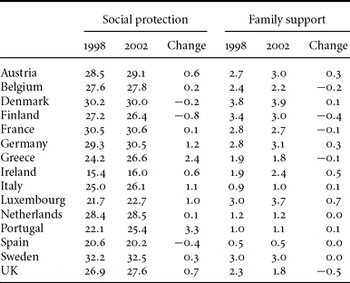
Eurostat estimates for the cost of social protection in general, and family benefits in particular, are shown in Table 1 as a proportion of GDP in 1998 and 2002. The Scandinavian countries, Luxembourg, Germany and Austria are the ones that spend most on family support, while the Southern countries (except Greece) and the Netherlands spend least. In recent years expenditure on family benefits has increased considerably in four countries (Austria, Germany, Ireland and Luxembourg), and substantially fallen in two (Finland and the UK).
Expenditure on social protection and family support as a proportion of GDP in 1998 and 2002 (per cent)

Source: Eurostat (2005).
These social protection statistics do not include the value of tax concessions which are of direct benefit to children. So while, according to this table, the expenditure on family support in the UK fell by 5 percentage points between 1998 and 2002, in fact the recent reforms have shifted a considerable part of support from social benefits to tax credits and, overall, family support has risen. According to the UK Treasury (HM Treasury, 2004: 107) families with children were £1,350 per year better off on average as a result of all tax and benefit reforms over a slightly longer period (1997 to 2004). This highlights the difficultly in using a single concept to measure support over time or across countries.Footnote 3 In the analysis that follows we focus on elements of both cash benefits and direct personal taxes which are specifically designed for the support of children and their families. The following descriptions of policies to support families with children in the three countries explain which cash benefits and tax concessions are included in the analysis and illustrate how they impact on certain types of families.Footnote 4
Austria
While Table 1 shows Austria to be fourth in the ranking of spending on social protection for families in EU15, other measures indicate that it has one of the most generous systems for the support of children. For example, Austria comes top in a ranking of ‘child benefit packages’ among 22 industrialised countries (Bradshaw and Finch, Reference Bradshaw and Finch2002). Support is mainly provided through universal benefits that are supplemented to especially vulnerable population groups. Recent reforms have introduced new benefits and changed some of the existing ones, while largely reinforcing the lack of income targeting in the Austrian system.
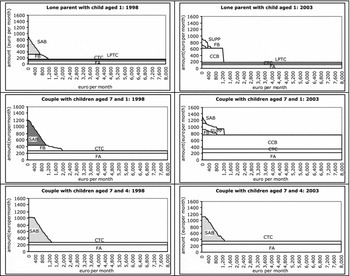
Figure 1 illustrates Austrian policies using three synthetic family types: a lone parent with a child aged one; a one-earner couple with two children aged seven and one; and the same couple with two children aged seven and four. This gives an indication of the relative size of each policy element and how it is targeted by parental income for these family types. In 1998, shown on the left-hand side of the figure, there were two policies available for all families with children regardless of their income: the family allowance and the child tax credit. The amount of the family allowance increased with the age of the child and was supplemented in the case of disability. The child tax credit was fully refundable, with an amount per child that increased with the number of children in the family. Lone-parent families were additionally eligible for a partly refundable lone parent tax credit.
Austria: 1998 and 2003 policies for three types of family, 2003 prices
Notes: The first family type consists of a 41 year old, employed single mother. The second family type consists of a couple with a 41 year old employed husband and a 41 year old non-working wife. In both cases, individual original income is computed as the product of multiplying a fixed hourly wage (€9.23 per hour) times an increasing number of working hours. All families are assumed to be tenants paying a rent of €400 per month. The amounts of the 1998 benefits are updated to 2003 levels using Eurostat's harmonised consumer price indices (8.04% in the case of Austria). Shaded areas represent policies that are not uniquely targeted to families with children and that are not ‘swapped’ to other countries.
Acronyms:
FA: family allowance; CTC: child tax credit; LPTC: lone parent tax credit; CCB: childcare benefit; FB: family bonus; SUP: parental leave/childcare supplement; SAB: social assistance benefit;
Source: EUROMOD

Low-income families with young children could also claim a regionally administered family bonus.
In addition, there were a number of maternity-related benefits not illustrated by the three family types shown in Figure 1. After the 16-week maternity benefit there was a flat rate parental leave benefit for a period of up to 18 months for parents who were employed before the birth of the child and without substantial earnings after it (two years for couples without any substantial employment). Low-income families receiving parental leave benefit were also eligible for a means-tested supplement to the parental leave benefit. Figure 1 shows that in 1998 the general social assistance scheme played a major role in supporting cases of very low parental incomes. Under the 2003 system (shown in the panels on the right of the figure) a considerable part of the social expenditure for low-income families shifts from general social assistance to specific support for families with children, particularly where there are children under the age of three. This is partly as a result of increased generosity of the universal elements of the system: the family allowance payment was increased for second and subsequent children and a means-tested supplement became available for every third and subsequent child. The rates of child tax credit for the first and second child were levelled up to match those for third and subsequent children (representing 85 per cent and 31 per cent real increases, respectively, compared with 1998 amounts).
The parental leave benefit was replaced by a childcare benefit which is not conditional on employment before the birth, lasts for longer (until age two and a half, or three if parents share childcare duties), and with a personal income limit more than four times higher than in 1998. Although the amount of this new benefit is slightly less in real terms than the 1998 parental leave benefit, the increased coverage makes the benefit a significant source of support for the lone parent and one-earner couple with young children shown in Figure 1. Based on the assumptions underlying the stylised family calculations, the lone parent loses her entitlement once her work income exceeds the limit. The couple retain entitlement at all income levels because one parent remains at home with the younger child. Since it is not income-tested at the family level, some high-income families can be entitled, though the system is ‘conditional’ rather than universal.
The supplement to the parental leave benefit in 2003 became linked to receipt of the childcare benefit that replaced the parental leave benefit. Hence, it is available to a greater number of families at low income levels as it is no longer restricted to parents who were previously employed.
Spain
In contrast to Austria, Spain has one of the least generous systems in the EU to support children. Table 1 indicates that Spanish expenditure on family and child social benefits as a percentage of GDP (0.5 per cent) is by far the lowest in the Union. According to Bradshaw and Finch (Reference Bradshaw and Finch2002), the Spanish ‘child benefit package’ is negative: on average, housing costs and charges for services exceed the value of tax and cash benefits for children. Support for families with children is provided mainly through tax concessions and a means-tested child benefit. Recent reforms have reinforced this structure by considerably increasing the size of the tax concessions.
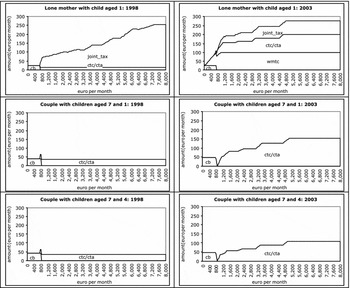
In 1998, families with ‘children’ under 30 years of age were entitled to a non-refundable child tax credit. Only taxpayers whose tax liability was greater or equal to the tax credit could fully benefit from it. The amount per child of this tax credit increased with the number of children and was the same for all age groups. Until 1998, the tax schedule's exemption limit and income brackets were larger under joint taxation than under individual taxation. Hence, one-earner families paid considerably less tax under joint taxation. Single parents with children aged under 18 could also benefit from joint taxation (effectively, the tax is assessed jointly with the children). In Figure 2, which shows the effect of the Spanish system on the three stylised families, as well as in the analysis which follows, the advantage to lone parents of being taxed under joint taxation is treated as a child-targeted part of the system. It is not treated as such for couples because they could be taxed in this way whether or not they have children.
Spain: 1998 and 2003 policies for three types of family, 2003 prices
Notes: The first family type consists of a 41 year old, employed single mother. The second family type consists of a couple with a 41 year old employed husband and a 41 year old non-working wife. In both cases, individual original income is computed as the product of multiplying a fixed hourly wage (€9.23 per hour) times an increasing number of working hours. All families are assumed to be tenants paying a rent of €400 per month. The amounts of the 1998 benefits are updated to 2003 levels using Eurostat's harmonised consumer price indices (16.2% in Spain).
Acronyms:
cb: means-tested child benefit; wmtc: working mother tax credit; ctc/cta: child tax credit/allowance; joint_tax: tax relief due to joint taxation
Source: EUROMOD

Low-income families with children under 18 were entitled to a means-tested child benefit. As shown in Figure 2, this had approximately the same value for non-taxpayers as the tax credit did for taxpayers.
By 2003, the child tax credit was replaced by a more generous child tax allowance. The amount per child of this tax allowance increases with the number of children and is supplemented for children aged under three. By its nature, the value of the tax allowance rises with the marginal rate of tax and hence with taxable income, as shown in Figure 2.
Single parents remain allowed to use joint tax if their children are aged under 18. However, since 1999, the tax schedule under individual and joint taxation is the same so that the benefit of joint taxation is limited to the use of an additional tax allowance. The value of it to the lone parent is less in 2003 than in 1998, but still represents a major component of support for this type of family, especially at higher income levels.
A working mother refundable tax credit was introduced for working women with children aged under three. This tax credit is paid at a fixed rate per child aged under three and cannot exceed the social insurance contributions paid by the working mother. Among the stylised families in Figure 2, only the lone parent is entitled.Footnote 5 It also shows how lower-income working mothers do not fully benefit as their social contributions are not large enough.
Whereas the amount of means-tested child benefit was uprated well above the level of inflation over the period 1998–2003, the income limit has remained constant in real terms. This is reflected in Figure 2 with somewhat higher levels of payment, but limited to families on very low levels of income.
United Kingdom
In order to achieve explicit targets for reducing child poverty, the British government has substantially reformed the support for families with children. Although there has been a universal child benefit since 1976, the British system has been mainly characterised as targeting children living in lower-income families. Recent reforms have reinforced income targeting, in particular by giving a stronger emphasis to in-work benefits and extending means-testing further up the income distribution.
In 1998, child benefit was a universal social benefit paid for each child in the family. The amount per child was higher for the first child and there was a complement for lone-parent families.
Low-income families with children and with at least one parent working at least 16 hours per week were also entitled to family credit. The amount of this means-tested benefit depended on the number of children and increased with their age. Parents working at least 30 hours a week received an additional supplement.
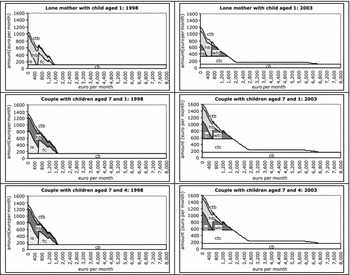
Low-income parents not working 16 hours per week or more were entitled to a complement to their income support/jobseeker's allowance payment (the UK's social assistance). The amount per child of this complement increased with the age of children. It was also higher for the first child and for lone-parent families. The means-tested housing benefit (HB) and council tax benefit (CTB) were similarly higher for families with children. These three benefits are not specifically child-targeted but, as can be seen from the left-hand panels of Figure 3, did form a very significant component of support for low-income families.
UK: 1998 and 2003 policies for three types of family, 2003 prices
Notes: The first family type consists of a 41 year old, employed single mother. The second family type consists of a couple with a 41 year old employed husband and a 41 year old non-working wife. In both cases, individual original income is computed as the product of multiplying a fixed hourly wage (€9.23 per hour) times an increasing number of working hours. All families are assumed to be tenants paying a rent of €400 per month and €100 per month for council tax. The amounts of the 1998 benefits are updated to 2003 levels using Eurostat's harmonised consumer price indices (6.19% in the UK). Shaded areas represent policies that are not uniquely targeted on families with children and that are not ‘swapped’ to other countries. Striped areas represent 1998 policies that were clearly targeted on families with children but that also had another social protection function (social assistance in the case of IS and work incentive in the case of FC).
Acronyms:
cb: child benefit; fc: family credit; ctc: child tax credit; wtc: working tax credit; is: income support; hb: housing benefit; ctb: council tax benefit.
Source: EUROMOD

In 2003, the child benefit was 3 per cent higher in real terms than in 1998. The complement for the first child had increased more (about 9 per cent), while the complement for lone-parent families had been abolished.
The family credit and the child complements in income support/jobseeker's allowance had been, by 2003, replaced by a child tax credit and a working tax credit. On the one hand, this reform splits the family support and the ‘make work pay’ parts of family credit into two. On the other, it consolidates previously independent policies to support families with children into one.
The child tax credit consists of two parts: a family and a child element. The family element is a fixed amount paid for families with children (doubled if there is a newborn child). This amount is tapered away above a quite generous level, set at the threshold for payment of the highest marginal rate of income tax (around €6,000 per month – see Figure 3). The child element is paid as a fixed amount per child (higher for disabled children) that is tapered away above a considerably lower income threshold. The working tax credit is a means-tested in-work benefit for families with children with at least one parent working 16 hours or more a week. In the analysis which follows, only the component of working tax credit which is more generous for families with children, by virtue of the hours condition being less stringent, is identified as ‘child targeted’.
The comparison between 1998 and 2003, in Figure 3, shows how the child tax credit has consolidated and increased the support to lower-income families, extended means-tested support higher up the income scale, and also introduced an element of ‘affluence testing’ at high levels of income. The 2003 system does not generally distinguish by the age of children and is very similar for lone parents and couples (the lone parent receives less than the couples in Figure 3 because she has fewer children).
Comparing across countries
Such calculations for stylised families are the basis for many international comparisons of the effects of tax-benefit systems.Footnote 6 Their great advantage is that they are able to set out clearly the differences between systems without becoming confused with other differences between countries. However, if we wish to understand what is the effect of a particular system on a particular population we must take account of the characteristics of that population. To fully understand the effect of country A's system in country A, and to consider what effect it would have in countries B and C, information about the population characteristics is needed in combination with information about the policy rules in each case. These are brought together in tax-benefit microsimulation models. The particular model used in this article is explained in the next section.
Method, data, assumptions and definitions
This article makes use of the tax-benefit microsimulation model EUROMOD.Footnote 7 Tax-benefit models simulate in detail each component of the tax-benefit system on each individual/household from microdata, representative of the household population, usually derived from a survey. They calculate disposable income as the sum of elements of gross original income taken from the data combined with elements of income – taxes and benefits – that are simulated by the model. They can be used to ask ‘what if’ questions about policy change. Here, the type of question asked is what would happen if country A's system were implemented in country B. The point of this is not to present the borrowed policies as though they were practical proposals for actual implementation in country B, although some ideas for new directions in policy may arise from the exercise. The point is to understand the nature of policy A and to learn about the relationship between its structure and its impact on populations with different characteristics.Footnote 8 With the exception of an unconditional, universal payment, any given policy will have an impact that is different across countries, not least because of differences in the position of children in the income distribution.
EUROMOD calculates liability for direct taxes and entitlements to cash benefits in a comparable way for all 15 countries that made up the European Union prior to the enlargement of May 2004. The input datasets used here are the Austrian version of the ECHP collected in 1999, the Spanish part of the Eurostat version of the ECHP collected in 2000 and, for the UK, the Family Expenditure Survey (FES) collected in 2000/1.Footnote 9 Throughout we consider all policies as they were on 30 June 2003. Original incomes are updated to this date by indexing each income component by appropriate growth factors, based on actual changes over the relevant period.Footnote 10 No adjustment is made for changes in population composition.
In swapping policies between countries, all child-targeted policies in country A are eliminated and replaced by the corresponding policies of countries B and C, and vice versa.Footnote 11 Only policies strictly targeted at children are swapped between countries, as indicated in Figures 1 to 3. Policies that have other purposes and that involve complements for children (such as the UK housing benefit) are not included in the swap.Footnote 12
Given that the objective of these simulations is to learn about the impact of different policy structures rather than the expenditure level, all reforms are designed to be budget neutral. Hence, the cost of implementing the policies from country B in country A is the same as the cost of current policies in country A. The way this is done is as follows. First, the income thresholds of means-tested benefits or tax credits are set relative to the country's median income.Footnote 13 Then all the remaining monetary parameters of ‘borrowed’ policies are scaled up or down by a common adjustment factor such that budget neutrality is achieved. The reason for treating income thresholds differently from the size of payments is that these have the function of determining where in the income distribution a policy takes effect, rather than the size of the effect. Child tax allowances are also scaled up/down by this scaling factor, but no swap or adjustment is made to the national tax schedule or to the definition of the tax base.
The contribution of each policy is measured as the difference in disposable income under the existing system and after removing the components of policy that are targeted on children. Policies or elements of policies that are not targeted on children remain in place. Following the United Nations Convention on the Rights of the Child, our definition of children is people aged under 18.Footnote 14 We generally assume that income is shared within the household such that household disposable income can be used to indicate the economic wellbeing of each individual within the household. (The issue of incidence within the household – which we acknowledge as important – is not considered here.)
Household disposable income is defined as original income added up over each household member plus between household receipts (for example, maintenance and alimony), minus taxes (income tax, social contributions and other direct personal taxes) plus cash benefits. Non-cash benefits are not included. Household disposable incomes are equivalised using the modified OECD equivalence scale, as recommended by Eurostat.Footnote 15
Poverty is defined as living in a household with equivalised household disposable income below a proportion of the median, where the median is calculated across individuals.
We do not explicitly model non-takeup of benefits, tax avoidance or evasion. More generally, we make the strong assumption that individual behaviour such as benefit takeup, tax evasion and other relevant socioeconomic decisions such as labour supply and family formation do not change as a result of the policy changes that are modelled. Correcting for such effects is not straightforward in a way that is comparable across countries. These behavioural responses depend on many factors such as the form and administration of each tax and benefit, labour market rules and characteristics, social values, and so on. They are therefore both nation- and system-specific.
The effects of the three systems in the three countries
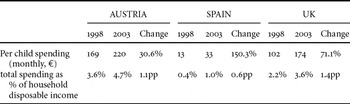
The level of spending on policies is critical for achieving any significant outcome. Estimates from EUROMOD in Table 2 show that, between 1998 and 2003, spending on child-targeted policies increased in real terms in all three countries. In relative terms, Spanish child-targeted spending increased most: expenditure under 2003 policy rules amounting to two and a half times the expenditure under 1998 rules in real terms. In spite of this increase, Spanish spending remained at a very low level of €33 per month per child. UK child-targeted spending increased by more than two thirds to reach €174 per child. Austrian expenditure, which was in 1998 already at the UK 2003 level relative to national household incomes, was further increased by one third, to €220 per child.
Child targeted spending, 1998 and 2003 tax benefit rules, 2003 prices

Note: For the UK an exchange rate of €1 to £ 0.70295 is used.
Source: Euromod. In simulating the 1998 system all monetary amounts are updated to 2003 levels using Eurostat's Harmonised Indices of Consumer Prices (HICP). These are 8.0% for Austria, 16.2% for Spain and 6.2% for the UK.
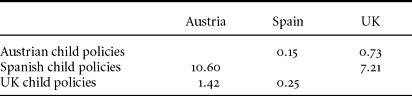
To make the child policies budget-neutral when they are exchanged, the factors shown in Table 3 are used to scale up or down the payments within the child-targeted policies.Footnote 16 To implement the Spanish and UK policies into the Austrian system, basic amounts were increased tenfold in the case of Spain and by 42 per cent in the case of UK. Austrian and UK child policies had to be scaled down considerably for implementation in Spain, in the case of the Austrian policies to less than one sixth, and in the case of UK policies to a quarter. To implement the other child policies in the UK, Austrian amounts were reduced by a quarter and Spanish amounts multiplied by seven. It is worth highlighting that there is not exact symmetry between the factors to be applied when exchanging systems, and that the budget-neutral scaling factors cannot be derived from the ratios of the spending per child in each national system. This is because the cost of implementing a particular system depends on the characteristics and circumstances of the children and their families: these are clearly different across countries. In addition, the cost depends to some extent on the way in which the child components interact with the rest of the national tax-benefit systems. So, for example, the value of the Spanish child tax allowances depends on the tax schedule into which they are introduced.
Scaling factors to achieve budget neutrality

Source: EUROMOD.
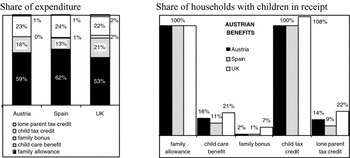
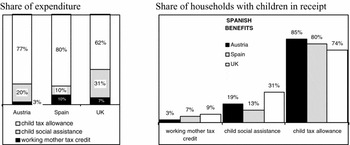
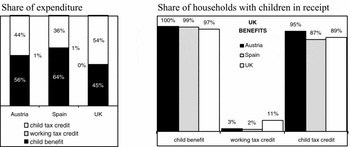
Figures 4 to 6 show the relative contribution of each of the policy instruments considered in the spending shown in Table 2, as well as the proportions of households with children who receive them. The figures show the effect of each system in turn, comparing the implementation in the three countries.
The contribution of each Austrian child-targeted policy instrument in Austria, Spain and UK.
Source: Euromod

The contribution of each Spanish child-targeted policy instrument in Austria, Spain and the UK.
Source: Euromod

The contribution of each UK child-targeted policy instrument in Austria, Spain and the UK
Source: Euromod.

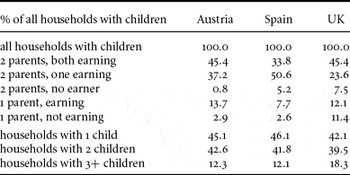
Among the Austrian instruments the two universal benefits – family allowance and the refundable child tax credit – make up three quarters or more of total spending when the Austrian system is implemented in any of the three countries (Figure 4). They are received by all households with children. While the family bonus and the lone-parent tax credit are nearly negligible in size, the childcare benefit is of considerable importance. This is targeted on young children whose parent(s) care for them rather than work. This benefit, as well as the lone-parent credit and family bonus, play a larger role in the UK than they do in Austria. This is because there are larger proportions of children within the target groups for these benefits in the UK. Conversely, they play a smaller role in Spain because there are fewer Spanish children in lone-parent families (see Table 4) and/or with parents at home caring for them.
Share of household types in Austria, Spain and the UK

Source: Euromod.
The most significant Spanish instrument is the child tax allowance (Figure 5). As only families paying (enough) income tax can (fully) claim this benefit, not all households with children receive it. The proportion receiving is higher in Austria than Spain but lower in the UK, reflecting the extent to which parents are subject to income tax in the three countries. The Spanish means-tested child benefit is quite important too, especially in the UK. Once the Spanish system has been scaled up to Austrian and UK levels of spending, larger proportions of households become eligible in these two countries than in Spain. The importance of the working mother tax credit depends on the extent to which mothers of young children are in paid employment in the three countries. The proportion of families who are eligible is highest in the UK, followed by Spain and then Austria.
Among UK instruments the universal child benefit and the means-tested child tax credit account for the bulk of spending, while the contribution of the child-specific part of the working tax credit is very small (Figure 6).Footnote 17 While child benefit is universal, children aged 16 or more who have left secondary school are not covered. Thus the households with children aged under 18 are not quite all covered in Spain or the UK. Coverage rates appear rather high for the child tax credit, a policy instrument that is described as ‘means-tested’. This is because a relatively small component is tested against income at a high level (‘affluence testing’) removing eligibility to any benefit in only 11 per cent of cases in the UK (see Figure 3). The proportion ineligible on grounds of high income is slightly smaller in Austria. Most of the spending on child tax credit is targeted on families with low to middle incomes. There are more qualifying families for this part in the UK than the other two countries and this is reflected in the lower share of spending for the tax credit in both Austria and Spain.
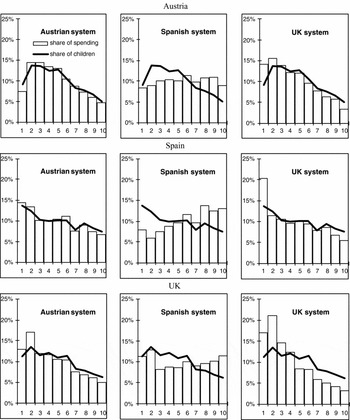
Figure 7 shows the distributional effect of the three systems applied within its country of origin, and applied to the other two countries. Each chart shows the share of total child targeted spending received by households, grouped by decile of equivalised income under actual 2003 policies. The charts also show the share of children belonging to each income group.
Three systems of child targeted spending by decile group of household disposable income Note: Deciles are defined using equivalised household incomes across all individuals under 2003 policies.
Source: Euromod.

The charts on the diagonal of Figure 7 show the effects of national systems implemented in their own country and largely confirm expectations based on what we know about the nature of the systems. The Austrian system has more or less the same effect on children at each level of household income, with a somewhat lower amount being spent on the lowest income children.Footnote 18 The Spanish system, while rather minimal from any perspective, favours those on higher incomes. The UK system favours children in low-income households, spending about three times as much per child in the bottom decile group as those in the top group. The bottom three decile groups benefit disproportionately to the number of children that they contain.
The Austrian system, when introduced into Spain and the UK, manages to achieve a distributional effect that matches quite closely the share of children in each income group. For a fully universal system this would be inevitable. The departures – for example, the excess of spending over number of children shown for the second decile group in the UK – arise from the targeting of specific groups, such as young children, within the Austrian system. It delivers far more to low-income Spanish children than does the Spanish system, but less to British children in the bottom three decile groups than does the UK system.
As one might expect, the Spanish system delivers disproportionately to children in the higher deciles in both Austria and the UK. Although in Spain it fails to deliver to low-income children, this is not the case for children in the Austrian bottom decile group or for British children in the bottom two decile groups: the shares of spending roughly match the shares of children. This is because once the small parts of the Spanish system that target low incomes have been inflated to Austrian and UK levels of spending, they are generous enough to make a significant difference. It is children in middle-income groups in UK and Austria who lose out particularly from the Spanish system.
The UK structure of spending on children strongly favours the lower-income groups: wherever it is implemented the share of expenditure received by children in households in the top six decile groups is less than their share of children. In contrast to the effect within the UK – where children in the bottom three decile groups benefit disproportionately – in Austria and Spain the disproportionate effect tends to concentrate in the bottom decile group. Also, while the UK system fails to deliver proportionately to children in the middle and top of the distribution in the UK, this is far less strongly the case when the system is implemented in either of the other two countries.
Who gains from the alternative systems?
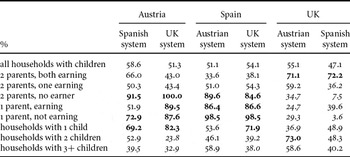
We have seen that the effects of the three systems differ across the three national income distributions. There are also both gainers and losers at each income level. In fact, in each country the number of households gaining from the alternative systems outweighs the number of losers, with the exception of the Spanish system when implemented in the UK. This is shown in Table 5, which also demonstrates how some groups of children would particularly benefit from one or other of the alternative systems. The large majority of both Spanish and Austrian lone-parent families, and families where no parent is in work or where there is just one child, would benefit from the UK system. Nearly three quarters of UK families with both parents earning would be better off under either the Austrian or the Spanish systems.
Households with children who gain from ‘borrowed’ child-targeted policies, by family type and number of children

Notes: Any increase in income is counted as a ‘gain’.
bold indicates more than 10 percentage points above ‘all households with children’.
italic indicates more than 10 percentage points below ‘all households with children’.
Source: Euromod.
Interestingly, the majority of Spanish households with parents not in work would benefit from the Austrian system, while the converse is true for the corresponding group of Austrian households with children: they would benefit from the Spanish system. These observations should not be taken to imply that these two countries should actually swap systems since the numbers involved in each group in each case are quite different, and in particular the proportion of Austrian families without an earner is very small (Table 4) and the results for this group are not statistically significant. Nevertheless, it is such groups who are most likely to be at risk of poverty in any country, and the next section focuses on the impact of the alternative systems on child poverty rates.
Effects on child poverty rates
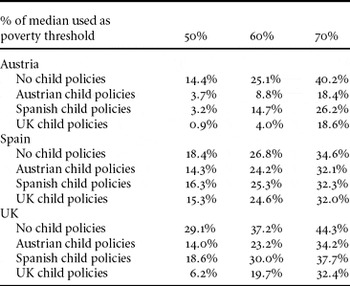
To assess the relative success of the three approaches in meeting the goal of reducing child poverty, Table 6 shows the extent to which the two alternative sets of child policies are able to reduce child poverty rates compared with existing national system. To give a more comprehensive picture the comparison is carried out using three levels of the poverty threshold: 50, 60 and 70 per cent of the median, and also shown are poverty rates calculated disregarding all child-targeted policies.
Child poverty rates under three alternative sets of child-targeted policies and with no child policies

Note: The base for calculating the poverty thresholds in all four scenarios is the equivalised median income under the actual 2003 system.
Source: Euromod.
It is striking that while in Austria and UK all child policy strategies are able to reduce child poverty rates considerably (though to different extents), the reduction is very moderate in Spain. Austrian and UK policies are slightly more successful than Spain's own policies, with Austrian policies achieving most. But even Austrian policies only reduce the child poverty rate at the 60 per cent threshold from 27 per cent to 24 per cent. Considering the monthly average per child spending in the bottom income decile group amounts to €34 with the Austrian, €20 with the Spanish and €48 with the UK strategy, it is hardly surprising that keeping children out of poverty is not very successful under any of them.
The importance of the level of spending is underlined by the fact that all strategies achieve the greatest reduction in child poverty in Austria, where spending is 25 per cent higher than in the UK and more than six times as high as in Spain. Even the small parts of the Spanish system that are tailored to support the poor become quite effective in child poverty reduction when scaled up to Austrian (or UK) levels of spending.
However, even when scaled up to cost the same as existing Austrian or UK policies, it is also clear that the Spanish approach is the least able of the three to reduce poverty rates. UK policies do most in terms of poverty reduction. When implemented in Austria, for example, the child poverty rate at the 50 per cent threshold approaches zero and is still only 4 per cent at the 60 per cent threshold (compared with 4 per cent and 9 per cent respectively under the Austrian system). We might expect that the success of Austrian and UK policies to be more equal at the 70 per cent than at the 50 per cent threshold, given the emphasis of UK spending on families with low incomes. Indeed, some convergence is evident, with Austrian and UK policies achieving similar results in both countries at higher income thresholds.
Concluding remarks
Our investigation of the 2003 cash benefits and tax expenditures targeted specifically on children confirms our expectations about the characteristics of the three countries under consideration. Making use of relatively generous and comprehensive benefits, with targeting restricted to particular vulnerable groups, spending in Austria is substantial and rather evenly distributed by household income. Spain's small system mainly based on tax concessions has a correspondingly small effect, clearly biased towards children in higher-income households. The UK's greater use of means testing is reflected in higher spending on children in the bottom third of the household income distribution.
Some conclusions can be drawn about the impact of the three systems on child poverty, regardless of the country in which they are implemented. First, UK policies are the most successful at reducing child poverty in all three countries and using a range of proportions of the median as poverty thresholds. Second, the Spanish system is the least successful, even when it is scaled up. Third, there is a crucial role for an adequate level of spending, regardless of its structure. In Spain the level of spending is too low to give any approach much power, whereas all strategies achieve the best results in Austria. Even with Spanish policies, the parts tailored to support the poor reduce child poverty reasonably effectively, once they are paid at a sufficient level.
There are also factors that are different across countries that result in differential effects from the same system of child policies. Some of these differences relate to the circumstances of children and their families. So, for example, a benefit targeted on working mothers of young children (as in the Spanish system) will cost less if implemented in a country where few such mothers are in work (as in Austria). Some of the differences relate to the nature of the tax-benefit system into which the borrowed policies are implemented. The value of the Spanish child tax allowances depends on the tax schedule, so in a country like the UK where the progression in the schedule is low, the value of the allowance does not increase with income as much as it does in Spain.
There are some particular aspects of national policies which seem to be effective in one or both of the other two countries, suggesting directions for actual reform in these countries. For example, the way UK policies impact on lone parents, workless and one-child families in both Austria and Spain seems particularly positive. Both Austria and Spain have explicit policies for young children, but it is only the Austrian policies – which support parents who take leave from work to look after their own children – that have a net positive impact on children in the UK. The Spanish approach is to support mothers of young children who do work. Both the Spanish and Austrian systems are better at supporting children in high- and middle-income households than the UK system.
Comparing the effectiveness of the Austrian and UK systems in reducing child poverty is of particular interest. While the means-tested system is inevitably more effective at targeting those at risk of poverty, the Austrian system, scaled down to be budget-neutral, is less effective in the UK at the 60 and 70 per cent median poverty thresholds than the UK system, but not enormously so: a difference of two and three percentage points on the child poverty rate, respectively. It is also worth noting that our calculation of means-tested benefit entitlements assumes full takeup in spite of the fact that there is evidence that these benefits may not always be claimed due to stigma, costs of claiming or lack of information. Thus we do not make comparisons on a ‘level playing field’ and calculations which did take non-takeup into account could narrow the gap between the poverty reduction achievements of the Austrian system and those of the UK system.
Furthermore, our investigation does not take behavioural reactions into account. These might be important in two ways. On the one hand, introduction of an alternative system may result in some second-round behavioural adjustment that is not captured in our calculations. On the other hand, and more importantly for understanding the differential effects of the same policies in different national contexts, the existing patterns of behaviour and income receipt in each case have been influenced by the prevailing tax and benefit approach. Indeed, it is well known that income targeting can have adverse effects on work incentives. The high poverty rates before child-targeted spending in the UK may well reflect this (Table 6). Long-term expectations about the role of benefits in supporting children may also have an effect. The pre-child spending poverty rates for Spain are relatively low, suggesting that Spanish parents are more likely than their British counterparts to live in households where they are protected from poverty by the incomes of others, or indeed that they may be postponing parenthood until their own incomes are sufficient to support their children.
As well as the distributional effects of child-targeted policies, there are many other aspects that might be considered, including the effect on parental work incentives of the alternative systems, the role of benefits not specifically targeted on children but received by parents, the role of non-cash support for parents (such as childcare subsidies) or of the incomes of other household members (such as adult siblings or grandparents). Nevertheless, this study has demonstrated the potential for comparing systems of support by ‘swapping’ them between countries. This method using microsimulation allows us to distinguish between the effects of level of spending, the relative importance of policy structure and design, and the differential impacts of policies in particular national contexts.
Acknowledgements
The research reported here was funded in part by the Nuffield Foundation to inform the UNICEF Innocenti Report Card 6 on Child Poverty in Rich Countries (UNICEF, 2005). The authors are grateful for comments and advice from Eva Jesperson and her colleagues at the Innocenti Research Centre. However, the statements in this article are the views of the authors and do not necessarily reflect the policies or views of UNICEF. The research was supported by activities within the MICRESA (Micro-level Analysis of the European Social Agenda) project, financed by the Improving Human Potential programme of the European Commission (SERD-2001–00099). The authors are indebted to Martin Evans, Daniela Mantovani, Magda Mercader and two anonymous referees for helpful comments, as well as to all the past and current members of the EUROMOD consortium. Nevertheless, the EUROMOD estimates, interpretation of results, conclusions and views that are expressed are the sole responsibility of the authors.