INTRODUCTION
Parrotfish represent one of the most dominant groups among herbivorous and detritivorous reef fish, being components of great ecological importance in communities in many tropical reefs (Ogden & Buckman, Reference Ogden and Buckman1973; Hay, Reference Hay1981; Choat et al., Reference Choat, Clements and Robbins2002; Hoey & Bellwood, Reference Hoey and Bellwood2008).
Despite the morphological similarity, the parrotfish are diversified (Bellwood & Choat, Reference Bellwood and Choat1990), presenting different types of habitat use, behaviour, and feeding ecology between species or ontogeny (Bruggemann et al., Reference Bruggemann, van Oppen and Breeman1994; MacAfee & Morgan, Reference McAfee and Morgan1996; Bonaldo et al., Reference Bonaldo, Krajewski, Sazima and Sazima2006). Currently, parrotfish are considered herbivorous and/or detritivorous fish that graze on the epilithic algal matrix or browse on larger macroalgae and seagrass (Bellwood & Choat, Reference Bellwood and Choat1990; Bonaldo et al., Reference Bonaldo, Krajewski, Sazima and Sazima2006), although some species also feed on live corals (Bonaldo & Bellwood, Reference Bonaldo and Bellwood2011).
One of the most representative genera of the parrotfish is Sparisoma, the second largest parrotfish genus, which is restricted to or mainly found in the Atlantic Ocean (see Bernardi et al., Reference Bernardi, Robertson, Clifton and Azzurro2000) and is ecologically diverse, containing species with browsing, scraping and excavating feeding modes, and occupying a wide range of habitats (Bonaldo et al., Reference Bonaldo, Krajewski, Sazima and Sazima2006).
Sea hares (Aplysiomorpha: Opisthobranchia) comprise a lineage of gastropods in which shells are reduced or absent (Takagi et al., Reference Takagi, Ono and Wright2010). These animals are known to be a rich source of novel secondary metabolites, most of which are sequestered from seaweeds upon which they feed and may act as chemical defences against predators (Pennings et al., Reference Pennings, Nastisch and Paul2001; Rogers et al., Reference Rogers, de Nys and Steinberg2002). Chemical defences found in sea hares of the genus Aplysia include compounds in their skin and tissues that are foul tasting and in some cases toxic (DiMatteo, Reference DiMatteo1982; Sheybani et al., Reference Sheybani, Nusnbaum, Caprio and Derby2009). Aplysia dactylomela (Rang, 1828), in particular, has an array of passive and active defences such as toxic molecules in the skin, mucus, gut and ink secretion (Carefoot et al., Reference Carefoot, Pennings and Danko1999; Pasternak & Galil, Reference Pasternak and Galil2010). For this reason, adult sea hares are thought to be free from most predators (Carefoot, Reference Carefoot1987).
In this paper, we describe for the first time two events of consumption by parrotfish on dead-sea hares under natural conditions.
MATERIALS AND METHODS
The observations were made in January and March 2012, during a feeding ecology study on parrotfish, carried out on a shallow coastal reef of Rio Grande do Norte State, north-eastern Brazil (Maracajaú Reefs; 5°21′12″S 35°14′30″W). Events were recorded using an underwater camera while snorkelling in two observation sessions, during daytime, totalling 40 minutes of observation. Sea hares were identified from photographs with the aid of a specialist and total length of parrotfish was visually estimated to the nearest cm and recorded on a plastic slate. Length of the sea hares was measured via photographs using the Image Tool® software.
RESULTS
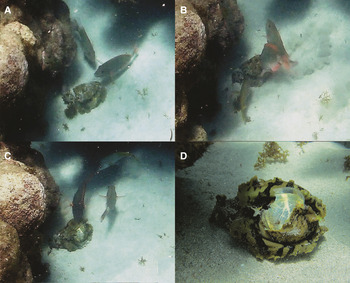
The first feeding event recorded (January 2012) involved a foraging group formed by six Sparisoma frondosum individuals (five initial phases and one terminal phase) and a recently dead adult sea hare (Aplysia dactylomela, 238 mm length). Our observation started when the parrotfish group attacked the sea hare, but we were unable to determine if the sea hare was killed in connection with the attack event. The six S. frondosum individuals consistently approached the sea hare and two of them (both at initial phase, 250 mm total length) bit the sea hare's inner shell and mantle (13 bites recorded) without exhibiting spitting behaviour (Figure 1). The group moved away from the gastropod and returned quickly to bite it again. In addition to S. frondosum individuals, a Sparisoma axillare (Steindachner, 1878) individual at initial phase was sighted near the sea hare while S. frondosum attacked it, albeit not exhibiting any evidence of feeding behaviour. A Haemulon plumieri individual remained near the Aplysia during the whole observation period, moving away when the parrotfish approached.
Feeding event recorded in February 2012: (A) group of Sparisoma frondosum approaching a recently dead Aplysia dactylomela individual; (B, C) S. frondosum individuals biting the sea hare's mantle and shell; (D) shell of A. dactylomela following the attack by the parrotfish.

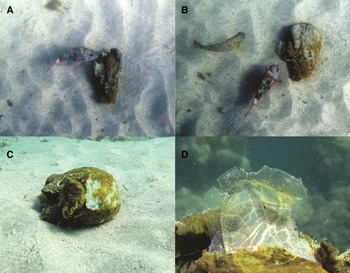
In the second event (March 2012), one initial phase S. frondosum (180 mm total length) individual was sighted biting the flesh and shell (7 bites recorded) of a recently dead adult A. dactylomela, approximately 200 mm in total length (Figure 2); no spitting behaviour was exhibited by S. frondosum. Rather, it swam around the sea hare, moved away from it, and returned to resume feeding. One S. axillare individual (initial phase) was sighted near the S. frondosum individual, occasionally remaining in close proximity to the sea hare's body. However, no attack or consumption took place.
Feeding event recorded in March 2012: (A) Sparisoma frondosum approaching the Aplysia dactylomela individual, biting the sea hare's shell and body; (B) Sparisoma axillare individual with S. frondosum; (C) sea hare's body, showing bite marks; (D) shell of A. dactylomela following feeding by S. frondosum.

DISCUSSION
Feeding on Aplysia has been explored in various experimental studies which centred on fish, sea anemones and crabs as predators (e.g. Pennings, Reference Pennings1990; Ginsburg & Paul, Reference Ginsburg and Paul2001; Pennings et al., Reference Pennings, Nastisch and Paul2001; Rogers et al., Reference Rogers, de Nys and Steinberg2002) in order to test the effectiveness of dietary-derived defences of sea hares and the relationship between their feeding and their vulnerability to predation (Nusnbaum & Derby, Reference Nusnbaum and Derby2010). In general these experiments were performed through exposure of sea hares in the water column, by artificially increasing the encounter rates with potential predators. Specifically in the case of fish predation, sea hares tossed in the water column are possibly more susceptible (Paul & Pennings, Reference Paul and Pennings1991).
While some studies have demonstrated that, when induced, few fish species will consume live sea hares (see Paul & Pennings, Reference Paul and Pennings1991; Pennings et al, Reference Pennings, Nastisch and Paul2001; Rogers et al, Reference Rogers, de Nys and Steinberg2002) records of their natural (not experimental) consumption by fish practically do not exist.
In the two feeding events recorded in north-eastern Brazil, parrotfish species remained close to dead-sea hares and bit their mantle more than once. According to Pennings et al. (Reference Pennings, Nastisch and Paul2001) the majority of algal metabolites found in sea hares, responsible for deterring predators, are located in their internal organs, especially on the digestive gland, and not on the sea hare skin, which in this study was the most consumed component. Furthermore, dead-sea hares do not release ink, increasing the chance of being consumed. It is not known that the ink is the main factor that makes the sea hare unpalatable, but it is possibly a factor that reduces their vulnerability (Ginsburg & Paul, Reference Ginsburg and Paul2001).
Regardless of their feeding specializations, fish in general are highly opportunistic, being able to practically eat any available prey of appropriate size given (Helfman et al., Reference Helfman, Collette, Facey and Bowen2009). This feeding plasticity indicates benefit to opportunistic fish (Lowe-McConnell, Reference Lowe-McConnell1987). Specifically, Sparisoma frondosum is known to feed primarily on the epilithic algal matrix (Bonaldo et al., Reference Bonaldo, Krajewski, Sazima and Sazima2006; Francini-Filho et al., Reference Francini-Filho, Ferreira, Coni, Moura and Kaufman2010). It is known however, that this item is not only small filamentous algae, which forms a small carpet over rocks, calcareous algae or dead corals, but also consists of detritus and sediment aggregations, microbes (including bacteria, cyanobacteria, diatoms and dinoflagellates) and meiofauna (Hatcher & Larkum, Reference Hatcher and Larkum1983; Choat & Clements, Reference Choat and Clements1998; Crossman et al., Reference Crossman, Choat and Clements2005). These associated items complement the epilithic algal matrix with food products of animal origin, which are sources of a large amount of proteins which compared to algae, make a food of higher nutritional value (Bruggemann et al., Reference Bruggemann, van Oppen and Breeman1994; Wilson et al., Reference Wilson, Bellwood, Choat and Furnas2003).
The consumption on dead-sea hares by Sparisoma frondosum is an example of their feeding plasticity and a method of capturing their energetic requirements, by ingesting animal products through sea hares' mantle and possibly through sediment aggregations and associated microorganisms in their skin.
ACKNOWLEDGEMENTS
We thank the Instituto de Desenvolvimento Sustentável e Meio Ambiente do Rio Grande do Norte (IDEMA) for the research permission. Thanks are also due to Professor Dr Tatiana Leite for sea hares identification, to Felipe Torquato, André Castro and Aline Alves for their support with the illustrations, to Paulo Medeiros for constructive comments and three anonymous referees for revising this manuscript. Special thanks to Dr Thomas Carefoot for providing valuable information about the predators of sea hares. This project was supported by CNPq and the Programa de Pós-Graduação em Ciências Biológicas (Zoologia), Universidade Federal da Paraíba scholarship granted to A.L.P. Moreira.