Introduction
The internet, public services and information and advice about problems with a legal dimension
Since the late 1990s, the British Government has promoted the use of the internet as a tool to aid in the dissemination and delivery of advice, information and advocacy services (Cabinet Office 1999, 2000; HM Government 2010). This increased Government Web-presence, also known as ‘e-Government’ (or ‘e-Gov’), has been justified (at least in part) on the basis that the internet may reduce the transaction costs of traditional services by reducing demand for other modes of delivery (Lord Chancellor's Department 1998, 2000; PriceWaterhouseCoopers (PwC) 2009; Saxena Reference Saxena2005).Footnote 1 This is particularly so in relation to legal services, where online self-help/self-service in relation to problems with a legal dimension may go beyond simply promoting public legal awareness; by reducing public demand for more costly state services such as legal aid lawyers, telephone advice, and/or face-to-face community advice and the cost of legal aid and advice provision (Buck, Pleasence and Balmer Reference Buck, Pleasence and Balmer2008; Denvir, Balmer and Buck Reference Denvir, Balmer and Buck2012; Magee Reference Magee2009; PLEAS Taskforce 2007).
With websites offering scalable infrastructure capable of covering the wide variety of information related to the types of ‘problems with a legal dimension’ that individuals might face in their lifetime (such problems include job loss; eviction; terms of employment; the purchase of faulty goods or poor quality services; debt repayment; credit terms; contact with children following the breakdown of relationships; domestic violence; entitlement to welfare benefits; anti-social neighbours; unfair treatment by the police; and planning permission), online advice and information in legal services has become a popular approach, with a number of websites – both government and third sector – having emerged in the last decade.Footnote 2 Planned reforms to legal aid in England and Wales (Ministry of Justice 2011) which propose a change to the public's eligibility for other (traditional) forms of advice and information (e.g. telephone and face-to-face advice) for a variety of problems (Ministry of Justice 2010, 2011),Footnote 3 suggest, if anything, the need for information and advice online is set to rise. A number of areas of legal advice have been excluded from future legal aid provision on the basis that self-help, such as using information found online, offers a sufficient replacement for access to traditional advice for those experiencing such legal problems (Ministry of Justice 2010). However, the appropriateness of legal self-help for particular demographics, particularly where this self-help is intended to be accessed online, has not been widely researched. This is an issue that needs to be addressed given that in certain circumstances or in respect of certain groups – particularly older people – online services present their own set of barriers (Gilbert, Balestrini and Littleboy Reference Gilbert, Balestrini and Littleboy2004) which may compromise the success of online self-help and, consequently, the resolution of individuals’ legal problems.
Barriers to use
Physical access and the ‘first digital divide’
The shift to online provision of legal advice and information, especially where this replaces traditional access to services such as face-to-face advice, poses opportunity and consequence, with outcomes speculated to vary across demographics. Existing research has focused on the importance of home access in facilitating internet use for a wide range of activities (HM Government 2010), although not necessarily for resolving legal problems. Where the resolution of legal problems has been discussed, home internet access appears no guarantee of its use in the resolution of problems with a legal dimension, particularly amongst (somewhat counter-intuitively) the ‘tech-generation’ of 18–24-year-olds (Denvir, Balmer and Pleasence Reference Denvir, Balmer and Pleasence2011).Footnote 4 Yet, findings of a more general nature suggest that home access may be a more crucial catalyst for certain demographics, particularly where access outside the home is limited as may be the case for elderly individuals who are retired, or who suffer from mobility restrictions (Campbell and Wabby Reference Campbell and Wabby2003).
With older individuals defined as unwilling consumers of technological devices they consider to be unnecessary (Haddon Reference Haddon2000), it is perhaps not surprising that while internet use for all age groups has risen steadily over the last decade, those aged over 65 have remained the exception, with their internet use remaining largely unchanged since 2005 (Dutton and Blank Reference Dutton and Blank2011). Efforts to expand internet access and overcome the ‘first digital divide’ have retained presence on the government's agenda during much of the last decade. Policies have included subsidies to support the cost of home internet provision for younger users from low-income households under a pilot project launched in 2009 (Brown Reference Brown2008; Department for Education 2010). Other initiatives have been instigated primarily by local governments, offering free city-centre Wi-Fi access, low-cost equipment or the provision of computers in central community locations (Berry Reference Berry2011). However, so far no nationally co-ordinated government initiatives targeted at older users have come to fruition, despite the Government having identified the digital engagement of older people as a particular priority (HM Government 2011: 15).
Physical access issues in relation to internet use by older individuals have been conceived of predominately in terms of home installation or use outside of the home. Yet, there are also particular limitations that may apply to this age group to a greater degree which arguably constitute physical ‘access’ barriers. For example, sitting for long periods of time, managing hand–eye co-ordination difficulties and being able to see the screen clearly and focus on it at length, are concerns previously and recently raised (Cody et al. Reference Cody, Dunn, Hoppin and Wendt1999; Wong et al. Reference Wong, Fung, Law, Lam and Lee2009); concerns which come in addition to those identified by Morris (Reference Morris2007) and Selwyn et al. (Reference Selwyn, Gorard, Furlong and Madden2003) who note a number of problems relating to motor functioning, cognitive functioning, dexterity, hearing and vision. At least in respect of the latter concern, the Royal National Institute for the Blind (Edwards Reference Edwards2012) has highlighted that the perception of inaccessibility may be more of a barrier than any physical impediment itself. A belief that the internet does not cater to the specific needs of certain population groups may discourage its use, for example, among those with partial or full vision impairment. This is true even where adaptive technology tools are available, including for example, devices that magnify text on screens, read aloud functions, voice recognition technology and ergonomic hardware (O'Hara Reference O'Hara2004). Physical access issues, whether geographic or health related, may in fact make the internet a more feasible method of obtaining advice than traditional services. This is especially true for those located rurally, those with health conditions or mobility impairment, and those who lack the support necessary to access face-to-face advice (AgeUK 2009).
Such physical barriers generate an imperative to design advice websites with the needs of older people in mind; taking care as Basu, Duffy and Davey (Reference Basu, Duffy and Davey2009) note, to provide information responsive to the information requirements of older people. Detlefsen's (Reference Detlefsen2004) research has suggested that such information must be easy to read, with a simple page layout, large font size and use of colour for emphasis. To which Alpay et al. (Reference Alpay, Toussaint, Ezendam, Rovekamp, Graafmans and Westendorp2004) adds: the conservative use of colour; a lack of distracting features; relevant and understandable material; and query search functions which are explicit in detailing how free text should be formulated in order to promulgate the best results. Where necessary, adjunctive widgets designed to explain dynamic content and draw user's attention to the information of most relevance to the user's task may be of particular benefit to the older population (Lunn and Harper Reference Lunn and Harper2011). However, beyond these suggestions there appears little consensus on how websites can be designed to mitigate the cognitive decline inevitably experienced by an individual as he or she ages (Czaja and Lee Reference Czaja and Lee2007; Hanson Reference Hanson2010). Some organisations are mindful of these needs (e.g. AgeUKFootnote 5), others, such as the Government, have been criticised (see e.g. BBC News Online 2006; National Audit Office 2007) for failing to meet their own standards, despite demonstrating an early commitment to promoting e-access by developing a ‘Quality Framework for UK Government Website Design’ in 2003. The Government has also recently rationalised the public sector's Web presence, which among other changes, has led to the closure of the primary legal aid website ‘Community Legal Advice’ (www.communitylegaladvice.org.uk) with content integrated into the DirectGov website (www.direct.gov.uk) initially, before being moved to the GOV.UK website (www.gov.uk) in late 2012. Whilst this has meant there is only one portal for information that users needs to find, it has also led to the loss of a number of accessibility functions as recognised by the Legal Services Commission's 2010Equalities Impact Review.
Internet know-how and the second digital divide
Whilst home access and its increase among the older population is an ongoing concern, physical access is not the only issue at play when it comes to digital engagement. An individual's willingness and capacity to utilise the internet as an information resource and the role this plays in shaping successful interaction online (Attewell Reference Attewell2001; Zhao and Elesh Reference Zhao and Elesh2007) has been the subject of ongoing attention over the last decade. Particular interest has been paid to what is known as the ‘second digital divide’, that is, the way in which equipment, autonomy, skills, support and purpose, all play a role in facilitating online activity (DiMaggio et al. Reference DiMaggio, Hargittai, Celeste, Shafer and Neckerman2004). Added to this, and of particular importance in the use of the internet for civil justice problems, is the consideration that must be given to an individual's help-seeking behaviour and the extent to which internet use would ordinarily feature in this.
This distinction between the physical and what may be considered the ‘mental’ barriers to internet use amongst older people is affirmed in previous studies. AgeUK (2009), for example, reports that those over the age of 65 without internet access can be characterised as either ‘digitally excluded’ by virtue of physical barriers, or ‘digitally dismissive’ in regards to their willingness to use the internet. Previous studies in respect of technology adoption by older people indicate that a lack of internet literacy and a heightened fear of computers both play a role (Czaja et al. Reference Czaja, Charness, Fisk, Hertzog, Nair, Rogers and Sharit2006; Edwards Reference Edwards2012; Mitzner et al. Reference Mitzner, Boron, Fausset, Adams, Charness, Czaja, Diikstra, Fisk, Rogers and Sharit2010). Among older people, the fear that they may do the wrong thing or appear foolish because they lack technological skill acts as a disincentive to internet use (AgeUK 2009). Such findings are echoed in technology adoption studies which identify perceived benefits of use and ease of use (Davis Reference Davis1989) and the extent to which new technologies address an existing ‘individual need’ (Hanson Reference Hanson2010), as central motivations. The benefits of use must additionally outweigh initial start-up costs and the ongoing effort required to learn and keep up with computer updates (Coleman et al. Reference Coleman, Gibson, Hanson, Bobrowicz and McKay2010).
Education is said to play a role in promoting individual willingness to use the internet for information seeking (Campbell and Wabby Reference Campbell and Wabby2003; Iske, Klein and Kutscher Reference Iske, Klein and Kutscher2005) as well as in enabling individuals to distinguish between the quality of advice they find online (Bennett, Maton and Kevin Reference Bennett, Maton and Kevin2008; Puustinen and Rouet Reference Puustinen and Rouet2008; Scott Reference Scott1999). Previous research suggests that education level and peer group frames internet use and that boredom with regular recreational use may result in the diversification of online activity so as to include information and advice-seeking pursuits (Iske, Klein and Kutscher Reference Iske, Klein and Kutscher2005). However, there appears to be no research that distinguishes between the elements of education that matter. That is to say, whether educational attainment plays a role where an individual's education or employment took place before computers were commonplace; or whether individual aptitude acts to overcome or undermine the level of education achieved. Existing evidence in the field does not paint a clear picture, but does suggest that, at least for problems with a legal dimension, education is more relevant for those aged 18–24 than it is for other age groups (Denvir, Balmer and Pleasence Reference Denvir, Balmer and Pleasence2011).
Generational differences equating to lesser familiarity with the internet and its potential uses may also account for the lack of take up amongst older people (Adler Reference Adler2006; Lenhart et al. Reference Lenhart, Rainie, Fox, Horrigan and Spooner2000). Amongst a cohort with a greater absence of basic information technology (IT) skills and lesser confidence in use of the internet (Ofcom 2011), it is not surprising that online help-seeking may hold less appeal, especially given its complexity. Ofcom's 2011 report on internet Media Literacy identifies older people as ‘narrow’ internet users – a cohort which orientates its internet activity predominately around emailing and online bill paying with almost negligible interest in completing government processes online, or finding information out about public services (2011: 39). However, such attitudes do not present homogeneously. Qualitative research conducted by AgeUK in 2009 illustrated that those aged 55–64 demonstrated greater familiarity and receptiveness to internet use than those aged 65 and older and this is a pattern repeated in Ofcom findings (AgeUK 2009; Ofcom 2011).
Older uses also report concerns with trusting the content they access online as well as a diminished confidence in the privacy of their personal details (AgeUK 2009). These results are confirmed by Ofcom (2011) research which suggests that trust in the internet is more strongly related to patterns of use, rather than length of time having used the internet. This is relevant in the field of legal advice and information where the diversity and potential independence of advice may present as a benefit, yet the lack of regulation and the non-mainstream nature of some websites means that issues of credibility and impartiality remain. Issues such as these may not be obvious to the inexperienced or unaware user when finding information online (Sillence et al. Reference Sillence, Briggs, Harris and Fishwick2007) and may act, not just to undermine faith in the reliability of information obtained online, but also as an initial deterrent to use of the internet for the purposes of help-seeking (AgeUK 2009). The same is true of data security concerns which may deter use and although it is contested whether level of trust in technology varies with age (Grimes et al. Reference Grimes, Hough, Mazur and Signorella2010), specially in relation to the procurement of specific types of knowledge (e.g. health, see Zulman et al. Reference Zulman, Kirch, Zheng and An2011), knowledge of privacy and information security online is said to be lower amongst older users (Grimes et al. Reference Grimes, Hough, Mazur and Signorella2010).
Beyond education, experience and access, Xie (Reference Xie2003) and Selwyn et al. (Reference Selwyn, Gorard, Furlong and Madden2003) highlight the role that gender may play in predisposing older individuals towards use/non-use, finding that men report greater use and a more positive attitude towards computers than women. Helsper's (Reference Helsper2010) work detailing the more frequent and wider range of internet use by men than women, especially for older people, leads her to suggest a relationship between generational (offline) gender roles and online use and type of use. Although Helsper (Reference Helsper2010) found that women were more inclined to use the internet to search for personal health advice irrespective of age (perhaps in keeping with their greater inclination to seek health advice in general; see Galdas, Cheater and Marshall Reference Galdas, Cheater and Marshall2005), the same may not be true of civil justice problems where distinct help-seeking preferences and strategies apply. Previous research in the field of civil justice looking at help-seeking in general suggests that problem-solving strategies do not appear to be influenced by gender (Pleasence et al. Reference Pleasence, Balmer, Patel and Denvir2009: 51), however, the gender dimension of online help-seeking specifically appears to have not yet been explored.
More generally, self-help itself (let alone online self-help) may present as a less attractive method of handling a problem for older people, especially given that help-seeking is said to diminish as a person ages (Gourash Reference Gourash1978) and an extensive body of literature highlights the psychological, demographic, interpersonal and environmental variables that may work to activate or suppress an individual's desire to seek information about an issue (see e.g. Cornally and McCarthy Reference Cornally and McCarthy2011; Wilson Reference Wilson2000). Indeed, when it comes to using the internet for help-seeking, research in the field of technological aids for the ‘everyday activities’ of older people has found that adoption is highly problem-specific (Guiliani, Scopelliti and Fornara Reference Giuliani, Scopelliti and Fornara2005).
Whilst little work has been undertaken on older adults preferred mode of advice-seeking for certain problems, Age Concern and Help the Aged's (2009) study exploring the information and advice needs of those over the age of 45 highlighted the relatively few number of individuals who desired to obtain advice via the internet, expressing preferences for face-to-face and telephone advice. For the obtainment of health information and advice, older people have been said to prefer professional and established sources, but were becoming more receptive to online health advice alternatives (Detlefsen Reference Detlefsen2004). With specific regard to legal issues, a legal needs assessment of older adults in six American states (Kentucky, Michigan, Nevada, North Dakota, Ohio and Utah) illustrated relatively low demand for website services (varying between 5 and 25% depending on the State) with even lower demand for learning about offline services via websites (2–3%) (Kaye, Adle and Crittenden Reference Kaye, Adle and Crittenden2010). Basu, Duffy and Davey's (Reference Basu, Duffy and Davey2009) research also suggests that family and often children are the first point of contact for older people seeking advice in respect of a problem (legal or otherwise), as has been shown to be the case since the 1960s (Daatland Reference Daatland1990; Gourash Reference Gourash1978).
Even where willingness, skill and access exist, this is not always a recipe for success in finding information online for any particular problem. For example, the study of Landauer et al. (Reference Landauer, Egan, Remde, Lesk, Lochbaum, Ketchum, McKnight, Dillon and Richardson1992) highlights that effective internet searching is a complex skill, and Ofcom's 2011 study found that half of those who use search engines do not understand search engine results pages (2011: 57). In the context of civil justice problems, Denvir, Balmer and Pleasence (Reference Denvir, Balmer and Pleasence2011) find that positive subjective assessments of success are not necessarily related to home internet access. The work of Czaja et al. (Reference Czaja, Sharit, Hernandez, Nair and Loewenstein2010) in the field of health searches suggests that search performance is more strongly associated with cognitive ability rather than internet know-how for older internet users. This is a concern, given that the cognitive skills necessary for successful searching are said to diminish as an individual ages (Dommes, Chevalier and Lia Reference Dommes, Chevalier and Lia2011) and as the complexity of an information enquiry increases (Sharit et al. Reference Sharit, Hernandez, Czaja and Pirolli2008). This is ominous in respect of civil justice problems, which whilst legal in nature, are rarely defined as such by those who experience them (Pleasence, Balmer and Reimers Reference Pleasence, Balmer and Reimers2010).
Existing policy interest in England and Wales (and arguably elsewhere) has remained focused on issues of access, with limited consideration of the broader issues such as willingness, ability and success in the use of the internet to obtain information and advice related to problems with a legal dimension. Consideration of these latter issues is a matter of clear importance, in respect of recent changes to legal aid and the way in which these changes emphasise both self-help and new (technology-driven) modes of access to advice (Ministry of Justice 2011). Our findings highlight the potential impact of greater provision of online legal services for the older population.
Aim of the study
This study aims to explore the use, patterns of activity and objectives demonstrated by older respondents (those over the age of 60) using the internet to obtain advice and information when faced with everyday problems with a legal dimension (also referred to as ‘legal-related problems’, ‘civil justice’, ‘justiciable’ or ‘rights’ problems)Footnote 6 and explore how they differ from other age groups.
First, internet access and use of the internet is explored by age group, and modelled as a function of age group, home internet access and their interaction. It is hypothesised that for older people, low levels of access will be accompanied by comparably low levels of use of the internet for problems with a legal dimension, but that home access will relate to a major increase in use. Second, use of the internet for problems with a legal dimension is explored as a function of educational qualifications (as a proxy for capability) for all survey respondents, and specifically for older respondents. It is hypothesised that findings will indicate a general pattern of increasing use alongside increasing qualifications, but that this effect will be less prominent for those aged over 60. Third, we examine how gender impacts upon use of the internet for those over the age of 60, and hypothesise that women will be less likely than men to use the internet. Fourthly, we explore what internet users hoped to obtain and what they actually got, again split by age group, as well as how the internet interacted with traditional forms of advice seeking (i.e. telephone or face-to-face). It is hypothesised that older respondents (60 years and older) will be more likely to utilise the internet as a means by which to access traditional services (‘someone to sort out the problem’, ‘an adviser to see in person’, ‘a telephone number of an adviser’) and less likely to be searching for specific information to help resolve the problem, as well as being less likely to be successful in obtaining any information at all. Finally, the increase in use of the internet to deal with problems with a legal dimension over time will be set out.
Method
The English and Welsh Civil and Social Justice Survey
Data in the present study come from the English and Welsh Civil and Social Justice Survey (CSJS). The CSJS, a nationally representative survey of the adult population of England and Wales, provides detailed information on the nature, pattern and impact of people's experience of problems with a legal dimension and the use and success of problem resolution strategies (Pleasence et al. Reference Pleasence, Balmer, Patel and Denvir2009). The CSJS is a substantially developed form of Genn's (Reference Genn1999) landmark ‘Paths to Justice’ survey.
The CSJS sample was drawn by randomly selecting residential addresses from 504 postcode sectors, spread throughout England and Wales. In total, 10,537 adult respondents (aged 18 years or older), living in 6,234 households, were interviewed face-to-face in their own homes between January 2006 and January 2009.Footnote 7 Of the survey respondents 2,894 (27.4%) were aged over 60 years and form the focus of this paper. All interviews were arranged and conducted by BMRB Social Research. The mean interview duration was 25 minutes, though interviews could be considerably longer if problems with a legal dimension were identified.
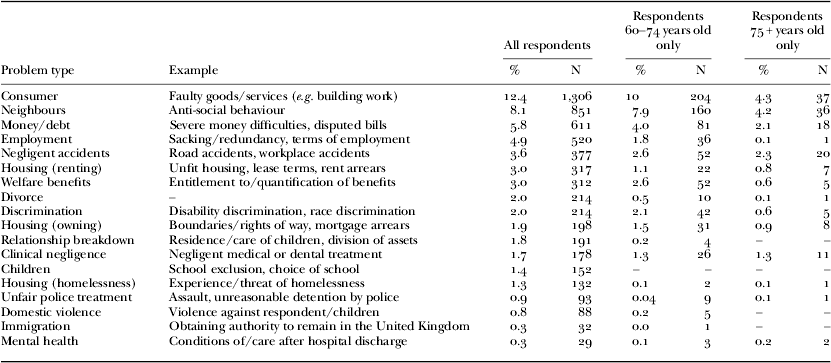
All respondents completed a screening interview, where they were asked if they had experienced a problem, in the three years to the date of interview, that had been ‘difficult to solve’ in each of 18 distinct problem categories. For the two most recent problems identified in each category, respondents were asked (if necessaryFootnote 8) to indicate the nature of the problem and specify whether, and from where, they had sought advice about them. The interview was carefully constructed to limit the problems reported to those to which legal principles can be applied. Problem categories are listed in Table 1, along with examples of the 106 constituent problem types and the proportion of all respondents, and those 60–74 and 75+ years old, reporting having experienced one or more problems of each category.
Percentage and number of all Civil and Social Justice Survey (CSJS) respondents (and all those 60–74 and 75+ years old) reporting one or more problems of each category and examples of constituent problem types

All respondents were asked for a wide range of information about themselves and the household in which they resided. Detailed information was also collected on how respondents dealt with problems with a legal dimension, including details of whether or not they tried the internet to address problems and, more recently, what they hoped to obtain from the internet. If a respondent had experienced at least one problem, he or she progressed to a follow-up (or main) interview, which addressed further aspects of a single problem drawn from those identified through the screening interview.
Throughout the report, analysis was weighted for non-response (i.e. acknowledging that some groups were slightly more or less likely to participate). Weighting is designed to return the profile of the survey respondents (in age and gender) to that of the population of England and Wales.
Analytical strategy
First, use of the internet to address problems with a legal dimension was explored and a multilevel binary logistic regression model was fitted with MLwiN (Rasbash et al. Reference Rasbash, Charlton, Browne, Healy and Cameron2009a) to examine the impact of age, home internet access and their interaction on use of the internet to obtain advice or information for problems. Second, a multilevel binary logistic regression model was fitted to explore the impact of academic qualifications on use of the internet when faced with problems, and how qualifications might interact with age. Third, a further multilevel binary logistic regression model was fitted to explore the impact of gender on use of the internet when faced with problems and the interaction of gender with age. In all models, two-level multilevel models (Goldstein Reference Goldstein2011) were fitted to correct standard errors for any clustering by household (Rasbash et al. Reference Rasbash, Charlton, Browne, Healy and Cameron2009b). Fourth, descriptive analysis was undertaken to explore what respondents hoped to obtain from the internet, what they actually got and how this varied for older respondents, as well as how use of the internet related to traditional advice seeking (face-to-face or by telephone) and self-help. Finally, we explored the growth in the use of the internet to address problems with a legal dimension over time and how this varied by age group.
Results
Age, internet access and use of the internet to address problems with a legal dimension
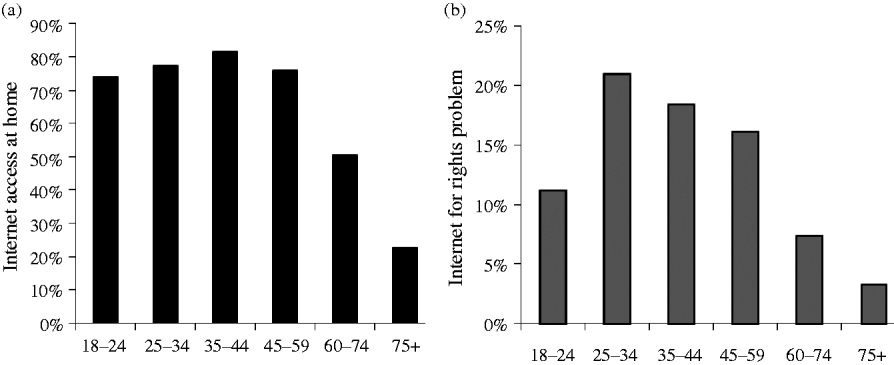
Overall, in the 2006–2009 CSJS, 67.7 per cent of respondents had internet access at home (whether or not they faced problems with a legal dimension) and of those with legal-related problems, 15.6 per cent tried the internet to find advice or information. Home internet access and use of the internet when faced with problems is shown by age group in Figure 1.
Percentage of respondents with internet access at home (a) and percentage trying to use the internet to obtain advice or information for problems with a legal dimension (b) by age group.
As shown, rates of access and use were far lower for older respondents: 50.3 per cent of 60–74-year-olds and 22.6 per cent of those aged 75 or over had internet access at home, while only 7.4 per cent of 60–74-year-olds and 3.2 per cent of those aged over 75 tried the internet to find advice or information when faced with problems with a legal dimension. Contrasting Figure 1 (a) with (b), while use of the internet to address problems was broadly correlated with home access, use when faced with problems with a legal dimension translated to higher percentages for 25–59-year-olds than for 18–24-year-olds and those aged 60 or over. For the youngest and oldest groups, use of the internet to address problems with a legal dimension was lower than might be expected, given their rate of internet access.
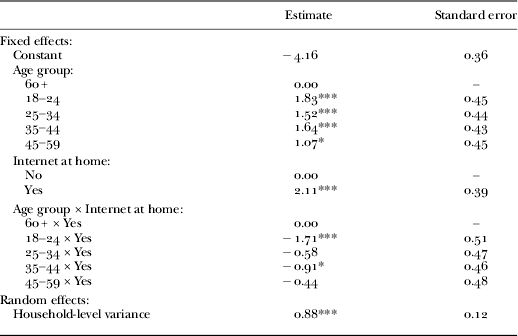
Table 2 shows multilevel binary logistic regression output modelling whether or not respondents tried the internet when faced with problems with a legal dimension on the basis of age group, home internet access and their interaction. Note that 60–74 and 75 or older age groups were collapsed into a single group due to the very small numbers of those aged over 75 using the internet for advice or information (see Figure 1(b)).
Multilevel binary logistic regression model of use of the internet to try to obtain advice/information for problems with a legal dimension on the basis of age group, home internet access and their interaction
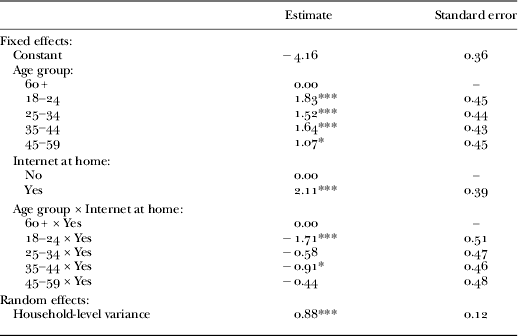
Significance levels: * p < 0.05, *** p < 0.001.
As can be seen in Table 2, age group, having the internet at home and their interaction all had a highly significant impact on the likelihood of using the internet to address problems with a legal dimension.
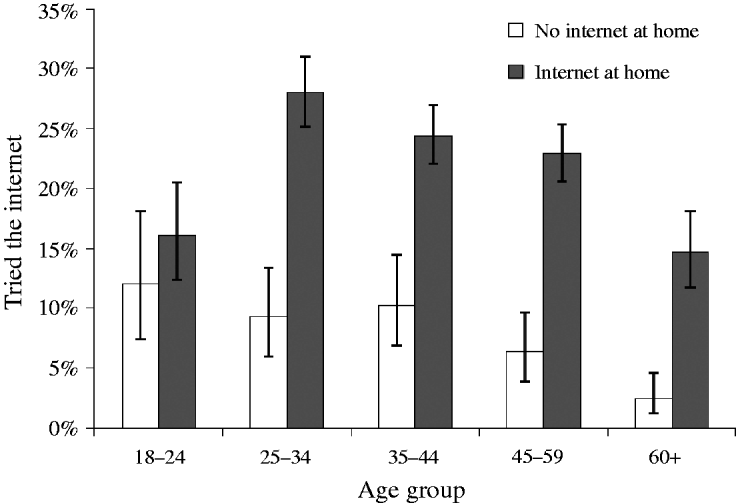
With regard to age group, not surprisingly where they had no internet access at home, older respondents (60 or over) were significantly less likely to use the internet to address legal problems when compared to all other age groups. However, having the internet at home was a particularly important driver of internet use to address legal problems for this group, relating to an increase in its use compared to other age groups, and a significant increase when compared to 35–44-year-olds and particularly 18–24-year-olds (where having the internet at home had little bearing on its use when faced with legal problems). Nonetheless, while having the internet at home related to a greater increase in its use when faced with legal problems than for other age groups, they remained significantly less likely than 25–59-year-olds to utilise it when faced with legal problems even in light of home access (though they were comparable to 18–24-year-olds. Figure 2 illustrates these findings, showing use of the internet when faced with legal-related problems on the basis of age group, home internet access and their interaction (simulated from the model in Table 2).
Percentage of respondents trying the internet by whether they had internet access at home and by age group.
Educational attainment and use of the internet
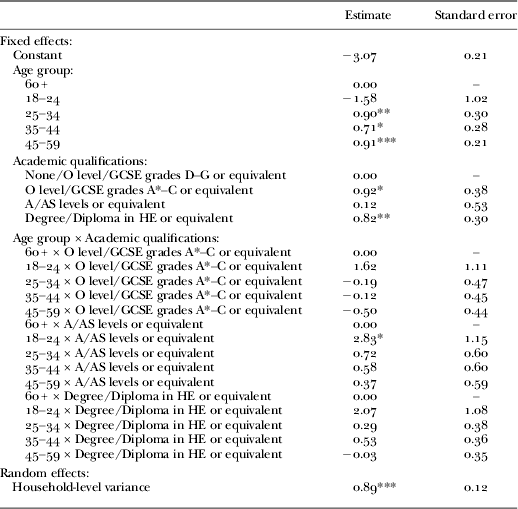
Table 3 shows multilevel binary logistic regression output modelling whether or not respondents tried the internet when faced with a legal-related problem on the basis of age group, education level and their interaction. Note that respondents aged 60–74 and 75+ were again collapsed into a single group due to the very small numbers of those aged over 75 using the internet for advice or information (see Figure 1(b)).
Multilevel binary logistic regression model of use of the internet to try to obtain advice/information for problems with a legal dimension on the basis of age group, academic qualifications and their interaction
Note: HE: higher education.
Significance levels: * p < 0.05, ** p < 0.01, *** p < 0.001.
As can be seen in Table 3, age and academic qualifications had some impact on use of the internet when faced with a problem with a legal dimension, though with the exception of differences for 18–24-year-olds, there was relatively little evidence of an interaction between the two.
As previously, the oldest respondents had particularly low levels of internet use when faced with problems. As shown in Table 3, those over 60 with fewest academic qualifications were significantly less likely to use the internet than comparable 25–59-year-olds. Internet use generally increased with level of qualification, though the picture was somewhat less clear for those over 60, with the highest use for those with GCSE grades A–C or equivalent. In addition, having A/AS levels did not appear to bring about the same increase in use for those over 60, though this may be attributed to the lower numbers of those aged over 60 reporting A/AS levels, rather than the impact of the qualification/s itself. Overall, however, interaction terms were non-significant. The single significant interaction term for 18–24-year-olds with A/AS levels (as well as near significant positive terms for other 18–24-year-old interaction terms) was predominantly a consequence of those with fewest qualifications having particularly low use of the internet for this age group.
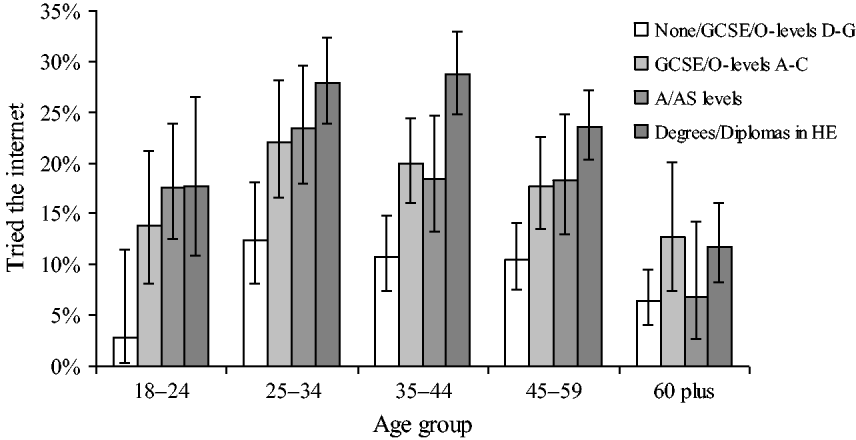
Figure 3 shows use of the internet when faced with legal problems on the basis of age group, education level and their interaction (simulated from the model in Table 3). As shown, the gap between use for those with some qualifications compared to no qualifications was particularly pronounced for 18–24-year-olds. In comparison, for those aged 60 + , education level did not appear to bring about quite as large an increase in internet use.
Probability of using the internet for advice/information when faced with a problem with a legal dimension by age group and academic qualifications.
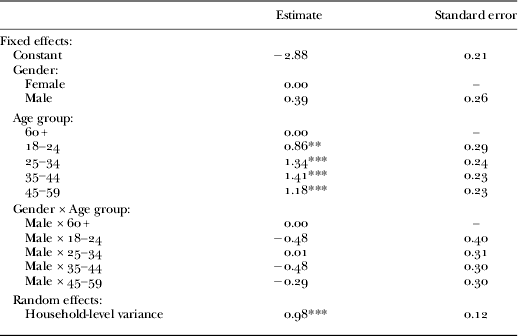
Examining the impact of gender, Table 4 presents a multilevel binary logistic regression model of use of the internet to try to obtain advice/information for problems with a legal dimension on the basis of gender, age and their interaction.
Multilevel binary logistic regression model of use of the internet to try to obtain advice/information for problems with a legal dimension on the basis of gender, age and their interaction
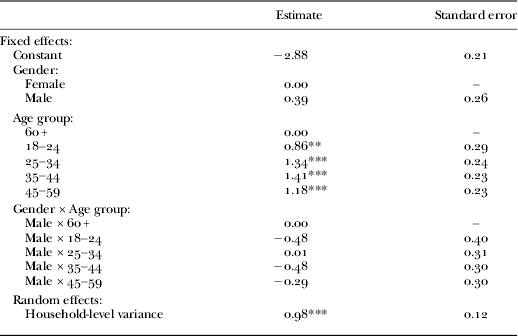
Significance levels: ** p < 0.01, *** p < 0.001.
As shown in Table 4, there was relatively little evidence of gender differences in use of the internet to try to obtain advice/information, and gender by age interaction terms were non-significant. Focusing specifically on those aged 60 or over, there was a modest increase in internet use for male compared to female respondents (7.7 per cent versus 5.5 per cent). For those aged under 60, percentages were 18.4 per cent for male and 17.0 per cent for female respondents. Even when fitting a reduced model containing age (18–59, 60+), gender and their interaction, the interaction term was non-significant. While older men did use the internet more than older women, the difference was not significantly greater than for other age groups.
Expectations of the internet
In the final year of the CSJS (January 2008 to January 2009), questions were introduced to further explore internet use, including questions asking respondents what they hoped to obtain from the internet and what they actually got.
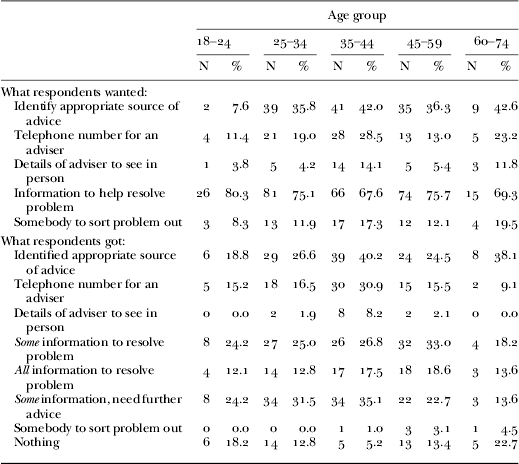
Table 5 shows what respondents who used the internet were trying to obtain and what they actually obtained by age group. Respondents were able to give as many responses as were applicable.
What respondents using the internet to address problems with a legal dimension wanted from it and what they actually got1
Note: 1. A single respondent aged over 75 was removed from the table. For reference, they suggested that they were seeking ‘information to help the problem’ and failed to obtain anything.
As with other age groups, 60–74-year-olds were most frequently looking for ‘Information to help resolve the problem’ and to ‘identify an appropriate source of advice’. While numbers were small, when compared to other age groups 60–74-year-old respondents had the highest percentage, suggesting that they wanted ‘somebody to sort the problem out’ and were less likely to desire ‘information to help resolve the problem’ when compared to other age groups. Like those falling within the 35–44 age group, 60–74-year-olds appeared more likely to utilise the internet as a pathway to obtaining advice in a traditional manner (e.g. ‘details of an adviser to see in person’, ‘telephone number for an adviser’, ‘identify an appropriate source of advice’, ‘somebody to sort out the problem’) compared to other age groups, who reported higher rates of using the internet to resolve the problem – that is, using the internet as an end in itself, rather than as a means to an end.
Referring to what was actually obtained, older respondents had the highest percentage obtaining nothing compared to other age groups and also fared poorly in obtaining the telephone number of an adviser. Of the comparably low percentage of older respondents seeking ‘information’ when compared to other age groups, four of 15 got ‘some’, with three also suggesting they needed further advice, three of 15 suggested they got ‘all’ the information they needed. Both of these findings might account for why, of the older people aged 60 or over who tried to use the internet, only 60.0 per cent went on to obtain face-to-face or telephone advice, compared to 66.9 per cent for 25–34-year-olds, 74.0 per cent for 35–44-year-olds and 70.9 per cent for 45–59-year-olds.
Use of the internet for advice or information and its change over time
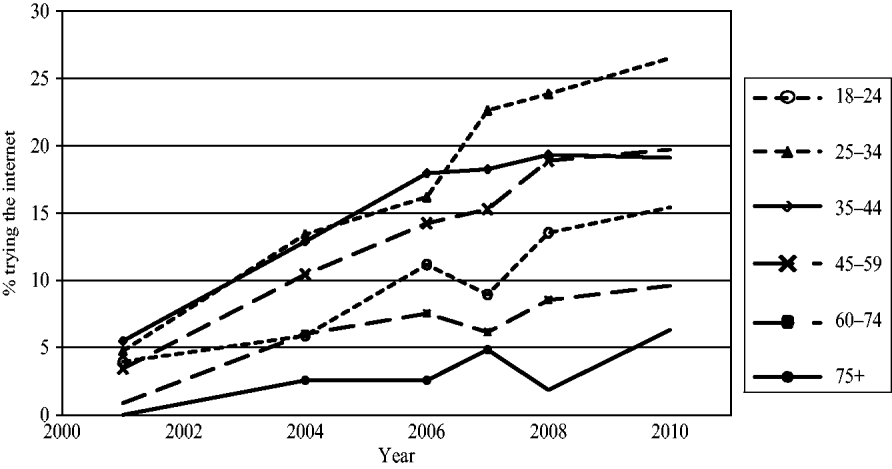
There has been consistent growth in the number of individuals obtaining information from the internet for problems involving rights. Of all problems with a legal dimension in the 2001 CSJS (then called the Survey of Justiciable Problems, see Pleasence et al. Reference Pleasence, Buck, Balmer, O'Grady and Genn2004), respondents sought information or advice from the internet for just 160 of 3,908 problems (4.1%). By the 2004 CSJS, this percentage had increased considerably to 283 of 2,705 problems (10.4%). Over the course of the most recent CSJS, use of the internet for advice or information for legal-related problems has increased still further, from 14.1 per cent in 2006 (267 of 1,892) to 15.6% in 2007 (343 of 2,200) and 17.7% in 2008 (358 of 2,024). The most recent figures from the English and Welsh Civil and Social Justice Panel Survey for 2010 suggest that respondents tried the internet for 348 of 1,828 problems (19.0%). Figure 4 shows use of the internet when faced with problems from 2001 to 2010, split by age group.
Percentage trying the internet for advice or information when faced with a problem with a legal dimension from 2001 to 2010.
As can be seen from Figure 4, growth in use of the internet has been most dramatic for those falling with the range of 25–59 years of age. Given the increasing use of the internet for problems with a legal dimension, we might anticipate this trend to continue for those over age 60 into the future.
Discussion
Our results demonstrate that there has been a consistent increase in use of the internet for those seeking advice for problems with a legal dimension across the 2001–2009 span of the CSJS, rising from 4.1 per cent in 2001 to 16.6 per cent in 2009. Yet older people are both less likely to utilise the internet for finding information pertaining to legal problems, as well as being less likely to have access within their own homes. In contrast with other age groups (particularly 18–24-year-olds), older respondents showed a large leap in use where they had home access. It would appear that alternative access for those without home access was more significant for younger respondents. These findings demonstrate our first hypothesis to be correct.
Whilst level of academic qualification appeared to have some influence on whether older respondents utilised the internet for help-seeking, use did not rise smoothly with qualifications as could be seen for other age groups. However, as hypothesised, older people with the lowest level of educational attainment did have the lowest level of use. It should be noted that some qualifications (e.g. A/AS levels) were far less common for older respondents and are subject to far higher error. Nonetheless educational qualifications appeared less significant for older respondents in predicting use of the internet for problems with a legal dimension.
Older men (60+) were somewhat more likely than older women to use the internet to try to obtain advice/information (7.7 per cent versus 5.3 per cent), confirming the hypothesis regarding their increased use. However, the difference was not significantly greater than for other age groups (see Table 4), with little evidence of an interaction between gender and age in internet use when faced with problems.
Older people were more likely than other age groups to use the internet in order to find ‘someone to sort out the problem’ and to ‘identify an appropriate source of advice’ as well as showing comparably high rates of use to obtain the ‘telephone number of an adviser’ or ‘details of an adviser to see in person’. Whilst obtaining ‘information to sort out the problem’ remained the most frequently reported objective, it was reported less frequently by those over 60 than it was by other age groups. The findings demonstrate our fourth hypothesis to be correct, as there was an increased tendency amongst those over 60 to utilise the internet as a means by which to access offline advice.
Our results also suggest that for the oldest age group, internet use is likely to increase as the population ages, with younger uses (who are currently more likely to use the internet) remaining consistent in their willingness to use the internet as they age. As such, we would anticipate a greater number and proportion of older people using the internet going forward.
Current and future use of the internet by older people
The increase in internet use seen across the life of the CSJS is in line with increasing patterns of general internet use and access across the population (Dutton, Helsper and Gerber Reference Dutton, Helsper and Gerber2009) although our findings depart from Dutton and Blank's (Reference Dutton and Blank2011) 60+ specific results which suggest that use for this age group has not substantially increased. Our findings in respect of the lesser use of and access to the internet demonstrated by older people correlates with findings from a number of large-scale studies (Adler Reference Adler2006; Ofcom 2011). Findings also correspond to Ofcom (2011) results and are in keeping with findings establishing older users as typically difficult to reach in respect of promoting IT use (Basu, Duffy and Davey Reference Basu, Duffy and Davey2009).
In addition, and not surprisingly, older respondents had low levels of internet use when faced with problems. Of those who did use the internet, home access appeared to be key – suggesting that the first digital divide remains an ongoing barrier for this age group. It may well be that unlike other age groups where access may be obtained in educational or employment settings, there are little alternative means by which those aged over 60 can access the internet. The demonstrated lack of access at home may be, as Haddon (Reference Haddon2000) suggests, an issue of cost or as Davis (Reference Davis1989) suggests, one of cost/benefit. Alternatively, given the fact that older people are more often utilising the internet to direct them to offline services, we could conclude that older people are more inclined to use the internet as a signposting tool rather than as an information resource. This may explain why those without home access are far less likely to seek access to the internet elsewhere, perhaps not simply because access is unobtainable but potentially also because they have alternative signposting mechanisms they can utilise. We cannot rule out that non-use may be attributable to anxiety surrounding internet use or a lack of IT know-how, as has been suggested (AgeUK 2009; Cody et al. Reference Cody, Dunn, Hoppin and Wendt1999; Czaja et al. Reference Czaja, Charness, Fisk, Hertzog, Nair, Rogers and Sharit2006; Mitzner et al. Reference Mitzner, Boron, Fausset, Adams, Charness, Czaja, Diikstra, Fisk, Rogers and Sharit2010). However, the pattern of older people's use leads us to suggest that their lack of internet use may also be accounted for by a greater inclination towards traditional forms of help-seeking such as via family and friends, as Daatland (Reference Daatland1990) contends.
In respect of the relationship between educational attainment and internet use, we found it less applicable here in respect of older people compared to other age groups. This sets our findings slightly apart from that of previous research (Iske, Klein and Kutscher Reference Iske, Klein and Kutscher2005) although the timing of education for those currently 60+ may be of importance. It is also possible that the impact of education has been muted by the role life experience plays in compensating for lower attainment, as has been previously suggested (Denvir, Balmer and Pleasence Reference Denvir, Balmer and Pleasence2011). Were this to be the case, it might explain why educational attainment appeared a less important factor dictating internet use for older people, yet remains a variable of significance for younger respondents who may rely on education to provide cues where life experience does not.
While women over 60 were marginally less likely to use the internet to address problems than men over 60, the concept of ‘traditional gender roles’ influencing online activity would require additional analysis, since our models did not take the marital status of respondents into consideration. As it stands, older people are less likely to use the internet in general: the fact that older women were less likely to use the internet than their younger counterparts is therefore not surprising. As Helsper (Reference Helsper2010) notes, a generational influence may be at play, however, since we did not find a large difference in internet use by men and women over the age of 60, any generational difference would appear to apply as equally to men as to women.
Whilst we predict that internet use among those aged 60+ will increase in the long term, we attribute this to the presumption that those in the 25–59 age groups will retain their willingness to use the internet as they age into their sixties. In the short term, we would anticipate only small increases in use amongst the current generation of over sixties as they age. We attribute this to our belief, based on the evidence detailed herein, that use is contingent upon home access (or ease of access outside the home), know-how, educational attainment (to varying degrees) and personal advice-seeking behaviours that may be linked to generational differences. The latter factor may account for why younger users tended to see the internet as a means in itself, using it to try to obtain information to help resolve the problem, rather than a means to an end, as older users often did in trying to find routes to offline sources of advice. This interpretation would explain the lesser rate of home access amongst older users who may not see the benefit of a tool they believe duplicates the work of a directory service and which, by virtue of this, is unnecessary (Haddon Reference Haddon2000). It may also account for Ofcom's (2011) findings indicating that older people are much more likely not to be intending to obtain home access in the near future. This perception of the internet by those over 60 may be a generational anomaly as Lenhart et al. (Reference Lenhart, Rainie, Fox, Horrigan and Spooner2000) and Adler (Reference Adler2006) note – a combination of the fact that for those aged 60+ the majority of their life has been spent without the internet, and without online resources. Campaigns intended to promote the internet as a self-help tool or information resource may act to displace this presumption. However, the utility of such an endeavour cannot be ascertained without a better understanding of whether it is their perception of the internet or their entrenched advice-seeking behaviour which frames the online activity and expectations of those over 60.
Of those older people who do use the internet for information and advice in respect of legal problems, they are less likely to achieve their objectives. This may be a reflection of their typical pattern of ‘narrow use’ and their reported lesser confidence using the internet (Ofcom 2011), providing some support for the continued existence of a second digital divide. Irrespective, it is clear that general IT skills are not conducive to success in obtaining information online in this study as in previous studies (e.g. Denvir, Balmer and Pleasence Reference Denvir, Balmer and Pleasence2011; Landauer et al. Reference Landauer, Egan, Remde, Lesk, Lochbaum, Ketchum, McKnight, Dillon and Richardson1992). This will have implications for government policy which at present emphasises the need to generally improve IT skills amongst citizens (HM Government 2010, 2011). It will also have implications where continued moves to e-Government are made, particularly where such moves seek to shift access to advice services online.
Conclusion
Policy efforts to widen home access, coinciding with increased general ‘up-skilling’, may support a general increase in internet use, particularly among those aged over 60. However, more substantial interventions are likely to be required in order to displace entrenched advice-seeking behaviours and/or preconceptions relating to the purpose and benefit of online activity. Beyond this, the design of websites and their ease of use will inevitably play a role, not just in promoting e-Government, but also in enabling individuals to obtain the information they require. Converging www.communitylegaladvice.org.uk into www.gov.uk has meant the subsequent loss of features such as: website foreign-language translation; advice delivered via video in ‘British Sign Language’ format; accessibility features; the legal aid directory of providers; self-help tools; and advice search functions (Legal Services Commission 2010). Whilst tailoring online services to promote accessibility comes at a price given that the greater the customisation, the greater the costs (Hazlett and Hill Reference Hazlett and Hill2003), failing to consider such accessibility issues may discourage use, particularly amongst those over 60, given their already low level of utilisation. In addition, it may undermine the quality of services provided, making it hard to justify further IT investment (Al-Kibsi et al. Reference Al-Kibsi, de Boer, Mourshed and Rea2001; Hazlett and Hill Reference Hazlett and Hill2003). These recent developments in respect of www.gov.uk have to be balanced with the government's recognition that older people have specific accessibility issues (HM Government 2011).
Whilst transaction savings will not be achieved if the internet is merely seen or used as a precursor to obtaining advice in a traditional format, we would argue that website services for legal-related advice and government activity, particularly for older users, should be considered an option and not the only option. Recent changes to the delivery of legal aid and the availability of legal advice in certain areas of law (Ministry of Justice 2010, 2011) suggest that in the coming years a decline in the availability of traditional forms of advice may place even greater emphasis on self-sufficient handling of problems and searching for information online (Justice for All 2011). Any such eventuality will have particular implications for older users, who are clearly less inclined and potentially less well-equipped to manage such a transition. More crucially, we would stress that placing advice or information online is no guarantee that people will find it, irrespective of their age, even where they possess adequate computer skills and continuing access. Nor is it a guarantee that such information will be sufficient to enable individuals to forgo the need to obtain additional help from elsewhere. As yet, little is known about how people search online for information. Our results suggest that successfully obtaining information online, particularly where this information is orientated towards independent problem resolution, is not as easy as it appears. This is a finding that has relevance for the delivery of legal advice and information in all jurisdictions, not only in England and Wales.
Further research
Whilst much has been said about the need to digitally engage older users, little has been said about how this can feasibly be achieved. If offline services are to be decreased with the expectation that individuals can or will go online for advice, further research needs to be undertaken. A necessary part of this research will be to investigate with greater clarity the process by which older people search for information and advice online and the factors that might dictate their success in obtaining the information they require. Beyond this, research needs to better understand how online self-help brings about problem resolution and the extent to which it can, in itself, enable the resolution of civil justice problems, without requiring individuals to seek alternative offline assistance.