Introduction
Attention deficit hyperactivity disorder (ADHD) is characterized by symptoms of impaired attention, hyperactivity, and increased impulsivity and is considered the most common childhood mental disorder. Recent research has documented its persistence into adulthood showing that about 50% of children diagnosed with ADHD retain symptoms of ADHD into adulthood (Barkley, Reference Barkley2002; Faraone et al., Reference Faraone, Biederman and Mick2006; Okie, Reference Okie2006; Asherson et al., Reference Asherson, Chen, Craddock and Taylor2007; Centers for Disease Control and Prevention, 2010; Merikangas et al., Reference Merikangas, He, Burstein, Swanson, Avenevoli, Cui, Benjet, Georgiades and Swendsen2010).
The prevalence of adult ADHD has recently been estimated at 4% in two community-based epidemiological studies (Faraone et al., Reference Faraone, Biederman and Mick2006; Kessler et al., Reference Kessler2006) and is today assumed to present throughout the lifecycle. The persistence of ADHD symptoms is, however, largely lacking especially in older populations. A systematic literature survey of PubMed and PsychLit up to and including August 2011 revealed only seven relevant studies (Kooij et al., Reference Kooij, Buitelaar, van den Oord, Furer, Rijnders and Hodiamont2005; da Silva and Louza, Reference da Silva and Louza2008; Wetzel and Burke, Reference Wetzel and Burke2008; Guldberg-Kjär and Johansson, Reference Guldberg-Kjär and Johansson2009; Manor et al., Reference Manor, Rozen, Zemishlani, Weizman and Zalsman2011; Brod et al., Reference Brod, Schmitt, Goodwin, Hodgkins and Niebler2012). The study of ADHD in old age offers a major methodological challenge in the context of a lifespan developmental perspective, a challenge that ideally requires a prospective longitudinal design. Identifying ADHD symptoms in older adults also requires verification of previous ADHD manifestations and that the symptomatology has persisted throughout the lifespan with onset in childhood. In addition, diagnostic criteria for ADHD also require pervasiveness across situations/settings that can be difficult to define for those retired, adults in their 60s, 70s, and beyond. Interestingly, in the first large-scale epidemiological study of psychiatric disorders including adult ADHD, adults over the age of 45 years were excluded due to “concern of recall failure among older adults” (Kessler et al., Reference Kessler2006). Increasing evidence for the persistence of ADHD, however, suggests that the impact of the disorder in many cases remains into adulthood and even perhaps into older ages (Biederman et al., Reference Biederman, Faraone, Spencer, Mick, Monuteaux and Aleardi2006; Mordre et al., Reference Mordre, Groholt, Kjelsberg, Sandstad and Myhre2011; Bernardi et al., Reference Bernardi2012). Considering both the present and future demographic age structure in society, research, and healthcare systems are therefore challenged to direct their awareness to ADHD across the entire lifespan. There are recent reports of an increasing number of patients 60 years or more who suspect that they might have an ADHD history and now demand to be investigated (Manor et al., Reference Manor, Rozen, Zemishlani, Weizman and Zalsman2011; Brod et al., Reference Brod, Schmitt, Goodwin, Hodgkins and Niebler2012). The increasing evidence that childhood ADHD can persist into adulthood addresses the question whether ADHD also remains into older age groups. In a recent Dutch study (Michielsen et al., Reference Michielsen, Semeijn, Comijs, van de Ven, Beekman, Deeg and Kooij2012), the prevalence of syndromatic ADHD in older adults was found to be 2.8%, demonstrating that ADHD does not fade or disappear.
The aim of this study was to examine specifically whether ADHD symptoms may persist across the lifespan by comparing self-reports from a sample of older adults concerning current ADHD symptoms and the degree they experienced in childhood using the Wender Utah Rating Scale (WURS) for childhood symptoms and a Swedish Scale, Wender Riktad ADHD Symtom Skala (WRASS), for current symptomatology. We expected higher scores on WURS to be related to higher WRASS scores.
Methods
Study sample
From our previous study (Guldberg-Kjär and Johansson, Reference Guldberg-Kjär and Johansson2009) of a population-based sample of 1,599 persons in the age range 65–80 years, we identified all individuals with a total WURS score of 36 or more. Out of those 52 individuals, 30 accepted participation in the present follow-up. A group of 30 individuals amongst those with a total WURS score below 36 was derived randomly for comparison.
The sample for the present study consists of 60 individuals (30 individuals with a total WURS score of 36 or more and 30 individuals with a total WURS score below 36). All individuals accepted participation and written informed consent was obtained from all subjects. The age range was 66–86 years; mean age 74.4 (SD = 5.2).
Attrition
Reasons for non-participation among the 22 individuals (16 males, 6 females) with a WURS score of 36 or more are known for 17 subjects; 3 reported compromised health/frailty, 2 were deceased, 1 had moved to another part of Sweden and 11 (50%) declined without any stated reason. In five cases, we have no information regarding the reasons for non-participation. Attempts to gather more detailed information about reasons for non-participation from these five individuals were made several times through telephone calls but without success. In the comparison group with a WURS score below 36, there were no dropouts besides one man who was deceased and randomly replaced by another man.
Procedure
Approval for the study was obtained from the Regional Ethical Review Board in Lund (Dnr 194/2004). Subjects from our previous study, where no personal meeting took place were in this follow-up study asked for participation in a personal meeting in an information letter in which they were instructed to return their reply in a prestamped envelope together with a signed form for informed consent if they accepted participation. Two reminders were sent within a 3–4-week interval. Reasons for non-participation were collected when reported. Participants were recontacted by telephone and scheduled for a follow-up interview at Hässleholm hospital, Sweden. If they were unable or unwilling to travel, a home-based interview was offered. Semi-structured interviews with the Swedish Scale, WRASS, a Swedish version of the Targeted Attention Deficit Disorder Rating Scale (TADDS), (Wender, Reference Wender1995) were conducted in one session lasting between 60 and 90 minutes. All interviews were conducted by author Taina Guldberg-Kjär. Although, the interviewer was not blind to the results on the WURS scale, this potential bias was counterbalanced by the semi-structured format of the interview, by the interviewers’ expertise in neuropsychology and geropsychology that motivated the elderly person's participation and willingness to provide accurate information.
ADHD – identification and measurement
The methodological framework for our study comprised the restrictive Utah Criteria, developed to identify a homogeneous “core” of ADHD cases. These criteria require assessing both childhood and adult signs and symptoms, preferably using the subjects’ parents to assess their childhood behavior and a “significant other” to assess current symptoms. The criteria for a childhood history consistent with ADHD are defined by A or B:
A. Narrow criteria. The individual met DSM-IV criteria for ADHD in childhood (six of the nine signs or symptoms of inattention and/or six of the nine signs or symptoms of hyperactivity/impulsivity).
B. Broad criteria. The individual had a history of attention deficits and hyperactivity, and at least one of the following: behavior problems in school, impulsivity, overexcitability, or temper outbursts. The patient also had a “Parent Rating Scale” or “Wender Utah Rating Scale” score in the 95th percentile.
The adult criteria are at least moderate impairment including both motor hyperactivity and attentional difficulties, plus at least two of the following characteristics: “affective lability, inability to complete tasks/disorganization, hot temper, emotional over-reactivity/stress intolerance, and impulsivity” (for details see Wender, Reference Wender1995; Reimherr et al., Reference Reimherr, Hedges, Strong, Marchant and Williams2005).
– WURS and WRASS
The results from the WURS version used in our previous study (Guldberg-Kjär and Johansson, Reference Guldberg-Kjär and Johansson2009) were employed in present study as retrospectively self-rated amount childhood ADHD symptoms. The WURS was developed by Wender and collaborators (Ward et al., Reference Ward, Wender and Reimherr1993; Wender, Reference Wender1995; Reference Wender2000) to guide clinicians in using retrospective self-reports in diagnosing childhood ADHD in adults. A cut-off score of 36 and more was suggested to distinguish non-patients from patients with ADHD and depression (Ward et al., Reference Ward, Wender and Reimherr1993). Using a cut-off score of 46 and more, 86% of patients with ADHD, 99% of normal subjects, and 81% of depressed subjects were found to be correctly classified (Ward et al., Reference Ward, Wender and Reimherr1993). The WURS scale is described in detail in Ward et al. (Reference Ward, Wender and Reimherr1993). The 25-item Swedish version used in our previous study (Guldberg-Kjär and Johansson, Reference Guldberg-Kjär and Johansson2009) is still a widely used instrument for identifying ADHD symptoms in the Swedish clinical context. Cronbach's α in our sample (Guldberg-Kjär and Johansson, Reference Guldberg-Kjär and Johansson2009) was 0.92, indicating good internal consistency.
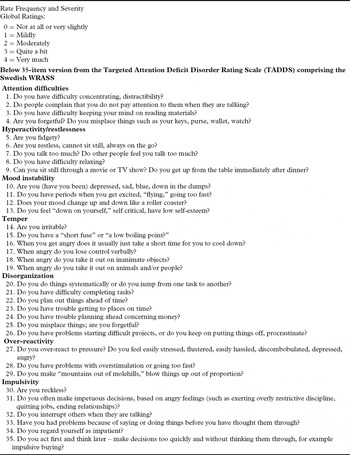
WRASS is a modified and Swedish version of the TADDS (Wender, Reference Wender1995), named “Wender Riktad ADHD Symtom Skala” to capture persisting ADHD symptoms in adulthood. The scale properties of the TADDS are described by Paul Wender in his book Attention-Deficit Hyperactivity Disorder in Adults (Wender, Reference Wender1995). The TADDS has later been further developed and modified (Reimherr et al., Reference Reimherr, Hedges, Strong, Marchant and Williams2005) and is presently known as the Wender–Reimherr Adult Attention Deficit Disorder Scale (WRAADDS). The TADDS measures symptoms in seven categories: attention difficulties, hyperactivity/restlessness, temper, mood instability, disorganization, over-reactivity, and impulsivity. The Swedish version of the TADDS, the WRASS, is largely based on the TADDS. It consists of in total 35 items and rates individual items from 0 to 4 (0 = not at all or very slightly, 1 = mildly, 2 = moderately, 3 = quite a bit, 4 = very much). The range of total scores is 0 to 140. Like the TADDS, the WRASS scale covers the above seven categories. There are no clear cut-off scores for WRASS, but scores of 70 or more are generally considered as a cut-off level based on clinical experience. We used WRASS as a clinician-administered, semi-structured interview. The 35-item WRASS version used is back-translated into English (see Table 1) by coauthor Dr Sally Sehlin, who originally translated and presented the scale in Sweden. Cronbach's α in our sample for WRASS was 0.97 indicating good internal consistency.
Wender Riktad ADHD Symtom Skala (WRASS), Interview version (modification of the Targeted Attention Deficit Disorder Rating Scale (Wender, Reference Wender1995)a

aModified and translated into Swedish by Sally Sehlin 1998.
Data analyses
The total score for the WRASS was calculated for each subject. Subsequent data analyses were conducted in three steps. First, differences between samples in total WRASS score were investigated. Next, we examined potential gender differences in the total WRASS score. Finally, we examined whether any associations between obtained WRASS scores and age, gender, marital status, educational level, occupational history, subjective health and memory, and amount of perceived problems in childhood using t-tests, χ2, and correlations. All tests were two-tailed with statistical significance set at p < 0.05. The analyses were performed using the SPSS package, version 17.0.
Results
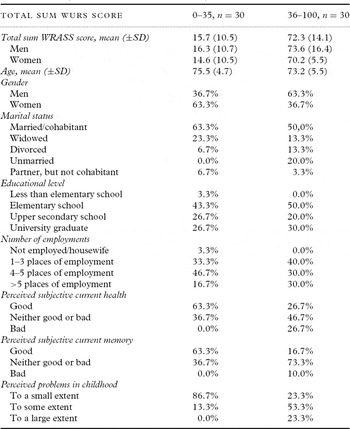
The mean WRASS score in the total sample was 44.02 (median = 49.00, SD = 31.11, range = 4–97). As shown in Table 2 amongst those with a WURS score of 36 or more, 16 (53.3%) individuals scored 70 or more (i.e., the clinical cut-off 70 used in Sweden). None of the individuals with a WURS score below 36 scored 70 or higher on WRASS. The WRASS mean score was 15.7 amongst those with a WURS score lower than 36 and 72.3 amongst those who scored 36 and above.
Descriptive characteristics of the sample (n = 60)

SD = standard deviation; WURS = Wender Utah Rating Scale; WRASS = Wender Riktad ADHD Symtom Skala (modified TADDS = Targeted Attention Deficit Disorder Rating Scale; Wender, Reference Wender1995).
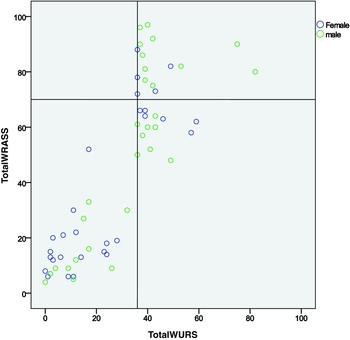
Significant differences in total WRASS scores were found between those with WURS scores of 36 and higher and those with scores below 36 (t = −17.64, df = 58, p = 0.000). Figure 1 demonstrates that those who reported more childhood ADHD symptoms also reported significantly more current ADHD symptoms (median = 72.50, SD = 14.12, range = 48–97). Those who rated less childhood ADHD symptoms also rated less current ADHD symptoms (median = 13.00, SD = 10.49, range: 4–52).
Scatterplot for the correlation between the total WURS and WRASS scores in the study.

Age was not associated with the WRASS scores. The mean WRASS scores, however, differed significantly between all men and women (t = −2.032, df = 58, p = 0.047), men rated more frequently current ADHD symptoms. Separate analyses of gender differences among those with a WRASS score below and above 70 revealed no gender differences.
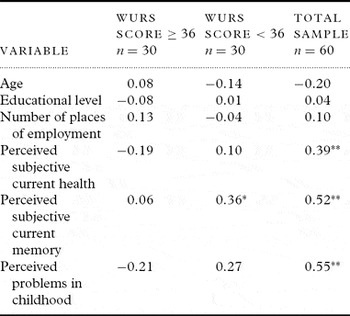
In the total sample (n = 60), we found that the total WRASS score was significantly associated with perceived subjective current health (r = 0.39), memory (0.52), and perceived problems in childhood (0.55). These associations did not remain significant in analyses based on a split, according to the WURS cut-off of 36, but the direction remained informative for current memory problems and problems in childhood. This was, however, only true amongst those with a WURS score lower than 36 (see Table 3).
Correlations between the total WRASS score and variables in the study

*p < 0.01.
**p < 0.001.
We also examined whether there were any differences between individuals with a WRASS score below (n = 14) and above (n = 16) the cut-off at 70. This comparison revealed no significant differences for age, gender, education, marital status, number of children, nor in responses to the questions concerning problems in childhood, current health, and memory.
Discussion
Our present study was designed to examine ADHD symptomatology across the lifespan by comparing the amount of self-reported ADHD symptoms in childhood and at present in a population-based sample aged 66–86 years.
The main finding was that there existed a significant persistence of self-reported ADHD symptoms over the lifespan, as those who reported more childhood ADHD symptoms on the WURS scale also rated more current symptoms at a high age on the WRASS scale. Notably, in the sample with a WURS score of 36 or higher, 16 or more than half of this subsample also scored 70 or more on the WRASS. Although this clinical cut-off level is not yet standardized, it is typically used as the level or rule of thumb for identifying adults who are likely to have an ADHD history. Similarly, individuals who reported less childhood ADHD also reported to a lesser degree of current ADHD symptoms and none of the individuals with a WURS score below 36 scored 70 or more on the WRASS.
A weak gender difference was found for the total WRASS score, namely that men rated more current ADHD symptoms compared to women. Interestingly, no gender differences were found in the total WRASS score when our total sample was divided into those with a WURS score of 36 or more and those with scores below 36. This is an interesting finding that might have clinical implications because the mean score for WRASS in our subsample of those with WURS score of 36 or more in fact was as high as 72.3. A high WURS score, based on retrospective reports of childhood functioning, seems to be consistent with symptoms corresponding with ADHD in late adulthood. In this respect, our finding seems to provide support for the current Swedish clinical cut-off of 70 suggested for the WRASS scale.
We also examined whether other self-evaluations of past and present situations mirrored the amount of current ADHD symptoms. Overall perceived problems in childhood, perceived impaired current health and memory turned out to be significantly related to current ADHD symptoms, more so for men than women. However, we found no gender differences in our subsamples when covariates were tested for their potential associations with current ADHD symptoms. Our present results confirm the findings in our previous study (Guldberg-Kjär and Johansson, Reference Guldberg-Kjär and Johansson2009), where perceived overall problems in childhood as well as subjective impaired current health and memory were perceived to be significantly related to the amount of current ADHD symptoms reported. This might be critical in a clinical setting aiming to identify a potential ADHD history in older adults. In a differential-diagnostic perspective, critical questions also arise concerning how we can differentiate ADHD in old age from depression, possible dementia, and other psychiatric conditions that might imitate ADHD symptoms. Other questions in need to be addressed are: What is the unique expression of ADHD in old age? How is normal mental status influenced by persistent ADHD? How do lifelong ADHD-associated difficulties in executive functioning compromise adaptation in old age? A small study of 11 patients, 55 years and older, assessed and treated for ADHD reported no significant decrease with age of the overall ADHD symptomatology but indicated that the symptoms may evolve and take on new forms, although dysfunction and impairment remain, alongside a persistent distress (Manor etal., Reference Manor, Rozen, Zemishlani, Weizman and Zalsman2011). Interestingly, they also observed that older adults similarly to younger adults are likely to underestimate their own impairments (Manor etal., Reference Manor, Rozen, Zemishlani, Weizman and Zalsman2011). Studies of healthy older adults have shown age-related deficits in emotional/cognitive integration as well as in executive function (e.g. Baena etal., Reference Baena, Allen, Kaut and Hall2010) that taken in conjunction with the evidence presented for deficits in emotional self-regulation as a core component of ADHD in one recent study (Barkley, Reference Barkley2010), raises questions whether age-related cognitive changes affect adults with an ADHD history to a greater extent. Some recent studies have also interestingly shown an association between ADHD and the development of dementia with Lewy bodies (Golimstok etal., Reference Golimstok, Rojas, Zurni, Doctorovich and Cristiano2010) and between childhood symptoms of ADHD and the development of Parkinson's disease (Walitza etal., Reference Walitza2007). Questions have also been raised about the effects of hormonal changes in later life on individuals with ADHD (Nadeau and Quinn, Reference Nadeau and Quinn2002). An ultimate question in a lifespan perspective is how various aging-related outcomes will become manifest in new birth cohorts and generations of individuals identified with ADHD.
Considering the fact of an increasing number of older individuals with a history of ADHD and the substantial increase worldwide in population aging, our basic knowledge of this disorder as well as information regarding burden of individuals daily functioning is still sparse. For example, in Sweden where our study was conducted 25% of the population is expected to be 65 years or more in 2060, a fact that makes ADHD in old age a challenge for the healthcare system. Results from our follow-up study suggest that an ADHD assessment should be considered regardless of the age because a majority of older adults will otherwise continue suffering from ADHD symptoms without an understanding of the origin of the problems they likely experience and which, hopefully, could be ameliorated if availed professional help.
The main limitations of the present follow-up study were the small sample size, reliability of self-reports, and the fact that the subjects WURS results were not blind for the interviewer, unfortunately not a realistic alternative since the interviewer, Taina Guldberg-Kjär for a practical reason conducted all the interviews. The small sample size is mainly due to the attrition among those from our previous study (Guldberg-Kjär and Johansson, Reference Guldberg-Kjär and Johansson2009) who had WURS score 36 or more. This of course is a weakness and might lead to association by error. The format and procedure with an extensive in-person interview restricted our sample size for many reasons, including logistics and practicalities. The reason for including Figure 1 is to explicitly demonstrate that the correspondence pattern is quite clear, something that for example could be less obvious in only showing an overall correlation coefficient. The possible lack of accurate recall of childhood conditions as well as the risk for both under- and over-estimation of symptoms concerning past long ago as well as the ability to provide valid information about the present behavior must be considered as possible biases. On the other hand, this is the only realistic alternative in older adults – there are no parents or teachers available and no significant others who could provide objective information or confirm self-evaluations. A potential confirmative source in a clinical setting might be reports from siblings and children, however, a method that was less feasible in the present population-based study. Our results are also highly dependent on the strengths and limitations of the scales used. Using only Utah-criteria-based scales prevents us from comparing sensitivity of the scales with other measures for assessing ADHD symptomatology. However, these scales were at the start of our data collection, the only available scales in Sweden for the study of retrospective childhood ADHD symptoms. We considered matching symptoms in childhood on the WURS and symptoms in old age on the WRASS by comparing and reporting responses at the item level, but found it more accurate for reasons of reliability to stick to the full scale scores. We are fully aware of the fact that our findings only can support ideas of persistence and not actually confirm. The optimal longitudinal design is for many reasons not a realistic alternative.
A major strength in the study was the population-based approach with a randomly drawn sample of individuals not dependent on the researchers, which is likely to facilitate participants in reporting more truthfully. Our findings may not be generalized for all older adults with ADHD symptoms but are likely to be generalized to similar birth cohorts and social settings for individuals currently in the age range 66–86 years.
In conclusion, our study provides evidence for a significant persistence of self-reported ADHD symptoms over the life course. Thus, there is an inevitable challenge in current psychogeriatric practice and research to focus also on a disorder previously considered almost only in younger ages.
Conflict of interest
None.
Description of authors’ roles
Taina Guldberg-Kjär and Boo Johansson were equally responsible for defining the research question and for design of the study. Taina Guldberg-Kjär was responsible for the recruitment and clinical interviews. Both Taina Guldberg-Kjär and Boo Johansson participated in methodological discussions, statistical analysis and data interpretation, and in writing of the manuscript. Sally Sehlin translated both the WURS and the WRASS into Swedish and participated in data interpretation, and in writing of the manuscript. All authors approved the final manuscript.
Acknowledgments
This study was supported by a grant to Taina Guldberg-Kjär from Hässleholm Hospital, Sweden.