In a functioning democracy, citizens must elect the candidate who represents their interests. To do this, they must have an accurate perception of a candidate's positions. In this paper, I revisit psychological mechanisms that contribute to candidate perception and focus on positive and negative projection, the tendency for people to perceive liked candidates as more similar to them and disliked candidates as less similar to them. Though this idea was popular in early work on political perception, later work has questioned its effect size (Feldman and Conover, Reference Feldman and Conover1983) or has rejected its existence in this context (Krosnick, Reference Krosnick1990). Previous studies have also used methods that make it difficult to isolate the causal effects of affectiveFootnote 1 feelings, which fuel projection. I isolate affect by manipulating it experimentally, allowing me to demonstrate the direction of causality that has been called into question: affect can cause perception.
BACKGROUND
The role of affect in candidate evaluation has been examined from a number of angles. At the micro level, subconscious affective primes––stimuli as basic as a smiley face––have influenced overall candidate evaluations (Lodge and Taber, Reference Lodge and Taber2013). Indeed, years of carefully executed experiments show that affect steers a series of subconscious cognitive steps and is then incorporated into conscious judgment, a model known as “hot cognition” (Erisen et al., Reference Erisen, Lodge and Taber2014; Lodge and Taber, Reference Lodge and Taber2005, Reference Lodge and Taber2013). Often the dependent variables in these studies are judgments of candidates, groups, and policies on likability scales rather than subsequent political stances, but the process-related implications are crucial: affect is primary and drives conscious reasoning and deliberation.
A separate but related line of research explores the role of more conscious feelings on other perceptions. This “feelings as information” concept was famously documented as a political heuristic by Brady and Sniderman (Reference Brady and Sniderman1985); simply knowing whether one likes or dislikes a group is enough to estimate its political location. These results are in line with other perception studies that cited “projection” as a critical explanation for how the public perceived the positions of candidates and parties. Positive projection takes place when an individual creates a subjective reality where the position of a liked object is closer to their own position (assimilation). Similarly, negative projection is when a disliked object is perceived as further from one's own position (contrast).
Using cross-sectional data, these studies found projection effects in the ideological perception of American and foreign parties (Granberg, Reference Granberg1987; Merrill et al., Reference Merrill, Grofman and Adams2001) and issue perception of candidates (Brent and Granberg, Reference Brent and Granberg1982; Granberg and Brent, Reference Granberg and Brent1980; Granberg et al., Reference Granberg, Harris and King1981; Granberg and Jenks, Reference Granberg and Jenks1977; Sherrod, Reference Sherrod1972). However, unlike the aforementioned work on experimental subconscious priming, these cross-sectional analyses could not discern whether affect lead to the perceived stance or vice versa (Feldman and Conover, Reference Feldman and Conover1983; Krosnick, Reference Krosnick1990). Panel data offers an improved technique (Feldman and Conover, Reference Feldman and Conover1983; Granberg and King, Reference Granberg and King1980; Markus, Reference Markus1982; Markus and Converse, Reference Markus and Converse1979; Swindel and Miller, Reference Swindel and Miller1986), but does not fully demonstrate that affect leads to perception either.
Two studies do demonstrate this causal direction, however. Lodge et al. (Reference Lodge, McGraw and Stroh1989) manipulated positive, negative, or neutral impressions toward a fictitious candidate before asking subjects to rate how much they liked his issue positions.Footnote 2 Later in a surprise memory test, subjects who felt positive toward the candidate were more likely to falsely attribute issue positions they liked to his platform; a positive projection effect. No negative projection effects were detected. Additionally, Castelli et al. (Reference Castelli, Arcuri and Carraro2009) asked participants to guess the birthday months of real politicians. Their subjects assimilated liked politicians toward their own birthday and contrasted disliked politicians away from it. This is a creative method since these findings demonstrate an irrational judgment that cannot be explained by using deductive reasoning.
These designs are a step in the right direction. However, Lodge and colleagues measure projection with a ratio (liked policies attributed to the politician divided by the total number of liked policies) rather than standard proximity scores. Castelli and colleagues use proximity scores but examined biographical judgments rather than political judgments. The current study fills in these gaps. Moreover, it examines a different dependent variable: perceived ideology. Ideological location has been subject to less perception testing, is becoming increasingly prominent in American politics (Abramowitz and Saunders, Reference Abramowitz and Saunders2008; McCarty et al., Reference McCarty, Poole and Rosenthal2006) and is more subjective than issue positions.
Hypothesis 1: Positive affect toward a candidate will cause people to positively project the candidate's ideological location toward their own
Hypothesis 2: Negative affect toward a candidate will cause people to negatively project the candidate's ideological location from their own
DESIGN
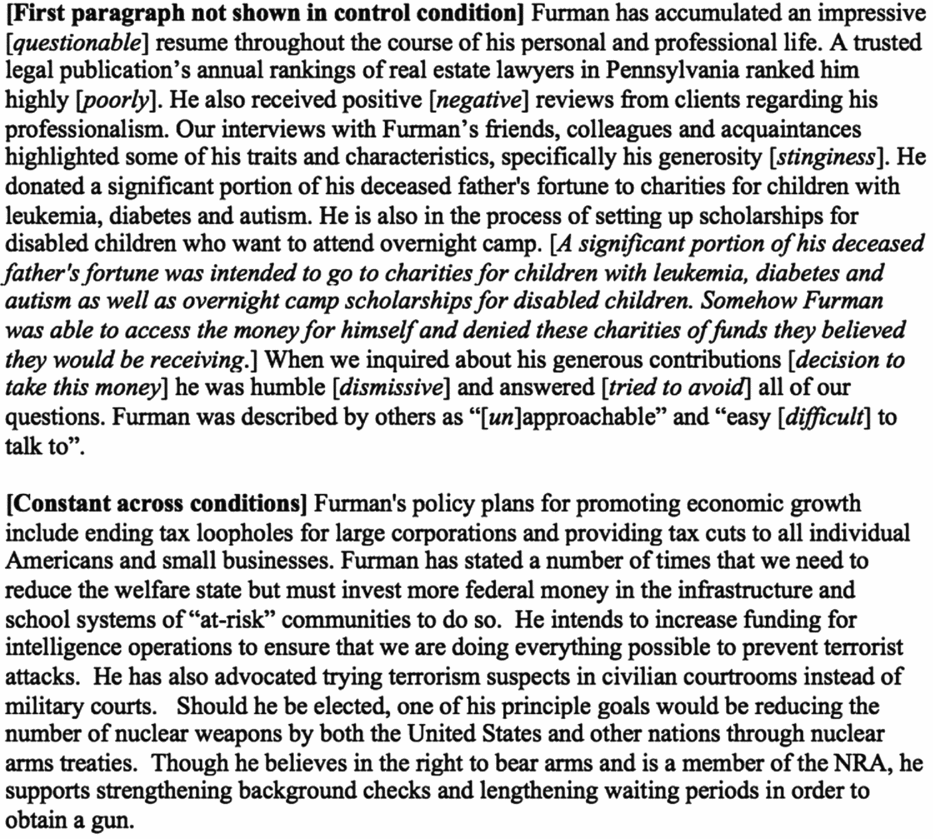
Prior to the 2016 election, I constructed a fictitious Congressional candidate: Ronald Furman. Participants were told a newspaper called the Daily Network had followed the early stages of his career and chronicled his personal and professional life. Each participant was randomly assigned to see one of the following: a positive condition with a flattering background paragraph about Furman's life, a negative condition with an unflattering background paragraph or a control condition with no background paragraph. Participants in all conditions also read a paragraph about Furman's issue positions that was held constant. The important portions of the text are shown in Figure 1. (See Online Appendix A for remaining text.)
Text of Experimental Conditions.
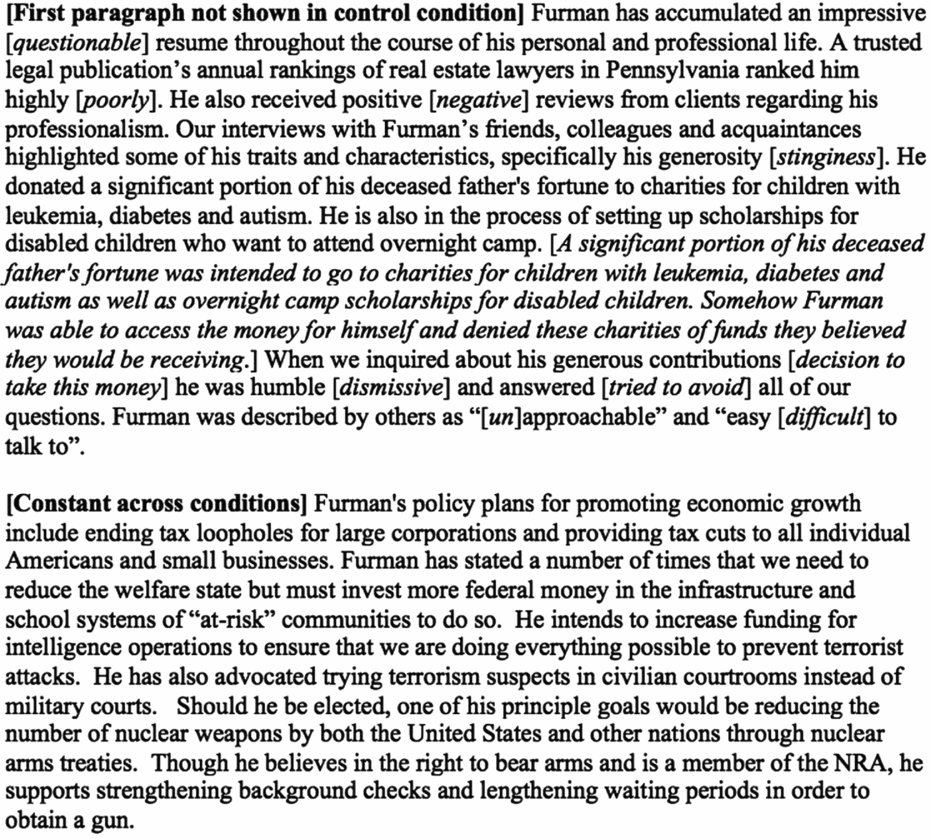
Importantly, the positive and negative background paragraphs needed to be perceived as non-political so they would not be tied to the issue evaluation process through deductive reasoning. In total, 93 online pre-test participants rated how political sounding the paragraph was by selecting response options that indicated “Very,” “Somewhat,” or “Not” political. In the positive condition, 72% said the paragraph was “Not political” and in the negative condition 63% chose the “Not political” option.Footnote 3 The issue position paragraph was pre-tested by a different set of online participants (N = 275) to confirm that it sounded moderate, ensuring room for respondents to assimilate and contrast the candidate. The average rating was 4.02 and the modal response was 4 (“Moderate”).
After exposure to the experimental conditions in the main study, all respondents rated the candidate on a 7-point Likert scale ranging from “Strongly dislike” to “Strongly Like” and placed him on a 7-point scale ranging from “Extremely Liberal to Extremely Conservative.”
Another block of questions asked participants to place prominent political figures and both major parties on ideology scales. There was also one question about how united or divided the parties are in Congress. These questions control for “inference” processes that occur when a person uses information they already have to fill in information they are missing (Conover and Feldman, Reference Conover and Feldman1982; Conover and Feldman, Reference Conover and Feldman1989; Feldman and Conover, Reference Feldman and Conover1983). The order of the inference questions was randomized. Another block of questions measured partisanship and ideological identification on a 7-point scales. The ordering of these blocks was randomized to prevent priming and persuasion, the changing of one's own ideological position to match a liked candidate (Abramowitz, Reference Abramowitz1978; Broockman and Butler, Reference Broockman and Butler2017; Markus and Converse, Reference Markus and Converse1979; Page and Brody, Reference Page and Brody1972).Footnote 4 Participants also answered a ten political knowledge questions and three questions that captured how well they understood the meaning of ideological labels (see Online Appendix A.)
Participants are online survey takers from Amazon Mechanical Turk (N = 593 after restrictions). Respondents had to be US citizens, at least 18, report English as their first language, have experience taking online surveys and report that they had never previously heard of Ronald Furman.Footnote 5 (See Online Appendix A for CONSORT flow diagram. See Table 1 in Online Appendix B for sample demographics and Table 2 in Online Appendix B for balance across experimental conditions.)
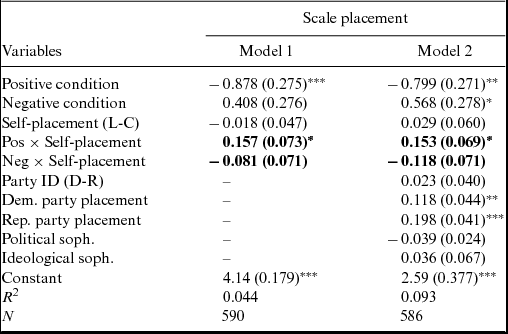
Interactive Effect of Treatment Conditions with Self-Placement on Candidate Perception
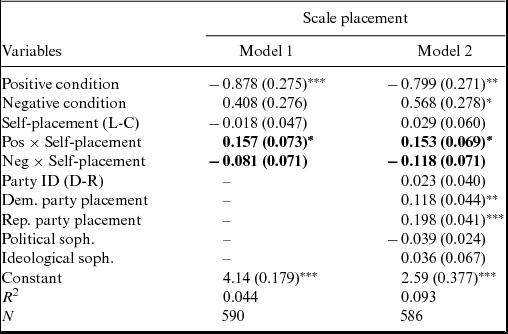
Note. The excluded category is the control condition which had no background paragraph. Models are OLS regressions with robust standard errors. Results hold when the sample is limited to ideological sophisticates, coded as people who answered at least 2 of 3 questions about ideology correctly, when different inference questions are used, when demographic variables are added and when the model is run as an ordered logit. Significance codes: *p < 0.05, **p < 0.01, ***p < 0.001.
Online Table 3 in Appendix B shows the results with different attention check conditions.
RESULTS
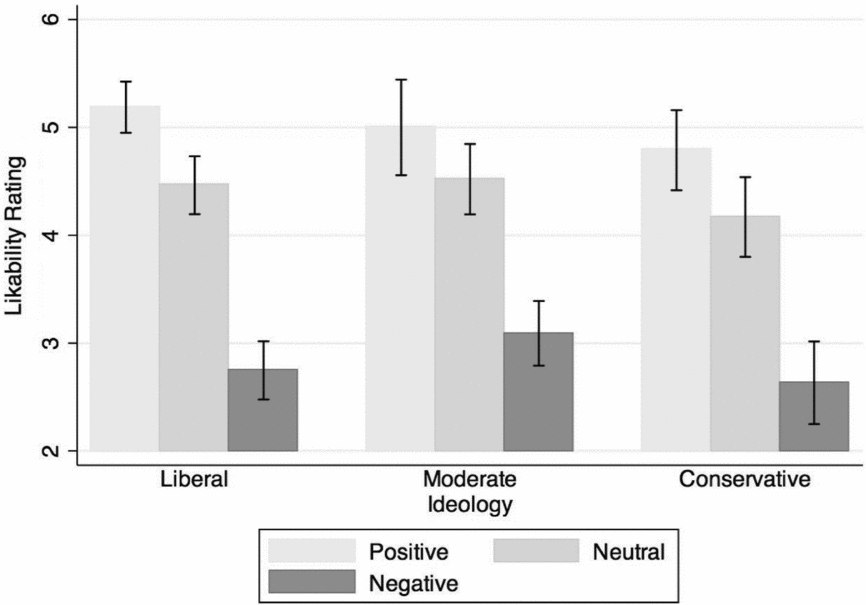
To ensure the manipulations worked, Figure 2 displays the mean likability rating disaggregated by experimental condition and ideology.
Likability Ratings for Candidates by Experimental Condition and Ideological Self-Placement.
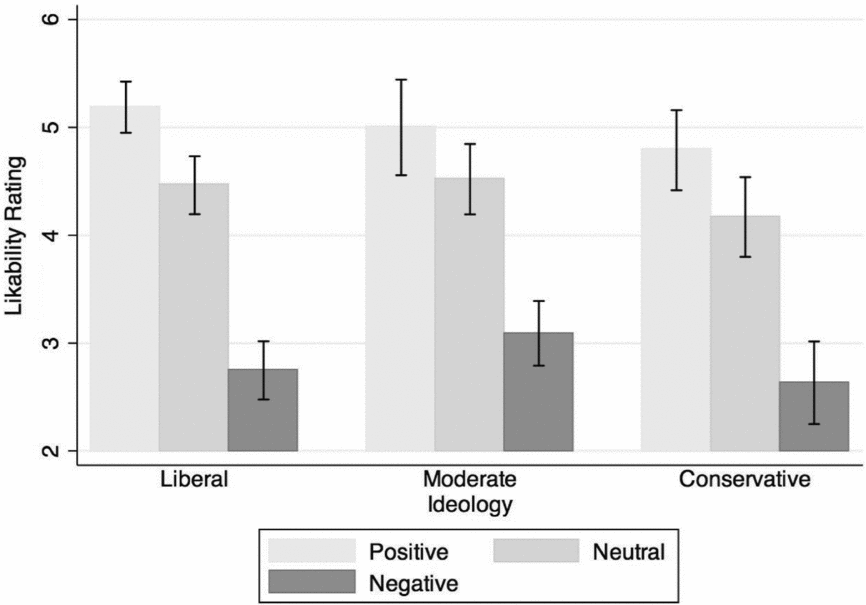
The experimental manipulations appear to be working. Each group liked the positive condition candidate more than the neutral condition candidate and liked the negative condition candidate less than the neutral candidate. Two sample t-tests confirmed that moderates liked the positive condition (M = 5, SD = 1.30) more than the neutral condition (M = 4.52, SD = 1.14) at t (84) = 1.80, p < 0.05 and conservatives liked the positive condition (M = 4.78, SD = 1.33) more than the neutral condition (M = 4.16, SD = 1.34) at t (103) = 2.37, p = 0.01.Footnote 6 It is also evident that negative information weighed more heavily on subjects than positive information—a negativity effect (Lau, Reference Lau1982).
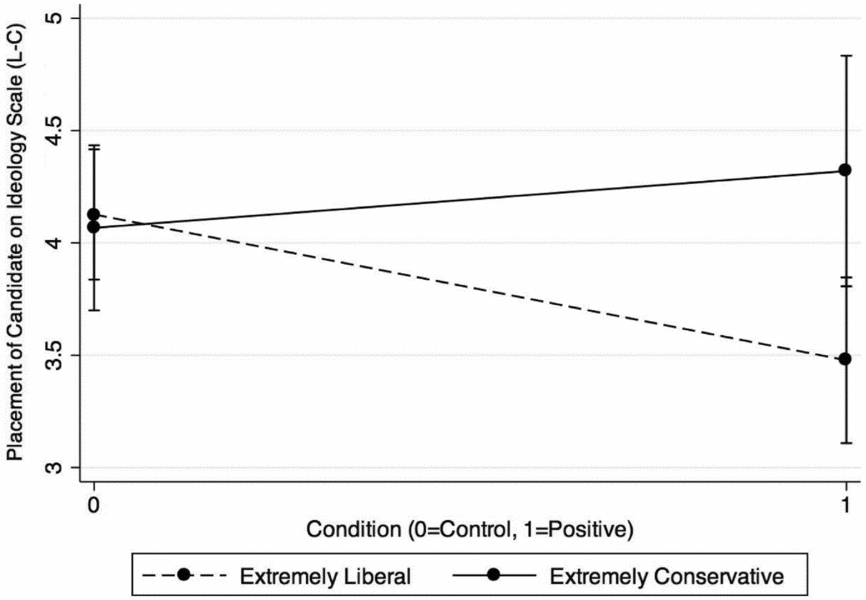
Table 1 reports the models that test perception. The dependent variable is where the subject placed the candidate on the 7-point scale from Extremely Liberal to Extremely Conservative. Since the hypotheses dictate that a candidate's placement will depend on both the respondent's own ideological identity and whether they (dis) like the candidate, they are tested with interactions between self-placement and the conditions. The significant interaction is presented graphically in Figure 3 for ease of interpretation.
Interactive Effect of Self-Placement and Positive Condition on Perceived Candidate Ideology.

Model 1 shows a significant effect for the interaction between self-placement and the Positive Condition. It remains robust against controls in Model 2. The interaction with the Negative Condition shows no effect in either model. Figure 3 displays the significant interaction from Model 2 by using Extremely Liberal and Conservative respondents.Footnote 7 (Figures 2 and 3 in Online Appendix B show the graph with the different attention check restrictions.)
When only the candidates’ issue positions are known, both liberals and conservatives perceive him to be moderate. When the same candidate has a positive background, liberals perceive him to be more half a unit more liberal; a positive projection effect. Conservatives positively project the candidate about a quarter of a unit toward their side. The overlapping error bars for conservatives are likely due to less precision in the estimation, as there are half as many conservatives in the sample as liberals. A kernel density plot indicates this was not a variance issue in which liberals and conservatives responded differently to the question (see Figure 4 in Online Appendix B.)
DISCUSSION
The results of this study indicate that positive affect caused positive projection and negative affect did not cause negative projection, despite exerting a large effect on likability levels. This asymmetry has been documented previously (Granberg et al., Reference Granberg, Harris and King1981; Kinder, Reference Kinder1978; Lodge et al., Reference Lodge, McGraw and Stroh1989). This may be because people disengage from those they do not like, leaving them less aware of their attitudes and less bothered by cognitive inconsistencies (Newcomb, Reference Newcomb1953). Moreover, experimental studies demonstrate that agreement with a liked other is more pleasant than disagree with a disliked other; agreement is psychologically primary (Insko et al., Reference Insko, Songer and McGarvey1974).
This experiment is one of the few studies to manipulate feelings about candidates and examine their effects on perception above and beyond the evaluation and inference processes. Like Lodge et al. (Reference Lodge, McGraw and Stroh1989), it also demonstrates that positive projection can exist in a context where information is fairly clear; in this study issue information was put in front of participants. In previous analyses using NES data, candidate judgments were likely constructed in imperfect information environments where candidates strategically obfuscated their issue positions (Page, Reference Page1976; Page and Brody, Reference Page and Brody1972; Shepsle, Reference Shepsle1972). When external explanations are unstructured, psychological explanations become more likely since greater assumptions are required (Sherif and Hovland, Reference Sherif and Hovland1961); there is more room for irrationality. In scenarios where candidates are reluctant to state their issue positions, or media coverage is limited (think: a low-level election), we may expect to see a large positive projection effects.
This design has limitations, the most obvious of which concerns external validity. Although measures were taken to make the candidate appear real, he was fictitious and most people do not make spontaneous judgments of unfamiliar candidates by reading one story. Moreover, Mechanical Turk samples are not representative. Although ideological identifiers (specifically conservatives) on Mechanical Turk have similar psychological profiles to identifiers in nationally representative surveys (Clifford et al., Reference Clifford, Jewell and Waggoner2015), future studies should replicate these effects with probability samples.
The likability scale was also placed prior to the candidate ideology question in an attempt to simulate the strong feelings that some candidates elicit and ensure that affect was indeed being tested. Still, this ordering possibly made affect unusually salient, generating a larger effect than what would normally happen. It should also be noted that despite the attempt to keep the profile vignettes equivalent, respondents may have interpreted a “highly” ranked lawyer to be more “self-made” than a “lowly” ranked lawyer, manipulating other associations (Mandisodza et al., Reference Mandisodza, Jost and Unzueta2006). Finally, the significance of the findings may be dependent on how the attention check questions are incorporated into the models (see Online Appendix B.)
Overall, my conclusions are in line with some of the previous research: null findings for negative projection and modest findings for positive projection in need of more replication. Experimentalists should continue to investigate the role of affective feelings on perception to identify where relationships do or do not lie.
SUPPLEMENTARY MATERIAL
To view supplementary material for this article, please visit https://doi.org/10.1017/XPS.2018.6