Introduction
In February 1617, Jan Lucasz. van Hasselt arrived in Persia. He had been hired as a painter by Pietro Della Valle (1586–1652), a Roman noble who traveled throughout the Middle East and India during 1614–26. Between 1618 and 1621, Van Hasselt entered the service of Shah ʿAbbas I (r. 1588–1629), whom he served until the shah’s death in January 1629. At that time, Van Hasselt returned to the Netherlands, where he tried to obtain a commercial treaty for Persian merchants while he engaged in painting. His service for the king of Persia was unprecedented at that time as he was the first European and Christian painter to work in the royal library, the most eminent art hub of the country.Footnote 1 Later, two other Dutch painters also provided artistic service to the royal court: Hendrick Boudewijn van Lockhorst and Philips Angel both painted for and gave painting lessons to Shah ʿAbbas II (r. 1642–66) during 1643–47 and 1650–55, respectively.Footnote 2 Despite Van Hasselt’s decade-long service in Persia our knowledge about his career is sketchy. His name is mentioned only once in a Persian document (albeit in a Dutch translation) and none of his artworks have been identified with 100percent certainty. Also, he is not mentioned in any contemporary or later biographical works about Dutch painters. The present paper examines the career of this Dutch painter (i) in Persia and (ii) in the Netherlands as well as (iii) the artworks that may be attributed to him.Footnote 3
Jan Lucasz. van Hasselt
Nothing is known about Van Hasselt’s date of birth, early life or education. His name is not mentioned in any contemporary or later books of biographies of Dutch painters that were written as of the sixteenth century. However, he must have been born around 1600, because during 1615–23 he is referred to as a young man.Footnote 4 He must have had a good basic education, because his handwriting in both Dutch and Italian is practiced (see samples in Figure 1 and in Appendix 2, Figure A1), while he also must have learnt the art of drawing and painting, otherwise he would not have been employed as a painter. As he was able to finance a journey to Italy and from there to Constantinople he must have been a member of a family with sufficient means to do so. His name is variously written. In two letters he signs his name as Jan Lucasz. van Hasselt. However, in other Dutch texts his name is written as Jan Lucasz. van Hasselt and Johan van Hasselt. Consequently, in foreign language texts he is referred to as Giovanni Luycasz Hasselt, Signor Jhon and Sieur Johany (see below).
Jan Lucasz. van Hasselt is mentioned for the first time in Pietro della Valle’s travelogue. In August 1615 Della Valle met Van Hasselt at the home of the French ambassador in Constantinople.
At the home of the [French] ambassador I met a young Flemish painter who had come from Venice in the same ship in which I had come and we then became friends. I also want and hope to take him with me when I leave here to go on the other travels that I want to make, just to have him paint many strange things that I will find in different countries; while we are still in this city he is often with me. I make him paint several good pictures painted from life in oil on canvas, in large size, so that you see a person in full-length, some of which are finished, while he is still working on some others. Footnote 5
Van Hasselt indeed accompanied Della Valle during his travels to Isfahan. Della Valle mostly referred to him as “the Flemish painter,” however, once, in January 1616, Della Valle called him “Giovanni, my painter, also a Fleming.”Footnote 6 There is no doubt that this Giovanno or Jan is Jan Lucasz. van Hasselt, because, first, in December 1617, in Isfahan, Della Valle paid wages to the Flemish painter Giovani Lucassen van Hasselt,Footnote 7 and, second, in his book Delle conditioni di ʿAbbas Re di Persia, Della Valle explicitly states that his Flemish painter took service with Shah ʿAbbas.Footnote 8 Although Della Valle referred to Jan Lucasz. van Hasselt as a Flemish painter this does not necessarily mean he was from Flanders.Footnote 9 Fiammingo, meaning “Flemish, Fleming or Dutch,” was the term by which Italians referred to denizens of the Netherlands (both south and north). However, when in India, Della Valle explicitly referred to the Dutch as Olandesi, thus implying that our Van Hasselt was a Fleming. However, in June 1630, in his statement to the States-General, Van Hasselt writes that he is a Dutchman and the Dutch Republic is his Fatherland.Footnote 10
Travel to Persia
It was because of the great fame of Shah ʿAbbas I that Della Valle wanted to travel to Persia.Footnote 11 In February 1617, Della Valle and his retinue arrived in Isfahan, the capital at that time. However, Della Valle had to bide his time before meeting Shah ʿAbbas, as he was informed that the shah was engaged in a campaign against the Georgians. In the shah’s absence, Della Valle used his time to explore the capital. When seeing the wall-paintings and decorations in the royal palaces he wrote: “I am afraid when the shah sees the works of my painter, he may decide to keep him.”Footnote 12
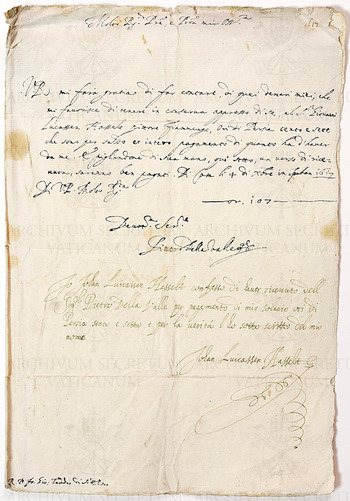
Van Hasselt left his Italian patron presumably at the end of 1617, although it is not known when and why this happened. In a signed note, dated 4 December 1617, Della Valle asked Giovanni Taddeo di Sant’Eliseo, a Carmelite Father in Isfahan to pay: “Mister Giovanni Lucassen Hasselt Flemish painter his salary of 107 Persian Ori (gold).” At the bottom of this note the painter confirmed having received this money as salary (Figure 1).Footnote 13 Shortly after the date of this letter, on 18 December 1617, just before his first meeting with Shah ʿAbbas, Della Valle expressed his satisfaction of having dismissed his painter.Footnote 14 This does not necessarily mean that Van Hasselt immediately entered royal service.
Salary receipt of Giovanni Lucassen (Jan Lucasz. van) Hasselt.
Source: The Vatican Apostolic Archive, Arch. Della Valle—Del Bufalo 37, ff. 90r, Rome. © The Vatican Secret Archives.

Van Hasselt in the Royal Library
Although in the pre-Safavid period Persian painters were acquainted with and even practiced European-style painting (ferangi), their interest was mainly limited to European iconography.Footnote 15 This also remained the case during the sixteenth century. In the seventeenth century, Persian painters began to paint European figures, European landscapes, and still lifes of flowers and birds. An early Safavid example of European-style painting is the Virgin and Child, painted by an anonymous artist before 1563, in the album of Bahram Mirza.Footnote 16 It is not surprising that the provincial court of Bahram Mirza’s son, the art-loving Ebrahim Mirza (1540–77), a nephew of Tahmasp I, was fertile ground for European-style painting, especially European portraiture (surat-e ferangi, tasvir-e ferangi, chehreh-ye gusha’i), to be practiced by Sheykh Muhammad Sabzavari. “It was he [Sheykh Muhammad Sabzavari] who introduced the European-style of painting in Persia and popularized it. No one equaled him in the delineation of faces and figures.”Footnote 17 After Ebrahim Mirza’s death he worked under Esmaʿil II (r. 1576–77) and ʿAbbas I in the royal library.Footnote 18
After the death of Tahmasp I in 1576, there were increased contacts with Europeans under Mohammad Khodabandeh (r. 1577–79), Tahmasp I’s oldest son. Mohammad Khodabandeh’s son ʿAbbas I even sought and cultivated contacts with Europeans. This trend was stimulated because of his war with the Ottomans, against whom he sought military alliances with European states. Also, European missionaries settled in Isfahan, ʿAbbas I’s new capital, and as of 1617 and 1623 new trading partners, respectively the English and the Dutch, established trading offices there and concluded commercial agreements with the shah. As a result, European craftsmen and artists also came to Persia, amongst whom Van Hasselt was one of the first.Footnote 19 A European painter who worked for the royal court prior to Van Hasselt’s hiring was a Greek named Jullio. In 1618, the Spanish ambassador Don Garcia de Silva y Figueroa reports that in a house belonging to ʿAbbas I, in the village of Tajurabad (on the road between Isfahan and Kashan), he saw that:
The walls were decorated from floor to ceiling—a distance of ten feet—with many golden flourishes, and in the spaces between these, there were some very lovely paintings that were incomparably more beautiful than those normally seen in Persia. They depicted women, banquets, carafes of wine, and the kinds of dances that are customary in these environs. Beginning at the frieze, which ran around the whole room at a height of ten feet, the vaulted ceiling was lavishly decorated with gold and blue and so polished that it dazzled the eyes of the beholder. … The master artist of these paintings was a Greek man named Jullio, who had been raised in Italy, and had died just a few days before the Ambassador’s arrival in Qazvin. The king ordered him to work on these paintings for many days. It was obvious that he had once lived in Europe, for not only were many of his works painted in the Italian style, but others showed a style of clothing currently worn by Christian women in Greece.Footnote 20
When Della Valle met Shah ʿAbbas I in 1618 in Farahabad, the royal residence in the north of Persia, Van Hasselt did not accompany him. Therefore, it is still unclear when and how Van Hasselt first met Shah ʿAbbas. It must have been between 1618 and 1621, when he was hired to work in the royal library. In 1625 an anonymous Austrian source states that Van Hasselt had been three and a half years in the shah’s service, implying that he was hired in 1621. And indeed, in May 1621, if not earlier, our painter definitely was in royal service, because the Carmelites reported on 5 June 1621: “at this audience there was present a Flemish painter, whom the king was keeping in order to make use of him.”Footnote 21 According to Della Valle, Van Hasselt received “an annual salary of 1000 zecchini and some other gifts” from the shah, which amount was equal to about 4,000 guilders.Footnote 22 However, despite this high salary, it seems that Van Hasselt was not fully satisfied with his royal employment, because Heinrich von Poser, who had just left Isfahan to travel to India, reports that on 20 July 1621 he was joined by the painter Johannes Eucassin in the village of Mardabad, just outside Isfahan, who wanted to accompany him to India. However, the painter’s “flight” did not last long—on 24 July 1621, when they were in the village of Sagzi, ʿAbbas I ordered him to return to Isfahan. Because there is no other source that mentions the painter Eucassin, and the fact that Van Hasselt was the only European painter at the royal court, whose name also was Johannes, it is quite likely that Eucassin and Van Hasselt are one and the same person.Footnote 23 By 1623, Van Hasselt had become a fixture at the royal court and, apart from painting, also engaged in political intrigue. In that year, the Carmelites wrote that the shah had taken Hormuz from the Portuguese and had not spoken to them for three years. Meanwhile, “a heretic painter is thought to be influencing the king against us.”Footnote 24 Because political intrigue, certainly by small players, may be said to be a symptom of people with too much time on their hands, one may suggest that Van Hasselt was looking for other activities, as his failed attempt to travel to India indicates.
The arrival of Huybert Visnich, a merchant in the service of the Dutch East Indies Company (VOC) on 20 June 1623 at Bandar ʿAbbas to assess possibilities for Dutch trade,Footnote 25 meant a change for Van Hasselt’s prospects. At that time, the English East India Company (EIC), which had traded with Persia since 1617, had difficulties in meeting its contractual obligations. In fact, the EIC agent at Isfahan had received orders that, if he could not secure better terms of trade, he was to close down the factory. Thus, when the Dutch appeared in Isfahan in 1623, they offered the Persian government the opportunity it needed to take bids from a competitor—and at just the right time. ʿAbbas I returned to Isfahan in August 1623, about the same time as Visnich arrived there. ʿAbbas I, who had been informed about the arrival of the Dutch merchants, had given orders to Van Hasselt to welcome them.Footnote 26 Visnich was fortunate that Jan Lucasz. van Hasselt was at court, as he knew the lay of the land and which people to contact. Moreover, Van Hasselt had met Visnich in Aleppo in 1615–16, when the latter was engaged in trade there. Visnich described him in a letter to the XVII, the directors of the VOC, as “A Dutchman, a young man of good reputation, and in great favor with His Majesty, named Jan Luyckassen van Hasselt, whom I knew from before in Aleppo, and who was willing to serve Your Honors.”Footnote 27 By 17 November 1623, Visnich had his commercial agreement with the shah. Moreover, it was an advantageous agreement for the Dutch, although in its general lines it did follow the lines of the English treaty.Footnote 28 In January 1624, Visnich was able to report to Surat that he had concluded an agreement with Molayem Beg, the shah’s “business representative” or, as he is usually styled, the royal factor, for the purchase of silk.Footnote 29 In the spring of 1624, however, when the Dutch tried to embark the silk cargo, the deputy governor at Bandar ʿAbbas, Sevendik Sultan, claimed the right to collect customs duties on the merchandise. Visnich was furious and sent Van Hasselt to the king to complain. He also asked the governor of Fars to intervene, who did. The mistake was corrected and the money was repaid.Footnote 30 Van Hasselt’s help in smoothing the company’s path was much appreciated by the directors of the VOC, who wrote to Visnich:
We have understood from your letter of 18 January 1624 that you have been greatly assisted by a master painter, who has much credit with Shah, to get an audience with the Shah and in getting permission to trade there. Therefore, this master painter should not be offended on any occasion.Footnote 31
Therefore, when in November 1624 Van Hasselt was leaving for the Netherlands, Visnich wrote to the XVII that: “He [Van Hasselt] has not been recompensed for this here, and I am sure that Your Honors will take care of this as required.”Footnote 32 However, that was not entirely correct. For Visnich had recompensed Van Hasselt somewhat for his services. He received turbans and cummerbunds to a value of Dfl. 100.Footnote 33 Visnich also bought raw silk from Van Hasselt (probably when he was painting in the royal pace at Farahabad), and at same price as paid to the king, which was higher than the market price.Footnote 34
When Visnich arrived in Persia he brought no letters or official greetings to the shah from the States-General and, therefore, the first thing he did was to request the VOC to take steps to remedy the situation. However, the shah was no passive player on the board. Robert Sherley, the incessant English “project maker,” had been in Europe as “ambassador” from the shah since 1611 and was, at that moment, in London trying to hoodwink the English Company or the English king, or both. Sherley, however, had been away from Persia for more than a decade and, reportedly, there were people at the shah’s court urging him to take action. One of these people was probably Jan Lucasz. van Hasselt, Visnich’s contact at court. Van Hasselt had apparently been angling for such a mission for a long time.Footnote 35 He later claimed that, at the very moment when Visnich arrived in Isfahan, the shah had been prepared to send him on an embassy mission to the Netherlands to interest the Dutch in trade with Persia. There is no one to confirm that claim, but Visnich himself wrote to a former business colleague in Aleppo on 24 September 1624, and mentioned in passing that it appeared that the shah would send Van Hasselt on such a mission in about a month. Two months later, the shah sent Musa Beg, one of his courtiers, as ambassador to the Netherlands. He was accompanied by a few Persian merchantsFootnote 36 and Jan Lucasz. van Hasselt. According to a report by an anonymous Austrian attached to ʿAbbas I’s court:
He [the shah] has a painter, Johan Lucas de Hasueld, a Dutchman, who has been three and half years in his service, whom he paid well and stood high in his favor, and was sent on mission like a half envoy. He honored him with one load of silk, with a value here of 50 tumans and two khal‘ats [robes of honor] of gold brocade on his discharge.Footnote 37
Besides the development of trade, Musa Beg’s mission was to induce the Dutch to ally themselves with the shah in his fight against the Portuguese in the south and against the Ottomans in the northwest.Footnote 38
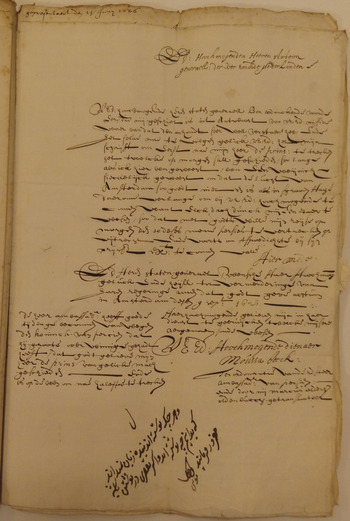
The envoys departed from Isfahan on 20 November 1624 and on 22 April 1625, Pieter van den Broecke (1585–1640), the director of VOC trade in Surat, reported that Musa Beg and company were on their way with the ship Dordrecht to the Netherlands. Van den Broecke referred to Van Hasselt as Johanni Lucassen Hassel, the servant of the king of Persia and the second person to the ambassador. He recommended that the Company treat him with respect in the Netherlands.Footnote 39 Musa Beg arrived in The Hague in February 1626, but his mission was not successful and was marred by serious disagreements among its members. One such problem was the translation of Shah ʿAbbas I’s letter. Apparently after reading the first translation of the letter, Van Hasselt requested to see the original letter and insisted on re-translating it himself. The XVII (the Directors of the VOC) agreed to his request, although they concluded that the second translation did not add any further information to the first one.Footnote 40 The problem was not limited to the shah’s letter, because on three other letters Musa Beg wrote that he neither knew Dutch nor was sure that what he said and meant had been translated properly (Figure 2).Footnote 41 In August 1626 the XVII wrote: “The Ambassador did not agree with Mr. Jan Luycaszs Hasselt, also with the merchant Ussain Begh [Hoseyn Beg], and the two last also have different idea, and we have wished otherwise. It is against what all we wished.”Footnote 42 A letter dated 12 September 1626 by Mohammad Taqi, a merchant accompanying Musa Beg, is the only instance where Van Hasselt’s name is mentioned in a Persian document, although now only surviving in a Dutch translation. In this letter Van Hasselt is referred to as sieur Johanny, Jan van Haffes and Jan van Hassel.Footnote 43 Mohammad Taqi explained that Van Hasselt asked him to label some parcels on cargo from Amsterdam under his name and that he had reluctantly done so.
Note of ambassador Musa Beg in the margin.
Source: Archive of the States General (1.01.02), The National Archives of the Netherlands, The Hague (no. 12595.7).

As noted above, Van Hasselt did not get along well with the other members of the Persian embassy and on 21 September 1625 he informed the States-General (the governing body of the Republic of the United Provinces of the Netherlands) about his decision to leave the group after having received the States-General’s reply to the shah’s letter. Shortly thereafter, on 26 September 1625, the States-General sent their reply, basically stating that: (1) the States-General would not cease their trade with the Ottomans as requested; (2) the Netherlands would send an ambassador to Persia; and (3) the Dutch would put pressure on the Portuguese in the Indian Ocean area.Footnote 44 Musa Beg remained in the Netherlands and kept negotiating with the States-General, while Van Hasselt left for Persia to meet Shah ʿAbbas I and “complain about the unhappiness and the inconsistent procedures of Musa Beg.”Footnote 45
In 1627–28 Van Hasselt was on top of the world. In the Netherlands he had hobnobbed with the country’s political leaders and the directors of the VOC. As a result, Pieter de Carpentier (1586–1659), the Governor-General of the VOC in Batavia, had fêted Van Hasselt and required that the company staff in Persia support him as much as possible without encumbering the VOC.Footnote 46 On his return to Persia in March 1628,Footnote 47 Van Hasselt traveled to Ashraf, where ʿAbbas I was residing at that time. On 25 May 1628, when Sir Dodmore Cotton, the English ambassador sent to ʿAbbas I (1626–29), was received at a banquet by Mohammad Ali Beg, one of ʿAbbas I’s most influential councilors, where “satt the Kinges great men, and amongst the rest ther satt my lord [Robert] Sherley and Senior Jhon, a Duch man, on of the Kinges servants.”Footnote 48 After the banquet the English ambassador was received by ʿAbbas I “and was accompanied home to his lodging by Senior Jhon.”Footnote 49 Thomas Herbert, Cotton’s secretary, briefly referred to Van Hasselt. In the first edition of his travelogue (1634) he writes: “a Dutch painter (who served the king of Persia twenty years … John the Flemming.”Footnote 50 In the second and third edition (1638, 1677), he referred to him as: “one John a Dutchman (rather a Jew) a painter,” because he together with Mohammad Ali Beg, alleged that the late Sir Robert Sherley (d. 1628) owed money to “one Crole a Flemming,” which explains Van Hasselt’s involvement in seizing repayment. Sir Robert’s widow pretended to be indisposed, while Robert Hedges, a member of the English embassy, took her jewelry away for safekeeping. Then, “Iohn the Boor enters with supercilious looks, attended by some Pagan Sergeants, who (without much talk to her, or pity to her distresse) rifled about, broke ope her Chests, and carried away what was valuable or vendible.”Footnote 51 This incident notwithstanding, Herbert and other members of the English again and amiably met Van Hasselt later that year. Stodart reports that on 2 November 1628, in the evening, when the English embassy was in Shiraz, “we went for to see Senior Jhon, wher we were curtiously entertained, he being lodged in the Kinges garden, wher we should have been lodged but we made choise of another howse.”Footnote 52
Although Van Hasselt still had access to the most influential courtiers, such as Mohammad Ali Beg, nevertheless it would seem that he had less favor and credit at court than before his departure.Footnote 53 In July 1628 he tried to induce the court to send him again to the Netherlands on an official mission.Footnote 54 However, Van Hasselt failed in his design, for he only received permission to leave and in a letter of recommendation he was not referred to as ambassador. However, after his return to Isfahan on 24 August 1628,Footnote 55 Van Hasselt pretended that he was sent on an official royal mission. Visnich commented that:
He thinks to travel with our ships; he’d like to act somewhat above his position as much as his wings can carry him. However, this [wing] span is not as wide as some believe, although he has enjoyed the king’s favor. Concerning expenses, he has received very little with regards to what he has spent and [the cost of] his voyage. In his recommendation letter he is referred to as Osta Nakaas, i.e. “the master painter.”
In fact, the shah’s most influential courtiers informed Visnich “that the king has ordered him to buy some toffas [tohfeh] or rarities, for which purchase he has not received any money.” Therefore, Van Hasselt turned to Molayem Beg and some leading courtiers to get some silk or other goods in commission, so that he might arrive in the Netherlands with more status, but initially without much result. Realizing that his clout and position had much diminished and that he might not be successful in the Netherlands, he developed an alternative plan. To that end Van Hasselt had “obtained letters of credence to the king of France, in case Your Honors will not defray him, he might seek his benefit in France with those there who as yet are little aware of the opportunities offered by Persia.”Footnote 56
Although Van Hasselt was finally successful in getting some raw silk and indigo, which was the property of others (merchants and/or courtiers),Footnote 57 his departureFootnote 58 was not without problems. His amiable and beneficial relationship with Visnich had changed into one of enmity. This may have been due to the fact that their relative positions had changed. Initially, Van Hasselt was the more influential party, but after his return Van Hasselt found that Visnich enjoyed more favor at court than he. Also, Visnich was critical of Van Hasselt, who still had not paid his debt to the VOCFootnote 59 and put on airs that Visnich considered were undeserved and ill-fitting. Also, Visnich was not sure whether he would allow Van Hasselt to embark on a VOC ship, as he had asked. Moreover, Musa Beg and Mirza Taqi, the son of the merchant who had arrived with Jan Smidt, the Dutch ambassador, from Batavia, clamored that Van Hasselt should not be allowed to depart until he had paid the money he owed them. Because of this problem it even looked as if Van Hasselt, who was in Bandar ʿAbbas in February 1629, might have to return to Isfahan. Van Hasselt’s position had weakened, because ʿAbbas I died on 19 January 1629. However, probably due to the good offices of Jan Smidt, he was allowed to embark and leave with a VOC ship. Musa Beg and Mirza Taqi threatened to sue the VOC and have it pay what Van Hasselt owed them.Footnote 60
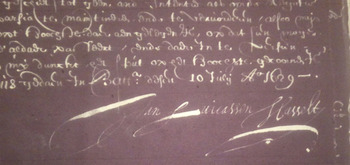
When he arrived in Batavia in July 1629, Van Hasselt wrote a letter to Jan Pieterszoon Coen (1587–1629), the Governor-General of the VOC there, in which he denounced Visnich’s trading activities and his lack of appreciation of Van Hasselt’s contribution to the start of Dutch trade with Persia. Van Hasselt argued that Visnich owed his good relations with ʿAbbas I and the royal court to him.Footnote 61 Apart from the content, this letter is of interest because it provides us with one of the few samples of Van Hasselt’s handwriting and signature (Figure 3).Footnote 62 Jan Pieterszoon Coen did not take any action; he died in September 1630 and Van Hasselt attended his funeral as ambassador Van Hasselt.Footnote 63
Letter written by Jan Lucasz. van Hasselt.
Source: The archive of the VOC (1.04.02), The National Archives of the Netherlands, The Hague (no.1097).

Van Hasselt’s Activities in the Netherlands
In June 1630, Van Hasselt presented his recommendation to the States-General. In the recommendation he was described as
Johan Van Hasselt, who is lucky to have our royal letter of recommendation, and is honored with our favor and grace, we have, trusting on his experience, diligence, and faithfulness, sent to your lands with our orders, to reside there for maintaining our friendship and mutual communication and the promotion of that which might be found on both sides to be the most beneficial and useful.Footnote 64
Because he had received no reaction to his proposal, Van Hasselt wrote on 1 October 1630 to the States-General asking whether they had come to a conclusion, because he had promised deceased ʿAbbas I to inform him of his arrival, reception, and reaction to the proposal.Footnote 65 On 3 December 1630, the XVII replied that as to the proposal that Persia might send some bales of silk with VOC ships to Amsterdam at a reasonable price and, on the return journey, ship some fraaigheden ofte rariteiten (fine things or rarities) it needed to examine this in the light of its charter.Footnote 66 Although the matter was discussed in 1631 the VOC took no definite position as yet. However, Van Hasselt’s request to conclude a commercial treaty between Persia and the Netherlands was approved on 7 February 1631 by the States-General. This treaty gave Persian merchants in the Netherlands the same rights and advantages that Dutch merchants enjoyed in Persia.Footnote 67 However, Van Hasselt’s request “to be able to enjoy exemption from ordinary and extraordinary charges for the detention of his residence” was dismissed.Footnote 68 The matter of the silk transport became less urgent when on 18 October 1631 the States-General received a letter from Shah Safi I (r. 1629–42), the grandson and successor of ʿAbbas I, which did not refer to Van Hasselt’s proposition at all. It would seem that nothing came of this request, because it is not mentioned in later correspondence. On 31 December 1631, the States-General decided to allow Van Hasselt, who was living in The Hague at that time, to send letters to the shah via Cornelis Haga, the Dutch ambassador in Constantinople, who would forward them.Footnote 69
Thereafter, the career of Van Hasselt is not clear and his name has been found in only two letters so far. The first one is a letter dated 1642 sent from the painter of the king of Persia to Captain Jan van Hassel.Footnote 70 In 1654, we hear again from Van Hasselt, when he sent a letter to the States-General in which he invoked (and summarized) the articles of the 1631 commercial agreement between Persia and the Netherlands. Referring to this treaty, he asked to be informed to which officials he had to address himself to have a house assigned to him and the Persian merchants, in accordance with the treaty. One may well ask the reason for the hiatus between 1631 and 1654, because it is clear that the commercial treaty had remained a dead letter. Van Hasselt, as agent of the Persian king, only had standing as long as there were Persian merchants in the Netherlands. It would seem that the first Persian Armenian merchants were only active in Amsterdam as of 1627. How long they remained trading in the city is unknown, because in later years their names no longer occur in the records of the city of Amsterdam. Thus, their stay in Amsterdam may have been temporary and exploratory, which would explain Van Hasselt’s absence from the records after 1631. In fact, in his letter to the States-General of October 1654 he explains that the lack of an adequate number of Persian merchants had prevented the implementation of the treaty. However, as of 1650 Persian Armenian merchants are regularly and increasingly mentioned in Amsterdam’s notary records. The return of Armenian merchants and their rising numbers (in 1668 there were sixty-six of them) justified Van Hasselt’s renewed involvement with the Persian mercantile community. In fact, Van Hasselt gives the presence and the expected arrival of more Persian merchants with a large quantity of valuable goods and the promise of fiscal benefits for the Dutch Republic as the justification for his petition. He further stressed that the shah had diffused the contents of the Dutch–Persian treaty among merchants in Persia. Therefore, on their arrival in the Netherlands these merchants had contacted him as the commercial agent of the Persian crown with the objective to ensure and enhance their legal standing through the enactment of the above-mentioned treaty. There is no information available, as far as we have been able to ascertain, what the States-General decided. Given the fact that the Armenian merchants in Amsterdam did well and enjoyed a good legal position one may assume that their reply must have been a positive one.Footnote 71 This is the last time that we have found mention of Jan Lucasz. van Hasselt, so that we even do not know the date of his death.
Jan Lucasz. van Hasselt’s Artworks
Van Hasselt worked two years, during 1615–17, for his Italian patron Della Valle, and from around 1620 to 1629 for ʿAbbas I. Although he worked for more than three decades as a painter, none of his artworks have been recognized with certainty by art historians. Della Valle’s observations cannot help us to gauge the quality of his art as they are conflicting in nature. Initially, Della Valle was pleased with the quality of Van Hasselt’s work, because on 4 September 1615, before leaving Constantinople on his travels, he wrote:
I am also taking a painter with all his materials, to produce a thousand pretty things for pilgrims on the journey and (since he is a man of some talent) I also hope and desire that he will be with me for ever, as he assuredly will, or at least till we settle in Italy, where he wants to stay for a while to learn more still.Footnote 72
Furthermore, in Isfahan, Della Valle expressed the fear of having to lose his painter to the shah (see above). However, after Van Hasselt had left his service, Della Valle judged a drawing the painter had made of his wife to be inept work. Della Valle also expressed his satisfaction of having let him go.
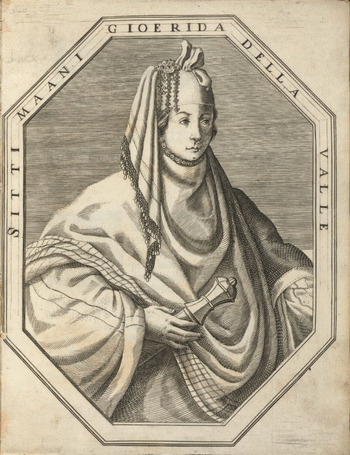
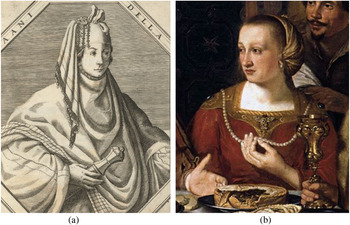
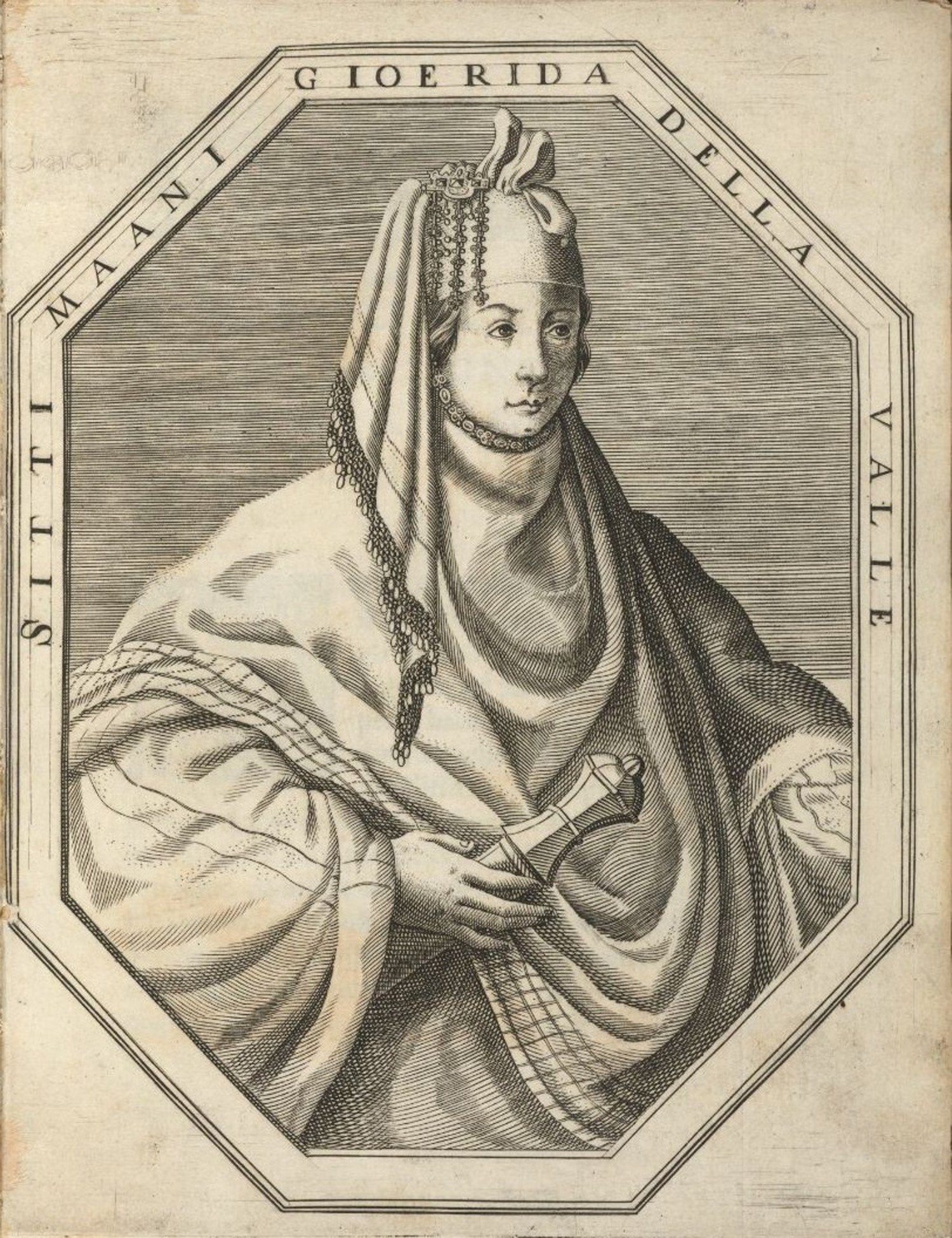
From Della Valle’s observations we have some idea of what kind of works Van Hasselt produced. For example, in Constantinople, Van Hasselt made several paintings for Della Valle such as of a Greek lady, Mme Smeralda Cativolina, his godmother, dressed in the clothes that were worn in those parts as well as a portrait of Della Valle himself and one of Mme Ismichan wearing a rich brocade dress that reached down to her feet. Della Valle also notes a painting of three persons seated on a carpet, talking to each other and drinking coffee; one of them being Mme Salehé, dressed in a rich robe with short sleeves.Footnote 73 Furthermore, Van Hasselt drew a picture of Babylon in 1616.Footnote 74 In 1617, Della Valle considered asking the painter to make a portrait of himself in Persian dress with a beard in Persian style. In the same year, he wanted to order the painter to draw a picture of Indian elephants.Footnote 75 However, Della Valle does not record whether these works were executed. Later, in Isfahan, Van Hasselt painted a portrait of Sitti Maani, wife of Della Valle, and the painting was sent to Rome in 1619.Footnote 76 Cristelle Baskins explained that this portrait was in the inventory of Della Valle in 1652, and later it was kept at the Palazzo Della Valle in 1709. The location of the portrait after this date is unknown. Nevertheless, we may form an idea about this portrait, because in 1627 Girolamo Rocchi made a print after this painting in Rome that was published in a book titled: Funerale della signora Sitti Maani Gioerida della Valle: celebrato in Roma l’anno 1627 (Figure 4).Footnote 77
A folio from the book Funerale della Signora Sitti Maani Gioerida della Valle: celebrato in Roma, p. 1, d. 1627. Published by Appresso l'Erede di Bartolomeo Zannetti, Rome.
Source: Leiden University Library (HOTZ 330).
From Van Hasselt’s works during his service in Persia and onwards no existing painting has been identified so far. Based on a description by Thomas Herbert, a member of the English embassy to Persia in 1628, Van Hasselt decorated the royal palace named Ashraf in the north of Persia:
But the chamber by the length it had was more resembling a gallery than a room of state; the seeling was garnished with gold, and pencill’d with story in lively colors; all which see’d to strive whether art or nature to a judicious eye would be more acceptable. One John a Dutch-man (who had long served the king) celebrated his skill here to the admiration of the Persians and his owne advantage.Footnote 78
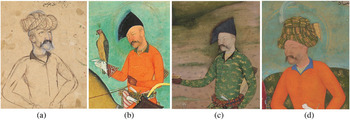
VOC documents confirm the presence of Van Hasselt in Ashraf in July 1624 and August 1628 and he may have decorated the palace at those times. However, it is more likely that this happened in 1624 or before that time, because in 1628 Van Hasselt was involved with the English embassy (see above). Moreover, there is a sketch that may be attributed to him, i.e. the Portrait of Shah ʿAbbas I, dated ca. 1617.Footnote 79 The drawing is usually attributed to the Indian painter Bishandas (d. 1640), due to the fact that in 1617 the Mogul emperor, Jahangir (r. 1605–27) sent Bishandas in the company of ambassador Khan ʿAlam to the court of Shah ʿAbbas I. During his stay in Isfahan, Bishandas made a few portraits of Shah ʿAbbas and of some of his courtiers. A comparison of three versions of Shah ʿAbbas I’s painting shows that the Harvard drawing cannot have been by the hand of Bishandas (Figure 5).
(a) Portrait of Shah ʿAbbas I, detail, attributed to Bishndas, c. 1617. Ink and opaque watercolor on paper, (full page) 19.5 x 15.6 cm. (b) Portrait of Shah ʿAbbas I, detail, signed by Bishandas, c. 1615. Watercolor, gouache and gold on paper, (full page) 15.5 x 25.5 cm. (c) Portrait of Shah ʿAbbas I, detail, signed by Bishandas, c. 1620. Opaque watercolor and gold on paper, (full page) 36.9 x 25.3 cm. (d) Portrait of Shah ʿAbbas, detail image from Jahangir Entertains Shah ʿAbbas, St. Petersburg Album, attributed to Bishandas, c. 1620. Opaque water color, gold and ink on paper, (full page) 25 x 18.3 cm.
Sources: (a) Harvard Art Museums, Cambridge, Massachusetts (1999.304). © Harvard Art Museums. (b) St. Petersburg Album (E-14), fol. 36-recto, Library of the St Petersburg branch of the Institute of Oriental Studies, Russian Academy of Sciences, St Petersburg. © The Institute of Oriental Manuscripts of the Russian Academy of Sciences. (c) Museum of Fine Arts, Boston (14.665). © The Museum of Fine Arts. (d) Freer Gallery of Art and Arthur M. Sackler Gallery, Washington, DC (F1942.16a). © Freer Gallery of Art and Arthur M. Sackler Gallery.

While the Harvard sketch is done in the European painting style, the Bishandas portraits of the shah overwhelmingly show the Mogul-Indian style. In the Harvard sketch Shah ʿAbbas I’s face and turban are illustrated much more naturalistically. Particularly, the lines around the eyes and lips are finely drawn. Considering the quality and characteristics of the Mogul-Indian and even the Persian style of painting in the first half of the seventeenth century, the Harvard sketch cannot have be drawn by either Bishandas or any Persian royal painter who worked in 1610s–20s, such as Reza ʿAbbasi (d. ca. 1635) or Sadeqi Beg Afshar (d. 1610). Moreover, Van Hasselt was the only European artist residing in Isfahan in 1618; therefore, this drawing presumably was made by him. The above is supported by an observation made by the Carmelite Fathers, who, on 5 June 1621, were received in audience by ʿAbbas I. At that audience there was also “a Flemish painter, whom the king was keeping in order to make use of him: and on this occasion he caused another painter, one of the best in Persia (but much inferior to the Fleming), to come in.”Footnote 80
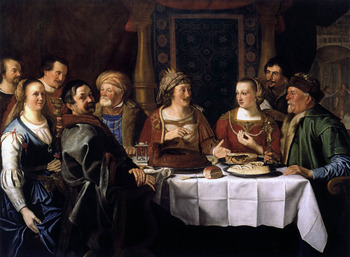
There is still another work that may have been painted by Van Hasselt: The Wedding Feast, signed J. Hasselt fe 1636 (Figure 6).Footnote 81 In 1949, Pieter Swillens argued that this painting was done by Jacob van Hasselt.Footnote 82 In 1983, Leonard Slatkes attributed the work to Jan Lucasz. van Hasselt, but this attribution has not been accepted by most scholars of Dutch art. In 2014, however, Schwartz cautiously accepted Slatkes’ attribution, opining that: “It seems reasonable to suppose that he [Jan Lucasz. van Hasselt] was involved in the conception if not the execution of the painting.”Footnote 83 He pointed out that the carpet has features that suggest a Shirazi origin and the dress of the woman sitting on the right-hand side may have been made of Persian brocaded silk.
The wedding feast, signed by J. Hasselt, d.1636. Oil on canvas, 102.1 x 135.5 cm.
Source: Centraal Museum, Utrecht (10046). © The Centraal Museum.

Besides Schwartz’s points, one may also see a water pipe (qalyan), a popular smoking device in Persia, which is held by the woman on the left-hand side of the painting. The position of the woman and her hand on the water pipe indicates that she was smoking it. It is plausible that Jan Lucasz. van Hasselt, who had spent a long time in Persia, was familiar with the water pipe and depicted it in this artwork.Footnote 84 Moreover, a comparison between the portrait of Sitti Maani and the woman in the red dress suggests a similarity in physiognomy and the depiction of the hand. It is of interest that in both works the hands are imperfectly and crudely depicted (Figure 7).Footnote 85 Therefore, following Slatkes and Schwartz’s conclusions, we believe that this work was painted by Jan Lucasz. van Hasselt.
(a) Detail, Portrait of Sitti Maani, from the book Funerale della Signora Sitti Maani. Published by Appresso l'Erede di Bartolomeo Zannetti, Rome. (b) Detail, The wedding feast, signed by J. Hasselt, d. 1636.
Sources: (a) Leiden University Library (HOTZ 330). (b) Centraal Museum, Utrecht (10046). © The Centraal Museum.

Discussion and Conclusion
This paper discussed the career of the Dutch painter Jan Lucasz. van Hasselt in Persia in the seventeenth century. He joined the royal library of Shah ʿAbbas I between 1618 and 1621, and served the shah for about ten years. Van Hasselt was the first European and Christian painter to serve in the royal painting department there. He was well paid and enjoyed the shah’s favor and was even used as the shah’s representative in the first Persian embassy to the Netherlands. He also helped the VOC establish contact at court to conclude a trade agreement. In 1629 Van Hasselt returned to the Netherlands and tried to establish himself as a commercial agent for Persia and Persian traders. He failed in this endeavor. In 1654 Van Hasselt made another effort to conclude a commercial treaty between Persia and the Netherlands, but this endeavor also failed. The paper further assesses what is known about his art output and discusses three pictures that may have been done by him.
Letter from the Persian court to the States-General and Prince of OrangeFootnote 86
A most illustrious Majesty among the highest ranks, a might as illustrious as glorious, a brilliant and glorious empire bear witness of an exceptional government that is bursting with nobility. It is a might of an admirable order and of the highest Christian wisdom of an extraordinary high repute, the king is the most illustrious of kings, his name of Christian ruler is the most glorious among glorious rulers; he is at the level of the Prince of Piarangia [Orange?], whose wealth and armed forces may easily be compared to the stars and whose head is crowned by the sun. May God surely lead him to the success that he desires. The beauty and glory of the military equipment and of His Majesty, excellent and all-mighty lord and master of Holland [Olandia], the strong ties that unites the kingdoms with an affection that is as indissoluble as exceptional, the numerous and magnificent benefactions of a perfection that is more than extraordinary and so useful that the people we have already sent to Your Majesty as a beginning and foundation [of our future relations] have been overwhelmed by the gentility and the benevolence that Your Majesty has shown, who, with good reason, has shown very fair arguments. All that should make advance positively with the supreme assistance of Your Majesty.
But let us now set aside all past discussions, so that for Your Majesty, in his famous and perspicacious wisdom, it will be clear and obvious and most shining than light, that it has come to the ears of the King that a certain number of merchants was going to depart to your provinces who have been prevented and retained by the officials of the mighty Majesty contrary to the customs of friendship and the continuous stable benevolent communications that have never changed. The merchants and traders who came to your kingdom have not been protected by your good reputation and they have been prevented by this incident. [This, we desire that] a higher right will be imposed with firm benevolence and that it will be ordered to those that work under your orders and who apply your regulations that nobody will hinder and bar the movement and freedom of merchants to come and go in these kingdoms.
As your emissaries are already with us permanently it appeared to the just and wise reflection of our king that one of our men might help us, working on our behalf in your regions and kingdoms. Therefore, Johannes van Hasselt, will soon be sent to Your Majesty [on our behalf]. He is an industrious and intelligent man, whose nobility is very much appreciated by our King and who, among us, has a very high and honored rank, to whom we have accorded total confidence, we are sure of his honesty and wisdom. We send him to your provinces so that he may facilitate as soon as possible trade with you and the movement of goods. As he will observe himself [the situation] and will draw his own conclusions as to what will be useful and practical for both sides that could be implemented. This will greatly contribute to the union and friendship as well as to the development of benevolent feelings. Very detailed letters and envoys bear witness to our gratitude and our satisfaction.
Thus, if in these regions Your Majesty proposes [regulations], as everything is based on your word, we then will be reassured and thereafter the royal will by which we will be informed of the decrees, will be applied with the greatest zeal and as soon as possible, as soon as we have been informed.
I end here; may the days of the Empire, his might, his splendor and of his glory be eternal.
The Latin script
Excelsa majestas in gradu altissimo, supremum, ac illustre dominium parittr que gloriosum, clarum et gloriosum imperium Dominostratio ordinatissima et Majestate plena. Dominatio Admirabilis ordinis, ac prudentia Christianus altissima, ac sublissima fama et nominis, inter Principes illustrissimus, clarissimorum Principum clarissimi Princeps Christianus, Similis Regi Piangia cujus copie et exercitus facillimicum stellis comparari possunt, et cujus caput solvestit, Deus feruct etad optatum finem perducat. Pulchritudino et ornamentum gloria et Majestatis, Excellentissome et potentissime Domini et Dominator Olandia, Regnorum fortis concatenatio, et indissolubilism eximij amoris, honores frequentes ac sublimes, et mirum in modum - excelsi perfectissimi, c efficassisimi, quos jugiter as vestram Majestatem misimus tanquam basis et fundamentum impressi funt in amore et benevolentia, qua tua Majestati significata, et est ostensa argumentis efficassisimism jure etiam, optimo hacm omnia a’ suprema illa Majestati firmanda cruet.
His omnibus praetermissis clarae, ac perspicaci sapeintia tua. Majestatis ac menti fit notum et manifestum, ac luce clarius, ad Regis aures pervenisse qu'omodo juidam mercatorum numerus profecturus erat ad has vestras regiones, et qu'omodo etiam a’ ministris illius ingentis Majestatis fuere prohibitac impediti posita inter mos amoris, de benevolentia communicatione, stabili, et immobili, ac quod mercatores et negotiatores, ac hac vestra Regna venientes a nomine immediantur ac prohibeantur a qu'oquam in emendo, ac vendendo pr vicissitudine et benevolente firmitate illius alta stirpis etiam erit imperare, et jubere sub sua obedientia existantibus et struientibus it sicut nos, ne quis prohibat aut impediat communicationem ac libertatem mercatoribus, fundi ac vedeundi in hisce Regnis Quoniam agentis vestri jugitur apud nos existunt ac morantur, visum est etiam nostra Reali menti-justae ac prudenti, ut etiam nomine nostro vir assistat in istas partes et Regna. Qua propter cum modo apud Majestatem nostrum reperiatur Johannis van Hasselt vir industrius, ac ingeniosus, qui nobilitatis felicissima Reali cognitione, ac etiam a nobis exaltatus et ornatus, maximam fecimus de eo confidentiam, consisi in sua prohibitate ac prudentia, mittimus ad istas vestras Regionis, ut posito inter nos commertio et communicatione jugiter assistat apud vos. Et animadvertens ipse et diligentie considerans, quidquid erit utilitatis et commodo utriusque partis exsequatyr. Nec non fundamentum unionis, et amicitiae, quam amore et benevolentia conciliavirit, in medie nostri, copiosissimis epistolis et legatis certiorem fieri nobis per gratum erit, ac perjucondum, Quidquid ergo Majestati vestra in hisce partibus sisi obtulerit, omni seposita circum locutione, certiorem nos reddat, et secondum Regiam suam voluntatem, ea qua nobis significata fuerint pracepta omno studio ac diligentia exequitioni mandari quantocius a nobis pracipictur finem facio Dies impery, Dominationis, magnificentiae, et gloriae permaneant.
To the High and Mighty Lords of the States-General of the United Netherlands.
Herewith, Johan van Hasselt, Agent of the king of Persia, respectfully submits how he petitioner in the year 1630 has arrived here in this country, his fatherland, empowered with full commission on behalf of His Royal Majesty of Persia to establish himself here as Agent of Persian Commerce (in accordance with the translation of his letters of credence annexed herewith) and to maintain friendly correspondence between the abovementioned king and this government. Therefore, the petitioner by virtue of this commission addressed the Assembly of Your High and Mighty [Lords] and Your High and Mighty [Lords] having seen the royal letters and his commission on the 7th of February 1631 have made a treaty with the petitioner on behalf of the abovementioned king, consisting in ten articles as shown in the authenticated copy attached herewith. This meant that he would be given free passage (vrijgeleide) and [right to] pass in all towns and cities of the United Provinces, or its territory to [those of] the Persian Nation, who, on behalf of the often mentioned king, would come here to this country. Item, [would be given] such exemptions and privileges as the citizens of these lands enjoy; [allowed to use] all their own weights and measures, subject to the limits imposed by art. 3 and that orders would be given as to the storage and management of the goods of those persons, who would happen to die here, subject to appropriate accounting, evidence and remainders (reliqua) of His Majesty’s goods, or of private goods of friends and relatives. Item, if of that same nation an adequate (competent) number would have arrived that these would be provided with a proper house and, in the location of their residence, would enjoy exemption of the [1] imposts on goods that would be consumed in their household, just like they also would be provided with a proper house, which by commission of the above mentioned king of Persia would represent his nation here and would be its principal [representative]. Item, that the house of the Agent would be and remain privileged just like the houses of other Agents of kings and princes in Europe and when this nation would have established a trading station (comptoir) with residents and capital within these lands it would enjoy such rights, both with regards to the commission as to the [matter of] justice, just like the English Court and the Scottish nation enjoy here in this country; also that they would have [free] exercise of religion within their home and if somebody wanted to change their religion that Your High and Mighty [Lords] would not interfere (aentrecken) in this matter. Item, that they would be allocated a proper place for burial of their dead in accordance with their custom, and in case someone of that nation acts improperly (verloopen), commits a untoward act (misgrijpen) or opposes the Agent of the mighty king that the local judicial authorities will assist the said Agent when they have been apprised of the unlawful act (delict), and will render justice to such a person or persons as required, based on the findings of the circumstances. Also, the said treaty is not limited by a time period, for it is stipulated in art. 5 that it will become effective once Persian merchants in an adequate (competent) number with a large capital would have arrived within these lands. The petitioner having made known the said treaty to aforesaid king, as soon as he had received it, but since then [2] many troubles have occurred in the kingdom, which have prevented that an adequate number [of Persian merchants] has come here. However, now the situation is such that a substantial number of seventeen persons have arrived here in Amsterdam with important merchandise amounting to a value of a few tons of gold and any day now more merchants are expected [to come] with a large [amount of] capital, all of this based on the trust that the treaty that the petitioner has agreed upon with Your High and Mighty [Lords] on behalf of the aforesaid king will be fully implemented. To which end they have addressed themselves and have made themselves known to the petitioner in this matter, so that it might be enacted by him, in accordance with the various articles obtained by him from Your High and Mighty [Lords], which the aforesaid king has made public throughout his realm. For this reason, the petitioner could not remain idle, to apply the treaty, which so far has not yet been revoked, but, by virtue of the same, the said merchants have addressed themselves to him to do his duty so that the said treaty may become implemented, he addresses himself herewith to Your High and Mighty [Lords] with the said treaty, which Your High and Mighty [Lords] have approved and accorded and requests that Your High and Mighty [Lords] would be so kind as to fully implement the same as to all its points and articles and to that end permit a proper residence in Amsterdam to the aforesaid nation as is required for the establishment of trade and the maintenance of commerce and all friendly correspondence with aforesaid [3] king will have to be done. The more so, since the Dutch Nation has already established in Persia its trading station (court) due to the activities (beleyt) of the petitioner and that through the petitioner’s intercession it has obtained many advantageous conditions with regard to the exemption of tolls and otherwise, just like Your High and Mighty’s treaty calls for. In case of the establishment of the said commerce and because of this the result would be a great success that this State in the matter of the right export (licenten) and transit (convoyen)Footnote 87 due to the trade of this nation (in the opinion of the petitioner as well as of others) would benefit a sum of one hundred thousand guilders per year. He further requests that Your High and Mighty [Lords] would be so kind as to give the petitioner letters of instruction (addresse) to the officials of the [city] government of Amsterdam so that they will provide him and those of the said nation with a proper house to carry out that which has to be done by virtue of the above mentioned treaty concluded with Your High and Mighty [Lords].
Presented on 29 October 1654 Done by J van Hasselt
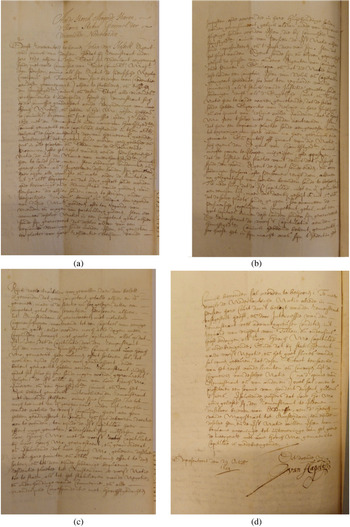
The Dutch Script Footnote 88
The script of Jan Lucasz. van Hasselt’s letter to the States General, October 1654.
Source: Archive of the States General (1.01.02), The National Archives of the Netherlands, The Hague (no. 12563.30).