Today, despite the efforts made to reduce accidents and emergencies, enormous economic losses, injuries, and many damages are still caused by industrial accidents. Major accidents not only affect the industry, but also can affect adjacent industries, local governments, and provincial governments, finally leading to a crisis. Reference Tang, Chen and Shao1 An organization’s capacity to cope with and manage emergencies and crisis is usually limited. Reference Mohammadfam, Bastani and Esaghi2 Under such circumstances, an organization requires a collaboration among local, regional, and sometimes national and international officials. Petroleum industry, on the other hand, is hazardous and commonly experiences accidents, such as fires and explosions. Reference Cheng, Yao and Wu3 Due to the presence of flammable and explosive materials in this industry, the rapid spread of fire and explosion is possible. Reference Cheng, Yao and Wu3 In addition, most of raw, produced, stored, or processed materials are liquid and gas that are processed at high temperatures and pressures; hence, the risk of fire and explosion is high in this industry. According to studies, most of the accidents occurring in petroleum industry are associated with “fire after explosion, recrudescence, and three-dimensional, large area, multi-point and other forms of combustion that could easily lead to heavy casualties and property loss and environmental damage.” Reference Liu, Zhang and Xu4
Such accidents can lead to a chain of accidents that affect adjacent industries and even cities; hence, the severity of their off-site consequences is high. Reference Pinkowski5 Due to the presence of high volumes of toxic, explosive, and flammable materials in this industry as well as the residential areas around related plants, in case of an accident and release of materials to the environment, the event may cause major health risks for residents living around the area. Reference Keshmiri, Pordel and Raeesi6
Due to the unexpected occurrence of such emergencies and crisis and their severe consequences, crisis preparedness and management programs are important to mitigate the impact of the events and related damages. The implementation of such programs requires the coordination and collaboration among different organizations. Reference Mohammadfam, Bastani and Golmohamadi7
One of the problems with crisis management is the establishment of crisis management plans and rules at the organizational, city, and provincial levels; hence, the programs may not match and are likely to contradict with each other. In most countries (including Iran), national laws are established to prepare for and respond to emergencies and crisis at the country, provincial, and local levels. There are many differences between organizational culture, organizational hierarchy, and structure of interorganizational relationships. The goals and responsibilities of these organizations may sometimes oppose each other. Therefore, 1 of the major challenges in crisis management is the need for the presence of multiple organizations and institutions at different local, regional, and national levels that might have not cooperated previously, while they should develop rapid and accurate coordination and communication within a short period of time. Reference Balcik, Beamon and Krejci8
On the other hand, at the time of crisis, in addition to every organization’s crisis management team, other crisis management teams are also set up in other organizations, such as the Crisis Management of Provincial Government (CMPG) and Crisis Management of University of Medical Sciences (CMUM). Hence, there might be some changes in the scope of responsibility of groups and teams. According to various studies, the lack of coordination among executive agents is 1 of the major management problems in Iran, which is attributed to weaknesses in the implementation of existing legislation and policies. Reference Bikdelo and Rahnavard9
Lack of proper coordination and collaboration among involved organizations can lead to disastrous consequences, such as the reduction in the effectiveness of crisis management, chaos, and expansion of critical conditions, as well as increase in losses and injuries. Reference Tang, Chen and Shao1 Therefore, assessing the coordination and collaboration among involved organizations in crisis management leads to improved team performance. One of the common methods for understanding and analyzing the structures of network collaboration and coordination in dynamic systems, such as crisis management, is social network analysis (SNA). Reference Aros and Gibbons10 SNA approach examines the social relationships and related structure in a network. Social networks consist of a set of members and the links between them. Members of a social network may include social entities, such as individuals, groups, organizations, and other related social agents; on the other hand, relationships between members may include power relationships, organizational relationships, collaboration, and so forth. The aim of SNA is to investigate the relationships existing in a graphical and mathematical network at 2 levels: actor level and network level. Reference Opdyke, Lepropre, Javernick-Will and Koschmann11
According to studies, interorganizational networks help understand the status of interactions among different organizations. Reference Tang, Chen and Shao1 The investigation of interorganizational networks is especially important in organizations with similar roles and responsibilities, as well as organizations with leadership roles because this tool can help resolve problems. Reference Kwok, Hanig, Brown and Shen12 Without using conceptual tools, it is difficult to understand the complexity and relationships among organizations. Reference Mohammadfam, Bastani and Esaghi2 In this study, structural characteristics of interorganizational networks were investigated during a crisis in a petrochemical industry. The problems of interorganizational collaboration and coordination were also investigated using SNA. Finally, strategies and solutions to improve these relationships were discussed to achieve the highest performance in crisis management.
METHODS
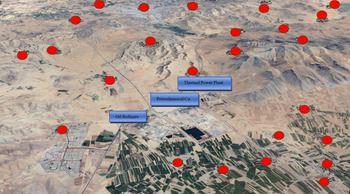
This applied study was conducted in 2019 in a petrochemical plant in Markazi Province, Iran. The studied petrochemical plant is adjacent to an oil refinery company, a thermal power plant, as well as an industrial city and residential towns and villages (Figure 1). Twenty-two villages, 1 municipality, and 1 city are close to these industrial plants.
The Studied Industry and Adjacent Industries and Nearby Residential Areas (Residential Areas Are Shown in Red Circles)

The investigated scenario was fire and explosion in a degassing tank (containing hydrocarbons). Experts’ viewpoints and the qualitative Delphi method were used to select the most important criteria for the emergency scenario. In the next step, a table was designed to score the emergencies based on the defined criteria. Reference Abbassinia, Kalatpour and Soltanian13 Finally, according to expert opinions, high-priority emergencies were identified, and the most important emergency was the explosion and fire in a degassing tank (containing hydrocarbons). This unit uses a tank for degassing (hydrocarbon) polymer product and transferring the product to another tank.
In case of fire and explosion and failure to control them, there is the possibility of the spread of fire to adjacent industries, which can cause irreparable damage. Figure 1 shows the studied plant and adjacent industrial sites, as well as neighboring residential towns. Under such a situation, crisis management teams will be formed, and the performance of these teams plays a critical role in the effectiveness of crisis management plans. In the first step of this study, organizations and executive groups involved in crisis management were identified.
In the next step, to collect more detailed information about the organizations involved in crisis management, after conducting several meetings with the experts in the field of study (petrochemical experts), as well as crisis management experts and specialists and university professors, the main organizations involved in crisis management were identified. Then, an open-ended questionnaire was used to identify the relationships and interactions among organizations. Accordingly, 25 questionnaires were sent to experts and specialists in crisis management teams in the studied petrochemical plant, and 21 completed questionnaires were collected. After the identifications of organizations, several interviews were conducted to obtain additional information from organizations involved in crisis management.
The interviewees included the managers of the responsible organizations. A total of 32 individuals working in organizations involved in crisis management were interviewed. In the next step, SNA was used to evaluate interorganizational relationships in crisis management, key features of the network under investigation, key organizations, leadership roles in the organizations, focal organizations, and changes needed to achieve the highest performance in crisis management. Organizations involved in crisis management and their relationships were selected as the basic items of the network in this study. Each of the studied organizations was evaluated as a node; in addition, SNA indicators were used to evaluate interactions and collaboration among organizations.
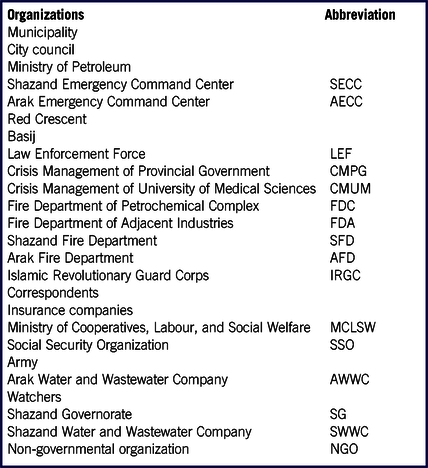
Gephi version 0.9.1, as an open-source network analysis and visualization software, was used for SNA. Reference Bastian, Heymann and Jacomy14 In this study, weighted edges were used to show the relationships between the organizations. The expert panel comments were used to determine the weight of the edges. As listed in Table 1, the crisis management team in this study consisted of 25 public and private organizations and non-governmental organizations (NGOs).
Involved Organizations in Crisis Management

RESULTS
Immediately after a crisis, involved organizations are dispatched to the scene of the accident to deal with an unexpected situation and reduce injuries and damages. Under such situations, different organizations are responsible for disaster management, each with specific responsibilities and roles.
In the case of the spread of accident and the need for more facilities and equipment to control the situations, adjacent industrial plants and local authorities (Shazand Governorate [SG] organization) are the first groups dispatched to the scene of the accident. Provincial authorities may also take action, if needed. NGOs and volunteers are other groups involved in crisis management. Involved organizations will act as recommended by existing laws.
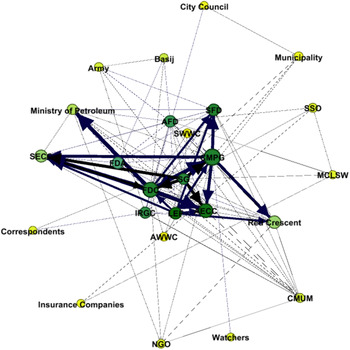
Using SNA, members of the crisis management team were considered as a node in the network, and their interactions and relationships during the crisis were examined as an edge. Figure 2 presents the network of interactions between crisis management organizations in the studied setting. As shown, communication between different groups is different; in addition, the large number of edges and the high density reflect the greater relationships between the involved agents and the importance of the node and information flow.
Interorganizational Network in Crisis Management

In this figure, the status of organizations in terms of degree is reflected by size (small and large node) and color (dark and light), so organizations with a higher degree are shown as larger and bolder nodes.
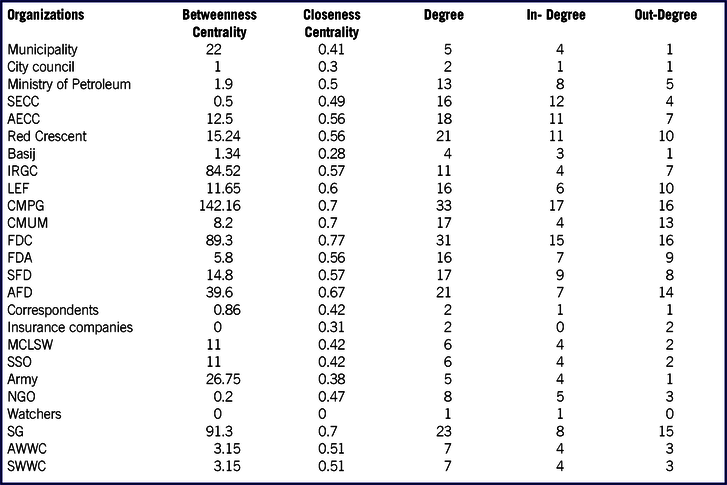
The results of the network survey indicated that the CMPG had the highest degree of centralization among the organizations, and the Fire Department of Petrochemical Complex (FDC) had the second-highest degree of centralization. The findings of the SNA are summarized in Table 2.
Summarized Findings of the SNA

As presented in Table 2, the highest betweenness centrality was observed in CMPG and FDC. The highest closeness centrality was observed in FDC, CMPG, SG, and CMUM organizations. Moreover, the highest degree was observed in CMPG and FDC.
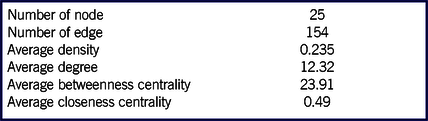
The general characteristics of the studied network are presented in Table 3. The total network density was 0.235 and the average degree of the network was 12.32. Average degree means the average number of organizations directly connected to each organization.
Key Metrics of the Network

DISCUSSION
The aim of this study was to investigate the structure of interorganizational network of crisis management, identify the problems and barriers in this area, provide solutions to improve the relationships to achieve the highest performance in crisis management, and reduce the damage and losses caused by the crisis. The investigated accident scenario was the explosion and fire in the degassing tank (containing hydrocarbons). According to the scenario, due to deficiencies in hydrocarbon absorption, an explosion occurs in the degassing tank, and there is the high likelihood of fire after the explosion. The fires can spread to other units. Due to the use of hydrocarbon compounds, the risk of fire and explosion in this unit is very high. The study by Holmstrom et al. showed that the leakage and sudden release of flammable hydrocarbon, both in liquid and vapor form, in the Texas City refinery, created a combustible flammable vapor cloud, resulting in fire in ISOM unit and other neighboring units with 15 people killed and 170 injured. Reference Holmstrom, Altamirano and Banks15 On the other hand, given the short distance between the studied petrochemical plant and the refineries and thermal power plants, with high volumes of explosives, flammable, and toxic materials, the likelihood of chain accidents is high. These industrial sites are located close to several cities, towns, and villages, and have a significant impact on the social and environmental life of the surrounding residents. If an accident occurs, high volumes of pollutants are released to the environment. So, in addition to environmental damage, neighboring residents are likely to be exposed to pollutants. Reference Ghorani-Azam, Riahi-Zanjani and Balali-Mood16 Hence, the crisis management plan is important to prevent damage and losses to the studied and adjacent industrial plants and people living in neighboring towns and villages. In this study, the investigation was performed using the SNA method.
Various public and private organizations are involved in crisis management. The role and responsibilities of these organizations are too diverse. This diversity can cause a considerable overlap in roles of different organizations. These problems make it difficult to achieve the goals of crisis management and reduce its effectiveness.
Organizations involved in crisis management in Iran include private, government, and public organizations. According to the results of SNA in this study, 25 organizations were involved in crisis management of the investigated accident. SNA indicators can be used to show the importance of each organization in crisis prevention. The indicator used in this study was centrality. Centrality reflects the importance of an organization in the network, which is reflected by the degree centrality, betweenness centrality, and closeness centrality. Degree centrality represents the degree of communication in each node. This indicator represents the number of direct edges connected to each actor and is divided into out-degree and in-degree. Out-degree refers to the number of links sent to another actor, whereas in-degree refers to the number of links received by each actor. Accordingly, the out-degree indicator shows the degree of involvement of organizations in emergency control. A high out-degrees value index also represents organizations that other organizations are depended on. Reference Chai, Liu and Zhang17 In this study, both CMPG and FDC had an important role in crisis control based on out-degrees value.
FDC plays an important role in controlling the situation, because it is usually present at the scene of the accident and makes attempts to control it. CMPG is 1 of the municipality-affiliated companies. The mission of CMPG is to coordinate items related to crisis management (prevention, preparedness, response, and recovery). This organization, with its comprehensive crisis management database, plays a critical role in crisis management and controls the accident. The highest out-degree was observed in SG, followed by FDA, and CMUM, respectively. Based on the results, it can be concluded that FDC, CMPG, and SG organizations play an important part in establishing appropriate communications and interactions among organizations. The proper performance of these organizations leads to a better performance of the whole crisis management network, whereas improper performance of these organizations leads to serious problems in crisis management. Municipality, city council, Basij, Correspondents, Army, and Watchers had the lowest out-degree value. The low value of this indicator means that these organizations have the least roles in crisis management, and, if they leave the network, the crisis management team’s overall performance is not impaired significantly.
The presence of some of these organizations is mainly exhibitive and propagandized and, usually, they do not have an executive responsibility. In order to achieve a better performance of the crisis management team, it is suggested to control and reduce the presence and involvement of these organizations and organizations with similar roles.
The highest in-degree values were observed in CMPG and FDC organizations, with 17 and 15 values, respectively. The high in-degree value indicates that other organizations have more relationships with the 2 organizations to carry out their roles and responsibilities.
Centrality indicators identify the nodes with the central role, importance, as well as power in the network. The betweenness centrality index is defined as the shortest paths between all members in the network with an actor. In other words, betweenness centrality is the extent to which an organization is located, with the shortest distance between 2 organizations. Betweenness centrality indicates the position of an organization and its important role in controlling conditions, as well as its role in connecting other organizations. Reference Mohammadfam, Bastani and Golmohamadi7 This indicator measures the amount of connection between an organization and 2 other organizations within the network. In this study, the highest level of betweenness centrality index was observed in CMPG, SG, FDC, and Islamic Revolutionary Guard Corps (142, 91.3, 89, and 84, respectively). These organizations play the largest connecting role in the network. If an organization with a high value of centrality leaves the network, indirect communication between other organizations will break, and the tasks of the organizations as a crisis management network may be disrupted. Studies have shown that high betweenness centrality of nodes plays a major role in the network. Reference Kwok, Hanig, Brown and Shen12 Therefore, a large number of organizations with high betweenness centrality values can cause an overlap in tasks between organizations, especially inconsistencies in leadership, which is due to the lack of a specific leader or commander in the crisis management team.
Closeness centrality indicates the sum of the shortest paths between any 2 organizations within a network; it reflects how accessible an organization is to all other organizations. Reference Mohammadfam, Bastani and Es-haghi18 The highest closeness centrality was observed in FDC, CMPG, SG, and CMUM organizations (0.7). This means that the intensity of sharing information in these organizations is more than that in other organizations. The density (a number between 0 and 1) indicates the cohesion between organizations, and a higher density index indicates closer relationships among organizations. The lower density index also indicates poor and ambiguous communication between organizations.
This index shows the overall level of cohesion in the network. The density of the studied network was 0.233, which indicates that only 23% of all possible connections existed in the network. These results showed that the relationships between organizations were much weaker than the expected ties. Low density affects coordination between organizations. For higher cooperation between organizations, network density must be increased and relationships between organizations should be strengthened. The results of studies conducted through SNA have also shown that inconsistencies in crisis management and poor performance are improved through increasing the overall cohesion in the crisis management team and increasing the interactions (and network density). Reference Mohammadfam, Bastani and Esaghi2,Reference Mohammadfam, Bastani and Es-haghi18 Improving interactions is of great importance, especially for the first groups of organizations. Reference Mohammadfam, Bastani and Es-haghi18
Various studies have shown that the lack of proper communication, lack of on-time dispatch of organizations, duplication and parallel work of organizations, and lack of proper use of resources can affect interorganizational coordination in crisis management in Iran. Reference Behmanesh and Kargar19 Based on studies, although crisis management structure and related rules and regulations are formulated and applied in Iran, they are not implemented as a coherent program. Crisis management laws in Iran are also implemented at 3 national, provincial, and city levels. Reference Mohebifar, Tabibi and Asefzadeh20
Bikdelo and Rahnavard’s study showed that lack of coordination is a common problem among executive organizations at national, provincial, and local levels in Iran. The results of their research also showed a high level of inconsistency in the public organization of Karaj city. In order to solve existing problems, they suggested to increase organizational awareness regarding the importance of coordination, improve communication mechanisms between organizations, and emphasize coordination based on legal issues in public organizations. Reference Bikdelo and Rahnavard9 Also, Sahebi showed that, in addition to cultural problems, lack of periodic training and maneuvers and inadequate coordination and collaboration between organizations were the major challenges in crisis management in the Red Crescent Organization. Reference Sahebi, Arab and Moghadam21
Given the nature of crisis, organizations and individuals have unusual tasks at the time of crisis. Reference Behmanesh and Kargar19 Studies have shown changes in the structure of organizations in response to the crisis and at the time of involvement in crisis management teams, which usually deteriorate the level of cooperation of the organization. Therefore, usual methods of interorganization coordination do not meet the needs emerged at the time of crisis. Lack of adequate information on duties and roles is also a common problem during the crisis in Iran. Reference Behmanesh and Kargar19 In addition to the lack of proper interorganizational communication, other problems in crisis management in Iran are the existence of multiple independent commanders during the process of crisis management. The study of Rabiee et al. also showed that the most important problems of crisis management in Iran are leadership weaknesses, lack of a precise plan, and existence of different and multiple organizations with a leadership role that lead to parallel works and duplication. Reference Rabiee, Ardalan and Poorhoseini22
Government organizations often have higher social capital, better level of communication, and a larger impact on crisis management. Reference Kapucu, Arslan and Collins23 Accordingly, government organizations play a critical role in crisis management. Therefore, the presence of multiple government organizations in crisis management team, as the center of power and decision-making in the system, leads to a reduction in the effectiveness of crisis management and an increase in vulnerability. Previous studies have also indicated that the lack of a clear command and lack of legal support for the crisis commander are important reasons for chaos during a crisis. Reference Rabiee, Ardalan and Poorhoseini22 Studies have shown that each organization has its commander, and there is no specific instruction on how to determine a commander for all of the involved organizations. Studies have also reported a common problem in Iran; as reported, sometimes some officials use their position to force organizations to obey their commands. Reference Rabiee, Ardalan and Poorhoseini22 The results of this study also indicate these problems, especially in organizations with low interactions within the crisis management network. SNA tools and guidelines and rules can help solve these problems. SNA results can be used to select the most qualified organization to act as the leader of the crisis management team. Team performance improvement and chaos prevention are expected when the best leader and commander is selected for the crisis management team. Reference Rabiee, Ardalan and Poorhoseini22 Studies have shown that, using SNA results, a group with the highest betweenness centrality can be selected as the leader organization. Reference Kwok, Hanig, Brown and Shen12
As a result, it is suggested to design a comprehensive crisis management plan, provide periodic training and maneuvers, and provide a precise definition for the roles and responsibilities of the organizations during the crisis. In order to better manage a crisis, it is necessary to define and develop crisis management plans, regulate the process of crisis management, provide clear definitions for the processes, responsibilities, and structures, and identify the exact positions and responsibilities of the involved organizations. Reference Mohebifar, Tabibi and Asefzadeh20 Another problem in crisis management is the existence of organizations and individuals with no executive responsibility who disrupt the relationships between responsible organizations. Reference Rabiee, Ardalan and Poorhoseini22 In this study, organizations with low out- and in-degree values, and without relationships with other organizations, may reduce the control over the situation. The presence of these individuals and organizations is often promotional. Reference Rabiee, Ardalan and Poorhoseini22 Therefore, to improve interactions between the main organizations involved in crisis management, it is better to limit the presence of such organizations in crisis management teams.
CONCLUSION
Coordination between organizations is an important prerequisite for crisis and emergency management, and SNA is a useful tool for examining such relationships. As the main advantage of SNA to examine interorganizational relationships during a crisis, it is able to quantify the extent and type of communication. This tool helps identify the strengths and weaknesses of organizations involved in crisis management and their interactions. Moreover, it makes it possible to strengthen interaction between the executive and first responder teams, limit the organizations with no executive responsibilities, and reduce chaos and inconsistency. Moreover, given the problems associated with crisis management leader and numerous organizations with a lead role, based on the SNA results, the most appropriate organization to lead the role can be selected. Effective command operations and optimal management of resources and organizations, along with exact rules and regulations, play a critical role in improving the performance.
Financial Support
This study is supported by Hamadan University of Medical Sciences, Iran (grant No. 9611037026).
Conflict of Interest Statement
The authors have no conflicts of interest to declare.