I. INTRODUCTION
Additive manufacturing (AM) is a general expression for several computer-based methods to transform CAD data into physical objects. Joining materials based on a ‘layerwise’ approach is the common denominator for different AM-techniques. Reference Gibson, Rosen and Stucker1 AM is opposite to subtractive technologies, e.g., traditional machining like drilling, milling, or grinding, where the material is removed from a preform to achieve a desired shape. This is expressed also in the recently published definition of the first basic ASTM standard for the new AM-Technology (ASTM F2792): “ Additive manufacturing (AM) – Processes of joining materials to make objects from 3D model data, usually layer upon layer , as opposed to subtractive manufacturing fabrication methodologies.”
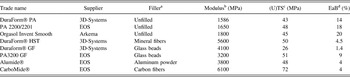
Selective laser sintering (SLS) of polymer powders is one component of the ‘layer upon layer’ based additive production techniques, occasionally considered as part of the next industrial revolution. Reference Hopkinson, Hague and Dickens2 Space-resolved solidification of polymer powders with high-energy laser opens countless opportunities to produce customized parts with great freedom of complexity. Reference Breuninger and Becker3 However, there are still some drawbacks obstructing a broader acceptance of SLS in many industries. One important issue is the limited number of available polymer powders processable by SLS. Conventional polymer processing techniques (e.g., injection molding or extrusion) have access to thousands of different recipes composed of several dozen basic polymers. Reference Dominighaus4 For SLS treatment just handful different formulas are provided so far and almost all of them are based on polyamide 12 (PA12). Reference Schmid and Levy5 A brief overview over the presently most common PA12 types on the SLS market is given in Table I. Frequently new materials for SLS appear Reference Drummer, Rietzel and Kühnlein6–Reference Schmidt, Pohle and Rechtenwald8 but none of them has attained a similar success in volume and economic turn over as PA12 and some of them vanished from the market shortly due to their poor performance or their inadequate processing behavior. However what are the obstacles for developing new SLS-powders? Generally it is the very challenging combination of intrinsic and extrinsic polymer properties that must be fulfilled simultaneously to transfer a polymer into a SLS processable polymer powder. This mandatory property combination will be issued as well as the outstanding properties of PA12 powders during SLS processing. Furthermore, the chemical structure of PA12 and the specific control of molecular factors will be introduced and explained in detail.
Most common PA12 powders used in SLS technology.

a Fillers and matrix materials are mixed by dry blending.
b Tensile modulus or E-modulus: data taken from suppliers material data sheet (XY-direction).
c (Ultimate) tensile strength: data taken from suppliers material data sheet (XY-direction).
d Elongation at break: data taken from suppliers material data sheet (XY-direction).
II. POLYMER PROPERTIES FOR SLS PROCESS
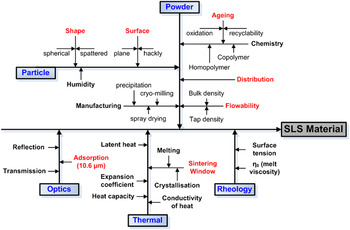
To understand the primary factors influencing the material characteristics a careful consideration of the most important parameters on SLS powder is beneficial. Figure 1 outlines five main factors in this association: powder and particle as well as thermal, optical, and rheological behavior. Accepting Fig. 1 it is obvious that a complex system of interrelated features exists. The different properties can be divided into intrinsic (thermal, optical, and rheology) and extrinsic ones (particle and powder). Intrinsic properties are typically determined from the molecular structure of the polymer itself and cannot be influenced easily, whereas production of powder controls extrinsic properties.
Interconnection of different polymer properties necessary to provide promising SLS materials.

A. Thermal properties
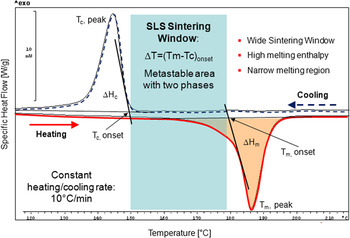
Understanding the challenging aspects of the desired thermal behavior of SLS powders needs to envision the sequence of SLS processing. Reference Kruth, Levy, Klocke and Childs9 A CO2-laser is used to melt the polymer particles deposited in a thin layer selectively. Space-resolved full coalescence of polymer particles in the topmost powder layer is necessary as well as an adhesion with previous sintered layers. For semicrystalline polymers usually used in SLS processing, this implies that crystallization (T c) should be suppressed through processing as long as possible, at least for several sintered layers. Thus, processing temperature must be precisely controlled in-between melting (T m, red line, Fig. 2) and crystallization (T c, blue line, Fig. 2). This metastable thermodynamic region of undercooled polymer melt is called ‘sintering window’ of SLS processing. Figure 2 depicts a differential scanning calorimetry (DSC) run for commercial PA12 SLS-powder. The nature of sintering window between onset points of T c and T m is apparent. However, it must be emphasized that the scheme in Fig. 2 is an idealized representation with fixed heating and cooling rates (10 °C/min). In fact, there are undefined and hardly controllable temperature change rates whilst SLS processing. Especially, if the process temperature during sintering is too close to crystallization onset and cooling rate is slow, crystallization is stimulated and begins at higher temperature. Curling or warpage due to premature crystallization is induced and SLS-parts are finally useless. Furthermore, there are complex temperature conditions in the building chamber of SLS equipment as bottom and compartment walls are heated and controlled at different temperatures. Reference Rietzel, Drexler, Kühnlein and Drummer10 An exact understanding of the thermal conditions at any place in the SLS building chamber especially regarding the temperature gradient along the vertical axis where parts are evolved is still missing. Investigations on theoretical description of thermodynamic and kinetic process were started with modeling and simulation recently. Reference Amado, Wegener and Schmid11 It could be shown that especially for PA12 powder, a model combining the Nakamura Reference Nakamura, Watanabe, Katayama and Amano12 with the Hoffmann–Lauritzen Reference Hoffman and Lauritzen13 theory, the determination of the crystallization rate presents a very good agreement with experimental results. Coupling the thermomechanical properties with the crystallization theory results in a better understanding of how the warpage or curling of parts develops during a SLS build in future. Besides the very complex point of suitable thermal conditions, there are further intrinsic factors like optical properties, melt viscosity, and surface tension that need to be very specific for a successful application of polymer powders for SLS.
DSC-Thermogram indicating the ‘sintering window’ of SLS-processing - region between melting (Tm) and crystallisation (Tc).

B. Optical properties
Evidently an adequate capability of the material to absorb energy at present laser wave length (CO2-laser: 10.6 µm) is mandatory. This is palpable for most polymers as they consist of aliphatic compounds (C–H bonds). In the majority of cases, aliphatic polymers have group vibrations in the ‘fingerprint’ infrared (IR) region sufficient to absorb relevant portions of 10.6 µm radiation. Furthermore, in case of a poor absorption capability, an increase of laser energy power can compensate the effect. This means that absorption is the less critical of the intrinsic polymer properties.
C. Viscosity and surface tension
Besides IR absorption capability a low zero viscosity (η0) and a low surface tension (γ) of polymer melt are essential for successful SLS processing. Reference Rietzel14 This is vital to generate an adequate coalescence of polymer particles. Especially, a low melt viscosity at low shear stress conditions is of high importance, as, unlike injection molding, SLS cannot provide an additional compacting during part generation (holding pressure). The required low η0 is also the reason why attempts to process amorphous polymer powders with SLS usually end with brittle and instable parts most likely. Reference Nelson, Xue, Barlow, Beaman, Marcus and Bourell15,Reference Childs, Berzins, Ryder and Tontowi16 The fact that viscosity of those polymers above the glass transition (T g) temperature is still very high in general a proper coalescence does not take place typically.
As shown in Fig. 1, it is palpable that besides the polymer-related properties, also properties mainly determined by production of the powders are important. It must be distinguished between the desired properties of a single particle and the obtained powder prepared from these particles.
D. Particle
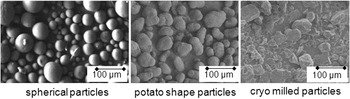
Shape and surface of the single particles determine the behavior of the resulting powder to a great extent. Reference Amado, Schmid, Levy and Wegener17 In case of SLS powders, the particles should be spherical at least as attainable. This is to induce an almost free-flowing behavior and is necessary as SLS powders are distributed on the part bed of an SLS machine by roller or blade systems and will not be additionally compacted. The achievable SLS part density is directly linked to powder density in part bed and is thus coupled to the shape of particles and their free-flowing behavior. Figure 3 depicts some particle forms achievable by different powder generation processes. Spherical particles are usually established by co-extrusion processes with soluble/nonsoluble material mixtures, like oil droplets in water. Potato-shaped particles are typical for the today available commercial PA12 powder confected by precipitation process. Particles obtained from cryogenic milling are inadequate in the majority of cases for SLS processing. The inferior powder flowability generates a poor part bed surface with reduced powder density. Thus, crushed powders finally end in weak, less condensed SLS parts with low density, and poor mechanical properties.
Particle shapes attainable by different production technologies.

E. Powder
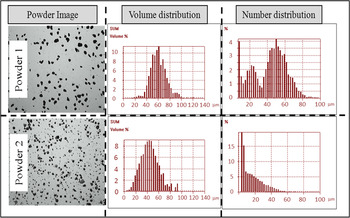
SLS powders should present a certain particle size distribution (PSD) to be operated on SLS equipment. The distribution is favorably between 20 µm and 80 µm for commercial system. However, it is necessary to identify not only the volume-based PSD, especially the fraction of small particles is of high importance. Particularly, the amount of small units could be responsible if a powder depicts a reasonable SLS processing behavior or not. Figure 4 illustrates such a case. Both ‘Powder 1’ and ‘Powder 2’ have some good and acceptable PSD looking at volume distribution (Fig. 4, middle column). Thus, both powders should be processable on SLS equipment. However, in reality, the trial to do so with ‘Powder 2’ failed. The reason can be recognized from number PSD (Fig. 4, right column). ‘Powder 2’ contains a remarkable portion of small particles which may induce stickiness in powders. Reference Mazur, Narkis and Rosenzweig18 The enhanced adhesion between particles reduces the free-flowing powder behavior and prevents SLS processing. In particular, as cryogenic milled powders contain often a high amount of fine particles, this is another reason why these powders are ineffective in SLS processing.
Distribution of powders with similar volume distribution and dissimilar number distribution.

The challenging requirements for SLS powders described in this chapter are one reason for fewer SLS materials to be commercialized. PA12 and some dry blends based on PA12 are today the materials which are used to generate almost all commercial SLS parts. The specific performance of PA12 for SLS processing is unmatched from other polymers till now. This is due to the fact that commercial machines are optimized over the years in their performance for PA12 but more important, for some specific molecular facts existent for PA12.
III. SLS PROCESSING OF POLYAMIDE 12
Thermal behavior and a precise powder distribution with well-shaped powder particles are material key factors for successful SLS processing. In case of commercial PA12 powders, the material is specially treated and adjusted to fulfill these needs to a great extent. On the one hand, the molecular structure of the polymer is controlled regarding chain length (viscosity) and crystallinity and on the other hand, the shape of particles is adjusted to depict outstanding powder flowability.
A. Molecular structure (thermal control)
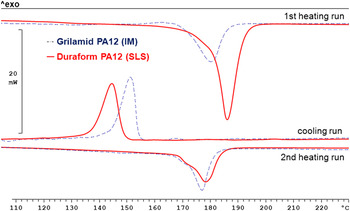
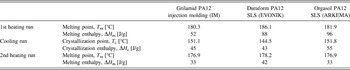
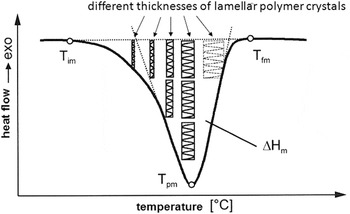
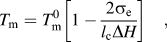
Obligatory for successful SLS processing is that polymers display a sufficient sintering window, an appropriate gap between melting and crystallization (Fig. 2). As regular polymers often show a very narrow sintering window or even an undesirable overlapping of melting – and crystallization onset, SLS powders are controlled precisely for this purpose. Figure 5 depicts the thermoanalytical results (DSC measurement) of a commercial Injection Molding PA12 grade (Grilamid®, company Ems Chemie, Switzerland) in comparison with a commercial PA12 for SLS processing (Duraform PA®, company 3D-Systems, Rock Hill, SC). Comparing the curves of first heating and cooling of these two polymers, it is obvious that the sintering window is drastically stretched for Duraform PA (red lines, Fig. 5). Shifting the melting point (T m) to higher temperature and the crystallization point (T c) to lower temperature are man-made. The very specific effect of higher melting is diminished in the curve of the second heating run. Consequently, the induction of higher melting transition and also higher melting enthalpy (for values see Table II) in the first run of Duraform powder is introduced by a special treatment during powder production (thermal history). The effect could be understood from crystalline structure consideration. Besides the basic chemistry, the melting of a polymer is determined from the thickness of its lamellar polymer crystals. A simple sketch for illustration is depicted in Fig. 6. Reference Ehrenstein, Riedel and Trawiel19 In reality, polymer crystals of PA12 exhibit usually a γ-morphology and have a unit cell (l c) with a dimension of about 16.5 Å. Reference Cojazzi, Fichera, Garbuglio, Malta and Zannetti20 Following the theory of Gibbs Thomson, Reference Lippits, Rastogi and Höhne21 the melting point of a polymer can be calculated by Eq. (1)
 $${T_{\rm{m}}} = T_{\rm{m}}^0\left[ {1 - {{2{\sigma _{\rm{e}}}} \over {{l_{\rm{c}}}\Delta H}}} \right]\quad {\rm{,}}$$
where T m = melting point; σe = surface energy of chain folding; ΔH = melting enthalpy; l c = length of unit cell; T m 0 = equilibrium melting point (melting of an infinity thick crystal).
Comparison of a commercial (Grilamid) and a SLS (Duraform PA) polyamide 12; enlargement of sintering window.

Melting and crystallization values for different polyamide types.

Nature of broad melting points of polymers; different thickness of lamellar crystals.

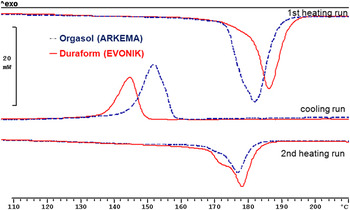
Using this relation and the usually obtained melting point for PA12 of about 178 °C, l c is typically around 66 Å or 4 molecular unit cells in a single crystal in thermodynamic equilibrium for regular PA12. The higher melting for SLS PA12 can now be assigned and explained by a very precise crystallization resulting in homogeneous crystalline phase with 5 linear unit cells with a theoretical melting point of 189 °C. This is almost exactly the melting point of Duraform PA in the first heating run (Table I). Also the melting enthalpy (ΔH m) is increased drastically by this unit cell enlargement and homogenization of crystalline phase: 88 J/g in comparison with 52 J/g for regular PA12 (Grilamid) (Table I). Introduction of this exceptional crystalline morphology is performed by the producer of the basic powder of SLS PA12 (company EVONIK, Germany) most likely during the precipitation of the powder after polymerization. However, the exact procedure is reasonably confidential. Another SLS basic powder is produced from company ARKEMA (France) with trade name: Orgasol Invent Smooth. Figure 7 depicts the thermal analysis for the Orgasol polymer type in comparison with Duraform PA. Apparently, Orgasol Invent Smooth did not exhibit the same favorable thermal behavior as Duraform PA although depicting a high melting enthalpy (ΔH m = 96 J/g). The much smaller sintering window of Orgasol Invent smooth needs a precise and challenging process control during SLS sequence. However, it is well known that the surface quality of Orgasol SLS-parts is outstanding in comparison with other materials due to precise controlled particles regarding shape and distribution.
Comparison of two SLS polyamide 12 (Duraform PA and Orgasol).

B. Particle shape and size distribution
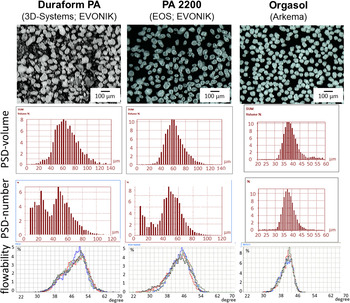
Figure 8 provides an overview over the three most frequently applied PA12 powders for SLS processing concerning optical appearance, particle distribution (volume- and number PSD), and flowability. Duraform PA12 from company 3D-Systems and PA2200 from company EOS (Germany) is based upon the same basic powder produced by Evonik (trade name: VESTOSINT). Orgasol powder is independent from this source and produced with a polymerization process ‘emulsion polymerization’. This approach allows controlling the particle shape in a very precise manner. The differences can be observed from the particle pictures (Fig. 8, row 1). Powders based on VESTOSINT material have slightly disordered spherical shapes, frequently named ‘potato-shaped particles’. Slightly better regarding sphericity are Orgasol particles; however, they are much on top concerning distribution. They display a very narrow dispersion as well in volume- and number PSD. Moreover, it can be detected that Duraform PA and PA2200 consist of different fractions of the VESTOSINT powder of EVONIK. This is clearly visible in number-PSD of Duraform DF. The differences in particle distribution of the three powders have some effect for SLS processing. Free-flowing behavior of powders, depending on PSD and powder shape is coupled with powder density and finally with part density. The free-flowing properties can be estimated from the measurements presented in row 4 of Fig. 8. These measurements are performed by revolution powder analysis. A distribution of avalanche angel is visualized. The smaller and higher symmetrical the curves are, the better is the flowing behavior. Further details are given elsewhere. Reference Amado, Schmid, Levy and Wegener17 Clearly on top in this connection is again Orgasol powder. This means that usually SLS parts produced with Orgasol powder has a very good density and smooth surfaces. However, as said the control of SLS process with Orgasol is delicate due to restricted thermal boundary conditions. Moreover, powder density influences mechanical properties of SLS parts to a certain extent. But another important effect on the mechanical properties of SLS parts is coming from the molecular structure of SLS polyamides as well.
Distribution of commercial SLS powders regarding particle size and flowability.

C. Molecular structure (end groups)
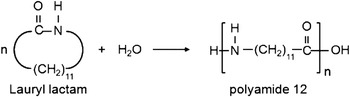
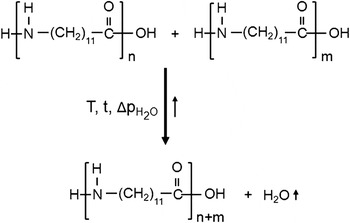
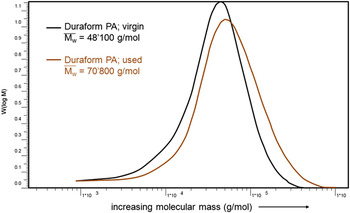
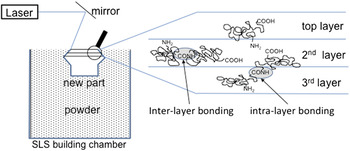
The reaction to generate PA12 chains is usually accomplished by ring-opening polyaddition starting from lauryl lactam. Reference Novitsky, Mathias, Osborn, Ayotte and Manning22 As catalyst for the ring cleavage water is used. This means that the reaction ends in a polymer chain with defined end-groups. Usually one carboxylic group (–COOH) and one amide-group (–NH2) terminate each polymer chain. Figure 9 illustrates the chemical reaction to generate PA12. This open structure with unblocked chain ends has some important effects on the behavior of PA12 powders during SLS processing. As PA12 powders are heated through SLS execution very close to its melting temperature and SLS machines are filled with dry nitrogen to avoid polymer oxidation, Reference Crompton23 ideal conditions occur in SLS machines for solid state condensation reaction. Reference Gantillon, Spitz and McKenna24 As the dried-up state with high temperature lasts usually for several hours, polymer chain ends have enough time to meet reaction partners by molecular movement. As almost all organic reactions are in an equilibrium state depending on the temperature, time, and pressure (in case of PA12 condensation the partial pressure of water) the PA12 chains tend to increase to higher molecular weight. Figure 10 illustrates the rise of polymer chains regarding their equilibrium condition for SLS processing. Any reaction between carboxyl- and amine group evolves one molecule of water, which is evaporated and removed by dry nitrogen. So the reaction shifts to the higher molecular weights until the equilibrium for given conditions is achieved. The rise of molecular weight is depicted in Fig. 11. The presented size exclusion chromatography measurements show a weight average molecular weight distribution (M w) for a virgin SLS powder and a powder after several hours at processing conditions. The M w-value is almost doubled. The same effect can be recognized in melt flow index (MFI) measurements. Virgin Duraform SLS powder starts with a MFI-value of around 80 g/10 min (235 °C/2.16 kg) and is reduced to less than 20 g/10 min (235 °C/2.16 kg) for ‘aged’ powder after several processing cycles. The extension of chains involves a drastic increase of melt viscosity. However, the effect of solid-state condensation is ambivalent for SLS processing. The increase of molecular weight in SLS parts during development leads to parts with desired enhanced mechanical properties and even more to strong interlayer bonding of parts. Reference Dupin, Barrès, Lame and Charmeau25 Figure 12 indicates a sketch of intralayer bonding and interlayer diffusion of SLS-layers during SLS processing. It is stressed that this behavior is just possible when premature crystallization of single layers is suppressed and the material lasts for a certain time in the state of undercooled liquid as explained above. Unfortunately, the same reaction determines that nonsintered powder in the machine changes the molecular structure as well and behaves differently in the following SLS actions due to the increased melt viscosity. If melt viscosity of nonsintered powder is finally very high the material must be discharged, as parts tend to evolve poor surface quality (orange peel). There are already several attempts to avoid the effect of solid-state condensation in SLS powder by blocking the end groups (a quite common procedure from polymer producers to fabricate polymers with defined viscosity). Attempts for SLS polyamides to do so have failed so far, as parts made from these polymers tend to layer delamination. 26 Building parts by SLS processing needs a good interlinkage of layers, otherwise a non-acceptable anisotropy of part properties in different directions (X-, Y-, versus Z-direction) appears.
Synthesis of polyamide 12 from lauryl lactam.

Nature of solid state condensation in polyamide 12.

Comparison of weight average molecular mass from virgin and aged polyamide 12.

Interlayer reaction of polyamide 12 during SLS processing.

IV. SUMMARY AND OUTLOOK
AM is close to become a genuine production technique changing the way of producing parts in future. Enhanced complexity and personalized features are targeted. SLS of polymer powders is one component of the additive production techniques. In general, polymer powders and their key properties controlling the applicability for successful SLS processing was introduced. The very demanding combination of intrinsic and extrinsic polymer properties to be fulfilled simultaneously was outlined. Moreover, the chemical arrangement of PA12 and the specific control of molecular structure were explained in detail. Especially, the open chain structure of PA12 with reactive end groups is sketched and their meaning for successful SLS processing is emphasized.
To widen the application of SLS parts to new technology areas in future, the development of new polymer powders applicable for SLS is mandatory. Especially, the development of polyolefin types (PP, PE, POM) with impact modified properties or flame retardancy should attract new markets (automotive, household, electronics, aviation) and enlarge the business drastically.