


Electoral quotas, which are used in more than 100 countries around the world, increase the representation of target groups in legislatures. But do the beneficial effects of quotas persist after they are withdrawn? Answering this question is important because quotas are often thought of as temporary measures, used to improve the lot of particular groups of people until they can take care of themselves. Target groups could secure representation for themselves after quotas lapse as the constraints that previously prevented their effective political voice are mitigated, either by broad social processes or by quotas themselves. Therefore, a thorough accounting of the costs and benefits of quotas must investigate whether quotas themselves can continue to boost the representation of target groups in legislatures after they are withdrawn. This question is particularly important because quotas restrict the opportunities available to nontarget groups and might, in fact, cause a backlash against beneficiaries (Weiner Reference Weiner1978; Wilkinson Reference Wilkinson2000).
Little evaluation of the lasting effects of quotas has been conducted for at least two reasons. First, despite intentions to the contrary, quotas are rarely withdrawn.Footnote 1 This makes it difficult to assess what would happen to target groups once quotas have been eliminated. Second, because incumbent politicians have the incentive to implement quotas in areas where target groups would do well anyway, simple comparisons of seats with and without quotas would probably yield biased estimates of the effects of quotas.
I circumvent these problems by examining the results of a unique policy initiative in India that sets aside randomly chosen seats in local governments for women for one election at a time. I use this natural experiment to determine the effect of “reservations” on the chances of women winning elections after quotas have lapsed. Using data from Mumbai, I find that the chances of a woman winning office conditional on the constituency being reserved for women previously are approximately five times the chances of a woman winning office if the constituency had not been reserved for women. I also explore suggestive evidence on the mechanisms by which reservations might improve women's ability to win elections. I find that reservations mainly work through introducing into politics a cohort of women that are able to secure party tickets and win office after reservations lapse. This finding speaks to the external validity of my results. It also suggests that the degree to which the beneficial effects of reservations persist will depend on the extent to which the cohort of women that enter politics while reservations are in effect continue to run for office after reservations lapse. Because quotas have continuing positive effects on women's representation after they are withdrawn, the costs of this remedy for inequalities in political representation—in terms of preventing men from running for office—need only be temporary. This finding should provide succor to those that deplore the reverse discrimination (against men, in this case) that quotas institute.
I proceed as follows. I explore the related literature in the next section and introduce the context in which I explore the next-election effects of reservations in the section after that. Next, I describe the data and empirical strategy, and present my findings on the next-election effects of reservations. I then explore the channels through which reservations might improve women's chances of winning elections, and then conclude.
LITERATURE REVIEW
This article contributes to the substantial literature on remedies for inequalities in political representation. Although a large portion of this literature has devoted itself to developing rationales for various remedies for inequalities in political representation (e.g., see Mansbridge Reference Mansbridge2005 for a robust defense of quotas for women) and to explaining the mechanisms by which some of these remedies, such as gender quotas, have come to be used the world over (Krook Reference Krook2006), there is also a substantial literature on the effects of such remedies. The literature on majority–minority districting, for example, examines the partisan and policy effects of such districting strategies (Cameron, Epstein, and O'Halloran Reference Cameron, Epstein and O'Halloran1996; Lublin and Voss Reference Lublin and Voss2003; Shotts Reference Shotts2003), whereas the literature on quotas examines their effects on the provision of public goods (Chattopadhyay and Duflo Reference Chattopadhyay and Duflo2003, Reference Chattopadhyay and Duflo2004), attitudes toward female politicians (Beaman et al. Reference Beaman, Chattopadhyay, Duflo, Pande and Topalova2008), the targeting of social expenditures and transfers (Bardhan, Mookherjee, and Torrado Reference Bardhan, Mookherjee and Torrado2005; Pande Reference Pande2003), candidate quality (Ban and Rao Reference Ban and Rao2008), and several other outcomes (Ghatak and Ghatak Reference Ghatak and Ghatak2002; Jha and Mathur Reference Jha and Mathur1999; S. Singh Reference Singh2003). Although much of this literature examines the effects of remedies for inequalities in political representation while they are in place (e.g., while quotas are in force, or while districts are gerrymandered), I depart from this literature to investigate the effect of quotas for women after quotas are withdrawn.
Insofar as I examine the mechanisms by which quotas affect the odds of women securing political office, this article relates to an even broader literature that aims to understand the causes of the underrepresentation of various peoples in politics. This literature includes works on the determinants of people's decisions to run for office (Chhibber Reference Chhibber2002; Fox and Lawless Reference Fox and Lawless2004), the literature on party (Sanbonmatsu Reference Sanbonmatsu2006) and voter perceptions (Barry, Honour, and Palnitkar Reference Barry, Honour and Palnitkar2004; Beaman et al. Reference Beaman, Chattopadhyay, Duflo, Pande and Topalova2008; Hajnal Reference Hajnal2001) of minority candidates, and the literature on changing social norms (Mackie Reference Mackie1996). This article contributes to this literature by examining the effects of an exogenous and random shock (the quota) on the election process. By examining the behavior of relevant actors in wards with and without quotas, I am able to improve our understanding of the constraints that women face in being elected.
In terms of methodology, this article analyzes an atypical natural experiment, where those in the treatment group were chosen through an explicit lottery rather than through an intervention that was “as if” random. In so doing, the article joins a spate of recent works by economists that have examined the effects of such lotteries—often employed by governments to ensure apolitical selection of beneficiaries, rather than to facilitate policy evaluation—on various outcomes (Clingingsmith, Khwaja, and Kremer Reference Clingingsmith, Khwaja and Kremer2009; McKenzie, Gibson, and Stillman Reference McKenzie, Gibson and Stillman2006).
Last, this article addresses a weakness of the literature on institutions. This literature highlights the effects of exogenous factors—such as colonialism, diseases, and wars—on institutions and, in turn, their effect on politics and economics. Although this research agenda helps identify important effects, it provides little room for human agency and policy advice: we cannot recommend that states acquire colonial subjugators or new geographies, or that they engage in wars. I, therefore, focus on trying to specify the effect of a deliberate policy (reservations) on a social institution (discrimination).Footnote 2
CONTEXT
Inspired by India's precolonial history of local self-government and Mahatma Gandhi's vision of an India made up of self-sustaining “village republics,” the Indian constitution of 1949 directed the state to work toward the establishment of vibrant local governments. Most of these governments—particularly at the village, block, and district levels—existed on paper since the 1950s, constituted without elections and bereft of substantial powers. The 73rd and 74th constitutional amendments, passed in 1992, directed India's state governments to conduct elections at local levels, devolved powers of expenditure and oversight to these bodies, and mandated the reservation of one-third of the seats in these local bodies for women.Footnote 3, Footnote 4 Because only female candidates can run for election in wards reserved for women, only women are elected from these seats.
A silent revolution in local governance has followed. Two to four elections have been held for more than an estimated two million seats in more than 220,000 local government bodies across the country since 1992.Footnote 5 Women's representation, which had ranged between 3% and 9% of house strength in India's state and national legislatures, now stands at more than one-third of seats in local bodies.
Seats reserved for women are randomly chosen and change from election to election. This ensures that the process is fair, to the extent that every seat has an equal chance of being reserved, and that men in reserved constituencies are not permanently excluded from office.
I consider the impact of reservations for women on local politics in Mumbai. Mumbai is located on India's west coast, in the state of Maharashtra. With a population of approximately 13 million, it is India's largest city and one of the largest in the world. Its municipal corporation was established in 1888, and elections for its “corporators” or members have been conducted—on a first-past-the-post basis for single member districts—more or less every five years since. Through its executive wing, the Brihanmumbai (Greater Mumbai) Municipal Corporation (BMC) is responsible for the provision of most of the city's essential services, including roads, water, sanitation, education, and health. It raises approximately $2.5 billion in revenues every year for these purposes, which makes it the largest local government in India. As is the case with many local governments in India, however, the deliberative wing of the BMC is weak.
I trace the impact of reservations in 1997 on electoral outcomes in 2002. Although one-third of the seats in the city's municipal corporation were reserved for women in 1997 and 2002 per the constitutional amendments described previously, the city's experience with reservations started earlier, in 1992, when 30% of the seats were reserved for women under a state election law that was subsequently superseded by the national constitutional amendments. My analysis, however, will be restricted to a comparison of 1997 and 2002 election results for reasons that I detail in the next section.
Local elections in India are an appropriate choice to study whether reservations have a sustained impact on the ability of women to win office due to the confluence of two unique factors. First, although quotas are rarely withdrawn once they are introduced, the fact that seats reserved for women in India change in each election means that quotas are, in fact, withdrawn in some instances. Second, because seats are reserved for women through a randomized process, comparisons of wards that were reserved and not reserved do not suffer from selection effects that would be endemic to such comparisons in other contexts.
Although an identical analysis could, in principle, be conducted using data from other regions in India, the places that we could examine are surprisingly limited, for three reasons. First, few local election authorities maintain detailed historical election data. I managed to retrieve detailed 1997 and 2002 election data for Mumbai from the BMC after much effort. Second, the analysis would probably have to be limited to city elections because conducting such an analysis for rural areas would involve the examination of too large a geographic area (encompassing many small villages because each village has few legislators) for comparisons to be meaningful. Third, the electoral systems in many Indian cities have changed multiple times in the past two decades, rendering comparisons between electoral outcomes over time difficult. Therefore, Mumbai offers us an unusual opportunity to identify the effects of randomized quotas.
DATA AND EMPIRICAL STRATEGY
To test whether reservations for women affected the probability of women winning subsequent elections, I collected data from the Maharashtra State Election Commission and BMC. The data collected were, in a mix of Marathi and English and for the 1997 and 2002 elections, official “result sheets” for each of Mumbai's electoral wards, Maharashtra gazette notifications of ward boundaries, the reservation status for various seats and candidate lists, and internal documents of the Election Office of the BMC. For each ward, I coded the names, sex, party, incumbency status, and vote tallies for every candidate in the 1997 and 2002 elections. This yielded 2,725 and 2,065 records for the 1997 and 2002 elections, respectively. I also coded, for each ward, the reservation status and the total number of eligible voters: this yielded 221 records for the 1997 elections, and 227 records for the 2002 elections.
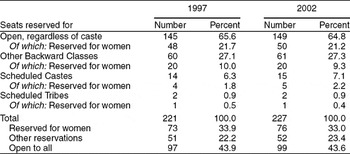
The empirical strategy of this article is straightforward because seats reserved for women were randomly chosen. More specifically, the reservation process proceeded as follows. First, constituencies (also called seats or wards) with the highest concentration of Scheduled Castes (SCs), Scheduled Tribes (STs), and Other Backward Classes (OBCs) were reserved for SCs, STs, and OBCs, respectively.Footnote 6 The proportion of seats reserved for these groups was set equal to the proportion of these groups in the city's population. Second, within the four groups created by the previous step (the fourth group contained seats that were open to all regardless of caste or class), 33% of the seats were randomly reserved for women—independently, and with equal probability—in 1997 and 2002. Table 1 summarizes the reservation status for all the BMC wards in the three elections. It shows that the result of this process was that 33% of the wards were reserved for women through randomized, stratified, and independent draws in 1997 and 2002.
Constituencywise Reservations in 1997 and 2002

Note: Constituencies reserved for Other Backward Classes, Scheduled Castes, and Schedule Tribes were ones with the highest concentrations of Other Backward Classes, Scheduled Castes, and Schedule Tribes, respectively. Constituencies were reserved for women using random, stratified, and independent draws in 1997 and 2002. See text for details.
That such randomization really did occur is evidenced by the fact that reserved and unreserved wards in 2002 were statistically indistinguishable from one another in terms of a number of 1997 election-related characteristics, including their reservation status in 1997, their track record of electing women to office, and their party affiliation. I could not conduct such an analysis to verify that the 1997 reservations were orthogonal to 1992 election characteristics due to changed ward boundaries between the elections. However, similar tests comparing the socioeconomic characteristics of reserved and unreserved wards across a number of different locales and election years in India have shown that reserved and unreserved wards are statistically indistinguishable from one another (Chattopadhyay and Duflo Reference Chattopadhyay and Duflo2003; Pande Reference Pande2003).
Furthermore, qualitative evidence for the probity of the randomization process comes from the fact that the 2002 BMC elections saw the reservation of the seats of the sitting male mayor and deputy mayor, and 18 other male BMC incumbents (Naik and Lokhande Reference Naik and Lokhande2001). The reservation of their seats, and the norm that representatives be resident of the ward from which they are running for office, meant that these politicians were barred from running for local political office in 2002, which is an outcome that we may safely assume they would have prevented if they could have. Given their inability to do so, we may assume that the reservations process was not tampered with. Footnote 7
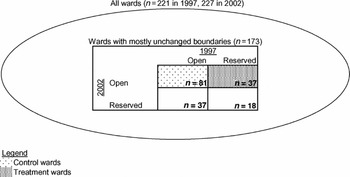
Although the contemporaneous, within-election effects of reservations on political outcomes can be estimated by comparing reserved and open wards in 1997 and 2002, the challenge lies in devising a way to estimate the next-election effects of reservations. To do this, I restrict my analysis to wards in 2002 that were not reserved or “open,” and compare those that were reserved in 1997 (the treatment wards, n = 37) with those that were not reserved in 1997 (control wards, n = 81). In comparing these wards, I use difference in proportions tests for dichotomous data, and difference of means tests (t-tests) for continuous data.
To make the experimental setup clearer, consider the “transition matrix” in Figure 1, which notes the reservation status of wards in 1997 and 2002. The matrix shows that 81 wards were randomly declared “open” in 1997 and 2002 (the control group), and 37 wards were randomly reserved for women in 1997 and were open in 2002 (the treatment group). Comparing these wards allows me to test my central question—whether the 1997 reservations increased the probability that women win elections in 2002.Footnote 8, Footnote 9
Control and Treatment Groups to Calculate the Next-Election Effects of Reservations

Randomization addresses the concern of controlling for heterogeneity in the baseline characteristics of treatment and control groups by ensuring that assignment to the reserved wards group is orthogonal to ward characteristics that might dispose wards to elect women. If reservations were not randomized, political parties would have the incentive to run female candidates in wards that would have elected women in the absence of reservations, in which case the estimated effect of reservations on women's chances of winning subsequent elections would be attenuated. The randomization of reservations addresses such concerns.
I do not incorporate the results from the 1992 or the 2007 BMC elections in my analysis because electoral wards from these years are not comparable to wards from other years. That this is the case is not surprising because the ward boundaries were substantially revised in 1997 and in 2007 in order to take into account the new population figures from the 1991 and 2001 censuses, respectively.Footnote 10 I also do not use the 1992 data because the secondary literature (Sankaran Reference Sankaran1992) and my discussions with BMC officials suggest that the reservations process was not random in 1992.Footnote 11 I employ data from 1997 and 2002 for my analysis instead because ward boundaries in these years were comparable to one another, and because seats were randomly chosen to be reserved in these years.
Although the randomized manner in which quotas were implemented maximizes the internal validity of my analysis, the results should also be externally valid. My investigation of the mechanisms through which reservations might boost women's chances of winning office in subsequent elections hints at the conditions under which the effects of reservations are likely to persist and to hold elsewhere. I discuss these conditions in the concluding section.
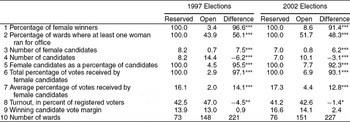
To confirm that reservations were indeed implemented in practice, consider Table 2, which shows the contemporaneous, within-election effects of reservations in 1997 and 2002. The first row of Table 2 indicates that reservations had their primary intended effects: women became corporators in all seats set aside for them. In comparison, women won 3.4% and 8.6% of the open seats in the 1997 and 2002 elections, respectively.Footnote 12 The difference in average outcomes between the reserved and open wards is statistically significant at the 1% level using one-sided difference of proportions tests. This is not surprising given that only women were eligible to run for office in reserved wards. Similarly, and consistent with the previous result, the number and percentage of female candidates in reserved seats (rows 3 and 5), and the total and average percentage of votes received by female candidates (rows 6 and 7), are higher to statistically significant degrees (using one-sided difference of means tests) in reserved seats than in open seats. Although reserved constituencies are also somewhat less competitive than open constituencies (rows 4 and 9), they are still competitive.
Contemporaneous, Within-Election Effects of Reservations in 1997 and 2002

Note: *significant at 10%, **significant at 5%, ***significant at 1% using one-sided difference in proportions and means tests. Only women could run for office in reserved constituencies; men and women could run for office in open constituencies. Constituencies were reserved for women using random, stratified, and independent draws in 1997 and 2002. See text for details.
These results suggest why we might expect reservations to have effects on subsequent elections. The elections in reserved seats were real, rather than sham, elections. For the first time, because of reservations and in wards with reservations, a stream of viable female candidates entered politics, the city's leading parties nominated female candidates, voters came out in substantial numbers to vote for women, and seats were won by women. Reservations were perfectly implemented in the sense that only women were allowed to run for office in reserved seats, and women were elected in all seats reserved for them. Moreover, that the percentage of open seats in which women won elections increased from 3.4% in 1997 to 8.6% in 2002 (this increase is statistically greater than zero at the 5% level) indicates the possible next-election impacts of the 1997 reservations, which is what the rest of my article analyzes.Footnote 13
NEXT-ELECTION EFFECTS OF RESERVATIONS
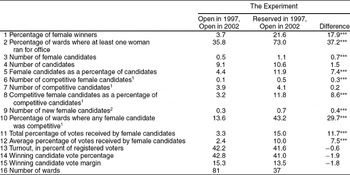
Table 3 details the result of the natural experiment central to this article. It tests for the continuing effects of the 1997 reservations on various aspects of the 2002 elections. The first row reveals the main result of this article: although approximately 21.6% of wards that were reserved for women in 1997 but were open in 2002 (treatment wards) were won by women, only 3.7% of wards that were open in 1997 and 2002 (control wards) were won by women. Women's chances of winning ward elections are therefore more that quintupled by the 1997 reservations. The increase in the chances of a woman winning an election is statistically significant at the 1% level.Footnote 14
Next-Election Effects of the 1997 Reservations on the 2002 Elections

Note: *significant at 10%, **significant at 5%, ***significant at 1% using one-sided difference in proportions and means tests. Only women could run for office in reserved constituencies; men and women could run for office in open constituencies. Constituencies were reserved for women using a random, stratified, and independent draws in 1997 and 2002. See text for details.
1 Competitive candidates are defined as those that received 5% or more of their constituency's vote.
2 Candidates are coded as “new” if they did not run in 1997.
A number of other indicators are consistent with this result. As row 2 of Table 3 indicates, the percentage of treatment wards where at least one woman ran for office (73), for example, is double the percentage of control wards where at least one woman ran for office (36). The average number (row 3) and percentage of female candidates (row 5) that ran for office in treatment wards is also double the figure in control wards. Remarkably, although female candidates were competitive in 43% of treatment wards, they were competitive in just 14% of control wards (row 10).Footnote 15
Interestingly, the women who won elections in treatment wards did so equally across the four stratification layers (open wards, and wards reserved for OBCs, SCs, and STs) that the 1997 reservations were randomized within. A chi-squared test comparing the distribution of treatment seats in 2002 by stratification layer and treatment seats where women won in 2002 by stratification layer is unable to reject the possibility that the distributions are equal.
That the 1997 reservations affected the 2002 elections is corroborated by a comparison of wards that were reserved in 1997 and 2002 with wards that were not reserved in 1997 and were reserved in 2002. This analysis reveals that the effects of reservations in 1997 are noticeable five years after, even if we restrict our attention to wards that were reserved in 2002. For example, the number of female candidates in wards that were reserved in 1997 (7.4) was higher than the average number of female candidates in wards that were open in 1997 (6.5).
It is important to note that because the reservation status of wards in 1997 and 2002 was random, the effect of the reservations in 1992 will have equally “shown up” in constituencies that are open and reserved in 1997 and 2002. The estimated impact of the 1997 reservations on electoral outcomes in 2002 is accurate then, but is conditional on there having been reservations in 1992.
So far, I have presented striking evidence that quotas improve the chances of women winning elections even after quotas are withdrawn. A natural question that arises from such analysis, however, is what are the possible mechanisms through which reservations impact subsequent elections? I turn to exploring this question next.
MECHANISMS THROUGH WHICH RESERVATIONS WORK
To structure the exploration of how reservations have their next-election effects, consider the steps that women have to go through in order to be elected to office. Women must first decide whether they want to run for office. Those who decide to run for office approach the decision makers within their household (usually the men—husbands or fathers-in-law) in order to gain their assent. If this is granted, they may approach the political party of their choice for the party's nomination (known as the party “ticket”) for the ward in which they reside. Alternatively, parties might approach prospective candidates to run for office (possibly based on the recommendations of local party cadres—although the ultimate decision on whether a candidate can run for office vests with the party's leadership), in which case prospective candidates would confer with their families after being approached by parties. Parties can nominate a maximum of one candidate for each electoral ward. Candidates who secure party tickets compete with one another at the polls, where incumbents might have an advantage and voters choose between candidates. The candidate who garners a plurality of votes wins office. Corporators may try to use their time in office to build an incumbency advantage. Five years later, elections are held again. Although this is a radically simplified representation of a complex election process, it captures its essential features.
In light of this stylized representation of elections, we may discern four hurdles that women face in their path to power. These might occur as women face entrenched male incumbents, or as they face opposition to their candidacies from people in their households, from parties, and among voters. I explain how reservations might improve the performance of women at each stage and provide preliminary tests of these conjectures below.
Briefly, I find that reservations largely work by introducing into politics a group of female candidates who are able to run for and win elections even after reservations lapse, and by allowing parties to learn that women can win elections.
This analysis is not as straightforward as the analysis presented previously because although the reservations policy ensures that only women run for office (and are therefore elected) from reserved seats, the policy does not directly manipulate variables such as the number of female candidates or voter registration by ward, both of which, as discussed later, might be intermediate mechanisms through which reservations influence elections. The impact of such intervening variables, however, might be causal to the degree that they are determined temporally prior to the election of women and might influence the probability of women winning office. To deal with the challenge of observational data, I supplement the difference in proportions and means tests used previously with multivariate regressions. Although this analysis does not produce definitive results, it provides us with a starting point to think about the mechanisms through which quotas affect subsequent elections, and indicates the conditions under which we might expect the effects of reservations to hold and persist.
Incumbency Hurdle
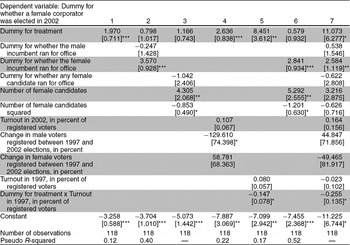
Six of the eight women who won elections from treatment wards in 2002 were incumbents. The results in Table 4 corroborate this finding. I first use a logistic model, with a dummy for whether the winners in the 2002 elections were women as the dependent variable and with observations restricted to wards that were not reserved in 2002, to replicate the main result of the article. Regression 1 shows that quotas for women in 1997 (the treatment) are a significant predictor of the dependent variable. Consistent with the main result, the coefficient of 1.970 on the treatment dummy means that having a ward reserved for women in 1997 increased women's chances of winning the election by 18 percentage points, from 4% to 22% in 2002. Regression 2 adds dummies for whether a male or a female incumbent corporator ran for office to the base logistic regression. The dummy for whether a female corporator ran for office yields a positive and statistically significant coefficient. Together, these figures indicate that whether a female incumbent ran for office explains much of the dependent variable.
Logistic Analysis of the Determinants of Whether a Female Corporator Was Elected in 2002

Note: Regressions 3 and 7 use Firth's penalized-likelihood approach to deal with a separation problem. See footnote 22 for details. Standard errors in brackets. *significant at 10%, **significant at 5%, ***significant at 1%.
Despite these results, it would be incorrect to conclude that an incumbency advantage explains the improved election prospects of women for at least two reasons. First, comparisons of incumbents and nonincumbents probably suffer from a selection bias. Incumbents, for example, might do better than nonincumbents because they have superior abilities rather than because of their status as incumbents. Second, we, in fact, have reasons to believe that incumbents in BMC elections suffer from an incumbency disadvantage, Footnote 16 a pattern that has been shown to hold in the case of India's national and state elections (Linden Reference Linden2004; Uppal Reference Uppal2005).Footnote 17 In light of this, perhaps women suffer less of an incumbency disadvantage than men? This possibility too is not sustained by the data.Footnote 18
All this suggests that reservations mainly work through selecting a group of female winners in 1997 that are able to win office in 2002 after reservations have lapsed. The number of women who would have been able to win office in the absence of reservations appears to have been so low that the mere introduction of a group of female candidates into politics under the 1997 reservations policy—regardless of their propensity to develop an incumbency advantage or disadvantage—increased the proportion of women that won office in 2002.
Individual and Familial Hurdles
Women's underrepresentation in politics may be caused by a dearth of female candidates. Women may not run for office for a number of reasons, including because they do not view themselves as being qualified to run (Fox and Lawless Reference Fox and Lawless2004); because they are unable to negotiate an independent space for themselves within their households (Chhibber Reference Chhibber2002); or because their husbands, fathers-in-law, or mothers-in-law disapprove of their candidatures (Honour, Barry, and Palnitkar Reference Honour, Barry and Palnitkar1999). Reservations might increase the number of women who try to run for office by relaxing these constraints.Footnote 19 Hence, we would expect treatment wards to have more women candidates, including “new” women candidates that ran for the first time in 2002, than control wards. These expectations are confirmed by the data.Footnote 20
To ascertain whether the 1997 reservations increased the number of new women that ran for office in 2002, I compare the 2002 candidate list to the 1997 one in order to code whether those who ran for office in 2002 ran in 1997 as well.Footnote 21 This analysis reveals that treatment wards had a higher average number of new female candidates (i.e., candidates that did not run in 1997) than did control wards (row 9 of Table 3). Consistent with this result, control wards had a lower average number of female candidates (row 3) and competitive female candidates (row 6) run for office per ward than did treatment wards. These differences are statistically significant using one-tailed difference of means tests at the 1% level. This suggests that reservations might have altered the chances of women securing office in 2002 by continuing to expand the pool of female candidates that run for office even after reservations lapsed. Indeed, treatment wards that elected female candidates had the greatest number of female candidates per ward in 2002 (1.75).
Further evidence for this mechanism is presented in regression 3 of Table 4, which adds controls for whether any female candidate ran for office, the number of female candidates, and the number of female candidates squared to the base regression.Footnote 22 The positive and negative (and statistically significant) coefficients on the number of female candidates and its squared term, respectively, indicate that having more women run for office in a ward increases the odds that a woman will win the election with diminishing returns (the turning point for the average ward occurs at 2.5 female candidates), possibly because increasing the numbers of female candidates tends to split the vote for women. This evidence is consistent with the conjecture that the beneficial effect of quotas occurs through increasing the number of female candidates that run for office. Note, however, that I am not arguing that women no longer face opposition to their candidatures within the household, but rather that reservations relax this constraint somewhat.
Party Hurdles
A third hurdle that women face in their path to power is getting a party ticket. Parties systematically grant women fewer tickets than they grant men. The four major parties in the 1997 and 2002 BMC elections granted women 32% to 42% of the tickets in all wards. Parties, however, granted most of these tickets to women in reserved wards. Women received only 7% of the tickets in unreserved wards.Footnote 23 Furthermore, getting a party ticket is critical to women's chances of winning elections. Few independents of either sex win elections—9 and 3 corporators in the BMC were independents in 1997 and 2002, respectively—and all female corporators elected in 1997 and 2002 were elected on party tickets. So, although getting a party ticket is critical for women to win elections, they are systematically granted fewer tickets than are men.
To understand how reservations might alter the propensity of parties to grant women tickets, consider the logic of why parties would grant female candidates tickets. As elsewhere, parties in India generally grant candidates tickets based on their perceived electability. Considerations of ethnicity, caste, money, and “muscle power” play a large role in the process (M.P. Singh Reference Singh2003). Parties might deny women tickets for two reasons: either because of ideology (in Becker's [1957] terminology, these parties discriminate based on “taste”) or because they do not perceive women to be electable (“statistical discrimination”). We may therefore classify parties into two types, based on their reasons for granting or denying women tickets. We expect taste-discriminating parties to deny women tickets both when reservations are in effect and after they have been withdrawn, and statistical-discriminating parties to grant women tickets when reservations are in force, but to only do so once reservations have been withdrawn to the degree that they view women as being electable.
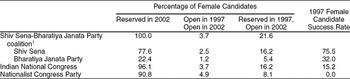
The four main parties in the BMC hardly behaved as taste-discriminating parties because they all took the opportunity to run female candidates in wards that were reserved in 2002 (Table 5, column 1). There is also some weak evidence to suggest that the major parties are statistical discriminators because their willingness to field candidates from treatment wards (column 3) is positively correlated with the degree to which their female candidates won the previous elections with reservations (column 4). Footnote 24 Together, these data suggest that parties have not just played along with the new rules of the game since reservations were introduced, but that they have used the reservations policy to learn about the ability of women to win elections, and have subsequently granted or refused women tickets based on their experience with female candidates.
Which Parties Granted Women Tickets in 2002?

Note: Only women could run for office in reserved constituencies; men and women could run for office in open constituencies. Constituencies were reserved for women through random, stratified, and independent draws in 1997 and 2002. See text for details.
1 I do not include figures for the Shiv Sena-BJP coalition for the 1997 election because the parties competed against one another in that election.
Voter Hurdles
The fourth hurdle that women might face on their path to power is with voters. Voters might discriminate against women or might rationally not vote for them if they think that other voters will not vote for women. I consider each of these two constraints in turn.
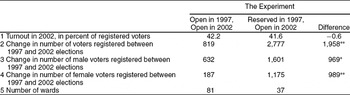
First, the underrepresentation of women in politics might be as a result of voters’ discrimination against women. Reservations might alter the influence of voters who discriminate against women as pro- or antiwomen groups mobilize in response to the reservations policy. The evidence on this mechanism is inconclusive, however. On the one hand, turnout in treatment wards in 2002 was statistically indistinguishable from turnout in control wards (Table 6, row 1), suggesting that reservations in 1997 had no discernible effect on turnout in 2002. On the other hand, the increase in the number of registered votersFootnote 25 between elections in treatment wards was triple the increase in voters in control wards (Table 6, rows 2–4). Furthermore, the differential increase in the number of voters in treatment wards was driven by wards that did not elect women (where the average number of voters increased by approximately 3,300) rather than by wards that did elect women (where the average number of voters increased by approximately 1,000). This suggests that voters might have been mobilized in order to vote against women and that this strategy was not tried or failed in treatment wards that did elect women.Footnote 26 The evidence remains mixed using the logistic regression test, as seen in regression 4 of Table 4.
Impact of Reservations on Voter Mobilization

Note: *significant at 10%, **significant at 5%, ***significant at 1% using one-sided difference in means tests. Only women could run for office in reserved constituencies; men and women could run for office in open constituencies. Constituencies were reserved for women using random, stratified, and independent draws in 1997 and 2002. See text for details.
Second, the low representation of women in politics might be due to a coordination failure among rational voters who are willing to vote for women, but think that other voters are not willing to do so. More specifically, if voters behave strategically in order to not “waste” their vote by considering candidates that others would not vote for (this is a common assumption in the literature, see Cox Reference Cox1997 for a prominent application), we could imagine that reservations could move voters from an equilibrium where they consider only male candidates to one where they consider both male and female candidates. Whether voters tip from one equilibrium to the next would depend on whether people think that others will consider female candidates. Assuming that turnout in reserved wards is a measure of voters’ willingness to consider female candidates (which may be the case because voters could have chosen to abstain from voting in 1997 if they were not willing to consider female candidates), I expect constituencies within the treatment group and with high turnout in 1997 to be more likely to vote for female candidates in 2002. To test for this channel, I include the interaction between turnout in the 1997 election with the treatment dummy and its constituent terms in the base logistic regression. My prior, which is not borne out by the test (Table 4, regression 5), is that voters will be more likely to vote for women candidates in constituencies where turnout was high in 1997.Footnote 27
Regressions 6 and 7 of Table 4 pool the multivariate tests for the mechanisms by which reservations might influence the chances of women securing office. Note that these regressions do not include a test for whether parties learn to nominate female candidates because I had not tested this mechanism in a regression framework. Regression 6 combines tests for the mechanisms for which we have the strongest evidence: it includes indicators for whether incumbents ran for office, and for the number of female candidates and its squared term. Both mechanisms are associated with an increased probability of a woman winning an election. Regression 7 adds to this specification indicators for the voter mobilization and coordination mechanisms. In the pooled regression, the only statistically significant predictor for a woman being elected is the dummy for whether a female incumbent ran for office. Overall, this analysis indicates that reservations work in part by introducing into politics women who are able to win elections after reservations are withdrawn.
CONCLUSION
I have exploited a natural experiment to present evidence on the impact of quotas for women on their chances of winning subsequent elections. In an analysis of elections for Mumbai's city legislature, I found that women's chances of securing political office in wards that had been reserved for women in the previous election were approximately five times their chances in wards that had not been reserved for women previously. This is a remarkably large effect.
I detailed several mechanisms by which reservations could boost women's chances of winning elections. Although the data are not conclusive, the evidence suggests that reservations affect subsequent elections in part by introducing into politics women who are able to win elected office even after reservations are withdrawn and by increasing the willingness of parties to grant women tickets. I find evidence against the possibility that reservations allow nondiscriminatory voters to coordinate on considering female candidates for office. The data are inconclusive on whether reservations cause some voters to mobilize against voting for women and on whether the increased number of female candidates boosts the chances of women winning office.
Although my investigation of the channels through which reservations might impact women's chances of winning elections was hindered by the limited size of my data set and by the complexity of the processes that keep women out of power, my exploration of the mechanisms by which reservations work provides ground for future work, and also yields insights into the circumstances under which we might expect the effects of reservations to hold and persist. Whatever the variety of the hurdles that women face in political life, we now know that reservations have managed—in one city—to cut through it all to increase women's chances of winning elections. That they have done so is remarkable, given the deep-seated prejudices against women in Indian society and India's checkered experience with caste-based reservations.
Although the findings of this article invite replication, as do all experimental studies, I expect the effects of reservations uncovered here to hold in a variety of settings. Most obviously, the result that reservations boost women's ability to win elections after they are withdrawn is likely to hold in places with a reservations system similar to that described here. Other local legislatures in India fit this bill, as do the legislatures of countries such as Jordan, Rwanda, and Uganda, which have reservations—rather than voluntary or party list quotas—for women. The fact that the women who win elections in treatment wards are mainly incumbents suggests that the effects of reservations are likely to hold when male incumbents from the election without reservations are weak, when women elected under the reservations policy are of sufficiently high quality (or are able to use their time in office) to be re-elected after reservations lapse, and when neither voters nor political parties display a “taste” for discriminating against women. Unfortunately, it is not clear whether quotas more generally—whether those based on ethnicity, for example—could have the same beneficial effects on subsequent elections. These could have lasting positive effects to the degree that politicians selected by the quota system are of a high enough quality (or are able to use their time in office) to be re-elected once reservations lapse. However, reservations might not work if people have a “taste” for discriminating against people based on their ethnicity or if voters find it easier to mobilize to vote against people of different ethnicities than of different genders.
A separate but related question is how far into the future will the knock-on effects of reservations uncovered here persist. That reservations have their next-elections effects partly by introducing into politics a cohort of women that is able to continue to win office after reservations lapse means that anything that affects the ability of these women to win elections will affect the longevity of the effects of reservations. If female legislators, for example, are recruited for higher office subsequent to elections with reservations, the beneficial impact of reservations on the presence of women in the BMC would be attenuated.
Many questions about the efficacy of quotas and other remedies for inequalities in political representation remain: do the socioeconomic effects of reservations persist after they are withdrawn? Do female politicians inducted by the reservations process at the local level go on to challenge state- and national-level politicians?Footnote 28 What types of political exclusion are quotas most effective at remedying? How do the effects of reservations compare to the effects of other types of quotas and to the effects of other means of ameliorating inequalities in political representation, such as majority–minority redistricting? Do these have effects on subsequent elections as well?
Despite the remaining questions, the central finding of this article—that quotas for women improve the chances of women winning elections even after quotas are withdrawn—has broad implications, especially for scholars of democracy. First, although much of the literature on democracy in plural societies either calls for explicit quotas for different groups of people (to form what Lijphart Reference Lijphart1977 calls consociational governments) or warns against the use of such quotas because it leads to the permanent “ethnification” of politics (Horowitz Reference Horowitz1985), this article reminds us of, and provides strong evidence for, a third possibility: that quotas can themselves set in motion processes that ensure the fairer representation of people even after quotas are removed. Recognizing this possibility should allow people to better design policies that ensure representation of the politically marginalized without permanently “ethnifying” politics. Second, although most political scientists argue that the virtues of democracy—such as fair representation and accountability—emerge over time, through the slow building of new social ties (Lipset Reference Lipset1960), culture (Putnam Reference Putnam1993), and class formations (Moore Reference Moore1966), my examination of the effects of quotas for women shows that there are ways in which policy makers can achieve fairer representation speedily. It is for these broad implications that the comparative analysis of policies to remedy inequalities in political representation promises to be an exciting field for research.
 ≈ 38 (as compared with the actual 37 treatment wards). Similarly, we would expect the control wards to number Pr(a ward is not reserved for women in 1997) * Pr(a ward is not reserved for women in 2002) * number of wards that have nearly identical boundaries in 1997 and
 (as compared with the actual 81 control wards). I am also unable to reject the hypothesis that the reservations processes in 1997 and 2002 were independent using a chi-squared test.



Comments
No Comments have been published for this article.