Officials at Texas Health Presbyterian Hospital Dallas initially blamed their electronic health record (EHR) for Ebola patient Thomas Eric Duncan’s initial release from the emergency department (ED) because his fever and West African travel history were documented in the electronic chart by the triage nurse but were not noticed and acted upon in a timely manner by the ED physician.Reference Keneally and Candea
1
The blame was soon retracted, but this scenario raises an important question: how might EHRs best help clinicians screen and treat patients with suspected Ebola infection today and other emerging public health threats tomorrow?
Officials initially blamed the EHR on the assumption that triage documentation is effective and sufficient for communicating important facts requiring prompt action. As this case demonstrates, however, this is not correct. When the fever and travel history were recorded in the EHR, the EHR was not configured to do anything other than display these data upon request. The documentation itself does not prompt the physician that it contains unexpected important information; thus, the ED physician, who has many concurrent cases and competing priorities, may not give special urgent attention to it. The effective use of health information technology depends on an understanding of the normal steps, tasks, and objectives of clinical workflow; what information a clinician needs for optimal performance at each step; and how software can help the clinician see and utilize the most relevant information, particularly when it is unexpected.
The information task here is rapid, early screening. Such screening is the classic “needle in the haystack” challenge: to obtain a small amount of information from all patients so as to identify the fraction who need isolation and management. For Ebola, the relevant information includes travel to specific West African countries or other endemic areas, exposure to a patient with known Ebola, and fever or other specific symptoms. Thus, the intake or triage staff could ask screening questions of all patients as they arrive and initiate action immediately on those who give positive answers to certain combinations of questions. Intake screening can readily be done without computer support if the number of questions is small, the important combinations of positive answers are simple to remember, and the staff are reliable and prompt about asking the questions and reacting to the answers. However, ensuring perfect screening reliability and minimizing variation is difficult without additional tools.
Alternatively, consider a version of the screening questionnaire on a computer that uses the hospital’s EHR or a separate application. The intake staffer asks the patient questions from the electronic form and enters the answers. Properly designed, the computer version promotes reliability by requiring that the questions be asked and that all answers be documented as part of a standard workflow (a “forcing function”),Reference Leape
2
because EDs already have a required initial check-in process. Simple logic underlying the form analyzes the responses. If the patient affirmatively answers certain combinations of questions, the computer produces an on-screen alert prompting the staff to consider immediate isolation. The questions could even be answered by the patient at home, through an electronic patient portal or other website, helping worried patients to decide whether to seek care and reducing the number of low-risk patient visits to health care providers.
If the questions change—owing to new evidence, changes in recommendations, local variations, or additional screening conditions—the form can be changed, and that change will be immediately apparent to all intake staff, a process that may be more difficult and inconsistently applied in the noncomputerized version. Furthermore, Ebola is just the most current acute example of a condition that requires screening; the same process can be utilized for screening for other more common conditions, such as sepsis or influenza. By using these screening tools daily, staff will become more familiar with their use. The content can be updated as needed for the next outbreak when it occurs.
In this example, the computer enhances screening in large part because it makes use of clinical decision support (CDS), rather than passive electronic clinical documentation. CDS has been defined as “providing clinicians or patients with clinical knowledge and patient-related information, intelligently filtered and presented at appropriate times, to enhance patient care.”Reference Osheroff, Teich and Levick
3
Computerized CDS tools do not replace clinicians; but when properly implemented, the computer plus the clinician can be better than the clinician alone.Reference Friedman
4
Here, CDS ensures that the intake process will not proceed without asking the screening questions, filters out later questions based on responses to earlier ones, and logically combines data (the patient’s answers) and knowledge (the guidelines for isolation), presenting an alert to the clinical staff only when necessary.
CDS is not limited to alerts; alerts are valuable in situations such as this, but overuse and over-alerting can interrupt workflow and limit the effectiveness of this tool.Reference Weingart, Simchowitz and Shiman
5
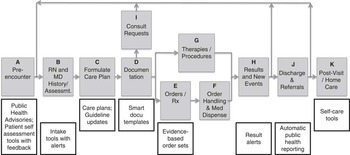
Figure 1 illustrates the basic workflow and information steps of a clinical encounter. Each step has different information needs and opportunities for CDS enhancement. In our example, the electronic screening tool is applied early in the encounter (step B) or even beforehand by the patient (step A). After intake, when the clinician is formulating a detailed assessment and plan (step C), CDS can provide a one-click link to the latest research, national recommendations, and local guidance. When the provider is writing orders (step E), the computer can provide evidence-based order sets to guide testing and treatment. Important new findings and critical test results, such as a newly measured fever or a viral titer, can happen at any time (step H) and thus would best be managed by alerting a responsible clinician whenever the test is done. For certain conditions, automatic public health reporting could occur at the end of the encounter (step J), and the computer could suggest and deliver self-care and self-monitoring instructions for the patient to use at home (step K) on the basis of all the other information entered during the encounter. Different types of CDS are most easily used and most effective at different points in the workflow; they can be used individually or together to further enhance the overall care process.Reference Osheroff, Teich and Levick
3
Figure 1
Workflow Steps in a Clinical Encounter (Gray Boxes) and Opportunities at Each Step for Ebola Care Improvement Through Clinical Decision Support (White Boxes). Adapted with permission from Osheroff et al.Reference Osheroff, Teich and Levick
3
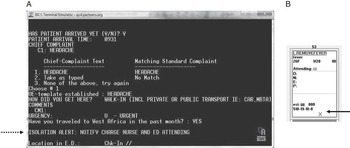
Using our hospital’s homegrown EHR, we implemented CDS to force Ebola screening at the earliest part of the ED encounter, display the patient’s screening status to all ED staff, and make Ebola policies and procedures more easily accessible. As part of the initial patient check-in process using our EHR, we added a required question asking if the patient has traveled to West Africa (Figure 2A). An affirmative response displays an alert to immediately notify the charge nurse and attending physician (Figure 2A, dotted arrow), who isolate the patient in a private room with standard, contact, and droplet precautions and perform a more detailed secondary screening evaluation. Furthermore, to ensure all staff are aware of the patient’s positive travel history, a red X is displayed on the patient’s tile on our electronic tracking board (Figure 2B, solid arrow). Staff can click on the red X to link to an internal Microsoft SharePoint (Microsoft Corporation, Redmond, WA) site containing our hospital’s Ebola policies, procedures, and educational materials.
Figure 2
Clinical Decision Support in a Hospital Electronic Health Record. (A) Ebola screening was added to the initial check-in process in the Brigham and Women’s Hospital Emergency Department EHR system. If the patient has traveled to West Africa, an alert displays (dotted arrow). (B) Patients who screen positive have a red X displayed on their icon on the Emergency Department electronic tracking board (solid arrow), which makes all staff aware of the patient’s positive Ebola screen. Abbreviations: EHR, electronic health record.
We used travel history to West Africa as our primary screening question. Another option is to screen for travel to specific countries, such as Guinea, Sierra Leone, Liberia, Nigeria, Mali, and Senegal. Overall, the initial screening should aim to achieve 100% sensitivity and as high a specificity as possible. Given our broad initial screening, an attending physician performs a more in-depth secondary screening using the US Centers for Disease Control and Prevention case definition for Ebola virus disease and guidelines for person under investigation
6
to help reduce any false positives from the initial electronic screening.
Ideally, widely applicable knowledge and well-designed CDS interventions should be easily shared and utilized by clinicians at many sites locally, nationally, or globally. Model templates for alerts, order sets, smart documentation, and access to guidelines and patient materials could be created based on best evidence and accepted guidelines; these templates could then be transferred to different EHR systems through a standard interface or delivered via services and devices external to the EHR. Several groups are working to enable wider access and sharing of CDS, including the recent Health eDecisions initiative of the US Department of Health and Human Services and the OpenCDS collaborative project. These computerized screening, treatment, and tracking tools could also be helpful on the frontlines of West Africa today.
Embedding and diffusing CDS based on evidence-based guidance and best-available expert recommendations throughout our health system will help us to rapidly identify, isolate, and care for patients with suspected Ebola now and other emerging public threats in the future. Well-designed CDS carefully placed in the workflow does not replace personal human vigilance, but rather works as a helpful and reliable partner.





 You have
Access
Officials at Texas Health Presbyterian Hospital Dallas initially blamed their electronic health record (EHR) for Ebola patient Thomas Eric Duncan’s initial release from the emergency department (ED) because his fever and West African travel history were documented in the electronic chart by the triage nurse but were not noticed and acted upon in a timely manner by the ED physician.Reference Keneally and Candea 1 The blame was soon retracted, but this scenario raises an important question: how might EHRs best help clinicians screen and treat patients with suspected Ebola infection today and other emerging public health threats tomorrow?
Officials initially blamed the EHR on the assumption that triage documentation is effective and sufficient for communicating important facts requiring prompt action. As this case demonstrates, however, this is not correct. When the fever and travel history were recorded in the EHR, the EHR was not configured to do anything other than display these data upon request. The documentation itself does not prompt the physician that it contains unexpected important information; thus, the ED physician, who has many concurrent cases and competing priorities, may not give special urgent attention to it. The effective use of health information technology depends on an understanding of the normal steps, tasks, and objectives of clinical workflow; what information a clinician needs for optimal performance at each step; and how software can help the clinician see and utilize the most relevant information, particularly when it is unexpected.
The information task here is rapid, early screening. Such screening is the classic “needle in the haystack” challenge: to obtain a small amount of information from all patients so as to identify the fraction who need isolation and management. For Ebola, the relevant information includes travel to specific West African countries or other endemic areas, exposure to a patient with known Ebola, and fever or other specific symptoms. Thus, the intake or triage staff could ask screening questions of all patients as they arrive and initiate action immediately on those who give positive answers to certain combinations of questions. Intake screening can readily be done without computer support if the number of questions is small, the important combinations of positive answers are simple to remember, and the staff are reliable and prompt about asking the questions and reacting to the answers. However, ensuring perfect screening reliability and minimizing variation is difficult without additional tools.
Alternatively, consider a version of the screening questionnaire on a computer that uses the hospital’s EHR or a separate application. The intake staffer asks the patient questions from the electronic form and enters the answers. Properly designed, the computer version promotes reliability by requiring that the questions be asked and that all answers be documented as part of a standard workflow (a “forcing function”),Reference Leape 2 because EDs already have a required initial check-in process. Simple logic underlying the form analyzes the responses. If the patient affirmatively answers certain combinations of questions, the computer produces an on-screen alert prompting the staff to consider immediate isolation. The questions could even be answered by the patient at home, through an electronic patient portal or other website, helping worried patients to decide whether to seek care and reducing the number of low-risk patient visits to health care providers.
If the questions change—owing to new evidence, changes in recommendations, local variations, or additional screening conditions—the form can be changed, and that change will be immediately apparent to all intake staff, a process that may be more difficult and inconsistently applied in the noncomputerized version. Furthermore, Ebola is just the most current acute example of a condition that requires screening; the same process can be utilized for screening for other more common conditions, such as sepsis or influenza. By using these screening tools daily, staff will become more familiar with their use. The content can be updated as needed for the next outbreak when it occurs.
In this example, the computer enhances screening in large part because it makes use of clinical decision support (CDS), rather than passive electronic clinical documentation. CDS has been defined as “providing clinicians or patients with clinical knowledge and patient-related information, intelligently filtered and presented at appropriate times, to enhance patient care.”Reference Osheroff, Teich and Levick 3 Computerized CDS tools do not replace clinicians; but when properly implemented, the computer plus the clinician can be better than the clinician alone.Reference Friedman 4 Here, CDS ensures that the intake process will not proceed without asking the screening questions, filters out later questions based on responses to earlier ones, and logically combines data (the patient’s answers) and knowledge (the guidelines for isolation), presenting an alert to the clinical staff only when necessary.
CDS is not limited to alerts; alerts are valuable in situations such as this, but overuse and over-alerting can interrupt workflow and limit the effectiveness of this tool.Reference Weingart, Simchowitz and Shiman 5 Figure 1 illustrates the basic workflow and information steps of a clinical encounter. Each step has different information needs and opportunities for CDS enhancement. In our example, the electronic screening tool is applied early in the encounter (step B) or even beforehand by the patient (step A). After intake, when the clinician is formulating a detailed assessment and plan (step C), CDS can provide a one-click link to the latest research, national recommendations, and local guidance. When the provider is writing orders (step E), the computer can provide evidence-based order sets to guide testing and treatment. Important new findings and critical test results, such as a newly measured fever or a viral titer, can happen at any time (step H) and thus would best be managed by alerting a responsible clinician whenever the test is done. For certain conditions, automatic public health reporting could occur at the end of the encounter (step J), and the computer could suggest and deliver self-care and self-monitoring instructions for the patient to use at home (step K) on the basis of all the other information entered during the encounter. Different types of CDS are most easily used and most effective at different points in the workflow; they can be used individually or together to further enhance the overall care process.Reference Osheroff, Teich and Levick 3
Workflow Steps in a Clinical Encounter (Gray Boxes) and Opportunities at Each Step for Ebola Care Improvement Through Clinical Decision Support (White Boxes). Adapted with permission from Osheroff et al.Reference Osheroff, Teich and Levick 3
Using our hospital’s homegrown EHR, we implemented CDS to force Ebola screening at the earliest part of the ED encounter, display the patient’s screening status to all ED staff, and make Ebola policies and procedures more easily accessible. As part of the initial patient check-in process using our EHR, we added a required question asking if the patient has traveled to West Africa (Figure 2A). An affirmative response displays an alert to immediately notify the charge nurse and attending physician (Figure 2A, dotted arrow), who isolate the patient in a private room with standard, contact, and droplet precautions and perform a more detailed secondary screening evaluation. Furthermore, to ensure all staff are aware of the patient’s positive travel history, a red X is displayed on the patient’s tile on our electronic tracking board (Figure 2B, solid arrow). Staff can click on the red X to link to an internal Microsoft SharePoint (Microsoft Corporation, Redmond, WA) site containing our hospital’s Ebola policies, procedures, and educational materials.
Clinical Decision Support in a Hospital Electronic Health Record. (A) Ebola screening was added to the initial check-in process in the Brigham and Women’s Hospital Emergency Department EHR system. If the patient has traveled to West Africa, an alert displays (dotted arrow). (B) Patients who screen positive have a red X displayed on their icon on the Emergency Department electronic tracking board (solid arrow), which makes all staff aware of the patient’s positive Ebola screen. Abbreviations: EHR, electronic health record.
We used travel history to West Africa as our primary screening question. Another option is to screen for travel to specific countries, such as Guinea, Sierra Leone, Liberia, Nigeria, Mali, and Senegal. Overall, the initial screening should aim to achieve 100% sensitivity and as high a specificity as possible. Given our broad initial screening, an attending physician performs a more in-depth secondary screening using the US Centers for Disease Control and Prevention case definition for Ebola virus disease and guidelines for person under investigation 6 to help reduce any false positives from the initial electronic screening.
Ideally, widely applicable knowledge and well-designed CDS interventions should be easily shared and utilized by clinicians at many sites locally, nationally, or globally. Model templates for alerts, order sets, smart documentation, and access to guidelines and patient materials could be created based on best evidence and accepted guidelines; these templates could then be transferred to different EHR systems through a standard interface or delivered via services and devices external to the EHR. Several groups are working to enable wider access and sharing of CDS, including the recent Health eDecisions initiative of the US Department of Health and Human Services and the OpenCDS collaborative project. These computerized screening, treatment, and tracking tools could also be helpful on the frontlines of West Africa today.
Embedding and diffusing CDS based on evidence-based guidance and best-available expert recommendations throughout our health system will help us to rapidly identify, isolate, and care for patients with suspected Ebola now and other emerging public threats in the future. Well-designed CDS carefully placed in the workflow does not replace personal human vigilance, but rather works as a helpful and reliable partner.
Acknowledgments
The authors wish to thank Joshua C. Feblowitz, MS, for his review of an earlier version of the manuscript. We also thank the Brigham and Women’s Hospital Emergency Department Information Systems team, including Ronak Patel, MD, MPH, Lorraine Fenelon, Gail Penrod, and Jennifer Theriault for quickly developing and implementing this clinical decision support.
Conflict of Interest
ABL and EG report no conflicts of interest. JMT is the Chief Medical Informatics Officer for Elsevier, which produces a wide range of evidence-based information in the form of publications as well as clinical decision support tools and content.