Introduction
Biodynamic (BD) agriculture, as one of the organic (ORG) agricultural farming methods, was proposed by SteinerReference Steiner1 and the BD farming method is striving for diversified, resilient and ever-evolving farms, which could provide ecological, economical and physical long-term sustainability for humankind. It encompasses practices of composting, mixed farming systems with use of animal manures, crop rotations, care for animal welfare, looking at the farm as an organism/entity and local distribution systemsReference Reganold2, all of which contribute toward the protection of the environment, safeguard biodiversity and improve livelihoods of farmers. Nowadays, there are more than 4200 BD farms in 43 countries, the area of which, over 128,000 ha, is certified according to Demeter standards3. Next to the standards of ORG agriculture, Demeter standards demand the use of BD preparations, keeping of farm animals, use of animal manures, and strongly encourage local production and distribution systems using local breeds and varieties. Stringent processing standards are in place as well3. The BD method emphasizes a holistic approach toward farming and became the subject of research efforts during the past decades.
However, to what extent can biodynamics be regarded as a scientific category? This review paper will explore and summarize up-to-date peer-reviewed scientific papers, PhD theses and include other sources, where additional information is needed to explain the background and modes of action. Basic experiments, case studies, food quality comparisons and landscape design and its development are expected to differentiate between biodynamics and other production systems. Although significant differences were attained with the use of the BD method, the exact mode of action of BD preparations, which present the greatest difference from the ORG production method, remains unexplained. Published research data will be analyzed and future development will be brought into focus to better understand and explain the BD farming method. Finally, research proposals and future implications are put into the wider perspective.
Basic Experiments
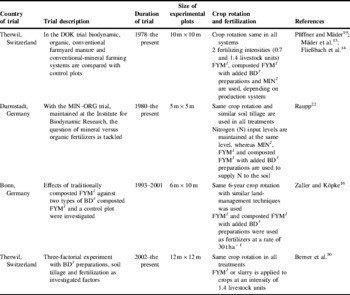
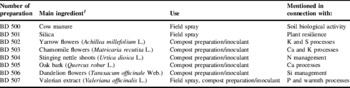
Besides published results of short-term trials and aimed researchReference Ryan and Ash4–Reference Zaller8, several long-term trials have been effected with the inclusion of the BD farming method and/or BD preparations (Table 1), where all BD preparations, given in Table 2, were used.
The main characteristics of long-term trials, which are based on sound scientific methods and include BD research.

1 FYM – farmyard manure.
2 MIN – mineral fertilizers.
3 BD – biodynamic.
Numbers of BD preparations, their main ingredients, mode of use and predicted influence.

1 The procedure of preparation and fermentation is described in detail by SteinerReference Steiner1.
BD preparations are designed to be used together on a farm/farming system.
BD preparations (Table 2) are one of the main features of BD agriculture. The thoughts behind the preparations are unconventional and sometimes difficult to understandReference Reganold2 and the up-to-date underlying natural science mechanistic principle of BD preparations is still under investigation, whereas some attempts have been made to explain the mode of action. Effects were first explained as a normalization (normalizing yields under low-yielding conditions) or compensation (BD preparations compensating for lower N fertilization) effect, where both explanations leave many open questionsReference Raupp and König9. A systems response and adaptation model was suggested as a possible explanation, where the effects of BD preparations do not depend only on their properties and mode of application. Foremost, properties of soils, plants, environmental conditions and how they interact are suggested as factors, which determine the effects of BD preparations to the greatest extentReference Raupp and König9. Moreover, BD preparations are applied in small quantities of 4–160 g ha−1, where physical or biological effects seem unlikelyReference Reganold2. However, bioactive ingredients, such as herbicides, have also been found to have a great influence in small (less than 10 g ha−1) amountsReference Zimdahl10. In addition, BD preparations were also shown to have hormone-like effectsReference Goldstein, Barber, Carpenter-Boggs, Daloren and Koopmans11. To better understand the mechanisms behind the BD preparations and to determine ongoing processes in plant physiology, further research designed to separate the effects of the preparations from other aspects of BD farming is needed.
Microorganisms at work
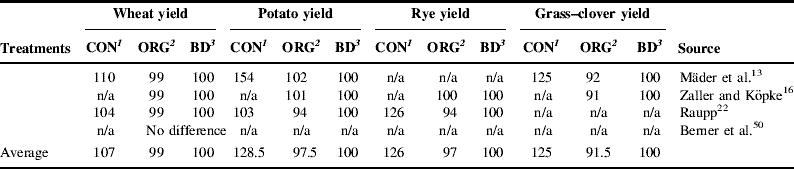
Experimental results show effects of BD preparations not only on yields (Table 3), but also on some ongoing processes in compost piles and in the long term in the soil. Carpenter-Boggs et al.Reference Carpenter-Boggs, Reganold and Kennedy5 report higher average temperatures (3.4°C higher compared with the control pile) throughout the active composting period, whereas ZallerReference Zaller8 measured no significant differences in the average temperature of BD and conventional (CON) compost piles. BD-treated compost also contained 65% more nitrate in the final samples, respired carbon dioxide (CO2) at a 10% lower rate, and had a larger dehydrogenase enzyme activity to CO2 production ratioReference Carpenter-Boggs, Reganold and Kennedy5. Carpenter-Boggs et al.Reference Carpenter-Boggs, Reganold and Kennedy5 suggest that BD preparations caused these effects through their bioactive ingredients or by serving as microbial inoculants. In addition, the microbial population in BD preparations was found to be substantialReference Rupela, Gopalakrishnan, Krajewski and Sriveni12, where bacteria population ranged from 3.45 to 8.59 log10 g−1. Also a population of fungi was found in the preparations 502 and 506 (5.30 and 4.26 log10 g−1, respectively). Several bacterial and fungal strains showed a potential for suppressing fungal plant pathogensReference Rupela, Gopalakrishnan, Krajewski and Sriveni12. This could also be the reason for the significant and clear-cut difference in dehydrogenase, protease and phosphatase activities with respect to the farming systems in the DOK (Biodynamic, Organic and Conventional agriculture long-term comparison) trial, where highest values were measured for the BD systemReference Mäder, Fließbach, Dubois, Gunst, Fried and Niggli13. Microbial biomass nitrogen also differed significantly and was highest in the BD system with 59% more than that in the CON–farmyard manure (FYM) systemReference Fließbach, Oberholzer, Gunst and Mäder14. Furthermore, the microbial biomass carbon was 35% higher in the BD system, compared with the CON–FYM systemReference Mäder, Fließbach, Dubois, Gunst, Fried and Niggli13, Reference Oehl, Frossard, Fließbach, Dubois and Oberson15. In contrast, Zaller and KöpkeReference Zaller and Köpke16 report no differences between treatments in regard to microbial biomass carbon, where untreated FYM and FYM treated with BD preparations were applied (Table 4). In both cases, microbial biomass carbon was significantly higher than on control plotsReference Zaller and Köpke16, which leads to the conclusion that FYM had an important effect on the soil microbial biomass build-up. Wada and ToyotaReference Wada and Toyota17 went a step further and discovered that FYM applications add to the stability of soil biological functions, where microbial and fungal populations show resilience and resistance against disinfection. In addition, FYM contributes toward a changed soil nitrogen composition and higher rates of protein amino acids, which bind nitrogen in the soilReference Scheller and Raupp18. However, differences between treatments do not seem to depend solely on amino acid supply from manure. An altered amino acid metabolism in the soil also influences soil amino acid composition and contents. Soils receiving FYM with BD preparations have a lower catabolism/anabolism ratio than soils receiving non-prepared FYM, which results also in a more intensive humification process. The explanation for the influence of BD preparations on anabolism is yet to be foundReference Scheller and Raupp18.
Yield comparison of some crops under different agricultural production systems.
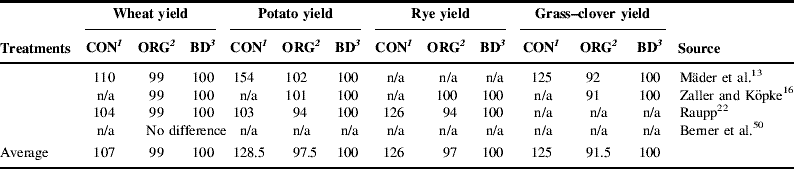
Yield relative to BD=100.
n/a – no data available.
1 CON – conventional or mineral treatments.
2 ORG – organic treatments.
3 BD – biodynamic treatments.
Soil organic matter carbon (Corg) change, microbial biomass carbon (Cmic) content and dehydrogenase activity depending on the production system.

n/a – no data available/non-applicable.
1 CON – conventional or control treatments.
2 MIN – mineral treatments.
3 ORG – organic treatments.
4 BD – biodynamic treatments.
5 Estimates are given from figures.
‡,† Note that results are given in different units; TPF, triphenylformazan.
Biodiversity
In this sense, the effects of ORG and BD farming practices are difficult to separate in terms of macro flora and fauna diversity. In the DOK trial, weed species diversity and arthropod diversity (such as carabids, spiders and staphilinids) were interrelated and were highest in the ORG and BD treatments over the period of 21 yearsReference Mäder, Fließbach, Dubois, Gunst, Fried and Niggli13, which indicates a good site quality. Fließbach et al.Reference Fließbach, Oberholzer, Gunst and Mäder14 report a less dense, but more diverse weed flora in BD and ORG plots. Furthermore, BD and ORG treatments affect earthworm species compositionReference Zaller and Köpke16 and quantityReference Zaller and Köpke16, Reference Pfiffner and Mäder19. Significant differences between the BD and ORG treatments are reported for earthworm biomass and quantity in one trialReference Pfiffner and Mäder19 and species composition and biomass in another trialReference Zaller and Köpke16.
However, the BD farming method affects the diversity of soil micro flora and fauna more clearly, where various scientists have come to similar conclusions on the basis of long-term trials. When looking at the complexity and diversity of the microbial food web in soils, the metabolic quotient for CO2 (qCO2) indicates the economy of microbial carbon utilizationReference Anderson and Domsch20. Higher qCO2 values can indicate young microbial communities with greater energy requirements to maintain itself, whereas lower qCO2 values, which were also found for long-term (more than 8 years) cultivated BD soils, indicate less stressed soils and thus diverse and highly interrelated soil communitiesReference Goldstein, Barber, Carpenter-Boggs, Daloren and Koopmans11, Reference Goldstein, Barber, Carpenter-Boggs, Daloren and Koopmans14–Reference Zaller and Köpke16, Reference Scheller and Raupp18. In line with these findings, Carpenter-Boggs et al.Reference Carpenter-Boggs, Kennedy and Reganold6 measured higher qCO2 values for soils amended with BD compost in a 2-year short-term study.
Environmental impacts
Soil organic matter is an important indicator of the soil organic carbon pool in soils. Increasing the amount of carbon stored in vegetation and soil (also called carbon sequestration) is a preventative measure toward slowing carbon dioxide (CO2) build-up in the atmosphereReference Janzen21. Soil organic carbon was maintained at the same level for over 21 years and even showed a small gain in the BD system at the DOK trial, whereas the other farming systems investigated all had a net loss of soil organic carbonReference Fließbach, Oberholzer, Gunst and Mäder14. Similarly, soil organic matter in the MIN–ORG (mineral versus organic fertilization) trial was maintained at the same level only in the BD, whereas it declined in the FYM and mineral treatmentsReference Scheller and Raupp18, Reference Raupp22. Farm-scale comparisons also show differences between conventional and BD farms, where long-term BD cultivation results in higher soil organic matter levelsReference Reganold, Palmer, Lockhart and MacGregor23, Reference Droogers and Bouma24. Next to CO2 and methane, also nitrogen in the form of nitrous oxide plays an important role in greenhouse gas emissions from agricultural land useReference Janzen25. With the rising use of supplemental nitrogen added to soils, nitrous oxide emissions also increase and might become a more urgent issue in tackling greenhouse gas emissions from agriculture than CO2 is todayReference Janzen25. When we look at the DOK trial, the ratio between yield levels and nitrogen applied turns out to be highest in the BD and ORG systems, when compared with the conventional and mineral-fertilized systems and ranges from 2:1, 2:1, 1:1 to 1:1.2, respectivelyReference Mäder, Fließbach, Dubois, Gunst, Fried and Niggli13, indicating more efficient use of the nitrogen supplied in BD and ORG systems. Moreover, the BD system contained higher levels of total soil nitrogen on account of soil organic matter and soil microbial biomass when compared with the other systems investigatedReference Fließbach, Oberholzer, Gunst and Mäder14.
In addition, rising energy prices will eventually intensify interest in the search for farming systems, where energy efficiency would consistently increase and consequently energy consumption per unit will be lowerReference Pimentel, Herperly, Hanson, Douds and Seidel26. However, interest is already present, as long-term studies and farm comparisons have been carried out comparing the energy efficiency of different farming systems. Results show better performance of ORG systemsReference Pimentel, Herperly, Hanson, Douds and Seidel26, as well as the BD systemReference Mäder, Fließbach, Dubois, Gunst, Fried and Niggli13. As mentioned before, yields are lower in the BD system (compared with the CON–FYM system), but so is the energy consumption: up to 50% lower mainly due to non-use of external production factors, such as mineral fertilizers and pesticidesReference Mäder, Fließbach, Dubois, Gunst, Fried and Niggli13. This leads to a more energy efficient production in the BD system (20–56% better than CON–FYM), in terms of energy consumption per crop unit of dry matter and energy consumption per unit of land areaReference Mäder, Fließbach, Dubois, Gunst, Fried and Niggli13. Less fossil energy used results in less carbon dioxide being emitted to the atmosphere and thus has a direct impact on global climate change mitigationReference Janzen21.
Case Studies of Production Systems
The first peer-reviewed study directly comparing BD and CON farms was carried out in New Zealand on 16 farmsReference Reganold, Palmer, Lockhart and MacGregor23. BD farming practices for at least 8 years resulted in higher soil organic matter contents, increased quality of soil structure, increased microbial activity and higher numbers of earthworms. BD farms were financially as viable as their CON counterparts.
Droogers and BoumaReference Droogers and Bouma24 compared BD and CON soils on two neighboring farms, where each farming practice has been applied for at least 70 years. They found significant differences in soil organic matter (SOM) content and water availability in favor of BD soils. In addition, soil density, and thus compaction, was lower in BD soils. Initial research provided data for a simulation model, in which BD farming practices expressed higher yield potential, long-term stability and sustainability than CON soils.
Several comparisons between BD and CON farms have been effected in Australia, where the main focus was on phosphorus (P) availability in relation to arbuscular mycorrhizal fungi, since P is a limiting nutrient in Australian soilsReference Ryan and Ash27. According to Ryan et al.Reference Ryan, Small and Ash28, there is a strong negative correlation between the levels of P (soil extractable and in pasture shoots) and arbuscular mycorrhizal fungi colonization in white clover and rye grass, where BD plants and soils contain less extractable P, but have higher levels of arbuscular mycorrhizal fungi colonization. Also, a steady decline of arbuscular mycorrhizal fungi in two out of three CON farms was observed. However, it is suggested that higher arbuscular mycorrhizal fungi colonization cannot compensate for the lower levels of soil extractable P in the final yields of BD systems. It is discussed that nutrient mobilization from soil minerals is not the only benefit of arbuscular mycorrhizal fungi. Frey-Klett et al.Reference Frey-Klett, Garbaye and Tarkka29 report that fixation of atmospheric nitrogen and protection of plants against root pathogens are also among the myriad benefits of arbuscular mycorrhizal fungi and mycorrhiza helper bacteria. RauppReference Raupp22 also reports a higher density of roots on plots treated with BD preparations. Mycorrhiza helper bacteria could be the possible reason for this effect, as they have been proved to stimulate lateral root formation and thus increase potential root–mycorrhiza interaction pointsReference Frey-Klett, Garbaye and Tarkka29.
Burkitt et al.Reference Burkitt, Small, McDonald, Wales and Jenkin30 compared ten BD and CON dairy farms for 4 years in northern Victoria and New South Wales. In some points, findings are comparable with results of long-term systems trials done in Europe, where soil P has a negative balance. The N and K balance, however, is reported to be non-significantly different between BD and CON farms. Soil organic carbon and soil microbial biomass are also reported to be equal between the farming systems. In addition, earthworm biomass was greater in the CON system on account of one earthworm species, where no information was given on the number of earthworms. Burkitt et al.Reference Burkitt, Wales, McDonald, Small and Jenkin31 also report lower milk yields on BD farms on a per hectare and per cow basis. A significantly greater number of chemical treatments per cow were used on CON farms. However, this did not result in reduced parasitic infection, for infection levels were similar on both farm types. In addition, somatic cell count was higher on farms under BD management, where, in turn, significantly fewer chemical treatments were used. Information on incidences of clinical mastitis and longevity of animals, however, is not provided. Burkitt et al.Reference Burkitt, Wales, McDonald, Small and Jenkin31 suggested the use of certified inputs on BD farms to increase milk fat, protein and production levels, but did not give further details. This was the only published study found that dealt with farm animals and BD farming practices; thus a serious lack of research projects/results is found and research in this area is strongly encouraged.
The difference between Australian BD farms reported in studies and other BD field trial comparison studies and farm comparisons is, however, that in Australia only preparation BD 500 was applied 1–2 times each yearReference Ryan and Ash27. Also Nguyen and HaynesReference Nguyen and Haynes32 report only preparation BD 500 being used on a BD farm in New Zealand. As discussed in the professional literature, however, the preparations were designed to be used together and only as such can they have the desired effectiveness. In addition, because of all-year grazing farming systems, Ryan and AshReference Ryan and Ash27 report no additional organic fertilizers added to soils for over 17 years. Nguyen and HaynesReference Nguyen and Haynes32 also report no organic or inorganic fertilizers being used on BD soils and as a consequence also lower yields in a 4-year crop rotation (without pastures). In addition, results of previous studies were confirmed, which indicate BD farming systems as more energy efficient (both in terms of crops and animals) on a per hectare basis but at the same time also more labor intensive than conventional farmsReference Nguyen and Haynes32.
BD wine grape production is also increasingly attracting attention, as some of the world's prestigious wine producers have started to use BD practices in the past decadeReference Reeve, Carpenter-Boggs, Reganold, York, McGourty and McCloskey7. Research followed suit and experimental results suggest that BD practices have an effect on wine grape canopy and chemistry, whereas no significant effects on soil fertility parameters were shown in a 6-year on-farm comparison trial between ORG and BD practices in an organic vineyard in CaliforniaReference Reeve, Carpenter-Boggs, Reganold, York, McGourty and McCloskey7. Probst et al.Reference Probst, Schüler and Joergensen33, however, measured significant differences in soil fertility between CON and BD soils on farms with a long history of BD (since 1981) and CON cultivation. Results are in accordance with the findings stated in Table 4. More research is needed to make conclusive statements on quality performance and a long-term systems comparison trial in wine grape production would be of great scientific and practical value.
Quality Assessment
Biocrystallization and the capillary dynomalysis (or Steigbild) method are two so-called picture forming or holistic methods to assess food quality and origin. Although originating in the 1930s, in recent years they have gained more attention as innovative quality conceptsReference Kahl34, not only in connection with BD, but also with ORG agriculture. The methods have been developed from the viewpoint that living organisms do not just exist as substances, but have structuring and organizing properties (i.e., one can know the exact composition and quantity of elements an apple has, but still cannot ‘produce’ an apple by mixing those sub-stances). These properties control the form and function of an organismReference Meelursarn35. At first, soluble extracts of the desired food product are prepared according to the defined working standards of each method, which have been up-to-date validated and tested on several samples originating from controlled field system comparisonsReference Kahl34. Furthermore, a Triangle network of laboratories dealing with bio-crystallization (University of Kassel, Louis Bolk Instituut and Biodynamic Research Association, Denmark) was established, whose goal is to develop uniform ISO standards for the evaluation of biocrystallograms and dynomalysis picturesReference Andersen, Huber, Kahl, Busscher and Meier-Ploeger36. Next to the introduction of computer image analysisReference Andersen, Henriksen, Laursen and Nielsen37, a modified method of panel evaluation of obtained images, using a defined set of ten criteria, was tested and successfully appliedReference Kahl34. With the use of these methods, however up-to-date, one is able to discriminate only products originating from controlled field trials with different production methods, and thus create reference lines. Plants grown in different climatic and environmental conditions express different qualitative parameters and therefore one is unable to make direct comparisons and conclusive statements on the quality of such plants, which is also true for sensory evaluation methods. Recent promising results from renowned institutions and an increasing number of dissertations in the past years could spur even more interest and acceptance of picture-forming quality determination methods.
Landscape Development in Relation to Biodynamics
The idea of a farm organism or farm individuality is one of the core principles of BD agricultureReference Steiner1. Usually it indicates that farm management should minimize nutrient and energy inputs in order to make the farm self-supporting and autonomousReference Vereijken, van Gelder and Baars38, which is true also for ORG farms. But it also encompasses a broader idea of the farm placement in its surroundings, the involvement of the people working on the farm, a balance between the sub-systems or ‘organs’ of the farm (arable crops, pastures, livestock, horticulture, etc.) and the elements of nature, such as forests, heaths, moors and watercoursesReference Vereijken, van Gelder and Baars38. In addition, Ho and UlanowiczReference Ho and Ulanowicz39 provide supportive arguments for an organisms point of view upon sustainable systems, based on thermodynamics. If we extend this point of view to a greater scale, a farm also plays an important role in landscape design and development. For this reason, a bottom-up, present situation improvement approach toward landscape design on farms has been developed, where it is aimed to develop nature-compliant agricultural systems, starting with the acceptance of the natural conditions and developing them according to the needs of the societyReference Vereijken, van Gelder and Baars38, Reference Beismann40. The Goethean-phenomenological approach has, next to CON methods and solutions, an integral part in this method of landscape assessment, design and developmentReference Colquhoun41. In conjunction with the above-mentioned methods this bottom-up approach resembles participatory action research, where researchers are not merely observers of the system, but actively take part in the process of shaping itReference Greenwood, Whyte and Harkavy42. Moreover, it is argued that sustainable and ecologically sound management of the landscape cannot be achieved only by top-down planning and regulations, but rather with bottom-up, individual and participatory landscape developmentReference Beismann40. Indeed, solutions to problems of one farm do not necessarily solve the same type of problem on another farm and tailor-made solutions should be applied, where demandedReference Vereijken, van Gelder and Baars38. Encompassing a broader set of goals than just landscape design, Helmfried et al.Reference Helmfried, Haden and Ljung43 used participatory action research methods to research and shape local, sustainable and environmentally friendly food systems. Linking both approaches with a goal of improving agricultural and natural systems is a promising future perspective.
Conclusion
Many questions on BD farming practices have been addressed in the past decades and results have been published in more than 30 peer-reviewed scientific papers. We have a better understanding of the effects of BD farming on soil physical, chemical and biological properties, crop growth, yield, processes in soils, etc. BD farming practices are also gaining importance in the face of increasing climate change, energy scarcity and population growth, where they indicate a more resilient, diverse and efficient system. In this sense, BD farming presents a viable farming method, which is worthy of study in more detail on its own account. But what are the priorities in moving forward? Is getting a deeper understanding of the exact mode of action of BD preparations one of them? Until now no fully satisfactory natural science mechanistic principles explanation has been provided. However, the systems response and adaptation modelReference Raupp and König9 does give a partial, but promising, explanation. But still, does this lack of clarity make the BD method unscientific? There is also no satisfactory explanation on the pathways and mechanisms of soil organic matter equilibrium establishment in soilsReference Stevenson44, but the topic is still considered to be of high research interest to scientists. So in order to better understand the role and effects of BD preparations, some methods such as photosynthesis measurements and isotope marking could also be taken into consideration. It is important to search for inspiration in the ‘Agricultural course’Reference Steiner1, but also make a step ahead and develop new ideas, research current challenges we are faced withReference Turinek, Grobelnik-Mlakar, Bavec and Bavec45 and build new, yet undiscovered perspectives of BD agriculture, while taking into account over 80 years of experienceReference Koepf, Schaumann and Haccius46 with the BD method.
What about energy efficiency on a wider scale (production to consumption)? Does it make a difference if the preparations are made on-farm or bought from a distant location? Does this affect the effectiveness of the preparations? Must the making of the preparations with the use of animal organs stay as given by SteinerReference Steiner1? Or do we need to move forward, explore new possibilities and develop an understanding of the reasons behind given procedures? This is especially an important issue in the face of recent stringent EU hygiene and sanitary regulations47, which were put in place because of animal diseases that originated in industrial farming. What about research on farm animals? Moreover, is there a difference between BD-prepared compost of animal and plant origin? How does this affect soil fertility and health? And after all, do we need to make more production systems comparison trials? If yes, how well defined are the systems to be compared? And what are the areas of interest to compare? Food quality is certainly a still highly discussed and debated area, which would deserve more attention on this account.
A working group of researchers and professionals, who have gathered in an active process to exchange thoughts, experiences and research resultsReference Hurter48, is certainly a signpost into the future. Also a web portal on biodynamic research49, which was recently put into practical existence, could facilitate the exchange of ideas, thoughts and results. A worldwide network of farmers, researchers, advisors, teachers and others interested in BD farming could contribute toward naming and addressing questions from everyday practice in order to make important steps toward a more sustainable, healthy, prosperous and secure future.
Reviewer's Response
At the Editor's suggestion we are including a reviewer's perspective in order to broaden the understanding of the subject matter:
‘My personal perspective is that the authors do not need to ask whether BD can be regarded as a scientific category or even point out that part of the scientific community looks at it with skepticism and marks it as dogmatic. There are over 4200 farms around the world that are certified as BD so it is clearly worthy of study. There are also many research studies and publications identifying the benefits of organic farming and the ability to maintain yields and improve soil health with organic farming methods. To my knowledge BD includes all the key components of ORG so what is true for ORG is true for BD.’
Acknowledgements
We thank both anonymous reviewers for their constructive and useful criticism that has improved this paper, especially reviewer no. 2 for motivating us to extend the ‘Conclusions’ section. This review is the initial part of a future PhD thesis, based on two research projects (L4-957-0482-06 and J4-9532-0482-07) that are funded by the Ministry of Higher Education, Science and Technology of Slovenia. We acknowledge the Ministry of Higher Education, Science and Technology of Slovenia for financial support.