

This study concerns how olive oil producers and local bureaucrats in western Turkey use geographical indications (GIs)Footnote 1 as a localist strategy to strengthen their position in global markets by challenging conventional agricultural practices. The goal of the study is to examine the social impacts of GI protection on the livelihood of olive producers. In particular, I will attempt to explain how local actors have been using GI-based product differentiation strategies in response to the declining prices of agricultural commodities and to increasing competition from global markets.
European countries have a long tradition of associating certain kinds of food with particular regions.Footnote 2 The protection of GIs was integrated into the European Union’s (EU) new Common Agricultural Policy (CAP), where the focus has shifted from “quantity-based” to “quality-based” products; that is, from the large-scale production of bulk commodities to the production of products with high added value.Footnote 3 The resurgence of GI protection in Europe aims to strengthen rural livelihoods, increase farmer incomes, and protect European heritage.Footnote 4
In Turkey, GI is a novel public issue whose effectiveness and benefits are still being debated. The protection of GIs was first put into practice in 1995 so as to provide a legal framework for the protection of the names of products produced with local materials and/or methods exclusively within the regions with which they were originally associated. The implications of GI projects in Turkey in producing inclusionary social consequences (e.g., the fair distribution of added value) are controversial, given that local producers are relatively unfamiliar with GI protection.
Since GIs are a unique form of intellectual property related to place or territory, they are considered to be a type of “collective property.”Footnote 5 A plurality of agents can employ a GI as a property; however, this opportunity is strictly based on the capacity and ability of local actors to create the institutional processes for controlling and regulating the conditions required for the granting of a GI label.Footnote 6 Some scholarsFootnote 7 consider GIs “club goods” in that they exhibit the characteristic of a collective monopoly based on membership and exclusion in the form of certain barriers to entry. These barriers to entry are introduced or removed according to particular definitions of who can make a particular product, where the product is to be made, and what ingredients and techniques are to be used.Footnote 8
This study employs the disarticulation approach of global commodity chains analysis in order to understand which factors delink people and places from conventional commodity and industrial chains and link them instead to GI chains. The disarticulation approach offers a systematic understanding of commodity chains as being the result of ongoing and continuous interactions among the production of goods, places and subjects, and their reproduction.Footnote 9 It focuses on the “linking” and “delinking” processes so as to explore the connections that tie people and places to a particular chain, thereby excluding them from others. A closer examination of all these factors together is crucial for a comprehension of the social mechanisms that make GI strategies resistant to the homogenizing tendencies of agro-industry. In this study, I seek to show how a discontinuous and partial industrialization of agriculture generates certain dynamic rent opportunities for local actors, and I look at how local actors decipher different rates of industrialization and the potential of GI systems to make products more resistant to placeless agriculture.
I selected the Edremit Gulf Region Olive Oil GI and the Ayvalık Olive Oil GI for my fieldwork, which took place between June 30 and August 30, 2012 in Turkey’s northern Aegean region around the Edremit Gulf. This region is steeped in history, as it served as the main supplier of olive oil to Topkapı Palace in Ottoman times and has enjoyed a certain level of added value and market share due to its reputation and presumed distinctive quality.Footnote 10 Its reputation also helped to make it the leading region in controlling and governing the domestic olive oil supply chain up through the first decade of the twenty-first century. The region has thus long been a major hub in olive oil production, and the center of the olive oil market in Turkey, ever since some of the local family businesses became major brands, after which they were consolidated in the hands of a few of the corporations that supply large volumes of oil to both the domestic and international markets. However, over the past decade, the region has begun to lose its leading status due to high production costs tied to land characteristics, especially after the implementation of neoliberal policy reforms in Turkey.Footnote 11
In the fieldwork, 16 key informant interviews (with non-producer stakeholders, such as local public officials), 40 in-depth interviews (with producers), and 150 in-person survey interviews (with producers) were carried out, with separate protocols being designed and used for respondents in the different groups. I analyzed the data using the disarticulation approach of global commodity chains analysis,Footnote 12 which focuses on the processes of “articulation,” or the linking of people and places to particular chains, and “disarticulation,” or delinking them from other chains. The idea behind this is to challenge the inclusionary bias of commodity chains analysis and shift the focus of analysis to the various kinds of exclusions as well.Footnote 13 The study will thus extend the disarticulation approach to a discussion on the potential for place-specific rents to delink commodity chains from the leading extraterritorial firms that tend to govern these chains and shape the rent structure and extraction of surplus value in their favor.
The first section of the study focuses on disarticulation/delinking factors, discussing how the increasing cost-price squeeze impacts the marginalization and disarticulation of commodity chains from industrial chains. In this section, I assess how industrial modes of production generate a new division of labor among regions, as well as how the increased cost-price squeeze generates a new power configuration in the governance of quality; i.e., which actors come into the picture and which segments of the chain are industrialized or restructured. The section’s conclusion is that, as production costs vary from region to region, local actors who are at a disadvantage grow increasingly interested in GI protection so as to reduce their dependence on industrial chains.
The second section of the study focuses on articulation/linking factors, illustrating how rent opportunities derived from local resources (which give non-industrialized agricultural products their distinctive quality) are transferred into consumer surplus (i.e., the difference between the price that consumers pay and the price that they are willing to pay) in the form of higher quality. This section analyzes how the harmonization of global standards—implemented in the conventional olive oil supply chain through the ban on “white can trade” (i.e., sales of unlabeled and unpackaged tins and bottles) and the introduction of hammer mills—led to the proliferation of local brands on the one hand and the consolidation of major brands on the other. This section also examines how local actors stand to gain or lose from the rents and barriers to entry provided by parties external to the chain. The role of governments in rent-generating policies through import controls and production subsidies will also be identified.
The process of disarticulating from industrial chains
As the industrial paradigm becomes dominant in agriculture, local actors engage in grassroots rent-seekingFootnote 14 for the distinctive quality of their products in order to cope with neoliberal transformation and policies that force trade liberalization and an expanding cost-price squeeze. Watts and Goodman explain that food production has become increasingly industrialized and globalized, creating “a systemic placelessness” in which agriculture and food production lose the link to nature.Footnote 15 In such a context, and due to their explicit reference to place, GIs are perceived as an effective means of coping with the continual pressure of economies of scale in the production of standardized and simplified products.Footnote 16 Some scholars argue that a GI can be an effective way to deal with the economic, social, and environmental destructiveness of the dominant industrial model.Footnote 17 This has led some to call on local actors to engage in “face-to-face ties”Footnote 18 and foster social bonds, as well as to generate alternative ways to link their product with consumers by opening a physical and mental space that can challenge agro-industrialism.Footnote 19
In Turkey, liberalization policies bring with them certain mechanisms that put producers under the pressure of global prices. The removal of agricultural subsidies and the privatization of agricultural sales cooperatives are the most visible mechanisms making this pressure felt. Keyder and Yenal have shown that, in Turkey, there are new institutions that link small producers to larger markets, which leave small producers vulnerable to market forces at a growing rate of risk and insecurity.Footnote 20 This fear of insecurity is not just about free market trade, the state’s withdrawal from agricultural policies, or the elimination of state subsidies—everyone is now the architect of their own fate.Footnote 21 This is what Buller and Morris call “competitive territories.”Footnote 22 While territorial and cultural distinctiveness are increasingly used for product differentiation strategy by local actors, territory has itself become a commodity and a source of commodified relations.Footnote 23 In this transition process, GIs have been seen both as a quality standard and a marketing tool for opening alternative supply chains and escaping from big retailers or corporations,Footnote 24 and as an effective general policy for coping with trade liberalization.Footnote 25
Since production costs vary from region to region, local actors who are at a disadvantage grow increasingly interested in GI protection as a way to become less dependent on industrial chains. In Turkey, the introduction of neoliberal policies in agriculture changed the established division of labor among regions. Olives, for instance, have become an alternative to industrial crops like cotton, tobacco, wheat, and sunflowers.Footnote 26 As other regions replaced these industrial crops with olives, the Edremit Gulf region—where production is necessarily based on traditional methods due to certain features of the landscape, such as sloping land—has been faced with the risk and fear of losing its leading status in the market. The quote below reveals the fear of a producer in Edremit:
We have begun to see olive production as a part-time, seasonal job. People here take their annual leave in the harvest season to pick their olives. Yes, everyone here needs a second income … If you ask me why I am still involved in this business, it’s just romanticism.Footnote 27
Over the last decade, not just increasing input prices but also decreasing commodity prices have led to declining incomes for all farmers in Turkey. This pressure, known as the “cost-price squeeze” or “deteriorating terms of trade” has increased over the years, either through new technologies that make the production of a crop more efficient, or through a politics of finance in which governments regulate prices and supply chains on the basis of rent-seeking activities. Although olive production involves relatively less intensive inputs, olive oil producers have increasingly suffered from this pressure because olives have become an alternative to all other industrial crops in Turkey. Labor costs are the main cost item in olive production, and the quote below illustrates how increasing labor costs are creating pressures for producers along the Edremit Gulf:
Back in the day, female workers received 1 kilo of oil and male workers received 2 kilos [for a day’s work] … Today, female workers get 3 kilos, male workers get 4 kilos, and nothing is left for the producers.Footnote 28
The cost-price squeeze pushes farmers to change how they arrange the labor force during the harvest. The most marginalized group of producers can only remain involved in olive production by exploiting unpaid family labor, which reflects the characteristics of a “peasant mode of production.”Footnote 29 Some families in the north Aegean region, while continuing to grow olives, used to supplement their household income by producing labor-intensive crops like tobacco. After the ban on tobacco production, villagers in Ayvalık, a town on the northern Aegean coast, began to grow okra for the okra processing plants that had recently been established in neighboring cities. The self-exploitation of family labor has now intensified—especially as women enter the labor force created by the global demand for okra—not only in the production stage, but also in the processing stage. Okra is gathered in the morning, immediately cut and cleaned, and then collected by merchant trucks visiting the village the same day. One female villager states that they earn less than a dollar for three to four hours of work each day:
We cut and clean okra for 0.08–0.10 lira per kilo. A person cuts at most 20–25 kilos of okra in a day. That means you can earn only 2–3 lira per day. That money does not buy two loaves of bread … Our crops make money after they are taken from our hands. It is unjust.Footnote 30
The comparative advantage of the northern Aegean region in olive production relies on the ability of local actors to manage production through the peasant mode of production. Olive production is traditionally labor-intensive, depending largely on the exploitation of family labor. However, the established division of labor between regions changed when olives became an alternative crop for farmers involved in industrial production. Labor costs in olive production declined as producers on the new plantations in other regions adopted mechanical harvest techniques made possible by the land characteristics of those regions.
Below, I discuss how the increasing cost-price squeeze disarticulates the Edremit region from industrial chains. The region has gradually become marginalized due to the introduction of olive monoculture in other regions, which has led to a policy of GI protection emerging to prevent the downgrading of Edremit’s historical reputation and to better cope with interregional competition.
The cost-price squeeze
Until the 1980s, the northern Aegean region was able to fully meet the need for extra virgin olive oil in Turkey. In the 2000s, there were 100 million olive trees in the country as a whole, with 15 million of them located in this region.Footnote 31 Recently, the number of trees in Turkey has reached 150 million, yet the number in the northern Aegean region has remained stable.Footnote 32 The neoliberal reforms in Turkey introduced new restrictions on the production of certain crops, such as tobacco and sugar beets, while increasing the cost-price squeeze in the production of industrial crops like cotton, wheat, corn, and sunflowers. For instance, over the last decade the cotton sector, which had previously depended on labor-intensive production, has begun to be articulated into supply chains dominated by multinational corporations like Monsanto and Bayer.Footnote 33
The seed industry can extract a monopoly rent from farmers through new seed varieties packaged with specific chemical products, such as fertilizers or chemical sprays.Footnote 34 Fertilizers, seeds, fuel, and other inputs have become more expensive, causing a cost-price squeeze and making it difficult for small farmers to cover the rising costs.Footnote 35 Moreover, the cost-price squeeze has been exacerbated by increased concentration at various points in the supply chain—including input suppliers, financial schemes, processors, and retailers—which often results in the dominance of leading companies. Consequently, the farmers’ share in the added value of the final product decreases over time.
Olives have become an alternative to the crops mentioned above, and the number of trees has dramatically increased through the introduction of monoculture into other regions. For example, after tobacco production was banned in the area, the number of olive trees in Akhisar, a southern Aegean district that had previously grown tobacco, rose from 1.3 million to 11 million in just 10 years.Footnote 36 While olive production is labor-intensive, other industrial products are both labor- and input-intensive owing to increased mechanization and the use of high-yield seeds. This is why cotton producers, the group most affected by increasing input costs, have switched to olive production in recent years. While olive production has been relatively less articulated to agro-industry chains, other seasonal crops like cotton have been dramatically affected by the cost-price squeeze, and the labor costs of olive production have declined as producers on the new plantations adopted mechanical harvesting.
In short, the cost-price squeeze in certain industrial crops forced farmers from other regions to switch to alternative products, such as olives. Producers in other regions were able to establish their olive plantations on flat terrain with a greater number of trees per hectare. Land characteristics suited to new technologies, like irrigation and mechanical harvesting, offer certain advantages for reducing production costs. In contrast, olive trees in the northern Aegean region are, in some cases, centuries old, and they grow on a rough landscape. As a result, the northern Aegean region faced the risk and fear of losing its leading position in the market. In addition, over several generations landholdings have been subdivided into numerous small farms. The following statements by a producer illustrate how the characteristics of the land increase production costs in the region:
Adana and Hatay have begun to produce olives at lower costs than we do in this region. If labor costs 0.59 lira per kilo in this region, it costs 0.05 lira in other regions … It is impossible to benefit from technology or mechanization during the harvest here. We rely on manual labor for everything … Production here is necessarily traditional and cultural.Footnote 37
Local actors perceive the cultural and traditional characteristics imposed by the land as a significant resource rent because land characteristics are assumed to play a great role in shaping the distinctive quality of the olive oil produced in the region. They endorse localism in terms of local variety and agricultural practices, being willing to preserve the local variety and their on-farm practices in order to maintain the link between the product’s ecological and cultural components (local and traditional knowledge, agricultural practices, pruning methods, artisanal production, and other cultural habits). One olive producer in Ayvalık characterizes this reputation as a source of rent that distinguishes the region’s product from placeless mass products:
The way people look at trees, the love they feel for their trees is indeed different here. This is a story that customers simply have to know. Imagine a businessman who has 2,000 hectares of land as a single property, and 60,000 trees on it. This man may own more than what thirty villagers have in total here, but his involvement with trees is based only on commercial interest. It is not like that here. When you look at the labels on the bottles, you will see family histories going back to Greece, Crete, and Lesbos … People are proud of their family histories … We argue that it is not difficult to produce olive oil now, but in the first fifty years of production, it must have been very difficult.Footnote 38
While the cost-price squeeze was creating fierce competition, local institutions and bureaucrats in the region became aware of GIs and their role in protecting local food markets by creating alternative supply chains and avoiding big retailers and corporations.Footnote 39 In this case, GI protection can be seen as helping livelihood strategies in two ways: by building networks and institutions that strengthen rural producers so that they will receive higher added value, and by combating regional homogenization.Footnote 40
Farmers’ interest in resisting regional homogenization is closely related to the French concept of terroir, which refers to how “the special quality of an agricultural product is determined by the character of the place from which it comes.”Footnote 41 As a spatial and ecological concept, terroir reflects cultural practices as well as the environmental characteristics of the region in maintaining local resources over time.Footnote 42 In this way, farmers are identified as the agents who, through their agricultural practices, maintain the link between the ecological properties of their locale and the taste or quality of products.Footnote 43 It might thus be said that Ayvalık olive growers’ local values—such as culture, traditions, and authenticity—offer a marketing strategy in the global marketplace.Footnote 44
The liberalization of agricultural markets
Soon after the founding of the Republic of Turkey in 1923, agricultural and sales cooperatives were established in order to overcome input-credit market failures in rural areas. Cooperatives provided a type of input-credit scheme for smallholders to capture their output (surplus value) and be able to estimate production volume and quality. Until the last decade, such cooperatives served as the dominant actors in the supply chain of olive production in terms of regulating market price and maintaining quality controls. In 2000, however, cooperatives were privatized and their financial support was cut off. For producers, the most important outcome of this policy of liberalization was the breaking of the link between inputs and credit, which amplified the impact of the cost-price squeeze and generated new power configurations in the area of quality governance.Footnote 45 According to the producers, this led to the emergence of new actors, especially at the processing stage:
In the past, there used to be small local traders [agent middlemen] who collected oil from their own locality and sold it to wholesalers. They have now disappeared. Now, many big olive producers have mills of their own and collect oil from the villages surrounding their mills. Major brands source oil from these families, too. The number of these family mills has rapidly increased over the last few years.Footnote 46
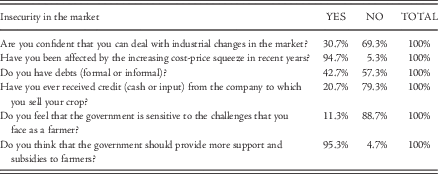
Ever since input subsidies (credits) were abolished and cooperatives were privatized, producers have been feeling the cost-price squeeze more acutely. For instance, as cooperatives initially began to experience financial difficulties, producers were forced to enter informal credit markets, and as a result local traders became stronger in the market. Informal markets trapped producers in a credit-and-debt cycle, which then made them even more dependent on traders (mill owners), not only to market their product but also to actually produce it. This is evident from the interviews conducted: 42.7 percent of the producers reported being in debt (bank loans, informal loans from moneylenders), while 20.7 percent said they received credit (cash or input) from the traders to whom they sold olives. Below, a local mill owner explains how the current rules of competition are harsh for the villagers in the region:
Here, there are mill owners who have been increasing the number of their olive trees every year. If you have fewer than 5,000 or 6,000 trees, then you need to source olive oil from the villagers. But if you have more than 40,000–100,000 trees, your own produce is enough to run your business. As I see it, it isn’t fair to grab trees from the villagers. If you do that, how can they survive? … Some villagers ask for a cash advance before harvest and I give them some cash.Footnote 47
Due to the increasing cost-price squeeze imposed by trade liberalization, nearly all small agricultural producers have become unable to compete in the domestic and global markets. In the present study, 94.7 percent of the producers reported that they had been affected by an increasing cost-price squeeze in recent years. Table 1 shows that many (namely, 69.3 percent) admitted to not feeling confident that they could keep up with purchasing new industrial inputs or technologies.
Insecurity in the market

In Turkey, cooperatives worked as a mechanism to organize “vertical coordination,” which allows local actors to retain surplus value in the local region.Footnote 48 Their input-credit facilities, as well as their role in regulating market price, made agricultural cooperatives the dominant market actors in various product supply chains in Turkey. However, their lack of finances created significant difficulties for the cooperatives in terms of sustaining operations like supplying input-credit and regulating prices. Although producers are aware of the regulatory role that Tariş (the Union of Olive and Olive Oil Agricultural Sales Cooperatives) plays in the market by paying slightly higher prices than those offered by the competitors, they nevertheless cannot give their entire yield to Tariş because of their immediate need for cash. Consequently, Tariş-affiliated cooperatives have experienced a significant loss of market power. One member of an organization representing olive oil exporters argues that financing is an important production cost, and that whoever pays cash can collect the raw material from producers at the lowest cost:
When there is a cooperative system in place, exporters like me don’t get involved with individual producers or local trader [middlemen] networks to source a sufficient volume of oil. We have difficulties in making contracts with foreign buyers … Let’s think, how possible is it to collect the required volume at a standard quality, at the right time, and for the right price? Alright, let’s suppose you found the oil—the next problem is how possible is it to set a future price? We’re simply unable to store large volumes of oil due to financial deficits.Footnote 49
Traders can capture more added value than villagers because their financial resources usually come from other industries. There are examples showing that traders can make a greater profit than producers without owning a single olive tree. Many of the farmers surveyed (59.3 percent) reported that they marketed most of their produce through local traders. Only about one-fifth (20.7 percent) said they primarily marketed their product directly to consumers, and less than one-fifth (17.3 percent) marketed it primarily through Tariş. While the role cooperatives play in shaping the supply chain is diminishing, the rate of profit that private traders get from this vertical coordination is on the rise, as the words of an olive grower indicate:
Traders buy oil from us at the lowest price, like 4.5 or 5 lira, then they sell it for 12 or 13 lira. Since it’s natural extra virgin olive oil, they can just filter the oil and sell it. So what’s the reason for the huge gap between our price and their price?Footnote 50
The reorganization of supply chain networks has increased territorial competition either through new regional monocultures shaped by the requirements of the food processing industry,Footnote 51 or through increased local interest in GIs as a marketing tool that makes territory a component of value.Footnote 52 This rivalry creates new patterns, especially in supplying or sourcing relations that lead to the consolidation of major brands on the one hand, and in the proliferation of microbrands on the other. This dual pattern has been structured through sourcing relations, where mill owners are the key actors, working as producers, processors, and traders, but especially as sub-suppliers between producers and the olive oil industry. In the next section, it will be argued that certain crop characteristics (in this case, of the olive) shape the ways the supply chain is restructured under the pressure of placeless agriculture, which in turn provides certain dynamic rent opportunities in terms of the characteristics of territorial quality and the cultural characteristics of a local product.
The process of articulating to GI chains
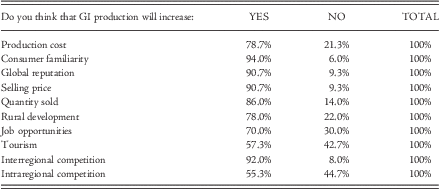
In olive production, natural characteristics have remained important, especially in the extra virgin olive oil trade. For example, synthetic materials cannot be substituted for the taste and flavor of the oil if it is labeled as “extra virgin olive oil.” Placeless agriculture makes quality and reputation the single alternative resource rent in the north Aegean region. According to the producers surveyed (see Table 2), GI protection will boost consumer familiarity (94 percent), global reputation (90.7 percent), sales price (90.7 percent), quantity sold (86 percent), rural development (78 percent), local employment (70 percent), and local tourism (57.3 percent), although the majority (78.7 percent) also think it will increase production costs.
Perceived benefits of GI protection

According to the producers, the main factor that delinked them from the conventional olive oil commodity chain was tied to regional disadvantages in land characteristics, resulting in high production costs, while the main factor that linked the region and producers to GI chains was identified as certain dynamic rent opportunities related to characteristics of territorial quality.
There has been a dual development in the olive oil sector: the consolidation of major brand names, and the proliferation of local microbrands. Harmonization in global standards and the adoption of new processing technologies have resulted in substantial changes in sourcing relations along the chain. The main factor behind this dual development has been the creation of dynamic rent opportunities derived from local resources, which transform into consumer surplus in the form of higher quality. Because the strategies of corporate companies in sourcing raw material are based on multi-scale and multi-place networks rather than on a specific region, with GI protection local actors have a chance to promote their high-quality products, as long as they simultaneously supply medium- or low-quality oil to large companies.Footnote 53
Olive oil quality depends on the variety, condition, and ripeness of the fruit, as well as on processing and storage conditions. All producers have at least two different qualities of oil, based on the difference between ground fruit and tree fruit. They usually keep the best oil for direct sale or for self-consumption and market medium-quality oil to the suppliers (local mills). Low-quality oil is sourced from thousands of producers through main suppliers that have constructed pressing plants (mills).
The commodification of olive oil production, along with the imposition of industrial standards, has generated new patterns—especially in supplying and sourcing relations—that have led to the consolidation of major brands. The four brands Komili (founded in 1878), Kırlangıç (1953), Kristal (1934), and Tariş (1913) are all well accepted in Turkey’s olive oil market, and together account for over 50 percent of the total market. With the globalization of markets and the growth of competition on a global scale, two of these brands (Komili and Kırlangıç) were consolidated into a company called Anagıda, which is a local distributor of major global brands like Coca-Cola and McDonald’s. With the exception of Tariş, all these brands had previously been designated as Ayvalık olive oil, and these firms used to be run by well-known Ayvalık families. Over the past two decades, however, they were appropriated by non-local actors operating according to a strategy of multi-scale and multi-place networks.
In contrast, Tariş, as the brand name of the union of cooperatives of the same name, was designated as the brand offering olive oil from Turkey’s Aegean region in its entirety, with the oil sourced exclusively from members within a strict production area; producers who had their own brand and businesses were removed from membership. The members must sell a certain amount of their yield to Tariş every year, although they can sell the surplus to other traders. Combining oils from various microunits in the region is crucial to Tariş, but this creates a dilemma for producers, because Tariş pays some of them at a higher rate than the price of its products on supermarket shelves, for reasons explained below. The words of one local olive oil producer speak to this dilemma:
Olive producers in this region face a dilemma: whether to sell oil in bulk to Tariş, or to market it as their own branded product. If you have your own brand, then you have more expenses, such as storage, tax, waste products, and so forth … But if you sell to Tariş, then prices go down … Tariş is a huge cooperative and manages a large volume of product; it ultimately has to mix or blend oils from different regions … It is a dilemma in this region: Tariş sells your product at a price lower than what it paid you.Footnote 54
Tariş is able to pay some local producers—those working where olive oil has a distinctive quality, like Edremit or Ayvalık—prices higher than it receives for its own products on supermarket shelves in the following manner. Like other major brands in the market, Tariş bases its strategy on multi-scale and multi-place networks. Thus, Tariş blends expensive oil from a microarea with cheap oil from other microareas in the region. According to officials at Tariş, blending oil is unavoidable if one wishes to attain large volumes of oil. Tariş benefits from the blending method in two ways: it reduces production costs, and it achieves a sustainable and standard quality that can be supplied throughout the year.
Local producers think that the unfair distribution of the added value along the supply chain is a matter of strategy for well-established brands in the market. This is put into practice via two pressure points: low quality (i.e., cheap products) and low prices. For producers, falling prices are all about the cheap products sitting on supermarket shelves and governed by the retail industry. Low grades of blended olive oil, or olive oil mixed with other vegetable oils, can be passed off as “extra virgin” in the market at a lower price. Yet it is the traders who force low wholesale prices on producers. According to one olive oil producer, this is the main reason why they receive an unfair share of the added value of the end product:
Every villager is trying to market their olive oil directly to the consumer … I sell oil to tourists who visit the village for 10 lira per kilo. However, I can’t sell the traders a kilo of oil for more than 4 or 4.5 lira.Footnote 55
GI protection offers a monopoly rent not only by creating a scarcity of certified land, but also by establishing desirable standards of behavior.Footnote 56 Local actors, concerned about environmental issues and sustainable wealth, point to the differences between industrial and traditional methods. As the cost-price squeeze makes itself increasingly felt, the metabolic content of olive oil encourages local people to defend their cultural and traditional production methods, even if these come with high production costs. Producers in the region believe that their future depends on consumer awareness, as the following statement indicates:
People should evaluate the price of oil from this region by taking into account its distinctive characteristics … Customers should pay more if they want oil from this area. This is the only way this region will be able to survive this fierce competition.Footnote 57
Local actors clearly recognize local resources as strategic rents, not only for creating property rights, but also for establishing boundaries of acceptable behavior that will bring a fair share from the added value of the end product. In this way, GIs have a dual function in linking producers with consumers: on the one hand they set barriers to entry (property rights), and on the other hand they create consumption politics on the basis of ethical values.Footnote 58 Increasing consumer anxiety regarding the metabolic and digestive functions of food reinforces growing pressures and demands for ethical standards. Therefore, in these voluntary standards, consumer wages are articulated as a mechanism of social policy conveying fair redistribution and rewarding ethical practices.Footnote 59
In the next section, I discuss this dual development, in which major brands are consolidated on the one hand, and local microbrands flourish on the other. I will then address the lack of policy rents (i.e., characteristics of the political process that constitute barriers to entry for competitors) provided by parties external to the chain, as well as the unfair rules of competition in global markets resulting from barriers to entry in competitor countries.
The proliferation of local microbrands
In the northern Aegean region, the number of local brands has increased in recent years after the so-called “white can trade” was forbidden in 2002 for health and safety reasons by the Ministry of Food, Agriculture, and Livestock (Gıda Tarım ve Hayvancılık Bakanlığı), acting so as to adjust to the EU Common Agricultural Policy. The “white can trade” refers to sales of unlabeled and unpackaged tins and bottles of olive oil, typically sold by villagers to visitors. This kind of trade is still quite widespread, and many consumers still believe that it showcases Turkey’s most traditional and authentic products. However, after the ban, local producers who had previously sold their oil in unlabeled tins or plastic bottles began instead to create their own family brands in order to overcome obstacles and benefit from selling to customers directly. One retired engineer from Tariş explains the increase in the number of local brands:
We took a brand census and stopped counting when we reached 500. So there were already more than 500 brands. I think this is the case because this is a transition phase.Footnote 60
While the ban on the “white can trade” pushed local producers to invest in their own brands, the commodification of olive oil production, along with the imposition of industrial standards, forced them to shift to new technologies in order to meet mandatory chemical levels. This initiated an increase in the number of hammer mills (high-technology processing plants), which make oil extraction a labor-saving phase, with increased yields leading to greater quantity and a decrease in the oil’s free acidity level leading to improved quality. As their number increased, these mills became the dominant channels through which the majority of oil produced in the region was collected and distributed downstream as part of the supply chain.
Two characteristics of supply chains help to elucidate and explain why mills have assumed a central role along the chain: true timing, and personal credit schemes. The former reflects the factors imposed by crop characteristics, while the latter refers to the factors imposed by power relations (labor relations) within the chain. First, the olive fruit is supposed to be pressed within hours of being picked, so as to ensure freshness and minimum free fatty acid levels; otherwise, oxidation and fermentation occur. Second, farmers and mill owners usually know each other, being from the same town or city, and their personal relationships can lead to the development of more flexible sourcing relations that both reduce transaction costs and enable informal product-credit provision. Because prices are at their lowest during the harvest season, mill owners encourage farmers to leave their yields in deposit in order to make a greater profit.
Taken together, these two aspects play an important role in shaping new power configurations to govern quality practices in the olive oil supply chain. The statement below, from an interview with a trader, reveals just how important trust is in the supply chain, as well as the financial power of storage:
If you’re going to buy a high volume of product, it’s difficult to know who has oil and how many tons of each quality. You have to collect this big volume from thousands of producers. We have to analyze the oil before buying it … However, local suppliers know their own districts better then you do … They don’t need chemical analysis like you do.Footnote 61
Since having informal ways to store oil is a mutual desire on the part of farmers and mill owners alike, the mill becomes an important site not just for production, but also for marketing. Clearly, understanding existing cash flows and credit structures at the level of each actor in the market should be integral to any analysis of the supply chain structure. The introduction of new processing technologies seems to have brought with it personal forms of credit schemes and sourcing relations, which emerged as important ways to tie farmers to big retailers.
The need for large volumes of oil inevitably forces major companies to collect oil from several different regions and from thousands of producers. This forces these companies to work with mill owners in order to secure sufficient supplies of oil from farmers, as well as to reduce the costs of transaction (i.e., chemical analysis for benchmark grades) and storage (i.e., the cash for collecting oil and the capital for storage). Local mills thus work as middlemen between the farmers and major companies. As one technician explains, establishing a pressing plant is very costly, and is only a rational investment if it is to be used as a sourcing facility:
People spend huge amounts of money to invest in these new systems, at least 3–4 million lira, but the annual return on investment is at most 60,000–70,000 lira per year. However, the most delicate part in the olive oil trade is collecting the raw material from producers … One of the mill owners here has a saying, “If you use the mill grounds as a parking lot for big trucks, you’ll most likely have a better chance to earn more.”Footnote 62
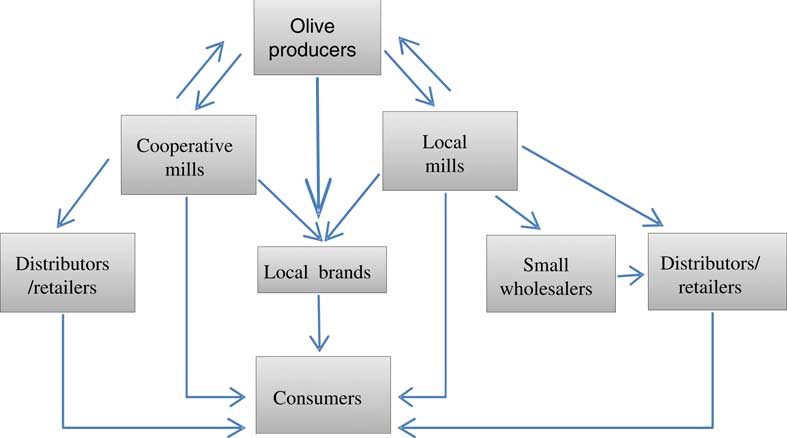
While the local mills work as middlemen between the farmers and major companies, they collect oil from the farmers not only in order to source the oil to the retail brands mentioned above or to large wholesalers, but also for their own family and/or local brands. These local mill owners usually keep the best oil for their direct sales (i.e., boutique production), and then market medium- or low-quality oil to the suppliers (i.e., retailers or major brands). The consumption of olive oil rises annually, and it is these local brands that benefit the most from this increase. Figure 1 illustrates these main actors in the local olive oil supply chain.
Extra virgin olive oil commodity supply chain

In addition to the ban on the “white can trade,” local actors also point to certain additional factors that help explain the flourishing of trademarks in the region. For instance, one aim was to expand the marketing networks already established with end consumers through regional tourism. Local producers try to sell their olive oil to customers with a story, hoping in this way to distinguish their product from others. These stories sometimes deal with mythology, sometimes with ancient civilizations, and sometimes with personal family history. In the 2000s, the growing importance of ecotourism as a form of travel—one where flora, fauna, and cultural heritage are the primary attractions—boosted the value of lands and properties in villages in the northern Aegean region. Upper middle-class urbanites began to settle in these villages, either to enjoy their retirement or to run boutique hotels or cafés. Ecotourism seems to play an important role in creating a “commodity culture,”Footnote 63 consisting of strong cultural forms and elements found among both the commodity producers and the consumers of olive oil in the region.
In summary, agricultural trade reforms in olive production have introduced the pressure to commodify standards in line with industrial technologies, due to the ban on the “white can trade” and the introduction of hammer mills producing oil at ideal chemical levels. This triggered the consolidation of certain major brands, which in turn became compatible with the proliferation of local brands, because local producers also supply low-quality oil to the major brands while marketing their high-quality oil to end consumers in short supply chains. The reason for the proliferation of local brands can be understood by focusing on the dynamic rent opportunities created, including different characteristics of valorization processes and new ways to commodify territoriality.Footnote 64 GI-based localism develops as part and parcel of neoliberal processes.Footnote 65 Therefore, it is crucial to underline that it is not “erasing the market logic but rather … [is an] alternative within it by constraining it with social, historical, and ecological limits.”Footnote 66
Global governance of rent-seeking activities
Despite the expectations of GI protection at the local level, demands are still being made to reinstate national policies to regulate, intervene in, and support GI development against the exclusionary measures put in place by other national or transnational bodies in global markets. Local systems or regions still lack clear-cut physical or administrative boundaries,Footnote 67 and this presents a huge challenge for the potential of GIs to sustain the livelihoods of small farmers in a global world. In this section, I discuss how parties external to the chain do not provide policy rents, as well as how the rules of competition in the global market are unfair due to barriers to entry in competitor countries.
Local actors perceive the limits of GI protection to cope with the disarticulation of commodity chains on the basis of particular rules of competition in a global market they deem unfair, with these rules in fact being certain national or transnational barriers to entry put in place via import controls and subsidy policies. Given the asymmetries of power that shape the global governance of commodity chains, local producers are calling for the reinstitution of a national policy to erode rents and barriers to entry set by competing countries.
According to opinion leaders, in order to become a global market leader Turkey’s olive oil industry must first overcome two important challenges: unstable production, and lack of brand awareness. In 2016, Turkey ranked fourth in the world in olive oil production, behind Spain, Italy, and Greece.Footnote 68 Production capacity fluctuates between 70,000 and 195,000 tons annually, as a result of on-year and off-year cycles.Footnote 69 Some believe that the fluctuation in production prevents Turkey from being viewed as a global leading brand in the international arena.
Turkey exports olive oil to more than 100 countries. The greater part of exports are non-labeled products, including bulk sales (primarily to companies in Europe) and secondary industry sales (e.g., the fish processing and canned sardine industries). In the exportation of labeled products, the private label comes first. In this trade, oil is supplied to companies after being labeled under their own brand, with these companies most likely being supermarket chains or major distributors. One bureaucrat believes that two urgent measures need to be taken to improve Turkey’s position in world markets; namely, an increase in production and a ban on bulk trade:
Turkey has had no voice or authority in international markets due to the unstable, on-year/off-year production cycle. Given the existence of major players like Spain and Italy, we have not had a chance to play a role in international markets … There are two crucial and urgent steps we need to take: to increase domestic consumption, and to ban bulk sales to global markets in order to increase branded trade.Footnote 70
Local actors, however, believe that olive production in Turkey is competitive and productive enough to be a world leader in the international markets. For farmers, the problem is not related to production quantity or quality. According to local actors, the economic rents of competitive productivity (i.e., low price or high quality) are increasingly found in areas outside of production. The import controls and agricultural subsidy policies in European countries are said to be the main obstacles to competing in world markets.
Turkey cannot export labeled olive oil to foreign markets, especially the EU market, owing to high customs rates. In 1996, Turkey signed the Customs Union Agreement with the EU, according to which processed olive products are included in the category of agricultural products rather than industrial products, with the latter being duty-free. This means that EU countries purchase oil in bulk from Turkey as a component of industrial products, but apply customs taxes on branded products as agricultural products. According to the farmers, this strategy of differentiating the import controls on bulk oil and labeled oil reveals the role of politics in creating unfair competition among competitor countries. They view customs taxes as barricades that competing countries have set up against them:
Customs taxes are very high for us as well. Regardless of the GI, we cannot compete with the current price margins in the EU. There is a GI olive oil there for 10 Euros. Why would people pay you 30 Euros? GI status or not, it doesn’t matter in a situation like this.Footnote 71
Local actors criticize inefficient governmental policies, since uncertainty is also on the rise in domestic markets. Of the producers surveyed, 88.7 percent thought that the government was insensitive to the challenges that they faced as farmers, while 95.3 percent believed that the government should provide more support and subsidies to farmers. Accordingly, local producers demand that the government take two urgent measures: first, to promote the daily intake of olive oil so as to increase domestic consumption; and second, to provide subsidies at reasonable rates, as is the case in the EU, in order to help them compete in world markets. Furthermore, they also specified the need for a strong lobby, which should be coordinated by the government so as to overcome the unfair rules of competition (i.e., barriers to entry) in global markets. To the producers, the problem is that Turkey is mainly a price-taker in world markets: Turkey cannot set prices, even for high-quality products, and even if it is the world leader in the production of a certain item. For example, Turkey ranks first in both hazelnut and dried fig production, yet producers must follow the prices set in other countries’ commodity markets.
In 2007, two different institutions were established to maintain lobbying and advertising activities for Turkish olive oil across the world. The Olive and Olive Oil Promotion Committee (Zeytin ve Zeytinyağı Tanıtım Komitesi, ZZTK) was founded by a group of traders, primarily exporters, and conducts campaigns meant to build up Turkey as a brand image and a leading country in olive oil production, as well as expanding marketing channels in world markets. The second institution was the National Olive and Olive Oil Council (Ulusal Zeytin ve Zeytinyağı Konseyi, UZZK), which reconvened for the first time after Turkey left the International Olive and Olive Oil Council in 1998. This national council consists mainly of major brand managers and bureaucrats retired from Tariş whose aim is to create development plans meant to solve structural problems in the organization of domestic supply chains, as well as to increase the market share of Turkish olive oil in international markets.
While local producers demand strategies for dealing with the policy rents found in areas outside of production, bureaucrats and traders involved in lobbying argue for a substantial increase in production. According to these stakeholders, the two leading countries in olive oil production—i.e., Italy and Spain—control the global supply by making use of different strategies. Italy is a country that can sell more than it actually produces because it imports oil from other countries, including Turkey, but labels and exports such oil as its own product. This maneuver is said to be dependent on Italy’s ability to market the entire country as a GI, and some say that this national policy is based on creating an image of the country as a macro olive oil brand. Spain’s ability, on the other hand, is perceived to lie in its production capacity, which challenges Italy’s role in the world market. All in all, lobbyist groups argue for an increase in mass production, not in boutique production. This reveals their skepticism about the potential of GI protection in global markets, as the words of one exporter indicate:
How can a small production volume become important in the globalizing world? The return on investment required to enter the global market would probably be less than for the investment itself. What should be done? We should focus on mass products, not traditional ones.Footnote 72
The conflicts of interest that exist among stakeholders in the GI chain can also be observed between these two different lobbies. Bureaucrats from the UZZK explain that they disagree with the group of exporters in the ZZTK, which aims to expand the market by blending Turkish oil with cheap oil from other countries:
Turkey produces 200,000 tons of olive oil, 40,000 tons in stock. Domestic consumption is 150,000 tons. So you have 90,000 tons to export. However, only 20,000 tons can be exported; 70,000 tons of oil remains. An exporter group insists on exporting the rest after blending it with cheap oil from other countries … But how can you be a well-established brand in the global market if you sell blended oil? … We are the children of Kuvâ-yı Milliye [“National Forces,” the irregular military units who fought in the first phase of the Turkish War of Independence between 1919 and 1920] … They are in search of short-term profits.Footnote 73
As this example reveals, physical and cultural boundaries reflect different marketing strategies, and the actors involved in GI projects endorse different rationales and politics according to individual versus national interests. The conflict of interest between these lobbies seems to be hidden in the tradeoff between quantity (i.e., the scale of production) and quality (i.e., blending), and hints at the potential difficulties in developing collective action meant to govern the quality chain in peace. Responses to globalism reshape these discursive and tangible boundaries (local, regional, national, and international) as barriers to entry for rent-generating instruments (i.e., GI protection and customs taxes), because the setting and governance of these boundaries have been questioned and negotiated through struggles between different groups of actors, primarily on the basis of scale.Footnote 74
In summary, local actors express a need for an efficient government that can erode the rents set by competitor countries through import and subsidy policies. However, at this point there remains a lack of collective action and collective policy. This presents a major challenge for the potential of GIs to sustain the livelihoods of small farmers in a globalized world. The localities in question do not have clear-cut physical or administrative boundaries, and what is more, they are also heterogeneous entities, with different groups of actors reflecting widely varying interests and pursuits. It would seem that a state policy regarding GI protection could play a critical role in restructuring horizontal forms of coordination and action, and could potentially open a space for negotiation between different actors in appropriating resource rents. Overall, the GI issue is closely tied to effective agricultural policies meant to set the rules of competition for the localization of resource rents in a globalized world.
Conclusion
Given the different rates of capitalist penetration into the agro-food sector, differences in crop characteristics affect efforts to develop and benefit from GI protection.Footnote 75 In this study, I have employed the disarticulation approach to commodity chain analysis in order to understand the factors (e.g., the increased cost-price squeeze because of land characteristics) that delink people and places from conventional commodity or industrial chains and link them instead to GI chains (e.g., territorial quality and cultural characteristics). On the one hand, regional disadvantages—namely, high production costs due to land characteristics—have been identified as the main factor delinking local actors from the conventional olive oil commodity chain. On the other hand, certain dynamic rent opportunities related to characteristics of territorial quality and cultural characteristics have been identified as the main factors linking the region and producers to GI chains.
This study shows that placeless agriculture makes quality and reputation the single alternative resource rent for olive oil from the northern Aegean region. Local actors increasingly make use of GIs to cope with the persistent pressure to produce placeless products, and they react to this transformation by diminishing the negative impact of the disarticulation process via promotion of their high-quality local products, as well as by creating rents based on territorial quality. Nevertheless, local actors are of the opinion that GI protection is somewhat limited in terms of its ability to cope with trade liberalization, owing to unfair rules of competition in the global market, such as barriers to entry like customs taxes and agricultural subsidy policies. Local producers are still calling for a national policy that would market the entire country as a macro GI. These responses to neoliberalization seem to be shaped under the pressure of conceptual and institutional boundaries (i.e., local, regional, national, and international boundaries, as well as related interests), all of which are questioned and negotiated through struggles between different groups of actors, and primarily on the basis of scale.Footnote 76