Introduction
Subjective memory complaints, or the feeling that one's ability to remember and to retrieve information is not as good as it used to be, are common complaints among middle-aged and elderly persons. One study using a large sample of almost 2000 participants aged 24 to 86 years indicated that nearly 40% considered themselves to be forgetful (Ponds et al., Reference Ponds, Commissaris and Jolles1997). In a sample of 500 older people between 50 and 90 years of age, 57% of the respondents were slightly concerned about their forgetfulness, and over 32% were very concerned (Commissaris et al., Reference Commissaris, Jolles, Verhey, Ponds, Damoiseaux and Kok1993).
Whether subjective memory complaints are indicative of mild cognitive impairment (MCI) or dementia has been studied extensively but no clear-cut conclusions have emerged so far (Iliffe and Pealing, Reference Iliffe and Pealing2010). Some studies have demonstrated that self-perceived forgetfulness is indeed predictive of cognitive decline and dementia (Geerlings et al., Reference Geerlings, Jonker, Bouter, Ader and Schmand1999; Jonker et al., Reference Jonker, Dik, Kamp and Deeg2000). It has been argued that a person's belief about his or her own memory performance is an important moderator of changing memory functioning since it can affect memory performance through cognitive, affective, and motivational routes (Berry and West, Reference Berry and West1993). Other studies have found no association between subjective memory complaints and objective memory decline and argued that these complaints are merely related to depressive feelings and anxiety (Mol et al., Reference Mol, Boxtel, Willems and Jolles2006; Elfgren et al., Reference Elfgren, Gustafson, Vestberg and Passant2010). Moreover, earlier research suggested that subjective feelings of memory impairment are more closely related to personality traits (i.e., feelings of inferior personal competence and capacities as well as tendencies toward phobic or obsessive/compulsive reactions) than to actual memory performance in normal elderly people (Hanninen et al., Reference Hanninen1994).
Although subjective memory complaints are not necessarily directly related to objective memory decline (Mol et al., Reference Mol, Boxtel, Willems and Jolles2006), the extent and impact of these self-perceived memory problems could in any case be significant. Previous research has demonstrated that, in older individuals, subjective memory complaints were associated with a lower quality of life (Mol et al., Reference Mol, Carpay, Ramakers, Rozendaal, Verhey and Jolles2007). Moreover, in a study conducted in a general practice-based population, results indicated that the presence of subjective memory complaints increased the cost of health care utilization by 60% over three years (Waldorff et al., Reference Waldorff, Siersma and Waldemar2009). These findings underscore the impact of subjective memory complaints on a person's daily life and on society as a whole. Hence, it is important to gain more insight into the predictive factors contributing to subjective memory complaints. Investigating these potentially important factors may contribute to the development of a risk profile for elderly patients with self-perceived forgetfulness.
Multimorbidity, a term that describes the co-occurrence of two or more chronic medical conditions within one person (van den Akker et al., Reference van den Akker, Buntinx and Knottnerus1996), has been indicated as one factor that might contribute to the presence of subjective memory complaints. Prior research has suggested that morbidity status (i.e. morbidity and multimorbidity) might be predictive of objective memory decline (Comijs et al., Reference Comijs, Kriegsman, Dik, Deeg, Jonker and Stalman2009). A variety of medical conditions, including diabetes mellitus (van Boxtel et al., Reference van Boxtel, Buntinx, Houx, Metsemakers, Knottnerus and Jolles1998) and cardiovascular diseases (Elwood et al., Reference Elwood, Pickering, Bayer and Gallacher2002) have already been associated with decreased memory performance. Given that multimorbidity is the rule rather than the exception among older individuals and that patients suffering from multimorbidity use health care services more frequently than patients suffering from a single chronic condition (Vogeli et al., Reference Vogeli2007), the impact of multimorbidity on society is substantial.
Although subjective memory complaints have been an important topic in recent gerontological and neuropsychological research, the association between multimorbidity and subjective memory complaints has, to our knowledge, never been evaluated. The first aim of the current study was to evaluate the relationship between multimorbidity and the presence of subjective memory complaints. The second aim was to investigate whether multimorbidity was associated with the degree of worrying about these memory complaints. The final aim was to determine if multimorbidity was related to an increase in memory complaints during the previous year. The results of the present study could help clinicians to identify subgroups of older people who are at risk of developing subjective memory complaints, which may be mediated by poor morbidity status.
Methods
Study design
This study was based on data from a cross-sectional postal survey, designed by the Public Health Service (Geneeskundige Gezondheids Dienst, GGD Zuid Limburg and GGD Limburg-Noord), that was sent to a representative sample (of the municipal registrar's office) of people aged 55 and over living in the province of Limburg, the Netherlands. This questionnaire comprised questions concerning health status, lifestyle and special care needs.
Study population
In 2008, more than 21,000 community-dwelling persons aged 55 years and over were sent a questionnaire, which was completed and returned by 15,188 persons (response rate of 72.3%). All participants were living in the province of Limburg in the Netherlands.
Measures
Independent variables
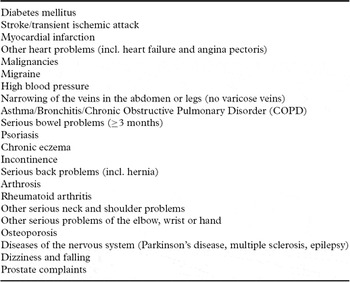
Morbidity (i.e. the occurrence of one disease within a patient) and multimorbidity (i.e. the co-occurrence of two or more diseases within one patient) were conceptualized by a simple disease count (Guralnik, Reference Guralnik1996). This count incorporated self-reported medical conditions that had been diagnosed by a medical doctor (see Appendix). Based on these medical conditions, four distinct groups of respondents were identified: (1) people without any of the medical conditions of interest, (2) people who suffered from one medical condition (i.e. morbidity), (3) people who suffered from two medical conditions (i.e. multimorbidity 2), and (4) people who suffered from three or more medical conditions (i.e., multimorbidity ≥3). The last group was formed to determine if the degree of multimorbidity mattered.
Dependent variables
Memory complaints were probed using three questions. The first question was, ‘Do you perceive yourself as forgetful?’ and required a yes or no answer. Participants who replied affirmatively (n = 3,976) also rated the degree of worrying about their subjective memory complaints on a 5-point scale ranging from 1 (“not at all”) to 5 (“a great deal”). Based on this question, two groups were identified: those who perceived themselves as forgetful but did not worry about it (a rating of 1, 2 or 3 on the 5-point scale was required; n = 3,527) and those who considered themselves as forgetful and were also worried about their forgetfulness (a rating of 4 or 5 on the 5-point scale was required; n = 446).
The third question asked the respondent if his or her memory complaints had increased during the last year. Again, five answers were possible, ranging from 1 (“not at all”) to 5 (“a great deal”). Again, two groups were created. The first group contained participants who perceived themselves as forgetful and whose forgetfulness had not increased much during the last year (a rating of 1, 2 or 3 on the 5-point scale was required; n = 3,586). The other group consisted of participants who perceived themselves as forgetful and whose forgetfulness had increased during the last year (a rating of 4 or 5 on the 5-point scale was required; n = 254).
Confounders
Potential confounders that were taken into account included sex, age (grouped in two categories: people aged 55 to 69 years and people aged 70 and over), educational level (low, medium or high), current smoking status (smoker/nonsmoker), alcohol intake (excessive drinker: yes/no; excessive was defined as more than 21 glasses per week for men and more than 14 glasses per week for women), living arrangements (living alone: yes/no), exercise (persons who meet the Dutch Healthy Exercise Standard (Nederlandse Norm Gezond Bewegen) versus persons who did not meet this standard) (Douwes and Hildebrandt, Reference Douwes and Hildebrandt2000), healthy eating habits (persons who meet all of the standards regarding fruit, vegetable and breakfast consumption versus persons who did not meet any of these three standards).
Because psychological distress is known to be associated with memory complaints, psychological distress was used in all statistical analyses to adjust for the presence of mood on subjective memory complaints. The questionnaire included ten questions that were based on the depression and anxiety subscales of the Kessler Psychological Distress Scale (K10) (Donker et al., Reference Donker, Comijs, Cuijpers, Terluin, Nolen, Zitman and Penninx2010). Its brevity, strong psychometric properties and ability to discriminate DSM-IV psychological distress cases from non-cases make the K10 appropriate for use in health surveys. The K10 consists of ten items that were answered on a five-point Likert scale (where 5 = “all of the time” and 1 = “none of the time”). The possible total score ranges from 10 (no distress) to 50 (severe distress). Two groups were formed based on this score: people with low/medium psychological distress and people with high psychological distress (i.e. a score of 30 or more). If responses to one or two questions were missing, imputation based on all participants' average scores on that particular question was conducted. Persons with three or more missing values on this questionnaire were excluded from the analyses.
Statistical analyses
Multivariate logistic regression analysis was conducted to determine the association with multimorbidity and to predict subjective memory complaints. Next, two in-depth analyses were performed to obtain a more detailed view of the participants suffering from multimorbidity who perceived themselves as forgetful. First, among people who perceived themselves as forgetful, the association between multimorbidity and the degree of worrying about these memory complaints was evaluated. Second, among people who perceived themselves as forgetful, the relation between multimorbidity and increased subjective memory complaints perceived during the last year was investigated.
Multimorbidity was conceptualized by a simple disease count. First, simple logistic regression models (unadjusted models), using only multimorbidity as a predictive factor, were separately conducted for all three outcome measures. Second, three multivariate analyses were conducted, including all confounders. Third, the model was expanded by including the relevant interaction terms. In all three analyses, interaction terms of (multi)morbidity with age and (multi)morbidity with sex were included because of the association between multimorbidity and subjective memory complaints was expected to differ between men and women and between age groups. Only the interaction terms that appeared significant are reported here.
The multivariate analyses were conducted with corrections for sex, age, educational level, smoking status, alcohol intake, living arrangements, exercise, eating habits and psychological distress. Categorical confounders were coded into dummy variables. Potential confounders that were not significantly related to memory complaints were excluded from the final analyses (p values >0.05). The confounders of gender, age and education always remained in the final analyses, irrespective of significance. A stepwise backward method was employed using the statistical software package SPSS version 17. Only persons with no missing data were included in the analyses. Odds ratios (OR) and 95% confidence intervals (CI) are reported; p values ≤0.05 were considered statistically significant.
Results
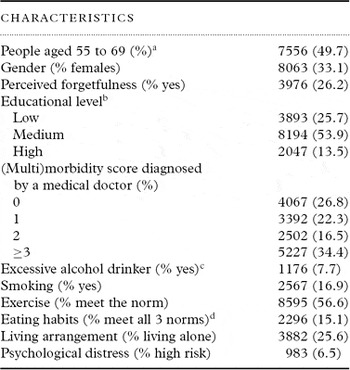
Descriptive characteristics of the 15,188 participants are shown in Table 1. More than 26% of the participants considered themselves forgetful, and more than 50% suffered from multimorbidity.
Descriptive characteristics of the study population (N = 15,188)

a Mean age was 70 years (age ranged from 55 to 90 years).
b Low is defined as primary school, lower medium or lower vocational education; medium as secondary school and/or medium level vocational education; high as higher vocational education or university degree.
c Excessive drinkers: >21 glasses per week (men) or >14 glasses per week (women).
d Meeting all three norms for fruit, vegetable and breakfast consumption.
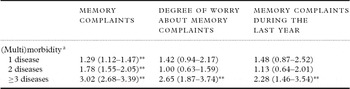
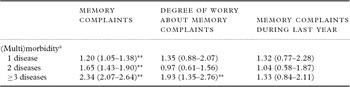
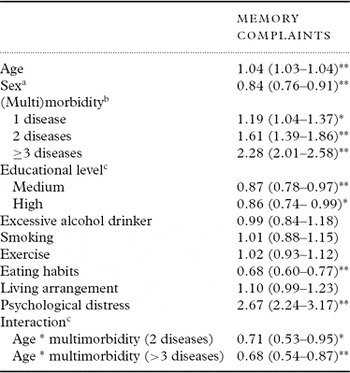
In the adjusted as well as the unadjusted analyses, multimorbidity appeared to be significantly associated with subjective memory complaints (Tables 2 and 3). In the interaction analyses, there was a significant two-way interaction between multimorbidity and age, indicating that the relationship between multimorbidity and subjective memory complaints was stronger in people aged 55 to 69 years (OR: 2.08) than in people aged 70 and over (OR: 1.48) (Table 4). The two-way interaction between multimorbidity with three or more diseases and age was also significant (OR: 3.09 for people aged 55–69 and OR: 2.11 for people aged 70 and over). Interactions between morbidity and age and between multimorbidity and sex were not significantly related to the presence of subjective memory complaints. Psychological distress and healthy eating habits both appeared to be significantly related to subjective memory complaints.
Uncorrected relations between (multi)morbidity and memory complaints, degree of worry about memory complaints and the increase of memory complaints perceived during the last year (OR and 95% CI)

*p < 0.05; **p < 0.01.
aReference group consisted of people with none of the included health problems.
Corrected relations between (multi)morbidity and memory complaints, degree of worry about memory complaints and the increase in memory complaints perceived during the last year (OR and 95% CI corrected for age, sex, education and psychological stress)

*p < 0.05; **p < 0.01.
aReference group consisted of people with none of the included health problems.
Relation between (multi)morbidity and memory complaints in the full study sample (corrected odds ratio and 95% CI)

*p < 0.05; **p < 0.01 | Note: 0 = no memory complaints 1 = memory complaints.
a1 = male, 2 = female.
bReference group consisted of people with none of the included diseases.
cReference group consisted of people with low education.
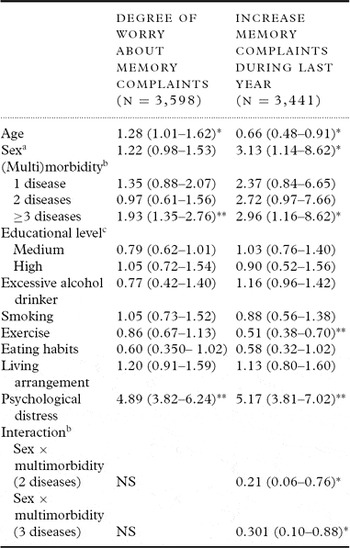
Among participants who perceived themselves as forgetful, suffering from multimorbidity appeared to be significantly associated with a higher degree of worrying about subjective memory complaints (see Table 2). After adjustment for significant confounders, this association remained statistically significant (see Table 3). In interaction analyses, no significant interactions with multimorbidity were detected. Psychological distress was indicative of a higher degree of worrying about subjective memory complaints (Table 5).
Relations between (multi)morbidity and the degree of worry about memory complaints and the increase of memory complaints during the last year among participants who perceived themselves as forgetful (corrected and 95% CI)

NS = not significant (and therefore omitted).
Note: 0 = low degree of memory complaints 1 = high degree of memory complaints.
Note: 0 = small increase 1 = large increase.
*p < 0.05; **p < 0.01.
a1 = male, 2 = female.
bReference group consisted of people with none of the included diseases.
cReference group consisted of people with low education.
Among participants who perceived themselves as forgetful, multimorbidity appeared to be significantly related to increased memory complaints over the previous year (Table 2). However, when corrected for the presence of depressive symptoms, multimorbidity did not remain a significantly related to the degree of increase in memory complaints during the last year (Table 3). There was a significant two-way interaction between multimorbidity and sex, indicating that this relationship was higher among men (OR: 2.72) than among women (OR: 1.79) (Table 5). Moreover, there was a significant two-way interaction between multimorbidity (i.e. multimorbidity 3 or higher) and sex (OR: 2.96 for men and OR: 1.12 for women). Interaction terms between morbidity and sex and between multimorbidity and age were not significantly related to an increase in memory complaints during the last year.
Psychological distress and exercise both appeared to be significantly related to subjective memory complaints. Living arrangements, alcohol consumption, smoking behavior, and exercise did not significantly contribute to any of the three outcome measures and were therefore removed from all statistical analyses.
Discussion
The primary aim of the study was to evaluate the relationship between multimorbidity and subjective memory complaints in community-dwelling older adults aged 55 years and over living independently in Limburg, the Netherlands. The results indicate that multimorbidity is indeed related to subjective memory complaints. The association between multimorbidity and self-perceived forgetfulness was stronger among people aged 55 to 69 years than among people aged 70 and above.
In participants who suffered from three or more co-occurring medical diseases and who perceived themselves as forgetful, multimorbidity was significantly associated with the degree of worrying about subjective memory complaints. This finding indicates that multimorbidity was indeed indicative of a higher degree of worrying about one's self-perceived forgetfulness.
Among participants who perceived themselves as forgetful, multimorbidity appeared to be significantly related to the degree of increase in memory complaints during the last year. However, when corrected for psychological distress, this association disappeared. Men who perceived themselves as forgetful and who suffered from multimorbidity reported a larger increase of their memory problems during the last year than did women who perceived themselves as forgetful and suffered from multimorbidity.
This is the first study that aimed to evaluate the association between multimorbidity and subjective memory complaints. Several explanations for this association are suggested. First, in patients suffering from multimorbidity, self-reported memory complaints may reflect a real decline in objective memory performance, which may be mediated by poor health status. Unexpected common pathogenetic mechanisms, such as autoimmune responses, genetics, inflammation and/or immunological mechanisms, might contribute to this association. Some studies did find an association between the total number of morbid conditions and poor performance on memory tests (Nguyen et al., Reference Nguyen, Evans and Zonderman2007; Comijs et al., Reference Comijs, Kriegsman, Dik, Deeg, Jonker and Stalman2009). Second, a patient's knowledge that he or she is suffering from multiple medical conditions may change his or her subjective assessment of other health-related problems. People who are suffering from multimorbidity may tend to overestimate the risk of acquiring more health-related conditions, which may, among other consequences, result in more complaints and a higher degree of worrying about their self-perceived forgetfulness (Hodek et al., Reference Hodek, Ruhe and Greiner2010). Third, it could be argued that memory complaints are completely secondary to psychological distress, which may influence a person's evaluation of their memory functions. However, after controlling for psychological distress, multimorbidity remained a significant predictor of subjective memory complaints.
The question remains why the association between multimorbidity and subjective memory complaints is stronger among people aged 55 to 69 years than among people aged 69 and over. Younger people may still be active in professional activities and managing a workload and may therefore perceive more direct hindrance due to their forgetfulness in daily life. Hence, older individuals might evaluate their memory complaints as being more common than do younger individuals who are confronted with age-related memory complaints at an earlier stage in life (Mol et al., Reference Mol, Ruiter, Verhey, Dijkstra and Jolles2008).
In short, attention should be paid to the physical as well as the cognitive consequences of multimorbidity. Early identification and monitoring of people with multimorbidity could provide opportunities for controlling the negative health-related consequences of multimorbidity, including subjective memory complaints. Older patients with an increased probability of subjective memory problems, possibly mediated by a poor morbidity status, may be identified by routinely inquiring about memory complaints. Early inquiry is especially important in those patients suffering from three or more diseases and those in whom memory complaints are indeed a consequence of objective memory decline. These patients can then be monitored appropriately, including by a general practitioner (Iliffe and Pealing, Reference Iliffe and Pealing2010). If objective memory performance is found to be normal, patients need to be reassured that their worry is unfounded and that their forgetfulness can be ascribed to normal forgetfulness, which tends to increase with age. Psychosocial interventions aimed at reducing psychological distress related to these complaints may be beneficial for people with subjective memory complaints (Hurt et al., Reference Hurt, Burns, Brown and Barrowclough2010).
Another finding of the current study was that participants who perceived themselves as forgetful and who suffered from high psychological distress worried more about their reported memory problems and reported a larger increase in these problems during the past year compared to persons with lower psychological distress. These findings are in line with previous research that claims that anxiety and psychosocial stress may affect both patients' perception of their own memory performance and their objective memory performance (Jorm, Reference Jorm2004; Mol et al., Reference Mol, Boxtel, Willems and Jolles2006). Because self-observations of memory decline may also lead to depressive feelings, the relationship between depressive feelings and subjective memory complaints may be a reciprocal one (Schmand et al., Reference Schmand, Jonker, Geerlings and Lindeboom1997).
Two other intriguing findings were present in this study. First, persons who met the norm for healthy eating (i.e. the norm for vegetables, fruit or breakfast consumption) had a lower risk of reporting memory complaints. Moreover, people who met the standard for exercise had a lower risk of reporting increased memory complaints during the past year. This result is in accordance with previous research indicating that a healthy eating pattern and sufficient exercise are related to a variety of profitable health-related outcomes, including a lower risk for diabetes mellitus type II (Ma et al., Reference Ma, King, Wilson, Xiao and Stafford2009) and cancer (Mosher et al., Reference Mosher2009).
One of the strong points of this study was its use of data based on a large number of participants aged 55 years and over living in the community. Consequently, the results are representative for community-dwelling older individuals and are therefore more generalizable than results of studies conducted in more homogeneous populations (Lahr et al., Reference Lahr, Beblo and Hartje2007). Furthermore, several relevant health-related factors have been used to control for possible confounding.
Despite these strengths, our findings must be interpreted in light of some possible limitations. First, multimorbidity was conceptualized based on participants' self-reports, which could have compromised the validity of these data. Although self-reported morbidity status has been shown to correlate reasonably well with medical records, the oldest old (i.e. people aged 90 and over) tend to under-report certain diagnosed medical conditions (Goebeler et al., Reference Goebeler, Jylha and Hervonen2007). Moreover, defining multimorbidity by a simple disease count might be overly simplistic for studies like the present one. Secondly, the present study did not control for the presence of mild cognitive disorder or dementia in participants. Because participants were required to be cognitively intact to fill in the questionnaire, the percentage of participants with objective memory problems is expected to be small. Third, the present study is of a cross-sectional nature, which means that no conclusions can be drawn regarding the longitudinal effects of multimorbidity on subjective memory complaints. Because memory complaints due to health status are likely to develop over the course of many years, ideally the underlying process should be investigated longitudinally. Hence, a well-conducted longitudinal study with adequate control for confounding factors is warranted to evaluate the effects of multimorbidity on the evolution of subjective memory complaints. Future research should also explore the role of multimorbidity as assessed by using a more objective approach, such as a general practice database that incorporates all medical diseases diagnosed by a general practitioner. It might be argued that the predictive capability of multimorbidity as assessed by a more objective approach is less strong than that found in the present study.
In conclusion, our findings indicate that multimorbidity and subjective memory complaints are both common in a population of older adults and appear to be related. Taking into account previous research that suggested that subjective memory complaints may be related to future memory decline, the present results may have implications for clinical practice in an aging population.
Conflict of interest
None.
Description of authors' roles
S. Aarts was responsible for the (statistical) design of the study, carried out the statistical data analysis and wrote the paper. M. van den Akker and M. P. J. van Boxtel contributed to the design of the study and assisted with writing the paper. K. J. Hajema and A. M. van Ingen supervised the data collection. J. F. M. Metsemakers and F. R. J. Verhey revised the manuscript for important clinical and scientific content.
Medical conditions (morbidities) reported by participants