Raffles was a burglar. I had helped him to commit one burglary, therefore I was a burglar too. . . . My blood froze. My heart sickened. My brain whirled. How I had liked this villain! How I had admired him! How my liking and admiration must turn to loathing and disgust! I waited for the change. I longed to feel it in my heart. But—I longed and I waited in vain! (Thoughts of Bunny Manders, on realizing he had acted as accomplice to Arthur Raffles during a burglary, in “The Ides of March” [1898], by Ernest William Hornung)Footnote 1
Arthur J. Raffles, elegant gentleman-of-leisure and England cricketing legend by day, and expert burglar by night, made his first appearance on the literary scene in Cassell's Magazine in 1898.Footnote 2 The fictional creation of Ernest William Hornung (1866–1921), brother-in-law of Sherlock Holmes author Sir Arthur Conan Doyle, Raffles conducted his burglaries with the aid of his very own “Watson”: the dim-witted cohort Bunny Manders, in whose narrative voice the Raffles stories were written. Throughout twenty-six short stories and one novel published between 1898 and 1909, Raffles was described skillfully plundering the wealthy commercial and residential resorts of London with Manders present to keep a lookout. Stealing almost exclusively from the jewelers of Bond Street and the Mayfair mansions of the lords and ladies with whom they dined, the young burglars' adventures saw Raffles and Manders continually elude capture by the police.Footnote 3 As the quote above suggests, the moral code of the stories fully endorsed the criminals' escape from punishment, guiding the reader to see, through Bunny's eyes, how committing a burglary could provide all the thrill and excitement of a legitimate sport (with material benefits). Raffles's characterization was central to the attractive veneer cast upon the crime, “seducing” Bunny—and thereby vicariously, the reader—to act as his accomplice by his wit, cleverness, and purportedly irresistible physical beauty.
This subversive combination did not pass without remark. As a reviewer for the middlebrow periodical Academy commented of the first eight stories, issued collectively as a book titled The Amateur Cracksman in 1899, “[A]ll one's notions of right and wrong are turned topsy-turvey.” This sentiment was echoed more disparagingly by Conan Doyle himself in 1924 when he reflected on the Raffles stories that “[y]ou must not make the criminal a hero.”Footnote 4 These critics voiced a genuine contemporary concern that young readers would be lured into copying such an attractive villain by failing to recognize the distinction between fictional versions of criminality and factual reports of crime. In so doing, critics inferred readers' complex emotional and ideological investment in the morality of these protagonists. Indeed, the Academy reviewer's use of the term “topsy-turvey” to articulate the idea that the gentleman-burglar was forcing a radical reassessment of readers' moral codes suggests the existence of a broad spectrum of attitudes toward crime and criminals in this period, which, for the reviewer, defied easy (or comfortable) categorization. Yet recent scholarly assessments of Raffles have tended to belittle the character's ideological significance. As Marty Roth and Stephen Knight have independently asserted, Raffles was merely “an ironic anti-hero” or the stuff of “lightweight adventure fantasy,” judgments that suggest the burglar be read only as a passing satire on the omnipresent Holmes.Footnote 5
Analyzing the literary, theatrical, and filmic versions of Raffles produced from 1898 to 1939, this article argues instead that Raffles functioned as a nexus for the articulation of a tacit, widely held culture of pleasure surrounding the representation of certain forms of criminal behavior throughout this era. The romanticized version of burglary Raffles embodied was consistently portrayed as a crime in which audiences could revel or take enjoyment. By this, I mean that one can identify in both the content and the reception of the Raffles compendium of fiction, plays, and films an attitude of unambiguous delight in the triumph of the burglar over society and the law. This suggests, therefore, that the Raffles stories provided an imaginative outlet for challenging the legal, social, cultural, political, and economic constraints of everyday life in Britain. Raffles's lifestyle as a wealthy bachelor in London, acquired through illegitimate means, challenged codes of class conduct, property rights, and law. As such, its initial appeal to the fantasies of upper-middle-class male readers progressively extended to viewers of all classes, as the story was disseminated more widely through the media of theater and film. With the transition into visual entertainment came the introduction of a glamorous female accomplice with whom women viewers could identify, entwining crime with the possibilities of romance and excitement in a way that encouraged women to vicariously collude in the legitimization of Raffles's burglaries. In all three formats, Raffles's physical attractiveness and athleticism, as well as that of his cohorts, provided readers/viewers with the thrills of sexual interest in the protagonists that blurred the lines between moral virtue and romantic allure.
Moving beyond the realm of the purely fictional, however, Raffles also featured in discourse about factual instances of crime located in press reports of burglaries. As the final section of this article shows, journalists progressively employed the Raffles name as a synonym for actual burglars, thereby establishing “Raffles” as a byword for a sanitized, romantic idea of criminal endeavor (e.g., by headlining reports of burglaries with descriptions like “A Modern Raffles”).Footnote 6 Besides instituting a more sympathetic cultural stereotype of burglars, this rhetorical device, which was used by both the British and the international press, secured for the fictional burglar a somewhat unique role as a new category of criminal. The specific “type” of burglary Raffles represented was that accomplished using superior physical and mental ability, effected against the property of the wealthier classes, without using excessive violence toward victims, and committed by criminals of an attractive appearance or manner. The way in which this “brand” of criminal gained ascendancy as a definitive category outside the artistic arena of fiction, theater, and film, and into frequent newspaper parlance therefore highlights Raffles's commercial currency, and what Shani D'Cruze has called “the subjective appropriation of fiction into individual and shared cultural imaginaries.”Footnote 7 Propelling “Raffles” into becoming an officially and legally recognized term when its use as a synonym for real burglars began to appear in criminological texts and police memoirs, the slippage of the character between these domains exposes how popular attitudes toward criminality infiltrated the highest echelons of state machinery.
For all these reasons, it is surprizing that while Raffles languishes understudied, other fictional tales of crime and deviancy—notably, those upholding the themes of justice and the law, such as works authored by Edgar Allen Poe, Conan Doyle, and Margery Allingham—have been repeatedly subject to academic focus.Footnote 8 In itself, the historiographical emphasis upon moralizing accounts of criminality allows us to pinpoint the moments at which, historically, popular culture has become the mechanism for reasserting social order, as Christine Grandy's recent article on the war profiteer as the dominant villain of 1920s fiction has shown.Footnote 9 However, by failing to explore narratives that celebrated criminal enterprise without a conventional punitive resolution, historians stand in danger of obscuring the full complexity of the role occupied by crime and criminals within the changing cultural landscape. As James Chapman and Matthew Hilton argue, all “popular fictions,” which they define by commercial success, “both reflect dominant values and serve to construct and reinforce them.”Footnote 10 Consequently, while Chapman and Hilton focus upon four “law-enforcing” figures of modern literature as exemplars of changing attitudes toward masculinity and British national identity (Sherlock Holmes, James Bond, Bulldog Drummond, and Simon Templar), they comment that “similar fruitful research could be made of . . . A. J. Raffles.”Footnote 11
Certainly, the sheer pervasiveness and recurrence of the fictional burglar in British and, to a lesser extent, international popular culture before the advent of the Second World War justifies closer scrutiny. Of the Raffles books, The Amateur Cracksman and the subsequent second and third collected volumes of the short stories titled The Black Mask (1901) and A Thief in the Night (1905) were commercial triumphs, reprinted in multiple editions and translated into various languages, including French and German.Footnote 12 Raffles was portrayed on the stage on both sides of the Atlantic, with theater productions enjoying runs in Philadelphia, New York, and Washington in 1903; in Hamburg in 1907; at London's Comedy Theatre in 1906 and Wyndham's Theatre in 1914; and in theaters in Edinburgh and Glasgow in 1909, 1912, 1915, 1917, 1921, and 1937.Footnote 13 This demonstration of Raffles's successful transition across genres and ascendancy as an internationally renowned British cultural icon was further augmented by the adaptation of the stories into film. No less than nine films about the burglar were made in Britain, France, and America between the years 1907 and 1939, arguably situating Raffles as Holmes's equal in enduring cultural currency, and as a phenomenon whose persona and familiar narrative terrain resonated with successive generations of audiences.Footnote 14
This article does not present Raffles's appeal as static, however. Fundamentally, it seeks to historicize the ebbs and flows of the burglar's popularity: first, by charting the greater or lesser commercial success experienced by particular fictional, theatrical, and filmic versions of Raffles; second, by observing how the image of the burglar and his accomplices, and the plots they inhabited, shifted over the course of time and between genres; and third, by analyzing the extent to which the content and presentation of each new rendition of the story engaged with concurrent themes of social, cultural, political, and economic change. While my focus here centers primarily upon depictions of Raffles that were circulating in British culture, I contextualize these representations alongside those delivered internationally. Although scholars in the disciplines of criminology and history have identified shared international stereotypes of criminal behavior in scientific discourse during the early twentieth century (particularly in relation to the ideas of Italian criminologist Cesare Lombroso), there have as yet been no similar studies made of a “popular” criminal attaining such extensive recognition.Footnote 15 By demonstrating how Raffles, as both a figure of entertainment and a new version of criminality, was embraced outside of Britain, I make two points: first, the legibility of an icon of British crime (and through him of British attitudes toward masculinity, humor, sexuality, and morality) in European and American thought; and second, the existence of a transatlantic intellectual interchange in popular understandings of crime. Exposing the complex cultural meanings of Raffles therefore marks an important departure from existing work on the history of crime, identifying a thus far unexamined attitude toward crime and criminals circulating in Britain and the Anglo-Atlantic world prior to the Second World War.
■ ■ ■
Stories glamorizing criminals have a long literary tradition in Britain. In what Gillian Spraggs has described as “the cult of the robber” in England, fictional and biographical tales of notorious thieves such as Robin Hood, Jack Sheppard, and Dick Turpin recurrently captured the imaginations of readers from the Middle Ages through the early nineteenth century.Footnote 16 Similarly, John Brewer has noted how The Beggar's Opera, a play that “satirized but did not condemn the criminal world,” was performed to such acclaim that it “became a craze,” gracing the stage at regular intervals from its first showing in 1728 until 1807.Footnote 17 Whereas the “activities” of Robin Hood could be deemed to conform with ideals of socially acceptable activity—the legend's theme of robbing from the rich to give to the poor was, Spraggs observes, openly linked with organized charitable endeavor in plays as early as the 1470s—the popularity of figures such as Sheppard and Turpin can hold no comparable association with redeeming virtues.Footnote 18 Although they were real-life highwaymen, housebreakers, burglars, and often murderers, their literary heroization played upon their working-class origins, “daring,” and “skill,” and made no apologies for their attempts to retain their ill-gotten gains for themselves.Footnote 19
Thus, a precedent existed in Britain for the lasting commercial success of narratives of crime that encouraged readers to take pleasure in the extraordinary feats and character of the criminal rather than the law enforcer. However, this attitude resided within certain narrative conventions: the aforementioned protagonists did not cross boundaries of class, rarely venturing out of a working-class lifestyle to adopt an upper-class persona, and were all ultimately captured and executed, restoring society to a state of order. Neither the conventions of class-based criminal stereotyping nor the efficacy of the police and the legal system were therefore challenged by these portraits. It is striking, then, that against a late-Victorian context of mass literacy and the proliferation of fiction targeted specifically at the middle and upper classes through middlebrow periodicals, Hornung's depiction of Raffles in Cassell's Magazine subverted both these traditions. Educated at a public school, resident of London's exclusive bachelor quarters The Albany (a famous private residence off Piccadilly), member of various unidentified gentlemen's clubs, and intimate friend of the fictional aristocracy Hornung created, Raffles was portrayed as an upper-class socialite par excellence.Footnote 20 Never legally captured (i.e., brought before judge and jury or incarcerated in prison), Raffles's closest brush with the law came when his identity as “the Amateur Cracksman” was unmasked at the end of the first series of stories, forcing Raffles to jump overboard from a cruise ship into the Mediterranean to escape the clutches of Inspector Mackenzie.Footnote 21 This ending was a far cry from the triumph of the state's disciplinary procedures against crime that was stamped so dramatically upon the resolutions of the lives of characters such as Sheppard and Turpin.
Indeed, Raffles's plunge into the Mediterranean at the close of The Amateur Cracksman signaled a decisive break from the moralizing philosophy of its literary antecedents. Kissing a recent flirtation, Miss Werner, a hasty farewell, and ordering Bunny to restrain the approaching detective, Raffles was described heading to the ship's rail and jumping, “his lithe, spare body cut[ting] the sunset as cleanly and precisely as though he had plunged at his leisure from a diver's board!”Footnote 22Cassell's Magazine, in which this scene was first published in 1898, was designed to appeal to an upper-middle-class readership. Costing one shilling an issue, and consistently valorizing upper-class gentlemen protagonists in a mixture of adventure, romance, and true-crime stories by authors such as Rudyard Kipling, the magazine's articles were juxtaposed against adverts for expensive tailor-made clothes, home decorations, and special edition encyclopaedias.Footnote 23 The lifestyle and masculine values evoked in Cassell's echo those that Martin Francis has argued functioned both as escapist fantasies for upper-middle-class British men in the late-Victorian and Edwardian period and as part of an ongoing “adventure culture.”Footnote 24 This culture embraced a rhetoric of imperial domination and racial strength that, as John Tosh asserts, celebrated men who sought adventure and might be depended upon for “struggle, duty, action, will, and ‘character.’”Footnote 25 Raffles's abandonment of his sweetheart and accomplice might not initially seem to appeal to those values, but the reader was assured by Raffles's parting words that Bunny at least would be repaid for his loyalty: “You were a good pal always when it came to the scratch; some day or other you mayn't be so sorry to remember you were a good pal at the last!”Footnote 26
Raffles's care for his male companion bespeaks a homosocial camaraderie inherited from their public school days, established by Hornung in his first story about Raffles when Bunny recounts how he served as the burglar's adoring “fag” (a junior who performs errands for a senior), then developing into an adulthood of shared club memberships, cricket tournaments, luxury apartments at The Albany, and finally, burglaries.Footnote 27 Hornung's own early life can be seen as directly informing his creations' world. Born to a wealthy merchant in 1866 and educated for several years at the private, all-boys' Uppingham School in Leicestershire, he was an enthusiastic cricketer whose early days as a writer were spent in lodgings in west London in close proximity to Oscar Wilde, holding membership at Pall Mall's elite Reform Club.Footnote 28 While none of Hornung's surviving letters make reference to his inspiration for Raffles, and few illuminate his response to the stories' success, it is useful to situate Raffles's characterization within the social and intellectual networks of which Hornung was a member in order to appreciate the stories' value, both as entertainment and as a satire on the contemporary social privileges accorded men of high rank and education.
Prominent members of the male gentry experienced bad press in the 1880s and 1890s. Judith Walkowitz has shown how an existing Radical attack on the habits and abuses of privilege by aristocratic gentlemen-of-leisure was manifested in newspaper editor W. T. Stead's 1885 “Maiden Tribute of Modern Babylon” exposé of the involvement of certain wealthy men in London's child prostitution racket. Around the same time, politicians Charles Dilke and Charles Stewart Parnell (an aristocrat and the wealthy son of a landowner, respectively) were independently named as corespondents in sensational divorce cases in 1886 and 1889. These were not criminal proceedings, but nonetheless they generated public condemnation of a magnitude that ruined both politicians' careers.Footnote 29 In Hornung's personal social network, Wilde and H. G. Wells—the former connected through their mutual friend George Ives, and the latter acquainted with Hornung after meeting on holiday in Rome in early 1898—had suffered very public unveilings of their legally and socially unacceptable sexual liaisons in 1895.Footnote 30 The infamous libel trial that exposed Wilde's homosexuality, and the publicity surrounding Wells's divorce from first wife Isabel and swift remarriage to lover Amy Catherine Robbins (formerly his student), threw into relief the chasm between the public and private personas of Hornung's literary milieu as never before.Footnote 31
Press reports of the crimes and indiscretions of the upper classes contributed both to Hornung's ability to portray them as “legitimate” victims of Raffles's crimes (it is notable that literary critics who gave unfavorable reviews of the Raffles novels failed to object to who he burgled) and to create Raffles as one of their own.Footnote 32 Analyzing Doyle's famous detective, Simon Joyce has noted that the majority of Sherlock Holmes's criminal opponents were upper-class residents of London's fashionable West End, the “ideological subtext” of Doyle's characterizations being to “collapse the distance between begging and the bourgeoisie.”Footnote 33 As villainy was progressively recoded to critique the supposed integrity of the upper classes, the double life of the upper-class male criminal became a key plot device of which the Raffles stories made full use. Raffles's defense of his cricketing alter ego, espoused to Bunny in the short story “Gentlemen and Players,” drew upon the literary portrayal of real-life criminals to ridicule the idea that moral caliber, as measured by contemporary conventions, could be judged by the appearance of social or professional respectability:
To follow crime with reasonable impunity you simply must have a parallel ostensible career—the more public the better. . . . Mr. Peace [a notorious burglar], of pious memory, disarmed suspicion by acquiring a local reputation for playing the fiddle and taming animals, and it's my profound conviction that Jack the Ripper was a really eminent public man, whose speeches were very likely reported alongside his atrocities. Fill the bill in some prominent part, and you'll never be suspected of doubling it with another of equal prominence.Footnote 34
Raffles's dual existence was, in fact, integral to the stories' commercial success. As Angus McLaren has observed, from the late nineteenth century through the interwar period, “disguise” and “duplicity” were important categories of analysis in English culture, enabling people to interpret shifting class, gender, and racial relationships.Footnote 35 The reference to the famously elusive Victorian murderer Jack the Ripper in the quote above suggests how narratives about crime in this period played upon the imaginative possibilities that derived from society's inability to identify and contain villains unless they were actually captured by police. Leading a double life was an idea that “empowered, frightened, and amused” depending on whether it was discussed with reference to the tactics employed by detectives, criminals, or in relation to fictional and theatrical plot devices. In the realm of the arts, “impersonations” that challenged the audience's expectations of the nature of gentility in particular became “a staple form of entertainment.”Footnote 36 Hornung's deployment of Raffles's dual identity thereby invoked an established literary and popular narrative twist that was guaranteed to attract readers, eliciting humor while subtly forcing middle- and upper-class readers to reflect on the morality of the economic and the social privileges enjoyed by the wealthy.
The relationship between Raffles and Bunny can also be regarded as appealing to a contemporary reassessment of social and gendered identities. Never explicitly romantic or venturing into the terrain of sexual intimacy that had so compromised Wilde, The Amateur Cracksman and its sequels nonetheless crafted a highly intense, emotionally intimate friendship between the two burglars. This can be aligned with what Harry Cocks has described as an ideal of “the true love of comrades” being articulated among other groups of male literary critics and thinkers in Britain during the 1890s.Footnote 37 Occasionally venturing toward overtones of homoerotic desire, this ethos of comradeship was also, according to Cocks, located within a broader cultural interest in spiritualism, self-expression, and the understanding of the soul, motifs that each appear in Bunny's first, reflective description of Raffles:
Again . . . I see his indolent, athletic figure; his pale, sharp, clean-shaven features; his curly black hair; his strong unscrupulous mouth. And again I feel the clear beam of his wonderful eye, cold and luminous as a star, shining into my brain—sifting the very secrets of my heart.Footnote 38
While Raffles's physical attractiveness was foregrounded in this description in a manner reminiscent of a romantic ode, the attributes that qualified Bunny's appreciation of Raffles's physique—the athleticism of his figure even when in a casual attitude, or the “strength” of the mouth that had been used to persuade him to act as accomplice—alternatively suggests a reverence for these contemporary markers of leadership and “character.” As Max Jones has shown, comparable traits were venerated in nearly identical language in press memorializations of Edwardian explorer Captain Scott, whose “strength and vigour and quickness” and “clear-cut features” were often recalled.Footnote 39 Further, Raffles's seeming ability to divine Bunny's innermost thoughts and feelings served to augment his status as leader, portending narratives of the emotional dependency felt by soldiers toward their immediate commanders that would later become common in accounts of life in the trenches during the First World War.Footnote 40
Yet one cannot exclude the possibility of some readers identifying the nature of the intimacy between Raffles and Bunny as betokening a homosexual relationship. As Matt Cook has shown, The Albany residence that featured as Raffles's home in the stories had a reputation as a hub of the “homosexual circuit” at the fin de siècle, whose notable occupants included Hornung's friend George Ives in 1894.Footnote 41 Bunny was also shown to be highly resistant to the intrusion of a woman into his and Raffles's shared time together, even when the woman in question had caught Raffles's interest only for her jewelry. Attention paid by Raffles to the aforementioned Miss Werner in the final story of The Amateur Cracksman provoked Bunny to narrate: “I confess to some little prejudice against her. I resented her success with Raffles, of whom, in consequence, I saw less and less each day. It is a mean thing to have to confess, but there must have been something not unlike jealousy rankling within me.”Footnote 42 The spatial context of the privileged, luxurious haunts of London's wealthy male elite against which Raffles's crimes were enacted, and the emotional intensity of his friendship with Bunny, thus held sexualized connotations that readers could not fail to miss—although to what extent is debatable. However, the bond between the two burglars, centering upon motifs of love and loyalty while punctuated by a frisson of sexual charge, did function to offer the original readership the enjoyment of a secure masculine friendship weathered by the extraordinary criminal adventures in which they took part.Footnote 43
Descriptions of Raffles's physical attractiveness, athleticism, and ability not only enhanced the tenor of his association with Bunny but also enabled Hornung to cast Raffles as a cricketing legend in the same mold as some of the most admired sportsmen of the day.Footnote 44 Raffles's cricketing career, as well as sustaining the duality of his life, was an important element of the stories' commercial success in other ways. Imbuing the stories with the excitement of reference to a popular sport, it also served as the perfect analogy to the modus operandi of Raffles's burglaries: throughout the stories, the gentleman-thief used his skill and wits to achieve his ends, rarely employing violence against a homeowner and adamantly declaring that “violence is a confession of terrible incompetence.”Footnote 45 Malcolm Tozer's examination of Raffles as cricketer argues that even the team for which Raffles played— Middlesex—was culturally symbolic. Middlesex players were the “Gentlemen of England,” and cricket the game of health, wealth, honor, and morality from which violence was excluded.Footnote 46 This fine moral distinction between committing burglary and committing burglary with violence distinguishes Raffles from murderous fictional peers like Wilde's Dorian Gray. Indeed, it was a distinction to which reviewers of The Amateur Cracksman clung when attempting to justify their enjoyment of the criminal's escape from the law; as one critic noted, Raffles “had a code of honour, and stuck to it; otherwise he would have been impossible as a hero.”Footnote 47 Other critics, by contrast, simply condemned the moral content of the novel, describing Raffles and Bunny as “weak-minded” and “evil,” “nefarious,” and “a heresy.”Footnote 48
Such comments were not without justification. Envisioning burglary as a fantastical—that is, criminal—version of “entrepreneurial” possibility that would secure both the lifestyle of the upper classes and material wealth, the Raffles stories represented an imaginary panacea to the economic and cultural pressure to surmount the social ladder besetting middle-class male readers. Raffles's “philosophy” seemed to encourage workers to disregard these worries altogether:
Why should I work when I could steal? Why settle down to some humdrum uncongenial billet, when excitement, romance, danger, and a decent living were all going begging together? Of course, it's very wrong, but we can't all be moralists, and the distribution of wealth is very wrong to begin with.Footnote 49
Hornung's creation thus represented burglary as a seductive “career” by which one could realize all the pleasures of a luxurious living, propel oneself into the upper echelons of British society, fulfill contemporary ideals of masculine endeavor, and take revenge upon an unrelenting class system with impunity. The act of burglary itself also appeared an enticing experience in Hornung's account. Describing to Bunny how he nearly got caught during his first attempt at burglary in The Amateur Cracksman, Raffles avers,
Bunny, if you ask me what was the most thrilling moment of my infamous career, that was it. There I stood at the bottom of those narrow stone stairs, inside the strongroom, with the door a good foot open, and I didn't know whether it would creak or not. The light was coming nearer—and I didn't know!Footnote 50
This story was concluded with more than an overtone of sexual metaphor, as Raffles, now having to contemplate the possibilities of being recognized, explained thus how he had changed his appearance: “I used to have a rather heavy moustache . . . but I lost it the day after I lost my innocence.”Footnote 51 Little wonder, therefore, that as sequels The Black Mask and A Thief in the Night found their way into print, reviewers began to voice fears that such books were “not . . . for an unbalanced juvenile, but all right for a policeman or a J.P.,” or “may become actually dangerous. . . . [A] novel which leaves a scientific and cold-blooded criminal triumphant and unrepentant, may be really harmful to immature and ill-balanced minds.”Footnote 52
Already, then, critics recognized the potential of Raffles's characterization to transcend the boundaries of fiction and infiltrate readers' perceptions of the reality of crime to an extent that would not only romanticize popular discourse of crime but also correspondingly denigrate the law. By the late nineteenth century, as Matt Houlbrook asserts, the reading habits of the middle classes were coming under increasing scrutiny, now in explicitly psychological terms that “dismissed engagement with popular fiction as irrational, hysterical, fantastical, or even childlike.”Footnote 53 Given the aforementioned prosperity of new forms of elite and middlebrow fiction, the success of a narrative like that of Raffles—continually celebrating the triumph of the criminal—can be seen to have provoked worrying reflections about its effects on the moral fiber of the classes upon whom the future intellectual, racial, and economic strength of the nation was popularly assumed to depend. Unfortunately for these commentators, by 1901 the stories' commercial currency had proven itself in triplicate, and Hornung, in collusion with theater and film producers, moved to test the allure of the narrative to an even broader audience.
The testing ground for the first theater adaptation of Hornung's Raffles stories was, interestingly, America. In September 1903, with a script coauthored by Hornung and Eugene Presbrey (of whom little is known), Raffles: The Amateur Cracksman premiered at the Garrick Theater, Philadelphia, with noted English actor Kyrle Bellew in the lead role.Footnote 54 The play was such a success that it proceeded to be staged at the National Theater, Washington, and the Princess Theater, New York, in October and November of that year.Footnote 55 This was not the American public's first exposure to Raffles. The Amateur Cracksman was reprinted in New York with the title Raffles by publishing firm Charles Scribner's Sons in 1901, and one theater reviewer for the Washington Times confidently assumed a broad familiarity with Raffles's fictional origins, noting that “[the play] is based, as almost every one knows, upon the fascinating sketches of the first-named dramatist [Hornung].”Footnote 56 The popularity of Hornung's original stories in America can be measured by the extent to which reviews indicated that in translation to theatrical form the stories' integral themes were maintained, instead of being replaced by something more universal. American reviewers identified the burglar as “Eton bred, a mighty cricketer in county matches,” and “a gentleman received in the highest social circles in London,” illustrating not only that American audiences were conversant with the structure, dynamics, and pastimes of Britain's upper classes but also that Raffles's characterization and crimes were, at this time, seen as inextricable from these configurations.Footnote 57 Sadly, no script survives for the 1903 version, but characters and motifs referred to by critics indicate that the narrative followed the same course as later London productions.Footnote 58 In doing so, the play witnessed a decisive departure from its fictional predecessors.
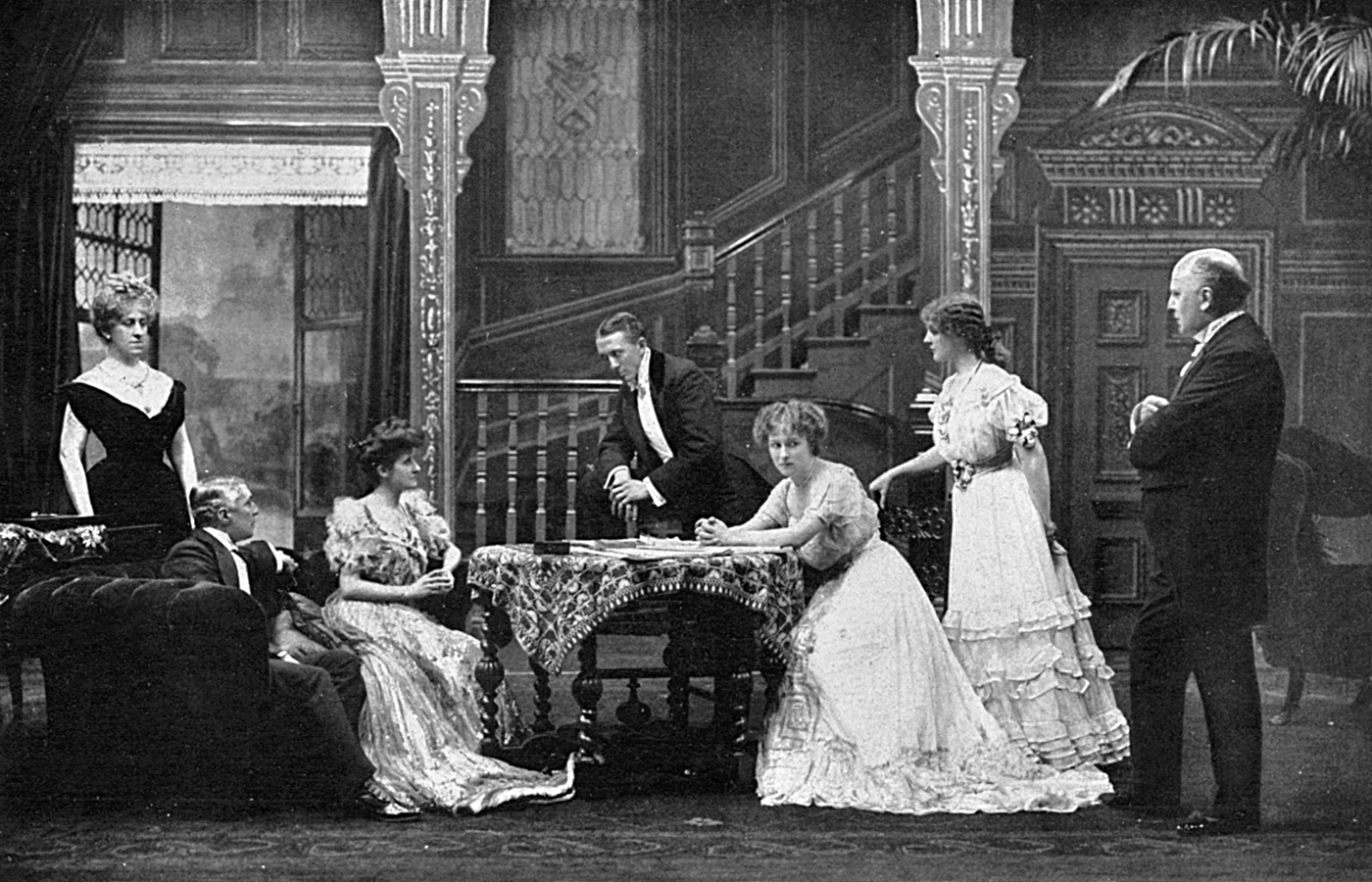
Abandoning Raffles's cosy homosociability with Bunny, the play (according to the surviving 1906 script) revolved entirely around Raffles's attempts to win Gwendoline Conran, cousin of the Earl of Amersteth. Initially determining to give up crime for Gwen's regard, Raffles finds this renunciation impossible as his identity is threatened first by a covetous former lover, Mrs. Vidal (nee Miss Werner), and finally unmasked by the detective on his heels, Curtis Bedford. Significantly, Raffles escapes the clutches of Scotland Yard with Gwen's help after she declares her love despite her discovery that he is a thief.Footnote 59 Preserving the original tropes that popularized Raffles in fiction—his gentlemanly persona, adventurousness, illicitly earned lifestyle, and ability to evade the police—the theme of heterosexual courtly love indicates Hornung and Presbrey's anticipation of the theaters' heterogeneous audience of men and women. This consideration appeared even more prominent when the play transferred to London's Comedy Theatre in 1906. With Gerald du Maurier replacing Bellew in the title role, the audience was presented with a Raffles who, as The Athenaeum's reviewer described, was “a lady-killer.”Footnote 60 As figure 1, taken from a photo review in the highbrow periodical the Sketch, shows, female characters were a conspicuous presence on the stage and du Maurier (center), an elegant, handsome, commanding lead. The Comedy Theatre was located on Panton Street in the heart of London's West End where, as Tracy Davis and Viv Gardner have independently asserted, middle-class women regularly attended the theater in the Edwardian period, albeit in the company of a male escort to maintain their respectability.Footnote 61 In this environment, the feminization of the narrative wrought by the introduction of glamorous female accomplice Gwen emerges both as a romantic counterpart to Raffles and as a reflection of changing cultural attitudes toward women's agency in British social, political, and domestic life.
“Raffles, The Amateur Cracksman, at the Comedy,” Sketch, 30 May 1906, 4. Cutting in file “Comedy: Raffles 12 May 1906.” Victoria and Albert Museum Theatre and Performance Collections. Reproduced by kind permission of the Mary Evans Picture Library,

Traveling to London to warn Raffles that Detective Bedford was on the trail, and facilitating the burglar's escape through a window and into the carriage in which she arrived, Gwen encouraged women viewers to envision collaboration with the gentleman-burglar as synonymous with wealth, love, and excitement.Footnote 62 As Elizabeth Carolyn Miller has argued, fictional, theatrical, and filmic depictions of female criminals in British culture at the fin de siècle represented “not the new circumspections of modern society, but its new freedoms.”Footnote 63 Employing their physical attractiveness and sexuality to evade the law, female criminals were portrayed as models of women's gradually improving autonomy in a period that saw both the advent of the suffragette movement and changing ideals of women's employment in the labor force as “liberating.”Footnote 64 Women also wielded increasing power as consumers, notably in the emergent market for romance fiction heralded by the arrival of the publishing phenomenon Mills and Boon, whose novels were littered with women performing daring acts for the sake of love in a commercially successful formula from which the theater versions of Raffles now clearly sought to profit.Footnote 65 This impression can only have been compounded for audiences by casting Bateman in the role of Gwen. A woman so beautiful she featured in Strand Magazine's December 1906 list of the one hundred most beautiful women of the previous century, Bateman was described as an “accomplished actress” who had “scored many successes at the Haymarket and other theatres.”Footnote 66 The allure of the character was thus twofold, being physically manifested by a famous beauty whose publicized personality and lifestyle held comparable motifs of glamour and independence.
Similarly, Gerald du Maurier, as his daughter Daphne later recorded, embodied Raffles in a way that sought the audience's emotional investment in the character's fate. In his first big stage success, du Maurier
brought something to it that was personal and unique—a suggestion of extreme tension masked by casual gaiety—making of Raffles someone highly strung, nervous, and finely drawn, yet fearless and full of a reckless and rather desperate indifference, someone who by the force of his high spirits had developed a kink in his nature.Footnote 67
This technique, along with du Maurier's good looks, proved a hit with theatergoers and critics alike. “In the warmth of his love-making and the coolness he displayed in the presence of danger Mr. Du Maurier is equally admirable, and to him the popularity of the whole is mainly due,” approved The Athenaeum, a sentiment reflected in the year-long run that the play was accorded at the Comedy.Footnote 68 It was the making of the actor's career. By December 1914, when du Maurier chose to revive, and star again in, the play at the theater he then managed, Wyndham's (on Leicester Square), reviewers deemed the actor necessary to render Raffles's moral and legal deficiencies attractive. As Play Pictorial's theater critic, B. W. Findon wrote,
[T]he gracious personality of Mr. Gerald du Maurier is a most admirable cloak for any villainy that might be attempted and carried out. . . . [A]s [Raffles] is presented by Mr. du Maurier we cannot but feel a sneaking regard for the man who so wantonly and treacherously betrays the generous hospitality of his host.Footnote 69
This review is particularly compelling. In evaluating the aspects of the play that audiences found appealing, Findon lauded not only the temperament with which du Maurier invested the burglar's character but also his portrayal of the crime itself, suggesting that audiences had enjoyed watching how the burglary was effected as much as they had admired the characters. Findon's expression for this state—“a sneaking regard”—exposes his awareness of having participated in an experience that, though staged for the purposes of entertainment, served to legitimize the glorification of crime. Indeed, this sense of a shared illicit enjoyment evokes Anna Clark's metaphor of “twilight moments” to describe those instances in history when people have engaged in sexual acts deemed “deviant,” afterward excusing their behavior on the grounds that it was “temporary; they returned to their everyday lives, and evaded a stigmatized identity.”Footnote 70
Undoubtedly, the 1914 revival of Raffles, The Amateur Cracksman marked an important cultural moment in which character and narrative could feasibly have been rejected for consumption by both the state and the theatergoing public. In the intervening years after the play's 1906 success, Prime Minister Herbert Asquith set up a joint committee to review the laws guiding theater censorship. In 1909, this committee decided that although the Lord Chamberlain should remain Licensor of Plays, his discretion should be guided by seven rules, the fifth of which was to reject any play “calculated to conduce to crime or vice.”Footnote 71 The permission granted by the Lord Chamberlain for the 1906 play had already been criticized in some quarters as “inconsistent.”Footnote 72Academy reported that in a 1907 debate about censorship at the liberal Playgoer's Club in London chaired by Marshall Hall, K.C., Hall opined that “the undoubtedly amusing play of Raffles (which throws a halo of romance round crime) did far more harm than a work dealing seriously with the problems of sex.”Footnote 73 However, with the play having already experienced such extensive public exposure, its return in 1914 could hardly be suppressed. Yet one might have expected that the international situation would have exerted its own subduing influence. After war broke out in August 1914, British theater, as Gordon Williams has observed, “became concerned not just to entertain but to mobilize; and theater-goers were invited to drop their inhibitions and submit to the great swelling mood of national solidarity.”Footnote 74 What place had a figure like Raffles among plays encouraging national solidarity?
Quite simply, he didn't. As shown by figure 2, the front cover of a program issued for the 1914 production at Wyndham's, Raffles remained a literally “dark” presence in the spectrum of central protagonists. Silhouetted in black against the yellow light of a presumably domestic interior, the sinister aspect of his intrusion into the home was magnified by the way that Raffles's face and hands were obscured, intimating that the burglar's very flesh was consonant with the shadow that failed to engulf his shirt, bowtie, and sleeve cuffs. Picked out in contrastingly lurid white, these details of Raffles's attire serve to visually reiterate the paradox at the heart of the criminal's narrative: his gentlemanly alter ego. With the names of Wyndham's, du Maurier, and Raffles written out in slick bloodred, nothing in the image suggests a redemptive theme or diminishes the glamour associated with the character and his crimes against property and privilege.
Front cover of program dated 23 December 1914, in file “Wyndham's 1915,” Victoria and Albert Musuem Theatre and Performance Collections.
The theatrical retention of Raffles's glamorous criminality during this period of international crisis denotes the middle classes' continued receptivity to his version of burglary. As an ideological position, it seems somewhat ironic given that, as Deborah Cohen has noted, the Edwardian period witnessed a progressively more economically stable, prosperous middle class for whom the security of the domestic space and the accumulation of valuable possessions were paramount.Footnote 75 Yet as Cohen also observes, suburban bliss in practice constituted renewed competition for social enhancement, with homeowners vying to acquire material belongings and decorations that would suitably equal, or better, those of their neighbors.Footnote 76 Thus, even into the interwar period, the middle classes continued to labor under comparable economic and social pressures similar to those that had made the original fictional stories so resonant with upper-middle-class male readers.
Certainly, the continuing existence of an audience for the Raffles narrative was confidently assumed by interwar film distributors, within whose relatively fledgling industry six films about Raffles were made between 1917 and 1939.Footnote 77 Cinema, as Annette Kuhn and Elizabeth Carolyn Miller have, respectively, noted, was immediately a more “democratic” form of entertainment than the theater had been, attracting large working-class audiences of mixed gender from its inception in the early 1900s.Footnote 78 Perhaps it was because of cinema's greater scope for mass consumption that Raffles's moral compass appeared less reactionary in films made during the immediate postwar years, with Raffles shown using the profits of his burglaries to make philanthropic “donations” to the poor. For example, the ending of Raffles (King Bagot, 1925) starring House Peters saw Raffles return Lady Amersteth's pearl necklace with strict instructions that the reward be sent to the Soldiers' Fund.Footnote 79 Early Raffles films thus attempted to profit from attuning their narratives to broader issues engaging postwar British society at the time of their release. In the first instance, by remolding Raffles as a socially conscious burglar, filmmakers echoed the desire of successive governments to promote national unity at a time when political commentators feared the working classes, suffering from the economic depression, would turn to Fascist or Communist political factions finding popularity on the Continent. In the second instance, these films placed a new emphasis on wealthy classes' material responsibilities toward the poor, drawing attention on screen to the financial plight of emotionally and physically scarred ex-soldiers attempting to acquire work in the war's aftermath.Footnote 80 Raffles's new, Robin Hood–style posturing in these early films did not detract from their exciting representations of the act of burglary, however. For instance, the 1917 American production Raffles, the Amateur Cracksman, directed by George Irving and starring John Barrymore, provided a graphic “prologue” in which Raffles's theft of a priceless pearl and plunge into the Mediterranean from a cruise ship in The Amateur Cracksman were acted out.Footnote 81 Yet public consumption of the films in Britain (measured in the duration of their screenings in London) suggests that socially conscious alterations to the narrative were not well received, because those later films that returned Raffles to his original, self-interested motives enjoyed greater commercial success.Footnote 82
Gwen's diminished participation in Raffles's escape from the law was also a marked feature of the less profitable early interwar films, which saw her role (played by a string of little-known actresses) increasingly reduced to that of a swooning love interest whose sensibilities were shocked by the revelation of her hero's criminal career.Footnote 83 Instead of warning Raffles of the detectives' arrival, or assisting his flight, Gwen stood by silently and watched. On the one hand, her reluctance to assist the burglar was resonant with conservative strands of interwar ideology that advocated middle- and upper-class women's role as preserving the “sanctity” of the home, that is, creating a stable domestic environment in which to support husband and family, and thereby foster the health and strength of the British race.Footnote 84 Burglary was the ultimate threat to domestic harmony, representing a loss of security both physical and symbolic, as well as an attack on material possessions. On the other hand, though, Gwen's passivity ran counter to the experiences of a new generation of cinemagoers: financially independent working-class women, whose expanding opportunities for employment in shops, factories, and offices, as well as their role as “breadwinner” in the home meant that, as Selina Todd writes, they had greater social freedom than before the war despite not being granted equal rights to vote until 1928.Footnote 85 The failure of these early films thus emerges as a product of their recycling the lovers into law-abiding citizens, thereby ignoring the antiauthoritarian sensibilities of a largely working-class audience.Footnote 86
This trend was thrown into sharp relief by the phenomenal box office success of Samuel Goldwyn's 1930 “talking” film Raffles starring English actor Ronald Colman. Made before the Hays code (restricting American films' ability to glamorize crime) began to be rigidly enforced in 1934, Raffles's lack of penitent speeches or charitable “donations” marked a striking antithesis to the principle supposedly governing the British Board of Film Censors—the “demoralization” of the British viewing public.Footnote 87 With its “record-breaking” eleven-week run at London's Tivoli cinema on the Strand, the film's two instances of burglary facilitated the gift of a bracelet for fiancé Gwen (played by Kay Francis) and a diamond necklace to ease Bunny's debts. Film critics were forthcoming with praise, notably affirming that Raffles “catches the real spirit of E.W. Hornung's famous stories,” and comparing Colman's portrayal to that of du Maurier's.Footnote 88 Like du Maurier, Colman's matinee-idol looks and sexual attractiveness were key commercial tactics in marketing the film and enhancing the appeal of Raffles as a character. Figure 3, one of a series of adverts for Raffles featured in lowbrow newspapers the Evening Standard, Daily Mirror, and Daily Express, shows the brooding visage of Colman positioned above the tagline “Wanted for Robbery of Safes and Women's Hearts,” a double entendre that seamlessly equated theft with romance while cleverly undermining rhetoric traditionally employed by the police to capture criminals.Footnote 89 The invitation for audiences to suspend their moral and legal scruples “in the face” of the handsome actor/burglar was issued even more succinctly in an advert featured in the Evening Standard on 29 August 1930, which put it simply: “Scoundrel! But you can't help liking him.”Footnote 90 The role of Gwen was comparably allotted some of the autonomy lost since the theatrical versions, because she was portrayed calmly assisting Raffles's escape at the film's conclusion. Played by Francis, who was voted America's best-dressed woman that same year and sported cropped black hair that, as Picture Show's feature on the actress noted, had almost cost her a career in cinema due to the contemporary demand for blondes, Gwen was termed a woman who “gets her own way” by the magazine.Footnote 91
Evening Standard, 10 September 1930, 4. Reproduced by kind permission of the British Library,
Exposed once more to the romance and rebellious fantasies that had fueled the original popularity of Raffles, critics' comparative lack of anxiety over, and outright endorsement of, Goldwyn's 1930 version may be attributed to the effects of economic depression following the 1929 Wall Street Crash. Cinema during the depression, observes Daniel LeMahieu, made a concerted effort to balance expressing sympathy for, and identifying with, the plight of the working-class unemployed while still appealing to middle-class consumers.Footnote 92Raffles's gleeful portrait of the burglar purloining riches from wealthy victims exposed filmmakers' engagement with the economic preoccupations of their audience, an issue to which film critics were comparably sensitive. Nor can their collective insouciance about the effects of romanticizing the crime be ascribed to progress in the regulation of burglary. As the Home Office's annual Judicial Statistics reports of the incidence of crime in England and Wales asserted, burglary had, on average, statistically increased over the interwar period.Footnote 93
Filmmakers' sensitivity to the politicized resonance of narratives of crime in their medium was used to opposite effect, though, when in 1939, on the eve of the Second World War, the last Raffles film was made. Produced again by Samuel Goldwyn, the plot of the retitled Raffles closely imitated its predecessor until the resolution, which saw the burglar, played by English actor David Niven, disappear into London's fog with the stated intention of turning himself in to Inspector Mackenzie. The modification of the ending resulted from pressure on Goldwyn by the Hays Office to display the moral standards appropriate to the international situation, similarly manifested in Bunny's new characterization as a young army officer who blatantly disapproved of Raffles's activities.Footnote 94 Portrayed by the heroic Niven, who left to join the Rifle Brigade before filming was completed, the Raffles of 1939 might be considered a cultural volte-face in terms of depictions of attractive criminality.Footnote 95 Yet for British audiences, as the Daily Mirror's film critic Reginald Whitley observed, Niven's war service actually served to compound the moral ambiguity of Raffles: “I am afraid this picture will have a devastating moral effect, for what chance does law and order have when a criminal is portrayed by a handsome young man who in real life sacrifices fame and fortune to fight for his country.”Footnote 96 The moral implications of Raffles's conclusion were also complex. Reviewers in magazines Picture Show and Picturegoer and Film Weekly highlighted that Raffles's surrender to Mackenzie was the result of his love for Gwen (played by Gone with the Wind actress Olivia de Havilland), in no measure enhancing the stature or efficacy of the police (or thereby, the supremacy of the state).Footnote 97 Gracing London's Regal Cinema Theatre at Marble Arch for a respectable three and a half weeks from, 25 March to 19 April 1940, Raffles neither obliterated the reckless allure of the gentleman-thief nor fully embraced it; neither capitulated to the law, nor undermined its orchestration.Footnote 98 As the farewell appearance of the burglar, who would not be given dramatic life in Britain for another thirty years, Raffles thus betrayed a peculiar tension between American and British filmmakers' and film regulators' conceptions of the relationship between popular ideas of criminality and British national values. Although Raffles clearly represented a critique of Britain's inequalities of wealth and social status, the burglar emerged as one component of a national identity that was unified in the face of international threat.
While Raffles's popular significance was negotiated through the entertainment media of fiction, theater, and film, the character's status as a liminal figure in the cultural landscape, straddling the imaginary borderland between fiction and reality, was cemented through its recurrence in press reportage of burglaries. Converting the name “Raffles” into a label that connoted the character's skilflul and predominantly nonviolent modus operandi, penchant for stealing from the wealthy, and enjoyment of his victims' lifestyle, the British press applied the name as a synonym for real-life burglars in forty-five instances I have discovered throughout the period 1906 to 1939.Footnote 99 Employing headlines such as “Raffles of the Paintpot” (a decorator turned thief, Daily Mirror, 1907); “An Office Boy as Raffles” (Daily Express, 1908); “Disciples of Raffles” (Scotsman, 1926), or using the appellation interchangeably with that of the real burglar's name throughout the articles, “Raffles” was used within a range of newspapers including The Times, Daily Express, Daily Mirror, Daily Telegraph, News of the World, Manchester Guardian, Daily Mail, Scotsman, Observer, John Bull, and Evening Standard. Commonly enthusing about, as opposed to denigrating, burglars' “daring” and skill, the sheer variety of newspapers in which this valorization of the burglar occurred indicates the cross-class imagining of Raffles both as a figure of popular entertainment and as a criminal “type,” illustrating how the usage of the term evolved from its fictional origins in tandem with its commercial currency.
The demographic composition of those accorded the epithet “Raffles” was actually expanded by the press, which did not exclusively reserve it for upper-class English male burglars. The aforementioned “Raffles of the Paintpot” demonstrated how a working-class tradesman was also an acceptable candidate for the name; in a further nine of the forty-five reports issued, the burglars referred to operated in countries outside Britain, including France, Switzerland, Germany, Serbia, and America. Class and nationality were no barriers to “achievement” in the sphere of criminal activity it seemed, with the press colluding in the fermentation of the idea of the “Raffles” model of burglary as an antidote to the prejudices that restricted advancement in everyday life. Nor was the promulgation of the name restricted to British newspapers. Disseminated with the same usage throughout press reports in Ireland, France, Holland, Australia, and America, Raffles became an internationally recognized persona under whose attractive auspices burglars could acquire a more forgiving public identity.Footnote 100 Indeed, in 1916, American penal reformer Lewis Edward MacBrayne, in collaboration with former Massachusetts probation officer James Petrie Ramsay, authored a criminological treatise on the motivations behind first offenders' crimes in that country that directly blamed the Raffles phenomenon for making burglary seem justifiable to the impoverished. One section of the book thus described the moment a young clerk, unemployed due to the changing “business conditions” of the company he worked for, read Hornung's The Amateur Cracksman. As MacBrayne bewailed, “The ingenious, cynical appeal of the apparently respectable Raffles got him as though the amateur cracksman had been in the room talking to him,” and the clerk was subsequently arrested for attempting to commit a burglary.Footnote 101
In Britain, such was the concern these reports generated in the Home Office that in the 1909 issue of Judicial Statistics, the increase in burglary during the previous decade was attributed to press and fiction “beguiling the lieges with fantastic pictures of a Raffles or Arsène Lupin. . . . [T]he modern criminal is vested with some of the romance that with more reason belonged to the highwayman of old.”Footnote 102 By 1906, the earliest instance I have found of the name being used in this way in Britain, the first three Raffles books had profited from encouraging readers to delight in Raffles's escape from justice. Newspapers' use of this label therefore suggests that they sought to manipulate a perceived public admiration for certain burglars that, through their recurrent use of the name, they in turn propagated, thereby augmenting the commercial and cultural value of pleasure-connoting versions of burglary. Simultaneously, though, “Raffles” was also embraced as a synonym for certain categories of burglar within the criminological lexicon. Describing the techniques of the “modern burglar” in his 1923 book, Sidelights on Criminal Matters, scientific criminologist John Goodwin explained that “[i]f the door is locked, and should its key not remain in the lock the modern Raffles tries his skeleton keys.”Footnote 103 Comparably, in 1926 ex-Chief Inspector of the Criminal Investigation Department at Scotland Yard Charles Arrow wrote in his memoirs that “[t]here are cracksmen of the Raffles type, who do not jeopardise their liberty every week or every month,” going on to add that these “first grade” burglars led “a gentlemanly existence.”Footnote 104 Although Goodwin and Arrow's intentions may well have been to engage a popular readership for their accounts, their affirmation of Raffles as a “type” of burglar authorized the idea of an attractive criminal, challenging the moral premise of the judicial code upon which, ironically, their careers depended.
Some burglars perceived the sentimental and financial gains to be made by inviting the public to compare them with Raffles. On his release from prison in 1929, George Smithson, a burglar active between the years 1910 and 1923, attempted to appropriate the favorable epithet when he titled his 1930 autobiography Raffles in Real Life.Footnote 105 Basing himself in a “luxurious flat in Kensington,” Smithson, in his own words, “graduated from a middle-class cracksman to a Raffles of the gentleman type. My methods, like those of most burglars, were ruthless yet genteel, unscrupulous but discriminating.”Footnote 106 In keeping with this assertion, the convicted criminal was at pains to emphasize that he only stole from the rich, “perusing the Society columns of The Times seeking news of their movements,” and numbering published lists of the wealthy in Debrett's and Burke's Landed Gentry among his “most treasured possessions.”Footnote 107 This description stands in stark contrast to comments made by the chief of the Criminal Records Office, who pronounced Smithson as having “remarkable impudence” and as being a “persistent and troublesome burglar.”Footnote 108
Although Smithson's motives appear purely commercial, his rendition of his life through the medium of a fictional narrative intersected with what Houlbrook has identified as “a broader reconfiguration of the meanings of selfhood that took place around the 1920s, through which subjectivity became bound up with notions of the fictional.”Footnote 109 Highlighting the analogous use of popular fiction that characterized wrongly convicted murderess Edith Thompson's understanding of her identity in her letters to lover Freddy Bywaters, Houlbrook argues that this process was underscored by “aspirational dreaming”: the possibility to imaginatively emulate or embody the desirable elements of the fictional creation.Footnote 110 In Smithson's case, his autobiography served both as a source of income after a life of crime and as a means to reassert, for public and private absolution, a more attractive alter ego in the grim aftermath of his fall from grace. As he commented forlornly in the concluding paragraph detailing his final entry into prison, “No longer was I Gentleman George, the modern Raffles. I had now become a marked, tabulated, and registered unit in one of His Majesty's prisons.”Footnote 111
■ ■ ■
Over the period 1898–1939, Britain witnessed a tacit public endorsement of the glamorized representation of burglary embodied in the character A. J. Raffles. Acting as a conduit through which increasingly heterogeneous audiences could vicariously enjoy illicit material gain and the lifestyle of the upper classes, the commercial success of the Raffles narrative reflected the fictional burglar's evocation of a politicized desire for the subversion of the traditional class and economic structure of British society. Raffles's acceptability was, however, predicated upon his romantic characterization, gentlemanly persona, and refusal to employ violence, enabling the construction of a culture of pleasure around the burglar that could be reconciled with a more fluid moral spectrum than historians commonly assume existed. Expanding his attraction by the addition of female counterpart Gwen, Raffles's commercial success was further ensured by the physical appearance, acting ability, and public personae of the actors who embodied their roles, illuminating the fragility of the boundaries between popular fiction and fact in early twentieth-century Britain.
Reminiscing in 1975 about first reading Hornung's Raffles stories as a boy, playwright/author Graham Greene (born 1904) in the same breath asserted how he had “loved the books” but admitted “these men were criminals—they should not be glorified.”Footnote 112 Pressed by the British Broadcasting Corporation (BBC)'s Radio Four interviewer Ronald Harwood about whether Greene “had gone on to compound the felony” by resurrecting the burglar in his own new play The Return of A.J. Raffles, premiered at Aldwych Theatre, London, on 4 December 1975, Greene hastily demurred, saying, “Well I've adapted very very loosely—this is not an adventure of Raffles which Hornung wrote.”Footnote 113 Seventy-seven years after “The Ides of March” first appeared in Cassell's Magazine, Greene was more confident discussing how his play (a farce that saw Raffles and Bunny team up with Oscar Wilde's lover, Lord Alfred Douglas, to burgle the Marquess of Queensbury—the aristocrat whose libel action sent Wilde to prison) brought out the “latent homosexuality” he perceived in the original characters of Raffles and Bunny rather than probing Raffles's peculiar criminality for listeners and theatergoers.Footnote 114 In the same year, Yorkshire Television Ltd. produced a pilot episode of a new TV dramatization of Raffles starring Anthony Valentine, aired on BBC's Channel One. Leading to two series that ran for fourteen episodes from 1975 to 1977, this production cloaked its villainy in a strictly Edwardian historical setting rather than updating the characters for a 1970s context. Consequently, as the Guardian's reviewer opined, “It is all very relaxing and that turn-of-the-century setting has that lushness which is so soothing to the threadbare viewer.”Footnote 115
In these later versions of Raffles, preserving the temporal origins of the narrative allowed Greene, in the first instance, to exert the license he required to draw Raffles into Wilde's milieu and thereby fashion an entirely new plot intersecting explicitly with the gay civil rights movement of the 1970s. In the second instance, TV enabled producers to devise a comfortably uncontroversial program. By maintaining the stories' temporal distance, producers eroded their flagrant defense of burglary because even in the form of analogy, those victimized in the TV series bore little relation to later twentieth-century members of Britain's wealthy classes (being, for example, a South African diamond smuggler and an unscrupulous gentleman “card-sharper”—a type of cheating at cards common to the late-Victorian period).Footnote 116 Because of this, it is arguably the pre–Second World War versions of Hornung's burglar that were aligned most closely with certain existing definitions of burglary and burglars, providing a unique figure through whose various incarnations historians can examine the historically specific relationship between factual and fictional accounts of crime. Raffles is therefore fundamental to nuancing our understanding of attitudes toward crime and criminals in Britain during the period 1898–1939, illustrating the currency of an idea of crime that was approbatory rather than fearmongering.