INTRODUCTION
Cystic echinococcosis (CE) is an important zoonosis with worldwide distribution. The disease is caused by Echinococcus granulosus sensu lato and has a considerable impact on economic and public health (Nakao et al. Reference Nakao, Lavikainen, Yanagida and Ito2013). The larval stage of the parasite, the hydatid cyst, is usually found in liver and lungs of intermediate hosts, as well as in humans (Eckert et al. Reference Eckert, Gemmell, Meslin and Pawłowski2001). In Rio Grande do Sul state, southern Brazil, the predominant species are: E. granulosus sensu stricto, reported in humans, cattle, sheep, pigs and dogs, Echinococcus canadensis (G7), reported in cattle and pigs and Echinococcus ortleppi, reported in cattle, humans and dogs (de la Rue et al. Reference de la Rue, Dinkel, Mackenstedt and Romig2006, Reference de la Rue, Takano, Brochado, Costa, Soares, Yamano, Yagi, Katoh and Takahashi2011; Balbinotti et al. Reference Balbinotti, Santos, Badaraco, Arend, Graichen, Haag and Zaha2012; Monteiro et al. Reference Monteiro, Botton, Tonin, Azevedo, Graichen, Noal and de la Rue2014). Human infections caused by E. ortleppi were reported in several countries such as Argentina, Mexico, Brazil, India and France (Guarnera et al. Reference Guarnera, Parra, Kamenetzky, Garcia and Gutiérrez2004; Maravilla et al. Reference Maravilla, Thompson, Palacios-Ruiz, Estcourt, Raminez-Solis, Mondragon-de-la-Peña, Moreno-Moller, Cardenas-Mejia, MataMiranda, Aguirre-Alcantara, Bonilla-Rodriguez and Flisser2004; de la Rue et al. Reference de la Rue, Takano, Brochado, Costa, Soares, Yamano, Yagi, Katoh and Takahashi2011; Sharma et al. Reference Sharma, Sehgal, Fomda, Malhotra and Malla2013; Grenouillet et al. Reference Grenouillet, Umhang, Arbez-Gindre, Mantion, Delabrousse, Millon and Boué2014).
CE treatment depends on the parasitized organ and on the larval stage of the hydatid cyst. The most common approaches include surgical procedure, drug and percutaneous treatment (PAIR – puncture, aspiration, injection and reaspiration) or only long-term monitoring (Brunetti et al. Reference Brunetti, Kern, Vuitton and Panel2010). The PAIR method consists of an ultrasound-guided puncture of the cyst followed by aspiration of the content and injection of protoscolicidal agents to inactivate protoscoleces inside the cyst. The procedure is finished with the reaspiration of all liquid present inside the cyst. This protocol reduces disease recurrence, since the leakage of viable protoscoleces in the body can cause secondary echinococcosis (Silva et al. Reference Silva, Caldeira and Nunes2001; Adas et al. Reference Adas, Arikan, Kemik, Oner, Sahip and Karatepe2009; Moazeni and Roozitalab, Reference Moazeni and Roozitalab2012). The protoscolicidal agent recommended by the literature is composed of 20% ethanol or hypertonic saline and, although efficient, may cause a strong osmotic gradient across the cuticle membrane, causing an increase in the hydatid cyst days after the procedure (Peláez et al. Reference Peláez, Kugler, Correa, Del Carpio, Guangiroli, Molina, Marcos and Lopez2000; Silva et al. Reference Silva, Caldeira and Nunes2001). In the search for more efficient protoscolicidal agents against Echinococcus spp. protoscoleces, studies have emphasized the use of medicinal plants and essential oils as potential antiparasitic substances (Hailong et al. Reference Hailong, Jiang, Liao, Sun, Zhang and Peng2013; Pensel et al. Reference Pensel, Maggiore, Gende, Eguaras, Denegri and Elissondo2014).
Tea tree oil (TTO) is an essential oil extracted from the leaves of an Australian native plant known as Melaleuca alternifolia. The main components of this oil are: terpinen-4-ol (majority component), 1,8-cineol, α-terpinene, γ-terpinene, α-pinene, β-pinene, α-terpineol, p-cymene and sesquiterpene alcohols (Carson et al. Reference Carson, Hammer and Riley2006). TTO is widely used especially due to its antibacterial (Cox et al. Reference Cox, Mann, Markham, Bell, Gustafson, Warmington and Wyllie2000), antifungal (Hammer et al. Reference Hammer, Carson, Riley and Nielsen2006), anti-inflammatory (Hart et al. Reference Hart, Brand, Carson, Riley, Prager and Finlay-Jones2000), antiviral (Carson et al. Reference Carson, Smith, Lampacher and Riley2008) and antiparasitic properties (Walton et al. Reference Walton, McKinnon, Pizzutto, Dougall, Williams and Currie2004; Baldissera et al. Reference Baldissera, Da Silva, Oliveira, Santos, Vaucher, Raffin, Gomes, Dambros, Milleti, Boligon, Athayde and Monteiro2014). Nanotechnology has been used to improve the efficiency of many compounds by altering their biodistribution and thereby improving their delivery to the action site (Schaffazick et al. Reference Schaffazick, Guterres, Freitas and Pohlmann2003; Anton et al. Reference Anton, Benoit and Saulnier2008; Monalisa et al. Reference Monalisa, Swati, Swetalina and Sudhanshu2013). Promising results of selenium nanoparticles were previously reported by Mahmoudvand et al. (Reference Mahmoudvand, Harandi, Shakibaie, Aflatoonian, ZiaAli, Makki and Jahanbakhsh2014) against Echinococcus spp. protoscoleces.
Due to the need for CE alternative therapies, the aim of this study was to analyse the in vitro and ex vivo scolicidal activity of TTO, its nanoemulsion formulation (NE-TTO) and its major compound (terpinen-4-ol) against E. ortleppi protoscoleces in a short period of time.
MATERIALS AND METHODS
Sample collection and viability
Hydatid cysts (n = 25) were obtained from naturally infected bovine lungs collected from a slaughterhouse in the central region of Rio Grande do Sul state, Brazil. The hydatid cysts were aseptically punctured with an 18-gauge hypodermic needle and syringe. Protoscoleces viability in hydatid liquid was evaluated using 0·1% eosin. Motile and non-stained protoscoleces were considered viable. Only samples with 100% viable protoscoleces were used for the in vitro and ex vivo studies.
Molecular analysis
An aliquot of protoscoleces obtained from a hydatid cyst was used for DNA extraction, according to the protocol established by Petrigh and Fugassa (Reference Petrigh and Fugassa2013). Polymerase chain reaction (PCR) was performed using the cytochrome c oxidase subunit I (COX I) gene following the protocol described by Bowles et al. (Reference Bowles, Blair and McManus1992). PCR products were submitted to DNA sequencing, and the sequences obtained were compared with those in the GenBank database. The analyses were performed using the BLAST program (http://www.ncbi.nlm.nih.gov).
TTO and terpinen-4-ol dilution
TTO was obtained from Laszlo Aromatherapy (Belo Horizonte, Brazil) and terpinen-4-ol was obtained from Sigma-Aldrich (São Paulo, Brazil). TTO and terpinen-4-ol were diluted in sterile water until the concentrations of 2·5, 5, 10 and 20 mg mL−1 and 1, 1·5, 2 and 2·5 mg mL−1, respectively.
NE-TTO preparation
NE-TTO was prepared (n = 3) according the conditions described by Flores et al. (Reference Flores, Lima, Ribeiro, Ourique, Rolim and Silva2011). An organic phase comprising TTO (0·5 g), sorbitan monostearate (0·383 g) and acetone (25 mL) was added to an aqueous solution (50 mL) containing polysorbate 80 (0·383 g) and kept under moderate magnetic stirring for 10 min. The formulation was concentrated and the organic solvent was removed on a rotary evaporator (Fisatom, São Paulo, Brazil) at 60 rpm and at a temperature of 30–35 °C. The final volume of the formulations was of 50 mL to give an oil concentration of 10 mg mL−1. Particles sizes and polydispersity indices (n = 3) were measured by photon correlation spectroscopy after appropriate dilution of an aliquot of the samples in purified water (Zetasizer® Malvern Instruments, Worcestershire, UK). Zeta potential values were measured using the same instrument at 25 °C after dilution of the samples in 10 mm NaCl. NE-TTO pH values were measured directly on the sample using a calibrated potentiometer (Mettler, São Paulo, Brazil), kept at room temperature. In order to compare the oil effectiveness, formulations without essential oil were also prepared (data not shown).
TTO characterization
Oil composition and yield were analysed by gas chromatography-mass spectrometry in a 7890N GC system coupled to a 5977A mass-selective detector (Agilent Technologies, USA). The separation was achieved on a DB-5MS 30 m × 0·25 mm × 0·25 µm capillary column and the injector temperature was set to 250 °C. The injection volume was 1 µL and helium of 99·999% purity at a flow rate of 1·3 mL min−1 was used as the carrier gas. The column oven temperature was programmed as follows: 50 °C held for 0·5 min, then programmed at 6·5 °C min−1 to 200 °C and further increased at 50 °C min−1 to 280 °C, which was held for 4·83 min. The transfer line temperature was 290 °C. The mass spectrometer was operated in electron impact ionization mode operating at 70 eV. The quadrupole temperature was set to 150 °C. The source of the mass instrument was operated at 300 °C. Identification of components was performed comparing with the mass spectra library search (NIST and Wiley). The relative amounts of individual components were calculated based on the resultant peak areas.
In vitro analysis
Protoscoleces used for in vitro analysis were prewashed with PBS (phosphate buffered saline) and stored at 4 °C. For each analysis, 500 µL of the solution to be tested (TTO, NE-TTO or terpinen-4-ol) were added to test tubes containing 5 µL of sediment rich in protoscoleces (~800 larvae). Tubes were incubated at 5, 10, 15 and 30 min at room temperature. Subsequently, the excess of liquid was removed and added to 500 µL of 0·1% eosin for 15 min. All viable and non-viable protoscoleces present in the tube were counted in an optical microscope. The tests were performed in triplicate. Water for injection (500 µL) was used as positive control to viability.
Ex vivo analysis
Fertile hydatid cysts (n = 20) in lungs obtained from naturally infected cattle were used for ex vivo analysis. Initially, 80% of the hydatid liquid was aspirated to confirm protoscoleces viability using 0·1% eosin and to perform the molecular identification of the species. This initial analysis was used as a positive control sample. Ten hydatid cysts were used for each concentration of TTO (10 and 20 mg mL−1). TTO was injected to fill the complete interior of the cyst. An aliquot was removed from the liquid with protoscoleces inside the cyst at 5, 15 and 30 min and 0·1% eosin was added to the precipitate. After 15 min, viable and non-viable protoscoleces were counted at the microscope. Each new puncture of the liquid inside the cyst was stirred for a greater uniformity of action of the product being tested.
Statistical analysis
Data were plotted using Kaplan–Meier analysis and differences in protoscoleces viability were analysed by the log-rank test using GraphPad software (version 6.1., La Jolla, CA). Each experiment was performed in triplicate. A P value of <0·05 was considered statistically significant.
RESULTS
Molecular analysis
PCR analysis of all samples obtained in this study amplified a fragment of approximately 366 bp, corresponding to the mitochondrial gene COX I. DNA sequences generated were compared with sequences in GenBank, showing high similarity to E. ortleppi.
TTO characterization
The characterization of TTO identified four major compounds, in decreasing order: terpinen-4-ol (35·4%), α-terpinene (11%), γ-terpinene (20·4%) and 1,8-cineole (3·4%).
NE-TTO
NE-TTO at 10 mg mL−1 showed 267 nm of diameter and polydispersity index lower than 0·25, indicating adequate homogeneity of these systems. The formulations showed an acid pH (4·86) and ζ (zeta) potential of −11·5 ± 0·78 mV.
In vitro analysis
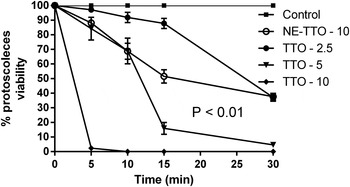
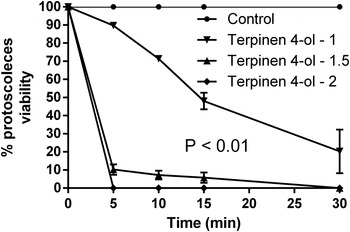
In vitro results indicated protoscolicidal effect in all formulations and concentrations tested in this study. NE-TTO at 10 mg mL−1 obtained its maximum action at 30 min, with 62·4% of mortality of protoscoleces (Fig. 1), whereas TTO obtained its best action at the concentration of 10 mg mL−1 at 10 min. A superior effect was observed for terpinen-4-ol, which showed 100% protoscolicidal effect at the concentration of 2 mg mL−1 at 5 min (Fig. 2). A great deposition of eosin was observed in the outer cuticular membrane of non-viable protoscoleces after contact with TTO at the concentrations tested (Supplementary Fig. 1, available from http://journals.cambridge.org/PAR).
Per cent viability of Echinococcus ortleppi protoscoleces exposed in vitro to different concentrations of tea tree oil (TTO) and to a nanoemulsion formulation of TTO (NE-TTO). The log-rank test was used to compare curves with the control (water). Data are expressed as mean ± s.d. (n = 3).

Per cent viability of Echinococcus ortleppi protoscoleces exposed in vitro to different concentrations of terpinen-4-ol (mg mg−1). The log-rank test was used to compare curves with the control (water). Data are expressed as mean ± s.d. (n = 3).

Ex vivo analysis
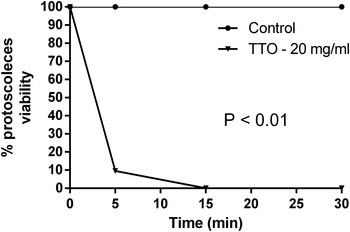
Ex vivo analysis evaluated the protoscolicidal action of TTO at the concentrations of 10 and 20 mg mL−1 against E. ortleppi protoscoleces directly in the hydatid cyst. The concentration of 10 mg mL−1, even though effective in vitro, did not demonstrate the same action in the ex vivo analysis, requiring a longer time to ensure a strong protoscolicidal effect. Notwithstanding, at 20 mg mL−1 and exposure time of 5 min, approximately 90% of protoscoleces were non-viable within the cyst (Fig. 3).
Per cent viability of Echinococcus ortleppi protoscoleces exposed ex vivo to TTO. The log-rank test was used to compare the treated group with the control (water). Data are expressed as mean ± s.d. (n = 3).

DISCUSSION
Echinococcus ortleppi is the species among the genus Echinococcus with greater predilection to infect cattle (Romig et al. Reference Romig, Ebi and Wassermann2015). This information was confirmed in our study, where we identified the presence of this species in cattle in Rio Grande do Sul state. Indeed, all hydatid cyst samples analysed in this study were infected by E. ortleppi.
The use of a protoscolicidal agent is essential to increase the efficiency of CE treatment, surgically or and by the PAIR method, because it reduces the risk of dissemination of viable protoscoleces in the body preventing disease recurrence (Silva et al. Reference Silva, Caldeira and Nunes2001; Puryan et al. Reference Puryan, Karadayi, Topcu, Canbay, Sumer, Turan, Karayalcin and Sen2005). Smego and Sebanego (Reference Smego and Sebanego2005) recommend 20–30 min of exposure to a protoscolicidal agent using the PAIR method. This time is considered too long for patients submitted to moderately invasive procedure. In our study, the in vitro efficacy of protoscolicidal agents was analysed in a shorter period of time, as observed in the treatment with TTO at 10 mg mL−1. Thus, we considered the lowest time of TTO treatment that was able to kill E. ortleppi protoscoleces in order to significantly decrease the procedure time of CE treatment. Baldissera et al. (Reference Baldissera, Da Silva, Oliveira, Santos, Vaucher, Raffin, Gomes, Dambros, Milleti, Boligon, Athayde and Monteiro2014) reported the antiparasitic action of TTO at 0·9 mg mL−1 against Trypanosoma evansi, in vitro and in vivo, successfully controlling the infection. Carson et al. (Reference Carson, Hammer and Riley2006) addressed the antibacterial mechanism of action of TTO and terpinen-4-ol, which consists in compromising the integrity of the cell membrane, leading to intracellular material leakage and loss of microbial capacity to maintain homeostasis. In line with this finding, we reported a high dye concentration (0·1% eosin) in the outer cuticular membrane of protoscoleces exposed to TTO treatment, an indicative of membrane damage. The protoscolicidal action of the TTO major compound, terpinen-4-ol, was very promising since non-viable E. ortleppi protoscoleces were observed at the concentration of 2 mg mL−1 within 5 min of exposure. Therefore, it can be inferred that terpinen-4-ol has more effective protoscolicidal action when compared with TTO. Bakkali et al. (Reference Bakkali, Averbeck, Averbeck and Idaomar2008) reported that the different pharmacological activities between essential oils and their isolated compounds may have antagonizing effects among compounds, which could alter the bioavailability of active components. Baldissera et al. (Reference Baldissera, Grando, Souza, Gressler, Stefani, Silva and Monteiro2016) reported the antiprotozoal action in vitro and in vivo of terpinen 4-ol, α-terpinene and γ-terpinene against T. evansi, highlighting that α-terpinene showed greater in vitro trypanocidal activity when compared with other compounds. Thus, it is observed that the antiparasitic activity of the compounds present in TTO differs according to the parasite evaluated.
In this study, we reproduced the PAIR method, with some modifications, using hydatid cysts removed from naturally infected cattle lungs. It was observed that the procedure demanded expertise in handling the hydatid cyst. Protoscolicidal should fill the entire cyst cavity, seeking contact with the protoscoleces, which sometimes are deposited in the cyst wall. It was observed decreased activity of TTO at the concentration of 10 mg mL−1 in ex vivo analysis. Therefore, in order to ensure the protoscolicidal effect, we used a concentration of 20 mg mL−1, obtaining a quick and lasting effect in ex vivo analysis.
NE-TTO at the concentration of 10 mg mL−1 was used to minimize volatilization of the compound and to increase the protoscolicidal effect at the action site, i.e. in a shorter time. It was observed a constant effect on the protoscoleces viability; thus, it is believed that this effect can be enhanced in studies in vivo, thereby generating an extended action within the hydatid cyst. Flores et al. (Reference Flores, Lima, Ribeiro, Alves, Rolim, Beck and Silva2013) evaluated the antifungal activity of polymeric nanoparticles of TTO against Trichophyton rubrum isolates, reporting that the formulation was effective in reducing fungal growth. Sagave et al. (Reference Sagave, Gressler, Flores, Silva, Vargas, Lovato, Sangioni, Pötter and Botton2015) studied the antimicrobial activity of TTO against a Rhodococcus equi isolate, and reported that the activity of the oil was enhanced when used as nanoformulation. Nanotechnology is an important feature of the pharmaceutical industry, especially in the development of more efficient formulations that can remain for long periods at the action site (Putheti et al. Reference Putheti, Okigbo, Madhusoodhan and Chavanpatil2008). Ahmadnia et al. (Reference Ahmadnia, Moazeni, Mohammadi-Samani and Oryan2013) used albendazole sulfoxide nanoparticles in animals experimentally infected with CE and observed ultrastructural changes in hydatid cysts. Gradual decrease in the viability of protoscoleces is expected when using nanostructured systems because of the slow and gradual release of active formulations.
To the authors' knowledge, this is the first report demonstrating the protoscolicidal effect of M. alternifolia against E. ortleppi protoscoleces in vitro and ex vivo. The results showed that both the formulations TTO and NE-TTO were active against the protoscoleces. This activity was related to the presence of the major compound of the oil, terpinen-4-ol, which demonstrated strong protoscolicidal activity when evaluated alone. The potential use of M. Alternifolia oil and terpinen-4-ol in the treatment of CE should be further evaluated in vivo.
SUPPLEMENTARY MATERIAL
The supplementary material for this paper can be found at https://doi.org/10.1017/S0031182016001621.
FINANCIAL SUPPORT
The first author (D.U.M.) thanks the Coordination for the Improvement of Higher Education Personnel (CAPES), Brazil, for the Doctoral Scholarship.