


Introduction
Pharmacogenomic (PGx) research investigates how genetic variation influences drug metabolism. Although PGx testing can identify clinically relevant drug–gene interactions (DGIs), clinical uptake remains limited by inconsistent, non-generalizable evidence of real-world utility [Reference Shively, Wizemann and Beachy1]. Current regulatory guidance states that real-world data (RWD) sources such as electronic health records (EHRs) and insurance claims can support real-world evidence (RWE) generation on PGx testing outcomes across diverse settings and fill evidentiary gaps focused on the clinical benefits and risks associated with DGIs [2].
CYP2D6, a key enzyme and biomarker, is involved in the metabolism of approximately 20–25% of United States (US) Food and Drug Administration (FDA)-approved medications [Reference Nahid and Johnson3–Reference Rodriguez, Kikerkov, Emmott, Lu and Hendricks-Sturrup5]. CYP2D6 is recognized, in fact, as a PGx biomarker across multiple FDA drug labeling sections and in Clinical Pharmacogenetics Implementation Consortium (CPIC) guidelines that rank evidence on drug–gene associations from Level A (strongest) to Level D (weakest) [6].
Evidence ranked at stronger CPIC evidence levels can provide greater certainty to PGx researchers and providers when they evaluate the effectiveness of PGx testing interventions in clinical care. Along that reasoning, in our prior work we systematically reviewed RWE on clinical outcomes associated with CYP2D6 PGx testing for drug-CYP2D6 pairs with strong evidence (CPIC Level A, Final) [Reference Rodriguez, Kikerkov, Emmott, Lu and Hendricks-Sturrup5]. However, RWE on clinical outcomes for drug–CYP2D6 pairs at lower CPIC evidence levels may still inform those exploring PGx testing utility and treatment decisions. Specifically, mid-to-low evidence evidence levels include drug–gene associations classified as Levels A/B through D, provisional or final, by CPIC [6]. Levels are initially assigned as provisional and, following in-depth evidentiary review, may become assigned as definitive and final [6]. Given the heterogeneous nature of evidence, researchers and clinicians must distinguish clinically informative translational studies from less informative ones, using CPIC resources as a guide.
In this brief report, we present key findings and themes from RWE studies concerning PGx testing for drug-CYP2D6 pairs at CPIC evidence levels Levels A/B through D, provisional or final. By examining this evidence we aim to support translational and clinical researchers’ assessments of RWE studies on drug-CYP2D6 associations presently classified at mid-to-low CPIC level evidence. Lastly, we propose a PGx RWE study checklist to support clinical and translational science assessments of RWE on CYP2D6 and other PGx testing outcomes in observational settings. We refer to such evidence in the sense of ‘clinical and translational utility,’ which is distinct from but complementary to other related terms like the Clinical Genome Resource’s term ‘clinical actionability’ [Reference Teutsch, Bradley and Palomaki7].
Materials and methods
Study materials and methods are generally described here; however, full methods are available in Supplemental Appendix A.
Literature search
A literature search was conducted in June 2024 for original research published in English and indexed in Google Scholar, PubMed, Scopus, and Semantic Scholar [Reference Rodriguez, Kikerkov, Emmott, Lu and Hendricks-Sturrup5]. No search filters or date restrictions were applied. Search terms included: CYP2D6, DGI, EHR, and claims data [Reference Rodriguez, Kikerkov, Emmott, Lu and Hendricks-Sturrup5]. A repeated search was conducted in June 2025 in the same databases to identify potential new articles published since June 2024 under the same criteria.
Data analysis
Key study characteristics, findings, and contextual considerations were documented. The research team conducted deductive data coding in Microsoft Word and Excel (Microsoft Corporation) and constant comparative analysis via the grounded theory approach [Reference Chun Tie, Birks and Francis8]. Qualitative themes were developed among three authors (P.R., E.K., and N.E.) and refined via iterative feedback from two additional authors acting as study supervisors (R.M.H-S. and C.Y.L.).
Results
Our search identified nine (n = 9) RWE studies for full analysis (see Fig. S1 and Table 1) [Reference Bain, Matos, Knowlton and McGain9–Reference Wittwer, Meier, Huber, zu, Allemann and Schneider17]. Two studies evaluated insurance claims data (n = 2) and seven studies evaluated EHR data (n = 7). Eight studies specifically evaluated retrospective data (n = 8) and four studies directly evaluated associations between CYP2D6 allele variation/testing and patient and/or provider outcomes (n = 4) [Reference Collett, Massmann and Petry10–Reference Finkelstein, Friedman, Hripcsak and Cabrera13]. Adverse events or other clinically relevant outcomes were often generalized across drug classes and therapeutic areas.
Study characteristics and study aims & key findings of identified articles

Table 1. Long description
The table presents a detailed summary of nine studies, focusing on their characteristics, aims, and key findings. It includes columns for author, study location, data type, sample size, study population, study design, convergence, and results scope. Each row provides specific details for individual studies. For example, the first row lists a study by Bain et al. from the USA, using claims data with a sample size of 300, focusing on a population aged 65 or older with various ethnic backgrounds. The study employed quantitative methods with a retrospective analysis and aimed to identify adverse drug events. The second row details a study by Colbert et al. from the USA, using EHR data with a sample size of 325, focusing on a population aged 65 or older, including various ethnic groups. This study used random sampling and quantitative methods with a retrospective analysis to look at CYP2D6 drug gene interactions. The table continues with similar detailed entries for each study, providing a comprehensive overview of the research conducted.
RWD, real-world data; EHR, electronic health records; PGx, pharmacogenomics; DGI, drug-gene interaction; DDI, drug-drug interaction; DDGI, drug-drug-gene interaction.
Studies investigated 32 out of 67 (48%) mid-to-low-level evidence drug-CYP2D6 associations across six therapeutic areas (see Table 2). Over 80% of therapeutic areas assessed were psychiatry (n = 22) or cardiology (n = 4). Taking the total frequency of provisional and final designations per drug into account (n = 32), CPIC evidence levels observed per drug-CYP2D6 association were A/B (n = 2 or 6%; eliglustat, pimozide), B (n = 11 or 34%; hydrocodone, metoprolol, venlafaxine, fluvoxamine, desipramine, imipramine, clomipramine, doxepin, trimipramine, aripiprazole, risperidone), B/C (n = 14 or 44%; flecainide, propafenone, deutetrabenazine, valbenazine, brexpiprazole, haloperidol, thioridazine, mirtazapine, protriptyline, amphetamine, clozapine, iloperidone, zuclopenthixol, tamsulosin), and C (n = 5 or 16%; oxycodone, carvedilol, citalopram, escitalopram, sertraline). PGx information was presented across nine US FDA labeling sections. The top three US FDA labeling sections per drug were Clinical Pharmacology (n = 15), Warnings and/or Precautions (n = 12), and Dosage and Administration (n = 9). Although, seven drug-CYP2D6 pairs were assigned to specific CPIC levels, these seven pairs did not have a US FDA PGx labeling section (n = 7; hydrocodone and oxycodone [analgesia]; flecainide [cardiology]; haloperidol, mirtazapine, zuclopenthixol, sertraline [psychiatry]).
CYP2D6-associated drugs, FDA labeling, and CPIC level

Table 2. Long description
A table with 32 rows and 7 columns. The columns are labeled Therapeutic area, Drug, CPIC level, Level state, CPIC description of FDA PGx information, FDA PGx drug label section, and Total articles. The rows list various drugs, their CPIC levels, level states, descriptions, FDA drug label sections, and the total number of articles. The table includes drugs from therapeutic areas such as Analgesia, Cardiology, Inborn Errors of Metabolism, Neurology, and Psychiatry. Each row provides specific details about the drug’s association with CYP2D6, including whether the CPIC level is provisional or final, and the section of the FDA drug label where PGx information is presented.
CPIC, Clinical Pharmacogenetics Implementation Consortium; FDA, U.S. Food and Drug Administration; PGx, pharmacogenomics.
Definitions:.
Provisional Evidence: An initial evidence level assigned to a gene–drug pair that may change as additional evidence becomes available (see https://www.clinpgx.org/cpic/pairs).
Final Evidence: A definitive evidence level assigned after sufficient in-depth review, typically when the gene–drug pair has been evaluated in clinical guidelines (see https://www.clinpgx.org/cpic/pairs).
Actionable PGx: The drug label provides guidance for patients with certain genotypes or metabolizer phenotypes (e.g., dose adjustment, contraindication, or alternative therapy) but does not require or recommend genetic testing before prescribing (see https://www.clinpgx.org/page/drugLabelLegend).
Informative PGx: The drug label notes that genetic variation may affect drug metabolism, exposure, or risk, but provides no specific clinical action or prescribing guidance (see https://www.clinpgx.org/page/drugLabelLegend).
Levels of Evidence: CPIC evidence levels classify gene–drug pairs based on the strength of available pharmacogenomic evidence and clinical actionability on a scale, with A being strong evidence supporting genotype-guided prescribing and D being weak evidence for a gene–drug interaction (see https://www.clinpgx.org/page/cpicPrioritization#level-definitions-for-cpic-genes-drugs).
PGx testing implementation and translation themes
We identified three PGx test implementation and translation themes distinct from our prior work [Reference Rodriguez, Kikerkov, Emmott, Lu and Hendricks-Sturrup5]. Themes include: (1) differences in CPIC guidance and FDA labeling, (2) variation in RWE study design and purpose, and (3) study generalizability across health care contexts.
Theme 1: Differences in CPIC guidance and FDA labeling
All nine articles examined at least one drug-CYP2D6 association that is viewed differently between CPIC and FDA (see Table 2) based on the organizations’ respective PGx tables describing DGIs [6,18]. One column within the CPIC table, called ‘PGx on FDA Label,’ (at www.clinpgx.org/cpic/pairs) indicates whether PGx information for a medication appears on an FDA label and, if so, the information type (e.g., testing recommended, actionable PGx, informative PGx). For three drugs, escitalopram, carvedilol, and metoprolol, that CPIC table column is blank, perhaps indicating no specific PGx information within those drugs’ FDA labels. However, from FDA’s table, those drugs have PGx information in the sections Clinical Pharmacology, Drug Interactions, or both. This discordance may complicate or convolute providers’ decision-making processes.
Theme 2: Variation in RWE study design and purpose
In our analysis, we identified two study design and purpose groupings (see Table 1). Five articles retrospectively examined RWD to identify where PGx testing, if it had been incorporated into providers’ prescribing decisions, could have improved patient outcomes in patient populations exposed to CYP2D6-implicated medications [Reference Bain, Matos, Knowlton and McGain9,Reference Liu, Van Driest and Vnencak-Jones14–Reference Wittwer, Meier, Huber, zu, Allemann and Schneider17]. Alternatively, four articles present qualitative or quantitative findings on real-world outcomes following PGx testing implementation in clinical settings [Reference Collett, Massmann and Petry10–Reference Finkelstein, Friedman, Hripcsak and Cabrera13]. The difference between potential and observed outcomes greatly impacts these studies’ utility for providers. While the former (potential outcomes) design demonstrates that PGx testing may have been helpful for patients and their providers during treatment, it does not demonstrate any true real-world impacts or outcomes following PGx testing. The latter (observed outcomes) can more concretely inform and reduce uncertainty among providers as they associate clinical outcomes (e.g., adverse events) with PGx test-informed decisions.
Theme 3: Study generalizability across health care contexts
International and versus local study settings, relative to a provider’s specific practice setting, can also impact notions of real-world utility. First, seven studies were conducted in the US [Reference Bain, Matos, Knowlton and McGain9,Reference Collett, Massmann and Petry10,Reference Dressler, Bell, Abernathy, Ruch and Denslow12–Reference Verbeurgt, Mamiya and Oesterheld16], while one was conducted in Switzerland [Reference Wittwer, Meier, Huber, zu, Allemann and Schneider17] and another one in the Netherlands [Reference den Uil, Hut and Wagelaar11]. Providers in different countries may be unfamiliar with international standards of care and therefore find limited applicability of international findings to their own local care practices. Second, regional differences within a single country may also limit studies’ generalizability. For example, results from a study conducted in a large, academic medical system [Reference Liu, Van Driest and Vnencak-Jones14] may not be easily combined with insights from a study conducted in a small, rural health care setting [Reference Dressler, Bell, Abernathy, Ruch and Denslow12]. While they might be individually informative, their cross-setting utility or generalizability may be perceived as limited.
Discussion
Here we describe findings from nine RWE studies, each designed differently to investigate real-world PGx testing outcomes for drug-CYP2D6 pairs presently assigned mid-to-low CPIC evidence levels and with differences between CPIC and US FDA guidelines and labeling, respectively. Our results highlight the need for a nuanced assessment tool to help providers determine how and when PGx testing is warranted. This is especially relevant given that the real or perceived value of PGx testing might vary significantly (as in the case of CYP2D6 where evidence is provisional or of insufficient quality) across providers and care delivery settings. Even in cases where the value of PGx testing is apparent, providers often make patient-specific prescribing decisions. Without RWE demonstrating a clinically meaningful link between PGx testing and outcomes, its translational utility can remain limited.
Limitations to our study should be noted. First, our review was limited to studies identified through the selected databases and search strategy and may not have captured all relevant publications, despite the use of multiple literature sources. Second, because the included studies varied substantially in their design, patient populations, therapeutic areas, and reported outcomes, direct comparisons across studies were limited. Finally, our findings are specific to CYP2D6-associated drug–gene interactions and may not be generalizable to other PGx biomarkers or clinical contexts.
Proposing a PGx RWE study evaluation checklist
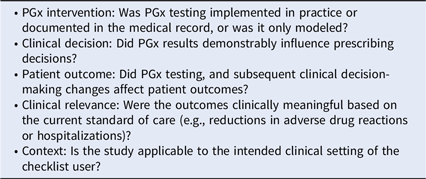
We propose a five-question checklist so that providers may quickly determine if and how an RWE study should inform their clinical PGx testing implementation and prescribing decisions (Table 3). The proposed checklist is structured around the sequential translational pathway from PGx testing to clinical impact where users answer “Yes” or “No.” Specifically, it evaluates whether: (1) PGx testing was clinically implemented, (2) PGx results demonstrably influenced prescribing decisions, (3) patient outcomes were measured following the intervention, (4) the outcomes were meaningful to clinical practice, and (5) the study is applicable to the intended care setting.
Proposed evaluation checklist to assess and report real-world pharmacogenomic test-related outcomes

Table 3. Long description
A textbox containing a checklist with five questions. The questions are: PGx intervention: Was PGx testing implemented in practice or documented in the medical record, or was it only modeled? Clinical decision: Did PGx results demonstrably influence prescribing decisions? Patient outcome: Did PGx testing, and subsequent clinical decision-making changes affect patient outcomes? Clinical relevance: Were the outcomes clinically meaningful based on the current standard of care (e.g., reductions in adverse drug reactions or hospitalizations)? Context: Is the study applicable to the intended clinical setting of the checklist user?
PGx, pharmacogenomics.
This framework presumes that PGx testing provides the greatest value when results are clinically actionable and serves as a preliminary, provider appraisal framework. It is intended to guide interpretation by indicating how far a study progresses from PGx testing implementation to clinical decision-making and patient outcomes, while highlighting gaps in the evidence. The framework may also be applied alongside other study-quality assessment tools described and used in our prior work and the broader literature.
Applying the proposed checklist to the nine articles included in this report and the 25 articles from our previous review (34 studies total; see Table S1) showed minimal real-world, clinically relevant PGx implementation. To demonstrate, we briefly examine two CYP2D6 PGx-RWE study use cases from our review. Because the last question within the checklist applies to an individual provider’s specific clinical context, we did not include that in our assessment of the 34 articles.
Use case 1: Metoprolol
This first use case is based on two studies presented herein that focus on metoprolol, a beta-blocker used to treat hypertension and angina [Reference Bain, Matos, Knowlton and McGain9,Reference Collett, Massmann and Petry10]. These two studies found that patients with CYP2D6 poor metabolizer status, or who metabolize metoprolol more slowly than normal, experienced increased adverse effects. When assessed using the proposed checklist, only Question 1 – clinical PGx testing implementation – was answered affirmatively. The two studies did not capture how PGx test results influenced prescribing decisions (Question 2) nor patient outcomes related to that PGx testing (Question 3). The studies also did not demonstrate outcomes that were meaningful to clinical practice based on the standard of care (Question 4), which is starting at low doses and increasing slowly and incrementally due to well-characterized side effects [19]. Therefore, this case is unlikely to meaningfully inform a provider’s clinical decision-making.
Use case 2: Sample case #RSPLT120
The second use case is a sample case study exploring the benefits of identifying DGIs in a nursing home for managing depression, pain, and dementia [Reference Dorfman, London, Metias, Kabakchiev, Mukerjee and Moser20]. While findings were generalized across patient cases, the authors did provide sample cases that are more useful. Specifically, sample case #RSPLT120 highlighted the role of CYP2D6 variation in depression and pain management, as well as the provider’s decision-making process. In this case, the patient was a CYP2D6 ultrarapid metabolizer – meaning the patient metabolizes CYP2D6-specific drugs significantly faster than normal – for three associated medications: amitriptyline (CPIC Level A, Final), mirtazapine (CPIC Level B/C, Provisional), and duloxetine (CPIC Level C, Final). The pharmacist recommended switching the three prescriptions “due to enhanced drug clearance and reduced response” to “medications that are better suited to resident’s drug metabolic profile” (p. 829.e1). Based on this information, the use case answers Questions 1, PGx intervention and 2, clinical decision. Questions 3, patient outcome, and 4, clinical relevance, are not answered because concrete patient outcomes are not tied to this example. Use Case 2 may therefore be a useful demonstration of clinical rationale but may not necessarily ground that rationale in specific clinical outcomes.
Conclusion
Our findings suggest that for DGIs with mid-to-low evidence levels, in the absence of strong evidence associations, the clinical value of these associations may not be sufficient to justify extensive integration of PGx testing. Varied care and community settings can particularly influence how relevant RWE study findings may be to specific settings or care contexts. Our proposed checklist offers a streamlined option to assess the utility or value of CYP2D6 PGx test specific outcomes across various use cases and contexts. Future research to further test the utility of our proposed checklist, either through continued use case assessment or real-world provider testing, is warranted. In the meantime, expert intitiatives within CPIC, US FDA, and others should continue to more closely evaluate, validate, and appraise RWE on drug-CYP2D6 interactions.
Supplementary material
The supplementary material for this article can be found at https://doi.org/10.1017/cts.2026.10820.
Acknowledgements
We would like to acknowledge Dr. Nancy Allen LaPointe for providing thoughtful feedback on the subject matter presented during the early stages of development of the manuscript.
Author contributions
Patrick Rodriguez: Conceptualization, Data curation, Formal analysis, Investigation, Methodology, Validation, Visualization, Writing – original draft, Writing – review & editing; Emma Kikerkov: Conceptualization, Data curation, Formal analysis, Investigation, Methodology, Validation, Writing – original draft, Writing – review & editing; Nora Emmott: Conceptualization, Data curation, Formal analysis, Investigation, Methodology, Writing – original draft, Writing – review & editing; Christine Y. Lu: Investigation, Methodology, Supervision, Writing – review & editing; Rachele M. Hendricks-Sturrup: Conceptualization, Data curation, Formal analysis, Investigation, Methodology, Project administration, Resources, Supervision, Validation, Visualization, Writing – original draft, Writing – review & editing.
Funding statement
The author(s) declare that no financial support was received for the research and/or publication of this article.
Competing interests
The authors declare that the research was conducted in the absence of any commercial or financial relationships that could be construed as a potential conflict of interest.




 Open access

