The processes underlying idiom acquisition in children is a subject that has continued to arouse interest ever since the first studies appeared in the 1970s (Lodge & Leach, Reference Lodge and Leach1975). One of the reasons is that idiom acquisition is based on a number of abilities of varying nature and complexity, which involve cognitive, linguistic, and pragmatic competence (Levorato & Cacciari, Reference Levorato and Cacciari1995; see also Qualls & Harris, Reference Qualls and Harris2003). Because of their complexity, idioms are acquired during school years when children are already competent speakers. Various factors affecting idiom acquisition have been identified, the most important of which are familiarity, semantic analyzability, and context.
FACTORS INFLUENCING IDIOM ACQUISITION
The factor Familiarity refers to the frequency with which idioms occur in communication. The “language experience hypothesis” states that idioms that occur frequently are easier for children to understand than less frequently occurring ones (Nippold, Reference Nippold1991; Nippold & Taylor, Reference Nippold and Taylor2002). The opportunity to encounter an idiomatic expression is an important factor in its acquisition, but several researchers agree that exposure alone is not sufficient in and of itself to guarantee acquisition (Cain, Oakhill, & Lemmon, Reference Cain, Oakhill and Lemmon2005; Levorato & Cacciari, Reference Levorato and Cacciari1992).
The factor Semantic Analyzability refers to the degree to which the meaning of an idiom's constituent words contributes to the interpretation of its figurative meaning. For semantically analyzable idioms, that is transparent idioms such as “skating on thin ice,” the figurative meaning is easily deducible from the literal meaning, whereas for semantically nonanalyzable idioms, that is opaque idioms such as “to kick the bucket,” the relation between the expression and its meaning is not easily identifiable. The more transparent an idiom is, the easier it is to understand it (Caillies & Sourn-Bissaoui, Reference Caillies and Sourn-Bissaoui2006; Gibbs, Reference Gibbs1991; Levorato & Cacciari, Reference Levorato and Cacciari1999; Nippold & Taylor, Reference Nippold and Taylor2002).
The factor Context has been shown to be the main factor in the process of understanding idiomatic expressions (Abkarian & Jones, Reference Abkarian and Jones1992; Gibbs, Reference Gibbs1991; Levorato & Cacciari, Reference Levorato and Cacciari1992, Reference Levorato and Cacciari1999): idioms embedded in a rich linguistic context are easier to understand than idioms presented in isolation.
The current study focused on idiom comprehension in relation to the ability to process the linguistic context in which it is embedded. Nonfamiliar idioms, both transparent and opaque, were presented in contexts of a story to children and adolescents with Down syndrome and typically developing first graders, with the hypothesis that there is a strong relationship between idiom comprehension and the ability to process a short text. This hypothesis was derived from the global elaboration model (GLM; Levorato & Cacciari, Reference Levorato and Cacciari1995), which explains the process of idiom acquisition in childhood. The model has been supported by various studies carried out with typically developing children (Cain, Oakhill, & Lemmon, Reference Cain, Oakhill and Lemmon2005; Levorato, Nesi, & Cacciari, Reference Levorato, Nesi and Cacciari2004; Levorato, Roch, & Nesi, Reference Levorato, Roch and Nesi2007), and the current study aimed at extending it to individuals with Down syndrome, comparing their idiom comprehension to that of typically developing children having the same text comprehension level. Individuals with Down syndrome make a particularly informative group to include in studies of figurative language, because their language profile of impaired sentence comprehension but relatively preserved text comprehension offers insights into the role of these two levels of language comprehension in idiom processing.
THE GLM
According to the GEM (Levorato & Cacciari, Reference Levorato and Cacciari1995), the same capacities, knowledge, and structures underlying the processing of linguistic information also guide idiom comprehension. In particular, “the comprehension and production of figurative meanings derive from the ability to go beyond a local, piece by piece elaboration of the linguistic context and to search for a global and coherent meaning” (Levorato & Cacciari, Reference Levorato and Cacciari1995, p. 263). The product of text comprehension is a semantic representation (or situational model; see Kintsch, Reference Kintsch1988) that provides the semantic information necessary to extract the figurative sense appropriate to the situation. When a text is processed at a local level, sentence by sentence and piece by piece, the meaning of the constituent parts is not integrated into the global meaning and a coherent semantic representation is not constructed (Kintsch, Reference Kintsch1988). The outcome of this shallow comprehension process will most likely induce the literal interpretation of each constituent word of the idiomatic expression. In contrast, in deep text processing, complex sentences, ambiguous meanings, and unfamiliar words are integrated into the semantic representation of the text (for an analysis of the consequences of shallow and deep processing, see Hannon & Daneman, Reference Hannon and Daneman2004). The meaning assigned to an idiom will depend on the context in which it appears. As the construction–integration model states, “the word meaning is always situation specific and context dependent” (Kintsch, Reference Kintsch1988, p. 165). Only when the child is able to construct a coherent semantic representation of the text can the text be used as a semantic background to recognize the figurative meaning of the idiom.
Given that the capacity to process the linguistic context is the main factor in explaining idiom comprehension, the predictions of the GEM concerning the above mentioned factors are that (a) the familiarity with or exposure to idioms plays a minor role in the process of acquisition of idioms and (b) semantic analyzability plays an important role, which nevertheless is affected by the context. Cain et al. (Reference Cain, Oakhill and Lemmon2005) showed that because the meaning of an opaque idiom cannot be derived from its constituents, as instead happens with transparent idioms, it must be inferred from the linguistic context surrounding it.
IDIOM UNDERSTANDING AND TEXT COMPREHENSION
The study of the relationship between idiom understanding and the ability to process linguistic context has focused on children with different text comprehension skills (Cain et al., Reference Cain, Oakhill and Lemmon2005; Levorato et al., Reference Levorato, Nesi and Cacciari2004; Nippold, Moran, & Schwartz, Reference Nippold, Moran and Schwarz2001).
It was shown that primary school children who were more advanced in text comprehension were also more able to understand (Levorato et al., Reference Levorato, Nesi and Cacciari2004) and produce (Nesi, Levorato, Roch, & Cacciari, Reference Nesi, Levorato, Roch and Cacciari2006) idiomatic expressions embedded in brief stories than children with lower text comprehension skills. This result was extended to preadolescents, where idiom comprehension was related to the comprehension of both written and oral texts (Nippold et al., Reference Nippold, Moran and Schwarz2001). Finally, Cain et al. (Reference Cain, Oakhill and Lemmon2005) demonstrated the importance of context when dealing with opaque idioms. The authors found that typically developing children with different text comprehension abilities differ in their ability to understand transparent and opaque idioms as well: less-skilled comprehenders were less able to deduce the meaning of opaque idioms because of their difficulty in integrating idiom meaning into a mental representation of a story (Cain et al., Reference Cain, Oakhill and Lemmon2005).
IDIOM UNDERSTANDING AND THE USE OF CONTEXT IN ATYPICAL DEVELOPMENT
Studies on idiom comprehension in atypically developing populations differ greatly in terms both of their methodology and of the types of populations sampled. The following studies have in common the fact of considering the ability to understand idioms in association with the ability to exploit linguistic context. A recent study by Norbury (Reference Norbury2004) involved children aged 8 to 15 years with different developmental disorders: children suffering from autism with language impairment, and children suffering from autism without language impairment. All groups with atypical development proved to be able to benefit from context to understand idioms. However, they were less able than the control group of typically developing children to exploit context, especially the groups with language impairment. Kerbel and Grunwell (Reference Kerbel and Grunwell1998a, Reference Kerbel and Grunwell1998b) studied idiom comprehension in two different groups of children between 6 and 11 years of age: one group with semantic-pragmatic difficulties without autism, and the other with language deficits associated with Asperger syndrome. They found that both groups had difficulties in choosing between literal and idiomatic meanings in context. The ability to process linguistic context in disambiguating figurative expressions was also studied by Barnes and Dennis (Reference Barnes and Dennis1998) in children between 6 and 15 years of age diagnosed with hydrocephalus, a neurological deficit. They found that these children are characterized by discourse-related deficits including poor reading comprehension and poor inference skills, regardless of the children's cognitive level. As far as idiom understanding is concerned, when the meaning of an idiom was presented in isolation and directly accessed from memory, children with hydrocephalus of average IQ were not disadvantaged compared to their age peers. However, they were impaired compared to typically developing children in deriving the meaning of idioms presented in context.
Taken together, these studies show that the ability to interpret idioms in children with atypical linguistic and communicative development lags behind that of the control group of typically developing children, and that this disadvantage is particularly strong when the context has to be used in order to derive the figurative meaning.
THE STUDY OF IDIOM COMPREHENSION IN DOWN SYNDROME
Idiom comprehension has not been studied yet in Down syndrome, even though the peculiar cognitive and linguistic profile of this population makes the analysis of this issue particularly interesting. Down syndrome is characterized by mental retardation and by the fact that different areas of linguistic development are impaired to different degrees. In particular, the lexicon is relatively preserved, but the morphosyntax and sentence comprehension are impaired (Chapman, Hesketh, & Kistler, Reference Chapman, Hesketh and Kistler2002). Their narrative and discourse abilities are comparable to those of children with the same mental age, and their ability to understand short texts is relatively preserved (Boudreau & Chapman, Reference Boudreau and Chapman2000; Seung & Chapman, Reference Seung and Chapman2003). These conclusions concord with studies carried out with Italian individuals with Down syndrome whose level of text comprehension, both written and oral, has been analyzed (Levorato, Roch, & Beltrame, Reference Levorato, Roch and Beltrame2009; Roch & Levorato, Reference Roch and Levorato2009; Verrucci, Menghini, & Vicari, Reference Verucci, Menghini and Vicari2006).
Presumably, the population with Down syndrome, which is characterized by a severe impairment in structural language and relatively preserved discourse processing, is able to compensate for linguistic difficulties with cognitive abilities, that is, inferential reasoning and world knowledge (Miles & Chapman, Reference Miles and Chapman2002).
The present study analyzed how the level of text comprehension affects idiom understanding in individuals with Down syndrome. If the existence of a relationship between text and idiom comprehension were confirmed, it might be concluded that the GEM is valid in this atypical population. Moreover, because Down syndrome individuals are characterized by a severe impairment in sentence comprehension, the confirmation of such a relationship would strengthen that proposition of the GEM that states that idiom comprehension is linked to global, rather than local, processing of a text.
IS SENTENCE COMPREHENSION A POSSIBLE MEDIATOR?
In a longitudinal study on first graders, Levorato et al. (Reference Levorato, Roch and Nesi2007) excluded the role of sentence comprehension as a mediating factor in the relationship between idiom and text comprehension: it was demonstrated that an improvement in idiom comprehension in first and second graders was paralleled by an improvement in text comprehension but not in sentence understanding. The issue of the role of sentence comprehension as a mediator in the relationship between text and idiom comprehension was reconsidered in the current study on individuals with Down syndrome because sentence comprehension is particularly impaired in this population (e.g., Chapman, Schwartz, & Kay-Raining Bird, Reference Chapman, Schwartz and Kay-Raining Bird1991): this impairment might affect both text and idiom comprehension. Given that sentence comprehension is a component of text comprehension, a scarce ability in this level of language processing might limit text comprehension. More important for the purposes of the current study is a possible influence of sentence comprehension on idiom understanding. This relationship may be hypothesized because the idioms used were true sentences, and therefore the level of sentence processing might influence idiom understanding. Analyzing a series of linguistic skills associated with idiom comprehension in children with communicative and linguistic impairment, Norbury (Reference Norbury2004) found that sentence processing explained some variance in an idiom definition task. The possible effect of sentence comprehension was controlled in the current study, taking into consideration the participants’ sentence comprehension skills.
RESEARCH QUESTIONS AND HYPOTHESES
In light of the above-mentioned literature, the main hypotheses can be articulated in the following predictions:
1. In accordance with previous studies on the effect of text comprehension on idiom comprehension (Nesi et al., 2004), differences in text comprehension should be paralleled by differences in idiom comprehension. If the same abilities underlie text comprehension and the comprehension of idioms in context, we expect no group differences in idiom understanding between Down syndrome individuals and typically developing children having the same text comprehension skills.
2. According to the GEM and to existing evidence on typically developing children (Levorato et al., Reference Levorato, Roch and Nesi2007), basic linguistic abilities, such as the recognition of the morphosyntactic cues necessary to understand sentences, should play a minor role in idiom comprehension in both groups of participants.
3. Consistent with the study of Cain et al. (Reference Cain, Oakhill and Lemmon2005), the ability to comprehend a text should be more relevant for the understanding of opaque idioms than for transparent ones. The same trend is expected for both groups of participants: in general, good text comprehension should favor the disambiguation of opaque idioms, whose meaning is not recognizable on the basis of the semantics of their constituent words.
METHOD
Participants
All 30 of the school-age Down syndrome individuals who were in the care of the National Health Service of the city of Ferrara (north Italy) in the school year 2003–2004 participated in the first phase of the study. These individuals were presented with a text reading comprehension test aimed at identifying those who were able to read and comprehend a short passage appropriate for first graders. Ten participants whose reading abilities were limited to single words or letters and those who were not able to autonomously complete the text reading comprehension task were excluded. The reading ability of the rest of the group was within the norm for first grade (e.g., 6–7 years): consistent with other recent studies on reading abilities in Down syndrome (Roch & Jarrold, Reference Roch and Jarrold2008; Roch & Levorato, Reference Roch and Levorato2009; Verrucci et al., Reference Verucci, Menghini and Vicari2006), participants were proficient in decoding.
Twenty participants with Down syndrome were able to complete the reading comprehension task and participated in the successive phases of the study. All the participants were Caucasian, Italian native speakers coming from middle and lower middle-class catchment areas of northern Italy. They were aged between 9 years, 9 months (9;9) and 18;1 (M = 14;9, SD = 2;2). All of them had full trisomy 21 and had normal or corrected vision and hearing. None of them had medical or neurological abnormality at the moment of the research that could affect their performance in the tasks proposed in the study. The National Health Service provides them with regular medical exams, psychological evaluation, and monitoring once or twice a year. In accordance with Italian law, all of them were attending normal schools with children and adolescents who had approximately the same chronological age (mean years of schooling = 9, SD = 2 years); these children were accompanied in class by a specially trained support teacher. The National Health Service supplied us with the data regarding their full-scale IQ, as measured by the Wechsler Intelligence Scale for Children—Revised test (adapted for Italian speakers by Orsini, Reference Orsini1993): their mean IQ was 47 (SD = 10), with a range of 30–61.
Each participant with Down syndrome was matched with a typically developing first grader on the basis of the score obtained on a text comprehension test (see details concerning the test in Materials and Procedure section). To identify 20 typically developing children having the same level of text comprehension skill as the individuals with Down syndrome, the text comprehension test was presented to three first-grade classes of the same city and comparable catchment area as those attended by the participants with Down syndrome. The 20 typically developing children, aged between 6;3 and 7;3 (M = 6;7, SD = 4 months), were Caucasian Italian native speakers, and shared a middle- and lower middle-class socioeconomic background. Their teachers reported that none of them were dyslexic or had learning, language, psychiatric, physical, neurocognitive, or any other developmental disorder. Their IQ was not known because in the Italian educational system children do not undergo intelligence tests unless their teachers recognize a problem. No signs of cognitive difficulties have been noted; therefore, we may presume that they have an IQ and mental age appropriate to their chronological age.
Materials and procedure
All of the participants were tested in two sessions, with an interval of 10 to 15 days between sessions. In the first session, typically developing children were presented with the test that evaluates text comprehension, whereas participants with Down syndrome were presented with both the comprehension test and with a parphrase task aimed at testing their knowledge of the idioms to be used in the study. Before the paraphrase task, each participant with Down syndrome was tested in a story recall task to ascertain that they had expressive abilities sufficient to produce a paraphrase. In the second session, all participants were presented with the idiom comprehension task and with the sentence comprehension task. Each session lasted 20–30 min, depending on the attention of the participants.
Evaluation of text comprehension. A standardized test that evaluates reading comprehension, the MT Test (Cornoldi & Colpo, Reference Cornoldi and Colpo1998), was used to assess participants’ text comprehension. A reading, rather than listening, text comprehension test was preferred because it allows children to read at a self-paced rhythm and thus to control attention and memory interferences. The test evaluates the ability to understand and memorize the information given in a story that is relevant to the construction of its semantic representation.
We decided to administer the test for first graders as it was the most appropriate for our group of Down syndrome individuals. The same test was used by other authors (see Roch & Levorato, Reference Roch and Levorato2009; Verucci et al., Reference Verucci, Menghini and Vicari2006) for the evaluation of text reading comprehension of a group of individuals with Down syndrome, and in fact, the level of difficulty, appeared to be appropriate for children and adolescents with Down syndrome. The task was explained and examples were given until we were certain that participants had understood the instructions.
The task consists of a story and 10 multiple-choice questions, each of which is followed by three options and accompanied by pictures. The 103-word story is formed by familiar words and simple sentences, and does not include figurative expressions. To minimize the memory load, children are allowed to return to the text whenever they want while answering the multiple-choice questions. The test has no time limits, so the participants are allowed to read at their own pace.
In accordance with the standard administration procedure, the reading comprehension test was administered collectively in class to typically developing first graders. Individuals with Down syndrome were tested individually because they did not all come from the same class. In both cases the participants worked autonomously, following standard test administration procedure, and no help or suggestions were provided; participants read the story and the questions and then marked the answer they felt correct. Very slow readers among typically developing children were excluded by considering valid only those protocols completed before 90% of the class had finished the task. This procedure, also used in Levorato et al. (Reference Levorato, Roch and Nesi2007), eliminated the influence of any possible difficulties in decoding from our analysis of text comprehension.
The reliability of the test measured by an item total correlations ranges between .41 and .69. The scoring range of the MT Test is 0 to 10, with 1 point assigned for each correct answer. The mean score of participants was 6.36 (SD = 1.95, range = 3–10).
Evaluation of idiom comprehension
CRITERIA FOR THE SELECTION OF IDIOMS. The idiomatic expressions used in this study were sentences containing a verb. They were chosen from an ample class of Italian idioms on the basis of a procedure consolidated in previous studies (see, e.g., Levorato et al., Reference Levorato, Roch and Nesi2007), which includes the following four steps:
1. A list of idiomatic phrases having both an idiomatic and a literal meaning was taken from a rich corpus (Pittano, Reference Pittano1992).
2. From this list, idioms were chosen that had been judged by elementary school teachers as expressions that children encounter quite frequently, but not extremely frequently, in storybooks and TV programs (Levorato & Cacciari, Reference Levorato and Cacciari1992). Expressions such as “to give a hand” were excluded because their figurative meaning is extremely familiar. Highly familiar idioms would not have permitted the influence of context on idiom understanding to be tested, because the idiom could be directly accessed from the mental lexicon.
3. The idioms remaining on this second list were presented to a group of fourth graders who were asked to evaluate on a 5-point scale how often they encountered each of them. A list consisting of the idioms which were judged by 30 to 70% of the children as having been encountered “quite frequently” or “frequently” was selected.
4. Finally, idioms were chosen from this third list that in previous studies had been shown to have a discriminating power. These idioms had never obtained a ceiling or a floor effect in the choice of correct answers.
This procedure yielded 16 idioms, half transparent and half opaque, that are used fairly commonly but are not too familiar. Given that an atypical population participated in the study, we chose eight idioms (four transparent, four opaque) that had produced the highest percentage of correct answers by 7-year-old poor comprehenders who participated in a previous study involving typically developing children (Levorato et al., Reference Levorato, Nesi and Cacciari2004). This ensured that the task was not too difficult for the participants with Down syndrome (see Appendix A for the list of idioms).
To exclude the possibility that the idioms were familiar to our participants with Down syndrome and that they choose the idiomatic meaning only on the basis of previous knowledge without understanding the text into which the idiom is embedded, they were presented with a paraphrase task. The experimenter asked “What does it mean . . . idiom)?” and the participant was invited to give a verbal answer. To be certain that participants with Down syndrome had at least a minimal level of expressive abilities, we read them a short, three sentence long story before presenting them with the paraphrase tasks and then asked them to repeat the story with the aid of puppets. All 20 participants understood the short story and were able to retell it.
The paraphrase task concerned the eight idioms used in the main study. The answers were coded as idiomatic (correct answer), literal (literal meaning of the idiom string), and no response. All participants were able to answer at least five out of eight items. Seventy-five percent of answers were literal: they often consisted of one- or two-word expressions such as “garbage” or “grocery shopping” (for “Vuotare il sacco,” to empty the sack: to spill the beans), “traffic lights” or “cross the road,” or “salad vegetables” (for “Essere al verde,” to be at the green: to be broke). Twenty-three percent of the items were unanswered or answered “I don't know”; only 2% of idiomatic answers were given in total. In general, the idioms used in this study were unfamiliar to the participants.
THE IDIOM COMPREHENSION TASK. For each idiom, a four- to six-sentence story was written. The mean length of the stories was 43 words (range = 23–50 words; e.g., “Marco fell asleep and missed the train. He was very disappointed but Marta told him it was useless ‘to cry over spilt milk’”).
Each idiom was embedded at the end of the story followed by a multiple choice task; therefore, familiarity with the idiom alone was not sufficient to produce a correct answer because a specific meaning related to the story context had to be recognized. This task was used in previous studies to measure idiom understanding, and has proven to be sensitive to the developmental changes that occur in the course of idiom acquisition; moreover, the results of the task were not influenced by production skills, which, instead, are involved in other types of tasks. (For details on the role of different tasks on idiom comprehension, see Levorato & Cacciari, Reference Levorato and Cacciari1995.) An experimenter read the stories and the comprehension questions aloud while the participant followed the written version. Each story ended with an idiomatic expression that could be interpreted both literally and figuratively (e.g., “crying over spilt milk”), but in the context of the story only the idiomatic interpretation was correct. This procedure allowed the role played by context in disambiguating the idiom meaning to be studied directly. The comprehension question was: “What does it mean that he/she did (or was) . . . idiom?” (e.g., “What does it mean that he was crying over spilt milk?”). Idiom comprehension was evaluated through a multiple choice task: three answers were read to the participant corresponding to (a) an idiomatic interpretation of the string (idiomatic answer), (b) a paraphrase of the literal meaning (literal answer), and (c) an answer related to the narrative, that is, a consequence of the event narrated in the story (associate answer). Each participant was asked to say which one was correct in his/her opinion. The task was explained orally and examples were given until we were certain that participants had understood the instructions.
The choice of the correct, idiomatic answer means that the child recognized the appropriate meaning of the idiom in that specific context. The choice of the literal answer means that the child processed the text only locally, piece by piece. Finally, the choice of the associate answer means that the context was partially taken into account, but the meaning of the idiomatic expression was not understood.
The reliability of the test was acceptable for both groups (.68 for the participants with Down syndrome and .71 for children with typical development).Footnote 1
Evaluation of sentence comprehension. Individuals with Down syndrome and typically developing children were presented with a sentence comprehension test standardized on an Italian population from 3 to 8 years of age (Rustioni Mertz Lancaster, Reference Rustioni Metz Lancaster1994). This test was presented orally, and it assesses the ability to comprehend isolated sentences of different length and complexity. It is similar in structure and procedure of administration to the Test of Reception of Grammar (Bishop, Reference Bishop1989): short sentences with a literal meaning are presented; they contain salient morphosyntactic cues (such as gender and number agreement, conjunction, and negation) and different types of phrasal structures (such as relative, passive, and temporal). After hearing the sentence, the participant had to identify the corresponding figure presented together with three fillers. The task was explained orally, and examples were given until we were certain that participants had understood the instructions.
In the present study, we used a protocol comparable in difficulty to the text comprehension task and appropriate for 6- to 7-year-old typically developing children. It consists of a set of 16 sentences; the raw score, ranging from 0 to 16, can be transformed into weighted scores that range from 0 to 100. For our analyses we used weighted scores because they are corrected for the morphosyntactic complexity with respect to typically developing children between 6 and 7 years of age.
RESULTS
All participants completed the tasks. To verify whether the performance in the tasks administered in the study was affected by individual characteristics of participants with Down syndrome, Pearson's one-tailed zero-order correlations were carried out between each task (text comprehension, sentence comprehension, and idiom comprehension) and individual characteristics, namely, chronological age, IQ, and years of schooling. Because no significant correlations emerged between these variables (r < .35 in all cases), they do not appear in any of the following analyses.
Group differences in idiom comprehension
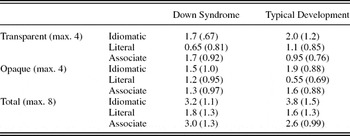
Table 1 summarizes the performance of the two groups on the measure of idiom comprehension.
Mean number (standard deviations) and range for idiomatic, literal, and associate answers for transparent and opaque idioms in each group

To evaluate group differences in the idiom understanding task, a log-linear saturated model was computed on the frequencies of idiomatic, literal, and associate answers (factor type of answer) given by individuals with Down syndrome and by children with typical development (factor group) to evaluate group differences in the idiom understanding task.
The results and the effect sizes calculated on the chi-squared values are the following:
1. The type of answer yielded significance, χ2 (2) = 23.48, p < .001; r = .38. The analysis of the parameters showed that idiomatic answers were given more frequently than expected (z = 4.24, p < .01) and literal answers were given less frequently than expected (z = −4.43, p < .01).
2. The association between group and type of answer did not yield significance. This finding suggests that the choice of the idiomatic versus literal answers is similar in the two groups having the same level of text comprehension.
Group differences in sentence comprehension
The two groups differed on their performance in the sentence comprehension task, t (38) = 2.5, p < .01: individuals with Down syndrome showed a lower performance than the typically developing children (M = 41.7, SD = 13.9 for the group with Down syndrome and M = 54.1, SD = 17.4 for typically developing children). The estimate of the dimension of this effect is large (d = 1.63). The difference in mean scores in sentence comprehension between the group of participants with Down syndrome and the group of typically developing children is 12.3. Because the 95% confidence interval for the difference between the two mean scores is between 2.2 and 22.4, the difference obtained may be considered large.
Relationships among the tasks
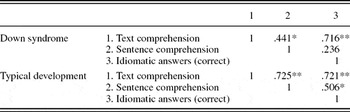
A zero-order one-tailed Pearson's correlation was performed for each of the two groups on the scores obtained on text, sentence, and idiom comprehension (idiomatic answers). Table 2 reports the results.
Correlations between the three tasks (text, sentence, and idiom understanding) in the two groups

*p < .05 (one tailed). **p < .01 (one tailed).
The pattern of relationships is partially different for the two groups: all the three tasks correlate in typically developing children, whereas in Down syndrome individuals only text and idiom understanding correlate. Further analyses allow this pattern of correlations to be explored and the contribution of reading comprehension and sentence comprehension to idiom understanding to be understood.
The predictors of idiom comprehension
The main focus of the present study was to test whether idiom comprehension is related to text comprehension in individuals with Down syndrome, and to test whether this relationship was affected by sentence comprehension and idiom degree of transparency. Because the variables considered were both continuous (i.e., text and sentence comprehension) and categorical (i.e., group and type of idiom), a multinomial logistic regression model for nominal response (see UCLA Academic Technology Services Statistical Consulting Group, http://www.ats.ucla.edu/default.htm; and Agresti, Reference Agresti1996) was performed, taking into account all of the variables included in the study (group, text comprehension, sentence comprehension, idiom type). This analysis is parsimonious because one single model tests different hypotheses and therefore the power of the findings is enhanced. The model permitted us to consider simultaneously all three types of answers, and to trace the trend in relation to the independent variables for each of them. A comparison between two dependent variables at a time has to be carried out: we chose idiomatic answers as the comparison variable, and the probability of choosing this answer was compared to the probability of choosing the literal answer and the associate answer.
We included type of answer (idiomatic/literal/associate) as the dependent variable in the model; group (Down syndrome vs. typical development), idiom type (transparent and opaque), text comprehension, and sentence comprehension were the independent variables. Moreover, all of the possible interactions with the variable group were evaluated: Group × Idiom Type, Group × Text Comprehension, and Group × Sentence Comprehension. None of these interactions yielded significance: transparent and opaque idioms were both processed in the same way, and sentence comprehension had the same effect in both groups. This result shows that the same profile characterizes the two groups having the same comprehension skills.
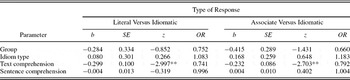
A second model including only main effects was run.Footnote 2 As shown in Table 3, only text comprehension yielded significance, and that was true both when considering the choice between the correct and the incorrect answers (idiomatic vs. literal) and the choice between the correct and semantically plausible answers (idiomatic vs. associate). No group differences were significant, and no differences between transparent and opaque idioms emerged; finally, sentence comprehension did not play a significant role.
Parameter estimates for the multinomial logistic regression model fitted to the observed data

Note: SE, standard error; OR, odds ratio.
**p < .01.
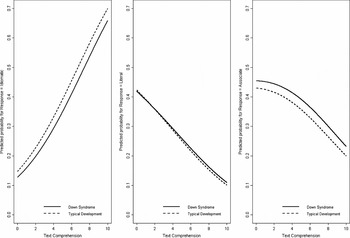
Figure 1 illustrates graphically the results obtained: it considers the probability of choosing the idiomatic, the literal, and the associate answer in function of text comprehension in the two groups. Because neither the sentence comprehension nor the idiom type was associated with the choice of the three answers, the graph was plotted controlling for the influence of these variables. The probability of choosing an idiomatic answer increased in function of text comprehension (see Figure 1, left). Inversely, a decrease in text comprehension was paralleled by a higher probability of choosing incorrect answers, both literal and associate (see Figure 1, middle and right plot). Of the most interest, the same trend emerged for both groups.
The predicted probability of idiomatic, literal, and associate answer by group and text comprehension, controlling for idiom type and sentence comprehension.

DISCUSSION AND CONCLUSIONS
The focus of the present investigation was on the relationship between idioms and text comprehension, taking into consideration the roles played by semantic transparency of idioms and by the level of sentence comprehension of participants. The theoretical background was the GLM, which posits a relationship between text and idiom understanding, that was previously confirmed in typically developing school-aged children (Cain et al., Reference Cain, Oakhill and Lemmon2005; Levorato et al., Reference Levorato, Nesi and Cacciari2004). The present investigation was aimed at extending this model to individuals with Down syndrome who are characterized by both cognitive and linguistic impairment.
The ability of individuals with Down syndrome to comprehend idioms was scarcely influenced by mental development. Age and years of schooling did not seem to significantly affect participants with Down syndrome; the idioms that we used were actually unfamiliar to participants with Down syndrome. These findings suggest that experience per se is not sufficient to favor the understanding of ambiguous expressions such as idioms. However, the same idioms were understood, at least to a certain degree, by the same participants when embedded in a short context: more idiomatic than literal answers were chosen. The ability to choose a correct interpretation of the idiom proved to be a function of the participant's ability to process a text, and the same trend emerged for children with typical development and for individuals with Down syndrome. Therefore, the selective disadvantage in sentence comprehension seems to have a scarce impact on other language processing, such as text and idiom understanding. This result strengthens the main assumption of the GEM: it is the ability to process a text that supports idiom understanding. Any given level of text comprehension corresponded to a particular level of idiom comprehension in both children with typical development and participants with Down syndrome.
When the ability to construct a coherent representation of a text is acquired, individuals with Down syndrome are able to detect the intended meaning of an idiom. The search for a global and coherent meaning of the story activates the inferences that allow the correct meaning of the idiom to be recognized. What we cannot conclude, given our design, is what processes participants used to recognize the appropriate meaning of the idiom, that is, whether they first rejected the literal meaning and then searched for a more context-appropriate meaning or whether they directly recognized the figurative meaning appropriate to the context. Further studies should analyze these two different options in typically developing children and individuals with Down syndrome. In contrast, it seems plausible that when the literal answer, which was incongruent with the topic of the story, was chosen, the text had been submitted to shallow processing and the meaning of the idiomatic utterance was not incorporated within the overall story representation. Participants were presented with a third option: the associate answer, which was semantically plausible, describing an event or cause related to the situation described in the short story, but was not appropriate to represent the meaning of the idiomatic expression. Results demonstrated that the probability of an associate choice is determined by text comprehension skills in the same way as literal choices are. Two semantically plausible answers were provided by the multiple choice task, the idiomatic, and the associate, but only the choice of the idiomatic one proved to be positively related to text comprehension, whereas the associate choices were negatively related, as were literal answers. This result shows that to understand the figurative meaning, it is not sufficient to process the text and choose a semantically plausible answer, because the meaning of the idiom has to be recognized and integrated within the global meaning of the text.
One of the predictions of this study was that the degree of semantic analyzability intervenes in the relationship between text and idiom comprehension. For opaque idioms, the meaning is not derivable from the constituents but is instead derivable from the context. Conversely, the idiomatic meaning of transparent idioms is more similar to their literal meaning and can be interpreted more easily without the context. Results obtained in previous studies with typically developing children (Cain et al., Reference Cain, Oakhill and Lemmon2005) who differed as to their text comprehension skills showed that skilled text comprehenders were more able than the less-skilled ones in detecting the meaning of opaque idioms because they used the context more efficiently to understand ambiguous expressions; in contract, the two groups did not differ in the interpretation of transparent idioms because they were equally able to analyze the meaning of constituent words. In the present study, no effect of semantic analyzability was found. Various possible explanations for this finding might be advanced. Some explanations are methodological: (a) the use of groups of unselected participants instead of groups of skilled and less skilled participants provides a more stringent control of the effect of the variable; (b) we used a small number of idioms, which might be insufficient to capture individual differences related to the degree of idiom transparency; (c) Cain et al. (Reference Cain, Oakhill and Lemmon2005) found that semantic analyzability particularly affects the comprehension of novel idioms, whereas we used real idioms; and (d) Cain et al. (Reference Cain, Oakhill and Lemmon2005) evaluated idiom comprehension through a production task, but we used a recognition task. Further work should analyze the validity of these explanations. Nevertheless, a conceptual explanation is also possible: semantic analyzability plays a role when a certain degree of metalinguistic awareness is acquired. In children as young as first graders and in individuals with Down syndrome, the ability to recognize the meaning of transparent idioms on the basis of constituent words might not yet have been acquired and, consequently, the difference between a transparent and an opaque idiom not perceived. This interpretation is consistent with a finding of a previous study where the effect of contextual information showed to be manifest at a younger age with respect to the effect of semantic analyzability (Levorato & Cacciari, Reference Levorato and Cacciari1999).
Another variable considered in the current study that turned out to be marginal in explaining idiom comprehension in Down syndrome as well as in typically developing children, was sentence comprehension. This result is supported by findings reported in a recent paper in which it was documented that poor sentence processing skills are not a source of idiom understanding difficulties for children who have poor text comprehension (Cain & Towse, Reference Cain and Towse2008). Similar results were reported in a recent paper where sentence comprehension did not have either a direct or a mediated relationship with idiom comprehension in typically developing children (for details, see Levorato et al., Reference Levorato, Roch and Nesi2007). The present study analyzed the role of sentence comprehension in Down syndrome individuals who are characterized by a pattern of nonhomogeneous relationships between different linguistic domains, and in particular, by a marked impairment in sentence processing. Compared to the group of typically developing children having the same level of text comprehension, individuals with Down syndrome had a weaker performance in a sentence comprehension task; however, idiom comprehension was scarcely affected by this difference. This finding supports the GEM, confirming that unfamiliar idiomatic sentences are processed and understood on the basis of the available linguistic context, rather than being associated to lower level linguistic abilities, such as sentence processing or the recognition of morphosyntactic cues.
In sum, the results of the current study show that idioms are processed in a similar way by the two groups of participants at a given level of text comprehension, and this relationship is scarcely influenced by lower level linguistic skills and by the characteristics of the idioms. We instead hypothesize that cognitive factors, in particular, inferential reasoning and the ability to use world knowledge in appropriate contexts, might explain the relationship between text and idiom comprehension, and further investigation should be dedicated to exploring this possibility. In the case of typically developing children, we know that text comprehension is paralleled by an ability to make inferences, whether by linking information found in the text or by using their knowledge of the world around them (for a review, see Cain & Oakhill, Reference Cain and Oakhill2007). The present study suggests that this could also be the case for individuals characterized by atypical cognitive and linguistic development. Individuals with Down syndrome have the ability to make simple inferences regarding a narrative text (Boudreau & Chapman, Reference Boudreau and Chapman2000; Levorato et al., Reference Levorato, Roch and Beltrame2009; Roch & Levorato, Reference Roch and Levorato2009): it may be presumed that those individuals who are more able to make inferences perform better in text comprehension as well, and that they use this ability to figure out non literal meanings of expressions embedded within linguistic contexts.
This study shows that a comparison between individuals with Down syndrome and typically developing children is useful to capture relational patterns between different abilities. It emerged that, even though in the population with Down syndrome dishomogeneities and asynchronies are present in various linguistic areas, these areas show relational patterns similar to those of children with typical development.
The participants with Down syndrome did not appear to be characterized by any difficulty in using context, contrary to what seems to be the case for other atypical populations (Barnes & Dennis, Reference Barnes and Dennis1998; Kerbel & Grunwell, Reference Kerbel and Grunwell1998a, Reference Kerbel and Grunwell1998b; Norbury, Reference Norbury2004). This result concerning the effect of the context has an important educational and clinical implication: the use of context for comprehension could be a very important resource for learning from context strategies. In the event future research confirms the main result of the present study, in particular, the importance of the relation between the ability to understand figurative expressions and the ability to process linguistic context, it would be useful to follow Norbury's (Reference Norbury2004) suggestion of including idioms in programs teaching text comprehension: actively teaching children to process context to understand an unknown expression could improve their abilities to make inferences from context.
APPENDIX A
Transparent and opaque idioms were used (literal English translation and meaning).
Transparent idioms
1. Piangere sul latte versato (to cry over spilt milk)
2. Fare un buco nell'acqua (to make a hole in the water: to be unsuccessful)
3. Far ridere i polli (to make the chickens laugh: to be socially unsuccessful)
4. Essere sulle spine (to be on the thorns: to be very anxious)
Opaque idioms
5. Vuotare il sacco (to empty the sack: to spill the beans)
6. Prendere per il naso (to take someone by the nose: to tease someone)
7. Essere al verde (to be at the green: to be broke)
8. Essere sulle nuvole (to be on the clouds: to be absentminded)
ACKNOWLEDGMENTS
This research was financed by Grant PRIN 2003119330_007 (to C.L.). Our thanks to the teachers and children who participated in this study. We also thank Gianmarco Altoè for statistical assistance and Kathleen Parker for her help in revising the English of this paper.