INTRODUCTION
Wheat (Triticum aestivum L.) is one of the most important cereal crops grown in Turkey. Approximately one quarter of the total arable land is cultivated with wheat. The area under wheat cultivation during 2006/07 was 9·5 million hectares with a production of 16·652 million tonnes (FAO 2007). Compared with other agricultural crops, it ranks first in terms of the growing area and its production share. The per capita consumption of wheat is about 170 kg/year, mostly as bread and, to a lesser extent, as bulgur (boiled and cracked wheat) pasta and macaroni. Bread is the daily staple of Turkish people and provides most of their calories and proteins. A stable wheat production is necessary to maintain human nutrition and is therefore of extremely high economic significance. Increase of wheat production through expansion of the area of wheat cultivated is not promising since arable land is diminishing as a result of urbanization and industrialization. Therefore, future production increases depend on the ability to improve or at least maintain the rate of yield increase to feed the growing population.
Wheat yield has shown a notable increase during the 20th century. The global average increase during the last 50 years of 2·5-fold is attributed to the adoption of both better crop management practices and cultivars with higher yield potential (Calderini & Slafer Reference Calderini and Slafer1998). Nitrogen use efficiency was higher in new varieties (Guarda et al. Reference Guarda, Padovan and Delogu2004; Ziska et al. Reference Ziska, Morris and Goins2004); however, they are of lower protein concentration and perhaps lower quality characteristics (Calderini et al. Reference Calderini, Dreccer and Slafer1995; De Vita et al. Reference De Vita, Nicosia, Nigro, Platani, Riefolo, Di Fonzo and Cattivelli2007).
Investigations on the effect of different factors on wheat grain yield focus specifically on determination of the intensity of the effect of values of certain yield components. Numerous yield structure elements determine the yield, but the spike number, kernel number/spike, 1000 kernel weight and harvest index are generally the most important ones. Genetic improvement in wheat yield can be attributed to selection for improved plant characteristics concerning either higher yield potential or increased resistance to biotic and abiotic stresses or a combination of both (Slafer et al. Reference Slafer, Satorre, Andrade and Slafer1994). Among yield components, increased harvest index and kernel number/m2 were the yield components mostly addressed for increased grain yield (Waddington et al. Reference Waddington, Ransom, Osmanzai and Saunders1986; Sayre et al. Reference Sayre, Rajaram and Fischer1997; Brancourt-Hulmel et al. Reference Brancourt-Hulmel, Doussinault, Lecomte, Berard, Le Buanec and Trottet2003). Efforts are under way to improve wheat yield through breeding and/or introducing high-yielding cultivars. Yield gains were reported for a number of countries. Annual yield increases were 0·5% from 1830 to 1986 in England (Austin et al. Reference Austin, Ford and Morgan1989), 0·4% from 1912 to 1980 and 1·0% from 1920 to 1989 in Argentina (Slafer & Andrade Reference Slafer and Andrade1989; Calderini et al. Reference Calderini, Dreccer and Slafer1995) and 0·5% from 1900 to 1983 in Italy (Canevara et al. Reference Canevara, Romani, Corbellini, Perenzin and Borghi1994).
The Mediterranean type of climate encompasses c. 121 000 km2 of the land in Turkey. Agriculture is important in this region, which covers c. 0·13 of the country but produces c. 0·17 of the wheat production of Turkey. Periodic evaluation of genetic improvement is essential for understanding yield-limiting factors, illustrating the importance of plant breeding to the public and identifying traits that might require increased effort by breeders (Cox et al. Reference Cox, Shroyer, Ben-Hui, Sears and Martin1988; Evans Reference Evans1993). The cultivar changes that contributed to wheat yield gains in the Mediterranean region of Turkey have never been documented.
The objectives of the present study are to provide novel information about wheat yield improvement in the past and what it might mean for yield improvement in the future, and to determine the trend in the grain yield and associated changes in yield-related traits of wheat cultivars developed since 1976 for the Mediterranean type of climates.
MATERIALS AND METHODS
National annual bread wheat yield estimates from 1925 to 2006 and annual yields for the Mediterranean region wheat production from 1978 to 2006 were obtained from the website of the Turkish Statistical Institute (TUİK 2008) and Statistic Year Book of State Statistical Institute.
Average yields were regressed against years using linear, exponential and logistic equations that were fitted to the data. All computed linear regression coefficients were significantly different from zero (P=0·05); therefore, standard errors were computed to ascertain significant differences between those coefficients. Trend lines shown in the figures were derived from the linear, exponential and logistic equations given below.
The linear equation is

where Y is yield, b is linear coefficient, T is year and a is constant.
The exponential equation is

where Y is yield, T is year, a is constant and r is exponential coefficient.
A logistic trend line was derived from the following equation (Waggoner Reference Waggoner1994):

where K is the wheat yield limit, r the logistic coefficient and Tm the year of the inflection point on the sigmoid curve. The values of two other logistic parameters, r and Tm , were ascertained by determining the best fit of the accelerating phase of the logistic curve to the exponential curvature present in the wheat yield v. time data.
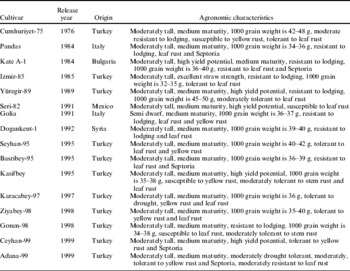
Field experiments in order to identify the field performances of recently and formerly released varieties were conducted. Therefore, 16 widely grown cultivars (Table 1), released from 1976 to 1999, were planted in a randomized complete block design with three replicates at the research farm of Mustafa Kemal University, Hatay (36°15′N and 36°30′E) located in the eastern Mediterranean region of Turkey. Planting was performed by hand (550 seed/m2 in 6 rows with 200 mm inter-row and 2·5 m row length) during the last week of November 2004, 2005. The soil of the experimental site, developed from alluvial deposits of river terraces, is typical for the eastern Mediterranean region of Turkey and is classified as a Chromoxeret by USDA Soil Taxonomy (1998) and as a Vertisol by FAO/UNESCO (1974), having relatively high clay content with the predominant clay minerals smectite and kaolinite. The soil of the experimental plots was a clay silt loam with a pH of 7·6, 17 g/kg organic matter, 1·3 g/kg total nitrogen content and water holding capacity of 0·34 cm3. Each plot was fertilized with 80 kg/ha N and 80 kg/ha P2O5 before planting and 80 kg/ha N during the tillering period. Recommended practices were used for weed and insect control. Total precipitation at the study site was 264·3 and 648·7 mm in the 2004/05 and 2005/06 cropping periods (December–May), respectively. Average air temperature was c. 12·9 and 14·4°C during the cropping periods in 2004/05 and 2005/06, respectively, while the mean relative humidity was c. 58 and 71% during the two growing periods, respectively. To assess the trends of agronomic performances, each trait was regressed on release dates of cultivars.
Release year and agronomic characteristic of 16 wheat cultivars grown in the Mediterranean region of Turkey during the 2004/05 and 2005/06 growing seasons

Maturation time, plant height, spike length, spikelet number/spike, grain number/spike, grain weight/spike, 1000 seed weight, harvest index and grain yield were measured during both years. Maturation time was recorded as the period from the heading to physiological maturity. Plant height was measured from the soil surface to the top of the main spike of 10 representative plants at physiological maturity and the average obtained. Spike length was determined as the length of spikes excluding awns at maturity. Spikelet number per spike was determined as the average spikelet number of 10 spikes randomly selected from the sample. Grain number per spike was determined at maturity from 10 randomly sampled spikes on each plot. Grain weight spike was determined on 10 randomly selected spikes and the average obtained. Thousand seed weight was also determined in each plot. Harvest index was calculated as the ratio of grain weight to total biomass. Plots were mechanically harvested at ripening and grain yield was expressed at 880 g dry matter/kg.
The 2-year data were combined and subjected to analysis of variance as a randomized complete block design, using the general linear models procedure in the Statistical Analysis System (SAS Institute 1996). The 16 bread wheat cultivars were divided into two groups, eight old cultivars (released before 1993) and eight new cultivars (released after 1993), and then old and new cultivars were compared for all of the investigated plant parameters.
RESULTS
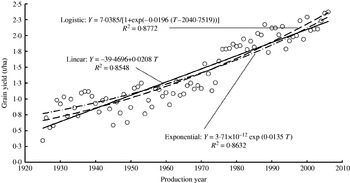
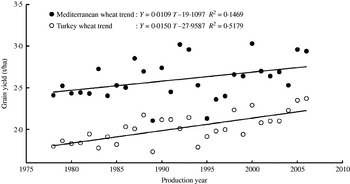
It can be seen from Fig. 1 that the linear, exponential and logistic models provided good fits to the long-term (1925–2006) national yield improvement data (Fig. 1). The linear, exponential and logistic models had almost identical R 2 values (0·855, 0·863 and 0·877, respectively). Annual wheat yield rose at a linear rate of 20·8 kg/ha/year from 1925 to 2006. Average wheat yield per hectare has increased at a rate of approximately 3·8% per year during the five decades since 1925 (Fig. 1), whereas little improvement in grain yield (1·3% per year) was evident during the three decades since 1975 (Fig. 2). During the period from 1978 to 2006, the wheat yield trend line for the Mediterranean region (10·9 kg/ha/year) is c. 38% lower than the national wheat yield trend line for Turkey (15·1 ha/year; Fig. 2). There was a 12·5% yield improvement or 0·45% per year as calculated from the linear regression equation across 28 years of plant breeding (from 1978 to 2006) in the Mediterranean region (Fig. 2). However, much higher yield improvement (23·3 or 0·83% per year) was recorded for the same year intervals for Turkey (Fig. 1). The annual deviation in wheat yield from the trend line mostly depends on annual precipitation, which is the major yield-limiting factor for wheat production. The approximate linearity was maintained in both good years and bad years, and there is no indication that wheat yield potential is approaching a ceiling.
Wheat yields from 1925 to 2006 in Turkey. Trend line parameters derived from the linear, exponential and logistic regression analyses are displayed in the legend box (Y=yield, T=year).

Wheat yields from 1978 to 2006 in the Mediterranean region and Turkey. Trend line parameters derived from the linear, regression analyses are displayed in the legend box (Y=yield, T=year).

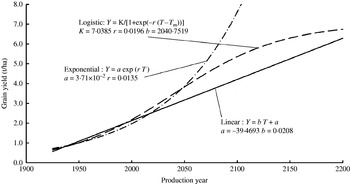
The linear model provided a modest projection of future yield improvement (Fig. 3). On the other hand, the exponential model provided a liberal estimate of future yield improvement, because an indefinite compounding of the annual yield improvement rate would produce biologically illogical yield improvements (Fig. 3).
Projection of wheat yield for the next millennium, based on exponential, linear and logistic (yield maximum) models that were fitted to observed yield data from 1925 to 2006 (cf. Fig. 1). Values for the parameters of each model are given in the legend boxes (Y=yield, T=year, Tm =year corresponding to the sigmoid inflection point).

The experimental site of the present study has a typical Mediterranean climate that is characterized by a dry, hot summer alternating with a humid and temperate winter. The dry season may last 4–5 months and it occurs during the summer. It rains in winter with typical mean annual rainfall values from 500 to 1200 mm. The temperature ranges from 3 to 18°C, not too cold for plant growth, consequently winter cereals grow well in these environments. Temperature was favourable for wheat production during both years. However, precipitation was favourable for wheat production only in the 2005/06 growing season. Mean temperatures were near normal during the 2004/05 and 2005/06 growing seasons. Precipitation at Antakya was 264·3 and 648·7 mm above the long-term mean during 2004/05 and 2005/06, respectively.
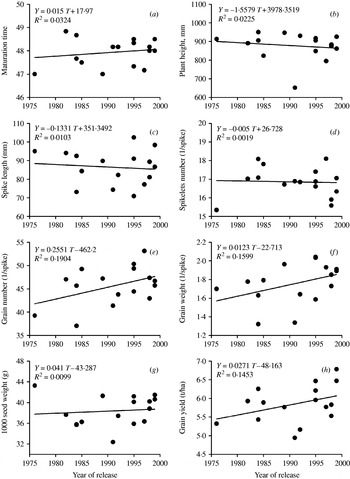
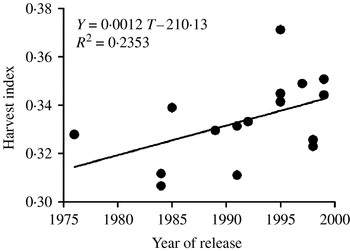
When data were combined across 2 years, there were no significant differences in maturation time, plant height, spike length, spikelet number/spike and grain number/spike between old and new cultivars, and no association was obtained with year of release (Fig. 4). However, grain weight/spike, 1000-seed weight, harvest index and seed yield were the only plant parameters that significantly varied between old and new cultivars. Like other investigated plant traits, grain weight/spike, 1000-seed weight, harvest index and grain yield did not show any historical cultivar patterns in the present study. The historical yield trend could not be attributed to a single yield component. There was a yield improvement of 11·5% across 23 years of plant breeding, selection and introduction, or 0·50% per year as calculated from the linear regression equation (Fig. 4 h). Linear regression analysis of harvest index against year of release indicated that annual gain in harvest index was 0·38% per year across the 23-year period (Fig. 5).
Relationship between year of cultivar release and (a) maturation time, (b) plant height, (c) spike length, (d) spikelets number/spike, (e) grain number/spike, (f) grain weight/spike, (g) 1000 seed weight and (h) grain yield.

Relationship between year of cultivar release and harvest index.

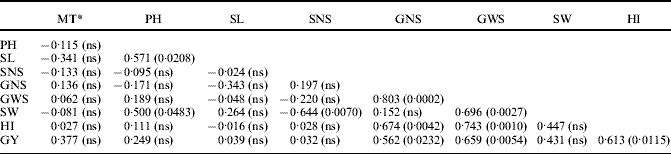
Grain yield was significantly and positively correlated with grain number/spike (r=0·562), grain weight/spike (r=0·659) and harvest index (r=0·613). The other traits investigated were not significantly correlated with grain yield (Table 2).
Correlation coefficients and associated P values among agronomic traits of 16 wheat cultivars representing 23 years of genetic improvement
* MT, maturation time; PH, plant height; SL, spike length; SNS, spikelet number/spike; GNS, grain number/spike; GWS, grain weight/spike; SW, 1000 seed weight; HI, harvest index; GY, grain yield.
DISCUSSION
National wheat yield increased noticeably at an average rate of 20·8 kg/ha/year, from 0·3 t/ha in 1925 to 2·4 t/ha in 2006 (Fig. 1). This yield increase was consistent with the increases of worldwide wheat production (Slafer & Satorre Reference Slafer, Satorre, Satorre and Slafer1999). Annual national wheat yield improvements are attributable to rapid producer adoption of agricultural innovation in the form of genetic, agronomic or genetic×agronomic technologies that provide producers with disease and lodging resistance and greater stress tolerant cultivars, better weed control, planting and harvest machinery.
Wheat yield is proportional to crop water use in Turkey's water-limited wheat environment. Storing and extracting more water from the subsoil in those situations would increase yield in most cases. Year-to-year rainfall variability makes it difficult to establish definite agronomic practices. Soil management and fallow practices that help to store water in the soil profile are required to assure successful crop growth. Most of the agronomic practices for wheat production are done to maximize water use since reduction in rainfall is a significant threat for wheat production in Turkey. For similar environments, Loomis & Connor (Reference Loomis and Connor1992) reported that seasonal water availability and crop water requirements must be balanced by determining the planting date, crop density and soil fertility.
Increasing soil fertility has been one of the major agronomic factors in yield improvement. Much of the fertility increase initially involved the introduction and use of N and P fertilizers. Supplying other elements such as K, Zn, Ca and S as they become exhausted by ongoing cropping has also contributed an extra yield increase in the last decade. In addition to these inputs, optimum sowing rates, application of herbicides, fungicides and insecticides have also contributed to the increases in wheat yield.
Around 0·10 of world wheat production and 0·17 of Turkey's wheat production come from Mediterranean type of environments. Higher rates of year-to-year variation in rain, which determines wheat yield, confines wheat yield improvement in the Mediterranean type of environments. Wheat yield improvement from 28 years of plant breeding and selection (from 1978 to 2006) in the Mediterranean region was 0·45% per year, while much higher yield improvement (0·83% per year) was recorded for the same year intervals for Turkey (Fig. 2). The lower yield improvement in the Mediterranean region was attributed to poor ability for improving yields through either genetic or management improvement and different approaches such as source and sink manipulation may be necessary for the further improvement of wheat yields (Reynolds et al. Reference Reynolds, Van Beem, Van Ginkel, Hoisington, Reynolds, Rajaram and McNab1996).
Figure 3 shows the wheat yield improvement scenarios that the exponential, logistic and linear models project for wheat yield improvement in the distant future. The logistic model projects that the wheat yield ‘average’ will reach the sigmoid inflection point (3837 kg/ha) by the year 2050. The yield improvement scenarios in the present study were close to the future wheat yield scenarios of Sehirali et al. (Reference Sehirali, Genctan, Birsin, Zencirci and Uckesen2000). This represents a 62% increase over the 2006 yield of about 2·4 t/ha. One needs to keep this 62% estimate in mind given the suggestion of needing to double (100%) or triple (200%) wheat yields in the next 50 years. The 4·0 t/ha national wheat yield milestone conceivably could be achieved in the near future (2055). Conversely, if the linear model holds, the 4·0 t/ha milestone would occur much later (2092).
The potential yield of wheat in the Mediterranean region is c. 8·0 t/ha (two-fold of the national potential yield), while actual yield ranges between 4·5 and 6·5 t/ha and average yield from 3·5 to 6·0 t/ha (Wheat growers, Turkey, Personal communication). The 8·0 t/ha grain yield probably overstates the yield limit for the average wheat yield in the Mediterranean region. Similar yield potential for wheat was reported by Calviño & Sadras (Reference Calviño and Sadras2002) in the south-eastern Pampas, South America. However, there is no real scientific consensus as to whether this is the most appropriate value for a wheat yield limit. Higher grain yield were accomplished with available high yielding cultivars, better cultivation (Feyerherm et al. Reference Feyerherm, Paulsen and Sebaugh1984) and CO2 levels (Amthor Reference Amthor2001; Long et al. Reference Long, Ainsworth, Rogers and Ort2004). Cassman (Reference Cassman1999) reported that annual crop yield improvement slows and ceases once the crop reaches 0·80 of the potential productivity established by the best wheat producers. Future wheat yield projections show that sustaining or increasing annual yield improvement rates will require technological advances to increase the ratio of irrigated areas and innovations that arise from basic and applied researches. Yield improvements must occur at annualized rates sufficient to support the yield improvement projected by whichever model in Fig. 3 is most appropriate. The present data indicated that there was a yield improvement of 11·5 or 0·50% per year, across 23 years of plant breeding, introduction and selection for the Mediterranean region (Fig. 4h). The estimate of yield gain is consistent with the estimates of Deckerd et al. (Reference Deckerd, Busch, Kofoid, Harper, Schrader and Howell1985), Hucl & Baker (Reference Hucl and Baker1987), Austin et al. (Reference Austin, Bingham, Blackwell, Evans, Ford, Morgan and Taylor1980, Reference Austin, Ford and Morgan1989) and Canevara et al. (Reference Canevara, Romani, Corbellini, Perenzin and Borghi1994) but inconsistent with the estimates of Waddington et al. (Reference Waddington, Ransom, Osmanzai and Saunders1986), Slafer & Andrade (Reference Slafer and Andrade1989), Bell et al. (Reference Bell, Fischer, Byerlee and Sayre1995) and Calderini et al. (Reference Calderini, Dreccer and Slafer1995). These studies showed that yield increases have been realized largely by greater partitioning of total dry matter into grain with little or no corresponding change in total dry matter production. Maturation time, harvest index, grain number/spike, grain weight/spike, 1000 seed weight and grain yield tended to increase in newer cultivars. However, the present results did not indicate a significant consistent relationship between year of cultivar release and any of the investigated plant traits. Yield increase in newer cultivars could be attributable to higher harvest index, grain weight/spike and grain number/spike. The cultivars developed more recently had higher harvest index, grain weight/spike and grain number/spike than that of the older cultivars. Also, increase in the maturation time and 1000 seed weight of newer cultivars slightly contributed yield increase. The plant height in newer cultivars slightly decreased. Compared with the taller cultivars, semi-dwarf cultivars allocate more assimilates to spike growth, resulting in higher weight in spike dry matter per unit land area at anthesis. Semi-dwarfism consistently combined improved yield potential with improved performance across a wide range of conditions, with the exception of very severe stresses (Richards Reference Richards1992; Miralles & Slafer Reference Miralles and Slafer1995). Slafer et al. (Reference Slafer, Satorre, Andrade and Slafer1994) stated that current cultivars are more responsive to environmental changes than their predecessors. Additionally, yield improvements of modern cultivars have been associated with improved lodging resistance, improved disease resistance, earlier flowering, increased grain filling, increased tiller survival, increased grains per spikelet and higher nitrogen-use efficiency (Ortiz-Monasterio et al. Reference Ortiz-Monasterio, Sayre, Rajaram and McMahon1997).
Development of yield components that contribute most of the gain in yields in the Mediterranean wheat genotypes is related to the climate in the region. Moisture and temperature in the region are most often favourable for vegetative growth of wheat during autumn and early spring. Most of the yield components such as spikelet number/spike and grain number/spike are determined during early vegetative stages. However, grain weight/spike and 1000 seed weight are determined during late spring and early summer, when stress from drought and heat is more common in the region. Wheat cultivars grown under typical high temperature suffered a mean 6% loss in grain number but a mean 21% decline in grain weight (Al-Khatib & Paulsen Reference Al-Khatib and Paulsen1990).
In conclusion, yield is a quantitatively inherited trait and estimates of national yield improvement from 1926 to 2006 suggest a 0·5% increase per year. In Turkey, expansion of new growing areas for wheat production seems unlikely; therefore, to increase wheat production to the level required at least to match the expected population growth, there will be dependence almost entirely on the ability to achieve the higher rates of yield gains. Average yields could continue to rise as long as plant breeders continue to improve higher yielding cultivars resistance to pests, diseases and environmental stresses as farmers adapt improved managements. A ceiling on yield potential for wheat has not yet been reached in either Turkey or the wider Mediterranean region. However, slow yield increase in the Mediterranean region indicates that wheat yield has tended to level off, which should be taken as a possible indication that different approaches may be needed for the further improvement of wheat yields. Maturation time, plant height, spike length, spikelet number/spike, grain number/spike, grain weight/per spike, 1000 seed weight, harvest index and grain yield did not show historical cultivar patterns. The historical yield trend could not be attributed to a single yield component.