Introduction
The embryonic pre-implantation transcriptome has been widely studied in many species in an attempt to understand the biological mechanisms that govern this developmental phase (Telford et al., Reference Telford, Watson and Schultz1990; Schultz, Reference Schultz2002; Kaňka, Reference Kaňka2003; Kaňka et al., Reference Kaňka, Bryova, Duranthon, Oudin, Peynot and Renard2003; Tesfaye et al., Reference Tesfaye, Ponsuksili, Wimmers, Gilles and Schellander2003; Mamo et al., Reference Mamo, Sargent, Affara, Tesfaye, El-Halawany, Wimmers, Gilles, Schellander and Ponsuksili2006; Badr et al., Reference Badr, Bongioni, Abdoon, Kandil and Puglisi2007; Wrenzycki et al., Reference Wrenzycki, Herrmann and Niemann2007). In this period, many factors can interfere negatively with the developing bovine embryo causing cleavage to cease. The embryonic developmental block occurs mainly during the fourth, or the transition between the fourth and fifth cell division cycle (Memili & First, Reference Memili and First2000).
During the in vitro production of bovine embryos approximately 90% of immature oocytes undergo nuclear maturation and 80% undergo fertilization and conclude at least the 2nd cellular cycle (Gordon, Reference Gordon1994; Lonergan et al., Reference Lonergan, Gutiérrez-Adán, Fair and Boland2003). However, only 30–40% of the fertilized oocytes are capable of developing to blastocysts (Lonergan et al., Reference Lonergan, Gutiérrez-Adán, Fair and Boland2003) leading to a large proportion of embryos that arrest their development. In general, embryonic development depends on mRNA and protein stocks present in the oocyte at the time of fertilization which are synthesized and stored during oogenesis. The main function of these stocks is to maintain embryo development until Embryonic Genome Activation (EGA) occurs (Schultz, Reference Schultz1993; De Sousa et al., Reference De Sousa, Caveney, Westhusin and Watson1998a, Reference De Sousa, Westhusin and Watsonb). Embryos that inherit low quality mRNA and protein stocks do not efficiently activate their genome and go into a passive developmental block (Betts & King, Reference Betts and King2001). Variation in cleavage timing, fragmentation rates and developmental potential are affected by the quality and quantity of maternally derived mRNAs and proteins (Gutiérrez-Adán et al., Reference Gutierréz-Adán, Rizos, Fair, Moreira, Pintado, De La Fuente, Boland and Lonergan2004; Biase et al., Reference Biase, Fonseca Merighe, Santos Biase, Martelli and Meirelles2008). Although EGA is expected to occur in the 8-cell-stage, there are reports describing genes that are transcribed earlier (Ma et al., Reference Ma, Svoboda, Schultz and Stein2001). These observations suggest that EGA occurs as a multiple-step event, as opposed to following a single global transcriptional switch (Ma et al., Reference Ma, Svoboda, Schultz and Stein2001).
In this report we tested the hypothesis that at the moment of major embryonic genome activation, in vitro-produced bovine embryos with high and low development potential show different patterns of gene expression. Using fluorescence differential display PCR and real-time PCR we identified genes that are differentially expressed between bovine embryos with high and low developmental competence to reach the blastocyst stage.
Material and methods
In vitro production of bovine embryos
Chemicals were purchased from Sigma Chemical unless otherwise stated.
Bovine embryos were produced after in vitro oocyte maturation, fertilization and culture, according to previously published protocols (Bousquet et al., Reference Bousquet, Twagiramungu, Morin, Brisson, Carboneau and Durocher1999). Briefly, healthy cumulus–oocyte complexes (COCs) with evenly granulated cytoplasms in the oocyte and surrounded by multiple layers of cumulus cells were obtained by aspirating follicles (2–8 mm) from abattoir-derived ovaries, washed with HEPES-buffered Tyrode's medium and cultured for 20 h under mineral oil in 90 μl drops of TCM199 medium with Earles salt solution, glutamine and NaHCO3, supplemented with 10% (v/v) fetal bovine serum (FBS; Invitrogen), sodium pyruvate (22 μg/ml), gentamycin sulfate (50 μg/ml), follicle stimulating hormone (FSH) (0.5 μg/ml), leuteinising hormoneLH (50 μg/ml) and estradiol-17β (1 μg/ml) at 38.5°C in 5% CO2. Matured oocytes were fertilized with motile sperm from a single Nellore bull recovered by centrifugation for 30 min at 700 g in a Percoll discontinuous density gradient (2 ml 45% Percoll over 2 ml 90% Percoll) in 90 μl drops under mineral oil of TALP medium supplemented with heparin (10 μg/ml), sodium pyruvate (22 μg/ml), gentamycin (50 μg/ml), fatty acid-free BSA (6 mg/ml) and PHE solution (2 μM penicillamine, 1 μM hypotaurine and 0.25 μM epinephrine) at 38.5°C, in 5% CO2.
At approximately 10 hours post insemination (hpi), presumptive zygotes were denuded by pipetting and co-cultured in modified CR2 medium supplemented with 10% (v/v) FBS and granulosa cells coming from the maturation dish (Watanabe et al., Reference Watanabe, Franceschini, Dayan, Galerani, Vila, Lôbo and Watanabe1999). At 48 hpi, embryos were analysed and those with fast cleavage divisions and high development potential (F8), and embryos with slow cleavage divisions (S4), showing 8 and 4 cells respectively, were recovered from culture, snap frozen in liquid nitrogen and stored at −80°C until RNA extraction. The remaining embryos with slow cleavage divisions and reduced rates of development to blastocyst (S8), showing 0–3 cells at 48 hpi were maintained in culture until 90 hpi when embryos with 8 cells were collected and frozen as described above.
RNA extraction and reverse transcription
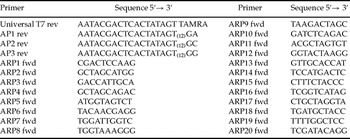
Total RNA was extracted from groups of 50 embryos of each category (F8, S4 and S8) with the RNeasy® Protect Mini Kit (Qiagen), according to manufacturer's instructions and eluted in 30 μl RNase-free water. Nine microlitres of total RNA from each embryo group was reversely transcribed in 20 μl reactions containing 1 μl SuperScriptIII™ (200 U/μl; Invitrogen™), 1 μl of an anchor primer (5 μM) 5′-AATACGACTCACTATAGT(T)12NN-3′ (NN = GC, GA or GG; Table 1), 2 μl dNTPs (2.5 mM each), 2 μl dithiothreitol (DTT) (0.1 M), 1 μl RNaseOUT® recombinant ribonuclease inhibitor (40 U/μl; Invitrogen™) and 4 μl 5× first strand buffer. Reactions were carried out at 42°C for 15 min, 50°C for 50 min and 70° for 15 min for enzyme inactivation.
Primers used in the fluorescent DDPCR experiments

AP, anchor primer; ARP, arbitrary primer.
Fluorescent differential display analysis
Differential display PCR analysis was performed according to previously published protocols (Ripamonte et al., Reference Ripamonte, Merighe, Watanabe, Caetano and Meirelles2005). Briefly, RNA was reverse-transcribed using different anchor primers with the following structure: 5′-T7 tail-T12-NN-3′, where NN was GC, GA or GG (Table 1). The resulting cDNAs were then PCR-amplified with different 10-mers and a TAMRA-labelled T7 primer. Each sample was PCR-amplified in triplicate. Amplified fragments were separated in 6.5% polyacrylamide gels for 5 h at 1500 V. After electrophoresis, gels were scanned with a Fuji FLA3000 fluorescence scanner and fragments were visualized with Image Reader FLA-3000 Series and Image Gauge software (Fuji Photo Film Co.). The gel was dried at 80°C and rinsed with ddH2O repeatedly to completely remove urea residues. Fragments differentially amplified in all triplicates in at least one of the embryo groups were precisely excised from the dried polyacrylamide gel with a scalpel, eluted in 80 μl of ultrapure water at 80°C for 10 min and stored at –80°C until analysis.
Cloning and sequencing of different amplified fragments
Each excised fragment was re-amplified with an unlabelled T7 primer and the corresponding arbitrary primer. Re-amplifications were carried out in 25 μl reactions containing 0.5 μl of a solution containing the eluted DDPCR fragment, 2.5 μl 10× Taq polymerase buffer, 4 μl dNTPs (2.5 mM each), 3.25 μl unlabelled T7 (5 μM), 3.25 μl arbitrary primer (5 μM), 0.2 μl Taq DNA polymerase (5 U/μl; Invitrogen™) and 1.5 μl MgCl2 (50 mM). PCR cycling conditions were: 95°C for 2 min, followed by 30 cycles of 92°C for 15 s, 42°C for 30 s and 72°C for 2 min, with a final step of 72°C for 10 min. Re-amplified fragments were cloned into the TOPO TA Cloning® vector (Invitrogen™) following the manufacture's instructions and sequenced with BigDye dideoxy terminator chemistry (Applied Biosystems). The sequences were submitted to BLAST analysis (BlastN, nr database, December 2007) for identification at the GenBank website.
Real-time PCR quantification
For quantitative analysis of individual genes, mRNA was extracted from embryos of each category (F8, S4 and S8) with QuickPrep Micro mRNA Purification kit (Amersham). Messenger RNA obtained from each embryo group was then amplified with MessageAmp aRNA kit (Ambion®), according to manufacturer's instructions and described in the literature (Kralj et al., Reference Kralj, Player, Sedrick, Munson, Petersen, Forry, Meltzer, Kawasaki and Locascio2009). Briefly, double-stranded cDNA was synthesized with an oligo(dT) primer bearing a T7 promoter which was then used in an in vitro transcription procedure with T7 RNA polymerase. A second round of amplification, using different primers, was done to generate additional aRNA. cDNA from each embryo group was then generated as follows: 9 μl of amplified RNA was reversely transcribed in 20 μl reactions containing 1 μl SuperScriptIII™ (200U/μl; Invitrogen™), 1 μl poly(A) primer (5 μM), 2 μl dNTPs (2.5 mM each), 2 μl DTT (0.1 M), 1 l RNaseOUT® recombinant ribonuclease inhibitor (40 U/μl; Invitrogen™) and 4 μl 5× first strand buffer. Reactions were carried out at 42°C for 15 min, 50°C for 50 min and 70°C for 15 min for enzyme inactivation.
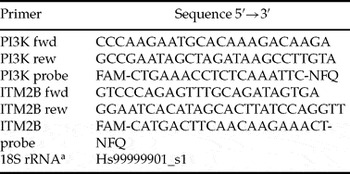
To determine the relative abundance of transcripts, real-time quantitative PCR was performed in an ABI Prism® 7500 (Applied Biosystems) using TaqMan™ technology (Applied Biosystems). Primers and probes were designed by Assay-by-Design (Applied Biosystems; Table 2). Prior to the quantification analysis, standard curves were constructed for both transcript targets phosphoinositide-3-kinase, catalytic, alpha polypeptide (PI3KCA) and integral membrane protein 2B (ITM2B), and endogenous control 18S ribosomal RNA (18S rRNA), using five serial dilutions of cDNA from F8 embryos. The cycling threshold (Ct) mean values were used to estimate amplification efficiency (E) given by E = 10(–1/slope)–1 and all of them were >0.99. Each reaction was performed in duplicate. Three replicates of RNA amplified samples from three different embryos groups (F8, S4 and S8) were evaluated. All reactions were carried out in 25 μl reactions containing TaqMan™ PCR Universal Master Mix (Applied Biosystems) and PCR cycling conditions were: 50°C for 2 min, 95°C for 10 min, followed by 45 cycles of 95°C for 15 s and 60°C for 1 min.
Primers used for real-time PCR

aAssay identifier provided by Applied Biosystems.
Relative mRNA expression levels were estimated based on the relative standard curve method suggested by the instrument manufacturer. Results are shown as relative expression or fold difference to the calibrator sample (i.e., F8 embryo) after normalization of transcript amount to the endogenous control (2−ΔΔCt Method; Livak & Schmittgen, Reference Livak and Schmittgen2001).
Statistical and gene ontology analysis
Expression level means and standard errors were estimated using least squares method in Proc GLM on S.A.S. v9.1.3 (SAS Institute Inc.). In instances in which no differences were observed among all three embryo groups, data were analysed using the same SAS procedure described above considering time of culture (F8 and S4 with 48 hpi vs. S8 with 90 hpi) or development kinetics (fast-developing F8 embryos vs. slow-developing S4 and S8 embryos). Gene ontology (GO) analysis was performed for categorizing differentially expressed sequences, including biological process, molecular function and cellular component using EASE, the Expression Analysis Systematic Explorer, v2.0 (Huang et al., Reference Huang, Sherman, Tan, Kir, Liu, Bryant, Guo, Stephens, Baseler, Lane and Lempicki2007).
Results
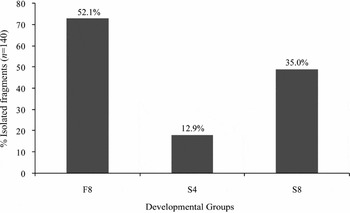
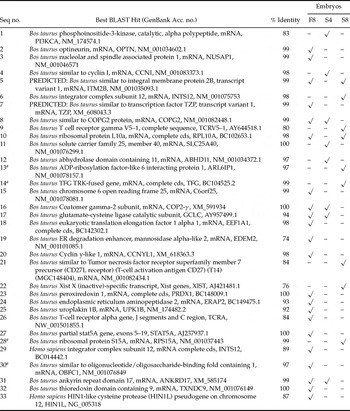
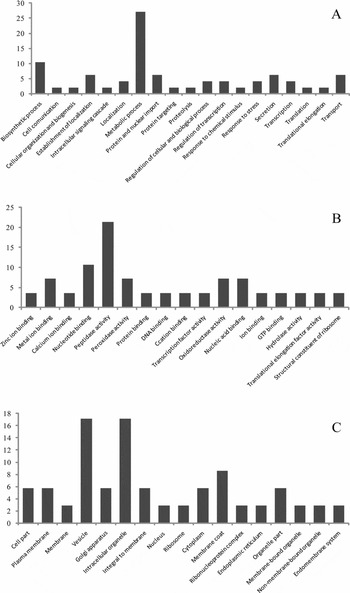
The fluorescence differential display PCR method was performed using 60 primer combinations (three anchor and 20 random primers) generating a total of 140 potential differentially amplified fragments, ranging in size from 150 bp to 1.5 kb. Fifty-two per cent of fragments were isolated from F8 embryos, while 35% and 13% were derived from S8 and S4, respectively (Fig. 1). From these, a total of 27 bands were selected for further analysis by cloning and sequencing. BLAST searches of the nr database with the resulting sequences showed hits for 33 different gene transcripts possibly related to mammalian/bovine embryonic developmental processes (Table 3). In some instances, we observed two to four heterogeneous sequences resulting from the same isolated DDPCR band therefore, sequencing of more than one colony was necessary for precise identification and characterization of the putative differentially expressed mRNAs. To categorizing the differentially transcript genes we used the EASE tool and a list of over-represented GO terms in our groups embryos was showed in Fig. 2. Several GO categories were found and over-represented in biological processes were related to physiological, cellular and metabolic process. Catalytic activity and binding, cellular and intracellular were over-represented terms for molecular function and cellular component, respectively.
Proportion of differentially amplified fragments isolated using differential display PCR in in vitro-produced bovine embryos. F8: 8-cell stage at 48 hpi; S4 and S8: embryos that reached the 4-cell and 8-cell stage at 48 and 90 hpi, respectively.

Description of DDPCR fragments that were isolated, cloned and sequenced

aSequences obtained from the same gel fragment after cloning in TA vector.
Selected Gene Ontology (GO) categories over-represented in bovine embryos identified by DDPCR. (A) Biological process; (B) molecular function, and (C) cellular component.

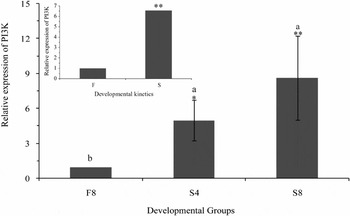
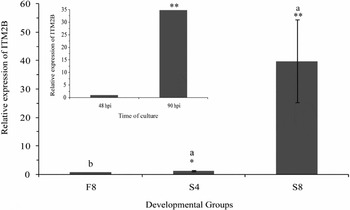
PI3KCA (Craddock et al., Reference Craddock, Orchiston, Hinton and Welham1999) and ITM2B (Fleischer et al., Reference Fleischer, Ayllon, Dumoutier, Renault and Rebollo2002a, Reference Fleischer, Ayllon and Rebollob) were chosen from the sequenced fragments for mRNA quantification by real-time PCR. PI3KCA was initially isolated in S4 embryos but the relative expression of PI3KCA did not differ when comparing S4 with S8 embryos (p > 0.05). However, comparisons between slow and fast-developing embryos showed higher PI3KCA expression levels in embryos with lower developmental potential (p < 0.01; Fig. 3). ITM2B was originally isolated from F8 and S8 embryos. However, the relative expression levels were ~40-fold higher in S8 than in F8 embryos while S4 embryos did not differ from F8 embryos (Fig. 4).
a, bRelative gene expression levels estimated by real-time PCR for PI3KCA in bovine embryos with high (F8) or low (S4 and S8) developmental potential. Detail: relative gene expression of PI3KCA by developmental kinetics in fast (F) and slow (S) bovine embryos. *p < 0.05 and **p < 0.01, n = 3.

a, bRelative gene expression estimated by real-time PCR for ITM2B in bovine embryos with high (F8) or low (S4 and S8) developmental potential. Detail: relative gene expression of ITM2B by time of culture in fast (F) and slow (S) bovine embryos. *p < 0.05 and **p < 0.01, n = 3.

Discussion
Many studies have reported correlations between COC morphology, 1st polar body extrusion or first cleavage timing and age of the oocyte donor with developmental competence of pre-implantation embryos (Pavlok et al., Reference Pavlok, Lucas-Hahn and Niemann1992; Lonergan et al., Reference Lonergan1994; Brevini et al., Reference Brevini, Lonergan, Cillo, Francisci, Favetta, Fair and Gandolfi2002; Lonergan et al., Reference Lonergan, Gutiérrez-Adán, Fair and Boland2003; Meirelles et al., Reference Meirelles, Caetano, Watanabe, Ripamonte, Carambula, Merighe and Garcia2004). Additionally, possible interactions of these factors with culture systems have also been reported (Niemann & Wrenzycki, Reference Niemann and Wrenzycki2000, Reference Niemann and Wrenzycki2003; Watson et al., Reference Watson, De Sousa, Caveney, Barcroft, Natale, Urquhart and Westhusin2000; Natale et al., Reference Natale, De Sousa, Westhusin and Watson2001; Gutiérrez-Adán et al., Reference Gutierréz-Adán, Rizos, Fair, Moreira, Pintado, De La Fuente, Boland and Lonergan2004). When considered jointly, these findings strongly indicate that the oocyte's inherited mRNA and protein stocks indeed play a major role in the early pre-cleavage embryonic development, and that early developing embryos interact with the development environment to express this potential.
DDPCR has been successfully used to identify new or rare gene transcripts when amounts of available RNA samples are limited, as is the case with preimplantation embryo models (Natale et al., Reference Natale, De Sousa, Westhusin and Watson2001; Kaňka et al., Reference Kaňka, Bryova, Duranthon, Oudin, Peynot and Renard2003; Li et al., 2003; Tesfaye et al., Reference Tesfaye, Ponsuksili, Wimmers, Gilles and Schellander2003). In the present study we used the fluorescence DDPCR method previously described by Ripamonte et al. (Reference Ripamonte, Merighe, Watanabe, Caetano and Meirelles2005) to identify messages putatively differentially expressed among three in vitro-produced bovine embryos with high- and low-development potential. The strategy proved to be very successful as we recovered hundreds of putative fragments differentially expressed. Using gene ontology analysis the main identified terms were related to embryo functions such as physiological process, metabolism, development, cell proliferation, cell cycle and death, and these terms reflect the biological condition of embryo groups.
Differential expression of anti- and pro-apoptotic genes in oocytes and early-developing embryos has been previously shown to be associated developmental potential (Jurisicova et al., Reference Jurisicova, Latham, Casper, Casper and Varmuza1998; Dalbiés-Tran & Mermillod, Reference Dalbiés-Tran and Mermillod2003). Genes previously shown to be involved in apoptotic mechanisms, like STAT5 (Debierre-Grockiego, Reference Debierre-Grockiego2004), PI3KCA (Craddock et al., Reference Craddock, Orchiston, Hinton and Welham1999) and ITM2B (Fleischer et al., Reference Fleischer, Ayllon, Dumoutier, Renault and Rebollo2002a, Reference Fleischer, Ayllon and Rebollob), were recovered in the present study. Considering the importance of apoptotic processes in determining early-embryo survival, PI3KCA and ITM2B were chosen for further study.
In both cases different results were observed between the DDPCR and the real-time PCR quantification. These variations may be generated by the artifacts of similar sizes fragments creating bands with heterogeneous cDNA as revealed by cloning and sequencing of bands recovered fragments.
PI3KCA is responsible for regulation of various biological processes such as growth, survival, proliferation and cellular metabolism (Fruman, Reference Fruman, Meyers and Cantley1998; Craddock et al., Reference Craddock, Orchiston, Hinton and Welham1999; Wymann et al., Reference Wymann, Zvelebil and Laffargue2003). PI3KCA is also associated with anti-apoptotic signaling in a large number of cell types (Craddock et al., Reference Craddock, Orchiston, Hinton and Welham1999). In our experiments, PI3KCA was isolated from S4 embryos and is expressed at higher levels in slow-developing embryos, which have also been shown to have lower developmental competence and therefore are usually destined to stop developing (Lonergan et al., Reference Lonergan, Khatir, Piumi, Rieger, Humblot and Boland1999; Gutierréz-Adán et al., Reference Gutierréz-Adán, Rizos, Fair, Moreira, Pintado, De La Fuente, Boland and Lonergan2004). Considering PI3KCA's previously describe role as an anti-apoptotic molecule, we hypothesize that slow-developing embryos may be over-expressing this gene in an attempt to avoid going into developmental block.
Conversely, ITM2B has been described as a pro-apoptotic regulator that shares the BH3 domain present in Bcl-2 gene family members (Deleersnijder et al., Reference Deleersnijder, Hong, Cortvrindt, Poirier, Tylzanowski, Pittois, Van Marck and Merregaert1996; Fleischer et al., Reference Fleischer, Ayllon, Dumoutier, Renault and Rebollo2002a, Reference Fleischer and Rebollo2004; Choi et al., Reference Choi, Yoo, Hong, Rhee, Sakaki and Kim2003; Van Den Plas & Merregaert, Reference Van Den Plas and Merregaert2004;). ITM2B induces mitochondrial membrane permeability promoting release of cytochrome c and activation of caspase-9 and -3 during apoptosis (Fleischer et al., Reference Fleischer, Ayllon and Rebollo2002b). Furthermore, Fleischer et al. (Reference Fleischer, Ayllon, Dumoutier, Renault and Rebollo2002a) suggest that ITM2B contributes to the establishment of mitochondrial PTP complexes (Permeability Transition Pore) and, as other Bcl-2 family members, it is involved in membrane pore formation. In both cases, ITM2B expression results in mitochondrial membrane potential loss and consequently induction of programmed cell death pathways. The higher expression level of ITM2B observed in S4 and S8 embryos may indicate that expression of embryonic genes is necessary to drive non-competent embryos to developmental block. Therefore, (partial) EGA is required even in early-developing embryos that are designated to die.
The majority of the differentially expressed transcripts isolated in the study were present in embryos with high development potential (F8), which is expected as a consequence of the activation of the embryo's genome. Our findings are consistent with the notion that embryos with high development potential strongly activate genes responsible for survival. However, several differentially expressed messages were isolated from low developmental potential embryos (S8), which according to the interpretation of the current literature are not supposed to undergo EGA (Bettegowda et al., 2008). Moreover, to differentially express genes related to cell death, embryos with low development potential also overexpress genes responsible for survival. These findings lead to the hypothesis that at the moment of EGA, slow developing embryos overexpress survival genes as a countermeasure to attempt to evade undergoing full developmental block and the consequential death.
Studies using DNA fragmentation assays as indicators of the onset of apoptosis (Singh et al., 1988; Gavrieli et al., Reference Gavrieli, Sherman and Bem-Sasson1992; Takahashi et al., 2000) verified that blastocysts from S8 embryos have higher DNA damage and nuclear fragmentation in comparison with F8 embryos (Garcia, 2004, unpublished data). These observations indicate that apoptosis is indeed occurring at a higher rated in slow-developing embryos.
In conclusion, our data suggest there are two different EGA mechanisms that may come into play in early-developing in vitro-produced bovine embryos: on one hand, genes responsible for embryonic development are activated in high-development potential embryos, while on the other hand genes responsible for survival/death are activated in low-development potential embryos. Therefore, it is tempting to propose that the developmental block is rather an active event, and that the embryo genome activation at a partial or specific level is required to trigger the 8-cell developmental arrest.
Acknowledgements
The authors thank FAPESP for financial support (Grant 99/12351–3) and for providing a scholarship to P. Ripamonte (Grant 02/02532–5).